TL;DR
- Soapstone kitchen countertops run $70 to $120 per square foot installed, depending on thickness and region.
- The stone is heat-resistant, non-porous, and needs no sealing ever.
- It scratches easily, but scratches sand out on a Saturday afternoon.
- Color is limited to dark grays and greens.
- Want a low-chemical natural stone with real character?
- Soapstone is hard to beat.
What exactly is soapstone, and why does it behave so differently from other stones?
Soapstone is a metamorphic rock made mostly of talc, with chlorite, magnesite, and other minerals filling out the rest. Talc is the softest common mineral on Earth, sitting at a 1 on the Mohs hardness scale, so pure talc would be useless as a countertop. Countertop-grade soapstone runs 2.5 to 3.5 on the Mohs scale [1], which means it scratches more easily than granite (6 to 7) or quartzite (7+). But it's soft in a predictable, workable way rather than a fragile way.
That high talc content is also what makes soapstone non-porous. There are no open pores for liquids to enter, so it never needs sealing and it doesn't stain from oils, wine, or acids the way marble does. Cut a lemon directly on soapstone and it won't etch. Granite can stain once the sealer wears off. Soapstone just doesn't play that game.
The stone has high thermal mass and very low thermal conductivity [1]. Put a hot pan on it and it spreads the heat slowly without cracking. Bakers sometimes prefer it for that reason: a cool soapstone surface keeps pastry dough from warming as fast as it would on a stone with higher conductivity.
Color range is limited. Countertop soapstone comes almost exclusively in dark gray to blue-gray to greenish-black. There's no white soapstone on the market, no reds, no tans. If your kitchen calls for a light stone, soapstone isn't the answer. If you want something that reads as nearly black with fine veining that emerges over time, it's one of the most striking options around.
How much do soapstone countertops cost?
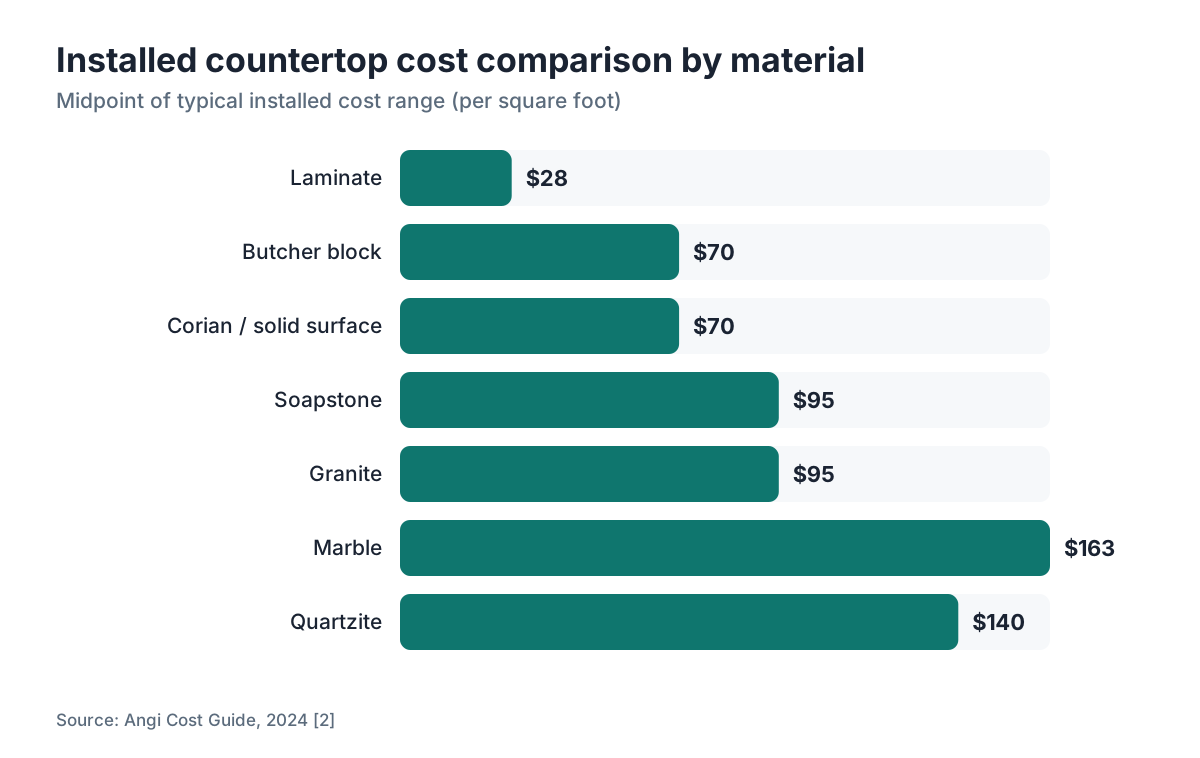
Installed soapstone countertops typically cost between $70 and $120 per square foot, with the national midpoint around $85 to $95 for a standard kitchen [2]. That figure covers material, fabrication, and basic installation on a straightforward layout.
The table below sets soapstone against other common countertop materials.
| Material | Installed cost range (per sq ft) |
|---|---|
| Laminate | $15, $40 |
| Butcher block | $40, $100 |
| Corian / solid surface | $45, $95 |
| Soapstone | $70, $120 |
| Granite | $50, $140 |
| Marble | $75, $250 |
| Quartzite | $80, $200 |
Several variables push the number up or down. Thicker slabs (3 cm is standard; 4 cm is available and looks heavier) cost more because you're paying for more raw material and more grinding time. Elaborate edge profiles add $10 to $25 per linear foot. Sinks cut into soapstone, farmhouse apron fronts especially, add $150 to $400 depending on complexity. The stone itself varies by origin: Brazilian soapstone, the most commonly imported variety, tends to cost less than Indian or Virginia-quarried stone.
Labor matters. Soapstone is denser and heavier than most people expect, running roughly 160 to 175 pounds per cubic foot [1]. Moving and setting slabs takes at least two experienced installers. In markets with high fabrication labor costs (the San Francisco Bay Area, New York metro, coastal New England), that floor can climb to $130 per square foot or higher.
For a typical 40-square-foot kitchen, a mid-range soapstone job runs $3,400 to $4,800 all in. That's real money. But it buys a stone that outlasts the house with reasonable care.
Does soapstone scratch, and what do you actually do about it?
Yes, soapstone scratches. That's the most honest thing you can say about it upfront. A Mohs hardness of 2.5 to 3.5 [1] means a key, a ring, a fork dragged across the surface, or even a rough ceramic bowl set down hard will leave a mark. Cook a lot and treat your counters roughly, and you'll see scratches within weeks.
Here's what most soapstone owners actually think about that: the scratches sand out.
A light sanding with 120-grit sandpaper, then 220-grit, then a coat of mineral oil, removes shallow scratches entirely. Deep gouges take more work, but they're still repairable without a professional. No other natural stone gives you that. Granite scratches are permanent. Marble etches and the only fix is professional honing. With soapstone you repair the surface on a Saturday afternoon with hardware-store materials.
Over years of use without any sanding, the surface develops what fabricators call a patina: a soft, lived-in texture that many owners prefer to the original polished look. Old farmhouse kitchens with soapstone that's been in service for 80 years often look better than the day they were installed.
If a scratch-free surface at all times matters to you, soapstone will drive you crazy. If you can make peace with a working surface that ages well and fixes itself with simple maintenance, scratching is a minor issue.
Does soapstone need to be sealed or treated with anything?
Soapstone needs no sealer, ever. Its non-porous structure means liquids can't penetrate the surface, so the sealing products sold for granite and marble have nothing to bond to and nothing to protect against [3]. That's a real benefit day to day: no annual resealing, no guessing whether the sealer wore off, no specialty cleaners required.
What soapstone owners do apply is mineral oil, and here's the thing to understand: mineral oil is cosmetic, not protective. Soapstone oxidizes over time, shifting from its quarried medium-gray to a deeper charcoal or near-black. Mineral oil speeds up that darkening and evens it out, so instead of a patchy, slowly darkening surface you get a uniform dark color faster. Many owners apply mineral oil every week or two for the first few months, then drop to once or twice a year. Some never apply it at all and let the oxidation happen naturally over a year or two.
Use food-grade mineral oil, which costs $5 to $10 per quart at a pharmacy, or a dedicated soapstone wax product. The stone doesn't care which one you pick. Apply it, let it sit for 15 minutes, wipe off the excess. That's all the maintenance the material asks for.
For detailed day-to-day cleaning guidance, how to clean soapstone countertops covers the full routine.
How does soapstone hold up to heat, acid, and everyday kitchen abuse?
Heat resistance is one of soapstone's strongest qualities. The stone has been used in laboratory benchtops and wood-stove surrounds specifically because it tolerates high temperatures without cracking or discoloring [4]. Setting a hot pot or pan directly on soapstone is fine. Marble can crack under thermal shock. Granite is generally heat-resistant but can occasionally crack at seam lines from sudden extreme temperature swings. Soapstone shrugs it off.
Acid resistance is just as strong. Lemon juice, vinegar, tomato sauce, and wine don't etch or stain soapstone. Marble, by comparison, etches almost immediately on contact with any acidic food, leaving dull marks that need professional attention to remove. Quartzite varies by composition but generally etches more than soapstone. If you cook with a lot of acidic ingredients and want a natural stone, soapstone is the most forgiving choice available.
Oil and grease don't stain it either, for the same non-porous reason. Grape juice, red wine, beet juice, none of it penetrates.
What soapstone does not handle well: abrasion. Heavy cleaning with rough scrub pads, dragging cast-iron cookware across the surface, anything that causes repeated friction will scratch it. The fix is to use trivets and cutting boards (which you should use on any countertop) and to accept that a scratch means 10 minutes of sanding rather than a permanent mark.
Against granite countertops, soapstone wins on heat and acid but loses on scratch resistance. Against marble countertops, it wins on both acid and scratch repair. The comparison with butcher block countertops is interesting: both are soft-ish materials that develop character with use, but butcher block needs oiling to prevent cracking and swelling, while soapstone's mineral oil treatment is purely cosmetic.
What are the biggest downsides of soapstone countertops?
Every countertop material has weaknesses. Soapstone's are real and worth naming plainly.
Color is the biggest limit for most buyers. Soapstone is dark. Always. You'll find slight variation between gray-green, blue-gray, and charcoal, but you won't find light soapstone for a countertop. If your kitchen has white or cream cabinetry and you want a light, airy feel, soapstone works against you visually unless you specifically want dramatic contrast.
Slab size is often limited compared to granite or engineered quartz. Most soapstone slabs run 6 to 8 feet long and 4 to 5 feet wide [5]. Very large kitchens or islands may require visible seams. A skilled fabricator can minimize seams. They can't always eliminate them.
The weight is real. At roughly 160 to 175 pounds per cubic foot [1], standard 3 cm soapstone is heavy. Older cabinet boxes with weak bottoms, floating shelves, or islands without full base support need checking before installation. This is a structural issue that occasionally adds cost when cabinetry needs reinforcement.
Price is higher than most people expect going in. Many homeowners hear "soft stone" and assume inexpensive. At $70 to $120 per square foot installed [2], soapstone competes with mid-range granite and costs far more than laminate countertops or Corian countertops.
And the stone is genuinely rare in some regions. Fewer fabricators work with soapstone regularly than work with granite or quartz. Finding a shop with real soapstone experience matters more for this material than for commodity stones. A fabricator who has never cut soapstone may struggle with the blades and feeds the material requires.
How is soapstone fabricated and installed differently from granite?
Soapstone cuts more easily than granite, which sounds like a fabrication advantage, and in some ways it is. The talc-heavy composition means standard carbide tooling works where granite demands diamond tooling for everything. Cutouts for sinks and cooktops go faster.
The flip side: soapstone chips and scratches during fabrication if the shop isn't careful. Granite is hard enough to resist casual handling damage. Soapstone dents if a heavy piece falls on a corner, and the material is heavy enough that drops are a real risk. Good fabricators handle soapstone slabs with more deliberate care than granite.
Edge profiles need attention. The soft surface means aggressive profiles with thin edges, like a pencil edge on a 2 cm slab, can chip over time. Most fabricators recommend a full bullnose, a thick eased edge, or a flat honed edge for soapstone to keep those corners strong.
Installation follows the same basic process as granite: template, cut, dry-fit, set in silicone adhesive or epoxy at seams, mechanical supports where needed. The difference shows up in the caulk and seam color. Soapstone's dark color demands a dark or black caulk and epoxy at seams to avoid an obvious light line. Getting the seam color right matters more than with a light material where a gray caulk blends in.
Shops that quote soapstone accurately have to account for the material's specific cutting behavior and handling. Software that tracks material costs and waste by stone type, like SlabWise, helps shops avoid underquoting jobs where soapstone's quirks add real labor time compared to a straightforward granite job.
For a full look at what happens during install, countertop installation covers the standard sequence in detail.
How long does soapstone last, and what does aging actually look like?
Soapstone lasts a very long time. There are soapstone countertops and lab surfaces in active use that are more than 100 years old [4]. The material doesn't degrade, doesn't absorb staining agents, and doesn't weaken from cleaning chemicals. Barring a major physical impact, the useful life of a soapstone countertop is essentially indefinite.
Aging goes like this. Over the first few months, the stone darkens from medium gray to a deeper charcoal, unevenly at first. Areas that get handled more, near the sink, at the prep corner, darken faster. Apply mineral oil consistently and the darkening evens out with a slight sheen. Skip the oil and the same darkening happens over one to two years, mostly uniform anyway.
After several years, if the surface has been used hard without any sanding, it develops a soft patina with gentle undulations where scratches have accumulated and smoothed. Old farmhouse soapstone has this look. Some owners love it. It reads as authentic age rather than damage. Others prefer to sand the surface back to flat every few years and start fresh. Both approaches work and neither harms the stone.
Cracks are rare if the installation is done right. Soapstone tolerates thermal cycling well. The scenarios that cause cracks: inadequate support at overhangs (more than 12 inches unsupported on a 3 cm slab is risky), a very hard direct impact like a dropped cast-iron pan from height, or a poor installation where the stone spans an uneven cabinet top and a seam or thin section bears a point load. Those are installation problems, not material failures.
How does soapstone compare to other natural stone countertop options?
The comparison that comes up most is soapstone versus marble, because they share a look: dark, veined, natural character. Marble is very acid-sensitive and easy to etch, but it's harder on the Mohs scale (around 3 to 4) and doesn't scratch as easily as soapstone. Marble stains and etches from kitchen use in ways soapstone doesn't. Soapstone scratches but repairs. For a working kitchen used daily, soapstone is more practical. For a lightly used kitchen where appearance comes first, marble's range of whites and golds opens design options soapstone can't match.
Soapstone versus granite: granite is harder (Mohs 6 to 7), more scratch-resistant, and available in a far wider color range [1]. Granite is porous and needs sealing, which soapstone doesn't. Both tolerate heat well. Granite is the better choice if color variety matters to you; soapstone wins on acid resistance and maintenance simplicity.
Soapstone versus quartzite: quartzite varies enormously by slab, but most countertop quartzite runs Mohs 7+, making it much harder and more scratch-resistant than soapstone. True quartzite is also acid-resistant, though some slabs sold as quartzite are actually soft marble-like stone that etches [6]. If a fabricator shows you a very white or veined stone labeled quartzite and you can't verify the composition, be cautious. Compared to soapstone, quartzite generally costs more and needs testing to confirm its properties. Soapstone's identity is more consistent.
Soapstone versus engineered quartz (Cambria and the like): engineered quartz is harder, available in hundreds of colors and patterns, highly consistent, and also non-porous. It doesn't have the natural character or repairability of soapstone. If you want the look of natural stone and the maintenance simplicity of a non-porous surface, both soapstone and Cambria countertops deliver on those fronts, through completely different materials.
A note on quartzite cleaning versus soapstone cleaning: quartzite that turns out softer than expected has similar acid sensitivity to marble, so the cleaning approach matters a lot more. Soapstone forgives almost any common kitchen cleaner.
What should you ask a fabricator before buying soapstone countertops?
Not every fabricator has worked with soapstone, and the ones who haven't will sometimes take your job anyway and learn on your dime. Ask directly: how many soapstone countertop jobs have you done in the last two years? If the answer is fewer than five, ask for photos. Soapstone-specific experience shows up in edge quality, seam finish color, and how cleanly the underside of cutouts is handled.
Ask about slab origin and thickness. Brazilian soapstone and Virginia soapstone (there's a historic quarry in Alberene, Virginia that has produced countertop-grade stone for over a century) [5] behave similarly, but some lower-cost imported stone is softer or has more void inclusions. Ask to see the specific slabs you're buying, more than a sample. Inspect for inclusions, which look like small holes or rough patches, because they show up in finished countertops and sometimes affect seam placement.
Ask what edge profile they recommend for soapstone. A fabricator who gives you a confident answer specific to the material is a good sign. One who offers the same menu they'd offer for granite, with no comment about soapstone's soft edge behavior, hasn't thought about it.
Ask about seam placement and seam epoxy color. For a dark stone, the epoxy has to be tinted to match or the seam will be obvious. Ask to see a seam sample before you commit.
Get a written quote that breaks out material cost per square foot, fabrication cost, edge profile cost, cutout charges, and installation separately. This lets you compare quotes fairly across shops. Fabricators who use modern quoting software, including tools like SlabWise, often produce cleaner itemized quotes that make those comparisons easier and cut down on surprise charges at install.
Is soapstone a good choice for your kitchen, or are you better off with something else?
Soapstone is the right call if you cook hard and want a surface that won't stain from acids, oils, or wine; you hate the ongoing maintenance of sealing stone; you want something that looks unmistakably real and gains character over time; and you can make peace with occasional scratches you fix yourself.
Soapstone is the wrong call if your kitchen design depends on a light or varied color palette; you need very large slabs without seams and your kitchen runs over 100 square feet of counter; you're in a region where finding an experienced soapstone fabricator is genuinely hard; or your budget is under $70 per square foot installed.
For cost-conscious buyers, laminate countertops and Formica countertops deliver reasonable durability at a fraction of the price. They don't age the same way and they don't have soapstone's heat resistance, but they're honest options worth comparing.
For context on the broader countertop market and where soapstone fits, kitchen countertops covers the full decision framework.
One honest hedge: there's no perfect countertop material. Soapstone's strengths (non-porous, heat-resistant, repairable, distinctive) are real and significant. Its weaknesses (soft, limited color, heavy, less available) are equally real. The buyers happiest with soapstone are the ones who went in knowing both sides.
Frequently asked questions
Can you use soapstone countertops in a bathroom as well as a kitchen?
Yes. Soapstone works very well in bathrooms. The same non-porous, non-staining properties that make it useful in a kitchen apply even more in bathrooms, where hard water, soap scum, and cleaning chemicals are constant. The dark color shows water spots less than light stone does. Installation cost and process are identical to kitchen work.
Does soapstone darken permanently, or can you reverse it?
The natural oxidation that darkens soapstone is permanent once complete. Mineral oil speeds the darkening cosmetically but doesn't change the underlying process. If one section darkened faster and you want to even it out, oiling the lighter areas more often helps. You cannot reverse completed darkening back to the original light gray through any standard method.
How thick should soapstone countertops be?
Standard countertop soapstone is 3 cm (about 1.18 inches). That's adequate for most kitchens with properly supported cabinet boxes and overhangs no longer than 10 to 12 inches. Some buyers choose 4 cm for a heavier, more substantial look, especially on thick-profile island edges. Thinner 2 cm slabs exist but aren't generally recommended for kitchen use because of the material's softness and weight distribution needs.
Will soapstone countertops affect my home's resale value?
There's no reliable data isolating soapstone's resale impact specifically. Appraisers generally treat it as a premium natural stone, similar to marble or granite. Buyers who recognize soapstone often see it as a positive. Buyers who don't may just perceive dark stone countertops. In high-end renovations aimed at buyers who value natural materials, soapstone tends to be a selling point.
What's the difference between soapstone and other dark stones like black granite or absolute black?
Absolute black granite is considerably harder (Mohs 6 to 7 versus 2.5 to 3.5), more scratch-resistant, and needs sealing since it's porous. Soapstone needs no sealing and is acid-proof, which black granite is not. They read similarly at a distance, but up close soapstone has more texture variation and the characteristic soapy feel on the surface. Black granite seams are also harder to hide.
Is soapstone safe for food preparation, and can I cut directly on it?
Soapstone is non-porous and doesn't harbor bacteria the way porous surfaces can, making it a hygienic prep surface. You can cut directly on it, but doing so will scratch the surface noticeably given the stone's softness. A cutting board protects both the stone and your knife edge. The stone itself won't contaminate food; the choice is purely about looks and keeping the surface consistent.
How do you repair a chip or crack in soapstone?
Minor edge chips can sometimes be repaired with a color-matched epoxy applied by a fabricator. Shallow surface scratches sand out with 120 to 220 grit sandpaper and mineral oil. Actual cracks through the slab are more serious; a fabricator can fill them with dark epoxy and the result is often invisible at normal viewing distance, but a structural crack in an unsupported span may need the piece reset with better cabinet support underneath.
What cleaning products are safe on soapstone?
Almost anything. Dish soap and water, diluted white vinegar, commercial stone cleaners, and pH-neutral all-purpose cleaners all work without damaging soapstone. Unlike marble or some granites, soapstone doesn't react to acids. Avoid abrasive scrub pads that cause surface scratches. For a complete cleaning routine, see the dedicated guide on how to clean soapstone countertops.
How much does a soapstone countertop weigh, and will my cabinets support it?
Soapstone weighs roughly 160 to 175 pounds per cubic foot. A standard 3 cm slab at 1 square foot weighs about 18 to 20 pounds. A 40-square-foot kitchen at 3 cm puts about 720 to 800 pounds on the cabinet boxes. Standard frameless and face-frame kitchen cabinets are typically built to support this, but older cabinets or floating sections used as lower counter space should be evaluated by an installer before you commit.
Where does countertop soapstone come from, and does the source matter?
Most countertop soapstone in the U.S. comes from Brazil, with secondary supply from India and historic domestic quarries in Virginia. The Alberene quarry in Virginia has produced countertop-grade soapstone for over a century. Source matters mainly for consistency and softness variation. Brazilian soapstone is generally consistent and widely available. Ask your fabricator to show you the specific slabs and check for inclusions or soft spots regardless of origin.
Can soapstone countertops be refinished, and what does refinishing cost?
Yes. Soapstone can be sanded and re-oiled to look very close to new. Light refinishing with fine-grit sandpaper and mineral oil is a DIY job requiring maybe an hour of work and $15 in materials for an average kitchen. A full professional resurface that removes deeper scratches and re-hones the entire surface runs $200 to $500 depending on kitchen size and how much material comes off.
Is soapstone a good choice for an outdoor kitchen countertop?
Soapstone tolerates outdoor conditions better than most natural stones because its non-porous structure means freeze-thaw cycles can't infiltrate and crack it the way they can with granite or limestone. The stone handles UV exposure without fading much since the color is mineral-based and dark to begin with. Weight and seam sealing still need proper installation. It's a reasonable outdoor choice, though outdoor-specific engineered materials often offer simpler maintenance.
Sources
- U.S. Geological Survey, Talc and Pyrophyllite statistics: Soapstone's talc content, Mohs hardness range of 2.5 to 3.5, density, and thermal properties
- HomeAdvisor (Angi), Soapstone Countertops Cost Guide: Installed soapstone countertop cost range of $70 to $120 per square foot nationally
- Marble Institute of America (MIA+BSI), Natural Stone Care and Maintenance: Non-porous stones do not require sealing; sealers are designed for porous materials
- U.S. Geological Survey, Mineral Resources Program: Steatite (Soapstone): Soapstone thermal conductivity and heat capacity properties; historical use in laboratory and industrial contexts, including surfaces in service over 100 years
- ASTM International, Standard C119: Terminology Relating to Dimension Stone: Standard definitions for natural dimension stone classification including soapstone, talc schist, and steatite; typical slab dimensions and quarry sourcing
- National Stone, Sand and Gravel Association, Stone Identification Resources: Some slabs sold as quartzite are actually softer marble-like stone; testing recommended to confirm composition
- University of Minnesota Extension, Kitchen Remodeling: Countertop Materials: Comparative overview of countertop material properties including hardness, porosity, and maintenance requirements
- Marble Institute of America (MIA+BSI), Dimension Stone Design Manual: Edge profile recommendations, slab overhang limits, and installation standards for natural stone countertops
Last updated 2026-07-09