
TL;DR
- Saratoga, CA sits in Santa Clara County's high-cost construction zone, where granite and quartz countertops typically run $65 to $130 per square foot installed.
- A handful of Silicon Valley fabricators serve the area directly.
- The best ones carry NSF or Marble Institute of America credentials, pull their own permits, and give you a written warranty covering both the stone and the installation labor.
What does stone fabrication actually mean, and why does it matter in Saratoga?
Stone fabrication is the work of taking a raw slab, cutting it to your exact countertop layout, profiling the edges, cutting sink and cooktop openings, and installing the finished pieces. The fabricator is not the stone supplier or the general contractor, even though some shops do all three. That distinction matters in Saratoga and the wider Silicon Valley market because the supply chain is split up. Many big-box retailers sell countertops but subcontract the cutting and templating to a third-party fab shop, sometimes one you never meet.
When something goes wrong, and things do go wrong sometimes, knowing who owns the problem becomes the whole game. A crack along a sink cutout. An edge profile that doesn't match the sample. A slab that shows up with a hidden fissure the templater should have caught. All of those are fabrication problems, not material problems. If you hired the fabricator through a retailer, your recourse runs through the retailer, who then has to push it back to the fab shop. Hire the fabricator directly and you get a shorter, cleaner line of accountability.
Saratoga homeowners tend to know their way around contractors and renovations. The projects run large. The median home value in Saratoga sits far above national norms [1], and kitchens in that price tier often carry 80 to 120 square feet of countertop across multiple surfaces. That scale makes the fabricator choice matter a lot more than it would on a 30-square-foot rental job.
Which stone materials are most popular with Saratoga homeowners?
Quartz engineered stone is the volume leader in the Silicon Valley market right now. It needs no sealing and holds up in busy family kitchens. Brands like Cambria, Silestone, and Caesarstone own the mid-to-high tier. If you're weighing options there, the Cambria countertops guide covers what separates the premium engineered lines from the commodity ones.
Natural stone is where Saratoga's market gets interesting. Marble is everywhere in high-end local kitchens despite being porous and prone to etching from acids. Designers will tell you marble develops a patina that quartz never can. That's true. The counterargument is that it takes discipline about spills and periodic resealing, and not every household wants that. A deeper look at the tradeoffs lives in the marble countertops guide.
Granite still holds a strong spot at the mid-market. It's harder than marble, seals more easily, and the slab variation gives each kitchen its own look. See the granite countertops guide for a full rundown on grades and pricing. Quartzite (not the same thing as quartz) has been climbing fast in luxury specs because it reads like marble but is harder and more acid-resistant. A small, steady segment of Saratoga kitchens goes with soapstone, mostly in older craftsman and mid-century homes where the matte gray look fits the architecture.
Whatever you pick, the fabricator's skill with that specific material matters. A shop that runs 90% quartz will not have the same touch on a hand-selected Calacatta marble slab as a shop that works natural stone every day. Ask what percentage of their work is in your chosen material before you commit.
What does stone countertop fabrication cost in Saratoga, CA?
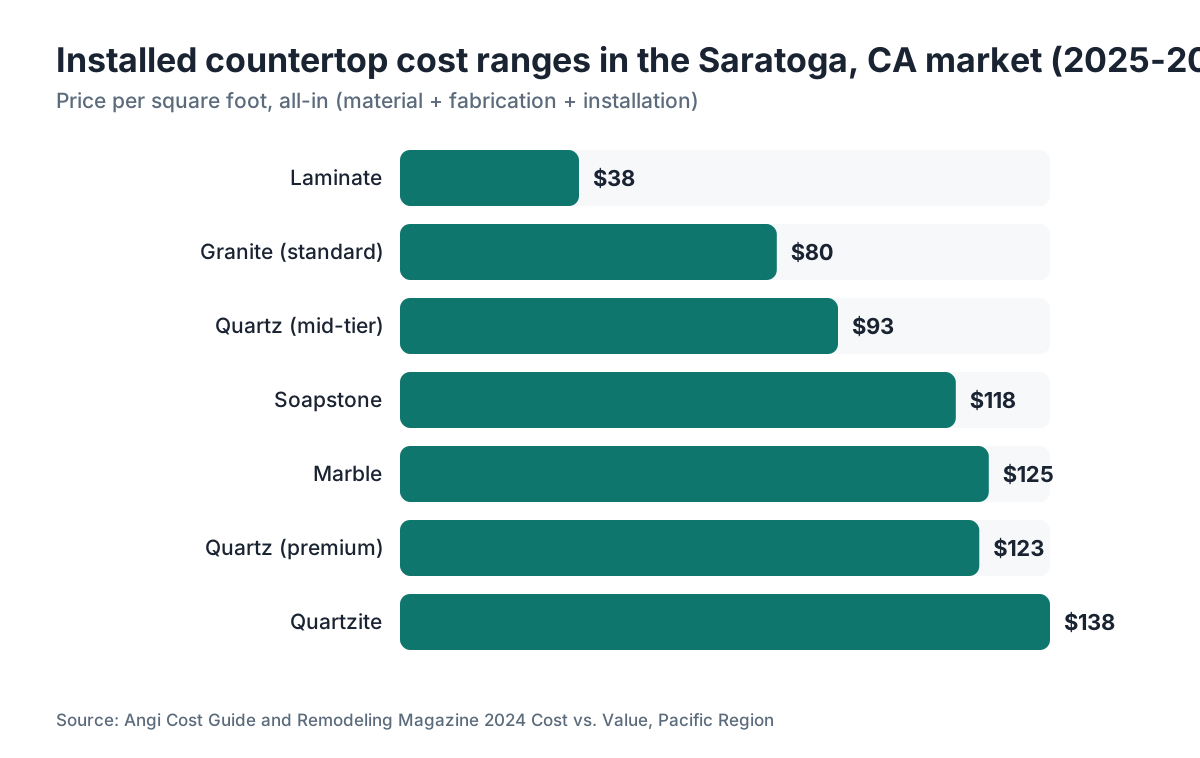
Prices in Santa Clara County run well above national averages. Labor costs, shop overhead, and some of the most expensive commercial real estate in California all push the number up. Expect granite and quartz to land between $65 and $145 per square foot installed. The table below shows what you should expect to pay all-in (material, fabrication, and installation) from a reputable local shop in 2025-2026.
| Material | Low end (installed, per sq ft) | High end (installed, per sq ft) | Notes |
|---|---|---|---|
| Laminate | $25 | $50 | Fabricated locally or prefab |
| Granite, standard grade | $65 | $95 | Domestic and common imports |
| Quartz, mid-tier | $75 | $110 | Silestone, Caesarstone, etc. |
| Quartz, premium | $100 | $145 | Cambria, specialty patterns |
| Marble | $90 | $160 | Depends heavily on source slab |
| Quartzite | $100 | $175 | Wide variation by origin |
| Soapstone | $85 | $150 | Limited local availability |
Those ranges come from contractor cost databases and regional remodeling surveys [2][3]. Your actual quote depends on slab selection, edge profile complexity, number of cutouts, and whether you want custom waterfall edges or mitered corners. A waterfall edge, where the stone runs vertically down the side of an island, can add $300 to $600 per linear foot in labor alone.
Don't anchor on price per square foot as your only metric. A shop that charges $95 a foot, templates precisely, cuts on a CNC machine, and backs the work with a written two-year labor warranty is a better deal than one charging $80 a foot that templates by hand with sloppy results and offers no written warranty at all.
Permits are a local wrinkle. Saratoga is served by the City of Saratoga Building Division [4]. Simple countertop replacements don't require a permit in most California jurisdictions, but work that moves plumbing, cuts a new rough opening for an undermount sink, or alters cabinetry can trigger one. A good fabricator knows the local threshold and tells you upfront.
How do you find qualified stone fabricators near Saratoga, CA?
Saratoga has few fabrication shops inside city limits, because land costs make industrial space too expensive. Most shops serving the area work out of San Jose, Sunnyvale, Santa Clara, Campbell, or Morgan Hill, with service areas covering the whole South Bay. A 20 to 30 minute drive from the shop to a Saratoga jobsite is normal and doesn't touch quality.
Start with these sources.
The Marble Institute of America (MIA) keeps a member directory on its website [5]. Membership isn't a quality guarantee, but it means the shop signed on to a code of ethics and has access to industry training. Use it as a filter, not a verdict.
Angi, Houzz, and Yelp all carry fabricator reviews, but read them carefully. Look for reviews that describe specific projects with before-and-after detail, name the templater, and note how problems got handled. Generic five-star reviews with no specifics tell you almost nothing.
Ask your kitchen designer or general contractor for referrals, then verify each one independently. Designers sometimes refer shops they have a financial relationship with, and that's not always disclosed. Call the shop, ask for three references on projects like yours in scale and material, and actually call those references.
Your local slab distributor (the warehouse where fabricators buy their stone) often knows which shops do quality work. They see the work orders, they hear the complaints, and they talk to fabricators daily. Visit a distributor showroom in San Jose and you can often get an honest, off-the-record read on which shops they'd want in their own kitchen.
What credentials and licenses should a California stone fabricator have?
California requires stone and tile installation contractors to hold a C-54 specialty license from the Contractors State License Board (CSLB) [6]. The C-54 covers tile and marble work. Some larger shops that also do cabinetry or general renovation hold a B (General Building) license instead. You can verify any California contractor license in seconds at the CSLB license check portal [10].
A valid license means the contractor passed a trade exam, has a responsible managing officer with experience, carries a surety bond ($25,000 as of 2024), and must carry workers' compensation insurance for any employees [6]. If an unlicensed shop damages your property or a worker gets hurt on site, your homeowner's policy may not cover it and your recourse gets complicated fast.
Beyond the license, look for a few things.
Workers' comp and general liability certificates. Ask for them. A legitimate shop sends them without complaint.
MIA or ISFA membership. The International Surface Fabricators Association (ISFA) runs training and certification programs built for countertop fabricators [7].
Manufacturer certification, if you're buying engineered stone. Cambria, Caesarstone, and Silestone all run authorized fabricator programs. Buying through an authorized fabricator is often required to get the full manufacturer's warranty on the material itself.
Lead-safe practices if your home was built before 1978. California follows EPA's Renovation, Repair and Painting (RRP) rule [8], which requires certified renovators when lead paint may be disturbed. Countertop swaps rarely disturb painted surfaces, but backsplash work or cabinet modifications might.
What questions should you ask a Saratoga stone fabricator before signing anything?
These are the questions that separate good shops from mediocre ones. Most homeowners don't ask half of them.
Do you do your own templating and installation, or subcontract it? Some shops are mainly CNC cutting operations that hire out templating and install crews on a project basis. Not automatically bad. But you want to know.
How do you template? Laser digital templating is standard at quality shops now. Cardboard templating is cheaper but adds measurement error, which shows up later as gaps at walls or uneven overhangs.
What's your lead time right now? In the Bay Area, good shops run 2 to 4 weeks from template to installation in normal demand, and 6 to 8 weeks during renovation surges. Anyone promising under a week for a full kitchen is either dead slow right now or cutting corners.
What edge profiles do you offer, and can I see samples? Profiles range from a simple eased edge (cheap) to a full bullnose, ogee, or dupont. The profile changes the look and the price. Some need two passes on the CNC machine. Others need hand finishing.
What does your warranty cover, and for how long? You want a written warranty that covers defects in the stone (though most slab defects fall on the supplier) plus fabrication and installation workmanship. Two years on labor is reasonable.
How do you handle slab remnants? Larger projects leave remnant pieces. Some shops keep them, some let you keep them for future repairs. Get it in writing.
Can I come see your shop? A shop proud of its operation says yes right away. A reluctant answer is a yellow flag.
What does the countertop installation process look like from start to finish?
Knowing the sequence helps you plan your timeline and dodge the most common scheduling mistake: ripping out old countertops before the new ones are ready.
Step 1 is the consultation and quote. You bring dimensions (or the fabricator measures rough ones), pick a material category, and get a ballpark. Most shops won't quote a firm price until after the template.
Step 2 is slab selection. With natural stone, you go to the distributor's warehouse and pick your slabs in person. Don't skip this. Two slabs of the same material from the same quarry can look dramatically different. Tag the slabs you choose so they tie to your project.
Step 3 is templating, which happens after your cabinets are fully installed and level. The fabricator comes to the jobsite, takes exact measurements, records every appliance cutout, and notes wall angles (almost no wall in a real house is perfectly square). Digital templating takes 1 to 3 hours for a typical kitchen.
Step 4 is fabrication in the shop. The template data feeds a CNC waterjet or bridge saw. Edge profiling, sink cutouts, and polishing all happen here. This phase usually runs 5 to 10 business days.
Step 5 is installation. The crew arrives with the finished pieces, sets them, joins seams, installs the undermount sink if you have one, and caulks at the wall. A full kitchen takes 4 to 8 hours. You usually stay off the counters for 24 hours while adhesive and caulk cure.
For a closer look at what install day involves, the countertop installation guide has a step-by-step breakdown.
Some fabricators run quoting and shop management software to keep all of this straight. Shops using platforms like SlabWise can generate accurate quotes faster and track each project from template through delivery, which tends to cut down on miscommunication over lead times and scope changes.
Are there any Saratoga-specific considerations for stone countertop projects?
A few things come up specifically because of the local market and housing stock.
Old homes with out-of-square walls. Saratoga has plenty of houses built in the 1950s through 1970s. Those kitchens weren't built to tight tolerances, and walls often wander a quarter-inch or more over a 10-foot run. Digital templating handles this well. Old-school cardboard templating handles it badly. A missed angle shows up as a visible gap between the countertop and the wall, which then gets caulked to hide.
Seismic considerations. California's building culture takes earthquakes seriously, and so should your fabricator. Stone countertops in high seismic zones need proper support and fastening so they don't shift in a tremor. This is less about the stone itself and more about how it sits on the cabinet substrate. Ask how the shop handles island tops, which are the most vulnerable because they often cantilever over a base cabinet.
Hard water and sealing. The Santa Clara Valley water supply can run moderately hard [9], and mineral deposits from splashing are a real maintenance issue. Honing marble or polishing it doesn't remove the need for periodic sealing. For keeping stone in good shape after installation, the how to clean stone countertops guide covers the basics.
Lead times in a hot market. The South Bay renovation market runs hard. If you're timing a kitchen around a season or holiday, start talking to fabricators 8 to 12 weeks ahead of your target install date. The shops good enough to wait for have backlogs.
How do you compare quotes from multiple Saratoga stone fabricators?
Get at least three written quotes for any project over $3,000. That's not cynicism, just good financial practice in a market where a 20 to 30% price spread on identical work is common.
When you compare, make sure each quote covers the same scope. Line items to check: material cost (the slab itself, priced by slab or by square foot of finished piece), edge profile (specify the same profile to each shop), sink cutout and undermount sink installation if applicable, seam location and number of seams (fewer is usually better aesthetically), removal and disposal of existing countertops if needed, and permit costs if any apply.
Don't just read the bottom line. A quote that's 15% cheaper but skips old countertop removal, uses a lower-grade material source, or drops a second sink cutout isn't actually cheaper.
Ask each shop to itemize. Shops with professional quoting workflows (their own system or software like SlabWise) usually put out cleaner, more comparable itemized quotes than shops still working on paper. A quote that's one line with a total price is a red flag. You don't know what's inside it.
Then weigh the quotes against what your reference checks turned up. A 10% premium from a shop with documented quality work and a clean warranty is almost always worth it.
What are the most common stone fabrication mistakes homeowners in Saratoga see?
These are the complaints that come up over and over in renovation forums and contractor review sites, and nearly all of them are preventable.
Not selecting slabs in person. Natural stone varies enormously. Handing slab selection to a designer or letting the shop pick is how you end up with a slab that looks nothing like the sample you approved. Go to the warehouse yourself.
Templating too early. If your cabinets aren't fully installed, shimmed, and level on template day, the measurements will be off. The countertop gets cut to fit the kitchen as it was that day, not as it should be.
Skipping the seam conversation. Where seams fall matters structurally and visually. A seam through the middle of a busy marble pattern looks jarring. Discuss seam placement before fabrication starts, and get the agreed placement noted on the shop drawing.
No written scope. Verbal agreements about edge profiles, overhangs, cutout locations, and warranty terms vanish the moment there's a dispute. Everything you discussed out loud belongs in the written contract or work order.
Ignoring the post-installation care window. Most stone adhesives and caulks need 24 hours to cure. Placing heavy objects, running water, or cooking too soon can compromise the install. Ask for the specific cure time and set-weight limits.
Skipping the sealer conversation. Most natural stone needs sealing before use and again periodically. Some quartz products don't. The fabricator should tell you what yours needs, how often, and which product. If they can't answer that, they're not finishing the job properly.
Are there alternatives worth considering alongside natural stone in Saratoga kitchens?
Natural stone and engineered quartz run the Saratoga market, but they aren't the only options, and sometimes a different material is genuinely the better call.
Laminate has come a long way. Modern laminate from Formica and similar brands can mimic the look of stone at a fraction of the cost with zero sealing. Renovating a rental, a guest suite kitchen, or a laundry room? Laminate countertops or Formica countertops deserve an honest look. They won't fool anyone up close, but they hold up well and cost $25 to $50 per square foot installed.
Solid surface like Corian sits in an interesting middle ground. It's repairable (scratches sand right out), nonporous, and runs without visible joints. Corian countertops aren't as heat-resistant as stone, but for secondary work surfaces and bathrooms they're practical.
Butcher block works beautifully as a baking prep section or island run alongside stone perimeter counters. It's warm, renewable, and a skilled woodworker can set it with a tight gap. The butcher block countertops guide covers species, oil maintenance, and how to spec thickness.
For bathrooms, plenty of Saratoga homeowners use smaller-format stone tile or a single-slab vanity top instead of full countertop fabrication. The cost per square foot is similar, but the smaller scale makes it easier to use exotic materials without the total getting out of hand.
Frequently asked questions
How far in advance should I book a stone fabricator in the Saratoga area?
For a standard kitchen, contact fabricators 8 to 12 weeks before your target installation date. The best shops in the South Bay carry 3 to 6 week backlogs even outside peak season. If your project involves large-format slabs or unusual materials like book-matched marble, add another 2 to 3 weeks for sourcing. Scheduling the template the day after your cabinets are confirmed level tightens your timeline further.
Do I need a permit to replace countertops in Saratoga, CA?
A straight countertop swap, same footprint, no plumbing relocation, typically does not require a permit in Saratoga under the California Building Code. But adding a new sink, moving a drain rough-in, or changing electrical for a new cooktop all require permits. The City of Saratoga Building Division handles permits for work within city limits. Your fabricator or GC should advise you based on your specific scope.
What is the difference between a stone supplier and a stone fabricator?
A stone supplier (or slab distributor) imports and warehouses raw slabs and sells them to fabricators and designers. A fabricator buys those slabs, cuts them to your exact dimensions, profiles the edges, and installs the finished product. Some vertically integrated shops do both. Most do not. When you visit a showroom with slabs on display, ask whether they fabricate in-house or outsource cutting and installation to a third party.
Is digital laser templating really better than cardboard templating?
For most kitchens, yes. Digital laser templating captures wall angles and appliance positions to within a millimeter, and the data feeds straight into CNC cutting software with no manual re-entry. That removes a whole class of transcription errors. Cardboard templating is faster to set up and cheaper for the shop, but any field measurement error gets baked into the cut piece. For irregular walls or complex island shapes, ask for digital templating specifically.
How do I verify a stone fabricator's contractor license in California?
Go to the Contractors State License Board (CSLB) website at www.cslb.ca.gov and use the license search tool. Enter the company name or license number. You can confirm the license is active, see its classification (look for C-54 or B), check for disciplinary actions, and see whether workers' comp is on file. This takes under two minutes and should be non-negotiable before you sign any contract.
What edge profile adds the most cost to a countertop job?
Multi-step profiles like ogee, dupont, and triple waterfall edges add the most because they need extra machine passes and often hand finishing afterward. A simple eased edge or flat polish is the baseline. An ogee on a full kitchen can add $400 to $900 in labor depending on linear footage. Mitered edges on a waterfall island are often the single most expensive line item, running $300 to $600 per linear foot of vertical face.
Can I supply my own slab and have a local fabricator just cut and install it?
Yes, many shops will do cut-and-install on customer-supplied stone, often called a CMO (customer material order). Expect a higher fabrication rate and a waiver releasing them from liability for slab defects, since they didn't select or source the material. You also take on getting the slab delivered to their shop. It can save money if you've found an exceptional slab at auction or from a private seller.
How long does stone countertop installation take on the day of install?
A standard kitchen with 60 to 80 square feet of countertop and one undermount sink typically takes 4 to 6 hours for an experienced two-person crew. Larger kitchens with multiple islands, waterfall edges, or complex seaming can run 7 to 9 hours. After install, most adhesives and silicone caulk need 24 hours to cure before normal use. Don't run the dishwasher or set heavy items on unsupported overhangs during that window.
What warranty should I expect from a reputable stone fabricator?
A solid fabrication warranty covers workmanship (seams, cutouts, edge profiles, installation) for one to two years. Material defects in natural stone are usually the slab supplier's responsibility, not the fabricator's. Engineered stone brands like Cambria offer their own lifetime material warranties, but only when installed by an authorized fabricator. Get the terms in writing before signing. A verbal 'we'll take care of any problems' is not a warranty.
Do stone fabricators in the Saratoga area charge for in-home estimates?
Most established shops offer free initial estimates based on rough dimensions you provide. The template visit, which produces the precise measurements used for fabrication, may carry a charge of $75 to $150 that's often credited toward the project if you proceed. Some shops waive it entirely. Clarify this upfront, because a fabricator who charges for an estimate and then doesn't credit it if you hire them is signaling something about how they operate.
Is quartzite harder than granite, and does that matter for a kitchen countertop?
Most quartzite rates 7 on the Mohs hardness scale, similar to or slightly harder than granite at 6 to 7 [11]. In practical kitchen terms, both are hard enough that normal knife use won't scratch them (though you'd ruin your knives). The bigger quartzite advantage is aesthetic: it can look marble-like while resisting acid better than marble. The catch is that mislabeling is common. Some stone sold as quartzite is actually a softer marble or dolomite. Ask for an acid drip test.
What happens if my countertop cracks after installation?
Document it with photos right away and contact the fabricator in writing. A crack along a sink cutout or seam is almost always a fabrication or installation issue and should be covered under the labor warranty. A crack in the field of the slab with no stress point nearby suggests a hidden fissure in the raw stone, which is a supplier issue. Fabricators inspect slabs before cutting, so a missed fissure is still partly on them. Put the dispute in writing early; verbal resolution rarely sticks.
How do I care for a new stone countertop once it's installed?
For natural stone like granite, marble, or quartzite, apply a penetrating sealer before first use and reseal every 6 to 18 months depending on traffic. Avoid acidic cleaners (vinegar, citrus) on marble. Use a pH-neutral dish soap for daily cleaning. For engineered quartz, no sealing is needed, but avoid prolonged heat exposure and harsh abrasives. The how to clean stone countertops guide covers specific products and techniques.
Sources
- U.S. Census Bureau, QuickFacts, Saratoga city, CA profile: Median home value in Saratoga, CA is significantly above national norms, reflecting the high-cost Silicon Valley real estate market
- Angi, Countertop Installation Cost Guide: Installed countertop costs by material type and regional variation, including California market premiums
- Remodeling Magazine, 2024 Cost vs. Value Report, Pacific Region: Kitchen remodeling cost data for the Pacific region, showing above-average labor and material costs compared to national figures
- Natural Stone Institute (formerly Marble Institute of America), Member Directory: The Marble Institute of America maintains a directory of member fabricators who have agreed to a code of ethics and have access to industry training
- California Contractors State License Board, License Classifications: California requires stone and tile installation contractors to hold a C-54 specialty license; workers' comp and a $25,000 surety bond are required
- International Surface Fabricators Association (ISFA): ISFA runs training and certification programs specifically for countertop fabricators
- U.S. EPA, Renovation, Repair and Painting (RRP) Program: EPA's RRP rule requires certified renovators when lead paint may be disturbed in pre-1978 homes; California follows this rule
- Santa Clara Valley Water (Valley Water), Water Quality: The Santa Clara Valley water supply can run moderately hard, leading to mineral deposit accumulation on stone surfaces
- California Contractors State License Board, License Check: Homeowners can verify any California contractor license, status, classification, and workers' comp filing using the CSLB online license check tool
- U.S. Geological Survey, National Minerals Information Center: Quartzite typically rates 7 on the Mohs hardness scale; granite rates 6 to 7; both are standard references in dimension stone mineralogy
Last updated 2026-07-09