TL;DR
- Stone fabrication shops in Santa Clara typically charge $55 to $120 per square foot installed for granite or quartz, with templating to installation running 7 to 14 days on most residential jobs.
- Local shops handle slab selection at Bay Area stone yards, CNC cutting, and polishing in-house.
- This guide covers how to vet a fabricator, what drives cost, and what to ask before you sign.
What does a stone fabricator in Santa Clara actually do?
A stone fabricator is not a countertop store. They buy raw slabs, cut them to your kitchen's exact dimensions, machine the edges, polish the surface, and install the finished pieces. The whole chain, from slab to glued-in countertop, happens in their shop and on your jobsite. Retailers sell. Fabricators manufacture.
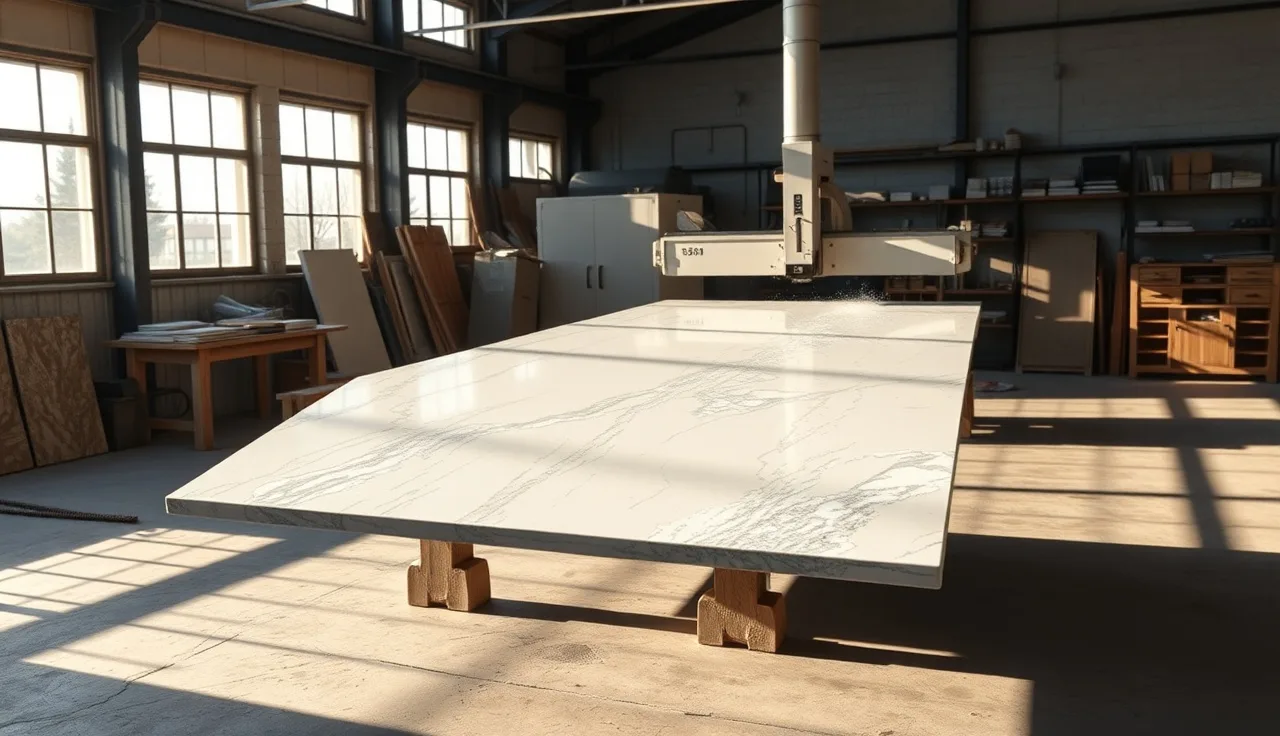
In Santa Clara and the broader South Bay, most shops run full-service facilities with CNC bridge saws, waterjet cutters, and edge profiling machines. Some keep their own delivery and install crews. Others subcontract the install. That distinction matters, because when a crew shows up who has never seen your job, callbacks get harder to resolve.
The work follows a fixed order: measure the base cabinets, build a template (physical cardboard or a digital scan), program the cuts into a CNC machine, cut and polish the slab, then install and seam the countertop on site. Turnaround from template to install runs 7 to 14 days for residential work, though high-volume commercial jobs or rare stone can push that to 3 to 4 weeks [1].
Some South Bay shops also help with slab sourcing, meaning they hold an account at a local distributor and can walk you through bundles before you commit. That service is worth more than it sounds. Choosing your actual slab, more than a material name, is the single biggest factor in how your countertop looks.
How much does stone fabrication cost in Santa Clara?
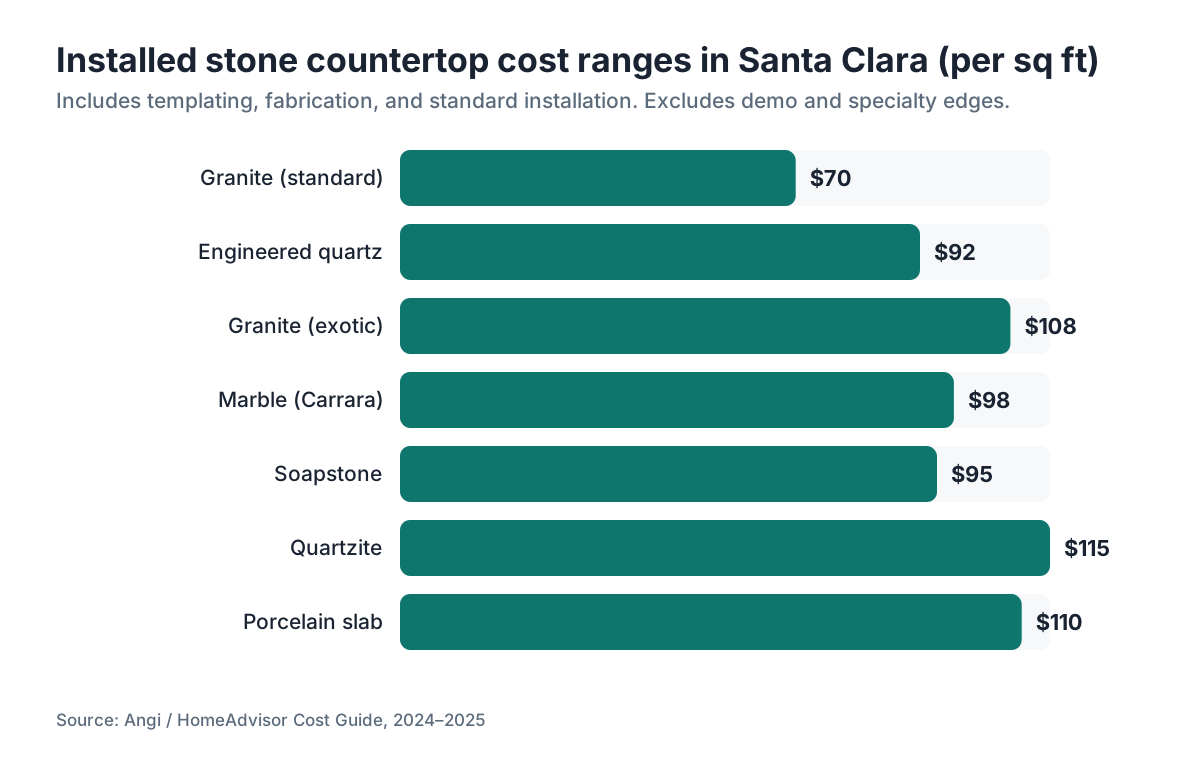
Installed cost in Santa Clara generally runs $55 to $120 per square foot for granite and engineered quartz, and $80 to $150 per square foot for natural marble or quartzite [2]. Those ranges cover templating, fabrication, and basic installation. They do not cover demo of old countertops, plumbing disconnects, or unusually complex edge profiles.
Here is how the main materials stack up:
| Material | Typical installed range (per sq ft) | Notes |
|---|---|---|
| Granite (standard) | $55 to $85 | Depends heavily on slab grade and origin |
| Granite (exotic) | $85 to $130 | Brazilian exotics, leathered finishes |
| Engineered quartz | $65 to $120 | Silestone/Cambria/Caesarstone brand spread |
| Marble (Carrara) | $75 to $120 | Requires sealing; etching risk |
| Quartzite | $80 to $150 | Harder to cut; commands a premium |
| Soapstone | $70 to $120 | Lower demand, fewer local yards carry it |
| Porcelain slab | $80 to $140 | Very hard to cut; saw blades cost more |
Prices above reflect 2024 to 2025 contractor and consumer data from California-focused cost surveys and regional fabricator pricing sheets [2][3]. They shift with shop margin, slab cost on the day you buy, and how many linear feet of edge work your project needs.
Edge profiles add cost. A simple eased or beveled edge is often included. Waterfall edges, full bullnose, or ogee profiles typically add $15 to $30 per linear foot. Cutouts for sinks and cooktops run $100 to $300 each depending on shape. Undermount sink cutouts take more machine time than drop-in cuts.
The square footage math trips people up too. Fabricators measure the full slab area needed, including overhang and the area cut away for sinks. You pay for material consumed, more than the countertop surface you keep. Always ask how your quote measures square footage.
What stone materials are most popular with Santa Clara homeowners?
Engineered quartz has been the most-requested material in California residential remodels for several years running, mostly because it needs no sealing and shrugs off the daily abuse of a busy kitchen [3]. Brands like Cambria and Caesarstone own the mid-to-upper market. Granite is nowhere near dead, though. Plenty of Santa Clara homeowners still want natural stone, and the South Bay has enough distributors that exotic granites (Brazilian fantasy brown, cosmic black, and the like) show up without a long wait.
Marble is the one fabricators have the most complicated feelings about. It looks better than anything else, full stop. It also etches from lemon juice and red wine, which in a Silicon Valley household where people cook late and experiment constantly is a real problem. Marble countertops make the most sense in bathrooms, low-traffic bars, or for owners who honestly do not mind the patina that comes with use.
Quartzite is the material causing the most confusion at stone yards right now. True quartzite is a metamorphic natural stone, harder than marble, and gorgeous. But some yards label softer marbles as quartzite because it sells better. If you are paying for quartzite, ask for a hardness test or at least the quarry of origin. Mohs hardness for true quartzite runs 7 to 8. Soft marble mislabeled as quartzite might test at 3 to 4 [4]. Once you know what you actually have, read up on how to clean quartzite countertops.
When budget is a hard constraint, laminate countertops and Formica countertops still serve millions of households well, and local cabinet shops in Santa Clara turn them faster than stone fabricators can. Stone is not always the right call.
How do you find and vet a stone fabricator in Santa Clara?
Start with the Contractors State License Board (CSLB). California requires stone fabricators who install to hold a valid contractor's license, most often a C-54 (Ceramic and Mosaic Tile) or D-12 (Synthetic Products) license depending on scope [5]. You can verify any California license number, its status, and the complaint history at the CSLB lookup tool. It takes two minutes and weeds out unlicensed operators who carry no bond and no accountability.
After you verify the license, ask for three things: recent local projects you can visit or photograph, proof of general liability insurance (a $1 million minimum is standard in the Bay Area), and a written quote that itemizes slab cost, fabrication labor, edge charges, and installation separately. Any shop that hands you one lump number and bristles when you ask for a breakdown is telling you something.
Online reviews help but are easy to game. Read Yelp and Google, but focus on reviews that describe a specific problem and how the shop handled it, not on five-star praise. A shop with 4.2 stars and a dozen detailed reviews about resolving an issue often beats one with fifty vague five-star ratings.
Building supply showrooms and kitchen designers in Santa Clara tend to have strong opinions about which fabricators hit commercial tolerances. General contractors who remodel kitchens in the 95051, 95054, and 95050 zip codes will tell you fast which shops cause callbacks and which do not. That informal referral network beats any review platform.
One operational question is worth asking: does the shop template and fabricate in-house, or outsource the templating? In-house work means one point of accountability. When a seam is off or a sink cutout lands wrong, there is nobody to point fingers at.
What does the templating and installation process look like?
Templating is the step most homeowners underestimate. A technician comes out after your base cabinets are set and level, measures every run of countertop, marks sink and cooktop locations, and either builds a cardboard template or uses a digital laser system (LT-55 or similar). Digital templating is faster, accurate to within 1/32 inch, and produces a file that feeds straight into the CNC saw with no manual transcription errors [6].
After templating, the file goes to the shop. The CNC programmer lays out cuts across the slab, trying to maximize yield and match veining across seams. This nesting step is where a good programmer saves you real money, because slab cost is the biggest single line item on most jobs. Some shops still nest by hand on paper. Larger operations automate it with software. (SlabWise, for one, is used by shops to automate quoting and slab nesting, which cuts waste and speeds turnaround for exactly this reason.)
Installation day is usually a two-person job for a standard kitchen. Pieces come in, get dry-fit, then the sink cutout gets checked against the actual undermount sink. Seams get color-matched epoxy. Countertops get set in silicone on the cabinet tops, and undermount sinks get clipped from below. A good crew finishes a standard kitchen in 3 to 5 hours.
After install, most fabricators say to wait 24 hours before using the sink. Natural stone (granite, marble, soapstone) should be sealed within the first week if it was not sealed at the shop [7]. Engineered quartz needs no sealing. For keeping stone clean after install, how to clean stone countertops is a good next read.
What permits or regulations apply to countertop work in Santa Clara?
For a straight countertop replacement with no structural changes, the City of Santa Clara does not require a building permit [8]. You are swapping a surface, not modifying the structure. If the project moves a gas cooktop, relocates plumbing, or adds an island that needs new electrical, each of those trades needs its own permit from the Santa Clara Building Division.
Prop 65 and worker safety matter here even if they do not feel like your problem. Some natural slabs, and engineered stones especially, contain crystalline silica. OSHA's silica rule (29 CFR 1910.1053) covers workers cutting stone in fabrication shops, requiring engineering controls like wet cutting and local exhaust ventilation [9]. That is the shop's obligation, not yours, but you can ask any fabricator what dust controls they run. Wet-cutting CNC machines and a real respirator program are the standard. A shop that still dry-grinds countertops indoors without controls is breaking federal workplace safety law.
The CSLB also requires that any home improvement contract over $500 include specific language: the total price, a payment schedule, a description of work, and a three-day right to cancel [5]. If a fabricator shows up, takes a deposit, and hands you nothing in writing, that is both a licensing violation and a warning sign.
How do Santa Clara stone yards and fabricators work together?
Most South Bay fabricators do not stock their own slabs. They keep accounts at regional distributors, usually in San Jose, Milpitas, or along the 101 corridor. You visit the yard, pick your bundle (a matched set of slabs from the same quarry run), and the fabricator buys it on your behalf, or you buy it directly and arrange delivery.
Visiting the yard in person is not optional if you care about the result. Material names like 'Kashmir White' or 'Calacatta Gold' describe a category, not a specific slab. Two slabs with the same name from different quarry runs can look completely different in veining, background color, and movement. Pick the actual slab, mark it with chalk or a sticky note, and confirm your fabricator is cutting from that exact bundle.
Some Santa Clara shops keep a small showroom of sample tiles or remnant pieces. Those samples help you see edge profiles and finishes. They do not help you pick stone color, because a 4-inch tile cannot tell you how a 9-foot run of veined marble will read across your kitchen. Go to the yard.
Remnants are worth asking about if your project is small (a bathroom vanity, a laundry room, a bar top). Remnants are leftover slab sections from earlier jobs. Fabricators usually sell them at $10 to $40 per square foot, far below full-slab pricing [2]. Many Santa Clara shops keep a remnant rack. For a 25-square-foot bathroom vanity, a remnant can cut your material cost by 50 to 70%.
What should a countertop quote from a Santa Clara fabricator include?
A complete quote has more line items than most homeowners expect. Here is what to look for.
Slab cost should sit on its own line, with the material name, grade, and slab dimensions spelled out. Fabrication labor gets its own line, covering the cutting, polishing, and seaming. Edge profile should name the profile and the linear footage. Cutouts should list each one (undermount sink, cooktop, soap dispenser) with individual pricing. Installation stays separate from fabrication. And any add-ons, like backsplash cuts, corbels, or specialty finishes, get itemized.
If a quote bundles everything into one number, ask for the breakdown in writing before you sign. You want that detail not to fight over each line, but because when something changes (you switch sinks, the cooktop shifts), you can see exactly what the change costs instead of arguing about it later.
Payment terms matter. California's Home Improvement Contract law lets fabricators collect a deposit, but caps it at 10% of the job or $1,000, whichever is less, before work begins [5]. Some fabricators ask for 50% down when you pick your slab. That practice sits outside the legal limit for a pre-work deposit, though CSLB enforcement varies. Know your rights.
Get the timeline in writing too: estimated template date, estimated fabrication completion, and estimated install date. Delays happen, especially when a slab has to be ordered from outside the Bay Area. A written timeline gives you a reference point for reasonable follow-up.
How does granite fabrication in Santa Clara compare to other countertop options?
Granite fabrication takes more machine time than engineered quartz, because natural stone has unpredictable hardness and the programmer has to account for fissures and pits during nesting. Even so, the installed cost gap between mid-grade granite and mid-grade quartz in Santa Clara is often smaller than people expect, maybe $5 to $15 per square foot, since both run through the same CNC process [2].
Against tile, solid stone has no grout lines to scrub and the seams (when done right) nearly disappear. Against butcher block countertops, stone is harder and more heat-resistant but less forgiving of structural movement in older homes (wood moves, stone does not). Against Corian countertops or solid surface, stone cannot be sanded out if it chips, but it takes heat better.
For kitchen countertops in Santa Clara's mix of 1960s ranches, 1990s builds, and 2000s townhomes, mid-grade granite and quartz both hold resale value well. Bay Area appraisers generally treat natural stone and engineered quartz as equal upgrades. Neither draws a dramatic premium over the other [3].
The honest answer on which to pick: choose the one you like looking at, that fits your maintenance tolerance, and that fits your budget after real quotes come in. The online material debates are mostly theoretical. In practice, granite or quartz installed by a competent Santa Clara shop will look good and last decades.
What are the most common fabrication problems and how do you avoid them?
Seam placement generates the most callbacks. A seam on a long run is unavoidable when your kitchen is longer than one slab, but where it lands matters enormously. Seams in the middle of a visible run look worse than seams tucked near a sink or a corner. Always ask to see the cut layout (the nesting diagram) before fabrication starts. If a shop treats the cut layout as proprietary, that is unusual.
Veining mismatch across a seam is the related complaint. On highly veined marble or granite, the fabricator has to flip or book-match the pieces to line up the pattern. That takes planning at the nesting stage, and not every shop does it unprompted. Ask.
Cabinet level is your job, not the fabricator's. Stone cannot flex to hide out-of-level base cabinets. If your cabinets vary more than 1/8 inch over a 10-foot run, get them leveled before templating. Fabricators will note unlevel cabinets during template, but many install anyway, and then the countertop looks like it follows the cabinet, because it does.
Chipping during transport or install happens now and then. Good fabricators wrap pieces in moving blankets and haul them upright on an A-frame rack. Pieces laid flat in a truck bed and slid around are asking for damage. Ask how pieces get transported.
Undermount sink support is the last one. The sink should be clipped and epoxied to the underside of the stone, not resting on cabinet supports. A properly mounted undermount sink handles the weight of a full pot. A poorly clipped one can crack the front edge of the countertop over time. Ask to see the mounting method before the install crew packs up.
What should fabricators in Santa Clara know about running a competitive shop?
The South Bay fabrication market is crowded. Shops range from one-person operations in a small warehouse to mid-size facilities with 10 to 20 employees. Labor here is among the priciest in the state. Santa Clara County's 2024 minimum wage tracks California's state minimum of $16 per hour [10], and skilled CNC operators and installers in the Bay Area command $25 to $45 an hour or more. That labor cost lands in your installed price.
Material waste is one of the biggest controllable costs in any shop. The industry average yield on a slab is roughly 70 to 75% usable material after cuts and offcuts [11]. Shops that run systematic nesting, by hand or by software, push that yield higher, which feeds straight into margin. On a $500 slab, a 5-point yield gain is worth $25 in reclaimed material. Across 200 jobs a year, that is real money.
Shops trying to tighten quoting and cut estimating errors can use software built for the job. SlabWise (slabwise.com) is made for countertop fabrication: quoting, slab nesting, and job management in one tool. It is worth a demo if you run more than a handful of jobs a week and quoting is eating your time.
On the homeowner side, itemized quotes and a clear walkthrough of the process are a genuine edge in a market where most buyers have no idea what they are paying for. Shops that teach win referrals from architects and designers who send repeat work.
Frequently asked questions
How long does stone countertop fabrication take in Santa Clara?
Most residential jobs run 7 to 14 days from templating to installation. That assumes the slab is already at a local distributor. If the stone has to be ordered from outside the Bay Area or is a specialty material, add 2 to 3 weeks. Commercial projects or unusually large kitchens can extend fabrication time too. Get a written timeline in your contract.
Do I need a permit to replace countertops in Santa Clara?
A straight countertop swap does not require a building permit from the City of Santa Clara. If the project involves moving gas lines, relocating plumbing, or adding electrical for an island, each of those trades needs its own permit. Check with the Santa Clara Building Division if you are unsure whether your specific scope requires one.
How do I verify a stone fabricator's license in California?
Use the Contractors State License Board (CSLB) license check at cslb.ca.gov. Search by business name or license number. You can see the license class, expiration date, bond status, and any disciplinary history. California fabricators doing installation typically need a C-54 or D-12 license. This check takes two minutes and is worth doing before you sign any contract.
What is the difference between quartz and quartzite countertops?
Engineered quartz is a manufactured product, roughly 90% ground quartz bound with polymer resin. Quartzite is a natural metamorphic stone quarried from the earth. Quartzite is harder and more heat-resistant than marble, with a Mohs hardness of 7 to 8. Engineered quartz is not heat-resistant, since the resin binder can scorch. They look different, cost similarly, and need different maintenance. Do not let a yard swap one for the other.
What deposit can a California stone fabricator legally require?
Under California Home Improvement Contract law, a contractor can collect no more than 10% of the total contract price or $1,000, whichever is less, as a deposit before work begins. Some fabricators ask for larger deposits at slab selection, which exceeds what the law allows for the initial pre-work deposit. You can file a complaint with the CSLB if a contractor demands an illegal deposit.
Can I buy a remnant slab to save money on a small bathroom vanity?
Yes, and it is often the smartest move for small jobs. Shops in Santa Clara and nearby San Jose regularly sell remnant pieces at $10 to $40 per square foot, against $55 and up per square foot installed for a full slab job. A 25-square-foot bathroom vanity can often be cut from a single remnant. Ask any local shop whether they keep a remnant rack before pricing a full slab.
Does stone fabrication affect indoor air quality in my home?
Once installed and polished, stone countertops do not meaningfully affect indoor air quality. The air-quality concern lives in the fabrication shop, where cutting stone generates crystalline silica dust. OSHA's silica rule (29 CFR 1910.1053) requires shops to use wet cutting or local exhaust ventilation to protect workers. You are not exposed to that dust during installation under normal conditions, since finished pieces arrive pre-cut and polished.
How do seams work in a stone countertop and can they be made invisible?
Seams are where two slab sections meet on a long run. A skilled fabricator fills the seam with color-matched epoxy and polishes it flat, making it nearly invisible on solid-color stone. Highly veined stone (marble, some granites) will always show a seam to some degree, because the veining pattern breaks. The best you can do is ask for book-matching and strategic seam placement away from the center of visual focus.
What edge profiles are available and how much do they cost?
Common options include eased (flat with a slight break), beveled, bullnose (fully rounded), ogee (S-curve), and waterfall (for island legs). A basic eased edge is often included in the base fabrication price. Decorative profiles like ogee or laminated mitered edges typically add $15 to $30 per linear foot. Waterfall island edges are priced separately, often $200 to $500 per side depending on run length.
How soon after installation can I use my new stone countertops?
You can use engineered quartz the same day. For natural stone (granite, marble, quartzite, soapstone), fabricators typically say to wait 24 hours before heavy use, so the adhesive and epoxy cure fully. Sealing natural stone should happen within the first week if it was not done at the shop. Do not set heavy pots on stone for 24 hours after install, whatever the material.
What is digital templating and is it better than a cardboard template?
Digital templating uses a laser measuring device to capture the exact geometry of your cabinets and walls, generating a CAD file that feeds straight into the CNC saw. Accuracy is typically within 1/32 inch. Cardboard templates are accurate when done carefully but introduce transcription errors when transferred to the CNC program. Most larger Santa Clara shops have moved to digital templating. It is faster and reduces fit errors on install day.
What should I do if my new countertop has a chip or crack after installation?
Contact the fabricator right away and document the damage with photos before anything is moved or cleaned. Most reputable shops carry general liability insurance that covers installation damage. Small chips can be repaired with color-matched epoxy. Cracks that run through a seam or a sink cutout are structural and require the section to be replaced. Get the repair scope and timeline in writing before you agree to any fix.
Is granite or quartz better for resale value in the South Bay real estate market?
Bay Area appraisers and agents generally treat natural granite and engineered quartz as equal upgrades. Neither commands a dramatic premium over the other. Condition, edge quality, and color choice (neutral vs. trendy) matter more than the material itself. Stone of any kind in good condition beats laminate or tile in resale appraisals, but the granite-vs-quartz debate has minimal impact on final sale price.
How do fabricators price jobs with unusual layouts like L-shapes or kitchen islands?
Square footage is the base, but complex layouts add cost. L-shapes need careful nesting to hold down waste. Islands often need full-perimeter edge finishing (four sides instead of one). Overhangs past 12 inches typically require corbel supports, priced separately. Cooktop cutouts in islands add $150 to $300. Ask your fabricator to walk through the nesting plan for a complex layout before you approve the final quote.
Sources
- HomeAdvisor (Angi), Countertop Installation Cost Guide: Typical residential fabrication and installation turnaround is 7 to 14 days for most countertop projects
- HomeAdvisor (Angi), Countertop Installation Cost Guide: Installed stone countertop costs range from $55, $150 per square foot depending on material; remnants sell at $10, $40 per square foot
- National Association of Realtors, Remodeling Impact Report: Kitchen countertop upgrades including stone and engineered quartz are among the top remodel projects for cost recovery and appeal to buyers in California markets
- USGS, Mineral Resources Program, Quartzite fact sheet: True quartzite has a Mohs hardness of 7 to 8; marble, sometimes mislabeled as quartzite, tests at 3 to 4 on the Mohs scale
- California Contractors State License Board, Home Improvement Contracts: California law requires home improvement contracts over $500 to include total price, payment schedule, and description of work; deposits are capped at 10% or $1,000, whichever is less
- Laser Products Industries, Digital Templating Technology Overview: Digital laser templating systems achieve accuracy within 1/32 inch and produce CAD files that feed directly into CNC machines
- Natural Stone Institute, Care and Maintenance of Natural Stone: Natural stone countertops including granite and marble should be sealed within the first week after installation if not sealed at the fabrication shop
- City of Santa Clara, Building Division: Straight countertop replacements with no structural, plumbing, or electrical changes do not require a building permit in Santa Clara
- OSHA, Occupational Exposure to Respirable Crystalline Silica Standard (29 CFR 1910.1053): OSHA's silica rule requires stone fabrication shops to use engineering controls including wet cutting and local exhaust ventilation to control silica dust exposure for workers
- California Department of Industrial Relations, Minimum Wage: California's state minimum wage is $16 per hour as of 2024; Santa Clara County tracks the state minimum
- Natural Stone Institute, Stone Industry Benchmarking and Fabrication Best Practices: Industry average slab yield in stone fabrication shops is approximately 70 to 75% usable material after cuts and offcuts
Last updated 2026-07-09