TL;DR
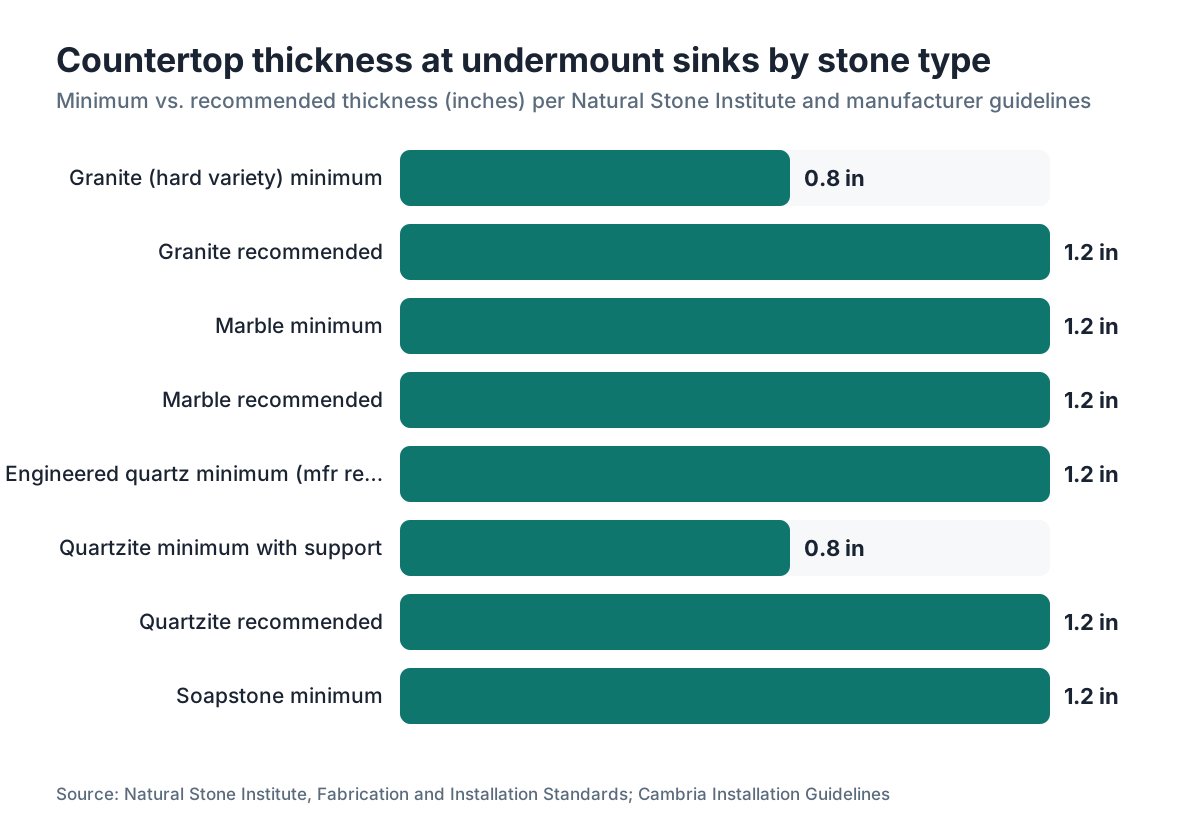
- Most fabricators and stone industry guidelines set 3/4 inch (2 cm) as the absolute minimum thickness for stone over an undermount sink cutout.
- The real-world standard is 1.25 inches (3 cm).
- Thinner stone needs epoxied rod reinforcement.
- Engineered quartz makers like Cambria require 3 cm outright.
- Go under 2 cm over an unsupported cutout and it cracks at the corners.
What is the minimum stone thickness over an undermount sink?
The short answer: 3/4 inch (about 19 mm, what the industry calls "2 cm") is the widely cited minimum, and 1-1/4 inch (about 32 mm, called "3 cm") is what most shops actually recommend. Those two thicknesses dominate the natural stone and quartz market, and the difference matters a lot at a sink cutout.
Here's the physics. An undermount sink removes a big chunk of stone from the center of the top. What's left are four thin strips bridging an open hole with nothing underneath. The corners of that cutout are stress concentration points. A crack almost always starts at the inside corner of a sink cutout, and it nearly always runs toward the front edge. Thicker stone resists that bending stress far better. Not slightly better. Dramatically. Flexural strength scales with the square of the cross-section, so going from 2 cm to 3 cm doesn't add 50% more strength; it roughly doubles it [6].
The Marble Institute of America, now the Natural Stone Institute, has long recommended 3 cm as the preferred thickness for countertops with undermount sinks [1]. That's a professional standard, not a code requirement in most places. But engineered quartz makers write it straight into their installation rules. Cambria, for example, specifies a minimum of 3 cm (1-1/4 inch) for undermount installations [2]. Install thinner and something cracks, the warranty is gone.
For homeowners: if a fabricator quotes 2 cm for a granite or quartz top with an undermount sink, ask exactly what support structure they plan to add. It's a fair question, not a rude one.
Does the stone type change the minimum thickness requirement?
Yes, and the spread is wider than most people expect. Granite behaves one way, marble another, quartz another still. The material sets the risk.
Granite is hard and brittle. Its modulus of rupture, the stress at which it breaks, runs roughly 2,000 to 3,000 psi depending on the variety [6]. A tight-grained granite like Absolute Black handles a 2 cm undermount install with decent corner support. An exotic granite with big feldspar crystals or heavy veining is weaker, and the same 2 cm job gets riskier.
Marble is softer and cracks more easily. The Natural Stone Institute's fabrication manuals treat marble as higher-risk over undermount cutouts, and most reputable shops won't go below 3 cm for it. If someone quotes a 2 cm Carrara top with an undermount sink, push back. Marble countertops have a reputation for cracking near sinks, and thin stone is a big part of why.
Quartzite, the real thing and not the soft marble sold under the name, ranks among the harder natural stones. It performs reasonably at 2 cm with proper support, but fabricators still prefer 3 cm.
Engineered quartz is a polymer-bonded composite. It behaves differently from natural stone: more homogeneous, so it skips the grain-direction weakness of granite, but stiffer and more brittle in bending. Manufacturer specs generally require 3 cm for undermount sinks, and that holds across the major brands [2][9][10].
Soapstone is soft (Mohs 1 to 2) and dense. Fabricators almost universally use 3 cm for soapstone tops with undermount sinks. You won't find a reputable shop offering 2 cm soapstone over a cutout.
| Stone type | Practical minimum at undermount | Industry preferred | Notes |
|---|---|---|---|
| Granite (hard variety) | 2 cm with support | 3 cm | Corner support required at 2 cm |
| Granite (exotic/veined) | 3 cm | 3 cm | Higher crack risk at 2 cm |
| Marble | 3 cm | 3 cm | Most shops won't do 2 cm |
| Engineered quartz | 3 cm | 3 cm | Most mfr warranties require 3 cm |
| Quartzite | 2 cm with support | 3 cm | Depends on specific stone |
| Soapstone | 3 cm | 3 cm | Too soft for 2 cm over cutout |
| Travertine/limestone | 3 cm | 3 cm | Porous, weaker than granite |
Why do fabricators talk about "2 cm" and "3 cm" instead of inches?
The stone trade adopted metric thickness designations decades ago, mostly because European quarrying and processing gear runs in metric. Slabs get cut to roughly those thicknesses, though real slabs wander a few millimeters either way.
A "2 cm" slab measures about 3/4 inch (0.75 inch). A "3 cm" slab is about 1-1/4 inch (1.25 inch). When a fabricator says "I'd go 3 cm on that sink," they mean the thicker option.
There's also a "1.2 cm" thickness used for some tile-format stone and overlay work. Nobody serious puts 1.2 cm over an undermount sink without laminating it to a substrate, and even then the detail is sketchy. See 1.2 cm in a countertop quote that includes an undermount sink? Ask a lot of questions.
For kitchen countertops in general, 3 cm became the North American default over the last 15 years. Shops used to reach for 2 cm mainly on cost: less stone, less money per square foot. As slab prices settled and buyers got used to the heftier look and feel of 3 cm, the market moved. Today 3 cm is what most homeowners get unless they ask for 2 cm on purpose for a thin-profile look.
What happens if the stone is too thin over the sink cutout?
It cracks. Specifically, a crack running diagonally from one inside corner of the sink cutout toward the front or rear edge. This is the single most common catastrophic failure in stone countertop work, and thin stone over an unsupported undermount cutout is the usual cause [7].
The failure tends to hit at installation, when the sink clips get over-tightened, or in the first year when the cabinet settles a hair and shifts the load. Sometimes it comes later, when someone leans hard on the front of the counter by the sink.
A crack through a stone top at the sink is almost never repairable to an acceptable cosmetic standard. The slab comes out. That means disconnecting plumbing, pulling the sink, removing the top, and fabricating a new one. The total to fix a cracked sink cutout runs $1,500 to $4,000 depending on material, size, and whether you replace just the sink section or the whole run [3].
The other failure is a chip at the inside corner. A tight square corner concentrates stress, which is why fabricators radius the corners, typically to 3/8 inch or larger. A thin slab with too-tight corner radii and no support underneath is asking for a chip or a crack.
None of this is hypothetical. Every experienced fabricator has watched a 2 cm undermount top crack on the job. Ask yours.
How does support under the stone affect the thickness requirement?
Support changes everything. The minimum thickness recommendation assumes the stone bridges the cutout with no help. Add support and you can sometimes run thinner stone safely.
The common support methods for undermount sinks:
Rod or bar reinforcement. Fabricators epoxy steel rods (typically 3/8 inch rebar or threaded rod) into routed channels on the underside of the stone, spanning the cutout front to rear. This is standard for 2 cm undermount installs and gets recommended even for 3 cm in some spots. The Natural Stone Institute's fabrication manual walks through the technique [1].
Plywood substrate. Older kitchens and some remodels still run a plywood deck under the stone. A well-adhered plywood layer under 2 cm stone cuts the risk at the cutout, because the plywood opening can be smaller than the sink opening, leaving wood support right where the stone needs it. This was standard with older thin-stone jobs.
Cabinet body extension. Some cabinet makers bring the face frame or a cross-member close enough to the sink to support the edge. It helps, but it's less reliable than epoxied rods.
For any stone thinner than 3 cm over an undermount sink, the Natural Stone Institute recommends at least two epoxied rods, one near the front and one near the rear of the cutout [1]. Some shops add a third. The rods disappear once installed, and they cost almost nothing against the value of the countertop.
Buying new tops and the fabricator offers 2 cm with an undermount sink? Ask point-blank: "Are you adding rod reinforcement across the cutout?" If the answer is no, ask why not.
Does countertop overhang at the sink change the risk?
Yes. An overhang past the cabinet face adds cantilevered load to the already-stressed front strip of stone above the sink. Standard overhang is 1 to 1.5 inches past the cabinet face. That's fine for 3 cm stone, fine for 2 cm away from cutouts, and manageable for 2 cm at a sink cutout with rod reinforcement.
Trouble starts when the overhang gets large. Some designers want 4 to 6 inches at a sink for drama, or the counter overhangs a full seating area next to the sink. The Natural Stone Institute recommends that overhangs beyond 1/3 of the total countertop depth get support, either corbels or brackets [1]. At a sink cutout, any overhang bigger than about 4 inches should push you to 3 cm stone and rod reinforcement regardless of stone type.
Bring this up with your fabricator before the template visit, not after. Overhang drives both the support plan and the edge profile options.
Are there building code requirements for countertop thickness over sinks?
Not really, not the way you'd expect. No section of the International Residential Code or the International Building Code specifies a minimum stone countertop thickness over an undermount sink [4]. Codes address structural loads, plumbing rough-in, and GFCI requirements near sinks. Countertop material thickness is left to industry standards and manufacturer specs.
So the requirement, when it shows up at all, comes from one of three places: the countertop manufacturer's installation guide (especially for engineered quartz), the Natural Stone Institute's fabrication standards (voluntary but widely followed), or a specific fabricator's shop standards and warranty terms.
In a new-construction project with a general contractor, the GC's countertop spec might reference NSI or NKBA (National Kitchen and Bath Association) standards. The NKBA's kitchen planning guidelines touch on installation quality but don't set a specific stone thickness [5].
The takeaway for homeowners: you can't wave a building code at your fabricator to force 3 cm. But you can cite the manufacturer's installation guide if it's quartz, or the NSI standards. And you can just ask for 3 cm, because it's the right call.
How do fabricators quote and track sink cutout details?
This is where fabrication software earns its keep. A sink cutout isn't just a hole. It's a stack of decisions: stone thickness, corner radius, reinforcement rods, edge profile on the exposed front lip, reveal amount, and how the cutout relates to the specific sink model.
Shops that track these details in their quoting system catch problems before the template stage. If a customer picks 2 cm material and an undermount sink in the same quote, the software can flag it and prompt the estimator to confirm rod reinforcement is included.
SlabWise, the countertop fabrication quoting platform, handles sink cutout specs as part of the job quote so nothing falls through the crack between the quote and the shop floor. That detail matters, because a cracked sink cutout is always a warranty job that costs more than the margin on the original sale.
Still quoting by hand? Use a checklist. Does this job have an undermount sink? What thickness is the stone? If 2 cm, are rods specified? Is the corner radius at least 3/8 inch? These questions belong at quote time, not at installation.
What corner radius do you need at an undermount sink cutout?
The inside corner radius matters as much as the thickness. A perfectly square inside corner concentrates stress into a point, and stone is poor at resisting concentrated tensile stress. Round that corner and the stress spreads over a larger area.
The Natural Stone Institute recommends a minimum inside corner radius of 3/8 inch (about 10 mm) for all sink cutouts [1][7]. Many shops use 1/2 inch as their standard. Some go to 5/8 or 3/4 inch on thinner materials or softer stones.
Look at any sink cutout that has cracked and the crack almost always started right at an inside corner. If the corner radius is under 3/8 inch, you can see why. The geometry forced failure there.
Asking a fabricator about their standard corner radius is a fast read on their attention to detail. A shop that runs 3/8 inch or larger corners and reinforces 2 cm cutouts with rods knows what it's doing. One that cuts square corners and skips the rods is hoping for the best.
What about 2 cm stone with a laminated edge at the sink?
Some fabricators use a "laminated" or "mitered" edge to make 2 cm stone look like 3 cm by gluing a strip of matching stone to the front edge. This is a cosmetic move for the visible edge profile. It does not add meaningful structural strength across the sink cutout.
The laminated edge makes the front lip look thicker, which is nice to look at and is the standard way to get a built-up edge without paying for a full 3 cm slab. But the unsupported span across the cutout is still 2 cm of stone, not 3 cm. If you have a laminated-edge 2 cm top with an undermount sink, you still want rod reinforcement under that cutout.
Don't let anyone tell you the laminated edge means you can skip the rods. It doesn't.
What are the real costs of going thinner to save money?
A 2 cm slab typically costs 15 to 25% less per square foot than a 3 cm slab of the same material, because there's less stone [3]. On a 30-square-foot kitchen top, that's $150 to $400 in material savings. Real money.
The risk math looks like this. A cracked sink cutout repair runs $1,500 to $4,000 in most markets [3]. The odds of a crack on a properly supported 2 cm install are low, maybe 5 to 10% over 10 years (nobody has good published data here; that range comes from fabricator experience, not a formal study). On a poorly supported install, the odds climb hard.
For most homeowners, saving $150 to $400 on a 2 cm slab doesn't justify the tail risk of a cracked top. Get the 3 cm. If budget is genuinely tight, switch to a cheaper stone species rather than cut thickness. Granite countertops in 3 cm can cost less than exotic quartzite in 3 cm. Thickness is the wrong place to save.
For fabricators, the case is even clearer. A warranty crack repair at the sink, labor and material, wipes out the margin on the original job and then some. Price 3 cm properly and fold rod reinforcement into the base price for any undermount job. That's the right policy.
How does an undermount sink installation actually work with stone?
Knowing the process explains why thickness matters. The fabricator cuts the sink opening from the sink's template (usually supplied by the sink manufacturer), then finishes the exposed front edge of the cutout with a polished or honed profile. The stone goes in first, set on the cabinet with silicone adhesive. The sink then rises from below and clips to the underside of the stone using mounting clips that thread onto studs epoxied to the stone.
The sink's weight (a cast-iron farmhouse sink can hit 200 pounds or more, though standard stainless sinks run 20 to 40 pounds) is mostly carried by the clips and the cabinet body. The stone bears the load of the clips pulling against it, plus the bending load from anything set on the counter near the sink.
For countertop installation generally, the key is a level, solid cabinet base before the stone goes in. An unlevel base puts uneven stress on the stone, and that stress lands at the sink cutout corners.
Silicone at the sink rim does two things: waterproofing and a little vibration dampening. It adds no structural strength. The rods and the cabinet support do the structural work.
Frequently asked questions
Can I use 2 cm granite over an undermount sink?
Yes, but only with proper support. The Natural Stone Institute recommends at minimum two epoxied steel reinforcement rods spanning the cutout front to back. Without rods, 2 cm granite over an undermount cutout carries a real risk of cracking at the inside corners. Most fabricators now default to 3 cm for any undermount installation specifically to avoid this.
What is 3 cm in inches for a countertop?
3 cm is about 1-3/16 to 1-1/4 inches. The slab is nominally 30 mm, which is 1.18 inches, but the trade rounds this to 1-1/4 inch for practical purposes. This is the standard thickness for kitchen countertops in North America today, and the recommended thickness for any undermount sink installation.
Do quartz countertop warranties require 3 cm for undermount sinks?
Most major engineered quartz manufacturers require 3 cm for undermount sink installations. Cambria states a 3 cm minimum in its installation guidelines. Installing engineered quartz at 2 cm under an undermount sink typically voids the warranty if the stone cracks. Always check your specific brand's installation guide before templating.
What corner radius should a sink cutout have to prevent cracking?
The Natural Stone Institute recommends a minimum inside corner radius of 3/8 inch (about 10 mm) for all undermount sink cutouts. Many shops use 1/2 inch as their standard. A sharp or square inside corner concentrates stress and is the most common starting point for a crack. Confirm your shop uses at least 3/8 inch radii.
How much does it cost to repair a cracked stone countertop at the sink?
Repairing a crack through the sink cutout area usually means full slab replacement for that section, not a surface patch. Total repair costs run $1,500 to $4,000 in most U.S. markets, depending on material, size, and whether plumbing needs to move. A clean crack can sometimes be filled with epoxy for cosmetic improvement, but structural integrity is rarely fully restored.
Can a laminated or mitered edge on 2 cm stone replace the strength of 3 cm stone?
No. A laminated edge glues a strip of stone to the visible front edge to make 2 cm look like 3 cm, but it adds no structural strength across the unsupported sink cutout span. The load-bearing section at the cutout is still 2 cm thick. Rod reinforcement is still needed for any 2 cm stone with an undermount sink, built-up edge or not.
Does marble need thicker stone over an undermount sink than granite?
In practice, yes. Marble is softer and cracks more easily than most granites, and most reputable fabricators won't install marble at 2 cm over an undermount cutout. The standard for marble is 3 cm with undermount sinks, with rod reinforcement still recommended. Some very tight-grained marbles approach granite in strength, but the default is 3 cm regardless.
How big should the sink cutout be relative to the sink itself?
The cutout follows the sink manufacturer's template, which specifies a reveal, typically 1/8 to 3/16 inch of stone visible past the sink rim from above. The exact size varies by sink model. The wrong cutout size can leave too much unsupported stone or too little, and it changes the finished look. Always use the sink manufacturer's template.
Is there a building code that requires a specific stone thickness over undermount sinks?
No. Neither the International Residential Code nor the International Building Code specifies stone countertop thickness over undermount sinks. The standards come from industry bodies like the Natural Stone Institute, manufacturer installation guides, and individual fabricator warranties. Local codes may reference plumbing and electrical requirements near sinks, but countertop material thickness is outside the code's scope.
Can you install an undermount sink under a butcher block or wood countertop?
Yes, but the support requirements differ from stone. Wood flexes more than stone, so it handles the cutout stress differently. The main concerns with wood are water damage at the sink rim and thickness (typically 1.5 inch for standard butcher block), plus thorough sealing. See our guidance on butcher block countertops for wood-specific sink cutout sealing.
Does the size of the sink affect the risk of cracking at the cutout?
Yes. A larger cutout leaves less stone spanning the opening, especially on the sides. A single wide bowl creates a bigger unsupported span than a narrow bowl. Extra-wide single-basin sinks (33 inches or wider) raise the risk at the side strips of stone, and fabricators may specify 3 cm and rod reinforcement even more firmly for those.
What is the minimum reveal for an undermount sink?
Most fabricators target 1/8 to 3/16 inch of stone visible past the sink rim. Too little reveal and the sink may not seal properly or the clip engagement suffers. Too much reveal and water pools on the ledge and migrates under the sink. The sink manufacturer's template is the authoritative source; don't adjust it without a good reason.
Can a 1.2 cm stone be used over an undermount sink with a plywood backer?
Technically possible with a thick plywood backer and careful cutout design, but almost no reputable fabricator offers this for kitchen countertops. At 1.2 cm the stone is barely more than 1/2 inch thick. The plywood cutout can support the stone closely around the sink, but the detail is fragile and the finished look is thin. Stick with 3 cm for undermount kitchen sinks.
Sources
- Natural Stone Institute, Fabrication and Installation Standards: NSI recommends 3 cm as preferred thickness for countertops with undermount sinks, minimum 3/8-inch corner radius, and epoxied rod reinforcement for 2 cm installations over sink cutouts
- Cambria, Countertop Care and Installation Guidelines: Cambria specifies a minimum 3 cm thickness for countertops with undermount sink installations, with thinner material voiding the warranty
- Angi, Countertop Repair and Replacement Cost Guide: Countertop repair or replacement at a sink cutout runs $1,500 to $4,000 depending on material and scope; 2 cm slab material costs roughly 15-25% less per square foot than 3 cm of the same stone
- International Code Council (IRC/IBC): The IRC does not specify minimum stone countertop thickness over undermount sinks; countertop material standards are outside the code's structural requirements for residential construction
- National Kitchen and Bath Association (NKBA), Kitchen Planning Guidelines: NKBA kitchen planning guidelines address countertop installation quality standards but do not set a specific stone thickness for undermount sink applications
- U.S. Geological Survey, Minerals Information: Dimension Stone: Granite physical property data documents modulus of rupture roughly 2,000 to 3,000 psi depending on mineralogy; flexural strength scales with the square of cross-section thickness
- Marble Institute of America (now Natural Stone Institute), Technical Manual: MIA technical manual identifies undermount sink cutout corners as the primary crack initiation site in stone countertops and recommends minimum 3/8-inch inside corner radii
- U.S. Geological Survey, Minerals Information Center: USGS dimension stone data documents the range of granite, marble, and quartzite physical properties used in construction and countertop applications
- Silestone by Cosentino, Installation and Care Guide: Silestone installation guidelines specify engineered quartz requirements for undermount sink installations including minimum material thickness
- MSI Surfaces, Quartz Countertop Installation Guidelines: MSI quartz installation guidance addresses undermount sink cutout requirements and specifies fabrication standards for corner radii and reinforcement
Last updated 2026-07-10