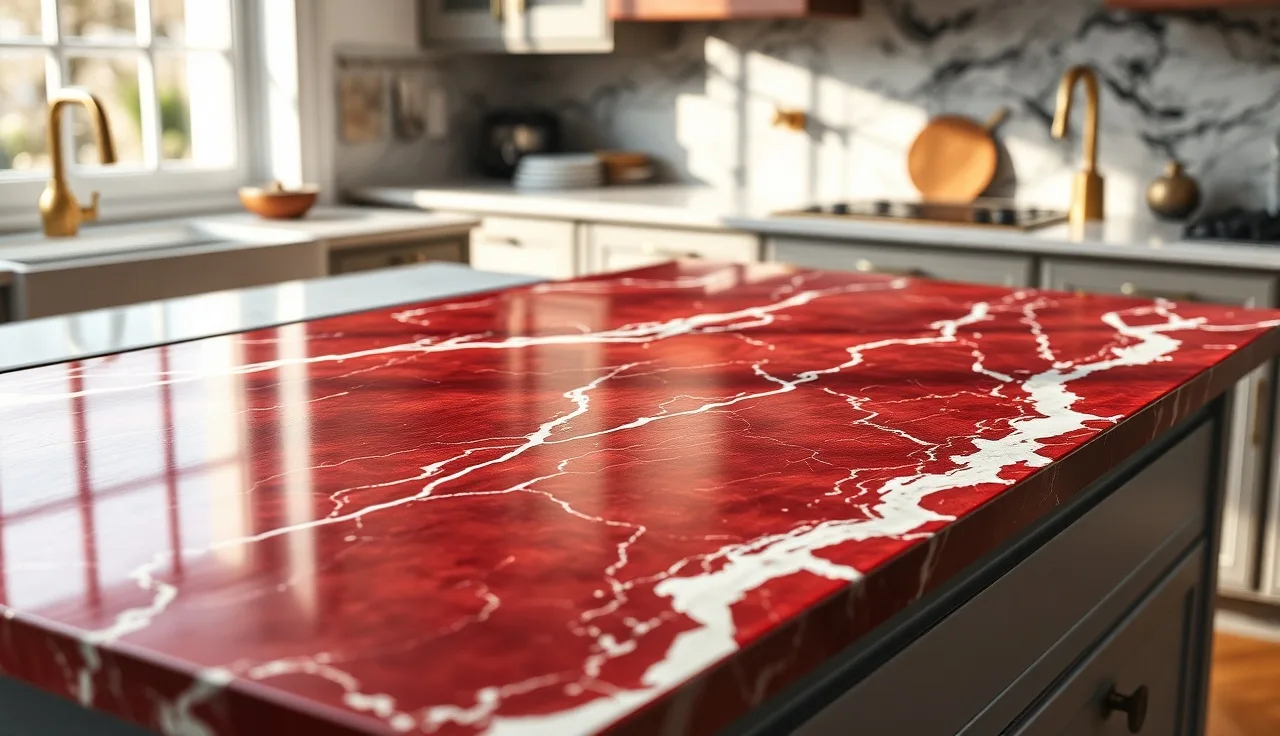
TL;DR
- Red marble countertops run $75 to $250 per square foot installed, depending on variety and region.
- They're softer and more porous than granite, so they etch and stain more easily.
- With good sealing and realistic expectations, they work well in low-acid kitchens, bathrooms, and decorative jobs.
- Rojo Alicante, Red Levanto, and Rosso Verona are the most common options.
What exactly is red marble, and where does it come from?
Marble is metamorphic limestone. Heat and pressure recrystallize the calcite or dolomite, and whatever mineral impurities were present during formation show up as color and veining. Red and pink hues come mainly from iron oxides and hematite locked inside the stone during metamorphosis. The deeper and more uniform the iron content, the richer the red. [1]
The most commercially available red marbles today come from Spain, Italy, Turkey, and Iran. Rojo Alicante from the Alicante province of Spain is the most recognized: a deep, blood-burgundy base with white calcite veins. Red Levanto, also from Spain, runs darker with green and white serpentine veining mixed in, which technically classifies it as a breccia marble. Rosso Verona from Italy is a more muted brick-red with fossil inclusions and irregular cream veining. Rosso Francia is pinker and more delicate. Turkish Rosso Levanto is a close cousin to the Spanish version but tends to run darker and more consistently colored.
Iranian marbles, sometimes sold as Persia Red or Royal Red, can be among the most intensely saturated reds you'll find. They're less common in North American fabrication yards simply because import logistics add cost and lead time. [9]
None of these stones are uniform. Two slabs cut from the same block can look remarkably different. View the actual slab you're buying, not a sample tile.
How much does a red marble countertop cost?
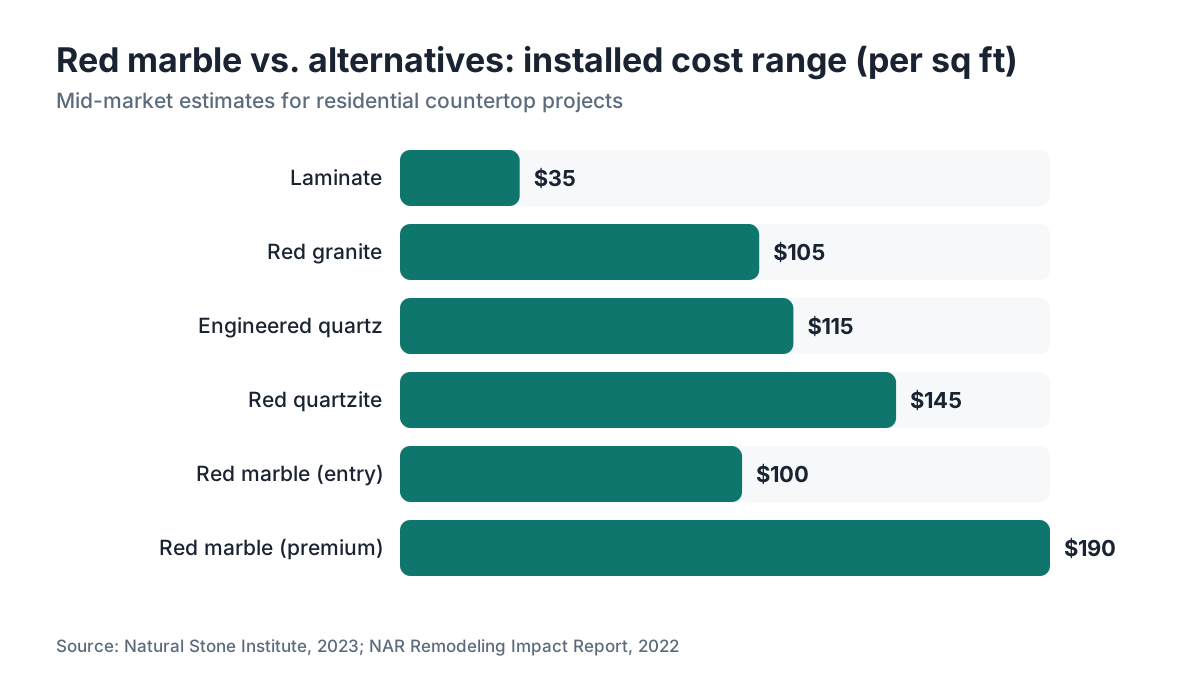
Material and installation together run $75 to $250 per square foot for most residential projects. That range is wide because red marble spans several tiers.
| Marble variety | Typical material cost (per sq ft) | Installed estimate (per sq ft) |
|---|---|---|
| Rosso Verona | $35, $65 | $75, $120 |
| Rojo Alicante | $45, $80 | $90, $140 |
| Red Levanto | $50, $90 | $100, $150 |
| Rosso Francia | $55, $100 | $110, $160 |
| Persian Red / Royal Red | $70, $140 | $130, $250 |
Those material figures are slab-yard prices for 3/4-inch (2 cm) or 1-1/4-inch (3 cm) slabs. Fabrication, edging, and installation layer on top. A standard eased edge is usually included. Ogee, waterfall, or mitered edges add $15, $40 per linear foot depending on the shop. [2]
For a typical 30-square-foot kitchen perimeter, figure $2,250 to $7,500 all-in. A bathroom vanity at 10 square feet might run $750 to $2,500. These are honest mid-market estimates. Boutique fabricators in high-cost metros charge more, and a wholesale slab yard in a lower-cost market charges less.
Lead time matters too. Red marble is not always stocked domestically. If your fabricator has to order a specific slab from an importer, add four to twelve weeks. Get that in writing before you lock a renovation timeline.
Commercial jobs with multiple slabs of red marble are a matching problem. Slab lots from the same quarry block vary, and lining up veining across a long run takes real skill and adds waste. Expect to pay for extra material, sometimes 15 to 20% overage, to handle matching and cutouts.
Is red marble durable enough for a kitchen countertop?
Here's the honest answer: marble is not the toughest countertop material, and red marble is no exception. The Mohs hardness of marble sits around 3 to 4. Granite runs 6 to 7. Quartzite, which people sometimes confuse with marble, runs about 7. That gap shows up in daily use. [3]
The bigger practical issue is acid sensitivity. Marble is mostly calcite, and calcite reacts with acids through a process called etching. When lemon juice, vinegar, tomato sauce, or wine sits on marble, it dissolves the surface slightly. The result is a dull spot that's different from a stain. You can't wipe it off, and a sealer won't stop it. The red background of a stone like Rojo Alicante makes etch marks read differently than on white marble, sometimes more visibly, sometimes less, depending on lighting and finish.
That said, marble kitchens have existed for centuries. Pastry chefs love marble for the exact reason it etches: the calcite keeps the surface cool, which is ideal for dough. Plenty of homeowners live with etches as patina. Others find them maddening. Be honest with yourself about which camp you're in before you spend $3,000 on a kitchen counter.
For a bathroom vanity or a fireplace surround, durability worries mostly disappear. Toothpaste and hand soap aren't meaningfully acidic, and a bathroom counter takes a fraction of the abuse a kitchen counter does. Red marble in a bathroom is genuinely low-drama.
If you want the look of red marble with more resistance, see the section below on alternatives. And if you're comparing marble countertops broadly to other stone options, the trade-offs apply across the category.
Does red marble stain, and how do you seal it?
Yes, marble stains. It's porous, and the pores wick up oils, coffee, wine, and dark liquids. Red marble has an edge here: the dark base hides certain stains better than white marble does. An olive oil stain on Rojo Alicante may barely show. The same stain on Carrara would be obvious. Don't count on color as your only protection.
Sealing is the right move. A penetrating impregnator sealer soaks into the pores and slows liquid absorption without changing the look of the surface. The Natural Stone Institute recommends sealing kitchen natural stone surfaces annually and lower-traffic areas every two to three years, though the right interval depends on your specific stone's porosity. [4]
Test porosity with the water droplet method: put a few drops of water on the surface and time how long it takes to darken. Under four minutes means seal now. Over ten minutes and you have some room. Most unsealed marble darkens in under two minutes. [10]
For product selection, look for a fluorocarbon-based or silane/siloxane impregnating sealer rated for natural stone. Brands like Tenax, Miracle Sealants, and StoneTech are common in the trade. Follow the directions exactly: apply thin, buff off before it dries, and let it cure before the surface gets wet. Two thin coats beat one thick one. [8]
Sealing does not prevent etching. That's the point homeowners miss most. Sealer addresses staining from liquids soaking in. Etching is a chemical surface reaction that happens on contact. The only ways to reduce etching are to keep acids off the stone or choose a honed finish, which hides etch marks better than polish because the surface is already matte.
For daily care across stone types, the guide on how to clean stone countertops covers the full routine.
What finishes are available for red marble, and which one is right for you?
Red marble comes in four common finishes, and the choice has real consequences.
Polished is the classic mirror surface. It intensifies the color saturation and makes the veining pop. Rojo Alicante polished looks far richer than the same stone honed. The downside: every etch mark shows because it contrasts against the gloss.
Honed is a matte or satin surface ground flat without the final polishing step. It makes etch marks far less visible because there's no shine to disrupt. Many fabricators recommend honed for kitchen marble for exactly this reason. The trade-off is that polished is easier to clean, since the microscopic surface valleys are closed. Honed holds onto oils a bit more.
Leathered (also called brushed) uses diamond-tipped brushes to create a soft texture with slight undulation. It hides etches and fingerprints well. It's a popular choice for dark stones, and red marble in a leathered finish looks genuinely distinctive. Expect a small upcharge, usually $5, $15 per square foot, for the extra processing.
Brushed is similar to leathered but typically less pronounced. The two terms get used interchangeably in the trade, so ask your fabricator to show you samples.
For bathrooms, polished red marble is generally safe because acid exposure is low. For kitchens, honed or leathered gives you a much more forgiving surface. For a fireplace surround or decorative island, polished is stunning and low-risk.
How does red marble compare to other red or bold countertop options?
If the look appeals to you but the maintenance doesn't, here are the real alternatives.
Red quartzite exists, though true red quartzite is rarer than red marble. Quartzite is a metamorphic sandstone, not calcite-based, so it doesn't etch. Hardness runs about 7 on the Mohs scale. The catch is that a lot of stone sold as quartzite in yards is actually a soft marble or dolomitic marble, and it behaves like marble. Ask your supplier for an acid test on the actual slab: put a few drops of muriatic acid diluted to 10% on a corner. If it fizzes, it has significant calcite content and will etch. If it doesn't react, you likely have true quartzite.
Red granite exists too, most notably Multicolor Red from India and Baltic Brown from Finland, though these lean brown-red rather than true red. Granite is harder and non-reactive with household acids. See the granite countertops overview for a broader comparison.
Engineered stone (quartz) in red tones is available from several manufacturers. Cambria, Silestone, and Caesarstone all produce bold-colored options periodically. They're non-porous, don't etch, and don't need sealing. The Cambria countertops guide covers that brand's lineup. The visual difference is real: engineered quartz lacks the natural variation and depth of real marble veining, and most people can tell up close.
For budget applications, laminate countertops and Formica countertops offer red and bold-pattern options at a fraction of the cost, and modern high-pressure laminate is genuinely impressive at mimicking stone from a few feet away.
A Corian countertops solid surface in a red tone is another option where a continuous surface matters, like a bathroom vanity with an integrated sink.
| Material | Etch resistance | Stain resistance | Hardness (Mohs) | Price range (installed, /sq ft) |
|---|---|---|---|---|
| Red marble | Low | Medium (sealed) | 3 to 4 | $75, $250 |
| Red quartzite (true) | High | High | 7 | $90, $200 |
| Red granite | High | High | 6 to 7 | $60, $150 |
| Quartz (engineered) | High | Very high | ~7 | $80, $150 |
| Laminate | N/A | High | N/A | $20, $50 |
What should you look for when shopping for a red marble slab?
Go to the slab yard in person. Photos are almost useless for picking stone with this much variation. Bring a sample of your cabinet door or flooring if you can.
Ask the yard to stand the slab upright under daylight-equivalent lighting. Overhead warehouse fluorescents flatten the veining and shift the color from what you'll see at home. A slab that looks dramatic under natural light can look flat under cool fluorescents, and the reverse happens too.
Check for fissures, more than cracks. Fissures are natural linear features that look like cracks but are part of the formation. A fabricator can work around most of them, but a fissure running through the area where a sink cutout will go is a structural concern. Point them out and ask your fabricator to evaluate.
Confirm the slab thickness. Most kitchen countertops today use 3 cm (roughly 1-1/4 inch) slabs. Thinner 2 cm slabs cost less but need a substrate for most countertop applications. A 3 cm slab on a laminated edge looks thicker and more substantial.
Ask about the lot. If you need more than one slab, will they come from the same quarry block? Even within one quarry, different blocks look dramatically different. Matching across lots is a real challenge with highly figured red marbles.
Fabricators running kitchen countertops projects on tight timelines sometimes use quoting software to flag material waste and matching requirements early. SlabWise, for example, lets fabricators nest complex slab layouts before committing to material quantities, which helps most with expensive stone where waste turns straight into cost overruns. If your fabricator is quoting your job, ask whether their yield estimate accounts for matching veining across seams. [7]
How do seams work in red marble, and can they be hidden?
Seams are unavoidable on most kitchen countertops. Marble slabs have a maximum usable size, typically around 60 by 110 inches for most commercial slabs, and most kitchens need more linear feet than a single slab provides.
On white marble, a good fabricator can match veining across a seam so closely you have to know where to look. On red marble, the job is harder in some ways and easier in others. The deep color makes the seam line itself less visible. But the veining in stones like Red Levanto is chaotic and irregular, which makes a book-matched (mirror-image) seam nearly impossible to pull off organically. Most fabricators instead align the general color flow rather than the specific veining.
Epoxy color matching matters here. Fabricators fill seams with colored epoxy, and matching a deep red base is more demanding than matching a neutral gray. Ask to see seam work on red or dark stone at your fabricator's shop, more than portfolio photos of white marble.
For a fireplace surround or a single-run kitchen counter under eight feet, you may get away with a single slab and no seams at all. Worth planning for.
How do you clean and maintain a red marble countertop day to day?
The daily routine is simpler than most people expect.
Wipe spills right away. Acids etch on contact, but the etching is surface-level and takes a few minutes to become significant. Blot, don't wipe, so you don't spread the liquid.
Clean with pH-neutral soap and water or a stone-specific cleaner. Windex, Lysol, bleach, and vinegar-based cleaners all harm marble. So does anything labeled antibacterial that contains quaternary ammonium compounds, which are mildly acidic. [4]
For a stone cleaner, products with a pH between 7 and 8 are safe. Many fabricators sell a house-brand cleaner. The markup is real, but the chemistry is usually right.
Dry the surface after cleaning. Standing water doesn't etch marble, but it can leave water spots (mineral deposits from evaporation) on a polished surface. A quick pass with a microfiber cloth prevents that.
For etch marks that already formed, a marble polishing powder (often sold as Etch Remover or Marble Polish) can abrade the surface back to a consistent finish. That works on polished surfaces. On honed surfaces, a matching-grit abrasive pad is the right tool. For deep or widespread etching, call a stone restoration service with a planetary polisher.
The guide on how to clean quartzite countertops covers overlapping principles for related natural stones.
What design styles work best with red marble countertops?
Red marble is a strong design choice, and it doesn't work in every kitchen. Be honest about that.
It pairs naturally with dark cabinetry, especially deep navy, forest green, charcoal, or black. The contrast is dramatic without being jarring. Lighter cabinetry in cream or white works too, but the red will dominate the room. That's the point, as long as you want a statement.
Metal finishes matter. Brushed brass and unlacquered brass are the most common pairings in design editorial. Polished gold works but can read as too ornate. Matte black hardware reads modern. Polished chrome or nickel can feel cold against warm red stone.
Flooring matters too. Red marble on a countertop reads very differently above warm terracotta or wood floors versus cool gray or white tile. Warm floors reinforce the richness of the stone. Cool floors create tension, which can be interesting or uncomfortable depending on execution.
Bathrooms are arguably where red marble performs best as a design choice. A red marble vanity top with simple white walls is a genuinely beautiful composition. It's lower maintenance than a kitchen, and the contrast with white fixtures is striking without needing a full room redesign to support it.
Fireplace surrounds are another strong application. No acid exposure, no daily wear, and the stone's relationship to heat (metaphorically) makes visual sense. Rosso Verona and Rojo Alicante have appeared in fireplace surrounds in European architecture for centuries.
How is red marble countertop installation different from other stone?
Installation follows the same broad sequence as any stone countertop: template, fabricate, deliver, set. But red marble has specific handling notes worth knowing.
Marble is more brittle than granite and more likely to crack during transport and installation. Slabs should travel vertically (on edge) in an A-frame rack, not flat. A fabricator who hauls slabs flat is taking a real risk with a material this expensive. [7]
Cabinets must be level and adequately supported. Marble does not flex. A high point or unsupported span creates a stress concentration that can crack the slab over time, sometimes months after installation. Experienced installers check cabinet levelness before setting stone and shim as needed.
Cutouts for sinks and cooktops create stress risers. The corners of rectangular sink cutouts are the most vulnerable. Quality fabricators route those corners with a radius rather than a sharp 90-degree cut, which cuts cracking risk significantly. Ask to see this in their portfolio.
For a full walkthrough of the process, the countertop installation guide covers the sequence from template to final set.
Think through the backsplash plan before installation too. If you're planning a marble tile backsplash to coordinate with the countertop, confirm the tile and the slab come from compatible lots so the color reads consistently. This is more of an issue with red than with neutral stones.
Is red marble a good investment for resale value?
Nobody has clean data on this. The closest proxies are appraisal studies and real estate surveys on stone countertops generally, not red marble specifically.
The National Association of Realtors' 2022 Remodeling Impact Report found that kitchen countertop replacement recovers roughly 71% of project cost at resale on average. [5] That figure is for countertops broadly and doesn't break down by material or color.
Red marble is a polarizing choice. Strong, distinctive design decisions attract some buyers and put off others. In markets where design-forward buyers are the norm (dense urban cores, resort areas), a well-executed red marble installation may genuinely draw more interest. In conservative suburban markets where neutral finishes dominate, the same installation can feel like a barrier.
The practical advice: if you're buying red marble mainly as a resale play, reconsider. If you're buying it because you love it and plan to live with it for at least five years, the question gets simpler. The real question is maintenance cost over that period, not theoretical resale.
What hurts resale is neglected stone: deep etching, staining, or cracking that never got repaired. Buyers discount visibly damaged stone heavily, sometimes below the cost of the stone itself. Budget for professional restoration if you plan to sell and the stone has taken abuse.
Frequently asked questions
What is the most popular type of red marble?
Rojo Alicante from Spain is the most widely available and recognized red marble in North American and European markets. It has a deep burgundy-red base with white calcite veining. Red Levanto and Rosso Verona are close seconds in availability. Persian Red and Royal Red from Iran are more saturated but harder to source domestically and often carry longer lead times.
Does red marble turn pink or fade over time?
True metamorphic red marble won't fade from normal indoor use. The iron oxide compounds that create the red color are stable under household conditions. What can change the look is surface etching, which creates matte spots on a polished surface, or mineral deposits from hard water. Prolonged direct UV exposure, like in a sunroom or near a south-facing window, can theoretically shift warm tones slightly over many years, but that's rarely significant indoors.
Can red marble be used outdoors?
Technically yes, but it's a bad idea in most climates. Marble is porous and absorbs water. In freeze-thaw climates, that water expands and contracts, which causes spalling and cracking over time. Even in warm climates, UV and acid rain degrade the surface. Exterior marble generally requires a specific engineered finish and aggressive sealing. Most fabricators will discourage outdoor marble countertops and recommend granite or engineered stone instead.
What edge profile looks best on red marble?
An eased or slightly beveled edge keeps the focus on the stone itself and works in most styles. For a more traditional or formal look, an ogee edge suits red marble's classical heritage well. Avoid fussy multi-step profiles on highly figured stone: the veining is already doing a lot of visual work. A waterfall edge on red marble makes a dramatic statement but requires careful slab selection and book-matching, which adds cost.
How thick should a red marble countertop be?
3 cm (about 1-1/4 inch) is the standard for kitchen countertops and is recommended for red marble specifically because marble is more brittle than granite. The added thickness reduces flexing stress. 2 cm slabs are available and cost less, but they need full substrate support and crack more easily at cutouts. For a bathroom vanity, 2 cm is more acceptable because spans are shorter and loads are lighter.
Is honed or polished red marble better for kitchens?
Honed is the practical choice for kitchens. Etch marks, which are chemically inevitable on marble in a kitchen, show up as dull spots on a polished surface and are much less visible on an already-matte honed surface. Polished red marble is more striking and easier to wipe clean, but the etch visibility frustrates many homeowners. If you're set on polished, plan to use a cutting board and trivets rigorously.
How long does red marble last as a countertop?
Marble countertops in European buildings have lasted hundreds of years. In a residential kitchen with proper care, sealed annually and kept away from acids, a red marble countertop should last the structural life of the house. The more honest question is cosmetic life: polished marble develops a patina of etch marks and minor scratches over years of kitchen use. Whether you call that wear or character depends on your perspective.
Can you repair a cracked red marble countertop?
Minor cracks and chips can be filled with color-matched epoxy by a stone restoration professional. The repair is visible up close on a polished surface but much less so on honed or leathered. A structural crack that runs through a sink cutout or across the full depth of the slab is a more serious problem and may require slab replacement. Preventing cracks starts at installation: level cabinets, properly supported spans, and radiused cutout corners all reduce risk.
Does red marble require a special cleaner?
It needs a pH-neutral cleaner. Anything acidic (vinegar, citrus-based cleaners, many multi-surface sprays) etches the surface on contact. Bleach and ammonia-based cleaners cause surface dulling over time. Warm water with a few drops of dish soap works fine for daily cleaning. For a dedicated product, any stone cleaner labeled pH-neutral and safe for marble works. Dry the surface after cleaning to prevent water spots on polished finishes.
What's the difference between red marble and red quartzite?
The key difference is mineralogy. Marble is metamorphic limestone, primarily calcite, which reacts with acids and etches. Quartzite is metamorphic sandstone, primarily silica quartz, which resists acid and is much harder. True red quartzite won't etch from lemon juice or wine. The problem is that 'quartzite' is widely misused in the stone trade, and many slabs sold as red quartzite are actually calcite-based and behave like marble. Always do an acid spot test on the actual slab.
How much waste should I expect when fabricating red marble?
Plan for 15 to 20% material overage for a typical kitchen project with red marble. Cutouts for sinks and cooktops generate waste, and with highly figured or boldly veined stone, fabricators need extra material to manage seam placement and veining direction. If you're matching veining across multiple countertop sections, overage can push to 25%. This is one reason red marble projects cost more than plain estimates suggest: waste is expensive when you're paying $50, $140 per square foot for the slab.
Are there red marble alternatives that look similar but perform better?
True red quartzite (verify with an acid test) offers similar warmth with better durability. Red granite is harder and acid-resistant but has a grainier visual character without the flowing veining. Engineered quartz in red tones is available and fully acid-resistant, though the look lacks the depth of real stone. For a budget alternative, high-pressure laminate in marble patterns has improved dramatically and costs under $50 per square foot installed.
How do I match red marble countertops to my existing flooring or tile?
Bring physical samples of your flooring and tile to the slab yard. Look at them together under natural light and under the artificial lighting that will actually be in your space. Red marble ranges from warm brick-reds with orange undertones (Rosso Verona) to deep cool burgundy (Rojo Alicante), and the undertone matters enormously for pairing. Warm floors and warm-toned marble reinforce each other. Pairing a cool-toned red marble with warm wood floors can create visual tension that reads as a mismatch.
Sources
- USGS National Minerals Information Center: Red and pink coloration in marble is caused by iron oxide and hematite present during metamorphosis of limestone.
- Natural Stone Institute (formerly Marble Institute of America), Stone Industry Education: Fabrication, edging profiles, and installation pricing for natural stone countertops; edge upgrades typically add $15-$40 per linear foot.
- USGS, Education and general science resources: Marble has a Mohs hardness of approximately 3-4; granite ranges from 6-7; quartzite ranges around 7.
- Natural Stone Institute, Care and Maintenance of Natural Stone: Recommends annual sealing for kitchen natural stone surfaces and warns against acidic or bleach-based cleaners on marble.
- National Association of Realtors, 2022 Remodeling Impact Report: Kitchen countertop replacement recovers roughly 71% of project cost at resale on average.
- Penn State University Extension: Marble is a metamorphic rock formed from limestone under heat and pressure, with calcite as the primary mineral.
- Natural Stone Institute, Standards and Technical Resources: Industry guidance on slab transport (vertical A-frame), cutout corner radii, and cabinet leveling requirements for stone installation.
- University of Minnesota Extension: Penetrating impregnator sealers based on fluorocarbon, silane, or siloxane chemistry are recommended for natural stone; sealer prevents staining but not etching.
- USGS National Minerals Information Center, Dimension Stone: Spain, Italy, Turkey, and Iran are major sources of imported dimension stone including decorative marbles used in countertop fabrication.
- Natural Stone Institute, Standards and Technical Resources: The water drop test is a standard field method for estimating when a stone surface needs resealing; water absorption under four minutes indicates immediate resealing is warranted.
Last updated 2026-07-09