TL;DR
- Quartzite countertops typically cost $70, $200 per square foot installed, while granite runs $40, $150 per square foot installed.
- The gap comes from quartzite's rarity, harder fabrication, and higher slab waste.
- For most kitchens, granite offers better cost-per-performance.
- Quartzite makes sense if you specifically want the look of marble without marble's acid sensitivity.
What does quartzite cost per square foot installed?
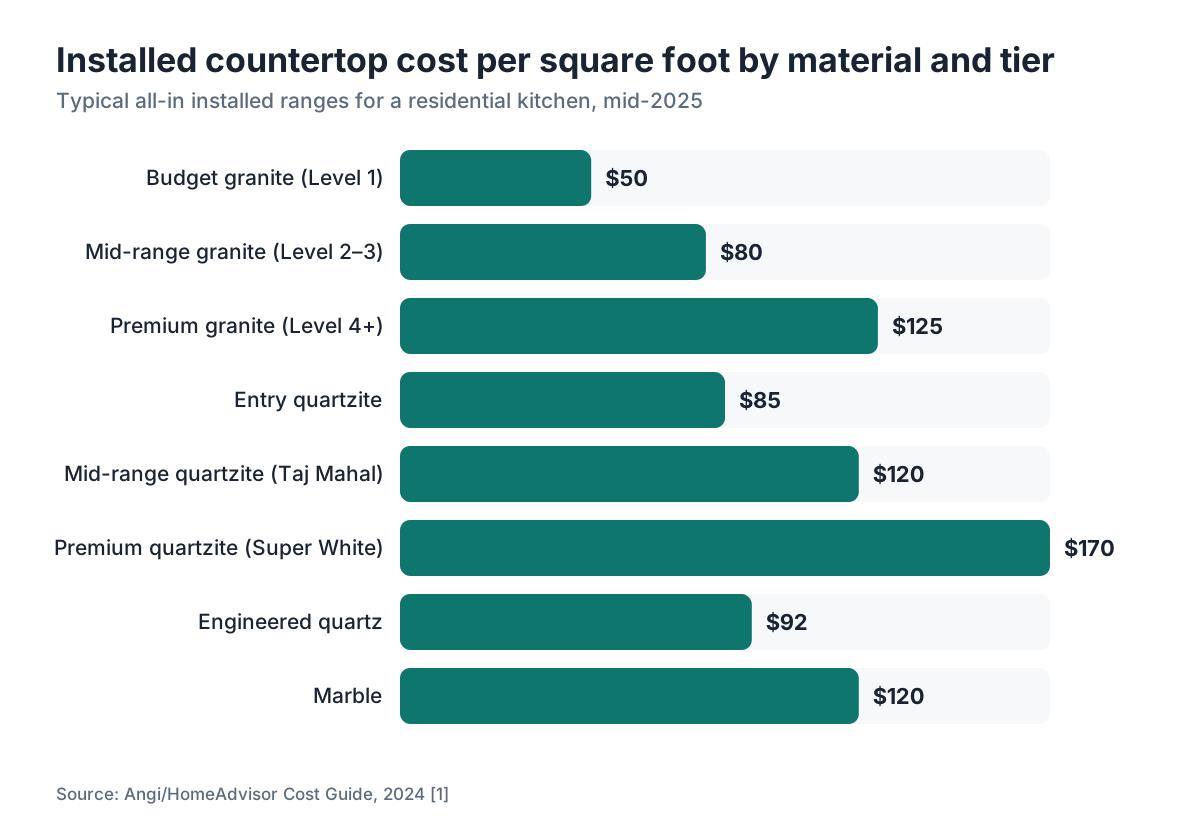
Quartzite countertops typically run $70 to $200 per square foot fully installed, meaning the slab, fabrication, edge work, and basic cutouts are all included in that range [1]. The lower end of that range covers domestic or more common quartzite colors like White Macaubas. The upper end reflects rare imported material like Super White or Taj Mahal quartzite, which have exploded in popularity and price over the last decade.
Raw slab cost alone is usually $50 to $130 per square foot at the distributor level, before a fabricator marks it up to cover their overhead [1]. Fabrication adds another $20 to $60 per square foot depending on edge profiles, the number of cutouts for sinks and cooktops, and how much material the shop wastes cutting around veining patterns homeowners want matched.
One thing that surprises people: quartzite is genuinely hard to cut. It sits at a Mohs hardness of 7, which is harder than most granites [2]. That means faster blade wear, slower cutting speeds, and more fabrication time per job. Shops price for that reality.
What does granite cost per square foot installed?
Granite installed costs roughly $40 to $150 per square foot, with most mid-range kitchens landing between $60 and $100 per square foot all-in [1]. Entry-level granite (think Uba Tuba, Venetian Gold, or St. Cecilia) is genuinely abundant and can be found installed for $40 to $60 per square foot at volume fabricators.
The high end of granite pricing covers rare stones like Blue Bahia, Van Gogh, or Leathered Titanium Black. Those exotic granites can actually overlap with quartzite pricing and sometimes exceed it. So the comparison is not always quartzite-expensive versus granite-cheap; it depends heavily on what specific stone you pick.
If you are looking for the best cost-effective granite countertops, the sweet spot is typically Level 1 or Level 2 domestic granite. These are consistently available, easy for fabricators to cut, and hold their appearance for decades with annual sealing. You get a natural stone countertop in the $50 to $75 per square foot installed range without any real compromise on durability.
See our granite countertops guide for a full breakdown of granite pricing tiers, color families, and what to watch for when buying slabs.
How do quartzite and granite prices compare side by side?
The table below shows a realistic cost comparison across common scenarios for a 50-square-foot kitchen countertop project. These numbers reflect mid-2025 national averages and are meant as planning anchors, not quotes.
| Scenario | Material | Slab cost/sq ft | Installed cost/sq ft | 50 sq ft total (est.) |
|---|---|---|---|---|
| Budget granite (Level 1) | Uba Tuba granite | $10, $20 | $40, $60 | $2,000, $3,000 |
| Mid-range granite (Level 2 to 3) | Bianco Romano granite | $25, $45 | $65, $95 | $3,250, $4,750 |
| Premium granite (Level 4+) | Blue Bahia granite | $60, $100 | $100, $150 | $5,000, $7,500 |
| Entry quartzite | White Macaubas quartzite | $50, $70 | $70, $100 | $3,500, $5,000 |
| Mid-range quartzite | Taj Mahal quartzite | $70, $100 | $100, $140 | $5,000, $7,000 |
| Premium quartzite | Super White quartzite | $100, $130 | $140, $200 | $7,000, $10,000 |
For a median American kitchen (roughly 50 square feet of countertop), quartzite adds roughly $1,500 to $4,000 over a comparable mid-grade granite installation [1]. That gap is real money and worth thinking through honestly.
For fabricators tracking these margins: the higher material cost in quartzite does not automatically mean higher profit margin. Blade costs, slower throughput, and higher breakage risk on thin slabs all eat into margin unless your shop prices quartzite jobs at a premium labor rate.
Why is quartzite more expensive than granite?
Three things drive quartzite's premium over granite.
First, supply. Granite is one of the most abundant rocks in the Earth's continental crust [3]. Quartzite is less common, most of the attractive material comes from Brazil, India, or Norway, and the logistics of getting it to U.S. distributors adds cost at every step.
Second, hardness. The USGS describes quartzite as a metamorphic rock composed almost entirely of quartz grains, which gives it that Mohs 7 hardness [2]. Granite is typically a 6 to 6.5 on the Mohs scale. That one-point hardness difference means quartzite dulls diamond blades faster, slows CNC cutting time, and occasionally chips along natural cleavage planes during fabrication. Shops that don't price for this lose money on quartzite jobs.
Third, waste. Quartzite often has dramatic directional veining. Homeowners want those veins matched at seams, which means the fabricator has to orient slabs in a specific way, often leaving large unusable offcuts. On a typical quartzite project, usable yield can drop to 65 to 75 percent of the slab purchased, compared to 80 to 90 percent for a more uniform granite. That waste is priced into the job.
Quartzite also tends to be more sensitive to improper handling during templating and installation. Thin sections near sinks or cooktops can crack under stress if not supported correctly. That's a liability fabricators price for, consciously or not.
Is quartzite harder and more durable than granite?
Quartzite is harder than most granite by Mohs scale measurement, sitting at 7 versus granite's typical 6 to 6.5 [2]. In practical terms, quartzite resists scratching from everyday kitchen use at least as well as granite does, and usually better.
Both stones are heat resistant enough to handle brief contact with hot pans, but fabricators and the stone industry generally recommend trivets for both materials because thermal shock from an extremely hot cast iron skillet can theoretically cause micro-fractures in any natural stone.
Where granite has a real advantage: porosity and sealing. Most granite is denser and less porous than quartzite, especially softer or more calcite-rich quartzite varieties. Some quartzite sold as "quartzite" is actually quartzitic sandstone or a marble-hybrid, and those stones etch with acids and absorb stains quickly [4]. This misrepresentation is common enough that the Marble Institute of America has published guidance on testing stones before purchase [4]. The practical lesson: always test an actual sample with a drop of lemon juice before you buy. True quartzite will not etch. If it hazes, you have something else.
For day-to-day durability, a well-sealed granite and a well-sealed quartzite perform similarly. Neither is impervious to staining without maintenance. See our guide on how to clean quartzite countertops for the sealing schedule and cleaning routine that preserves both stones.
Which stone holds its resale value better?
Honest answer: nobody has strong data on this specifically for countertop material choices. The closest relevant research is a 2021 study by the National Association of Realtors and the National Association of the Remodeling Industry, which found that a minor kitchen remodel (which includes countertops) recovers about 52 to 72 percent of its cost at resale on average [5]. That figure does not break down stone by stone.
What real estate agents generally report anecdotally is that natural stone countertops as a category sell better than laminate or tile in most markets. Between granite and quartzite specifically, buyers in high-end markets are increasingly familiar with quartzite as a premium option, so it may carry a slight listing advantage. In median-price markets, most buyers still see granite as the premium choice, so paying extra for quartzite may not yield any additional return at sale.
If resale ROI is your primary driver, best cost-effective granite countertops in a neutral color (think white or gray tones) historically photograph well and appeal to the widest buyer pool. If you are staying in the house for 10-plus years and you love the material, buy what makes you happy and stop optimizing for resale.
When does it make financial sense to choose quartzite over granite?
Quartzite makes financial sense in a few specific situations.
You want marble's aesthetic without marble's maintenance. White quartzite like Taj Mahal or Calacatta Macaubas looks strikingly similar to Calacatta marble, but it will not etch from lemon juice or coffee spills the way marble does. If you've priced true marble and discovered it needs quarterly sealing plus careful acid management, some quartzite at a similar price point is genuinely a better long-term investment [4].
You're doing a high-end kitchen where quartzite is the design anchor. If the rest of the kitchen has $60,000 of custom cabinetry and appliances, putting in budget granite to save $2,000 can actually hurt the visual coherence of the space. In that context, quartzite's material cost is a rounding error on the total project.
You found a slab at a good price. Slab pricing at the yard level varies more than most people realize. Distributors regularly run promotions on overstocked material, and a Taj Mahal quartzite on sale can overlap with a mid-grade exotic granite at full price. If you are flexible on exact color, shopping slab yards in person (or with your fabricator) can surface real value.
Quartzite is not the right call when your primary goal is keeping total project cost down, when you have a large countertop footprint with many seams, or when you want something that needs almost no maintenance. For budget-focused projects, compare granite against other natural stone alternatives, or look at laminate countertops and formica countertops if cost is the deciding factor.
How do fabrication and installation costs differ between the two stones?
Fabrication cost is where the quartzite premium really accumulates. Most fabrication shops charge a material-agnostic labor rate by the linear or square foot, but experienced shops separate their quartzite pricing because the job takes longer and wears through more tooling.
Edge profiles cost roughly the same per linear foot for both materials, but complex profiles (ogee, waterfall edges) take more passes on quartzite and risk chipping near the edge. Expect a 10 to 20 percent upcharge on edge work for quartzite compared to a standard granite job [1].
Sink cutouts are where breakage risk is highest. A porcelain undermount sink cutout in quartzite requires slower saw speeds and often additional support during the cut to prevent stress fractures. Some fabricators add $50 to $100 per cutout on quartzite versus their granite base price.
Installation itself (the actual setting of slabs on cabinets, seaming, and caulking) costs about the same for both materials. The weight difference is negligible for most residential countertop thicknesses. A 3/4-inch (2cm) or 1-1/4-inch (3cm) slab of either material requires two to four installers depending on slab size.
Fabricators using quoting software that accounts for material-level labor modifiers will price these jobs more accurately than shops using a flat square-foot rate. If you run a shop and your quartzite jobs consistently underperform margin-wise, the likely culprit is labor time that isn't captured in your quote template. SlabWise's quoting module lets you set per-material labor multipliers so quartzite jobs price themselves correctly without manual adjustment every time.
For a broader look at what drives your total project cost, the countertop installation guide covers labor rates, what to expect from templating day, and how seam placement decisions affect both aesthetics and price.
Are there cheaper alternatives worth considering instead?
If the price of both quartzite and granite feels steep, a few alternatives are worth honest consideration.
Engineered quartz (brands like Cambria, Silestone, or Caesarstone) runs $55 to $130 per square foot installed and offers consistent color, very low porosity, and no sealing requirement [6]. The tradeoff is that it is not natural stone, it can yellow slightly with prolonged UV exposure near windows, and it does not have the same one-of-a-kind look as a natural slab. See the cambria countertops guide for a detailed cost breakdown.
Marble countertops can actually overlap with quartzite in price, ranging from $60 to $180 per square foot installed, but require more maintenance because marble etches with acids [7]. For people who genuinely love the marble look and are willing to maintain it, marble is worth considering alongside quartzite.
Butcher block countertops cost $35 to $100 per square foot installed and work well in kitchens where a warm, natural feel matters more than stone. They require annual oiling but are easy to repair and refinish.
Corian countertops and other solid surfaces run $45 to $90 per square foot installed, install with joints sanded smooth so seams disappear, and are easy to repair, but they scratch more easily than any natural stone.
For kitchen renovation budget planning, the kitchen countertops guide covers all major material categories with installed cost ranges side by side.
How do you get an accurate quote for either material?
Getting a genuinely useful quote requires a few things that homeowners routinely skip.
Measure your actual countertop square footage before calling anyone. Length times width for each section, add them up, and add 10 percent for waste. Most fabricators quote from a template (a precise digital or physical measure of your cabinets), but having your own number prevents sticker shock and lets you sanity-check a quote that seems too high or too low.
Ask for the price to be broken into material cost per square foot and fabrication/installation cost separately. This makes it easy to compare two quotes that use the same stone grade but have different labor rates. A quote that bundles everything into one per-square-foot number hides useful information.
Get at least three quotes. Fabricator pricing for the same stone in the same city can vary by 30 to 50 percent [1]. That variation is real and it's not always correlated with quality. Some high-volume shops offer excellent work at lower prices; some small custom shops charge a premium for the same output. Visit the shop if you can, look at samples of their seam work and edge profiles.
For homeowners who want a baseline before calling any fabricator, SlabWise's instant quote tool at slabwise.com gives a ballpark based on your dimensions and material choice, so you know roughly what range to expect before a shop visit.
Always ask what's included: edge profile, sink cutout, cooktop cutout, removal and haul-away of existing countertops, and any permits. The quote that looks cheapest often excludes one of these items.
What should fabricators know about pricing quartzite jobs profitably?
Quartzite jobs fail on margin for one primary reason: shops use their granite labor rate and forget to account for the extra time, blade costs, and higher breakage risk.
Blades wear two to three times faster on quartzite than on standard granite. A diamond blade that cuts 150 square feet of granite may only get 60 to 80 square feet out of quartzite before it needs replacing [2]. If your shop buys blades at $150 to $300 each, that's a meaningful consumable cost per job.
Programmed CNC paths that work fine on granite may need slower feed rates on quartzite to prevent chipping at the edge. That means less throughput per shift. If your shop runs one CNC machine, a quartzite-heavy week can meaningfully reduce the number of jobs you complete.
Breakage risk during install is also higher than granite, particularly on narrow sections near sinks. Pricing a breakage reserve into quartzite quotes (even just 3 to 5 percent of total material cost) makes sense if your shop sees two or three breakage incidents per year.
Fabricators tracking job-level profitability will notice that quartzite's gross margin tends to run 5 to 15 percentage points lower than comparable granite jobs unless labor is explicitly priced up. The fix is a per-material modifier in your quoting template, not guessing job by job.
Frequently asked questions
Is quartzite always more expensive than granite?
No. Exotic granites like Blue Bahia or Van Gogh can cost $100 to $150 per square foot installed, which overlaps with or exceeds mid-range quartzite pricing. The price comparison depends on the specific stone tier you are choosing. Entry-level granite is consistently cheaper than entry-level quartzite, but the premium ends of both materials cross over significantly.
What is the average cost of quartzite countertops for a 30-square-foot kitchen?
A 30-square-foot quartzite countertop project typically costs $2,100 to $6,000 installed, depending on the specific quartzite variety. Entry options like White Macaubas run closer to $70 to $100 per square foot all-in, while premium quartzite like Super White or Taj Mahal runs $140 to $200 per square foot. Always get at least three quotes from local fabricators, since regional labor rates vary significantly.
Why does quartzite cost more than granite to fabricate?
Quartzite's Mohs hardness of 7 (versus granite's 6 to 6.5) dulls diamond blades faster, requires slower CNC cutting speeds, and increases breakage risk around sink cutouts. Dramatic veining also means higher slab waste when matching patterns at seams. These factors add roughly 10 to 20 percent to fabrication cost compared to a comparable granite job.
Is quartzite better than granite for kitchen countertops?
Neither is strictly better. Quartzite is harder and scratch-resistant, and true quartzite does not etch from acids. Granite is generally less porous and more forgiving during fabrication. For most kitchens, a well-sealed granite at a lower price point performs nearly as well as quartzite. Quartzite earns its premium mainly if you want marble aesthetics without marble's acid sensitivity.
Does quartzite require more sealing than granite?
It depends on the specific stone. Some quartzite is actually more porous than granite and absorbs liquids more readily, particularly stones that are partly calcite-based or misidentified as quartzite. True dense quartzite may need sealing once a year, similar to most granites. Test any slab with a water drop: if it absorbs in under 5 minutes, plan for annual sealing regardless of what it's called.
What is the cheapest natural stone countertop option?
Entry-level granite is consistently the cheapest natural stone countertop, with common colors like Uba Tuba, Venetian Gold, or Santa Cecilia available installed for $40 to $60 per square foot from high-volume fabricators. Slate and soapstone are also affordable in some regions, running $55 to $100 per square foot installed, though they are less widely stocked.
How can I tell if a stone sold as quartzite is actually quartzite?
The easiest test: place a drop of lemon juice or vinegar on the surface for 2 to 3 minutes. True quartzite will not etch or haze because it has no calcite content. If the surface dulls or shows a dull ring, the stone contains calcite and is either a marble, quartzitic marble, or quartzitic sandstone. The Marble Institute of America recommends this acid test for identification before purchase.
Is quartzite countertop cost worth it for a bathroom vanity?
For a small bathroom vanity (typically 15 to 25 square feet), the cost premium of quartzite over granite is $300 to $1,500 total depending on material choice. If you love the look, that is a manageable upgrade. For a bathroom that sees light use and no cooking acids, the performance difference between a well-sealed granite and quartzite is minimal, so granite is the better value pick in most bathrooms.
Do quartzite or granite countertops add more resale value?
There's no specific resale data separating granite from quartzite value contribution. The NAR/NARI 2022 Remodeling Impact Report found kitchen remodels recover roughly 52 to 75 percent of cost at resale on average. In high-end markets, quartzite's premium look may help with listing appeal, but in median-price markets, granite is still the recognizable premium stone for most buyers.
What edge profiles are available and do they cost more for quartzite?
Standard edges like eased, beveled, or bullnose typically add $10 to $20 per linear foot. Decorative profiles like ogee or waterfall edges run $20 to $40 per linear foot. Quartzite generally carries a 10 to 20 percent upcharge on edge work compared to granite because the harder material requires more machining time and has higher chipping risk on tight profiles.
How long does quartzite or granite countertop installation take?
Template-to-installation typically takes 5 to 14 business days for either stone at most fabrication shops. Templating takes 1 to 2 hours on-site. Fabrication takes 3 to 10 business days depending on shop load and stone complexity. Installation itself takes 2 to 6 hours for a standard kitchen. Quartzite does not meaningfully add installation time over granite.
Can I get quartzite or granite remnants to save money?
Yes, and it's one of the best ways to cut costs. Fabricators often sell remnant slabs (offcuts from previous jobs) at 20 to 60 percent below full slab price. For bathroom vanities, small kitchen islands, or laundry rooms with countertop footage under 25 square feet, a remnant can cover the whole project. Call local fabricators directly and ask what remnants they have in stock.
What thickness of quartzite slab should I buy, 2cm or 3cm?
Most residential kitchens use 3cm (1.25-inch) slabs because they sit on the cabinet edge without a visible lamination strip and feel more substantial. 2cm slabs cost less per square foot but require a plywood substrate on the cabinet deck and show a thinner profile at the edge. For quartzite specifically, 3cm is recommended because the added thickness reduces breakage risk during fabrication near cutouts.
Sources
- HomeAdvisor (Angi), Granite Countertops Cost Guide: Granite countertops cost $40, $150 per square foot installed; quartzite ranges $70, $200 per square foot installed; fabrication and installation cost ranges for both materials
- U.S. Geological Survey, Mineral Resources Program, Quartz and Quartzite: Quartzite is a metamorphic rock composed almost entirely of quartz grains, giving it a Mohs hardness of 7, harder than granite's typical 6 to 6.5; faster blade wear on quartzite during fabrication
- U.S. Geological Survey, Granite Mineral Resources: Granite is one of the most abundant rocks in the Earth's continental crust, which keeps supply high and raw material costs lower than rarer metamorphic stones
- Marble Institute of America (MIA+BSI), Natural Stone Identification and Testing Guidelines: Some stones sold as quartzite are actually quartzitic sandstone or marble-hybrid materials that etch with acids; MIA recommends an acid-drop test to verify true quartzite before purchase
- National Association of Realtors and National Association of the Remodeling Industry, 2022 Remodeling Impact Report: Minor kitchen remodels recover approximately 52 to 75 percent of their cost at resale on average according to the 2022 NAR/NARI Remodeling Impact Report
- Cambria, Product and Pricing Overview: Engineered quartz countertops including Cambria brand run approximately $55, $130 per square foot installed and require no sealing
- Marble Institute of America (MIA+BSI), Marble Care and Maintenance: Marble countertops cost $60, $180 per square foot installed and etch with acids including lemon juice and vinegar, requiring regular sealing and careful maintenance
- National Kitchen and Bath Association, Kitchen and Bath Market Index 2023: Natural stone countertops (granite and quartzite combined) remain among the top specified countertop materials in kitchen remodels; regional labor rates cause installed price variation of 30 to 50 percent for the same material
- U.S. Bureau of Labor Statistics, Consumer Price Index, Home Improvement and Remodeling: Labor and materials costs for home remodeling have risen substantially since 2020; countertop installation labor rates reflect broader construction labor market increases
- U.S. Geological Survey, Dimension Stone Commodity Summary: Dimension stone imports (including granite and quartzite slabs) are tracked annually by USGS; Brazil and India are primary sources of quartzite slabs used in U.S. countertop market
Last updated 2026-07-09