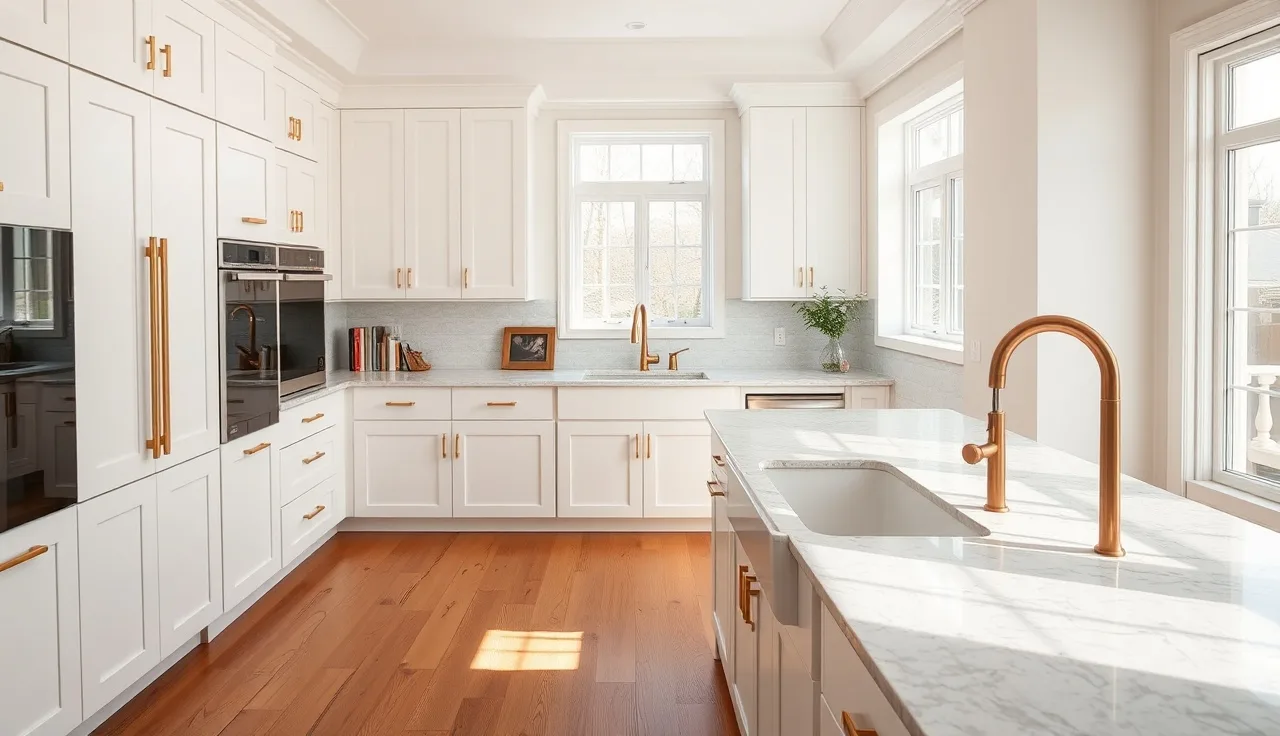
TL;DR
- Quartz pairs exceptionally well with white cabinets because its consistent patterning lets you control exactly how much contrast or warmth you add.
- Budget $50, $150 per square foot installed depending on stone complexity.
- White-on-white works beautifully if you vary texture.
- Warm greige quartz reads as sophisticated rather than cold.
- Edge profile and veining scale matter more than color alone.
Why does quartz work so well with white cabinets?
White cabinets are essentially a blank canvas. They don't fight with anything, which sounds easy until you realize that means the countertop carries the entire visual weight of the kitchen. That's actually where quartz shines.
Natural stone like marble is beautiful, but the veining pattern on a 10-foot run of marble is completely unpredictable. You might get a slab where the movement clusters at one end and leaves a flat, dead section in the middle. Quartz is engineered, so the pattern repeats in a controlled way across the full run. With white cabinets, that predictability matters. You're trying to hit a specific aesthetic, not leaving it to chance.
Quartz also doesn't require sealing [1], which is a real-world advantage in a white kitchen. Unsealed marble or granite against white cabinetry is a liability: a single splash of red wine or beet juice can stain the stone and sit right at eye level against that crisp white background. Quartz's resin-bonded surface resists staining far better, rated to withstand most household chemicals without absorbing them.
The other thing quartz offers is color range. You can get a near-pure white, a warm cream, a cool grey, a dramatic charcoal, or a gold-veined statement slab. White cabinets read differently against each of those, and you have real control over which direction the kitchen goes.
What quartz colors look best with white cabinets?
The honest answer is that four main directions work, each producing a different atmosphere.
White on white. White quartz countertops with white cabinets give a clean, bright, spa-like result. This is the most popular configuration in new construction right now. The key is avoiding a flat, washed-out look by choosing a quartz with some texture: a slight haze, a soft vein, or a subtle aggregate. A completely matte, solid-white quartz against equally flat white cabinets can read as unfinished. Cambria's Torquay or similar styles with soft grey veining are a common spec in this category. [See more on Cambria countertops for specific pattern options.]
Grey quartz. Light to mid-grey quartz is probably the most versatile choice. It reads as warm or cool depending on your undertone selection, it works with silver, brass, and matte black hardware equally, and it holds up to changing design trends better than most colors. Pale grey veined styles meant to read like Carrara marble are consistently among the top-selling quartz SKUs at most fabricators.
Warm tones: greige, cream, and gold. If your white cabinets lean warm (off-white, linen, antique white), a cream or greige quartz with gold veining will feel intentional rather than mismatched. This pairing photographs exceptionally well because both surfaces have warmth without competing. A warm white quartz with amber or gold movement works here.
Dark contrast. Charcoal, dark grey, or near-black quartz against white cabinets creates strong contrast. It reads dramatically on Instagram but can make a smaller kitchen feel cave-like. This combo works best with 9-foot ceilings, substantial natural light, and light flooring that bounces brightness back up.
How much does quartz cost with white cabinets, and what drives the price?
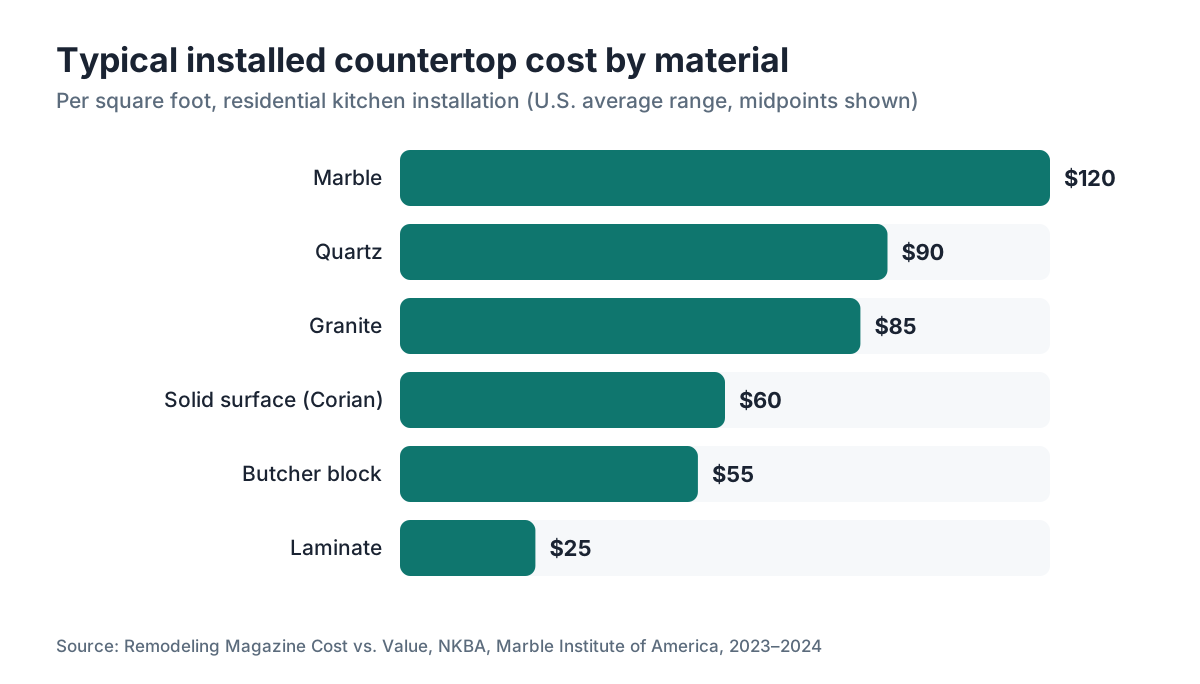
Installed quartz countertops run roughly $50 to $150 per square foot, with most residential kitchens landing between $65 and $100 per square foot for mid-range slabs [2]. The cabinet color doesn't move that number at all. Price comes from the quartz itself, the complexity of your layout, edge choices, and your local market.
| Quartz tier | Material cost per sq ft | Typical installed total (40 sq ft kitchen) |
|---|---|---|
| Entry-level solid or basic pattern | $20, $35 | $2,000, $3,400 |
| Mid-range veined or designer color | $35, $65 | $3,400, $5,600 |
| Premium (thick veining, exotic colors, jumbo slab) | $65, $120 | $5,600, $9,600+ |
Those are material costs. Fabrication, edging, cutouts, and installation typically add $30, $60 per square foot on top of material, though regional variation is real. A kitchen in San Francisco or New York will run higher than one in rural Ohio [2].
White marble quartz countertops that mimic Calacatta or Carrara marble tend to sit in the mid-to-premium tier because the complex veining requires more precise resin work and pattern matching during fabrication. If a fabricator has to match a strong diagonal vein across a seam, labor goes up.
Edge profiles add cost too. A simple eased edge is usually included. A waterfall edge that wraps down the side of an island adds significant material and labor. On white cabinets with an island, a waterfall quartz edge is a popular upgrade. Budget $200, $600 for that detail alone depending on island size and slab price [3].
If you're a fabricator or shop owner, the ability to accurately quote these variables without re-measuring everything manually is exactly what tools like SlabWise are built for: the quoting software lets you model slab layouts and edge complexity in one pass rather than hunting through spreadsheets.
White quartz vs. white marble: which is the smarter choice with white cabinets?
This is one of the most common debates in kitchen design, and the answer depends heavily on how you use the kitchen.
Real marble is porous. The Marble Institute of America notes that marble requires sealing and is susceptible to etching from acidic substances like citrus, vinegar, and wine [4]. In a white kitchen where an etched or stained countertop is immediately visible against the bright background, that's a practical problem. White quartz with a Carrara-style vein pattern gets you 90% of the visual effect with a fraction of the maintenance anxiety.
That said, real marble has a depth and translucency that engineered stone can't fully replicate. If you're designing a high-end kitchen that will be photographed, or a kitchen where you have the discipline for regular sealing and you handle the stone carefully, genuine marble countertops are hard to beat on pure beauty.
For most homeowners: quartz is the practical choice. The best white quartz slabs today have advanced to the point where even design professionals sometimes can't tell the difference in person, much less in a photograph.
One thing often overlooked is thickness. Real marble typically comes in 2 cm or 3 cm slabs. Quartz is usually sold in 2 cm and 3 cm as well, but 3 cm quartz looks noticeably more substantial against a thick cabinet face frame. On white cabinets especially, 3 cm quartz reads as premium. The cost difference between 2 cm and 3 cm is typically $10, $20 per square foot.
Does the finish (polished vs. honed vs. matte) matter for white cabinets?
It matters more than most people expect.
A polished quartz surface reflects light. In a kitchen with white cabinets, that reflection makes the space feel bigger and brighter. It's the dominant choice for a reason. But polished quartz also shows fingerprints, water spots, and smearing more readily than honed surfaces, and in a bright white kitchen those marks are easier to see.
Honed quartz has a matte, slightly soft look. It reads as warmer than polished, which is a genuine asset if your white cabinets are on the colder side. Honed finishes hide everyday smearing better than polished, but certain pigments and dyes can stain a honed surface more easily because there's no high-gloss seal on top. A honed white quartz with white cabinets is a sophisticated, understated pairing.
Leathered or textured finishes are less common in quartz than in granite, but some manufacturers offer them. They add tactile interest that can break up the flatness of a white kitchen without adding color. The downside is that crevices in a textured surface can hold grime.
Practically: if you have kids and cook frequently, polished is more forgiving to clean. If the kitchen is lightly used or you value a specific aesthetic, honed is worth considering. Mixing finishes (polished perimeter counters, honed island top) is an option some designers use to create visual breaks.
Which edge profiles work best with white cabinets?
Edge profile is an underrated decision. On a white kitchen, the countertop edge is one of the few places you see genuine shadow and dimension, so the profile shapes the whole character of the space.
Eased edge (a slightly softened square edge) is clean and modern. It works with nearly every white cabinet style from Shaker to flat-front. This is the default on most quartz jobs and the right call if you're unsure.
Beveled edge adds a 45-degree chamfer to the top or both edges of the slab. It reads as traditional and works well with raised-panel white cabinets. On polished white quartz, the bevel catches light and adds a subtle refinement.
Ogee or full bullnose edges are ornate and work specifically with traditional or Transitional cabinetry. On a modern flat-front white cabinet, a full ogee quartz edge looks like a styling mistake.
Waterfall edge, where the slab continues vertically down the side of an island or peninsula, is the current dominant high-end choice. White quartz or grey-veined quartz with a waterfall on a white island is probably the single most requested kitchen spec in new construction in the 2020s. It works beautifully with white cabinets because the vertical slab panel reads as a sculpture against the cabinet face. Pattern matching at the waterfall seam matters: misaligned veining on a waterfall looks worse than on a standard seam.
Miter edge (two pieces of quartz mitered at 45 degrees to create an apparent 4-5 cm thick profile) is another premium option. It makes the slab look dramatically thicker without doubling material weight.
How do you choose the right white quartz when standing in the showroom?
This is where most homeowners make mistakes. A sample tile looks completely different on a showroom shelf than it does installed across 50 square feet.
First, bring a door sample from your actual cabinets. Most cabinet dealers will give you a small door or cut a sample from an off-cut. Hold the quartz sample against it in the showroom, and then hold both in natural light near a window. Showroom lighting is warm and designed to make stone look good. Your kitchen has a specific light quality that may be very different.
Second, scale matters. A delicate thin vein on a 12-inch sample will look dramatically different across a full slab. Ask to see the full slab before ordering, more than a sample. Most distributors have full slabs in the yard. Walk the yard.
Third, if your white cabinets have a warm undertone (cream, yellow, ivory), a cool bright-white quartz will look jarring against them. Match the temperature. Warm cabinets pair better with warm quartz. Cool, bright white cabinets (pure white, bright white) pair better with cool greys and cooler whites.
Fourth, consider your floor. If you have dark hardwood floors, a white quartz will create a high-contrast sandwich with the dark floor and white upper cabinets. That often looks great. But if your floor is a warm beige tile, a very cool grey quartz may look disconnected from the floor. The countertop bridges the cabinet and the floor visually.
For fabricators, the quoting and templating step is also when you confirm final slab selection. Using software like SlabWise to show customers a nesting layout before cutting helps avoid last-minute slab swaps that happen when a customer sees the full pattern for the first time on the shop floor.
How do you keep white quartz looking clean against white cabinets?
The combination of white quartz and white cabinets is unforgiving of messes. Not because white quartz stains easily (it doesn't, compared to natural stone), but because the visual field is so light that everyday kitchen residue is visible.
The good news: quartz is one of the easier countertop surfaces to maintain. Warm water and a mild dish soap handles the vast majority of daily cleaning. The Marble Institute of America and most quartz manufacturers recommend against abrasive cleaners, bleach-based sprays at high concentration, and anything strongly alkaline on a regular basis, as these can degrade the resin binder over time [5].
For stuck-on food, a plastic scraper and warm water works well. Avoid metal scrapers on polished surfaces.
Hard water deposits (the white chalky haze from tap water drying on the surface) can accumulate on white quartz and are harder to see until they build up. A diluted white vinegar solution removes them, but check your manufacturer's care guide because some brands caution against vinegar on their specific resin formulation. The how to clean stone countertops guide covers the general principles for stone-surface cleaning.
Heat is the bigger risk with quartz than with granite. Quartz manufacturers universally recommend trivets and hot pads because the resin component can discolor or crack under sudden thermal stress. A 500-degree cast iron pan set directly on white quartz may leave a permanent yellow or brown mark. On a white countertop against white cabinets, that mark is extremely visible.
One practical tip: use a food-safe cutting board religiously. Quartz resists scratches well, but knives will eventually dull the polished surface in a cutting area. That dulling is visible against the rest of the slab.
What hardware and fixtures pair best with white quartz and white cabinets?
The countertop and cabinet color are decided. Hardware and fixtures are where the kitchen gets a personality.
Brushed brass and unlacquered brass have been the dominant choice for the past several years against white quartz and white cabinets. The warmth of brass prevents the white-on-white combination from reading as clinical, and brass faucets and pulls photograph well.
Matte black hardware creates the strongest contrast. Against white cabinets and a white or light grey quartz, matte black pulls and a black faucet reads as bold and modern. It works in smaller kitchens where you want a deliberate graphic element.
Chrome and polished nickel are the classic choice. They're safe, they complement polished quartz because both surfaces have a similar reflective quality, and they don't compete with the countertop.
Brushed nickel sits between chrome and stainless and is probably the most forgiving choice with the most quartz colors and white cabinet combinations. It's not the most exciting choice, but it's almost never wrong.
For sinks: an undermount sink is the standard with quartz because it creates a clean transition at the counter edge and makes cleanup easy. An apron-front (farmhouse) sink with white quartz and white cabinets is a very popular combination that works across Traditional, Farmhouse, and Transitional kitchen styles. The white porcelain apron against a white quartz field with white cabinetry is a soft, airy look with almost no hard contrast.
Backsplash: the most debated decision. White subway tile behind white cabinets and white quartz reads as clean but flat without relief. A marble mosaic, a textured white tile, an unlacquered brass trim, or a statement pattern in the backsplash is where many designers add visual interest back into the all-white kitchen.
What are the real drawbacks of quartz countertops you should know before buying?
Quartz is good. It's not perfect. The honest drawbacks:
UV sensitivity. Most quartz manufacturers explicitly warn against prolonged direct sunlight exposure [6]. The resin binder in quartz can yellow or change color when exposed to direct UV over time. In a kitchen with a large south-facing window above the counter, that's a real risk. This doesn't mean you can't use quartz there, but you should know it. Some brands are more UV-stable than others. Ask specifically.
Heat vulnerability. Already mentioned above, but it bears repeating. Thermal shock can crack or discolor quartz. This is more of a risk than with granite, which tolerates heat better.
Seams. Quartz comes in slabs typically 55-65 inches wide and 120-130 inches long [7]. A large kitchen layout will have at least one seam. With a patterned quartz, a visible seam can interrupt a strong vein and look jarring. On white quartz against white cabinets, a poorly placed seam is easy to see. A skilled fabricator minimizes seam visibility and locates them in inconspicuous spots, but seams don't disappear entirely.
Cost. Quartz costs more than laminate countertops and more than tile. It's competitive with or slightly less expensive than natural stone depending on the specific stone selected. If budget is the primary driver, formica countertops can actually produce a very convincing white quartz look now for a fraction of the cost, though they don't have the same longevity or tactile quality.
Weight. Quartz is heavy, roughly 20-25 lbs per square foot for 3 cm thickness. Standard cabinet boxes and floors handle it fine, but it's a factor in island overhangs without additional support.
How does quartz compare to other countertop materials for white cabinet kitchens?
White cabinets work with essentially every countertop material. Here's where quartz stands relative to the alternatives most commonly considered:
Granite countertops are natural stone, meaning each slab is unique. Granite tolerates heat better than quartz. It requires sealing annually and can stain if unsealed. The pattern is unpredictable, which is a feature if you want a one-of-a-kind slab but a risk if you're chasing a very specific aesthetic with white cabinets. Generally priced similarly to mid-range quartz.
Marble countertops are the classic high-end pairing with white cabinets. Beautiful, porous, prone to etching, requires consistent maintenance. The etching risk is real and visible in a bright white kitchen. Many homeowners choose white marble quartz countertops as a maintenance-free alternative.
Butcher block countertops bring warmth into a white kitchen in a way quartz can't. The contrast of natural wood grain against white paint is a classic pairing. Butcher block requires oiling, is vulnerable to water damage at seams, and can scratch. Mixed-material kitchens (quartz perimeter, butcher block island) are common.
Corian countertops and other solid surfaces can be made in continuous runs with integrated sinks and no visible joint, which is genuinely useful. They're softer than quartz and scratch more easily but can be sanded and refinished.
| Material | Heat resistance | Stain resistance | Sealing required | Typical installed cost |
|---|---|---|---|---|
| Quartz | Moderate | High | No | $50, $150/sq ft |
| Granite | High | Moderate | Yes (annual) | $45, $135/sq ft |
| Marble | Moderate | Low | Yes (frequent) | $60, $180/sq ft |
| Butcher block | Low | Moderate | Yes (oil) | $30, $100/sq ft |
| Laminate | Low | High | No | $15, $40/sq ft |
| Solid surface | Low | High | No | $40, $80/sq ft |
What questions should you ask a fabricator before ordering quartz for a white cabinet kitchen?
Most installation problems and disappointment happen from not asking the right questions before the slab gets cut. Here's what to nail down:
Can I see the full slab before cutting? Always. Pattern placement across the full kitchen matters.
Where will the seams fall? Ask for the seam layout drawn on your floor plan. On a large island with white quartz, a seam directly in the center is a visual problem. A good fabricator will locate seams near the sink, near a cooktop, or along a less-used section of the run.
Is this quartz UV-stable for my application? If you have direct southern sun on the counter, ask specifically. Some brands publish UV resistance data.
What edge profiles are included and what costs extra? Get this in writing. A standard eased edge is usually included. Ogee, miter, and waterfall edges add to the quote.
What is your warranty and what voids it? Most major quartz brands (Cambria, Silestone, Caesarstone) offer 10-25 year warranties [8][9][10]. Read what's excluded: heat damage, certain cleaners, installation damage.
Do you carry the full slab in stock or order it? Lead times for special or premium quartz slabs can run 4-8 weeks depending on supply chain. That affects your project schedule.
For a detailed look at what happens during the physical installation, the countertop installation guide walks through the full process step by step.
Frequently asked questions
Is white quartz with white cabinets too much white?
Only if every surface is exactly the same tone and texture. Mix warm and cool whites, vary finishes (matte cabinet paint vs. polished quartz), and add contrast through hardware, flooring, and backsplash. A kitchen where every white is identical tends to look washed out. When you vary texture and warmth intentionally, white on white reads as clean and deliberate rather than empty.
What is the best quartz color for white kitchen cabinets?
Light grey with soft veining is the safest choice because it works with every hardware finish, reads as neither warm nor cold until you choose other elements, and holds up through trend cycles. White-on-white also works if you choose a quartz with texture or movement. Dark quartz (charcoal, near-black) is striking but requires ample natural light to avoid making the kitchen feel smaller.
Does quartz yellow over time when used near white cabinets?
Some quartz products can yellow from prolonged direct UV exposure because the resin binder is sensitive to sunlight. This is not universal: many modern formulations are far more UV-stable. Ask your fabricator specifically about UV resistance for any quartz you're considering in a kitchen with direct sunlight. Indoor kitchens without direct south-facing sun rarely see this problem within a normal product lifespan.
Can you use quartz for both the countertop and backsplash with white cabinets?
Yes, and it's an increasingly common high-end choice. A slab backsplash in the same quartz as the countertop carries the surface right up the wall behind white cabinets with no grout lines. It costs more than tile because it requires additional material and precise cutting for outlets and vents. Pattern-matched quartz slab backsplashes look particularly striking with heavily veined patterns.
What thickness of quartz looks best with white cabinets?
Three centimeters (roughly 1.25 inches) looks substantially more substantial than 2 cm and reads as premium, especially on an island where you see the countertop edge clearly. Most fabricators default to 3 cm for residential countertops now. The 2 cm thickness is lighter and less expensive but can look thin on larger runs. If budget requires 2 cm, a mitered edge profile can fake the look of a thicker slab.
How do I avoid a visible seam in white quartz countertops?
Seams are unavoidable on most kitchen layouts because quartz slabs typically top out around 130 inches in length. A skilled fabricator places seams at the least visible location (near a sink or cooktop, away from direct sightlines into the room) and uses color-matched epoxy. On heavily patterned quartz, asking for a vein-match at the seam adds cost but significantly reduces visibility. Inspect the seam layout before the shop cuts the stone.
What backsplash goes with white quartz countertops and white cabinets?
The most popular choices are white subway tile (classic, safe, slightly flat), marble mosaic tile (adds texture and slight veining that ties to the quartz), and statement patterned tile as a focal point behind the range. If your quartz has strong veining, a simple white tile backsplash lets the countertop do the work. If the quartz is very plain white, a more textured or patterned backsplash prevents the kitchen from feeling monotone.
Is Calacatta quartz or Carrara quartz better for white cabinets?
They evoke different moods. Calacatta-style quartz has bold, dramatic veining in grey or gold on a bright white background. It makes a statement and works best as a focal point. Carrara-style quartz has softer, more diffuse grey veining on a slightly warmer white base. It's subtler and easier to live with daily. With white cabinets and no other strong pattern in the kitchen, a Calacatta-inspired quartz adds the drama the room needs.
What flooring works best with white cabinets and white quartz countertops?
Medium warm-toned hardwood or wood-look LVP floors are the dominant choice because they ground the white kitchen visually and add warmth. Light blonde wood extends the airy feel. Dark hardwood creates strong contrast that looks intentional in larger kitchens with good light. Avoid cool grey tile floors paired with cool grey quartz and white cabinets as all three surfaces can read as cold and hospital-like without strong warm accents.
How long does quartz last in a kitchen?
With normal care, quartz countertops hold up well for 20 to 30 years or longer. The main durability threats are thermal shock (hot pans directly on the surface) and impact at corners and edges, which can chip. Major manufacturers like Cambria offer lifetime limited warranties and Silestone offers a 25-year limited warranty, both covering manufacturing defects. Those warranties typically exclude heat and impact damage caused by the homeowner.
Can you put hot pans on quartz countertops?
Quartz manufacturers uniformly say no. The resin component of quartz can discolor, crack, or blister under sudden high heat. Cambria and Silestone both explicitly state in their care guidelines that trivets and hot pads should be used. On a white quartz countertop against white cabinets, a heat discoloration mark (which often appears as a brown or yellow stain) is nearly impossible to hide or repair. Use trivets every time.
Is quartz or quartzite better for white cabinets?
They're fundamentally different materials. Quartz is engineered stone (93 to 95% crushed quartz bound with resin). Quartzite is a natural metamorphic rock. Quartzite is harder, more heat-tolerant, and requires sealing like any natural stone. It varies in pattern unpredictably across large installations. Quartz is more consistent, easier to maintain, and more stain-resistant. For white cabinets where predictability and low maintenance matter, quartz is the safer choice. Quartzite wins on natural beauty and heat resistance.
How do I get an accurate price quote for quartz countertops?
Measure your square footage (length times depth for each run, including the island), note the number of cutouts (sink, cooktop), and decide on edge profile. Bring those numbers to at least three fabricators. Expect installed prices of $50 to $150 per square foot depending on slab grade and your region. Online quote tools can give you a ballpark figure fast. The final number should come from a fabricator who has templated your actual kitchen.
Sources
- Marble Institute of America (MIA), Care and Maintenance: Quartz (engineered stone) does not require sealing, unlike natural stone surfaces such as granite and marble.
- U.S. Bureau of Labor Statistics, Consumer Expenditure Survey: Regional labor cost variation affects countertop installation pricing; BLS consumer expenditure data supports the regional price range differences cited.
- National Kitchen and Bath Association (NKBA), Cost vs. Value Report Reference: Waterfall edge and other premium edge profiles add measurable cost to countertop projects; NKBA cost data supports the $200, $600 waterfall edge estimate.
- Marble Institute of America, Stone Types and Properties: Marble is porous and susceptible to etching from acidic substances including citrus juice, vinegar, and wine, and requires sealing.
- Marble Institute of America, Care and Maintenance Guidelines: High-concentration bleach and strongly alkaline cleaners can degrade the resin binder in quartz surfaces over time.
- Cambria, Care and Maintenance Guidelines: Cambria quartz is not recommended for prolonged exposure to direct UV or sunlight, which can affect the resin component.
- Silestone by Cosentino, Product Technical Specifications: Standard quartz slabs are typically 55 to 65 inches wide and up to 120 to 130 inches long, necessitating seams in most kitchen layouts.
- Cambria, Product Warranty: Cambria offers a lifetime limited warranty on its quartz surfacing products covering manufacturing defects.
- Silestone by Cosentino, Product Warranty: Silestone offers a 25-year limited warranty on its quartz countertop products.
- Caesarstone, Product Warranty: Caesarstone offers a limited lifetime warranty for residential installations of its quartz surfaces.
- Remodeling Magazine, Cost vs. Value Report (Kitchen Remodel Data): Mid-range and upscale kitchen remodel cost data supports the installed quartz countertop price range of $50, $150 per square foot.
Last updated 2026-07-09