TL;DR
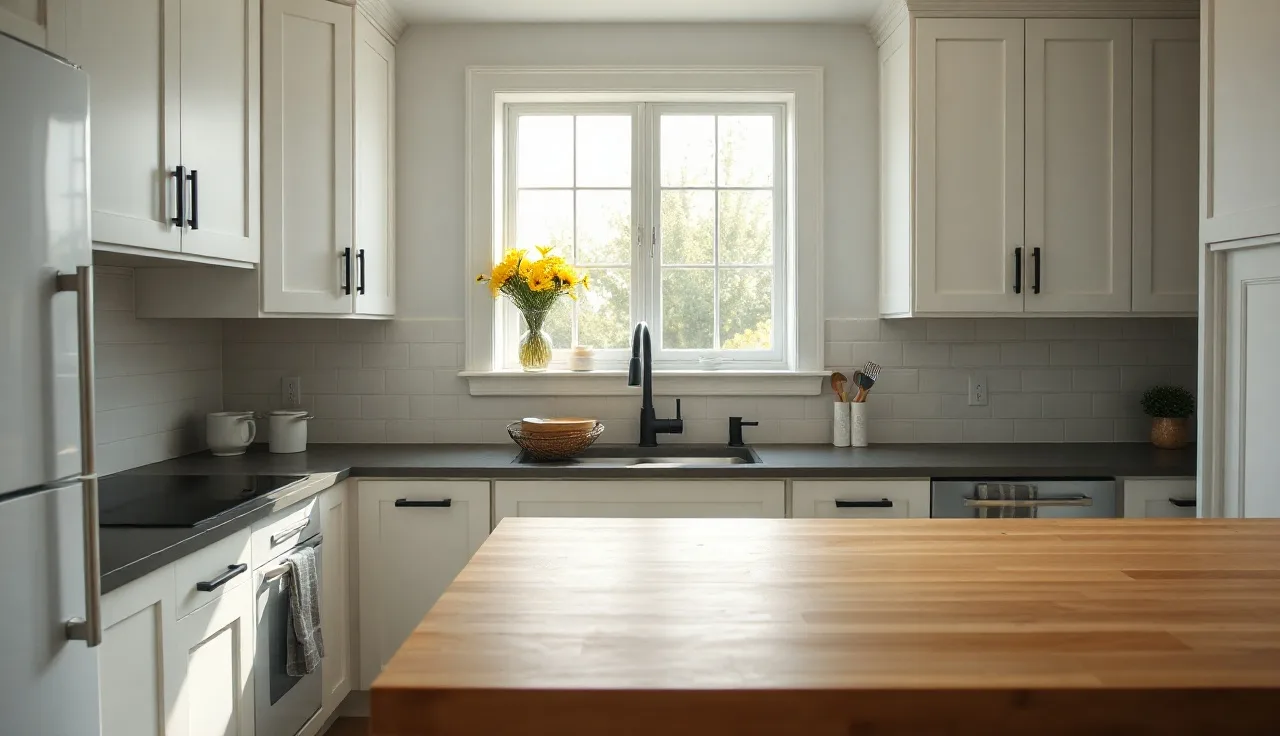
- White cabinets and butcher block countertops work well together because the warm wood grain offsets the cool, crisp cabinet color.
- Maple and hard maple are the most practical species.
- Expect to pay $30, $100 per square foot installed depending on species and thickness.
- Oil finishes need yearly maintenance; polyurethane does not.
- The combo suits most kitchen styles from farmhouse to modern.
Why do white cabinets and butcher block countertops work together?
White cabinets have almost no warmth of their own. The paint or thermofoil surface is clean, which is great for brightness, but it can make a kitchen feel clinical if everything else is equally cool and flat. Butcher block fixes that. Wood grain is warm, textured, and organic, and it does the visual work white cabinets can't do alone.
The contrast is the point. You're not matching the countertop to the cabinets, you're letting two opposite surfaces balance each other. Light-toned maple or birch reads almost like a neutral and keeps things airy. Walnut or acacia goes darker and richer, which adds drama but can feel heavy in a small kitchen. Most designers lean toward medium-toned species, specifically hard maple, for white cabinetry because it's warm without being too yellow.
There's a money angle too. Butcher block is one of the most forgiving countertop materials for DIYers, and it's among the cheapest surfaces per square foot. Pair it with white cabinets, which are themselves a low-cost finish, and the whole kitchen budget stays manageable without looking cheap.
The combo shows up in farmhouse, Shaker, transitional, and even some minimalist modern kitchens. It's not era-specific. That's a big part of why it keeps coming back.
What does butcher block countertop cost, and how does it compare to other surfaces?
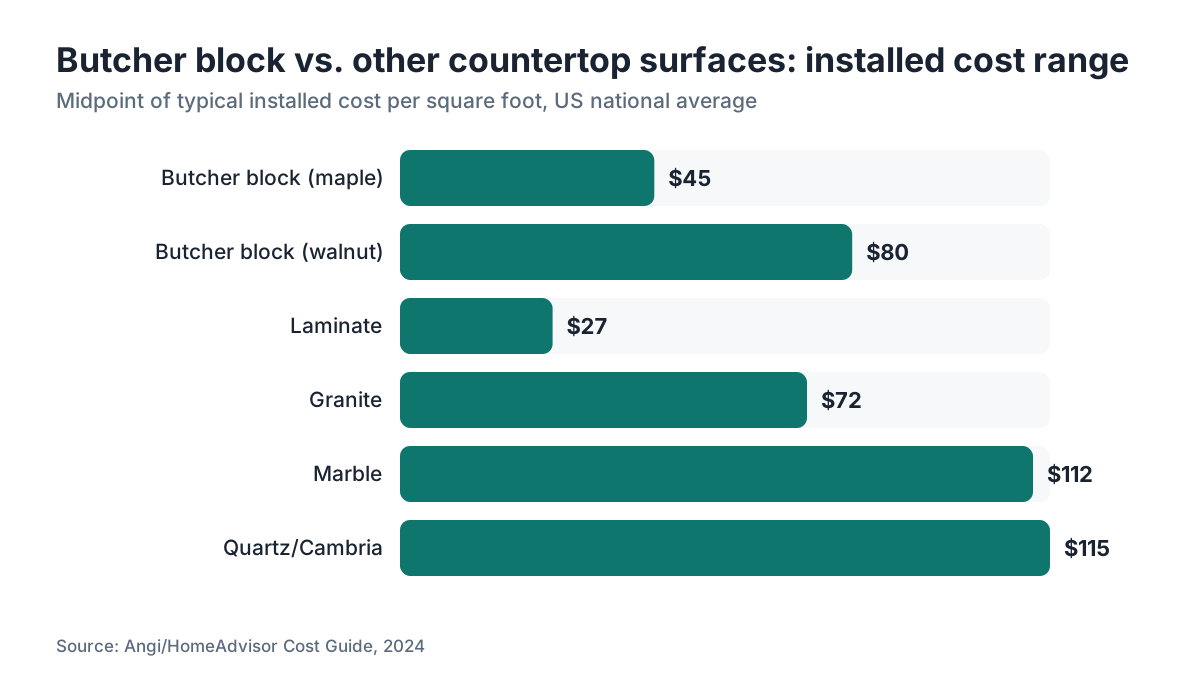
Butcher block is priced by the square foot and varies by species, thickness, and whether you're buying pre-made slabs or custom-fabricated pieces. Here's where things actually land:
| Surface | Typical installed cost (per sq ft) |
|---|---|
| Butcher block (maple, standard 1.5") | $30, $60 |
| Butcher block (walnut, custom) | $60, $100 |
| Laminate countertops | $15, $40 |
| Granite countertops | $45, $100 |
| Marble countertops | $75, $150 |
| Cambria countertops | $80, $150 |
These ranges come from contractor and retailer pricing aggregates. The exact number in your market will swing 20 to 30% depending on labor rates and local competition [1].
Pre-made butcher block panels from home centers (IKEA KARLBY, Lumber Liquidators, Home Depot) run $10, $25 per linear foot unmounted, which is why so many budget kitchens use them. You still pay for installation or do it yourself, add a sink cutout if needed, and apply finish, so the final number climbs. A professional installation with a sink cutout usually adds $150, $400 to the job.
For a typical 30-square-foot countertop run, expect total installed costs of $900, $1,800 with maple butcher block, or $1,800, $3,000 with walnut. That's a real bargain against natural stone for a comparable look.
See our full breakdown at butcher block countertops if you want to go deeper on pricing by species and thickness.
Which wood species works best with white cabinets?
Hard maple is the answer most fabricators and kitchen designers land on. It has a tight grain, it's Janka-rated at 1,450 lbf (hard enough to resist most daily dents), and its color is a creamy warm neutral that plays off white without competing [2]. It takes mineral oil well and doesn't yellow dramatically over time the way some lighter woods do.
Here's how the main species stack up:
Hard maple: Best all-around choice. Tight grain, durable, light warm color. Takes oil or poly finish equally well. Widely available.
Birch: A step down in hardness (1,260 Janka lbf), similar color to maple, but the grain can be slightly more irregular. Often cheaper. Fine for most kitchens.
Beech: Common in European-style kitchens. Janka hardness around 1,300 lbf, fine tight grain, pinkish-tan tone. Works well with pure white but can feel a bit plain.
Walnut: Janka around 1,010 lbf, so softer than maple. Rich chocolate-brown color creates a high-contrast look with white cabinets that reads as upscale. More expensive, especially for wide clear panels.
Acacia: Dramatic grain, varies widely by source, Janka around 1,700 lbf. Can look stunning with white cabinets, or chaotic. Inconsistency from slab to slab is real.
Teak: Expensive, naturally oily, Janka around 1,070 lbf. Used more in marine and outdoor work. Fine in kitchens but harder to source and harder to glue if repairs come up.
For the specific look of white cabinets, maple or birch give you the warm-neutral contrast that works in nearly any lighting. Walnut gives you drama. Acacia is a gamble.
What finish should you put on butcher block over white cabinets?
This is where a lot of homeowners get tripped up, because finish choice affects daily maintenance and how the wood looks over years, more than how it looks on day one.
There are two real categories: penetrating oils and surface sealers.
Penetrating oils (mineral oil, food-safe oils, hardwax oils): These soak into the wood fiber rather than sitting on top. They give the countertop a matte, natural look, and if you scratch or dent the surface, the damage is easy to sand out and re-oil. The catch: you re-oil roughly every 3 to 12 months depending on use, and you can't treat the surface as an actual cutting board near a sink without accepting that water will eventually swell and crack the seams if maintenance lapses. Pure mineral oil is food-safe, cheap (about $10 a quart at any pharmacy), and widely recommended. Food-safe hardwax oils like Rubio Monocoat or Osmo Polyx cost more ($50, $100 per liter) but penetrate deeper and last longer between coats [3].
Surface sealers (polyurethane, lacquer, conversion varnish): These form a hard film on top of the wood. They shrug off water better day to day, need almost no re-application for years, and win if you want to minimize maintenance. The downside: when they scratch or chip, the repair is more visible and harder to do well. Water-based polyurethane yellows less than oil-based and is the standard pick for countertops over white cabinets, where you want to keep the wood's color and skip any amber cast.
For a white-cabinet kitchen where looks matter as much as function, water-based polyurethane or a hardwax oil are both good. Oil gives you a handmade, rustic feel. Poly gives you a cleaner, slightly harder surface. Neither is wrong. What is wrong is using pure mineral oil and then leaving the countertop next to the sink unprotected for years, which leads to black mold staining at the seams, the most common butcher block failure.
Does butcher block hold up in a kitchen, or is it fragile?
Butcher block is tougher than its reputation suggests, and softer than stone in specific ways. Understanding the difference saves you frustration.
Wood handles impact better than granite or quartz. Drop a cast iron skillet and granite might chip; wood dents but stays in one piece. And the surface is repairable. You can sand out a scratch, stain rings, even moderate gouges, and re-finish in a couple of hours. Stone doesn't give you that.
Where butcher block struggles is moisture. Standing water, especially at sink cutouts and seams, will swell, crack, and eventually delaminate the wood if the finish is compromised. This is the single most common complaint. The fix: stay on top of finish maintenance around the sink, run a bead of silicone caulk where the countertop meets the sink basin, and never let water pool. Some designers put butcher block only away from the sink (a perimeter-and-island layout, where wood covers the island and a different surface handles the sink run) to sidestep the moisture problem entirely.
Heat is a concern too. Butcher block is wood, and a hot pan set directly on it will scorch. Use trivets. Most surfaces have this rule, but with wood the burn mark shows more.
Hardness by species matters. A 1,450 Janka maple countertop shows fewer dents over time than a 1,010 Janka walnut. With kids or a busy household, species choice is more than aesthetic.
A well-maintained butcher block countertop lasts 20 years or more. The USDA Forest Products Laboratory has documented wood's durability under sustained finish maintenance, though countertop-specific life expectancy data is thin in peer-reviewed literature [4]. Fabricators report lifespans that match or beat many laminate and tile installs.
Is butcher block sanitary and safe for food prep?
Yes, with some nuance. The FDA regulates food contact surfaces under 21 CFR Part 117, which requires surfaces to be "maintained in a clean and sanitary condition" but does not prohibit wood in residential kitchens [5]. The commercial kitchen rules (FDA Food Code Section 4-101.17) restrict wood in most commercial food prep areas, but those don't apply to your home [10].
Whether wood is more or less sanitary than plastic cutting boards has been studied. Research from the University of California, Davis, by Mazzotta and Cliver found that bacteria introduced into wood boards were not recoverable after drying, while bacteria on plastic boards survived in surface cuts. That finding has been cited and argued over for decades, but it established that wood is not inherently unsanitary [6].
For sealed butcher block (polyurethane finish), the surface isn't porous to food contact, so sanitation is like any smooth non-porous surface. For oiled butcher block, the wood is slightly more porous, so regular cleaning with hot soapy water matters. Diluted white vinegar (1:4 ratio) works as a mild surface sanitizer on oiled wood without stripping the oil.
One real concern: raw meat cross-contamination. You shouldn't use any countertop as a raw meat cutting board without cleaning it thoroughly after, but that's a food handling issue, not a material issue. Use a separate cutting board (most cooks do regardless of countertop material) and the sanitation worry is minor.
What kitchen styles suit white cabinets with butcher block?
The combination works across many kitchen aesthetics, but it's not equally good in all of them.
Farmhouse and cottage kitchens: This is the original home for the pairing. Beadboard details, apron sinks, open shelving with white cabinets and oiled maple or pine butcher block is a classic American farmhouse look. Warm, approachable, practical.
Shaker kitchens: White Shaker cabinets are probably the most common cabinet style in the US today. Butcher block pairs well because Shaker is intentionally humble and craft-oriented. The natural material makes sense with the aesthetic. Go with maple and a clean edge profile.
Transitional kitchens: Transitional blends traditional and contemporary. White cabinets with walnut butcher block and stainless appliances reads as modern without being cold. Strong combination.
Modern/minimalist kitchens: This is where it gets harder. Flat-front white cabinets with thick end-grain walnut can look intentional and strong. But you have to commit to the contrast, and the rest of the kitchen (hardware, backsplash, flooring) needs to back it up. Thin, country-style butcher block strips against ultra-modern cabinets usually looks accidental.
Coastal/Scandi kitchens: Light maple or birch with white cabinets, minimal hardware, and simple profiles fits well. Light and airy, no drama.
For kitchen countertops in a more traditional style where you want the elegance of stone, consider mixing materials: butcher block for the island, stone for the perimeter. That combination is increasingly common in high-end renovations.
What are the best hardware and backsplash choices with this combo?
Hardware and backsplash either tie the combination together or leave it feeling unresolved. Here are the honest options.
Hardware: Matte black is the most popular finish right now with white cabinets and butcher block. It creates a three-way contrast (white, warm wood, dark metal) that reads as intentional and current. Brushed brass or unlacquered brass is the runner-up, adding warmth that ties back to the wood. Brushed nickel and chrome are fine but add a coldness that works against the warmth of butcher block. Bin pulls and simple bar pulls tend to look better than ornate knobs here. Cup pulls are popular in farmhouse versions.
Backsplash: White subway tile is the easy default, and it's easy for a reason. It doesn't compete with the countertop, keeps the brightness up, and makes the butcher block the focal point. Handmade or slightly irregular subway tile adds texture without noise. Zellige tile (a handmade Moroccan clay tile) in white or off-white is a more current pick that brings similar light-bounce with more surface variation.
Natural stone backsplash slabs, particularly white marble or a veined quartzite, can look beautiful if the slab stays mostly white. A heavily veined stone backsplash with butcher block competes rather than complements. Keep the veining subtle, or save the dramatic stone for a different surface.
Color backsplashes (sage green, soft blue, terracotta) can work very well. The butcher block acts as a warm neutral that bridges the colored backsplash and the white cabinets. This takes confidence in the color choice, because you're adding a third major color to the mix.
Skip highly glossy or mirrored backsplash tile. It creates a disconnect with the matte or satin nature of wood.
How do you install butcher block countertops over white cabinets?
The installation matters because wood moves with humidity and temperature, and a countertop installed like stone will eventually crack or delaminate.
First, the basics. Butcher block panels are typically 1.5 inches thick for standard edge-grain boards, or up to 3 inches for thick end-grain blocks. They're heavy but manageable, usually 12 to 20 lbs per linear foot for 1.5-inch maple.
The key rule is that wood has to expand and contract seasonally. In most US climates, wood countertops move 1/8 to 3/8 inch seasonally across a 25-inch-deep countertop as humidity changes [7]. You can't screw it rigidly to the cabinet from below, because the wood will fight the fasteners and either crack or buckle.
Professional method: clip fasteners that ride in routed slots let the countertop move while staying held down. If you're screwing through corner brackets, use slotted holes (elongated in the direction of wood movement, which runs across the grain) with a washer so the screw can slide slightly as the wood moves.
Sink cutouts need a tight fit and sealed edges. Cut with a jigsaw, seal all cut edges with multiple coats of finish before dropping the sink in, and silicone around the perimeter after installation. This edge-sealing step is the one most often skipped in DIY installs, and it's the direct cause of most sink-area moisture damage.
Seams where panels meet should be tight, glued with waterproof glue (Titebond III or similar), and biscuit-or-dowel aligned so the faces are flush. Sand across the seam after installation to blend them.
See the full countertop installation guide for step-by-step process that applies across all countertop materials.
How do you maintain butcher block countertops long-term?
Maintenance is where butcher block owners either get 20+ years of beautiful counters or get frustrated at year three. The difference is almost entirely in the first two years of habits.
For oiled surfaces:
- Apply food-safe mineral oil monthly for the first three months after installation. Let it soak 30 minutes, wipe off excess. This builds the initial protective layer in the wood fiber.
- After break-in, re-oil every 3 to 6 months, or when the wood starts looking dry and lighter in color.
- Clean spills right away. Don't let water sit.
- Clean with mild dish soap and warm water. Rinse. Dry immediately. The "never use soap on wood" advice is outdated; mild soap is fine as long as you're not soaking the surface.
- Once a year, lightly sand the whole surface with 220-grit paper, then re-oil. This removes surface stains and minor scratches and resets the surface.
For polyurethane-sealed surfaces:
- Daily cleaning is just soap and water. No oil needed.
- The finish will show wear at high-use spots (near the sink, prep areas) over 5 to 10 years. When it does, sand the whole surface, recoat with 2 to 3 thin coats of water-based poly, and the countertop looks new.
- Skip abrasive cleaners and Scotch-Brite pads that cut through the film.
For both types, the best thing you can do is fix any finish damage, especially around the sink, right away instead of letting moisture get under compromised finish. A small chip in polyurethane that sits unaddressed for six months is how you end up with a black mold stain you can't sand out.
Can you mix butcher block with another countertop surface in the same kitchen?
Yes, and honestly, for most kitchens this beats going all-butcher-block. Mixed surfaces have become standard in high-end design because they put each material where it performs best.
The most common pairing with white cabinets: butcher block on the island, quartz or granite on the perimeter runs near the sink and range. The butcher block island handles prep, looks warm and inviting, and becomes the centerpiece. The quartz or granite perimeter handles moisture, range heat, and heavy use near the sink with no maintenance worry.
A second common mix: butcher block on all perimeter counters, marble or quartzite on a baking or pastry area. Marble's cool surface is genuinely useful for rolling dough, and the contrast between marble veining and wood grain looks striking.
Third option: butcher block on a small section of the perimeter (a dedicated prep zone or desk area) with a more durable surface on the main run. You get the warm natural material without maintaining 40 square feet of wood countertop.
When mixing, keep the cabinet color (white, in this case) as the unifying element. The surfaces don't need to match, but they do need to belong to the same visual family. Walnut butcher block and dark soapstone work together. Pale maple and white Carrara marble work together. Pale maple and dramatic black granite with white cabinets can feel like three different kitchens jammed into one space.
If you're a fabricator quoting a mixed-material kitchen, software like SlabWise handles multi-material jobs with separate nesting and pricing for each surface, which cuts quote time on these more complex projects.
What are the common mistakes people make with this combination?
A few mistakes come up again and again in white-cabinet-and-butcher-block renovations.
Choosing too thin a panel. Pre-made panels at 3/4 inch feel flimsy and flex when you lean on the counter. Standard 1.5-inch thickness is the minimum for a countertop that feels solid. For island overhangs past 12 inches, go thicker or add corbel support.
Skipping edge sealing at sink cutouts. Mentioned above but worth repeating, because it causes so much damage. Every cut edge gets sealed with finish before the sink goes in. No exceptions.
Using the wrong wood tone. Very yellow or very orange wood (some acacias, some red oaks) can make a white-cabinet kitchen feel dated fast. Aim for neutral warm tones, not orange or red-cast wood.
Ignoring the flooring. If your floor is a very warm red or orange tone (common in older homes with red oak flooring), adding warm butcher block can leave a kitchen feeling saturated and heavy. In that case, a cooler countertop material, or a gray-toned wood like cerused oak, might work better.
Over-sanding and removing finish unevenly. When homeowners try to sand out a stain without sanding the whole surface, you get an obvious low spot with fresh wood surrounded by darker aged wood. If you're sanding, sand the whole surface.
Going cheap on finish. Oil-based polyurethane over butcher block in a white kitchen yellows the wood over time, adding an amber cast that fights the white cabinets. Use water-based polyurethane or a penetrating hardwax oil instead. The cost difference is small. The visual difference over five years is real.
Where can homeowners and fabricators find pricing and project estimates?
For homeowners, the most useful starting point is a real quote based on your specific kitchen layout, not a rough national average. Species, thickness, edge profile, cutouts, and local labor rates all move the price a lot. An online estimate tool tied to actual fabricator pricing in your area beats a per-square-foot range from an article (including this one).
The SlabWise instant quote tool connects homeowners with real countertop pricing based on their actual dimensions and material choices, which is a better starting point than a generic estimate.
For fabricators quoting butcher block alongside stone or quartz, the challenge is that wood counters have different waste factors, different edge profile pricing, and different installation logistics than slab stone. A quoting system that handles every material type in one workflow saves real time per estimate.
National pricing data for kitchen renovations gets published periodically by Remodeling Magazine's Cost vs. Value Report, which surveys contractor pricing across US metro areas and is one of the few real datasets for installed remodel costs [8]. The 2023 report put the national average for a midrange kitchen remodel at roughly $77,939, with countertops taking a meaningful share of material costs, though the report doesn't break out countertops as a standalone line item.
For material-only pricing, the Bureau of Labor Statistics Producer Price Index tracks lumber and wood product prices at the wholesale level, a rough proxy for how butcher block material costs are trending [9].
Frequently asked questions
Do white cabinets and butcher block countertops look good together?
Yes. The warmth of natural wood grain directly offsets the cool flatness of white paint or thermofoil, which is exactly why the combination keeps showing up across farmhouse, Shaker, transitional, and even modern kitchens. The key is matching the wood tone to the rest of the room: neutral maple or birch works in almost any space, while darker walnut adds drama that can feel heavy in smaller kitchens.
What color butcher block goes with white cabinets?
Neutral warm tones work best. Hard maple (creamy warm tan), birch (similar to maple), and beech (slightly pink-tan) are the most consistently flattering choices. Walnut (rich chocolate brown) works if you want strong contrast and a high-end feel. Avoid very orange or red-cast species like red oak or some acacia cuts, which can make the kitchen feel dated against crisp white cabinets.
Is butcher block cheaper than granite or quartz?
Usually yes, especially for standard maple. Butcher block installed typically runs $30, $60 per square foot for maple, versus $45, $100 for granite and $50, $120 for quartz. The gap narrows for premium species like walnut ($60, $100 installed) and widens with cheaper maple or birch. Pre-made panels from home centers can drop costs further if you handle your own installation.
How do you protect butcher block near the sink?
Seal all exposed edges at sink cutouts with multiple coats of finish before the sink goes in, then run a bead of silicone caulk between the sink rim and the wood. Re-apply silicone yearly if you see any gaps. For oiled surfaces, re-oil the area around the sink more often than the rest of the counter, since that zone gets the most moisture. This one step prevents most butcher block water damage.
Can you use butcher block countertops as a cutting board?
Technically yes, but most fabricators and designers advise against it for finished countertops. Cutting on a polyurethane-sealed surface scratches and eventually cuts through the finish. On an oiled surface you can cut directly, but knife marks pile up and need more frequent sanding. A separate cutting board protects the countertop's appearance and is a better food safety practice regardless of countertop material.
Does butcher block warp or crack over time?
It can, if installation or maintenance is wrong. Wood moves with seasonal humidity, so rigid fastening that blocks that movement causes cracking. Proper installation uses clip fasteners or slotted screw holes that let the wood expand and contract. Well-installed, well-maintained butcher block rarely warps or cracks. The most common failure is delamination at seams or sink cutouts from sustained moisture when finish maintenance lapses.
What hardware color looks best with white cabinets and butcher block?
Matte black is the most popular choice right now and works because it creates a deliberate three-way contrast between white, warm wood, and dark metal. Brushed or unlacquered brass is the warm alternative that ties visually to the wood. Brushed nickel is fine but slightly cold. Chrome tends to fight the warmth of the wood. Simple bar pulls or bin pulls in any of these finishes look better than ornate decorative knobs in most kitchen styles.
How long do butcher block countertops last?
With proper finish maintenance, 20 years or more is realistic. The surface is repairable in ways stone is not: scratches, stains, and minor burns sand out and re-finish. The lifespan depends almost entirely on finish maintenance, especially around the sink. Neglected oiled surfaces near a sink can show mold staining within 2 to 3 years; well-maintained surfaces often outlast the rest of the renovation.
Is butcher block safe for food prep?
Yes for residential kitchens. FDA food safety regulations for residential kitchens do not prohibit wood surfaces. Research from the University of California, Davis, found that bacteria introduced into wood cutting surfaces were not recoverable after drying, suggesting wood is not inherently less sanitary than other materials. Clean with hot soapy water and rinse promptly. Use a separate cutting board for raw meat as a general food safety practice.
Can you mix butcher block with quartz or granite in the same kitchen?
Yes, and it's often the smartest approach. Butcher block on the island with quartz or granite on the perimeter near the sink gives you the warm look of wood without managing moisture over a large area. The white cabinets act as a unifying element across different surfaces. Fabricators commonly quote this as a mixed-material job with separate pricing for each surface.
What backsplash goes with white cabinets and butcher block countertops?
White subway tile is the default and works reliably because it doesn't compete with the wood and keeps the space bright. Handmade or Zellige tile adds texture. Soft color tiles (sage green, soft blue, terracotta) can work well because the butcher block acts as a warm neutral bridge between the white cabinets and the tile color. Avoid highly polished or mirrored tile, which creates a visual disconnect with the matte warmth of wood.
Is oil or polyurethane better for butcher block with white cabinets?
Water-based polyurethane needs less ongoing maintenance and resists moisture better day-to-day, making it practical for busy kitchens. Penetrating oils (mineral oil, hardwax oils) give a more natural matte look and make spot repairs easier, but need re-application every 3 to 12 months. For white cabinet kitchens specifically, use water-based rather than oil-based polyurethane, because oil-based finishes yellow over time and fight the cool bright tone of white cabinetry.
What thickness of butcher block is right for countertops?
1.5 inches is the standard and works well for most applications. It feels solid, handles standard overhangs up to 12 inches without support, and is what most pre-made panels come in. For a thicker, more substantial look (common in high-end kitchens and restaurant-style designs), 2.25 or 3-inch panels are available but add cost and weight. Anything under 1 inch feels flimsy and isn't recommended for countertop use.
What are the alternatives to butcher block for a warm look with white cabinets?
If you want warmth without the wood maintenance, consider a wood-look quartz or Cambria surface that mimics the grain with much lower upkeep. Honed quartzite in a warm tan or cream tone can bridge stone and wood aesthetics. Soapstone is another option: dark gray-green with a natural matte finish that contrasts white cabinets differently but just as effectively as wood. Each has its own care requirements worth understanding before you choose.
Sources
- HomeAdvisor (Angi), Butcher Block Countertop Cost Guide: Installed butcher block countertop costs typically range $30, $100 per square foot depending on species, thickness, and local labor rates
- Wood Database, Hard Maple Species Profile: Hard maple (Acer saccharum) has a Janka hardness of 1,450 lbf, making it one of the harder domestic hardwoods suitable for countertop use
- Rubio Monocoat, Product Technical Data: Hardwax oil penetrating finishes like Rubio Monocoat are marketed as food-safe and provide longer intervals between re-application compared to plain mineral oil
- USDA Forest Products Laboratory, Wood Handbook: Wood as an Engineering Material (General Technical Report FPL-GTR-282): Wood's durability and dimensional stability under sustained finish maintenance is documented in the USDA Forest Products Laboratory Wood Handbook
- U.S. Food and Drug Administration, 21 CFR Part 117 Current Good Manufacturing Practice in Manufacturing, Packing, or Holding Human Food: FDA 21 CFR Part 117 requires food contact surfaces be maintained in a clean and sanitary condition but does not prohibit wood surfaces in residential kitchens
- UC Davis, Department of Food Science and Technology, Mazzotta and Cliver research on wood vs. plastic cutting board sanitation: UC Davis research found that bacteria introduced into wood cutting surfaces were not recoverable after drying, while bacteria survived in surface cuts on plastic boards
- USDA Forest Products Laboratory, Understanding Wood Movement (FPL resource): Wood countertops can move 1/8 to 3/8 inch seasonally across a 25-inch-deep panel as humidity changes, requiring fastening methods that allow this movement
- Remodeling Magazine, Cost vs. Value Report 2023: The 2023 Cost vs. Value Report put the national average for a midrange kitchen remodel at approximately $77,939
- U.S. Bureau of Labor Statistics, Producer Price Indexes for Lumber and Wood Products: The BLS Producer Price Index for lumber and wood products tracks wholesale price trends that serve as a proxy for butcher block material cost direction
- FDA Food Code 2022, Section 4-101.17, Wood Restrictions in Commercial Food Establishments: FDA Food Code Section 4-101.17 restricts the use of wood for food contact surfaces in most commercial food service establishments; these rules do not apply to residential kitchens
Last updated 2026-07-09