TL;DR
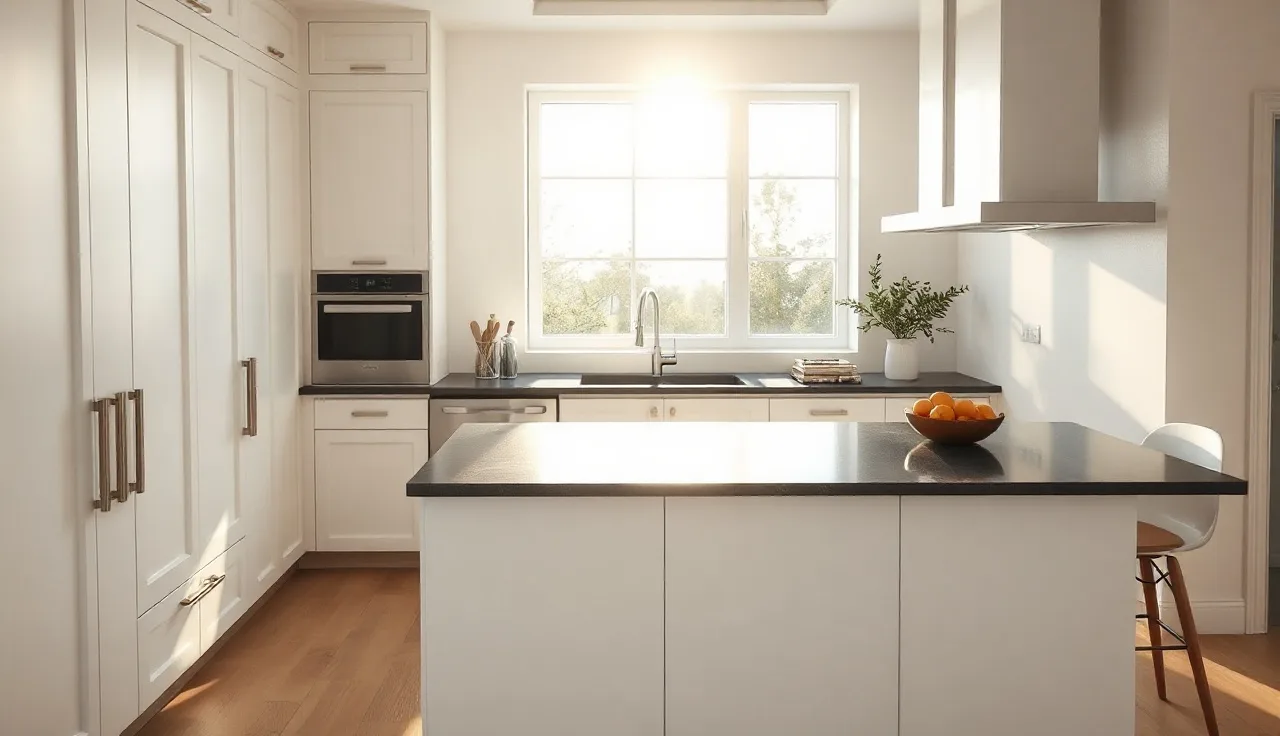
- White cabinets with black countertops is one of the most reliable kitchen combinations because the contrast reads well at any scale, hides no cabinet detail or countertop texture, and works across every budget from $3/sq ft laminate to $200/sq ft leathered granite.
- The look ages well because it isn't tied to one decade's color trend.
- Contrast, not color, is what carries it.
Why does white cabinet and black countertop combination work so well?
The short answer is contrast. Human vision reads contrast faster than it reads color harmony, and the lightness gap between white cabinetry and a near-black countertop is about as high as an interior room ever gets without feeling theatrical. That gap makes cabinet profiles, hardware, and countertop edge details all easier to read at once.
There's a durability argument too. White cabinets show fingerprints on gloss surfaces but hide everyday dust and wear far better than a dark painted cabinet. Black or very dark countertops hide crumbs, water spots, and fine scratches that jump out on white or pale stone. The two surfaces cover for each other's weaknesses.
Resale backs it up. The National Association of Realtors' 2023 Remodeling Impact Report found that kitchen upgrades rank among the top projects for appealing to buyers, and agents specifically cite neutral palettes as the safest bet in broad markets [1]. White-and-black isn't trendy the way a single color is. It's closer to a default setting for high-contrast modern kitchens.
Designers sometimes push back and call the look cold or predictable. Fair, if you stop at the two elements. Warm wood flooring, brass or unlacquered bronze hardware, and open shelving in a natural material all bring warmth into the palette without killing the contrast. The cabinet-to-countertop relationship is the anchor. Everything else is the adjustment.
What are the best black countertop materials for white cabinets?
Not all black countertop materials behave the same, and this choice matters more than almost any other decision in the kitchen. Here's how the main options actually perform.
Absolute Black Granite is the most popular pick, and for good reason. It's a uniform, dense stone quarried mostly in India and South Africa. It's hard (around 6 to 7 on the Mohs scale), shrugs off heat, and takes a high polish that holds up over years of use. Fabricated and installed, expect $60, $100 per square foot depending on region and edge profile [2]. Absolute Black can also be leathered or honed, which cuts glare and hides fingerprints better than polished. If you want a matte modern look, leathered Absolute Black is probably the single best countertop surface for white shaker cabinets.
Black quartz (engineered stone) is the right call if you want near-zero maintenance. Cambria, Silestone, and MSI all make deep charcoal and true-black slabs. Quartz is non-porous, so it never needs sealing, and the pigment runs through the full thickness of the slab. Installed cost runs $70, $120 per square foot for premium brands [3]. The tradeoff: quartz can't take prolonged heat, so you need trivets. Our Cambria countertops guide covers one popular premium option in detail.
Soapstone is underused here and shouldn't be. Real soapstone (talc content 50 to 80%) is naturally dark gray to near-black, gets darker and more even when oiled, and is genuinely heat-resistant. It scratches more easily than granite, but the scratches sand out with fine sandpaper. No other countertop material gives you that. Installed cost is roughly $70, $120 per square foot [4]. Maintenance is light oiling every few months. Our how to clean soapstone countertops guide covers the full routine.
Black marble (Nero Marquina from Spain, Black Beauty from India) looks stunning and carries a serious maintenance burden. Marble is calcium carbonate, so acids (lemon juice, vinegar, most cleaning sprays) will etch it. Etching shows up as dull spots on polished marble and is nearly impossible to avoid on a countertop used daily. Love the look and cook rarely? Marble can work. Otherwise it's a frustrating choice. Our marble countertops guide digs into the tradeoffs.
Black quartzite (not the same thing as quartz) is a metamorphic stone sometimes sold as black marble. Real black quartzite is much harder and more acid-resistant than marble. The problem is mislabeling, which is rampant in the stone trade. If a slab is labeled black quartzite, ask your fabricator for a lemon juice spot test on a remnant before you buy. Our how to clean quartzite countertops guide explains what to watch for.
Laminate and solid surface earn a mention for budget builds. Black laminate from Wilsonart or Formica runs $3, $10 per square foot for material alone, and $30, $60 per square foot installed [5]. It's not immune to heat or a sharp knife, but it's tougher than its reputation and far easier to replace when damaged. Our laminate countertops guide has the full cost breakdown.
How much does a black countertop for a white kitchen cost per square foot?
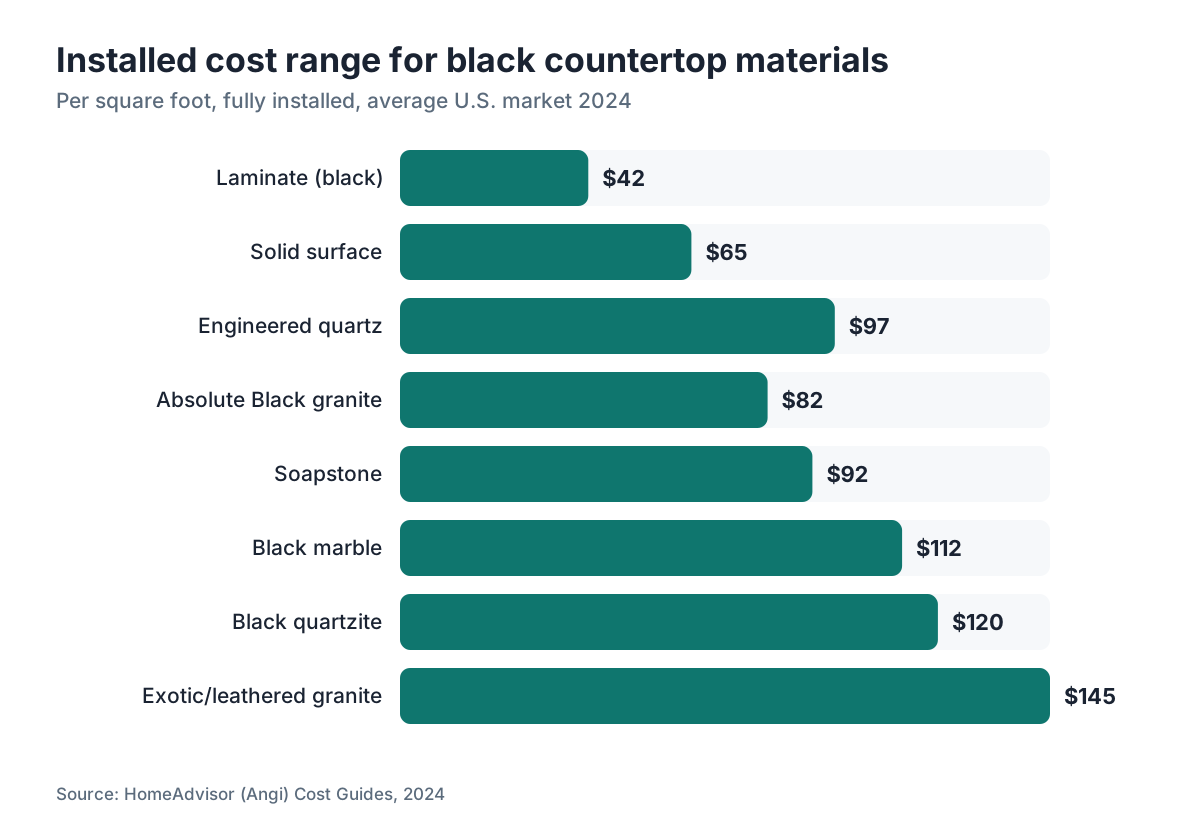
Cost ranges swing by material, region, edge complexity, and how much sink or cooktop cutout work the fabricator has to do. The table below gives real installed ranges for the common materials.
| Material | Installed cost range (per sq ft) | Sealing needed? | Heat-resistant? |
|---|---|---|---|
| Laminate (black) | $25, $60 | No | No (use trivets) |
| Solid surface (Corian-type) | $45, $85 | No | No |
| Engineered quartz (black) | $65, $130 | No | No (trivets required) |
| Absolute Black granite | $55, $110 | Yes, 1x/year | Yes |
| Soapstone | $65, $120 | No (oil only) | Yes |
| Black marble | $75, $150 | Yes, 2x/year | No |
| Black quartzite | $80, $160 | Yes, 1 to 2x/year | Yes |
| Leathered or exotic black granite | $90, $200 | Yes | Yes |
These ranges come from industry sources and regional fabricator surveys. Actual quotes in high-cost-of-living metros like San Francisco or New York City routinely run 20 to 40% above the upper end [2][6].
The average kitchen countertop is roughly 30 to 40 square feet for a standard U or L shape, and an island adds another 15 to 30 square feet. At the midpoint of Absolute Black granite installed ($82/sq ft), a 35 sq ft kitchen countertop costs around $2,870 before any edge upgrades, backsplash work, or demo fees. Use that as your anchor number.
Edge profiles add real cost. A standard eased or beveled edge is usually baked into the base fabrication price. A mitered waterfall edge, ogee, or laminated thick edge can add $15, $40 per linear foot to the job [6]. For a white cabinet kitchen with a modern feel, a simple flat or slightly eased edge usually looks best anyway.
What cabinet styles and finishes pair best with black countertops?
Shaker-style white cabinets are the most common pairing, and they work because the recessed panel throws shadow lines that add texture without competing with the countertop. Flat-front (slab-door) white cabinets give you a cleaner modern look and push the countertop to center stage. Both work. The choice is whether you want the kitchen to feel warm and craft-like (shaker) or architectural and minimal (flat-front).
Finish matters as much as door style. High-gloss white cabinets reflect light hard, which amplifies the contrast with a dark countertop. Matte or satin white cabinets forgive fingerprints and soften the contrast. Neither is wrong, but gloss demands more upkeep and performs better in larger kitchens with plenty of natural light. In a darker or smaller kitchen, glare from gloss white can feel harsh.
Hardware is where most people underinvest. On a white-with-black kitchen, the hardware is the jewelry of the room. Matte black pulls and knobs give you a monochromatic, architectural feel. Brushed brass or unlacquered bronze warms the palette and keeps it from reading like a black-and-white photograph. Brushed nickel sits in between. Whatever you pick, stay consistent across the whole kitchen. Mixed metal finishes in a high-contrast kitchen look accidental, not intentional.
Cabinet height changes how the countertop reads. Standard upper cabinets with 18 inches of open wall between the countertop and the uppers leave room for a tile or slab backsplash. Full-height uppers that reach the ceiling, more common in modern kitchens, wipe out that transition zone and make the countertop-to-cabinet junction the dominant line in the room.
What backsplash works with white cabinets and black countertops?
This is one of the more debated calls in the whole scheme, because the backsplash sits right at the intersection of both dominant elements.
White subway tile is the default, and it works because it holds the cabinet's value without competing with the countertop. 3x6 inch white subway tile in a running bond pattern is neutral, durable, and easy to clean. Grout color is your dial: white grout keeps things clean, gray grout adds definition, and dark (near-black) grout draws a graphic grid that ties back to the countertop.
A full slab backsplash in the same stone as the countertop is the premium move. Running leathered Absolute Black granite or black quartz from the countertop up to the uppers gives you a monolithic look that feels expensive, because it is. Material for the backsplash run alone can add $800, $2,000 to a typical kitchen job, and you need book-matching or at least matched veining direction across the joints [6].
White zellige or handmade ceramic tile adds texture and warmth without shifting the base palette. Slight variation in the glaze creates movement without fighting the countertop. This is probably the best middle ground between safe subway tile and the expensive slab backsplash.
One backsplash choice that keeps disappointing in this palette: heavily veined white marble mosaic tile. The busy veining turns visually noisy when strong black-and-white contrast is already running on two other planes (cabinets and countertop). Keep the backsplash simple and let the countertop be the statement.
How do you maintain black countertops in a white kitchen?
Maintenance depends entirely on the material. Two things tend to surprise people about dark countertops: water spots and fingerprints show more clearly on some finishes than they do on light countertops, and some dark stones (especially heavily dyed granites) can fade or mottle over years of chemical cleaning.
For natural stone (granite, quartzite, soapstone, marble), sealing is the first line of defense. The Marble Institute recommends the water droplet test annually: put a few drops of water on the surface and watch. If it beads for several minutes, the seal holds. If it soaks in within a minute or two, reseal [7]. Most true Absolute Black granite is naturally very dense and may need sealing once a year or less.
Polished black surfaces show water spots and fingerprints more than honed or leathered ones. If you cook regularly and wipe the counter several times a day, spec a honed or leathered finish instead of polished. You give up some mirror-like depth and gain a surface that looks clean with less effort.
Quartz is simpler: warm water and a soft cloth handles nearly everything. Skip abrasive pads, high-concentration bleach, and acetone-based products, which can break down the polymer binders in engineered stone [3]. Our how to clean stone countertops guide covers care across stone types.
Soapstone is the low-drama option. Wipe with soap and water, then apply a thin coat of mineral oil every one to three months. The oil darkens the stone evenly and keeps the surface from looking chalky or blotchy. Scratches sand out with 220-grit sandpaper followed by oil, which is a real advantage when you have kids or heavy daily use.
Laminate and solid surface need only basic cleaning. They aren't stone, so no sealing, no oiling, no special products. The main vulnerabilities are heat (never set a hot pan directly on either) and knife work (always use a board). On Corian-type solid surfaces, light scratches buff out with a Scotch-Brite pad and a little cleanser, which keeps them looking fresh longer than laminate.
Does a black countertop make a kitchen feel smaller or darker?
This comes up constantly. The honest answer: it can, but it usually doesn't if the rest of the design decisions account for the concern.
Light reflectance value (LRV) is the metric paint and material makers use to describe how much light a surface reflects, on a scale of 0 (absolute black) to 100 (pure white) [8]. A polished black granite countertop lands somewhere around LRV 3 to 8. That's genuinely low. But countertops are horizontal. They don't bounce light back into the room the way walls and ceilings do. A dark horizontal plane reads very differently than a dark wall.
Here's what actually shrinks a kitchen with dark countertops: dark lower cabinets paired with a dark countertop, weak task lighting under the uppers, and dark or mid-tone flooring that doesn't break up the lower half of the room. White upper and lower cabinets solve the cabinet issue on the spot. Under-cabinet LED strips are the single most impactful upgrade when you're using dark countertops.
Kitchens with black countertops, white cabinets, and good lighting routinely feel spacious because the high-contrast palette draws clear boundaries between surfaces, and that reads as organization and openness. In a small galley, the dark work plane recedes slightly, which can help the space feel less cramped than a white countertop that melts into white cabinets.
If your kitchen gets very little natural light, a honed or matte-finish black countertop beats polished. Polished black in low light can look like a void. Honed reads like a surface.
What flooring and hardware finish the look?
Flooring is the decision most people make before the renovation and then regret once the countertops go in. If you're still choosing flooring after the cabinet and countertop call, the best options for a white-and-black kitchen are these.
Light to medium hardwood or wood-look LVP (luxury vinyl plank) in a natural, warm tone. This is the choice that consistently works. The warm wood interrupts what would otherwise be a purely achromatic palette and keeps the kitchen from feeling clinical. White oak, natural maple, or a medium walnut all work. Avoid anything with a strong gray or cool undertone, which doubles down on the kitchen's built-in coolness.
Large-format light gray or cream porcelain tile. This holds a neutral, clean look and reads as a light floor, which helps the room feel open. The slight warmth in a cream tone does more than you'd expect.
Black and white checkered or geometric tile floors look intentional and graphic with this palette, but they demand commitment. Once you have a black-and-white floor in a black-and-white kitchen, you've locked in a specific aesthetic that's hard to shift if your taste changes.
For hardware, the real decision is between matte black (monochromatic, modern, strong) and warm metals (brass, bronze, copper, gold). Matte black on white cabinets with a black countertop is a complete look, and it's becoming the default in new construction and renovation photography. Brass is the warmer and, some would argue, more sophisticated choice because it adds a third element that keeps the palette from feeling binary. Avoid chrome and polished nickel in a strongly modern kitchen. They tend to read dated in this context.
Want a realistic price picture before you commit to a material? The SlabWise instant quote calculator lets you plug in your square footage and material choice to see fabricated and installed cost ranges in your region before you visit a single fabricator.
What are common mistakes people make with this kitchen combination?
Choosing the wrong black. Not all black countertops are the same color. Absolute Black granite is a true, cold, near-neutral black. Soapstone runs dark gray with green or blue undertones. Some black granites carry significant brown or gold undertones that only show up under natural light. Get a large sample (at least 12x12 inches) and look at it in your actual kitchen at midday and at night under your lighting.
Under-lighting the countertop. Dark surfaces absorb light. If your kitchen has only overhead fixtures and no under-cabinet lighting, the countertop becomes a visual dead zone, especially at night. Budget for under-cabinet LED strips from the start. This is a $200, $600 addition to a full kitchen project and it makes a wildly disproportionate difference.
Ignoring the grout color on the backsplash. Grout color on a white tile backsplash shifts the visual temperature of the whole kitchen. People pick white grout by default, install it, then wish they'd gone to a medium gray. Small decision, outsized visual impact.
Buying the cheapest black laminate and skimping on the edge. Budget laminate is a legitimate choice, but if the edge treatment is cheap (a thin rolled or post-formed edge with visible substrate), the countertop looks cheap no matter how good the cabinet and hardware are. A flat laminate with a built-up edge (stacked substrate for a thicker look) or a contrasting metal edge strip reads far better.
Mismatching undertones in the white. Not all white cabinetry is the same white. Some whites lean warm (cream), some lean cool (blue). A cool-white cabinet with a very cold black countertop can feel sterile. A warm-white cabinet with a black countertop that carries warm undertones feels inviting. Pull your actual cabinet door sample when choosing the slab.
How do I get an accurate quote for black countertops with white cabinets?
A real quote, rather than a ballpark, takes a little prep before you call fabricators.
First, know your square footage. Measure the depth of your countertop run (standard is 25.5 inches with an overhang, or 24 inches flush), multiply by the length, and add up each section. Don't forget the island. Add 10 to 15% for waste on natural stone, since slabs get cut to fit and remnants aren't always usable.
Second, decide on your edge profile before you ask for quotes. Fabricators price edge work by the linear foot, and a waterfall or ogee edge on a 10-foot island can add a lot compared to an eased edge on the same piece.
Third, count your cutouts. Each sink cutout adds $100, $300 to the job. A cooktop cutout is similar. An undermount sink takes more precise work than a drop-in and costs more.
Fourth, get at least three quotes from local fabricators. Prices vary widely even inside a single metro, and the cheapest quote isn't always the worst quality, but ask what stone grade and thickness (2cm vs 3cm) each quote is based on. Most residential kitchens look better with 3cm (1.25 inch) stone because it doesn't need a plywood substrate for a laminated edge and the thickness reads as more substantial.
Fabricators who want to tighten up this process on their end can use SlabWise quoting software, which handles edge profiling, cutout pricing, and material costs in one tool, so customers get consistent quotes faster.
Our countertop installation guide walks through the full sequence from template to final polish so you know what to expect from your fabricator.
Is white cabinets with black countertops a timeless look or a trend?
This is the design question everyone actually wants answered before spending thousands of dollars.
The honest take: high-contrast neutral palettes have shown up consistently in kitchen design since at least the 1930s (think early Bauhaus-influenced American kitchens) and have never fully disappeared. The execution changes. What counts as 'modern' hardware or backsplash tile shifts decade to decade. But the underlying palette of light cabinetry against dark countertops has been commercially viable and broadly appealing for nearly a century.
What actually dates a kitchen in this palette isn't the countertop-to-cabinet relationship. It's the specific materials and details: an edge profile that was fashionable for five years, a backsplash tile that was everywhere in 2018, hardware that's unmistakably from a single era. Choose classic edge profiles (eased, beveled, or miter), simple hardware shapes, and neutral backsplash materials, and the kitchen won't look dated in ten years.
The real risk isn't the palette. It's overcorrecting toward maximalism inside it: too much matte black hardware, black grout, black appliances, and black fixtures all at once. At some point the contrast that makes the look work disappears when every element pushes toward the dark end.
For resale, the National Association of Home Builders consistently finds that buyers prefer neutral kitchens, and white cabinetry is the most commonly requested cabinet color in buyer surveys [9]. A black countertop paired with white cabinets is unlikely to be a liability in any mainstream market.
Frequently asked questions
What is the most durable black countertop for a kitchen with white cabinets?
Absolute Black granite is the most durable widely available option. It's a dense, non-foliated stone that rates 6 to 7 on the Mohs hardness scale, handles heat from pots and pans without issue, and holds a polish for years with annual sealing. Leathered Absolute Black is arguably even more practical because the matte texture hides fingerprints and minor scratches better than polished, while staying a true black.
Do black countertops show scratches more than light countertops?
Polished black granite and polished quartz show fine scratches more visibly than honed or leathered finishes because the scratch interrupts the reflective surface. Honed or leathered black granite shows scratches much less. Quartz resists scratching better than granite but can't be refinished if it does scratch. Soapstone scratches easily, but uniquely among countertop materials, those scratches sand out and the surface reoils.
Will black countertops fade over time?
Natural black stone (granite, soapstone, quartzite) doesn't fade under normal indoor conditions. Some lower-quality black granites get treated with dyes or resins for a darker, more uniform look, and those treatments can dull or mottle over years of cleaning. Ask your fabricator specifically whether the slab has been treated. Untreated Absolute Black granite and true soapstone are colorfast for the life of the stone.
What shade of white cabinet pairs best with a black countertop?
A true white (Benjamin Moore White Dove OC-17 is a widely used benchmark at LRV 85.7) or a slightly warm white works with most black countertops. Avoid stark, cool whites with blue undertones, especially if your flooring or backsplash is also cool-toned, because the combination can feel cold rather than crisp. Pull your actual cabinet door sample when selecting the stone so you can see both under your kitchen's specific lighting.
Can I use black countertops on an island with white perimeter countertops?
Yes, and it's popular in larger kitchens. The island countertop becomes a focal point in a contrasting material or color, which visually defines the workspace. A common version: white quartz or marble-look on the perimeter cabinets and black or very dark granite on the island. Just make sure the two materials don't fight each other with competing veining or pattern scales.
How do I clean black granite or quartz countertops without leaving streaks?
Warm water and a microfiber cloth handles most daily cleaning on both granite and quartz. The streaks people notice on black surfaces usually come from dish soap residue or hard water minerals. If streaks are a problem, wipe with plain warm water after any soapy cleaning, then dry with a microfiber cloth immediately. Avoid ammonia glass cleaner on granite; it can strip sealers over time.
Are black countertops harder to keep clean than white countertops?
Depends what you mean by clean. Dark countertops hide food debris and staining better than white, but they show water spots, fingerprints, and dried soap more clearly. The net cleaning effort is roughly equal; you just notice different things. Honed or leathered finishes cut the visible fingerprint issue a lot compared to polished black surfaces.
What edge profile looks best on a black countertop in a modern kitchen?
For a modern kitchen, the standard eased edge (a very slight bevel on the top corner) or a flat mitered edge reads cleanest. The mitered edge fakes a much thicker countertop (1.5 to 2 inches vs the actual slab thickness) without the plywood substrate a traditional laminated edge needs. An ogee or bullnose edge can look dated in a modern context, though both are durable.
How thick should a black granite countertop be?
The standard residential choice is 3cm (about 1.25 inches) for natural stone. Three-centimeter slabs are structurally self-supporting across most spans, don't need a plywood substrate for most edge treatments, and carry better visual weight than 2cm material. Two-centimeter slabs cost less and weigh less, but need substrate support for overhangs and laminated edges. For an island or any countertop with a visible edge, 3cm is worth the difference.
Does a black countertop make the kitchen hotter?
No, not in any meaningful sense for a horizontal countertop indoors. The worry about dark surfaces absorbing heat applies to exterior surfaces under direct sun. An interior countertop under ambient or task lighting doesn't absorb enough radiant energy to change the room's temperature. The surface will feel slightly warm if direct sunlight hits it through a window, but that's true of any dark surface.
What is the cheapest black countertop option for white cabinets?
Black laminate is the least expensive material at $25, $60 per square foot installed. Wilsonart and Formica both make convincing matte black laminates that, with a built-up or contrasting edge, look sharp in a modern white kitchen. Solid surface (Corian-type) is the next step up at $45, $85 installed and offers integrated sinks with no visible seam plus the ability to buff out surface scratches, which laminate can't do.
Can I mix black quartz on the island and black granite on the perimeter?
Technically yes, but it's risky because quartz and granite black tones are often slightly different, and the variation shows when both surfaces are visible from the same spot. If you want to mix materials, a clear contrast (matte black granite perimeter, a different stone island) works better than two materials trying to match. For budget management, put the more expensive stone where it gets the most visibility.
How does a black countertop affect kitchen lighting requirements?
Dark countertops absorb rather than reflect light, so task lighting at the countertop level matters more than in a kitchen with light surfaces. Under-cabinet LED strips are the practical fix: they light the work surface directly and reduce the visual weight of the dark countertop. Budget $200, $600 for under-cabinet lighting on a full kitchen. Recessed overhead lighting alone is rarely enough with a black countertop.
Is honed or polished black granite better for a white kitchen?
Honed or leathered finish is better for most households. Polished black granite looks dramatic in showrooms but shows every fingerprint, water drop, and wipe mark in daily use. A honed finish has a flat, matte surface that stays looking clean. Leathered finish has a slight texture that hides imperfections even better than honed while still feeling smooth. The tradeoff: polished is slightly more stain-resistant because the surface is more closed.
Sources
- National Association of Realtors, 2023 Remodeling Impact Report: Kitchen upgrades rank among the top projects for appealing to buyers; neutral palettes are cited as the safest bet in broad markets.
- HomeAdvisor (Angi), Granite Countertops Cost Guide 2024: Absolute Black granite installed cost runs $60, $100 per square foot depending on region and edge profile; high-cost-of-living metros run 20 to 40% above average.
- Marble Institute of America, Quartz Surface Care and Maintenance: Quartz engineered stone is non-porous and does not require sealing; avoid bleach in high concentrations and acetone-based products which can break down polymer binders.
- HomeAdvisor (Angi), Soapstone Countertops Cost Guide 2024: Soapstone countertops installed cost runs roughly $70, $120 per square foot.
- HomeAdvisor (Angi), Laminate Countertops Cost Guide 2024: Black laminate countertops run $3, $10 per square foot for material, installed typically $25, $60 per square foot total.
- HomeAdvisor (Angi), Countertop Installation Cost Guide 2024: Edge profiles such as waterfall or ogee add $15, $40 per linear foot; full slab backsplash material adds $800, $2,000 to a typical kitchen job.
- Marble Institute of America, Natural Stone Care and Cleaning: The MIA recommends the water droplet test annually: if water absorbs within a minute or two, the stone should be resealed.
- U.S. General Services Administration, Facilities Standards for the Public Buildings Service: Light Reflectance Value: Light Reflectance Value (LRV) measures how much light a surface reflects on a scale of 0 (absolute black) to 100 (pure white).
- National Association of Home Builders, What Home Buyers Really Want 2023: NAHB buyer surveys consistently find white cabinetry is the most commonly requested cabinet color among home buyers.
- U.S. Bureau of Labor Statistics, Consumer Expenditure Survey: Housing and Remodeling: Kitchen and bath remodeling account for a large share of home improvement spending tracked in the Consumer Expenditure Survey.
- Marble Institute of America, Dimension Stone Design Manual: Standard residential stone countertop thickness is 3cm (approximately 1.25 inches); 3cm slabs are self-supporting across most spans without a plywood substrate.
Last updated 2026-07-09