TL;DR
- Quartz countertops sell for $50, $150 per square foot installed.
- Material alone runs $25, $100 per square foot depending on brand and pattern.
- Most kitchens land between $2,000 and $6,000 total, with the national average near $3,000, $4,000.
- Quartz is non-porous and never needs sealing, but it discolors under sustained UV and cracks under high heat.
- Always use trivets.
What does quartz countertop material actually cost?
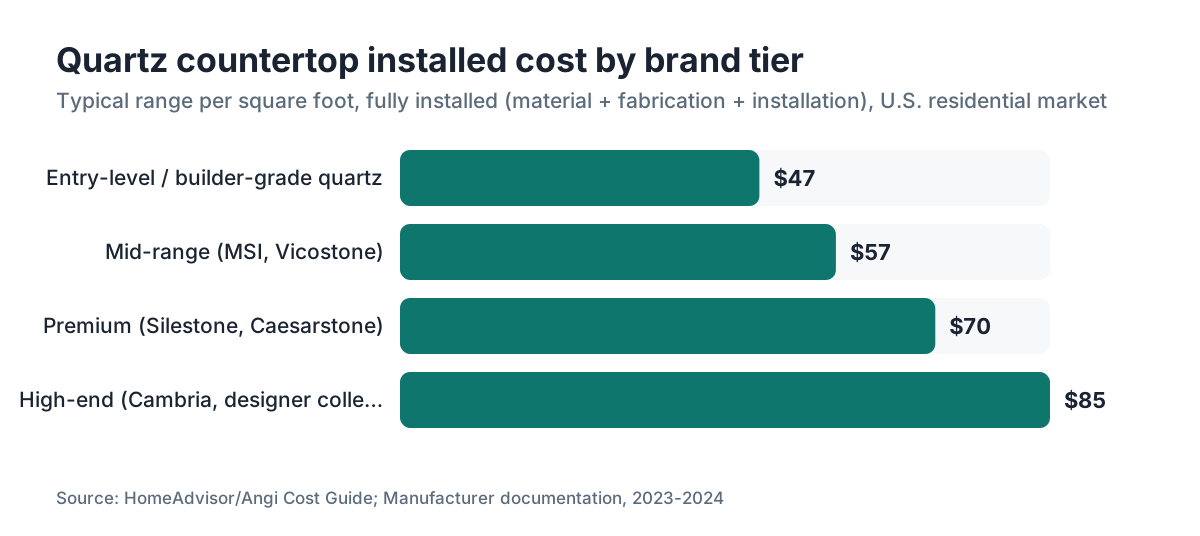
Quartz material sells for roughly $25, $100 per square foot before anyone cuts or installs it. The wide range isn't random. Entry-level solid-color quartz from brands like MSI or Wilsonart starts around $25, $40 per square foot at the slab level. Mid-range products with veining, sold under Silestone or Cambria, run $50, $75. Top-tier large-format slabs and high-vein Calacatta lookalikes push $80, $100 and sometimes beyond [1].
Fabrication and installation add roughly $25, $50 per square foot on top of material, depending on your market. A kitchen with 40 square feet of counter could land anywhere from $2,000 on the low end to $6,000 fully installed. The national average for a full kitchen quartz install sits around $3,000, $4,000 based on HomeAdvisor and Remodeling Magazine cost surveys, though "average" hides a lot [2].
Thickness moves the number. A 2 cm slab (about 3/4 inch) is cheaper to make and ship, but most residential installers laminate the edge to fake the look of 3 cm. A true 3 cm (1.25 inch) slab costs more per square foot, feels more solid, and makes edge profiles simpler. If a quote looks unusually cheap, ask whether it's 2 cm or 3 cm before you get excited.
Edge profiles add cost too. A standard eased or beveled edge is usually free. An ogee, waterfall, or double-bullnose edge adds $10, $30 per linear foot in most shops. A waterfall island with two 36-inch sides can add $200, $400 to the job in edge work alone.
Where can you buy quartz countertops?
You have four ways in: big-box stores, stone yards and distributors, online slab retailers, and fabricators direct. One of those beats the other three for most kitchens.
Home Depot and Lowe's both sell quartz, either as prefabricated drop-in pieces or through in-store design programs that send a fabricator to measure your kitchen. Prefab pieces are the cheapest option, sometimes $15, $25 per square foot for material, but selection is thin and you don't control seam placement. The in-store fabricator programs are convenient and usually carry a markup over going direct.
Stone yards and slab distributors (often the same company) sell by the slab to fabricators and, in many markets, straight to homeowners willing to pick their own slab. IKEA sells quartz as part of its kitchen system at a competitive price, but installation runs through a third-party program and lead times bounce around.
Online retailers like Etsy (for remnants), BuildDirect, and direct manufacturer sites let you buy material and sometimes arrange shipping. Shipping big stone slabs is expensive and risky. A 3 cm quartz slab weighs 15 to 18 pounds per square foot, so a 50-square-foot slab weighs 750 to 900 pounds [3]. Freight damage happens, and a cracked slab in your driveway is nobody's idea of savings.
Here's the path I'd take: find a local fabricator, go to their showroom or slab yard, pick your material, and let them handle everything. You see the actual slab (matters a lot for veined quartz), you deal with one company, and fabricators usually buy from distributors cheaper than you'd find retail. For a kitchen countertops project, the one-stop route saves real headaches.
Which quartz brands are worth the money?
Cambria, Silestone, Caesarstone, MSI, Vicostone, and Wilsonart run the North American market. Each has real strengths, and none of them is a scam.
Cambria is made in Le Sueur, Minnesota, and it's the only major brand that's family-owned. Slabs come 3 cm standard, the warranty is lifetime and transferable, and fabricators consistently praise the quality control [8]. Price sits high, $65, $100 per square foot installed for most patterns. Our Cambria countertops guide covers the full collection if you want to go deeper.
Silestone (owned by Cosentino in Spain) rolled out its "HybriQ" formulation a few years back, moving away from polyester resins toward higher mineral content and some recycled material [4]. Silestone runs $55, $85 per square foot installed and has very wide distribution. Its warranty is 25 years [9].
Caesarstone (Israel, with U.S. manufacturing) is one of the oldest engineered quartz brands and has reliable quality. Prices track Silestone.
MSI (M S International) is a distributor, not a manufacturer, so it sources from factories in several countries. Pricing is often the most competitive, $40, $65 installed, and the color lineup has grown fast. Quality varies a bit more slab to slab than the dedicated makers. The Q Premium line carries a lifetime limited warranty [12].
Vicostone (Vietnam) holds a strong spot in the mid-market with good vein mimicry at $45, $70 installed. Shops that run it regularly say it machines clean.
The honest answer: for most kitchens, the gap between a well-made mid-range slab and a premium brand won't show up in daily use. Premium brands earn their price in two spots. Slab-to-slab consistency, which matters when you need multiple slabs to match veining. And warranty support, which matters the day something goes wrong.
| Brand | Origin | Typical installed price/sq ft | Warranty | 3 cm standard? |
|---|---|---|---|---|
| Cambria | USA | $65, $100 | Lifetime, transferable | Yes |
| Silestone | Spain/USA | $55, $85 | 25-year | Yes |
| Caesarstone | Israel/USA | $55, $80 | Lifetime | Yes |
| MSI Q Premium | Various | $40, $65 | Lifetime | Yes |
| Vicostone | Vietnam | $45, $70 | 15-year | Yes |
| Wilsonart | USA | $35, $60 | 10-year | Some 2 cm |
How does quartz compare to granite, marble, and other countertop materials?
Quartz is engineered stone: roughly 90 to 93% ground natural quartz aggregate bound with polymer resins and pigments [5]. That makes it non-porous (no sealing ever), consistent in color, and resistant to staining from wine, coffee, and acidic food. Granite and marble are natural and porous, so they need periodic sealing.
Granite runs $40, $100 installed for most grades, which overlaps quartz almost completely. The real difference is that every granite slab is one of a kind (some buyers love that, others find it stressful to match), and granite shrugs off heat that would hurt quartz. Quartz scores around 7 on the Mohs hardness scale; granite averages 6 to 7. Our granite countertops comparison has the full breakdown.
Marble is soft (Mohs 3 to 4), etches from acids, and costs more to keep looking good. It's a beauty choice, not a durability choice. A marble-look quartz gives most of the visual payoff with far less upkeep. Our marble countertops article walks through exactly when marble earns it and when the quartz version is smarter.
Laminate (Formica) is dramatically cheaper at $10, $30 installed, and modern print technology has closed the visual gap more than people expect. It scratches and doesn't repair well. See laminate countertops for when that trade-off makes sense.
Solid surface like Corian runs $45, $75 installed and sands out scratches, but it lacks the stone-look depth most buyers want from a premium counter.
Butcher block is a real budget option at $35, $60 installed, warm and repairable, but it needs oiling and hates standing water. Butcher block countertops are worth a look for islands or secondary surfaces.
Quartz doesn't win everything. It can't take heat the way granite can. Sustained heat above 300°F (149°C) can discolor or crack it at the resin level [10]. Use trivets, always. And direct sun, like a quartz slab under a south-facing skylight, yellows it over time because the polymer resins aren't UV stable.
What determines the final installed price of quartz countertops?
Material grade is the biggest lever, and fabrication complexity is a close second. These are the factors that actually move the number on your quote.
Square footage: obvious, but measure carefully. Fabricators quote off their own template, not your rough guess. A standard kitchen averages 35 to 50 square feet of counter surface.
Number of cutouts: each sink cutout runs $100, $250 extra. Cooktop cutouts are similar. An undermount sink with a disposal notch plus a cooktop in the island can add $500 to the job.
Edge linear footage: measure every exposed edge. Islands carry more linear footage than perimeter counters. At $10, $30 per linear foot for upgraded edges, a big island with a decorative profile adds up fast.
Seams: quartz slabs run roughly 55 to 65 inches wide by 120 to 130 inches long [1]. If your run beats slab width, you need a seam. Seams cost labor and they're never truly invisible. Good fabricators hide them in low-visibility spots (inside a corner, near a cooktop). Cheap fabricators drop them wherever the material math lands.
Backsplash: some quotes include a 4-inch quartz backsplash, others don't. A full-height quartz backsplash (18 inches or more) can add $300, $800 to a kitchen.
Demolition and haul-away: pulling old laminate is cheap. Pulling old tile or a granite slab is slower and can run $150, $400 extra.
Region: labor and distribution costs mean the same job runs 20 to 40% higher in San Francisco or New York City than in Kansas City or Charlotte. No single national average applies everywhere, so treat any headline number as a starting point.
For shops building these quotes, software like SlabWise automates yield calculations and catches material waste before it eats margin, which gives you room to price sharper.
How do you evaluate a quartz countertop quote?
Get at least three quotes. That's the only way to know whether a price is normal for your market or someone padding margin. When the quotes come in, check these things line by line.
Does the quote name the brand and collection? "White quartz" is not a spec. Ask for the manufacturer, the product line, and the color code. Then you can confirm you're comparing the same product across three bids.
Is the thickness spelled out? 2 cm versus 3 cm changes both price and feel.
What edge profile is included, and what's the upcharge to switch?
Does the quote cover the sink cutout, faucet holes, and cooktop cutout if you have one?
Is templating included or billed separately? Most reputable shops include it. A few charge $100, $200 and credit it back if you proceed.
Does the fabricator warranty their own seams and installation, separate from the manufacturer's material warranty? A good shop stands behind its work for at least a year.
What's the lead time from template to install? One to two weeks is typical. A shop promising 3 to 4 days is either slow that week or cutting corners. A shop quoting 3 to 4 weeks is backlogged.
Ask where they source the slab. If they buy from a distributor you can visit, ask to see the actual slab before they cut. Quartz varies less than natural stone, but lot numbers still matter for color matching across multiple slabs.
What are common quartz countertop scams and mistakes to avoid?
The bait-and-switch is real. A shop quotes a great price on a specific color, you sign, and at templating they tell you that color is backordered and offer an upgrade for more money. Lock the exact color and material into the contract before you sign anything.
Be careful with heavily discounted "overstock" or "remnant" quartz. Remnants are legit and often a good deal for small jobs like a bathroom vanity or laundry room. A full kitchen from remnants is a puzzle that may not fit cleanly and will strand seams in odd places.
Unlicensed installers are a gamble. Quartz is heavy (a 3 cm slab at 18 pounds per square foot means a 10-square-foot piece weighs 180 pounds), and your cabinets have to carry that load [3]. Bad support cracks the top over time. Ask for proof of licensing and insurance, and don't accept a shrug.
Don't pay 100% upfront. A fair structure is 50% deposit at signing, 50% on install day or after you inspect the work. Some shops ask for more up front, and that's negotiable. Nobody legitimate wants full payment before they've even templated.
Watch "installed" prices that quietly leave out the sink cutout, old-counter removal, and haul-away. Those add-ons can pile $400, $800 onto a quote that looked like the winner.
One more: quartz is not quartzite. Quartzite is a natural metamorphic stone, harder in some ways, but it etches and needs sealing. Sales staff at some retailers blur the line. If you're buying engineered quartz, make the product literature say "engineered quartz" or list resin content. Quartzite care is covered in our how to clean quartzite countertops guide.
How do you care for and clean quartz countertops?
Day to day, quartz is easy. Wipe with a damp cloth and mild dish soap. That's the whole routine. No sealing, no special products, no fuss.
For stuck-on food, a plastic scraper and a little isopropyl alcohol do the job. Skip anything abrasive. And go easy on bleach-based cleaners as a daily habit, because repeated use can dull the surface.
Strong acids and bases can attack the resin. Battery acid is a non-issue in a kitchen, but a cast-iron pan full of tomato sauce sitting on the counter for hours is harder on quartz than it would be on granite.
Heat is the real enemy. The polymer resin in quartz starts to degrade above 300°F [10]. A pan straight out of a 450°F oven can trigger thermal shock cracking or permanent discoloration. Trivets and hot pads aren't optional. Manufacturers write heat damage out of their warranties, and Silestone's care documentation, for example, states that it "excludes heat damage from direct contact with hot cookware" [9].
UV yellows quartz over years. That mostly hits outdoor installs and counters under big skylights. If you insist on quartz outside, hunt for products marketed as UV-stable, though none are truly immune.
For the broader stone and engineered-surface routine, our how to clean stone countertops guide has the full picture. The countertop installation article explains how seams and edges shape long-term upkeep.
Is quartz a good investment for resale value?
Probably yes, but the return isn't guaranteed and it swings hard on your market and what you're replacing. Don't treat quartz as a money-maker. Treat it as a feature buyers expect.
Remodeling Magazine's Cost vs. Value Report tracks kitchen remodel returns. A minor kitchen remodel (which usually includes new counters) recouped about 96% of its cost nationally in 2023, while a major upscale remodel recouped only about 38% [6]. Read the gap: swapping tired laminate for quartz in a mid-range kitchen returns far better than jumping from decent quartz to premium quartz.
Buyers in most markets expect stone or engineered stone in a renovated kitchen. The National Association of Realtors surveys agents on this, and kitchen countertop upgrades land near the top of the features buyers want [7]. But the extra dollars for Cambria over a mid-range Caesarstone almost never show up in your sale price.
Renovating purely for resale? Mid-range quartz in a clean white or gray, matched to your neighborhood's price tier, is the safe play. Renovating for yourself with 5 to 10 years left in the house? Buy what you actually like and stop optimizing.
Quartz has one resale trick going for it. Buyers trust that they'll never think about maintenance, and "no sealing required" is an easy story for an agent to tell.
What should fabricators know about selling and pricing quartz?
Quartz has better yield predictability than natural stone because slabs are uniform and defect-free. Margin still leaks in three spots: underestimating linear edge footage, missing cutout counts, and sloppy slab nesting that wastes material. Fix those three and most quotes come out right.
On material cost: distributor pricing runs on tiered volume. Shops buying 20+ slabs a month get meaningfully better numbers than shops buying 3 to 5. If you're small, joining a buying cooperative or committing to a preferred supplier can drop material cost 10 to 15%.
Labor time on quartz is predictable next to granite. It machines consistently, tooling wears at a known rate, and there are no surprise fissures mid-cut. Rough benchmarks: 2 to 3 hours of shop time per countertop job before install. Install on a typical kitchen runs 3 to 5 hours with a two-person crew.
Pricing transparency has gotten harder. Homeowners walk in with a screenshot of an online price or a competitor's quote that looks impossibly low. Don't reflexively match it. Explain exactly what's in your quote and why. Shops that compete on price alone tend to collect the clients who cause the most grief.
Accurate quoting is where margin lives or dies. Shops using purpose-built quoting software (like SlabWise's instant quote tool) that reads real slab dimensions, nesting waste, and edge profiles report fewer back-end surprises. A demo is worth 20 minutes if you're still quoting off a spreadsheet or the back of an invoice.
How long does quartz countertop installation take from start to finish?
Three phases: selection and contract, templating, then fabrication and install. Plan on 2 to 4 weeks from signing to cooking.
Selection through signed contract: this part is on you. It can take an afternoon or three weekends depending on how decisive you are. Budget a week or two.
Templating: the fabricator sends a tech (or a digital templating tool) to measure your actual cabinets after they're set and level. That takes 1 to 2 hours on-site. Most shops require cabinets fully installed and plumbing roughed in before they'll template. And you can't template over old counters you haven't removed yet, so demo comes first.
Fabrication lead time: 5 to 14 days after templating is typical. Peak season (spring and summer) stretches it. Holiday weeks stretch it more. Rush jobs are usually possible for a premium, sometimes $200, $500 extra.
Install day: a two-person crew sets a standard kitchen in 3 to 5 hours. Afterward, most fabricators want you to wait 24 hours before loading heavy objects on the counters and 24 to 48 hours before hooking up the sink plumbing and running water.
Total from contract to counters you can cook on: 2 to 4 weeks is realistic. If you have a hard date for the renovation, work backward from install day and give yourself slack.
Frequently asked questions
What is the average cost of quartz countertops installed?
Most homeowners pay $50, $150 per square foot installed, all-in. A typical kitchen with 40 to 50 square feet of counter runs $2,000, $6,000 total, with the national average around $3,000, $4,000. Costs move with brand, edge profile, number of cutouts, and your local labor market. Entry-level quartz in a competitive market can come in near $40 installed; premium brands in high-cost cities push past $150.
Is quartz better than granite for kitchen countertops?
Quartz wins on maintenance: non-porous, never needs sealing, and consistent in color. Granite wins on heat resistance and natural uniqueness, and it handles a hot pan better than quartz, whose polymer resin can discolor above 300°F. Both last decades with normal use. The practical difference for most kitchens is smaller than the marketing suggests. Budget and looks usually decide it.
What is the cheapest way to buy quartz countertops?
Remnants from a local fabricator are the lowest-cost option for small projects like bathroom vanities. For full kitchens, buying directly through a fabricator (who has distributor pricing) usually beats big-box programs. Prefab quartz pieces from Home Depot or Lowe's are cheapest per square foot but limit your size and seam options. Avoid online shipping for full slabs; freight damage rates are high and eat the savings.
How thick should quartz countertops be?
3 cm (about 1.25 inches) is the residential standard and what most fabricators quote by default. It's stronger, handles edge profiles better, and looks more solid. 2 cm (about 3/4 inch) costs less and shows up in some vertical applications or when weight on older cabinets is a worry. Most 2 cm installs use a laminated edge to fake the 3 cm look. If a quote doesn't specify, ask.
Can you put hot pans directly on quartz countertops?
No. The polymer resin in quartz starts degrading above roughly 300°F (149°C), and a pan straight off a burner or out of an oven can reach 400 to 500°F. Sudden thermal shock can crack or permanently discolor the surface. Manufacturers universally exclude heat damage from their warranties. Always use trivets or hot pads. This is the one habit quartz demands that granite does not.
Does quartz countertop need to be sealed?
No. Engineered quartz is non-porous because the resin binders fill the spaces between quartz particles during manufacturing. It doesn't absorb liquids, so sealing does nothing. This is one of the main practical wins over granite, marble, and quartzite, all of which need periodic sealing to fight staining. Skip any product sold as a quartz sealer; it's money spent on nothing.
How long do quartz countertops last?
With normal use, quartz counters last 20 to 30 years or more. The resin can yellow slightly under direct UV over time, and heavy impact can chip corners or edges. But daily cooking, cleaning, and use don't degrade it in any real way. Most manufacturers warranty their products from 10 years to lifetime. The two biggest risks to longevity are heat damage, which you can avoid, and bad installation, which cracks the top.
What quartz colors and patterns are most popular right now?
White and light gray quartz with subtle veining dominate residential sales, especially Calacatta-style (white with dramatic gray or gold veining) and Carrara-style (white with fine gray veining). Greige tones have grown a lot in the past three to four years. Book-matched patterns and dark backgrounds (charcoal, black with white veining) are popular on islands. Solid colors have faded in popularity but remain the most affordable option.
How do you find a reputable quartz countertop installer?
Start with referrals from neighbors or local kitchen designers. Confirm the fabricator is licensed and insured in your state. Ask to see recent work, specifically seam quality and undermount sink installs. Favor shops that let you visit the slab yard and pick your actual slab. Read reviews for mentions of timeline accuracy and how problems got handled. Avoid any shop that wants 100% payment before templating.
Can quartz countertops be repaired if they chip or crack?
Minor edge chips can be filled with color-matched epoxy, and many fabricators offer this. The repair is visible up close but fine from normal viewing distance. Cracks that run through the slab are serious and usually mean bad support or a hard impact. Full-slab replacement is the only real fix for a through-crack. This is exactly why cabinet leveling and support before installation matters so much.
Is quartz good for outdoor kitchens?
Standard quartz is a poor pick outdoors. The polymer resin yellows and degrades under prolonged UV and temperature swings. A few manufacturers make exterior-rated products with higher UV resistance, including some Dekton lines (a sintered surface, not true quartz), but conventional engineered quartz warranties flatly exclude outdoor installs. For outdoor kitchens, look at porcelain slabs, quartzite, or granite instead.
What is the difference between quartz and quartzite?
Quartz is engineered: ground quartz mineral mixed with resin and pigments, made in a factory. Quartzite is a natural metamorphic rock formed when sandstone gets compressed and heated underground. Quartzite is harder, takes heat better, and varies naturally like granite. It also needs sealing and can etch from acids. The names sound alike and sales staff sometimes confuse them. Ask for the product spec sheet and look for resin content to confirm you're getting engineered quartz.
How much does a quartz countertop cost for a bathroom vanity?
A bathroom vanity in quartz, usually 20 to 30 square feet including a backsplash strip, runs $500, $1,500 installed depending on brand and complexity. Remnant pieces from a local fabricator can bring a small single vanity down to $300, $700. The per-square-foot cost often beats a kitchen's because setup and template cost gets spread over fewer square feet.
Do I need to remove my old countertops before quartz installation?
Yes, in almost every case. Fabricators template and install on the finished cabinet surface, so old counters have to come off before templating, not after. The template gets cut to exact measurements, including any cabinet quirks. Some installers remove old counters as part of the service (usually $150, $400 extra). You can save money doing demo yourself, but confirm what condition the shop needs the cabinets in before they show up.
Sources
- Natural Stone Institute (formerly Marble Institute of America), Dimension Stone Design Manual: Standard quartz slab dimensions are approximately 55-65 inches wide by 120-130 inches long; slab grades and pricing tiers used by the industry
- HomeAdvisor (Angi), Quartz Countertops Cost Guide: National average quartz countertop installation cost ranges from $3,000 to $4,000 for a typical kitchen
- Natural Stone Institute, Stone Weight Reference: 3 cm quartz slabs weigh approximately 15-18 pounds per square foot
- Cosentino Group, Silestone HybriQ Technology Product Documentation: Silestone reformulated its product line with HybriQ technology, increasing mineral content and incorporating recycled materials
- United States Geological Survey (USGS), National Minerals Information Center: Engineered quartz countertops contain roughly 90-93% ground quartz aggregate bound with polymer resins
- Remodeling Magazine, 2023 Cost vs. Value Report: A minor kitchen remodel recouped about 96% of its cost nationally in 2023; a major upscale remodel recouped about 38%
- National Association of Realtors, 2023 Remodeling Impact Report: Kitchen countertop upgrades consistently rank among the top features buyers look for according to NAR agent surveys
- Cambria Company, Product Warranty Documentation: Cambria offers a lifetime transferable warranty on its quartz products manufactured in Le Sueur, Minnesota
- Silestone by Cosentino, Warranty and Care Documentation: Silestone offers a 25-year warranty and explicitly excludes heat damage from direct contact with hot cookware
- U.S. Consumer Product Safety Commission (CPSC), Guidelines on Countertop Material Hazards: Thermal shock from cookware above 300 F can cause polymer-resin composite surfaces to crack or discolor
- Home Innovation Research Labs (formerly NAHB Research Center), Kitchen and Bath Consumer Preferences Study: Stone and engineered stone countertops are among the most expected features in renovated kitchens in mid-range and above price tiers
- MSI International, Quartz Product Catalog and Warranty: MSI Q Premium Natural Quartz line carries a lifetime limited warranty and is sourced from multiple international manufacturing facilities
Last updated 2026-07-09