TL;DR
- Quartz countertops come in more than 100 colors across white, grey, beige, black, blue, green, and bold statement shades.
- Most colors cost $50 to $150 per square foot installed.
- Whites and light greys drive the majority of kitchen sales.
- The color you pick affects resale appeal, how visible daily mess is, and long-term satisfaction more than almost any other countertop decision.
How many colors does quartz come in, and how are they made?
Quartz countertops are engineered stone: roughly 90 to 93% ground natural quartz crystal bound with polymer resins and pigments, then pressed and cured into slabs [1]. That process is why quartz hits colors natural stone cannot. A slab of granite is whatever the quarry gave you. A quartz slab gets formulated to a Pantone spec.
The major brands, Silestone, Caesarstone, Cambria, MSI Q, and Vicostone, each carry somewhere between 40 and 150 active colors at any given time [2]. Add up the whole market and a fabricator with good supplier access can show you well over 200 distinct options. Maybe 30 to 40 of those drive most sales.
Color comes from pigments blended into the resin binder, sometimes mixed with glass chips, mirrored flecks, or recycled material for texture. The veining in marble-look quartz is either printed with digital inkjet technology or made by swirling pigmented resin before pressing. Some brands are very good at this. Others produce veining that goes flat under direct light. Go see slabs in person before you commit.
Finishes matter as much as color. The same grey reads completely differently as a polished surface versus honed (matte) or leathered. Honed surfaces show smudges more than people expect, which surprises the homeowners who assumed matte hides everything. It hides some things and shows others.
What are the most popular quartz countertop colors right now?
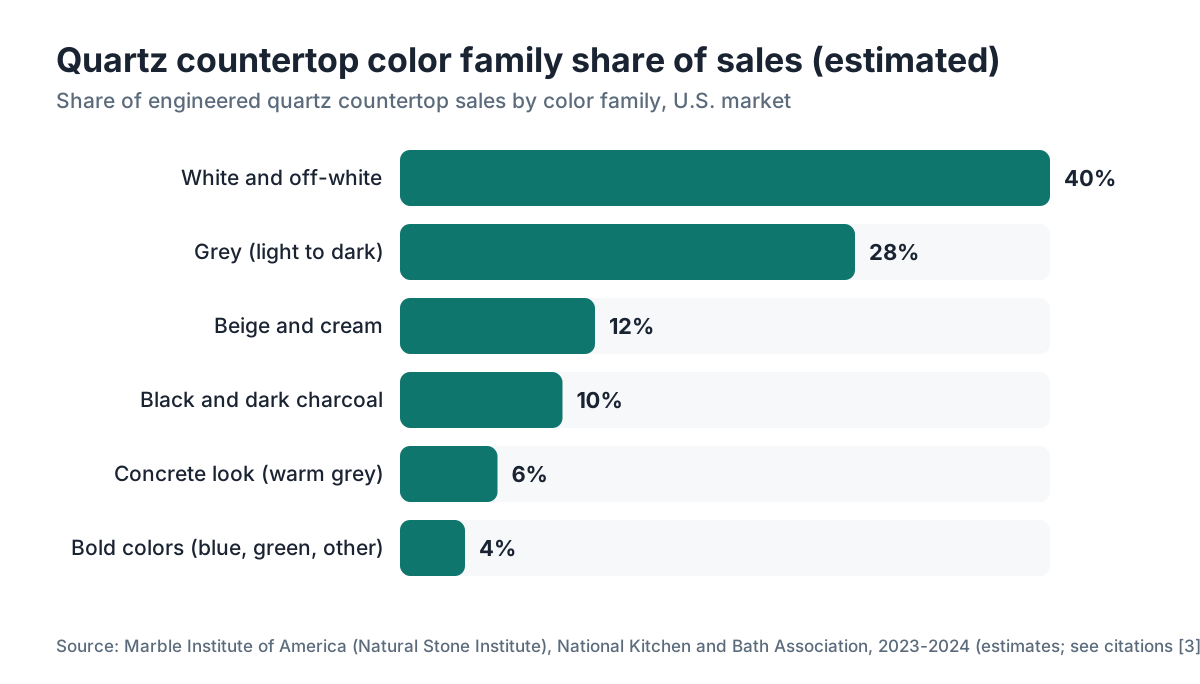
White is the best-selling quartz color category, and it isn't close. Sales data from the Marble Institute of America and retailer trend reports puts white and off-white at roughly 35 to 45% of quartz countertop sales [3]. The reasons are practical. White photographs well, appeals to the broadest buyer pool, and pairs with nearly any cabinet color.
Grey is the second-largest category. Light grey quartz especially has pulled enormous market share since about 2015. It gives you the clean look of white with a little more forgiveness on scratches and surface variation, and it feels more current than warm beige.
Here is how the major color families stack up in rough order of popularity:
| Color Family | Estimated Share of Quartz Sales | Common Use Case |
|---|---|---|
| White and off-white | 35 to 45% | Kitchens, primary baths |
| Grey (light to dark) | 25 to 30% | Kitchens, islands, commercial |
| Beige and cream | 10 to 15% | Traditional kitchens, baths |
| Black and dark charcoal | 8 to 12% | Islands, modern kitchens |
| Concrete look (warm grey) | 5 to 8% | Industrial, transitional |
| Bold (blue, green, terracotta) | 3 to 6% | Accent spaces, statement islands |
Nobody publishes audited market share by color. These numbers come from trade publication surveys and fabricator feedback, so treat them as directional rather than exact.
The concrete-look category deserves a flag. It sits between true grey and beige, with a slightly warm undertone and subtle aggregate texture. It has grown steadily because it works in farmhouse, transitional, and modern spaces alike.
What are the best white quartz countertop colors?
White quartz is not one thing. Pure bright whites read almost clinical under certain light, which some homeowners love and others find cold. Off-whites carry creamy or warm undertones that play better with wood cabinets and warm floors. Soft whites split the difference.
The colors designers and fabricators name most often:
Calacatta-look whites copy the dramatic white-and-gold or white-and-grey veining of Calacatta marble. Silestone's Calacatta Gold, Caesarstone's 5131 Calacatta Nuvo, and Cambria's Brittanicca all sit here. These tend to be premium-priced within the quartz range.
Pure and bright whites, like Caesarstone's 2141 Pure White, suit modern minimalist kitchens. They photograph brilliantly and show crumbs and water spots more than any other shade.
Warm white and ivory options, like Cambria's Torquay, pull toward cream rather than stark white. They forgive warm incandescent lighting and pair well with wood-tone cabinets.
One honest note. White quartz does not stain the way white marble does, but it will show grease, coffee, and turmeric if you don't wipe them quickly. The resin surface is non-porous [1], so stains sit on top rather than soaking in. Pigmented liquids left for hours can still leave a residue that takes some work to lift.
What grey quartz countertop colors are available, and how do they differ?
Grey quartz spans a wider range than most people expect before they start shopping. There is a real gap between a pale silver-grey with cool blue undertones, a warm greige (grey-beige blend), a mid-tone slate grey, and a deep charcoal that reads almost black in low light.
Light grey quartz is the most versatile. Colors like Silestone's Eternal Serena, Caesarstone's 5000 London Grey, and MSI's Calacatta Laza work with white, navy, sage, and greige cabinets without competing. Under north-facing light they can look slightly blue; under warm LED they shift toward silver. Pull a sample and look at it in your actual kitchen at different times of day. Always.
Mid-tone greys have more presence. They shine on islands where you want contrast with perimeter cabinets, or in contemporary kitchens with flat-front doors and integrated pulls. Caesarstone's 4033 Rugged Concrete and Silestone's Kensho both sit here.
Dark charcoal and near-black greys (Cambria's Blackpool, or Caesarstone's 3100 Jet Black used as a grey-adjacent option) create drama. They also show dust, hard-water spots, and fingerprints aggressively. With kids or a busy kitchen, dark grey means accepting that you'll wipe the counter more or it looks perpetually dusty between cleanings.
Greige, grey with brown undertones, earns its own mention. It dominated kitchen trends from roughly 2017 to 2022 and still sells strongly because it pairs naturally with the warm oak and walnut cabinets that have run popular for years. It is the grey least likely to feel jarring in a traditional or transitional home.
What other quartz color families are worth considering?
Beige and cream get underrated in trend-driven talk, and they are the right call for traditional kitchens with raised-panel cabinets, antique white or cream finishes, or wood floors with warm red or orange undertones. A stark white or cool grey in that setting looks wrong. Cambria's Torquay, Caesarstone's 9711 Classico, and MSI's White Carrara all work in this range.
Black quartz is having a real moment. Matte or honed black on an island, with a lighter perimeter, has become a standard contemporary move. The maintenance reality: you wipe it constantly if you want it to look good. That is a real lifestyle consideration, not a scare tactic.
Blue quartz runs from pale powder to deep navy to stormy slate. It is a genuine statement choice, almost always on islands or a bar area rather than the full perimeter. Silestone's Posidonia Green gets miscategorized here sometimes, but true blues like Cambria's Canterbury are less common and usually special-order.
Green quartz, sage and forest especially, has grown noticeably since 2022 in line with broader kitchen color trends. Like blue, it usually lands as an island or accent piece rather than a whole-kitchen solution.
Terracotta, dusty rose, and other warm statement colors live mostly in the design-forward part of the catalog. They are high risk for resale and best suited for a space that won't hit the market soon. If you love it and plan to stay, do it. If you are renovating to sell in three years, probably not.
For a full color comparison against other materials, look at marble countertops and granite countertops side by side, since natural stone carries its own color constraints and advantages.
How much do different quartz colors cost?
Quartz sells in tiers by brand, and color is one of the main things that decides which tier a slab lands in. Base-tier colors, usually simple whites and light greys with minimal veining, run $50 to $75 per square foot installed in most U.S. markets as of 2025 [4]. Premium colors, especially those with complex digital veining meant to mimic exotic marble, run $100 to $150 per square foot installed or more.
The cost gap isn't always obvious from the slab. A pure white quartz might be $55 installed. A white quartz with dramatic Calacatta-style veining from the same brand might be $115 installed. Both are white. One just costs more to produce and carries more brand cachet.
Imported quartz from manufacturers in China, Turkey, and India has pushed prices lower at the budget end. You can find installed quartz as low as $40 per square foot from some big-box and online suppliers, but fabrication quality, warranty terms, and slab consistency vary widely. A local fabricator who stands behind the install is worth paying a premium for.
Shops that quote with software, like the tools built into SlabWise, generate line-item quotes by material tier so you see exactly where the money goes: slab cost, fabrication, edge profile, cutouts, and installation as separate numbers instead of one opaque total.
For context, quartz sits between laminate countertops (typically $15 to $40 installed) and natural stone at the high end. Formica countertops cost less and offer far fewer options at the premium end of the range.
Does quartz color affect maintenance and how visible dirt is?
Yes, and this is one of the most underappreciated decisions in the whole process.
White quartz shows coffee rings, grease, and food coloring right away. You catch every crumb because there is no visual noise to hide it. The flip side: you see exactly what needs cleaning, so the counter rarely gets truly dirty without you noticing.
Light grey quartz is more forgiving than white in daily use. Minor crumbs and water spots read less, though white lime-scale from hard water still shows clearly against grey.
Dark quartz, polished black or charcoal especially, shows dust, fingerprints, and hard-water spots more than any other color. Matte and honed dark finishes handle fingerprints a little better and water marks and powdery residue a little worse.
Mid-tones, greige and medium grey and concrete-look, are the easiest to maintain visually. That is why commercial jobs, restaurant counters, and busy family kitchens lean toward them.
Quartz is non-porous, so sealing isn't required and the routine is genuinely simple: warm water, mild dish soap, soft cloth [1]. Skip abrasive pads and harsh cleaners, which dull the resin surface over time. For a full cleaning protocol, the guidance for engineered stone overlaps with how to clean stone countertops.
How do quartz colors hold up to UV light and heat?
This is a real limitation that natural stone does not share. The polymer resin binder in quartz is susceptible to UV degradation. Prolonged direct sunlight, like a counter running under a skylight or next to a big south-facing window, can cause yellowing or fading over time [5]. White quartz is most susceptible because yellowing reads most against a white base. Darker colors hide the shift better, though it still happens.
Most major brands warrant against manufacturing defects but exclude UV-related color change because it falls outside normal indoor use. Read the warranty before you buy.
For outdoor kitchens or sunroom counters, quartz is a poor choice. UV-stable materials like granite, porcelain, or Dekton handle exterior use much better.
Heat is a separate issue. Quartz handles normal kitchen use, but thermal shock from setting a 450-degree pan straight on the surface can damage or discolor the resin [5]. Use trivets. That applies to every color, and discoloration from heat shows most dramatically on white and light grey.
If your kitchen takes a lot of direct sun and you love white quartz, look at a product formulated with UV inhibitors (some brands list this in the technical spec sheet), or consider a light-colored quartzite, which is all-natural mineral and does not share the UV sensitivity.
Which quartz colors are best for resale value?
White and light grey are the conventional safe choices for resale, and the logic holds. They appeal to the widest pool of buyers, photograph well in listing shots, and pair with the broadest range of cabinet and flooring a future buyer might want.
National Association of Realtors data consistently ranks kitchens among the highest-ROI renovation categories, though countertop color isn't broken out at that level of detail [6]. Here is the honest state of the evidence: there is no rigorous academic study on countertop color and sale price, so what follows is practitioner opinion. Appraisers and agents generally say neutral quartz in good condition adds perceived value, and bold or highly trend-specific colors, even in good condition, are neutral to slightly negative on buyer appeal.
Bold color on a small accent island is a lower-risk move than bold color across the whole perimeter. Do the entire kitchen in terracotta quartz and you are betting future buyers share your taste.
The more expensive question is whether upgrading from mid-tier lightly veined quartz to premium heavily veined quartz moves the needle. In a high-end renovation market it might. In a median-priced home, the buyer probably won't pay a premium for the gap between $75/sq ft quartz and $130/sq ft quartz. That money goes into the house and does not come back out on a typical sale. It is a lifestyle spend, not an investment.
How do quartz colors compare across major brands?
The same color family can look quite different depending on who made the slab. Here is an honest take on the main players.
Caesarstone (Israeli-founded, with North American plants) has a well-edited catalog. Its whites and greys are consistently good. The 5000 London Grey has been a bestseller for years because it is genuinely useful. Batch-to-batch quality stays consistent, which fabricators appreciate.
Silestone (owned by Cosentino, Spanish) offers one of the broadest color ranges, including the Eternal Collection with very convincing marble looks [9]. Its Eternal Calacatta Gold is one of the most photographed white quartz colors on design platforms. Silestone also makes a hybrid quartz-porcelain HybriQ line.
Cambria (U.S.-owned, Minnesota-made) leans on American manufacturing and a lifetime warranty [7]. Designs run toward dramatic veining under a British-quarry naming convention. Brittanicca and Ironsbridge are among the most recognized. Cambria tends to price at the top of the market. For a full look, cambria countertops covers the range in detail.
MSI Q Quartz is an import-and-distribution brand with very competitive pricing. Color consistency is somewhat less predictable than Caesarstone or Cambria, but the value per dollar is strong for budget-minded projects [11].
Vicostone (Vietnamese) makes a large volume of quartz aimed at builders and the commercial market. Good quality for the price, less brand recognition at the consumer level.
When comparing, ask your fabricator to show you two or three slabs of the same color family from different manufacturers. How veining reads under light, how the surface texture feels, and how consistent the color runs across the slab can differ a lot.
How do you choose a quartz color that works with your cabinets and flooring?
Start with the fixed elements. If the flooring is staying, that is your anchor. If the cabinets are staying, those are your anchor. Work from what you cannot change toward what you can.
Undertone matching is the single thing most homeowners skip. Every countertop color has an undertone, warm (yellow, red, brown) or cool (blue, green, grey). Put a cool stark white quartz over a white oak floor with warm amber undertones and the countertop reads vaguely purple or blue against it. It will look off and you won't know why.
The practical test: pull a sample. Most slab suppliers and big-box stores will hand you a small sample or lend one. Take it home. Set it on your counter. Look at it at 7am in morning light, at noon in daylight, and at 8pm under your actual kitchen fixtures. Take a photo. Study the photo. The photo is more honest than your eye in the moment because it strips out adaptation bias.
Light cabinets (white, cream, light grey) give you the most freedom. Go white quartz for a tonal look, add contrast with medium grey, or go bold with black for drama.
Dark cabinets (navy, forest green, charcoal, dark stain) almost always look best under light countertops. White or light grey quartz on dark cabinets is a very reliable pairing. Dark on dark feels heavy unless you have excellent natural light.
Medium warm-wood cabinets in oak or walnut work best with warm whites, cream, greige, or warm concrete-look quartz. Cool greys can feel disconnected.
For kitchen countertops decisions more broadly, the cabinet-to-countertop relationship is probably the most covered topic in design advice, and for good reason. It is where most people go wrong.
Are there quartz colors made to look like marble, and do they actually work?
Yes, and the short answer: some work quite well, some don't, and you can tell the difference if you stand close enough.
The best marble-look quartz has gotten genuinely convincing from three or four feet away. Digital printing and resin-swirling have improved enough that a good Calacatta-look quartz photographs nearly indistinguishable from the real thing in a bright kitchen shot [9]. Up close, the veining lacks the three-dimensional depth of natural marble, where the veins run through the stone. In quartz the veining sits on or just below the surface.
The other giveaway is repeat patterning. Quartz slabs come from a press with a finite mold pattern, so across multiple slabs the veining can repeat. Good fabricators match seams and orient slabs to hide it. Bad ones don't.
Why choose marble-look quartz over real marble? Marble stains, etches from acids (coffee, lemon juice, wine), and needs sealing. See marble countertops for the full picture. Quartz does none of that. If you want the look without the maintenance anxiety, quartz makes a reasonable case.
Why choose real marble instead? Natural stone has depth, variation, and character no engineered product quite matches. It also ages in a way some people love. That one is personal. Neither answer is wrong.
What questions should you ask a fabricator before ordering quartz by color?
A few questions separate good buying decisions from expensive regrets.
Is this color in stock locally, or is it a special order? Special-order colors add lead time and sometimes a restocking fee if you change your mind. Locally stocked colors usually template and install in two to three weeks.
Can I see the actual slab I am buying, more than a sample chip? Chips show color and approximate pattern, but slabs carry natural variation. The slab on the warehouse floor is what goes in your kitchen. Go see it.
What batch number is this slab, and do you have a matching slab for seams? If your kitchen needs more than one slab, batch consistency matters. Some colors run slightly different between batches.
What edge profile is standard for this color, and what do upgrades cost? Edge pricing varies by fabricator and sometimes by color, since thicker-looking edges take more material removal.
What is the warranty on this color, and who backs it, the fabricator or the manufacturer? Most quartz brands provide a limited lifetime warranty to the original purchaser on manufacturing defects [2]. Workmanship is the fabricator's responsibility. Know who to call for what. For scheduling and prep, countertop installation walks through the timeline.
Fabricators who run their shops on modern job management and quoting tools (SlabWise is built specifically for countertop shops) can usually answer these in real time from their inventory and pricing database instead of guessing and calling you back.
Frequently asked questions
What is the most popular quartz countertop color?
White quartz is the top-selling color category, accounting for an estimated 35 to 45% of quartz countertop sales. Within white, Calacatta-inspired patterns with grey or gold veining are the most searched and pinned designs. Light grey is the second most popular family. Both photograph well and appeal to the widest buyer pool, which is the main reason they dominate.
Do quartz countertop colors fade over time?
They can, especially with direct UV exposure. The polymer resin binder in quartz is susceptible to UV degradation, which can cause yellowing or color shift over years of direct sunlight. White and light colors show the change most. Most manufacturers exclude UV fading from their warranty because it falls outside normal interior use. Use window treatments in sun-heavy kitchens.
What quartz color hides dirt and scratches best?
Mid-tone greys, greige, and concrete-look quartz hide everyday mess most effectively. They carry enough visual texture to absorb minor crumbs and water spots without making them obvious. Pure white shows everything; polished black shows fingerprints and dust. If you have a busy kitchen and a low tolerance for wiping the counter twice a day, stay in the mid-tone range.
Is light grey quartz still popular in 2025 and 2026?
Yes. Light grey quartz has sold consistently since around 2015 with no sign of a major retreat. It pairs with the warm-toned wood cabinets that are popular now, and it works in both contemporary and transitional kitchens. The shades trending now lean warmer (greige, light concrete) rather than the cooler blue-grey that dominated earlier in the decade.
Can you get quartz countertops in colors other than white and grey?
Yes. Major brands carry blues, greens, blacks, beiges, creams, terracottas, even pink and gold tones. Most non-neutral colors land on islands or accent pieces rather than a full kitchen perimeter. Bold colors are higher risk for resale and best suited to spaces where the homeowner plans to stay long-term. Special-order colors may carry longer lead times and no-return policies.
How do I match quartz color to my cabinet color?
Start with undertones. Warm cabinets (honey oak, warm white, cream) need quartz with warm or neutral undertones. Cool cabinets (bright white, grey-blue, navy) work with cooler quartz. Take a physical sample home and view it under your kitchen's actual lighting at different times of day. The in-store view is almost never how the color reads under your specific light.
What is the difference between white and off-white quartz?
White quartz is bright, often appearing almost blue-white under cool LED light. Off-white and cream quartz carry warm yellow, beige, or pink undertones. Off-white reads warmer and softer, especially under incandescent or warm LED lighting, and pairs better with wood cabinetry and warm-toned floors. Bright white suits modern, minimalist kitchens with cool lighting and white or grey cabinets.
Does darker quartz cost more than lighter quartz?
Not automatically. Price comes from tier (design complexity, veining technique, brand positioning) more than color darkness. A simple solid black might cost the same as a simple solid white. A dramatically veined charcoal with metallic fleck costs more than either. Marble-look patterns in any color family tend to land in premium tiers regardless of whether they are light or dark.
Is there a quartz color that looks like concrete?
Yes. Several brands make quartz designed to mimic poured concrete, including Caesarstone's 4033 Rugged Concrete and Silestone's Kensho. These sit in the warm grey family, often with a subtle aggregate texture in the surface. They are popular in industrial, transitional, and farmhouse kitchens. The honed or matte version of these colors reads most authentically concrete-like.
How does quartz color affect countertop price per square foot?
Color is a primary pricing driver within any brand's catalog. Base colors (simple whites, light greys, minimal veining) run roughly $50 to $75 installed per square foot. Premium colors with complex veining or special surface treatments reach $100 to $150 or more. The same brand will carry a $60 option and a $130 option that are both white; the difference is pattern complexity and manufacturing cost.
What quartz color is best for a small kitchen?
Light colors, white, off-white, and light grey, reflect more light and make small kitchens feel larger. Basic color science: darker surfaces absorb light and visually compress space. A small kitchen with dark quartz can still look good, but it needs excellent lighting to compensate. If you love a dark color in a small kitchen, use it on the island only and keep the perimeter light.
Are quartz colors consistent from slab to slab?
Mostly yes, but not perfectly. Engineered quartz is more consistent than natural stone, which varies dramatically. Batch-to-batch variation still exists, especially for colors with complex veining. If your project needs multiple slabs (most full kitchens do), ask your fabricator to source from the same production batch and verify the slabs side by side before installation. Fabricators routinely do this for large jobs.
Can quartz be used outdoors, and does color affect outdoor suitability?
Quartz is generally not recommended outdoors. The polymer resin is vulnerable to UV degradation and temperature extremes. Darker colors absorb more heat and can accelerate surface stress in direct sun. For outdoor kitchens and bars, porcelain slabs, granite, or engineered outdoor-rated materials are better choices. Most quartz manufacturer warranties explicitly exclude outdoor applications.
What quartz color looks most like marble?
Calacatta-style quartz, with a white or off-white base and dramatic grey or gold veining, comes closest to Calacatta marble. Top options include Cambria's Brittanicca, Silestone's Eternal Calacatta Gold, and Caesarstone's 5131 Calacatta Nuvo. None fully replicate the three-dimensional depth of real marble veining, but at normal viewing distances the best of these products are quite convincing, especially in photographs.
Sources
- U.S. Geological Survey, National Minerals Information Center: Engineered quartz consists of approximately 90-93% ground natural quartz crystal bound with polymer resins; the resulting surface is non-porous.
- Caesarstone Product Catalog and Warranty Documentation: Major quartz brands carry between 40 and 150 active colors; most brands provide a limited lifetime warranty to the original purchaser on manufacturing defects.
- Marble Institute of America (Natural Stone Institute), Industry Statistics: White and off-white account for an estimated 35-45% of engineered stone countertop sales, making it the largest color category.
- National Kitchen and Bath Association, 2024 Design Report: Base-tier quartz countertops run approximately $50-$75 per square foot installed in most U.S. markets; premium colors with complex veining reach $100-$150 or more installed.
- Silestone by Cosentino, Technical Product Specifications and Care Guide: Quartz polymer resin is susceptible to UV degradation with prolonged direct sunlight, and thermal shock from very hot objects can damage the resin surface.
- National Association of Realtors, 2023 Remodeling Impact Report: Kitchen remodeling consistently ranks among the highest-ROI renovation categories in residential real estate.
- Cambria Surfaces, Product and Warranty Information: Cambria is a U.S.-owned quartz manufacturer offering a lifetime warranty and a catalog of designs including Brittanicca and Ironsbridge at the premium market tier.
- U.S. Consumer Product Safety Commission: Engineered stone surface products are reviewed for material safety in interior residential applications.
- Cosentino Group (Silestone), Corporate and Product Information: Silestone's Eternal Collection uses digital veining technology to produce marble-look patterns; HybriQ is a hybrid quartz formulation.
- Home Innovation Research Labs, Builder Practices Survey: Engineered quartz is among the top two countertop materials specified by U.S. home builders, alongside granite, driven in part by consistent color availability.
- MSI Surfaces, Q Premium Natural Quartz Product Specifications: MSI's quartz line includes builder-grade and premium tiers with color consistency noted as somewhat variable compared to manufacturing-controlled brands.
- U.S. Environmental Protection Agency, Safer Choice: For non-porous surfaces including engineered quartz, warm water and mild soap are sufficient for routine cleaning; abrasive or harsh chemical cleaners can degrade surface coatings.
Last updated 2026-07-10