TL;DR
- Hiring a quartz countertop installer costs $300 to $700 in labor alone, with total installed prices running $50 to $150 per square foot depending on slab grade, edge profiles, and cutouts.
- Hire a certified fabricator who does both the template and the install, not a broker who subcontracts.
- This guide covers how to find one, vet them, price the job, and dodge the common mistakes.
What does a quartz countertop installer actually do?
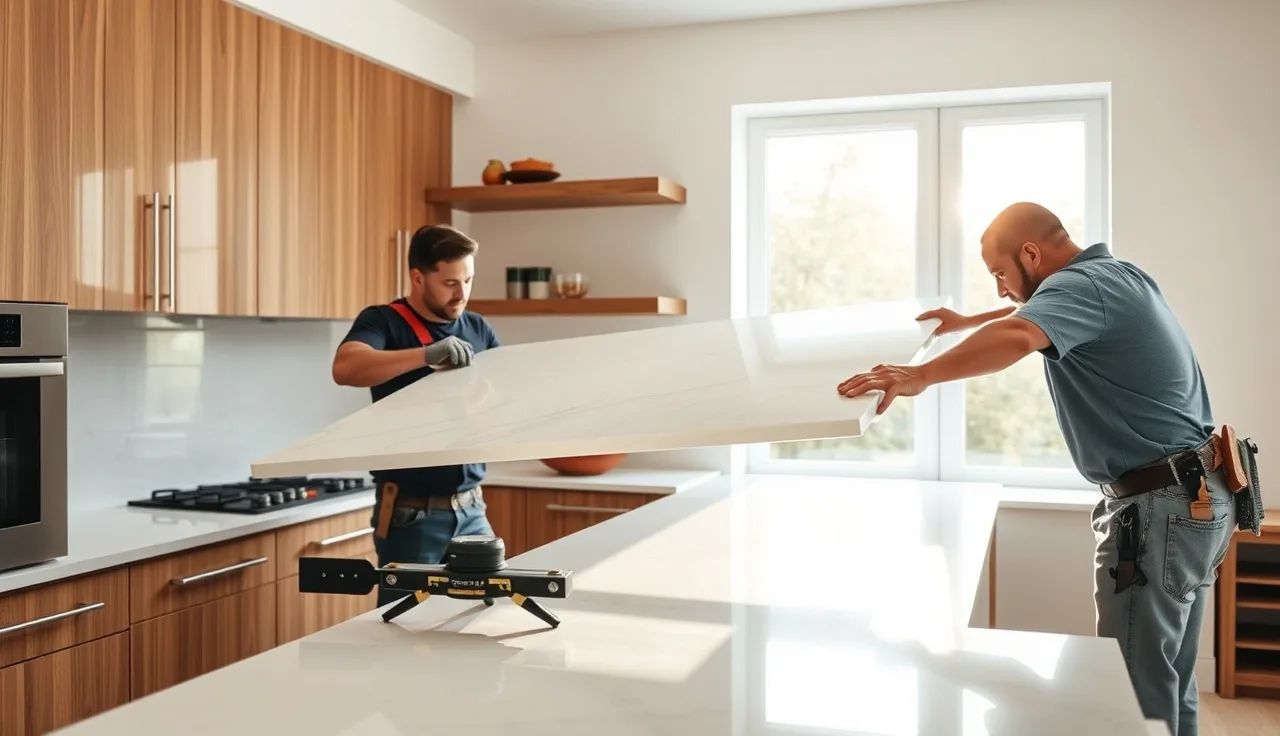
A quartz countertop installer does far more than drop a slab on your cabinets. The job starts with a detailed template, usually a digital laser scan or a physical cardboard cutout of your exact cabinet layout. That template drives the CNC cutting of the slab back at the shop. Then the installer returns, carries the finished pieces in (quartz runs 18 to 22 pounds per square foot, so a typical 40-square-foot kitchen counter weighs 700 to 900 pounds spread across multiple pieces), sets them on a bead of silicone, checks for level, and joins the pieces with color-matched epoxy.
Here is the distinction that trips up most homeowners. The person who sells you the slab, the fabricator who cuts it, and the installer who sets it are sometimes one company and sometimes three separate businesses. Buying from a big box store almost always means the store hands you off to a subcontracted installer network. A local stone yard usually runs its own crew. Both models can work. You just need to know which one you're dealing with before you sign, because warranty coverage and accountability split along that line.
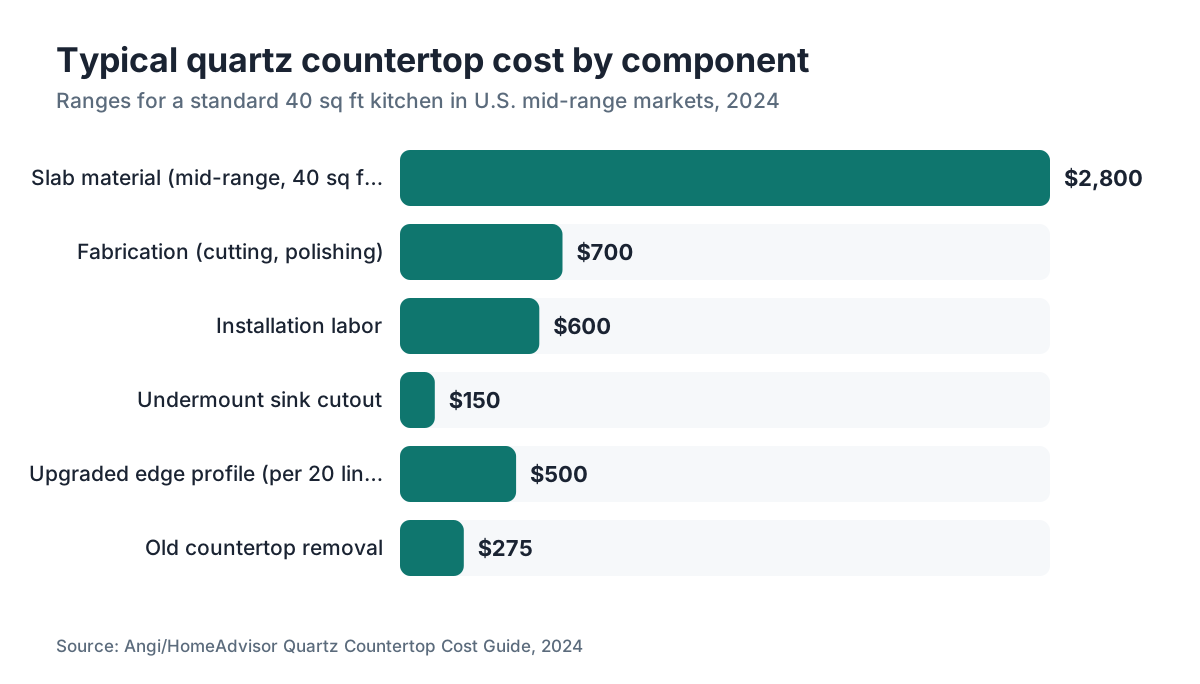
Cutouts eat labor. A sink cutout, a cooktop cutout, and faucet holes all add time and blade wear. A standard undermount sink cutout adds roughly $100 to $200 to the quote [1]. Edge profiles (eased, beveled, ogee, waterfall) get milled at the shop but polished on-site, and a complex profile like a double ogee can add $15 to $40 per linear foot [1].
For how quartz stacks up against other surfaces on install complexity, see our guide to kitchen countertops.
How much does quartz countertop installation cost?
Most homeowners pay $50 to $150 per square foot installed. The range is that wide for a simple reason: four variables move the price independently, and no honest shop can quote you a clean number until they know all four. Those variables are slab cost per square foot, linear footage of edge that needs profiling, number of cutouts, and local labor rates.
Here is a realistic breakdown by component:
| Cost Item | Typical Range | Notes |
|---|---|---|
| Quartz slab (material) | $40, $100/sq ft | Entry-level to premium brands |
| Fabrication (cutting, polishing) | $10, $25/sq ft | Usually bundled with slab quote |
| Installation labor | $10, $20/sq ft | Sometimes bundled, sometimes separate |
| Standard eased edge | Included, $5/lin ft | Many shops include one profile free |
| Upgraded edge (ogee, waterfall) | $15, $40/lin ft | Per linear foot of profiled edge |
| Undermount sink cutout | $100, $200 each | More for farmhouse/apron styles |
| Cooktop cutout | $80, $150 each | Varies by shape |
| Backsplash (4-inch) | $10, $20/lin ft | Full-height backsplash costs more |
| Removal of old countertops | $150, $400 flat | Some shops don't offer this |
| Permit (rare, but possible) | $50, $200 | Most jurisdictions don't require one |
A real 40-square-foot kitchen with a mid-range slab, an eased edge, one undermount sink cutout, and no cooktop cutout runs roughly $2,800 to $5,200 installed in most U.S. markets as of 2024 [1][2]. High-cost metros like San Francisco, New York, or Boston push toward the top of that range or past it. Rural markets can land below it.
That advertised "starting at $45 per square foot installed" number rarely survives contact with your actual kitchen. Edge profiling and cutouts are almost always extra. Get an itemized quote, not a per-square-foot teaser.
Comparing quartz to natural stone? Our granite countertops and marble countertops guides have matching cost breakdowns.
How do you find reputable quartz countertop installers near you?
The best quartz countertop installers are almost always fabricators first. They own the CNC equipment, they cut the slabs themselves, and the install is the last step of their own process. Hiring a standalone installer who buys pre-cut pieces from a third party adds a middleman and an accountability gap if anything warps, seams badly, or chips.
Four ways to find fabricator-installers worth a call:
-
Manufacturer dealer locators. Cambria, Silestone, Caesarstone, and MSI all run dealer networks on their websites. Dealers in those networks have signed agreements and often get training. That's not a quality guarantee, but it filters out the worst operators.
-
Contractor referrals. A general contractor or kitchen designer who has watched installers work in person beats online reviews. They see the aftermath: whether seams telegraph through the finish, whether the undermount sink bracket holds, whether crews clean up.
-
The Natural Stone Institute directory. NSI lists accredited fabricators at naturalstoneinstitute.org. Its fabricator accreditation program includes shop audits, and accredited shops are listed publicly [3].
-
Local stone yards. Every metro has two or three yards that sell slabs to fabricators. Call and ask which local shops buy from them regularly. They won't badmouth customers, but they'll tell you who moves volume.
Once you have names, ask each shop for three recent references in your zip code, ask to tour the physical shop (no CNC equipment means it's not a fabricator), and ask how they handle warranty claims. A shop that owns the whole process from template to install answers that question fast and with specifics. A broker stalls.
What questions should you ask a quartz installer before signing?
Most homeowners ask about price. Price matters, but five other questions matter more for how the job turns out.
"Who does the template and who does the install?" If those are two crews from two companies, find out who is liable when the template is off and the slab doesn't fit. Get the answer in writing.
"Is your quote all-in?" Ask specifically whether edge profiling, cutouts, haul-away of the old top, and plumbing reconnection are included or extra. Get line items on paper.
"What adhesive and seam filler do you use?" A good fabricator uses manufacturer-recommended two-part epoxy for seams and 100% silicone around the perimeter. Color-matching the epoxy matters, and it gets mixed on-site to match the specific slab. A shop that can't tell you this hasn't thought hard about the work.
"How long has your crew done quartz specifically?" Quartz installs differently from granite. The material is slightly more flexible, which means it can crack under point loading if the cabinets aren't level. Experienced quartz installers shim and level cabinets before they set stone, not after.
"What's your warranty, and is it in writing?" The slab manufacturer (Cambria, Silestone, and so on) warrants the material against defects. The fabricator warrants the workmanship: seams, cutouts, edges. Two separate warranties. Know which is which and what each claims process looks like.
For cross-surface context, the countertop installation guide breaks down how this works across all material types.
How long does quartz countertop installation take?
Two clocks run here, and mixing them up causes most homeowner frustration. On-site time on install day is usually two to four hours for a standard kitchen. The calendar from signed contract to install day is three to four weeks.
Install-day time assumes the cabinets are level, the layout is ordinary, and every piece is pre-cut. A complex kitchen with an island, multiple cutouts, and a waterfall edge can take six to eight hours. Plan to have your kitchen out of commission for a full day, not a morning.
The calendar is where things stretch. A reasonable sequence:
- Day 1: Contract signed, deposit paid (usually 50%)
- Day 3 to 7: Template appointment (after cabinets are installed and level)
- Day 7 to 21: Fabrication at the shop (most shops run one to three weeks depending on backlog)
- Install day: Final payment due at completion or shortly after
Three to four weeks is common. During busy seasons (late spring and fall, when kitchen remodels peak), six weeks is not unusual at good shops. A shop promising install in under a week for a complex job is either skipping the template step or running very low volume, and low volume at a fabrication shop can mean inexperienced crews.
If your general contractor has a hard punch-list date, tell your fabricator before you sign. Rush fees are real (10 to 25% markup is typical) and sometimes worth paying to hit a move-in date.
What credentials and certifications should a quartz installer have?
No federal license exists for installing countertops in the U.S. [4]. Most states don't license countertop installers separately from general contractors either, though the rules vary. California requires a C-54 (Ceramic and Mosaic Tile) or D-12 (Synthetic Products) specialty contractor license for some countertop work, through the California Contractors State License Board [5]. Florida requires a license through the Florida Department of Business and Professional Regulation for contractors working above a $1,000 threshold [6]. Check your state's contractor licensing board before you hire.
Beyond licensing, the Natural Stone Institute runs a Fabricator Accreditation program. Accreditation requires an on-site audit of shop equipment, safety practices, and quality procedures by an NSI auditor [3]. It's not common (fewer than 100 shops nationwide held accreditation as of 2023), but it is the most credible third-party credential in the trade.
Manufacturer certifications exist too. Cambria runs a network of authorized dealers and fabricators trained on its product. Silestone (from Cosentino) keeps a similar network. These are marketing relationships as much as quality programs, but they carry some accountability. A Cambria-certified fabricator who does poor work risks losing the certification and the margin that comes with it.
For any project over $1,000, confirm the installer carries general liability insurance (ask for a certificate naming you as additionally insured for the project) and workers' compensation if they have employees. This is not optional. A worker injured in your home on an uninsured job can turn into a claim against your homeowner's policy. Most policies cover it, but your rates can take the hit.
What can go wrong during quartz installation, and how do you avoid it?
Quartz forgives more than natural stone, but it isn't foolproof. When something goes wrong, it almost always traces to one of three causes: poor templating, out-of-level cabinets, or bad seam technique.
Poor templating. A template that's even slightly off means the slab won't fit. Laser templating (using tools like the LT-55 or Proliner systems) cuts that risk sharply compared to cardboard. Ask which method your fabricator uses. Laser is the current standard at professional shops.
Out-of-level cabinets. Quartz can't bridge gaps. If your cabinet run has a 3/8-inch low spot in the middle, the slab cracks there, either over time or right during install. A good installer checks level before setting stone and shims as needed. Cabinets should sit within 1/8 inch of level across the run, per most fabricator guidelines. Badly out-of-level cabinets need fixing before the template appointment, not after.
Bad seams. A good seam is nearly invisible from standing height. A bad one shows as a visible line and collects debris. The causes: mismatched epoxy color, pieces that weren't aligned, or a technician who didn't take time to clamp and cure the seam. Seams placed over cabinet joints, where there's no support beneath, crack over time. Seams should always land over a cabinet rail, never over a void.
Chipped edges in transport. Quartz pieces crack and chip at the corners if they aren't supported in the truck. Ask how pieces travel. A professional shop cradles slabs vertically in padded A-frames, not flat on a truck bed.
See our guide to how to clean stone countertops for how to protect the surface once it's in.
Should you DIY quartz countertop installation or always hire a pro?
Short answer: hire a pro.
Quartz slabs are heavy enough to injure or kill if mishandled, and the material doesn't forgive install errors the way laminate does. A chipped edge, a seam that didn't cure, or a crack from a cabinet that wasn't shimmed can cost nearly as much to fix as the original install. Most quartz manufacturers also void the material warranty if a non-certified installer does the work, though the fine print varies by brand.
Two things a handy homeowner can realistically do: tear out the old countertops (saving $150 to $400 on removal) and handle plumbing disconnect and reconnect (saving another $150 to $300 if you're comfortable with the P-trap and supply lines). Neither one touches the quartz warranty.
Some homeowners try to install prefabricated quartz pieces bought from big box retailers. These come pre-cut in standard sizes (typically 26 inches deep, in various lengths) and can work for a simple straight-run kitchen with no island. Material cost is lower, but the seam quality rarely matches a shop's custom work, and most layouts end up with more visible seams. If your kitchen is anything other than a straight run with a drop-in sink, prefab is the wrong tool.
If budget is the real constraint, laminate countertops and formica countertops are surfaces where DIY install is genuinely realistic and the skill ceiling is much lower.
How do quartz countertop installers price a job, and what's in a good quote?
From the fabricator's side, a quartz job starts with slab square footage (with a waste factor built in, usually 15 to 25% for most residential layouts) multiplied by the slab cost per square foot. Then they add fabrication time, edge-profiling linear footage, cutout count, and installation labor.
Fabrication software made this faster and more accurate. Tools like SlabWise let fabricators generate itemized quotes and optimize slab nesting to cut waste, which in a competitive market is a real cost difference. When a fabricator quotes you quickly and with line-item detail, that usually signals an organized back office, which usually tracks with an organized install crew.
A quote you should feel good about includes:
- Square footage used (ask how they calculated it)
- Slab cost per square foot and the specific slab/color (ask for the lot number once selected, so color stays consistent across pieces)
- Edge profile type and linear footage
- Cutout count and type (undermount, drop-in, cooktop, faucet holes)
- Tear-out and haul-away (included or priced separately)
- Seam locations (marked on a sketch or digital layout)
- Payment schedule and deposit amount
- Warranty terms
A quote that's just one number isn't a quote. It's a placeholder that grows. Get the itemization before you sign anything.
How does quartz installation differ from granite or marble installation?
Quartz and natural stone share most of the same install steps (template, cut, transport, set, seam), but the real differences matter if you're weighing bids from shops that mostly work in granite or marble.
Weight. Quartz runs 18 to 22 pounds per square foot [7]. Granite runs 16 to 18 pounds. Both need multiple people on the crew and proper transport. Neither is a one-person job.
Sealing. Granite and marble need periodic sealing (every one to three years depending on stone density and use) because they're porous. Quartz is engineered with resin binders that make it non-porous, so it never needs sealing [8]. That's one of the main reasons people pick quartz. An installer who tells you to seal your quartz slab doesn't know quartz.
Heat tolerance. Quartz is less heat-resistant than granite or quartzite. The resin binders can discolor or crack under sudden high heat, like a hot pan set straight on the surface. Installers should say this out loud, and homeowners should use trivets. Granite handles heat better, though thermal shock can still crack any stone.
Edge behavior. Quartz chips more cleanly than granite when an edge gets struck, and the chip shows more because the color runs uniform through the slab (unlike granite, where veining can camouflage a small repair). Experienced quartz installers handle corners with that in mind.
For more on natural stone, see granite countertops and marble countertops. Looking at Cambria specifically? The Cambria countertops guide covers that brand's installer network in detail.
What warranties should you expect from a quartz installer or fabricator?
Two separate warranty streams run on every quartz job: the manufacturer's material warranty on the slab, and the fabricator's workmanship warranty on the install.
Manufacturer warranties on the major brands are strong. Cambria offers a lifetime limited warranty to the original owner covering defects in material or manufacture [9]. Silestone offers a 25-year limited warranty [12]. Caesarstone offers a lifetime limited warranty on residential installations [10]. None of these cover damage from improper installation, thermal shock, misuse, or normal wear.
The phrase "defects in material or manufacture" does a lot of work in those documents. If your slab cracks because of an out-of-level cabinet, that's installation, not manufacture. Read the exclusion clauses.
Fabricator workmanship warranties vary widely because individual businesses set them, not manufacturers. One year is common. Two years is generous. Some shops offer no written workmanship warranty at all, which is a red flag. Ask for it in writing before you sign the job contract.
Buying through a big box store makes the warranty chain messier. The store may offer its own installation guarantee (Home Depot's countertop installation service, for example, offers a one-year labor guarantee as of 2024 [2]), but the actual installer is a subcontractor, and a claim may mean working both the store and the sub. Document everything in writing at the time of sale.
For fabricators: putting your warranty terms in the quoting system from day one makes claims easier to resolve and cuts disputes. Shops using software like SlabWise can attach warranty terms directly to the job record.
How should you prepare your home for a quartz installation day?
The most overlooked part of hiring a quartz installer is what you do before they arrive. A few hours of prep saves everyone time and protects your home.
Cabinets have to be fully installed and level before the template appointment, not before install day. Installers who show up to find cabinets that still aren't in or aren't plumb will reschedule, and that usually means the back of the production queue.
Clear the kitchen completely. Dishes, small appliances, everything in the cabinets below the counters, all of it out. The crew carries heavy slabs through your home and can't work around clutter. Clear a path from the entry point (usually the front door or garage) to the kitchen.
Disconnect the plumbing. The supply lines to the faucet and the P-trap under the sink need to come off before install. If you're not comfortable, hire a plumber for a one-hour service call. Leave it connected and the installer usually charges extra or just leaves it for you to sort out afterward.
Plan for dust. Even with wet cutting done at the shop, on-site grinding and polishing throws silica dust. This is a genuine health concern. Federal OSHA sets exposure limits and dust-control requirements for crystalline silica under 29 CFR 1926.1153, and OSHA's own guidance states that "exposure to respirable crystalline silica can cause silicosis" [11]. A professional crew works with a wet protocol. Ask about their dust control, and keep pets and kids out of the work area.
After install, the silicone perimeter bead needs 24 to 48 hours to cure before you reconnect plumbing or load the counter. Your installer should tell you this. If they don't, ask.
Are there permit requirements for quartz countertop installation?
In the large majority of U.S. jurisdictions, replacing countertops doesn't require a building permit. Countertop replacement counts as a cosmetic or maintenance item, not structural, electrical, or plumbing work, so it usually falls below the permit threshold [4].
There are narrow exceptions. If the countertop is part of a bigger kitchen remodel that moves plumbing or electrical (adding an outlet for a countertop appliance, relocating a sink drain), that broader project likely triggers a permit for those trades even when the countertop itself doesn't. Some jurisdictions also set their own thresholds. A few cities require a permit for any contractor work above a dollar figure, which isn't a common rule for countertops but exists in isolated cases.
Safest move: call your local building department or check its website before you start. The call takes five minutes. When a permit is required for countertop work, it's cheap (usually $50 to $200), and skipping a required permit can create problems at resale.
Your installer should know the local rules. If they go blank when you ask about permits, that tells you something about how informed they are in general.
Frequently asked questions
How much does it cost to have quartz countertops installed?
Most homeowners pay $50 to $150 per square foot all-in for quartz, covering slab material, fabrication, and installation. A typical 40-square-foot kitchen lands between $2,800 and $5,200 installed in most U.S. markets. Edge profiles, cutouts, and removal of old tops add to that base. High-cost metro areas push toward the top of the range or past it.
How do I find a quartz countertop installer near me?
Start with the dealer locators on the major brand sites (Cambria, Silestone, Caesarstone, MSI). The Natural Stone Institute at naturalstoneinstitute.org lists accredited fabricators. Referrals from kitchen designers or general contractors are reliable because they've seen the actual work. Local stone yards can also point you to active, high-volume shops in your area.
How long does it take to install quartz countertops from start to finish?
The calendar runs three to four weeks for most residential jobs: about a week to reach the template appointment, one to three weeks of fabrication, then install day. On-site time on install day is usually two to four hours for a standard kitchen. Busy seasons (spring and fall) can stretch the total to six weeks at good shops.
Does quartz countertop installation require a permit?
In most U.S. jurisdictions, countertop replacement doesn't require a permit because it counts as a cosmetic change, not structural or mechanical work. The exception is when plumbing or electrical work is part of the same project. Call your local building department to confirm. Requirements vary by city and county.
What certifications should a quartz countertop installer have?
There's no universal federal license for countertop installers, though some states require a contractor license for the work. The Natural Stone Institute's fabricator accreditation is the most credible third-party credential in the trade. Manufacturer dealer certifications (Cambria, Silestone, and others) also signal some training and accountability, though they're partly marketing relationships.
Can quartz countertops be installed over existing countertops?
Technically possible in some cases, but most fabricators recommend against it. Installing over existing tops adds height that can interfere with appliances and the undermount sink. More importantly, any movement in the old surface transfers straight to the quartz above. Standard practice is full removal of the old top before setting the new slab.
How long after installation can I use my quartz countertops?
The perimeter silicone bead needs 24 to 48 hours to fully cure before the counter goes under load or the plumbing reconnects. Most installers recommend light use (no heavy objects, no water exposure) for the first 24 hours. After that, quartz is ready for normal use with no sealing or extra treatment.
Do I need to seal quartz countertops after installation?
No. Quartz is engineered with resin binders that make it non-porous, so it never needs sealing. That's one of the main differences from natural stone like granite or marble, which do need periodic sealing. An installer who recommends sealing your quartz doesn't understand the material.
What is the difference between a quartz fabricator and a quartz installer?
A fabricator cuts and finishes the slab (edge profiles, cutouts, seam prep) on CNC equipment at a shop. An installer sets the finished pieces in your home. At good shops the same company does both. Some retailers use subcontracted installers who never cut the slab. Knowing who owns each step matters for warranty claims when something goes wrong.
How many seams will my quartz countertop have?
It depends on the layout. Quartz slabs are typically 55 by 120 inches. Any run longer than about 9 feet needs a seam. L-shaped kitchens almost always have one seam at the corner. An island may or may not need one depending on size. Your fabricator should provide a seam diagram before you approve the job, and every seam should fall over cabinet support, never over a void.
What should I do if my quartz countertop cracks after installation?
Document it immediately with photos. Contact your fabricator first, since cracking is usually a workmanship issue (out-of-level cabinet, no support at the seam) rather than a material defect. If the fabricator goes quiet, contact the slab manufacturer and reference your install date. Cracks from abuse or thermal shock (a hot pan straight on the surface) are typically excluded from warranty coverage.
Is quartz countertop installation a good DIY project?
Not for most homeowners. Quartz slabs weigh 18 to 22 pounds per square foot, seam technique needs specific tools and skill, and most manufacturers void the material warranty if a non-certified installer does the work. Where DIY makes sense is prep: removing the old counters and disconnecting plumbing, which can save $300 to $700 on the job.
How do I know if my cabinets are ready for quartz countertop installation?
Cabinets should be fully installed, secured to the wall, and level to within 1/8 inch across the run before the template appointment. Out-of-level cabinets are one of the most common causes of post-install cracking. Your installer should check level before setting any stone. If they don't, ask them to.
What is the average labor cost for quartz countertop installation separate from material?
Labor alone (installation, not fabrication) typically runs $10 to $20 per square foot, or $300 to $700 for a standard kitchen. Many shops bundle fabrication and installation and don't break them out. If you're comparing bids, ask each shop to itemize so you're comparing equivalent services.
Sources
- HomeAdvisor (Angi), Quartz Countertop Cost Guide: Typical installed quartz countertop costs, edge profile pricing, and cutout pricing ranges
- Home Depot, Countertop Installation Services: Home Depot's countertop installation service includes a one-year labor guarantee
- Natural Stone Institute, Fabricator Accreditation Program: NSI offers a fabricator accreditation program with on-site audits; accredited shops are listed publicly
- U.S. Department of Housing and Urban Development: Cosmetic home improvements like countertop replacement do not typically require a building permit at the federal level
- California Contractors State License Board, License Classifications: California requires specialty contractor licenses (C-54 or D-12) for certain countertop installation work
- Florida Department of Business and Professional Regulation, Contractor Licensing: Florida requires contractor licensing for projects exceeding a $1,000 threshold
- Natural Stone Institute, Stone Weight Reference: Engineered quartz slabs typically weigh 18 to 22 pounds per square foot
- Natural Stone Institute, Engineered Stone Care: Engineered quartz is non-porous and does not require sealing, unlike porous natural stone
- Cambria, Warranty Information: Cambria offers a lifetime limited warranty to the original owner covering defects in material or manufacture
- Caesarstone, Warranty Terms: Caesarstone offers a lifetime limited warranty on residential quartz countertop installations
- U.S. Occupational Safety and Health Administration, Crystalline Silica (29 CFR 1926.1153): OSHA sets exposure limits and dust-control requirements for crystalline silica; exposure can cause silicosis
- Silestone by Cosentino, Warranty and Guarantee: Silestone offers a 25-year limited warranty on quartz countertops
Last updated 2026-07-09