TL;DR
- Quartz countertop installation costs $75 to $150 per square foot installed, slab and fabrication and labor included.
- Most kitchens land between $3,000 and $6,000.
- The process runs in five fixed stages: template, cut, polish, deliver, set.
- Hire a pro.
- Quartz is heavy, cuts are one-shot, and nearly every manufacturer voids the warranty on a DIY install.
What does quartz countertop installation actually cost?
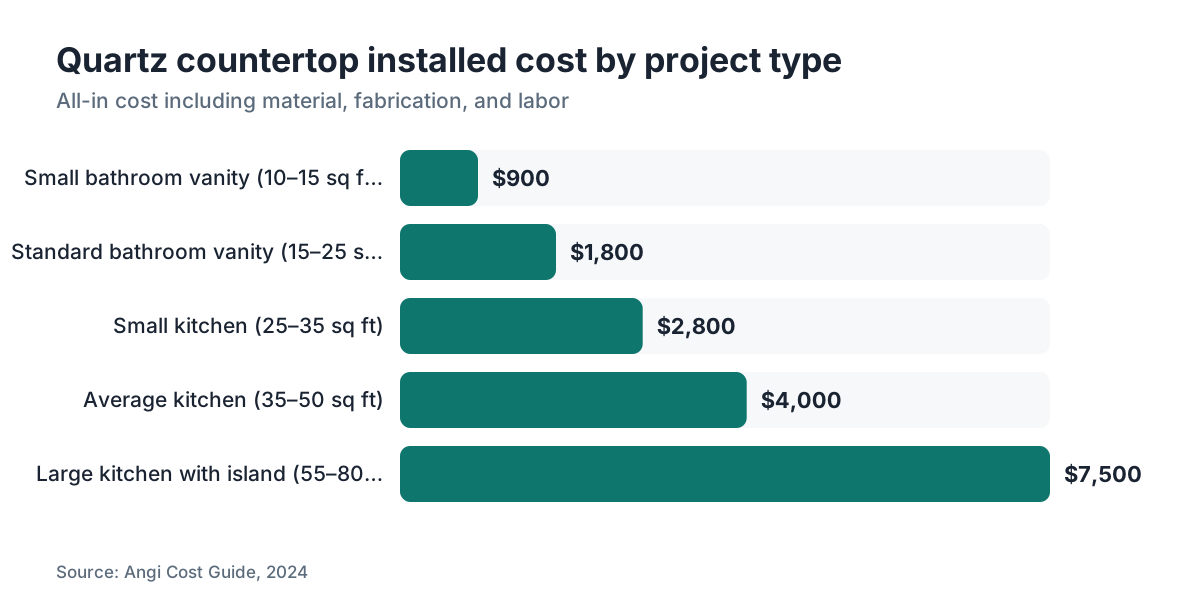
The honest answer is $75 to $150 per square foot, fully installed, slab cost baked in. A typical kitchen with 40 square feet of countertop runs $3,000 to $6,000 all in. Small bathrooms come in under $800. Big kitchens with islands and premium material push past $10,000.
That wide range exists because four separate cost buckets stack on each other: the raw slab, fabrication (cutting, edging, polishing), delivery, and install labor. Each moves independently.
Slab material alone runs $25 to $80 per square foot depending on brand and series. Entry-level quartz from a regional distributor (a basic white or gray from MSI or similar) sits at the low end, starting around $25 per square foot for material only [12]. Designer brands like Cambria or premium Silestone series sit at the top. Fabrication adds another $25 to $55 per square foot and covers CNC cutting, edge profiles, sink cutouts, and surface finishing. Labor to deliver and set the slab runs $150 to $300 flat per job for a straightforward kitchen, though stairs, tight access, or unusually heavy pieces push that higher [1].
A bathroom costs less to do, but not because anything is cheaper per square foot. You're just buying fewer square feet. A standard vanity top is 10 to 20 square feet.
What factors drive the cost to install quartz countertops up or down?
Edge profiles are the first hidden cost most homeowners miss. A simple eased edge (a slightly softened 90-degree corner) is usually included in the base fabrication price. Ogee, waterfall, or stacked mitered edges add $15 to $40 per linear foot. A kitchen with 25 linear feet of edge and an upgraded profile adds $500 to $1,000 to the bill [2].
Sink cutouts add $75 to $200 each depending on sink type. An undermount sink needs a precise cutout with a polished edge inside the bowl opening. Farmhouse and drop-in sinks are simpler. Cooktop cutouts cost about the same as an undermount sink cutout.
Thickness matters too. Quartz comes in 2 cm (about 3/4 inch) and 3 cm (about 1-1/4 inch). Most residential kitchens use 3 cm because it looks substantial and doesn't need a built-up edge to read thick at the front. Two-centimeter material is cheaper per square foot but often needs a laminated edge buildup, which adds the labor cost right back.
Layout complexity is real. A straight run along one wall templates and installs fast. An L-shaped kitchen with corners, an island, a peninsula, and a window sill is multiple pieces, multiple seams, and precise miters. More pieces mean more templating time, more fabrication time, and more weight for the crew to wrangle. Each piece weighs 18 to 22 pounds per square foot [3].
Removal of the old countertop adds $50 to $150. Most fabricators offer it but price it as a separate line. Plumbing reconnection after an undermount install is usually a separate plumber visit unless the fabricator's crew handles it.
Regional labor rates shift the total in a way you can feel. Skilled trade wages in high-cost metros like San Francisco, New York, and Boston run 20 to 40 percent above rural markets on the labor portion alone [11].
How does quartz countertop installation work, step by step?
The process has five stages and the order never changes. Knowing it helps you coordinate trades and dodge expensive mistakes.
Stage 1: Templating. A templater visits after cabinets are installed and level. They measure every dimension, note walls that are out of square (most are), pin the exact sink cutout location, and decide where seams fall. Modern shops use digital templating that transfers straight to the CNC machine [4]. The visit takes 30 to 90 minutes depending on complexity.
Stage 2: Fabrication. Your slab goes to the shop, where it's cut to the template, edges are profiled, cutouts are made, and every surface is polished. A residential job takes two to five business days in the shop. Rush jobs exist and cost more.
Stage 3: Delivery and dry fit. The finished pieces arrive on install day. The crew usually dry-fits each piece before any adhesive touches the cabinet, confirming the fit against cabinets and walls.
Stage 4: Setting. Silicone adhesive goes on the cabinet tops. Not epoxy, not construction adhesive. The slabs get set, leveled with shims where needed, and seams are joined with color-matched two-part epoxy. Undermount sinks are clipped to the underside of the stone at this stage.
Stage 5: Seam finishing and cleanup. Seam epoxy is shaved flush and polished. Silicone caulk goes at the wall-backsplash joint and around the sink. The crew leaves the surface protected with paper or cardboard and tells you to wait 24 hours before use.
For how this fits the wider project, the countertop installation overview covers every material type and how it sequences with other trades.
Can you install quartz countertops yourself, or do you need a pro?
You can. Plenty of homeowners have. Go in clear-eyed about what makes it hard.
Quartz slabs are heavy. A 3 cm slab weighs 18 to 22 pounds per square foot [3]. A typical 8-foot-by-2-foot kitchen section weighs 250 to 350 pounds. Moving and positioning a piece that size without cracking it at a cutout or wrecking your back takes three or four people and real lifting equipment.
Quartz is unforgiving of a bad cut. Once you cut it, that's the piece. A mistake that ruins a section means buying more material, maybe a full new slab, which starts at $300 and can top $1,500. Pros have CNC equipment and years of feel for the material. A circular saw with a diamond blade handles straight cuts, but it won't give you the clean edge a CNC router does.
Seaming is the hardest skill of all. Matching color-blended epoxy to the slab, pulling the joint tight, and sanding it truly flush takes practice. A rough seam on a $4,000 countertop is a daily reminder of the money you saved.
Here's where DIY actually makes sense: prefabricated quartz ("prefab" or "remnant" quartz) comes pre-cut in standard widths, usually 25.5 inches, and just needs cutting to length. It works for straight bathroom vanities with simple layouts. The savings are real. Prefab quartz can run $20 to $40 per linear foot, though the color selection is thin [5].
Warranty is the other catch. Most manufacturer warranties (Cambria, Silestone, Caesarstone, and the rest) require professional installation. Cambria's limited lifetime warranty voids outright if you install it yourself [10].
How do you install quartz countertops: the technical requirements
If you're doing this yourself or supervising a crew, these are the non-negotiables.
Cabinets must be level. Quartz does not flex. If cabinets are out of level by more than 1/8 inch across the run, you get either a slab that rocks or a visible gap at the wall. Level the cabinets before the templater shows up.
Support spans matter. A 3 cm slab can overhang unsupported up to about 12 inches before deflection risk climbs. Beyond that, you need corbels or steel brackets. Silestone's published technical data specifies a 6 to 12 inch unsupported overhang limit depending on thickness [6].
Adhesive is silicone, full stop. It bonds the stone to the substrate, stays flexible enough to handle seasonal movement, and won't telegraph cracks into the stone the way rigid adhesives do. Seams between pieces use a two-part color-matched epoxy.
Seam placement is the fabricator's call, but you should understand the logic. Seams avoid high-traffic zones like the front of the sink, align with cabinet face-frame joints where possible, and never fall over an unsupported span. Good fabricators minimize seams. The best layouts sometimes have none.
Outlet cutouts at the back edge mean notching the stone. That's far easier at the shop than in the field, so flag every outlet and switch box at the template visit.
Temperature matters less for quartz than for natural stone, but the adhesive needs to cure above 50 degrees F (10 degrees C). Don't install in an unheated garage in January and expect a fast set.
How long does quartz countertop installation take on install day?
For a typical kitchen, the crew is in and out in two to four hours. A complex kitchen with an island, multiple seams, and an undermount sink runs four to six hours. Very large or complicated jobs occasionally take a full day.
The day-of timeline looks about like this: the crew arrives, reads the space, and carries in pieces one at a time. Dry fitting takes 20 to 40 minutes. Adhesive and setting takes 30 to 60 minutes. Seam work and finishing adds another 30 to 60 minutes. An undermount sink clamp adds time on top of that.
The 24-hour wait before use is real. The silicone needs that time to reach full strength. You can use the space carefully after a few hours, but cooking with heavy pots on a fresh install before the adhesive cures is asking for trouble.
What does a quartz countertop cost estimator actually need to calculate your price?
Any honest estimator needs at least five inputs to give you a number worth trusting: square footage, edge linear footage, number of cutouts (sinks, cooktops, outlets), material grade, and whether removal of the old countertop is included.
Square footage is your total countertop surface area. Measure the depth of each run (typically 25.5 inches for a kitchen, 22 inches for a bathroom) times the length, then add the sections together. Count the island separately. Don't forget the windowsill if it's getting done.
Edge linear footage is the total length of exposed edges that need profiling. Front edges and any exposed side edges count. Walls and backsplashes don't, because those edges are hidden.
Material grade is the single biggest variable. If you're comparing quotes, compare the same brand and series, more than the word "quartz." A square foot of MSI White Carrara and a square foot of Cambria Brittanicca Gold are both quartz and are priced worlds apart.
Fabricators who run digital quoting software (tools like SlabWise generate a quote from a template directly) can hand you a line-item breakdown of material, fabrication, and install. Ask for it. It turns comparison shopping into an actual comparison instead of guessing what each bottom-line number bundles.
A realistic budget for a 40-square-foot kitchen with a standard edge, one undermount sink cutout, and mid-grade quartz: roughly $3,200 to $4,800 installed [1][7].
How does quartz installation compare to other countertop materials?
Here's the short version, because install process and cost vary more than most people expect.
| Material | Avg. installed cost (per sq ft) | DIY feasible? | Sealing required? | Weight (per sq ft, 3cm) |
|---|---|---|---|---|
| Quartz | $75, $150 | Difficult | No | ~18 to 22 lbs |
| Granite | $60, $130 | Difficult | Yes, annually | ~18 to 22 lbs |
| Marble | $80, $200 | Very difficult | Yes, frequently | ~18 to 22 lbs |
| Quartzite | $80, $180 | Very difficult | Yes, frequently | ~18 to 22 lbs |
| Butcher block | $30, $80 | Yes | Yes, periodic | ~7 to 12 lbs |
| Laminate | $20, $50 | Yes | No | ~2 to 5 lbs |
| Solid surface (Corian) | $45, $100 | Possible | No | ~4 to 8 lbs |
Quartz wins on maintenance: no sealing, good stain resistance, consistent color. It loses on heat. The resin binders are polymer-based and can discolor from sudden heat exposure, so trivets aren't optional [8].
Granite countertops run slightly cheaper on average and shrug off direct heat, but they need annual sealing and show more slab-to-slab variation (which some people want as a feature). Laminate countertops and Formica countertops cost a fraction of the price and are genuinely good products that get dismissed unfairly. Butcher block countertops are DIY-friendly and warm, but they demand steady oiling.
What are the most common mistakes during quartz installation?
Cabinets not level before templating is the single most common problem. The fabricator templates what they see. Off cabinets produce a countertop cut to match the off cabinets, and it looks right from above but wrong at the wall. Level your cabinets before you call the templater. That's the homeowner's job, not the fabricator's.
Not accounting for appliance dimensions is next. A slide-in range has a specific width. Buy it after templating, find out it's 1/4 inch wider than the gap, and now you have a problem. Purchase or at least dimensionally confirm every appliance before the template visit.
Underplaying wall angles. Walls are almost never square. A skilled fabricator scribe-cuts the back edge to follow the wall contour so there's no gap. A lazy shop cuts it straight and hides the gap with caulk. On a curved or badly irregular wall, ask specifically how they plan to handle it.
Ignoring seam location during the quote. You have a right to know where seams fall before fabrication starts. Looking at a proposed seam layout on paper (or a digital template) beats discovering a seam in an annoying spot on install day.
Skipping protective film removal before use. Most quartz arrives with a protective film. Make sure the crew peels it off completely. Film trapped under caulk or at an edge looks bad and gets worse over time.
What questions should you ask before hiring a quartz installer?
Get answers to these before you sign anything.
Do you fabricate in-house or outsource? Shops that fabricate in-house have tighter quality control and clearer accountability when something goes sideways. Outsourcers can still be fine, but you should know who's actually cutting your stone.
Can I see the slab before you cut it? With natural stone this is essential. Quartz is more consistent, but for large slabs or unusual colorways, seeing the specific slab matters. Many distributors allow selection visits.
What is your seam policy, and how do you decide placement? How is the epoxy color matched? A good shop has an answer and can explain it plainly.
Is installation labor included in the quote, and what does it cover? Some quotes split delivery from installation. Some include sink clips, some charge extra. Nail down exactly what's inside the number.
What happens if the slab cracks during install? Quartz cracks occasionally at cutouts during fabrication or setting. A reputable shop eats the replacement cost when the crack is their error. Get that in writing.
Do you warranty the installation separately from the material? Most major brands warrant the material for 10 to 15 years or lifetime. The workmanship warranty is the fabricator's and typically runs one to two years. Ask for both in writing.
How do you care for quartz countertops after installation?
Quartz is one of the lowest-maintenance stone surfaces going. No sealing, ever. Day to day, a pH-neutral dish soap and a soft cloth is all it needs.
Avoid these: bleach-based cleaners, acidic cleaners (vinegar, lemon products), and abrasive scrub pads. The resin binders are durable but not invincible, and harsh chemicals dull the surface finish over time. Caesarstone's own care guidance recommends pH-neutral cleaners and prohibits bleach, acid, and abrasive products [9].
Heat is the real vulnerability. Quartz is made with polymer resins that can discolor or crack under sudden thermal shock. A hot pan straight off the burner or a broiler dish can mark or crack the surface permanently. Trivets are not optional. Granite and quartzite take direct heat far better.
For general stone surface care, the guide on how to clean stone countertops covers principles that apply across materials. Quartz is more forgiving than most, but gentle cleaners and no mechanical abrasion apply everywhere.
Stains usually give way to a nonabrasive cleaner like Bar Keepers Friend (used gently, no hard scrubbing) or a paste of baking soda and water. Let it sit a few minutes, then wipe. Dried adhesive, paint, or hard residue can be lifted with a plastic scraper, never metal.
Is quartz worth the cost compared to other countertop options?
For most households, yes, if you're choosing among stone-look materials. You get a predictable appearance, no annual sealing, strong stain resistance, and warranties that often run 10 years to lifetime.
Where the math changes: if you want the real thing, quartz won't satisfy you. It lacks the depth and movement of natural marble. If budget is tight, laminate countertops and Corian countertops are genuinely good alternatives that get dismissed unfairly. Modern laminate at $20 to $50 per square foot installed is a reasonable call for a rental, a budget renovation, or secondary surfaces.
For a kitchen countertop that takes daily hard use for 15-plus years, quartz is hard to argue against at the mid tier. It's not the cheapest surface. But set against marble at $80 to $200 per square foot installed, plus ongoing sealing and chip-repair, quartz often comes out ahead over a ten-year horizon.
To see how quartz pencils out for your exact layout before you call fabricators, SlabWise's free instant quote tool takes your dimensions and returns a ballpark based on real material and labor rates in your region.
The answer is almost never "buy the cheapest thing." It's also never "buy the most expensive thing." Match the surface to how you actually cook, clean, and live. That's the real calculation.
Frequently asked questions
How much does it cost to install quartz countertops in an average kitchen?
An average kitchen with about 40 square feet of countertop runs $3,000 to $6,000 installed, including the slab, fabrication, and labor. Mid-grade quartz with a standard edge profile puts most projects in the $3,500 to $4,500 range. Upgrades like a premium brand, a fancy edge profile, or multiple cutouts push the number toward the high end.
Can I install quartz countertops myself to save money?
You can, but it's genuinely hard. Quartz slabs weigh 18 to 22 pounds per square foot, require precise cuts that punish any error, and most manufacturer warranties void with a DIY install. Prefabricated quartz for a simple straight vanity is the most reasonable DIY scenario. For a full kitchen, hiring a pro almost always makes more financial sense once you factor in the risk of a ruined slab.
How long does quartz countertop installation take from order to finished?
From your template visit to a finished install, plan on two to four weeks. The template visit itself takes under two hours. Fabrication runs two to five business days at most shops. Scheduling delivery and install adds a few days to a week depending on the fabricator's backlog. Rush service is available and usually costs more.
Do quartz countertops need to be sealed after installation?
No. This is one of quartz's real advantages over natural stone. Quartz is engineered with polymer resins that fill the pore structure, making it nonporous. Sealing is neither needed nor effective. You skip the annual sealing ritual that granite, marble, and quartzite all require.
How thick should quartz countertops be?
3 cm (about 1-1/4 inch) is the residential standard and what most installers recommend. It looks substantial, handles unsupported overhangs better than 2 cm material, and doesn't need a laminated buildup edge to read thick at the front. Two-centimeter quartz costs slightly less per square foot but often needs edge lamination, which adds back some of that savings.
What is the maximum overhang for quartz without support?
For 3 cm quartz, most manufacturers specify a maximum unsupported overhang of 10 to 12 inches. Past that, corbels or steel brackets are required. Silestone's published technical data puts the limit at 6 to 12 inches depending on thickness. Check your specific manufacturer's guidelines, since warranty terms can depend on following them.
What edge profiles are available for quartz countertops and what do they cost?
A simple eased or beveled edge is usually included in the base fabrication price. Mid-tier profiles like ogee or bullnose add $10 to $25 per linear foot. Decorative profiles like waterfall, dupont, or stacked mitered edges add $25 to $50 per linear foot. A kitchen with 25 linear feet of upgraded edge can add $400 to $1,000 to the total.
How do quartz countertop costs compare to granite?
Quartz typically runs $75 to $150 per square foot installed; granite runs $60 to $130. They overlap heavily in the mid range. Granite's installed cost can dip lower at the entry tier because simpler domestic stones are cheap to source, but high-end granite and high-end quartz cost about the same. Granite needs annual sealing; quartz doesn't, which shifts the long-run comparison.
Will quartz countertops crack or chip?
Quartz resists chips and cracks well under normal use, better than granite or marble. The most common cause of cracking is thermal shock: a very hot pan set straight on the surface. Cracks can also start during install at cutout corners if not controlled. Most fabricators cut stress-relief notches at the internal corners of sink and cooktop cutouts to reduce that risk.
What should be done before the countertop installer arrives?
Cabinets must be fully installed, secured, and level. Clear everything off the countertop area and give the crew clean access to bring large slabs in. Know where your shutoff valves are if an undermount sink is being set. Confirm all appliance dimensions so the cut sizes are right. If you're removing the old countertop yourself, do it before install day.
Can quartz countertops be installed over existing countertops?
Technically possible, generally not recommended. New quartz over old laminate or tile adds height that fights with appliances, sinks, and backsplash transitions. The substrate has to be perfectly flat and solid, and most old countertops aren't. Most professional fabricators won't install over existing countertops because they can't guarantee the result and it can void the material warranty.
How is a quartz countertop seam made, and will it be visible?
Seams are joined with a two-part color-matched epoxy, then shaved and polished flush. On solid or near-solid colors, a well-done seam is nearly invisible from standing height. On heavily veined or patterned quartz, the seam shows because the pattern can't match perfectly across two pieces. Placement matters: ask your fabricator to show you the proposed seam location before fabrication starts.
Does the color or brand of quartz affect installation cost?
Brand and color affect material cost, not install labor. A high-end brand like Cambria costs more per square foot of material than a mid-tier brand, but the labor to cut, set, and finish it is the same. Some exotic or heavily textured surfaces need more careful cutting, which adds minor shop time. The material price gap is the real driver.
What is prefab quartz and is it a good option?
Prefab quartz comes pre-cut in standard widths (usually 25.5 inches) and lengths, and you cut it to the length you need. It runs $20 to $40 per linear foot versus $75 to $150 per square foot for custom-fabricated quartz. It works well for simple straight bathroom vanities. The tradeoffs are limited color selection, no complex layouts, and no custom edge profiles. For a basic rectangular vanity, it's a smart choice.
Sources
- HomeAdvisor / Angi, Quartz Countertops Cost Guide: Quartz countertop installation costs $75 to $150 per square foot installed; typical kitchens run $3,000 to $6,000 all in
- National Kitchen and Bath Association (NKBA), Cost vs. Value Research: Edge profile upgrades add $10 to $40 per linear foot above base fabrication pricing
- Natural Stone Institute, Natural and Engineered Stone Handling Guidelines: Engineered stone slabs at 3 cm thickness weigh approximately 18 to 22 pounds per square foot
- Natural Stone Institute, Stone Fabrication and Digital Templating Resources: Digital templating systems transfer measurements directly to CNC fabrication equipment, reducing field-cut errors
- The Spruce, Prefab vs. Custom Quartz Countertops: Prefabricated quartz countertops run $20 to $40 per linear foot vs. custom-fabricated at significantly higher square foot pricing
- Cosentino / Silestone, Technical Installation Guidelines: Silestone technical data specifies maximum unsupported overhang of 6 to 12 inches depending on slab thickness
- Remodeling Magazine, Cost vs. Value Report, Kitchen Remodel Data: Mid-range kitchen countertop budgets for 40 square feet of engineered stone run $3,200 to $4,800 installed
- NSF International, Countertop Surface Performance Standards: Engineered quartz surfaces contain polymer resin binders that are susceptible to thermal discoloration from sudden heat exposure
- Caesarstone, Care and Maintenance Guide: Caesarstone recommends pH-neutral cleaners and prohibits bleach, acidic, and abrasive products on quartz surfaces
- Cambria, Warranty and Installation Requirements: Cambria's limited lifetime warranty requires professional installation; DIY installation voids coverage
- U.S. Bureau of Labor Statistics, Construction Trade Occupations Wage Data: Regional labor rate variation for skilled construction trades ranges 20 to 40 percent between high-cost metro areas and rural markets
- MSI Surfaces, Product Specification Sheets: Entry-level quartz slabs from regional distributors start at approximately $25 per square foot for material only
Last updated 2026-07-10