TL;DR
- Professional countertop installation usually costs $200 to $1,500 in labor, depending on material, edge complexity, and number of cutouts.
- The full job runs from demolition through template, fabrication, and final set.
- Stone slabs take one to three weeks start to finish.
- Prefab and laminate go faster.
- Trying to DIY stone almost always ends in a chipped edge or a broken slab.
What does professional countertop installation actually involve?
Installation is more than dropping a slab on some cabinets. The pro process has five phases, and each one can go wrong in ways that cost real money to fix.
Demolition and site prep come first. The old countertop comes out, the cabinets get checked for level (they almost never are), and any shims or corbels needed for overhangs go in. This alone can eat a couple of hours in a busy kitchen.
Templating is next. For stone, a fabricator sends a templater who measures every wall angle, every corner radius, and every appliance cutout to within 1/16 of an inch. Most shops now use digital templating (CNC-based arms or laser scanners) that feeds straight into their cutting software, which is where tools like SlabWise fit into the fabricator's workflow. Templating takes 45 minutes to two hours depending on kitchen size.
Then fabrication. The slab gets cut, edges get profiled, and sink and cooktop cutouts get made at the shop. For granite or quartz, turnaround is typically 3 to 10 business days after templating [1].
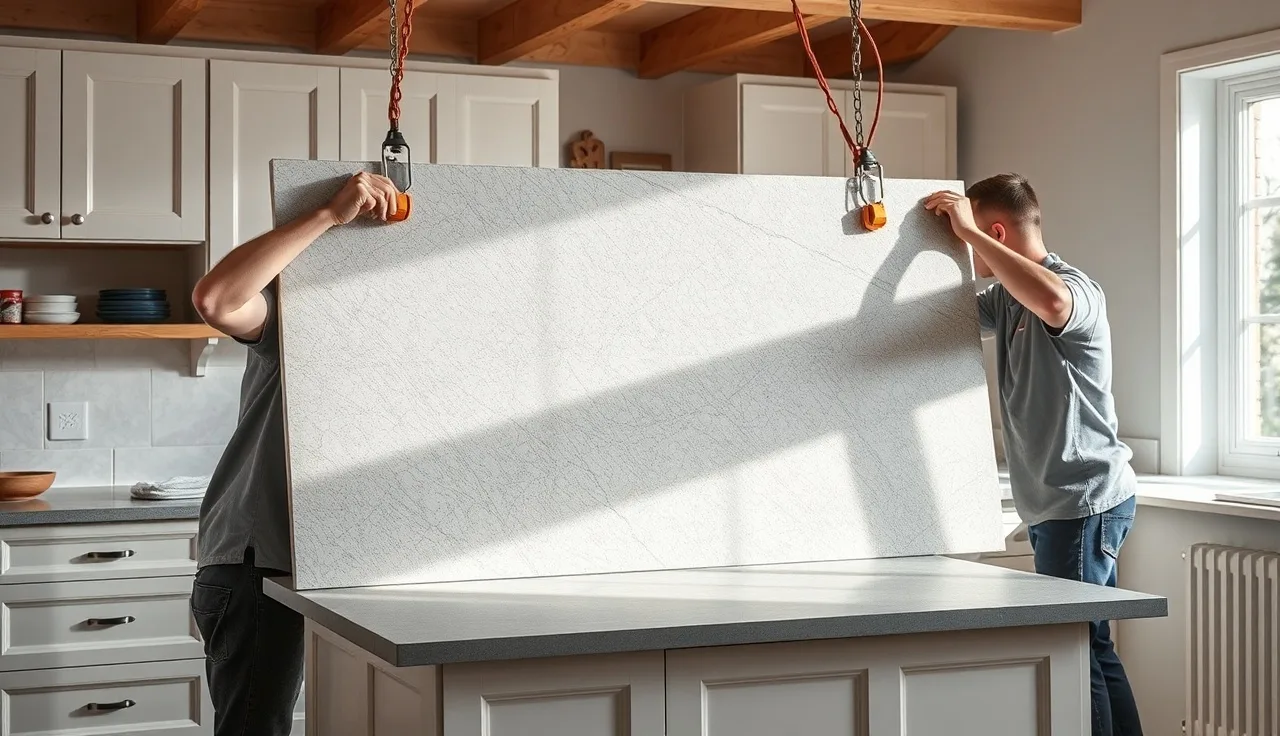
Install day arrives after that. For a typical L-shaped kitchen, a two-person crew handles delivery and set. Stone is heavy. A 3 cm granite slab weighs roughly 18 to 20 pounds per square foot [2], so a 30-square-foot section tops 500 pounds. Crews use suction cups and sometimes a dolly or carry strap to move sections into place.
Finishing closes the job. Silicone at the seams, caulk at the wall, sink attachment hardware, and a walk-through with the homeowner. Good installers don't leave until everything checks out.
How much does professional countertop installation cost?
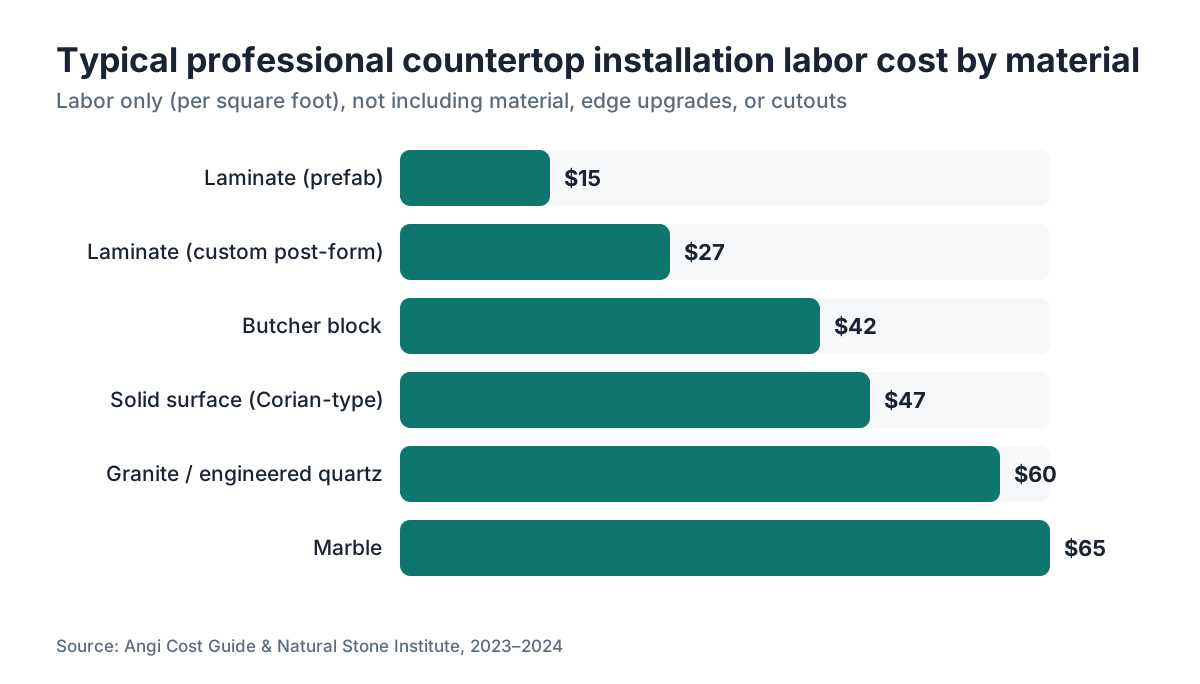
Labor alone, not material, runs from about $200 for a small prefab laminate job to $1,500 or more for a large stone kitchen with complex edges and multiple cutouts. The spread comes down to a handful of cost drivers.
| Material | Typical labor cost per sq ft | Notes |
|---|---|---|
| Laminate (prefab) | $10 to $20 | Low weight, simple seams |
| Laminate (custom post-form) | $20 to $35 | Requires more fitting |
| Granite or engineered quartz | $35 to $85 | Includes delivery, seaming, cutouts |
| Marble | $40 to $90 | Extra care, same process as granite |
| Butcher block | $25 to $60 | Lighter, but a level install is what matters |
| Solid surface (Corian type) | $30 to $65 | Seams fused, factory-trained installers preferred |
Angi (formerly HomeAdvisor) puts total countertop project cost (material plus labor) at roughly $1,870 to $4,700 for a typical kitchen, with labor making up about 15 to 25% of the total [3]. The labor share rises for expensive stone because the material cost dominates. It rises again for very simple materials, because minimum trip charges kick in on small jobs.
Cutouts add money. A typical undermount sink cutout costs $100 to $150 extra. A cooktop cutout adds another $75 to $125. Fancy edge profiles (ogee, dupont) run $15 to $30 per linear foot more than a simple eased or beveled edge.
Demolition of the old countertop is sometimes included, sometimes billed at $50 to $150. Ask upfront.
How long does professional countertop installation take?
Depends on whether you mean install day or the whole project. Install day itself takes two to six hours for most kitchens. The full timeline from cabinets to finished counters is more like three to four weeks for stone.
A small bathroom vanity might be one hour. A large kitchen with an island, multiple seams, and an undermount sink realistically takes four to six hours for the crew, plus curing time for the silicone before you set the sink.
The full project runs longer. For custom stone the sequence goes:
- Cabinet installation and leveling (done before template, not by the countertop crew)
- Templating: 1 to 2 hours on site, usually scheduled 1 to 3 days after cabinets are ready
- Fabrication: 3 to 10 business days at most shops
- Installation: scheduled after fabrication, usually 1 to 3 days out
Three to four weeks from cabinet completion is realistic for granite or quartz. Some shops run 2 to 3 weeks in slow season. Others back up to five weeks during spring remodel season [4].
Laminate prefab skips most of this. A plumber and a handyman can have a laminate top in place in a day if the product is in stock.
Butcher block countertops fall in the middle. They arrive in standard sizes and often install same-week, but the installer needs clean in-field cuts and the surface needs a finish coat (oil or polyurethane) that has to cure before you use it.
What should you do before the installation crew arrives?
Most installers give you a prep list. Not all do. Here's what actually matters.
Cabinets must be fully installed, leveled, and secured to the wall before templating. This is non-negotiable for stone. If a cabinet shifts after the template is cut, the stone may not fit. Some shops re-template once for free. Others charge $75 to $150 for a second visit.
Clear the cabinets. The crew sets heavy slabs on the boxes and opens doors to attach the stone from below. Empty everything in the uppers and lowers near the work area.
Remove the sink and disconnect plumbing before install day. Most countertop crews don't touch plumbing. Your plumber disconnects before, reconnects after. Budget for two plumber visits.
Protect floors and walls. Stone crews use moving blankets and suction cup dollies, but accidents happen. Pull up any floor covering you care about along the path to the kitchen.
Check appliance rough-in locations one more time against your template drawing. A cooktop sitting 2 inches off from where it was measured means a very expensive re-cut or a visible gap.
Make sure someone is home the whole time. Decisions come up (seam placement, caulk color, edge direction at corners), and calling the homeowner mid-job wastes everyone's afternoon.
How do fabricators handle seams, and can you see them?
Seam placement is one of the biggest decisions in the whole project, and homeowners often don't know they have a say until after the fact. A good seam, filled with color-matched epoxy and ground flush, is nearly invisible from standing height.
Seams exist because slabs have a maximum size (usually about 120 x 56 inches for quarried stone, larger for some engineered quartz [5]). Any run longer than one slab needs a seam. Islands with overhangs sometimes need seams just to manage weight.
Up close, you can usually find the seam. A bad one (misaligned, poorly color-matched, or dropped in a high-traffic spot) looks ugly and may crack over time.
Smart seam placement puts joints away from the sink, away from the main prep zone, and at an L-corner rather than the middle of a long run. If your fabricator sends a template drawing, look at where the seam lines land and ask to move them if they're in bad spots. Most fabricators will accommodate a reasonable request.
Engineered quartz and Cambria countertops have consistent patterning batch to batch within a color, which makes color-matching seams easier than natural stone, where two slabs from the same quarry can vary in veining and background. For highly veined natural stone, ask your shop to book-match or at least approve slab selection in person before templating.
What can go wrong during professional installation?
Even good crews hit problems. Knowing the common ones lets you catch them before they turn permanent. Cracks at cutout corners, unlevel cabinets, and mismatched silicone cause most of the complaints.
Unlevel cabinets are the top issue. If the run is out of level by more than 1/4 inch over its length, the stone will crack over time as it bridges a gap instead of sitting fully supported. Good installers shim and check level before setting any stone [11].
Cracks at cutouts happen more than shops admit. The corners of sink and cooktop cutouts are stress points. A small nick from a blade that runs past the score line, or a bump during delivery, can start a crack that spreads later. Inspect every cutout before the crew leaves.
Silicone color mismatches sound cosmetic but grate on you over time. White silicone under a gray slab reads like a gap. Ask to see the color before it goes in.
Wall gaps show up when the wall isn't straight, and walls are never straight. Most installers caulk these; the question is whether the line is neat and color-matched. On tile or painted walls, a wavy caulk line jumps out. Scribing the stone to follow the wall profile costs more but looks far better.
Undermount sinks bring their own trap: the rim can sit slightly proud of the stone, making a ledge where water and debris collect. The clip-and-epoxy method most shops use locks the sink height in for good once the silicone cures. Check it before the silicone sets.
If something's wrong, say so before the crew leaves. Getting a shop back for a warranty repair is much harder than getting a fix on install day.
Can you install countertops yourself, or do you need a pro?
It depends entirely on the material. Laminate and butcher block are fair DIY projects. Stone is not, and I'd never DIY it.
Laminate countertops and Formica countertops are genuinely DIY-friendly for anyone with basic carpentry skills. Prefab post-form sections (the rounded-front pieces at home centers) screw up from below and bolt together with draw bolts. There are hundreds of solid tutorials online, and the tool list is a jigsaw, drill, and belt sander.
Butcher block countertops are manageable if you can make a clean crosscut and own a router for the sink cutout. The bigger risk is getting the finish wrong, not the install.
Stone is a different animal. Granite, quartz, marble, and quartzite slabs are fragile before installation (they can crack under their own weight if handled wrong), extremely heavy, and need diamond tooling to cut and polish. Most homeowners who try stone end up with a chipped edge or a bad seam at best, a broken slab that cost $800 to fabricate at worst. Pay the labor.
Solid surface like Corian technically allows homeowner installation, but the manufacturer's warranty often requires certified installer work. Read the warranty before you decide.
For any material, if you're uneasy about the weight, the plumbing disconnect, or the odds of re-doing cabinets that turn out not to be level, hire a pro. Labor is rarely the biggest number in a countertop project.
How do you choose a countertop installer or fabricator?
This matters more than most homeowners realize, because the material and the install are inseparable. A beautiful slab set poorly looks bad and may fail structurally.
Start with fabricator reviews over installer reviews. In most cases the fabricator and the installer are the same company, since fabricators usually send their own crews. Google reviews help, but look for the ones that mention seam quality, how the shop handled a problem, and whether the crew cleaned up. Vague five-star reviews are noise.
Ask about template method. Digital templating (Laser Products Industries and similar systems are common in the trade [6]) beats manual template sticks for complex kitchens. A shop still doing all hand templates for a complicated remodel isn't disqualified, but it's worth a question.
Get at least two quotes. Pricing varies more than you'd think, even in the same market. One shop's quote for the same material can run 30% higher than another's because of different edge pricing, different minimums, or a different approach to seaming.
Ask who does the installation. Some shops subcontract install to a third party. That's not automatically bad (some subs are excellent), but you want to know who's showing up and who's liable if something breaks.
Check license and insurance. General liability insurance is the floor. In many states, a contractor installing something that attaches to a home's structure (which countertops do, loosely) should carry a contractor's license. Check your state's contractor licensing board [7]. A fabricator who balks at proof of insurance is a red flag.
Fabrication software like SlabWise gives shops structured quoting tools that spit out itemized written quotes, which is exactly what you want to see as a homeowner. A verbal quote with no line items for edge type, cutouts, and demolition is an invitation to surprise charges later.
What questions should you ask before signing a countertop installation contract?
A short checklist saves a lot of headaches. Get the answers in writing before you sign anything.
- Is templating included in the price, or billed separately? Most shops include one template visit; a re-template costs extra.
- How is seam placement decided, and can I approve it before fabrication starts?
- What edge profile is in the quote, and what does an upgrade cost?
- Is the sink cutout included, or extra? What about the cooktop?
- Do you handle demolition of the existing countertop, or do I arrange that separately?
- What's the turnaround from templating to installation? Get a range, not a promise.
- What's your policy if the stone cracks during installation or a seam fails in the first year?
- Who specifically is doing the install, your employees or a subcontractor?
- What do I need to do before templating, and before install day?
- Is the quote all-in, or will there be add-ons for extra-long seams, difficult access, or plumbing?
A shop that answers all ten clearly, in writing, is worth a bit more money than one that doesn't.
How do you care for countertops after professional installation?
The first few days matter more than most people know. Silicone seams and wall caulk need 24 hours to cure before they get wet.
Most installers tell you this. Some don't. Getting silicone wet before it cures can leave a whitish film that never fully goes away.
For natural stone (granite, marble, quartzite, soapstone), ask whether the stone was sealed at the shop or whether you need to apply a sealer before use. Most fabricators seal at installation, but not all. Check, because an unsealed marble in a busy kitchen picks up oil and acid stains fast. See how to clean quartzite countertops and how to clean soapstone countertops for material-specific care.
For daily stone care, mild dish soap and water is fine on most surfaces. Skip acidic cleaners (vinegar, citrus) on marble and limestone. How to clean stone countertops covers the specifics.
Engineered quartz needs almost no maintenance beyond wiping down. It doesn't need sealing. It's heat-sensitive in ways granite is not, so keep hot pans off it.
Butcher block needs oiling every month or two for the first year to condition the wood, then a few times a year after that. Mineral oil is cheap and works; food-grade finishes are fine too.
Check your undermount sink clips at six months. A loose bracket lets the sink sag over time, breaking the silicone seal and eventually letting water into the cabinet. If any were hand-tightened and vibrate loose, snug them back up.
How does countertop installation differ by material?
Each material has its own install quirks, and knowing them helps you ask the right questions. Natural stone and quartz share one process; laminate, solid surface, and concrete each work differently.
Kitchen countertops in natural stone (granite, marble, quartzite) all follow the same template-fabricate-install path. The differences are fragility (marble chips more easily than granite on edges) and sealing needs.
Engineered quartz (Silestone, Caesarstone, Cambria, and others) installs identically to natural stone. Weight per square foot is similar. One catch: some brands, including Cambria, require or recommend their own certified installer network to keep warranty coverage, so check before booking a random shop.
Laminate and Formica countertops install without a crane or suction cups. They use construction adhesive and screws from below. Seams use specialized biscuit-style connectors. The main risk is swelling at seams if water gets in, which is permanent.
Corian and solid surface countertops are bonded at seams with a color-matched acrylic adhesive, then sanded flat. A good solid surface seam is literally invisible to the touch. Installation needs Corian or DuPont-trained fabricators for warranty coverage; look for the current certified fabricator list on the manufacturer's website [8].
Concrete countertops are usually cast in place or cast in sections and mortared in. They need a structurally sound cabinet base because of weight (a 2-inch concrete top runs about 25 pounds per square foot) and must be sealed before use. Find a contractor who specializes in concrete counters specifically. General concrete contractors don't always understand the mix and finishing requirements.
Does countertop installation require permits?
In most jurisdictions, a straight countertop replacement needs no permit. You're not adding square footage, not changing structural elements, and not moving plumbing fixtures. You're disconnecting and reconnecting in the same spot.
There are exceptions. Some cities require a permit if you move the sink location. Others treat any plumbing work above a certain dollar value as permit-required. A full kitchen remodel with new cabinets and countertops may need a remodel permit even when countertops alone wouldn't.
The safest move: call your local building department and ask. It takes five minutes. Most installers know the local norms, but they're not liable if you land in a permit mess because they gave you bad information.
The International Residential Code (IRC) does not regulate countertop installation as a separate item [9]. Local amendments vary. Your city or county adopts the IRC with modifications, so local rules govern.
In a condo or co-op, check your HOA rules. Some buildings require notification or approval for any renovation that makes noise during business hours, permit or not.
Frequently asked questions
How long does countertop installation take on the day of install?
Most kitchen installs take two to five hours for a two-person crew. A simple single-run kitchen with no island runs closer to two hours. A large L-shaped kitchen with an island, undermount sink cutout, and multiple seams can hit five to six hours. Bathroom vanities are usually under an hour. Add an hour if the old countertop is being demoed at the same time.
What is the average cost to install granite countertops professionally?
Granite installation labor runs roughly $35 to $85 per square foot in most U.S. markets, on top of the material cost. A typical kitchen with 40 square feet of granite would add $1,400 to $3,400 in labor alone. Total project cost (material plus labor plus edge and cutout charges) for granite usually lands between $2,500 and $6,000 for a mid-size kitchen, though high-end slabs push that far higher.
Do I need to be home during countertop installation?
Yes. Decisions come up during install that only you can make: seam placement adjustments, caulk color, how to handle a wall that's badly out of plumb, where a silicone bead will show. Crews who finish without a homeowner walkthrough tend to make choices that annoy people later. Being present at the start and the end is the minimum. Staying the whole time is smarter.
Can countertops be installed without removing the sink?
For drop-in (top-mount) sinks in laminate or tile countertops, sometimes yes. For undermount sinks in stone, no. The undermount sink clips to the underside of the stone and gets set with silicone during installation, so it has to be out of the way before the stone goes in. Disconnect plumbing before install day and have a plumber scheduled to reconnect the same day or the day after.
How much does it cost to remove old countertops before new installation?
Demolition and removal of old countertops costs $50 to $150 at most shops when included as an add-on to a new install job. If you hire a separate demo crew or do it yourself, demo is faster than it looks for most materials. Tile-on-cement-board tops bonded to old laminate are the hardest to remove cleanly. Stone tops are heavy but usually set without adhesive and lift straight off.
How do I know if my cabinets are ready for countertop installation?
Cabinets should be fully installed, fastened to walls and each other, and level within about 1/8 inch across the run. Check with a 4-foot level. Any sag or high spot greater than 1/4 inch over the full run needs shimming before the stone goes in. Doors and drawer fronts should be installed so the installer can check clearances. Upper cabinets should be in place too, so the installer knows the backsplash height.
What is a countertop template, and why does it matter?
A template is a precise record of your cabinet layout: lengths, depths, corner angles, appliance openings, and wall irregularities. Fabricators use it to cut stone to exact fit before it ever comes to your home. An inaccurate template means stone that doesn't fit on install day, which shows up as a gap at the wall, a bad overhang, or a cutout in the wrong place. Templates take 45 minutes to two hours at your home.
How visible are seams in stone countertops after professional installation?
Well-executed seams in granite or quartz, filled with color-matched epoxy, are nearly invisible from standing height. You can usually find a seam by running a finger along it. Highly veined materials like white marble show seams more, because the vein pattern can't continue perfectly across the joint. Placement matters as much as execution: seams at L-corners read far less than seams crossing the middle of a long run.
Can countertops be installed over existing countertops?
Occasionally, for light materials like thin laminate over a sound existing laminate base. Stone over existing stone or laminate is a bad idea because it adds weight and raises the countertop height, which throws off appliance clearances, outlet heights, and sink rim depth. Demo of the old surface is almost always the right call. The exception is thin porcelain overlay systems, which are a specialty product.
What is the difference between a countertop installer and a countertop fabricator?
A fabricator cuts, edges, and finishes stone at a shop. An installer delivers and sets the finished pieces. In most cases they're the same company, with the fabricator's own crew doing installation. Some shops subcontract install to a third party. This matters for liability: if the stone cracks on install day, you want a clear answer about who's responsible. Ask whether install is in-house before signing.
How soon can I use my countertops after installation?
Stone countertops are usable right away for light tasks. Avoid heavy pressure on seam areas for 24 hours while the epoxy fully cures. The silicone bead at the wall and around the sink needs 24 hours before it gets wet. For undermount sinks, most installers recommend waiting 24 hours before reconnecting plumbing, to let the silicone bond cure under the sink's weight. Butcher block needs an oil or finish coat before heavy use.
Is professional installation included when you buy countertops from a big-box store?
It can be, but read the fine print. Home Depot and Lowe's both run installation programs where a local contractor, not a store employee, does the work. The store acts as coordinator; the actual installer is a third-party subcontractor. Quality varies by market. The convenience is real, but the same shop might be available direct at a lower price. Get a competing quote from a local fabricator before committing to the big-box program.
Do stone countertops need to be sealed after installation?
Most granite and quartzite should be sealed at installation, either by the fabricator or by the homeowner right after. Marble and limestone are porous and absorb stains quickly without sealer. Engineered quartz doesn't need sealing. Ask your fabricator whether they seal at the shop or whether you handle it. A simple water test works: if a few drops soak in within 10 minutes, the surface needs sealing.
Sources
- National Kitchen and Bath Association (NKBA), Planning & Design Guide: Typical fabrication-to-installation turnaround for stone countertops is 3 to 10 business days after templating
- Natural Stone Institute, Technical Manual Volume 2: 3 cm granite slab weighs approximately 18 to 20 pounds per square foot
- Angi (HomeAdvisor), Countertop Installation Cost Guide: Average total countertop project cost (material plus labor) for a typical kitchen is $1,870, $4,700; labor is approximately 15 to 25% of total
- National Kitchen and Bath Association (NKBA), 2023 Kitchen and Bath Market Index: Spring remodel season leads to extended fabrication lead times at many shops; typical full-project timeline from cabinet completion to installed countertop is three to five weeks
- Cambria Company LLC, Technical Installation Guide: Standard engineered quartz slabs are produced at approximately 120 x 56 inches; some brands offer larger format slabs up to 130 x 65 inches
- Laser Products Industries, Digital Templating Systems Product Documentation: Digital laser and arm-based templating systems are widely used in stone fabrication for accurate dimension capture that feeds directly into CNC cutting systems
- California Contractors State License Board (CSLB), state licensing board example: Most states require general contractor or home improvement contractor licensing for work installed into a home's structure; homeowners should verify installer licensing through their state's contractor licensing board
- DuPont, Corian Solid Surface certified fabricator information: Corian and solid surface warranty coverage generally requires installation by a manufacturer-trained or certified fabricator
- International Code Council, International Residential Code (IRC) 2021: The IRC does not include a specific permit trigger for countertop-only replacement; permit requirements depend on local amendments and whether plumbing or structural work is involved
- U.S. Bureau of Labor Statistics, Occupational Outlook Handbook: Tile and Stone Setters: Stone and tile installation is a recognized skilled trade tracked by BLS; median wages for tile and stone setters were approximately $22, $28/hour as of the most recent OOH update, informing labor cost benchmarks
- Natural Stone Institute (formerly Marble Institute of America), Dimension Stone Design Manual: Proper substrate preparation including cabinet leveling and shimming is required for stone countertop installation to prevent stress cracking
Last updated 2026-07-09