TL;DR
- Countertop fabrication turns raw slabs or sheet goods into finished kitchen and bath surfaces through templating, cutting, edge profiling, and polishing.
- Installation follows 1-3 days later.
- Stone fabrication runs $40-$100 per square foot in shop labor alone, and the full installed price for granite or quartz typically lands between $50 and $200 per square foot depending on material and region.
What does countertop fabrication actually involve?
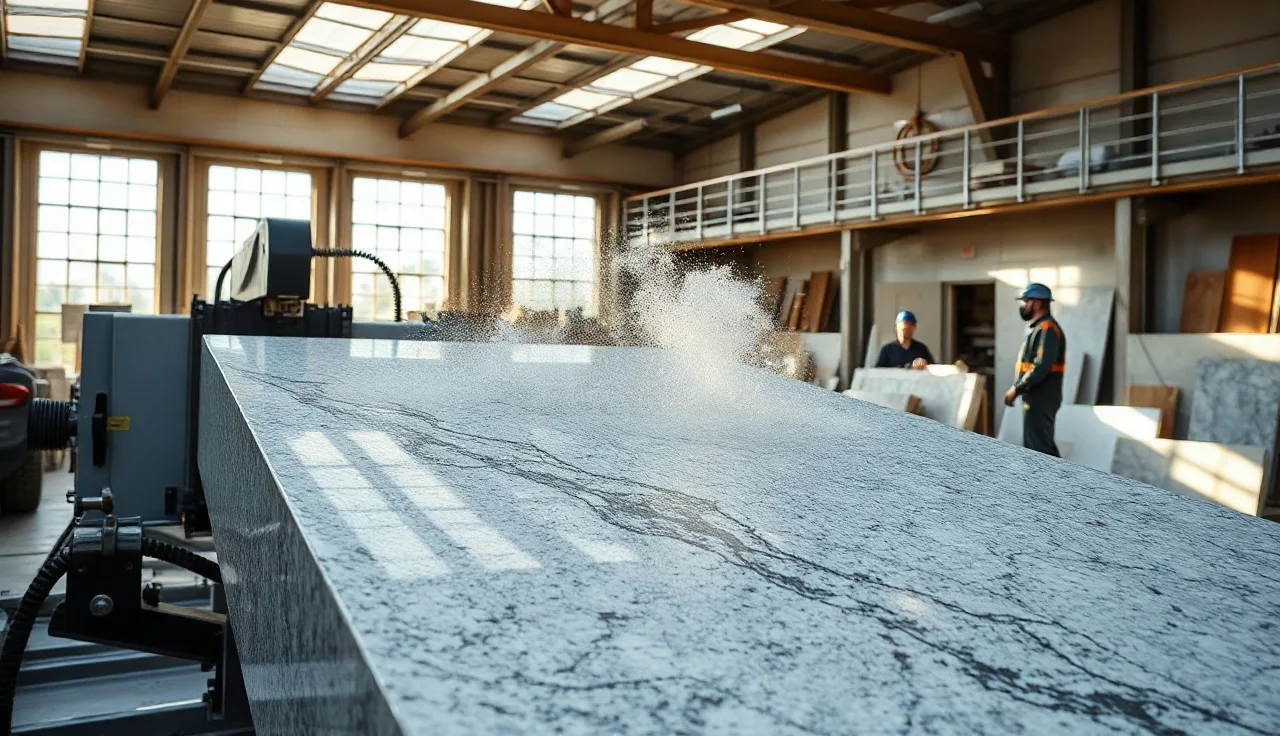
Fabrication is the manufacturing step between a raw slab (or sheet of engineered material) and the finished countertop sitting in your kitchen. It includes templating your existing cabinetry, digitally or manually drawing cut lines, running the slab through a CNC bridge saw or waterjet, grinding and polishing edges to a chosen profile, and cutting sink and cooktop openings. For stone, a surface finish pass with progressively finer diamond pads brings the face to its final gloss or honed level.
The word gets used loosely. Some homeowners say "fabrication" when they mean the whole project, and some fabricators separate templating as its own billable line. For clarity in this article, fabrication means everything that happens in the shop before the pieces leave for your home.
Most residential stone shops can turn a straightforward kitchen around in 3-7 business days from template to delivery [1]. Complex jobs with waterfall edges, mitered corners, or book-matched slabs take longer, sometimes two weeks or more. Engineered materials like quartz or laminate often move faster because they have tighter dimensional tolerances out of the factory.
Not all fabrication is equal. A shop running a five-axis CNC machine with digital templating and laser-guided positioning will produce tighter seam gaps and more consistent edge profiles than a small shop doing everything by hand with a circular saw and angle grinder. Both can produce beautiful results, but the margin for error is very different.
What are the steps from raw slab to installed countertop?
Here is the sequence in order. Each step matters, and skipping or rushing any one of them is where most problems start.
1. Slab selection. You pick your material at the stone yard or supplier showroom. For natural stone, you typically choose the specific slab you want, more than a color name, because every slab is unique. Granite, marble, quartzite, and soapstone all vary slab to slab. Engineered quartz and laminate are more predictable, so slab selection matters less.
2. Templating. A fabricator sends a crew to your home after cabinets are installed and any plumbing rough-in is done. They measure every run of cabinet, locate the sink opening, note wall angles (few kitchens have perfectly square corners), and capture the layout as either a physical cardboard template or a digital scan using a laser templating device. This scan feeds directly into the shop's CNC software.
3. Layout (nesting). Back in the shop, a layout technician places the cut shapes onto a digital image of the slab to minimize waste and, for patterned stone, to align veining across seam lines. Good nesting can save a slab. Bad nesting wastes stone worth hundreds of dollars [2].
4. Cutting. A bridge saw or CNC router cuts the rough shape. Stone shops almost always wet-cut with water cooling to suppress silica dust and protect blade life. For curves and cutouts, a waterjet or router follows.
5. Edge profiling. This is where the character of an edge gets built. A CNC edge machine or hand router with diamond tooling grinds the edge to the chosen profile: eased, beveled, bullnose, ogee, waterfall mitered, and so on. More complex profiles mean more passes and more time.
6. Polishing. The face and edge surfaces run through progressively finer grits (typically 50, 100, 200, 400, 800, 1500, and 3000-grit pads) until the desired finish is reached. A honed finish stops around 400-800 grit. A mirror polish goes to 3000 grit.
7. Seaming. If the countertop run is longer than a single slab can cover, two pieces are joined with epoxy mixed to match the stone color. The seam is clamped, leveled with suction cups and seam setters, and allowed to cure. A poorly done seam is the most common visible defect homeowners complain about.
8. Delivery and installation. The finished pieces travel to your home on padded racks. Stone is heavy. A standard 1.25-inch-thick granite slab weighs around 18-20 pounds per square foot [3], so a 40-square-foot kitchen requires two to four installers and careful planning through doorways and around corners.
9. Setting and securing. Pieces are set on a bead of silicone adhesive run along the cabinet tops. Sink clips or undermount silicone hold the sink. Seams get touched up on site if needed.
10. Sealing (for natural stone). Most granite, marble, quartzite, and soapstone gets a penetrating sealer applied at the end of the installation day or by the homeowner within a week. Engineered quartz does not need sealing.
How much does countertop fabrication and installation cost?
This is the question everyone asks first, and the honest answer is that it depends on material, complexity, and geography more than almost anything else.
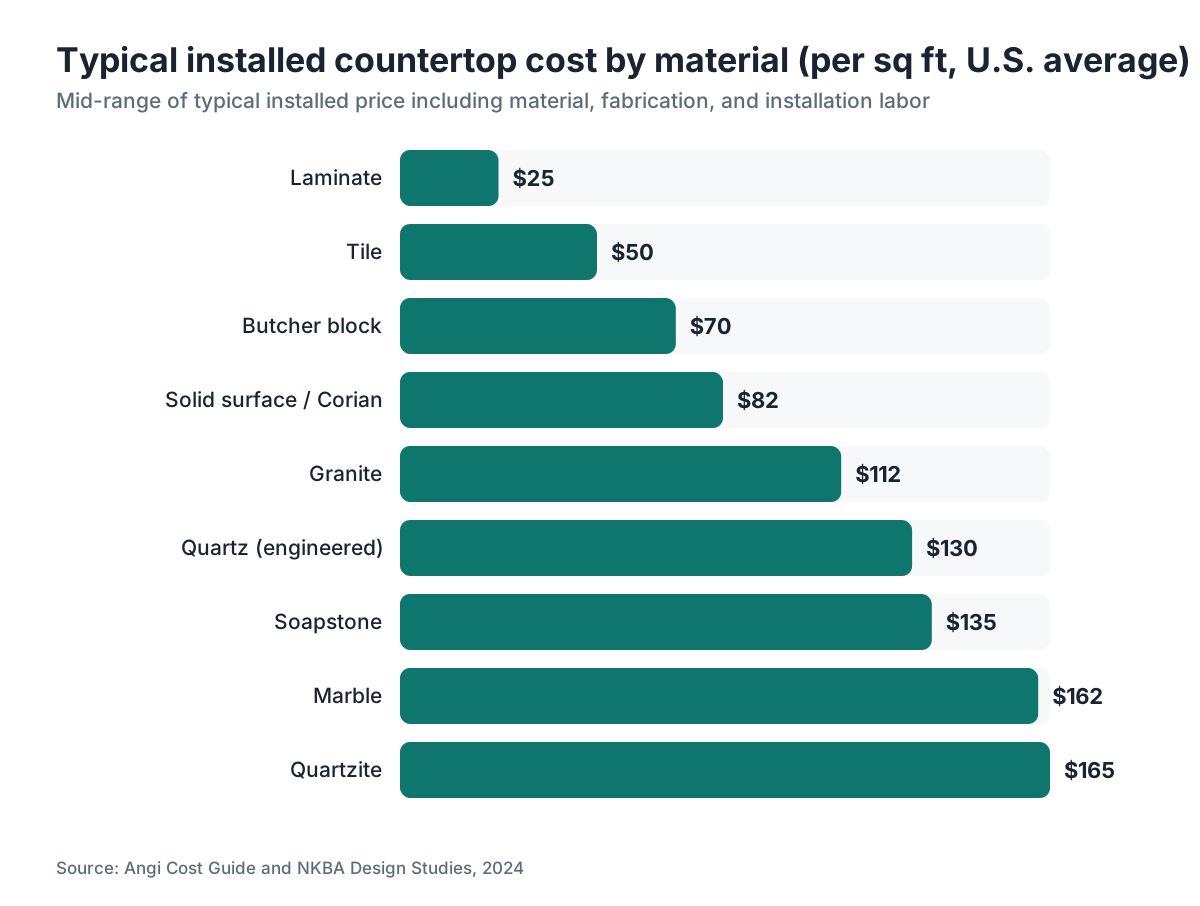
The table below shows typical installed price ranges by material for the continental United States as of 2024-2025. "Installed" means material plus fabrication plus installation, but usually not demolition of old countertops or plumbing reconnection, which are often add-ons.
| Material | Typical installed range (per sq ft) | Notes |
|---|---|---|
| Laminate (post-form) | $10 - $40 | Sheet goods, limited edge options |
| Butcher block | $40 - $100 | Wood species and thickness vary widely |
| Corian / solid surface | $45 - $120 | Glue joints hide well, thermoformable |
| Tile (ceramic or porcelain) | $20 - $80 | Grout lines are a maintenance factor |
| Granite | $50 - $175 | Huge range based on slab origin and color |
| Quartz (engineered) | $60 - $200 | Brand and pattern drive price |
| Marble | $75 - $250 | Softness and veining complexity add cost |
| Quartzite | $80 - $250 | Often mislabeled; harder and pricier than marble |
| Soapstone | $70 - $200 | Rare fabricators; soft but distinctive |
Sources for these ranges include data from the National Kitchen and Bath Association and retail pricing surveys from HomeAdvisor and Angi [4][5]. No single federal database tracks residential countertop prices, so treat these as ballpark figures with real regional variance. Coastal metros (New York, Los Angeles, Seattle) typically run 20-40% above mid-country.
Fabrication labor alone, separated from material, typically runs $40-$100 per square foot at most U.S. stone shops, according to industry pricing guides and fabricator surveys [4]. The raw slab usually sells to the shop at $5-$30 per square foot wholesale, then gets marked up 40-100% by the fabricator.
The cleanest way to read your quote is to ask the fabricator to break out four things: material cost, fabrication labor, installation labor, and any add-ons like demo, sink cutout fees, or edge upgrade charges. Many shops quote an all-in price per square foot and that is fine, but knowing the components helps you compare bids fairly.
What is digital templating and why does it matter?
Digital templating uses a laser measuring device, often a Proliner or similar tool, to capture a precise 3D scan of your cabinet layout. The result is a DXF or DWG file that feeds directly into the shop's CNC software without manual re-entry of measurements [1].
The practical benefit is accuracy. Traditional cardboard or wood templates work fine in skilled hands, but human transcription errors (writing down 36.25 inches when the measurement was 36.75, for example) cause pieces that don't fit. A digital template kills that transcription step. Most professional stone shops in North America have moved to digital templating. If a shop is still doing cardboard only, that is worth asking about.
Digital templating also makes layout optimization easier, which is the process of fitting your cut shapes onto the slab to minimize waste. Software used in professional fabrication shops can nest pieces automatically or semi-automatically to get the best yield from a given slab. For fabricators tracking job costs tightly, that yield difference can decide whether a job is profitable or breaks even [2].
One practical point for homeowners: templating can only happen after cabinets are fully installed and leveled. If your cabinets are not done, the fabricator cannot come. Do not order your countertops before you have a cabinet installation date locked in.
What are the most common edge profiles and do they cost extra?
Edge profile is the shape applied to the visible front edge of the countertop. It is one of the details that most affects the finished look, and yes, most profiles beyond a basic eased or beveled edge cost extra.
Common profiles and their typical upcharges (per linear foot, approximate):
| Profile | Description | Typical upcharge |
|---|---|---|
| Eased / straight | 90-degree corner with a slight safety break | Usually included |
| Beveled | Angled flat cut on the top corner | $0-$5/lf |
| Bullnose | Fully rounded top edge | $5-$15/lf |
| Ogee | S-curve profile, traditional look | $15-$30/lf |
| Waterfall / mitered | 45-degree miter on a vertical side panel | $50-$150/lf (labor-intensive) |
| Dupont (half-bullnose with step) | Flat face with rounded top corner | $10-$20/lf |
These numbers vary by shop and by stone type. Harder stones like quartzite wear tooling faster, so edge charges may be higher. A waterfall edge on a 10-foot island requires precision mitering of two pieces and is genuinely hard to execute well.
If you are watching your budget, pick an eased or slightly beveled edge. It looks clean, holds up well, and most fabricators include it at no charge.
How long does countertop fabrication and installation take?
For most residential kitchens in natural stone or engineered quartz, the timeline from signed contract to installed countertop runs 1-3 weeks. Here is how that breaks down.
Templating happens after cabinets are set. Many shops schedule template appointments 2-5 business days out from when you sign. The fabrication lead time after templating is typically 3-7 business days for standard jobs, though some busy shops run 10-14 days, especially during spring and fall remodel peaks. Installation itself usually takes 2-6 hours for a typical kitchen.
What stretches the timeline: custom edge profiles that need extra machine setups, slabs that have to be ordered from a distributor rather than pulled from the shop's inventory, book-matched veining that needs extra layout time, and unusually complex geometry like curved islands or multiple sinks.
Laminate countertops cut from sheet goods can move faster because the material is readily available and fabrication is simpler. A laminate job can sometimes be templated, fabricated, and installed within a week.
One scheduling point that trips up many remodels: you cannot install countertops until the cabinet installation is complete and level, but you often cannot finish backsplash tile or plumbing until after the countertop is in. Plan your trades sequence with that dependency in mind. Countertops land in the middle of the sequence, not at the end.
What can go wrong during fabrication and installation?
Most projects go smoothly. But when they don't, the problems cluster around a few predictable failure points.
Seam placement and quality. Seams are unavoidable on any run longer than the slab, typically around 9-10 feet. A seam placed in a high-traffic area or joined with an epoxy color mismatch will bother you every day. Ask the fabricator to show you the seam placement on the layout diagram before they cut anything. A visible, poorly colored seam is the single most common complaint in homeowner reviews of stone shops.
Measurement errors. Even with digital templating, a mis-measured wall or out-of-square corner can produce a piece that doesn't fit without recutting. Most fabricators will recut at their expense if the error is theirs. Disputes arise when there is ambiguity about who made the mistake. Take photos of your cabinets before the template crew arrives.
Chipping during transport. Stone chips at thin edges and corners. Reputable shops pad and rack slabs carefully. A chip discovered at installation is not always the shop's fault (it could have been a crack in the slab before cutting), but the shop should repair it or replace the piece.
Silica dust exposure during cutting. This is a genuine occupational health hazard for fabricators. The Occupational Safety and Health Administration set an enforceable permissible exposure limit (PEL) for respirable crystalline silica at 50 micrograms per cubic meter as an 8-hour time-weighted average, effective for general industry since June 2018 [6]. Shops that run dry cutting or inadequate ventilation expose their workers to serious lung disease risk. As a homeowner you are not at risk during installation, but the shop's safety practices still matter.
Undermount sink failure. An undermount sink held only by clips without adequate silicone can drop years later as the adhesive breaks down. Ask how the shop attaches undermount sinks and whether they use both clips and silicone.
Cracking after installation. Natural stone can crack from point loads (dropped heavy pans), inadequate cabinet support, or pre-existing fissures in the slab. Ask your fabricator to show you any fissures in the slab before cutting. A fissure is a natural feature. A crack is a structural failure. Fabricators sometimes stabilize fissures with epoxy before fabricating, which is accepted practice.
Do I need a permit to install countertops?
For a straight countertop replacement in an existing kitchen, most U.S. jurisdictions do not require a building permit. You are not moving walls, changing structural elements, or altering the rough plumbing supply lines.
Where permits do come in: if the countertop project involves relocating a sink drain (which changes rough plumbing), adding a gas cooktop (which requires a gas line permit), or is part of a larger renovation that is already under permit, then the countertop work gets folded into that broader scope.
Always check with your local building department. Permit requirements vary by municipality, and in some places any work done to a kitchen requires pulling a permit. Your fabricator will not usually know the local rules for your specific address. That is your responsibility as the homeowner.
For commercial projects (restaurants, office kitchens, medical facilities), the rules are more involved. Health code inspections, ADA countertop height requirements (34 inches maximum for accessible surfaces under the ADA Standards for Accessible Design) [7], and fire code may all apply.
How do fabricators calculate square footage and price a job?
Most fabricators price countertops by the square foot of finished material. The square footage comes from the dimensions of each piece, typically measured to the nearest quarter inch, then multiplied out and summed. Odd-shaped pieces like L-corners get calculated as the bounding rectangle of each piece (the rectangular block of stone the piece is cut from), which is called "book" or "block" billing. You pay for the stone that went into making the piece, including what got cut away.
This is why sink cutouts show up as a credit or no-charge line on some quotes but not others. The shop cut out 1.5-2 square feet to make your sink opening, but they already charged you for that stone in the bounding rectangle. Some shops credit back the cutout. Most do not.
A typical residential kitchen countertop runs 30-50 square feet of finished surface. An island adds another 15-30 square feet. A full primary and secondary bathroom adds 10-20 more. Do your own rough estimate before getting quotes so you can spot a big billing discrepancy.
Fabrication shops increasingly use dedicated quoting and job management software to price jobs, generate cut sheets, and track slab inventory. Tools built specifically for stone shops, like SlabWise, let fabricators build quotes from digital slab images, see exact material yield, and send professional estimates to homeowners faster than doing it on a spreadsheet. If you're getting quotes from multiple shops, a shop using organized software is often (not always) a sign of a more organized operation overall.
For homeowners getting multiple bids, make sure every quote covers the same scope: same material, same edge profile, same sink cutout, same installation, and the same number of seams. A bid that looks 20% cheaper often has a different scope.
What are the silica dust regulations fabricators must follow?
This section is aimed at fabricators and shop owners, though homeowners choosing a shop should know it exists.
OSHA's silica standard for construction (29 CFR 1926.1153) and for general industry (29 CFR 1910.1053) set the enforceable PEL for respirable crystalline silica at 50 micrograms per cubic meter (µg/m³) as an 8-hour TWA, with an action level of 25 µg/m³ [6]. Stone fabrication shops fall under the general industry standard.
OSHA's standard also requires a written exposure control plan, medical surveillance for workers exposed at or above the action level for 30 or more days per year, and training for all workers who may be exposed [6]. Dry cutting of stone is the highest-risk activity. Wet cutting with adequate water flow drops airborne silica dramatically.
Engineered stone (quartz countertops) contains 93-95% crystalline silica by weight, making it far more hazardous to cut than many natural stones [8]. The National Institute for Occupational Safety and Health (NIOSH) has documented cases of accelerated silicosis (also called engineered stone silicosis) in fabricators, with disease progression much faster than classic occupational silicosis from mining or construction [8].
As of 2024, California, Colorado, and several other states have enacted additional regulations beyond federal OSHA minimums for engineered stone fabrication [9]. The California Division of Occupational Safety and Health (Cal/OSHA) adopted an emergency standard in 2024 that effectively prohibits dry cutting of engineered stone and imposes stricter exposure monitoring requirements [9].
If you run a stone shop, this is not a side issue. Enforcement actions have resulted in significant citations. More to the point, the health consequences for workers are severe and irreversible.
How do I take care of a new countertop after installation?
Care varies a lot by material, which is why there is no single answer.
For natural stone (granite, marble, quartzite, soapstone): most need a penetrating sealer applied shortly after installation and reapplied every 1-3 years depending on stone porosity and sealer quality. Test with water. If water beads, the sealer is working. If water soaks in and darkens the stone within a few minutes, it's time to reseal. For care on specific stone types, see our guides on how to clean quartzite countertops, how to clean soapstone countertops, and how to clean stone countertops.
For engineered quartz: no sealing needed. Wipe with warm soapy water. Avoid harsh acids and high heat directly on the surface. Extended heat exposure (a hot pan left directly on quartz) can damage the polymer resin binder and void warranties.
For laminate and Formica: avoid standing water near seams, which can swell the substrate. No sealing needed. Do not use abrasive scrubbers.
For butcher block: oil periodically with food-safe mineral oil, especially in the first year. Avoid leaving water standing on the surface.
For solid surface / Corian: minor scratches can be sanded out with a fine abrasive pad, which is one of the real advantages of solid surface over stone.
One universal rule: no countertop material is safe for direct knife use except maybe very hard granite, and even then you'll dull your knives fast. Use a cutting board.
How do I choose the right fabricator?
The fabricator matters as much as the material. A skilled shop can make cheap granite look beautiful. A careless shop can butcher expensive marble.
Worth checking: ask if the shop uses digital templating. Ask to see examples of seams in their work. Read their reviews specifically for complaints about seam quality, measurement errors, and how they handled problems. Ask how long they have been in business. A shop that has run for 10+ years in your market has processed many kitchens and knows the local quirks.
Get at least three quotes. more than for price comparison, and because the quoting conversation tells you a lot about how organized and communicative a shop is. A fabricator who can show you a clean, itemized quote quickly, explain seam placement on a layout diagram, and answer your material questions without making you feel rushed is much more likely to run the actual job well.
Certifications: the Marble Institute of America (MIA+BSI) offers a Certified Fabricator program and a Certified Installer program [10]. Not every excellent shop is certified, and not every certified shop is excellent, but it is at least a signal that the company takes the trade seriously.
For homeowners who want an instant estimate before even contacting a fabricator, the SlabWise quote tool lets you enter your approximate dimensions and material preference to get a ballpark number as a starting reference.
Ask about the warranty. Most reputable shops offer a workmanship warranty of at least one year covering seam failure, edge chipping from fabrication, and measurement errors. Material defects are usually covered by the slab supplier, not the fabricator.
Frequently asked questions
How long does it take to fabricate and install countertops?
Most residential stone countertop projects run 1-3 weeks from signed contract to installed surface. Templating is typically scheduled 2-5 business days after signing. Shop fabrication takes 3-10 business days depending on complexity and shop backlog. Installation itself takes 2-6 hours for a typical kitchen. Laminate and solid surface jobs can move faster, sometimes within a week, because materials are more available and simpler to cut.
What is the difference between fabrication cost and installation cost?
Fabrication cost covers everything done in the shop: cutting the slab to shape, profiling edges, polishing, and cutting sink openings. Installation cost covers delivering the finished pieces, setting them on cabinets, adhering and securing them, and touching up seams on site. Most shops quote an all-in price per square foot, but you can ask for the breakdown. Fabrication labor typically runs $40-$100 per square foot at most U.S. shops; installation is usually a flat fee or included.
What is digital templating and is it better than traditional templating?
Digital templating uses a laser measuring device to capture your cabinet layout as a precise 3D scan, which feeds directly into shop cutting software without manual re-entry. It reduces transcription errors and allows better layout optimization on the slab. Traditional cardboard templating works well in skilled hands but introduces more opportunity for human error. Most professional stone shops in North America now use digital templating.
How thick are countertops supposed to be?
The two most common thicknesses for stone countertops are 2 centimeter (roughly 3/4 inch) and 3 centimeter (roughly 1.25 inches). Residential countertops are overwhelmingly done in 3 cm today because it looks more substantial, has a lower chip risk on edges, and requires less mitered lamination at edges to look thick. Two-centimeter stone is lighter and occasionally used in upper cabinets or weight-sensitive applications. Laminate and solid surface countertops are typically 1.5 inches thick including the substrate.
Do countertops need to be sealed after installation?
Natural stone countertops (granite, marble, quartzite, soapstone) generally need a penetrating sealer applied at or shortly after installation, and reapplied every 1-3 years. Engineered quartz, laminate, solid surface, and tile do not need sealing. Test natural stone with water: if water soaks into the surface and darkens the stone within a few minutes, it's time to seal. A bead of water that stays on the surface means the sealer is still working.
Can countertops be installed over existing countertops?
In theory, yes. Stone can be laid over existing laminate if the cabinet structure is sound and can support the added weight. In practice, most fabricators and contractors recommend removing the old countertop first because it ensures a flat, level substrate, makes plumbing work easier, and avoids adding height that might conflict with appliances or tile backsplash. Stacking countertops also voids most fabricator workmanship warranties.
Why are countertop seams necessary and can they be avoided?
Seams are necessary when your countertop run is longer than a single slab can cover, typically about 9-10 feet for stone. They are also used when countertops turn a corner if the layout requires it. You cannot always avoid seams, but their placement can be managed. Ask your fabricator to show you the seam placement on a layout diagram before cutting begins. Seams near sinks or in high-traffic areas are more noticeable and should be avoided when possible.
How much do sink cutouts cost and is the cutout piece mine to keep?
Sink cutout charges typically run $0-$150 depending on the shop and the shape of the cut (straight undermount cutouts are simpler; farmhouse sink cutouts require more precision). The cutout piece is technically yours, but most shops discard it unless you ask. Some homeowners keep the offcut for a pet feeding station, laundry room, or cutting board. Ask before installation if you want it.
Is granite or quartz easier to fabricate?
Engineered quartz is generally more consistent in thickness and flatness from the factory, which makes it easier to cut predictably. Natural granite varies in thickness across a slab, requires more attention to seam color matching, and can have fissures that affect fabrication decisions. Both are hard materials that require wet diamond tooling to cut. From a shop productivity standpoint, quartz is often faster to turn because there are fewer slab-specific decisions to make.
What OSHA rules apply to countertop fabricators cutting stone?
OSHA's general industry silica standard (29 CFR 1910.1053) sets a permissible exposure limit of 50 micrograms per cubic meter for respirable crystalline silica as an 8-hour time-weighted average. Stone fabrication shops must have a written exposure control plan, offer medical surveillance for regularly exposed workers, and ensure wet cutting or equivalent controls are used. Engineered quartz is particularly high-risk, containing 93-95% crystalline silica by weight.
How do I get an accurate countertop quote before the fabricator visits?
Measure the length and depth of each cabinet run (typically 25.5 inches for a standard kitchen base cabinet with overhang). Multiply each run's length by its depth in inches, then divide by 144 to get square feet. Add up all runs. Include the island if you have one. Bring that rough square footage figure plus your material preference and edge choice to any quote conversation. Most fabricators can give you a close ballpark price per square foot before they even see the space.
What should I ask a fabricator before signing a contract?
Ask about: digital vs. cardboard templating, seam placement and how it will look on your specific slab, edge profile pricing and what's included, sink cutout fee, timeline from template to installation, how they handle chips or errors discovered at install, and their warranty terms. Ask to see photos of seams in past work. A fabricator who answers these questions clearly and without annoyance is a better bet than one who rushes you to sign.
How does ADA compliance affect countertop height in commercial settings?
The ADA Standards for Accessible Design require that at least one accessible work surface in a kitchen or break room be no higher than 34 inches above the finished floor. This applies to commercial facilities and any housing covered under the Fair Housing Act's accessibility guidelines. Residential kitchens in single-family homes are generally not subject to ADA requirements, but homeowners planning for aging-in-place or wheelchair accessibility often target the 34-inch maximum height.
Sources
- Marble Institute of America (MIA+BSI), Fabrication and Installation Resources: Professional stone shops typically turn around residential jobs in 3-7 business days from digital template to delivery for standard layouts
- Natural Stone Institute, Estimating and Quoting Guidelines: Good nesting of cut pieces onto a slab directly affects material yield and job profitability; poor layout can waste significant amounts of stone
- Natural Stone Institute, Technical Bulletins on Stone Weight and Handling: Standard 1.25-inch-thick (3 cm) granite slabs weigh approximately 18-20 pounds per square foot, requiring multiple installers for typical kitchen jobs
- National Kitchen and Bath Association (NKBA), Design and Cost Studies: Fabrication labor for stone countertops typically runs $40-$100 per square foot at U.S. shops, separate from material cost
- Angi (formerly Angie's List), Countertop Installation Cost Guide: Installed countertop prices range from roughly $10/sq ft for laminate to $250/sq ft for premium marble, with granite and quartz most commonly landing $50-$200/sq ft
- U.S. Occupational Safety and Health Administration, Respirable Crystalline Silica Standard for General Industry (29 CFR 1910.1053): OSHA's PEL for respirable crystalline silica is 50 micrograms per cubic meter as an 8-hour TWA, with an action level of 25 µg/m³; the standard also requires written exposure control plans and medical surveillance
- U.S. Access Board, ADA Standards for Accessible Design, Chapter 8: Special Rooms and Spaces: ADA Standards for Accessible Design require accessible kitchen work surfaces to be no higher than 34 inches above finished floor
- National Institute for Occupational Safety and Health (NIOSH), Engineered Stone Silicosis Hazard Alert: Engineered stone (quartz countertops) contains 93-95% crystalline silica by weight and has been linked to accelerated silicosis cases in fabricators with faster disease progression than classic occupational silicosis
- California Division of Occupational Safety and Health (Cal/OSHA), Emergency Temporary Standard on Silica and Engineered Stone: Cal/OSHA adopted a 2024 emergency standard that effectively prohibits dry cutting of engineered stone and imposes stricter exposure monitoring; several states have enacted rules beyond federal OSHA minimums
- Marble Institute of America (MIA+BSI), Certified Fabricator and Installer Programs: The Marble Institute of America offers Certified Fabricator and Certified Installer credential programs for stone industry professionals
- U.S. Occupational Safety and Health Administration, Silica in Construction Standard (29 CFR 1926.1153): OSHA construction silica standard applies to stone cutting operations and requires wet cutting or equivalent dust controls
Last updated 2026-07-09