TL;DR
- Bathroom countertop installation runs $200 to $4,500 or more, driven by material, sink cutout type, and whether you DIY or hire a fabricator.
- Stone slabs need professional templating and cutting.
- Laminate and some solid surfaces are DIY-friendly.
- Most bathrooms take one to three days from template to install.
- Undermount sinks add cost and complexity.
What does bathroom countertop installation actually involve?
Bathroom countertop installation is more than dropping a slab on a vanity. It starts with measuring, moves through fabrication or purchase, includes a sink cutout, and ends with securing and sealing the surface. Each step has real failure points if you rush it.
Stone materials like granite, quartz, and marble follow one path: template, fabricate, deliver, set, and caulk. The fabricator drives to your home with a digital or physical template tool, maps the exact shape of your vanity cabinet, transfers that to the shop, cuts and finishes the slab, and then a crew returns to install it. That cycle usually runs five to ten business days from template appointment to installation day [1].
Prefab and modular options like laminate, Corian, and cultured marble move faster. You buy a premade top sized to common vanity widths (24", 31", 37", 49", 61") and either drop it in yourself or have a plumber or handyman handle the connection.
The sink is where most people underestimate the work. An undermount sink (the bowl sits below the stone, held up by the slab itself) means the fabricator has to cut a precise hole, finish the inside edge of that cutout, and confirm the slab is thick enough to carry the sink's weight plus the epoxy bond. That cutout alone adds $100 to $250 to a fabrication quote [2].
Drop-in sinks are simpler. The rim sits on top of the counter and hides any minor imprecision in the cutout. Vessel sinks are simplest of all, since you only need a small drain hole instead of a full sink opening.
How much does bathroom countertop installation cost?
Bathroom countertop cost breaks into two buckets: material and labor. They scale differently. A $15-per-square-foot laminate top and a $90-per-square-foot quartzite slab need roughly the same labor hours once fabrication is done, but the fabrication cost on the quartzite is far higher.
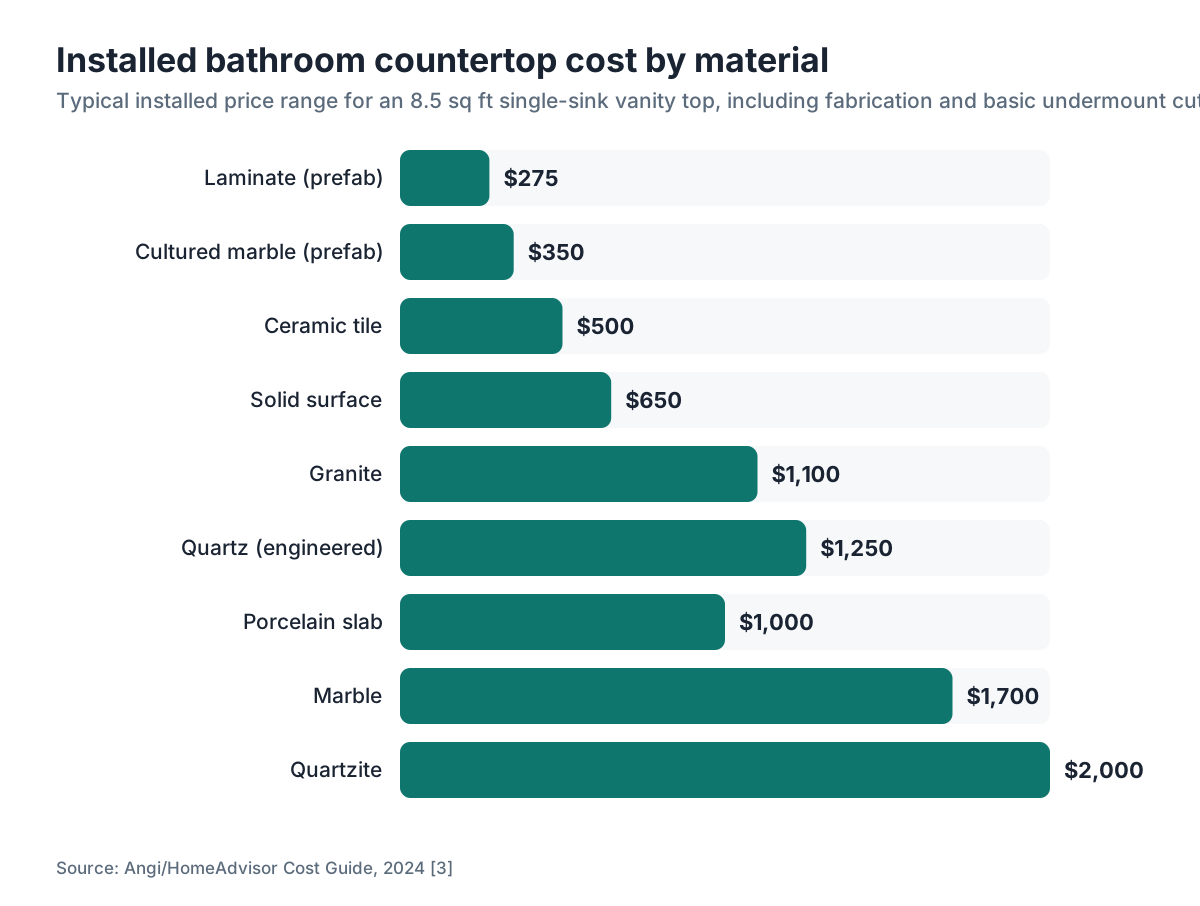
Here is a realistic cost table by material, including fabrication and a basic undermount sink cutout, for a standard 25" x 49" vanity top (about 8.5 square feet). These are installed U.S. prices as of 2024 to 2025 [3][4]:
| Material | Installed cost (8.5 sq ft vanity) | DIY-friendly? |
|---|---|---|
| Laminate (prefab) | $150, $400 | Yes |
| Cultured marble (prefab) | $200, $500 | Yes, with plumbing |
| Solid surface (Corian-type) | $400, $900 | Possible with skill |
| Ceramic tile | $300, $700 | Yes, tiling experience needed |
| Porcelain slab | $600, $1,400 | No, professional only |
| Quartz (engineered) | $700, $1,800 | No |
| Granite | $600, $1,600 | No |
| Marble | $900, $2,500 | No |
| Quartzite | $1,000, $3,000+ | No |
Professional installation labor (delivery, set, caulk, no demo) typically runs $200 to $600 for a standard bathroom vanity [3]. Demo of the old top, if needed, adds $50 to $150. A plumber to reconnect the drain and supply lines after a swap runs $100 to $300 depending on your market [5].
The single biggest variable is your vanity's shape. An L-shaped or double-vanity top with two sink cutouts costs a lot more than a simple rectangle. Every mitered corner, curved edge, and specialty profile (ogee, waterfall) adds shop time and cost.
Want a fast ballpark before you call shops? SlabWise has an instant quote tool that gives homeowners a rough stone fabrication estimate from slab dimensions and material choice.
Which bathroom countertop materials are worth the money?
Spend based on what your bathroom actually does. A guest bath used twice a day is a different job from a primary bath two kids share.
Engineered quartz is the most popular pick in new construction and remodels right now, and the reasons hold up. It never needs sealing, resists most bathroom chemicals, and shrugs off daily humidity without warping or staining. Brands like Cambria and Silestone are usually 3 cm thick, which makes undermount sinks easy to support. For the look without the upkeep, Cambria countertops are worth a look.
Granite is the second most common choice and costs a little less per square foot than premium quartz. It needs sealing once a year or so, and some granites are more porous than others. The payoff: every slab is unique, and a well-chosen granite looks genuinely good for decades. More on granite countertops if that interests you.
Marble is beautiful and it has real problems in a bathroom. It etches from acidic products (toothpaste, mouthwash, some cleansers) and stains from makeup and hair dye if left unsealed. Plenty of designers still spec it in powder rooms or low-traffic primary baths where the owner welcomes the patina. Go marble only after you read up on sealing and cleaning. Our guide to marble countertops covers maintenance honestly.
Laminate gets dismissed too fast. Good laminate with a tightly bonded substrate handles moisture better than people expect, the edge profiles have improved, and the installed cost is a fraction of stone. Laminate countertops and Formica countertops make real sense for a rental or a budget remodel.
Cultured marble is polyester resin cast with marble dust, and it is the standard in builder-grade baths. It comes with an integrated sink bowl molded right in, which kills the seam and the cutout entirely. It scratches and yellows over time, but a 20-year-old cultured marble top kept clean still works fine.
Soapstone and quartzite are less common and worth knowing. Soapstone is soft, develops a patina, and needs periodic oiling. Quartzite is very hard and heat-resistant. Both are natural stone and both need professional fabrication. See our guide on how to clean stone countertops for day-to-day care across these materials.
Can you DIY a bathroom countertop installation?
Sometimes, yes. It comes down to the material.
Prefab laminate, cultured marble, and some solid-surface tops are built for DIY. The manufacturer cuts them to standard widths, pre-drills the faucet holes, and includes instructions. You set the top on the cabinet, run silicone or construction adhesive along the cabinet rails, connect the drain and supply lines, and caulk the backsplash. A moderately handy person finishes in half a day.
Natural stone and engineered quartz are another animal. The slab is heavy (a 3 cm granite top for a 49" vanity weighs 60 to 100 pounds), brittle without support, and impossible to cut to fit with typical homeowner tools. Buy a remnant from a stone yard and own an angle grinder, and you still can't get a clean sink cutout with a finished edge without a router, the right diamond bits, and experience. One botched cut cracks the slab. Now the remnant is scrap.
The other real DIY risk with stone is the undermount sink bond. Fabricators use two-part epoxy plus mechanical clips or brackets rated for the sink weight and its water load. A bad bond drops the sink. That is a plumbing failure, a broken sink, and possibly a cracked slab, all at once.
Plumbing is the other question. In most U.S. states, replacing a countertop that involves disconnecting and reconnecting supply lines does not require a licensed plumber if you own the home and do the work yourself [6]. If you aren't comfortable with compression fittings and a P-trap reconnection, hire a plumber for that part even when you handle the countertop.
Here's the honest call. DIY the prefab materials if you're handy. Hire a pro for stone. The fabrication cost is where most of the money goes anyway, and the install labor on top of that is not the place to save $200 while risking a $1,500 slab.
What is the step-by-step process for professional stone installation?
Here is what actually happens when you hire a stone fabricator for a bathroom vanity top.
Step 1: Measure and quote. You call or submit a request online. The shop gives a rough quote from your vanity dimensions and material choice. This is when you pick your slab or color. Some shops have a yard you visit; others work from samples.
Step 2: Template. A tech comes to your home with a digital laser templating tool or physical template boards. They trace the exact shape of the cabinet, mark faucet hole locations, and confirm the sink model so the cutout is right. The visit takes 30 to 60 minutes. Do not skip having the cabinets fully installed and level before this. If the cabinets move after templating, your top may not fit.
Step 3: Fabrication. The shop cuts the slab to the template, cuts the sink opening, profiles the edges, and polishes everything. Three to seven business days in most shops, longer if they're slammed.
Step 4: Delivery and set. A two-person crew delivers the top. They remove the old top if that's in scope, set the new one, check for level, shim if needed, run silicone along the cabinet rails, and bond the undermount sink. They usually do not reconnect plumbing. That falls to the homeowner or a plumber.
Step 5: Caulk and seal. The crew caulks the backsplash seam and any wall joints. If the stone needs sealing, they apply a first coat. You typically wait 24 to 48 hours before using the sink.
Start to usable countertop runs two to three weeks in most cases. Rush jobs at busy shops can compress that, sometimes for an extra fee.
How do you prepare your bathroom for countertop installation?
Prep matters more than people expect, and poor prep is the number one cause of delays and callbacks.
First, get the vanity cabinet fully installed, secured to the wall, and level both directions. Fabricators template to the cabinet as it sits. If one corner is high by a quarter inch, the top will rock or the front edge won't sit flush with the cabinet face. Use a 4-foot level and adjust the cabinet legs or shim the base before the template appointment.
Second, have your sink selected and on hand. The fabricator needs the actual sink (or at minimum its cutout template) to make the opening right. Standard sinks have standard cutout dimensions, but some designer sinks are odd sizes. Don't assume your fabricator has every sink spec memorized.
Third, settle the faucet holes before templating. How many? Where? A spread faucet needs three holes on 8" centers; a single-hole faucet needs one. Once the template is done and the slab is cut, adding a hole in granite or quartz means calling the shop back with a diamond core drill and risking a crack.
Fourth, clear the bathroom. Strip the vanity, empty the cabinet, and give the crew room to move. Stone slabs in a small bathroom mean two people working together in tight quarters. Clutter slows them down and raises the risk of breakage.
Fifth, arrange the plumbing disconnect. The crew needs the water shut off at the supply valves under the sink before they can pull the old top. If those valves are old and won't close fully, replace them before installation day.
What edge profiles work best for a bathroom vanity?
Edge profile is part looks, part function. In a bathroom it also carries safety and maintenance implications people don't always think about.
Eased or straight edge is the most common for contemporary bathrooms. Clean, easy to wipe, costs nothing extra. The 90-degree corner is slightly sharp but not dangerous at vanity height for most households.
Beveled edge cuts the top corner at a 45-degree angle. It reads a touch more formal than a plain eased edge and adds little (sometimes $5 to $15 per linear foot over the base price).
Bullnose rounds the whole top edge into a half-circle. No sharp corner at all, which makes it a favorite for bathrooms used by young children or elderly family members. It's also the standard profile on cultured marble prefab tops.
Ogee is a traditional S-curve that looks ornate and formal. It costs $10 to $30 per linear foot more than a standard profile and eats real shop time. In a small powder room with a marble top, it can look expensive and intentional. In a utilitarian kids' bath, it's overkill.
Waterfall or mitered edge drops the slab material down the side of the cabinet. Striking, but it needs a lot more material and fabrication. Rare in bathrooms, and it only makes sense in a custom primary bath where the budget is there.
For most bathroom installs, eased or beveled is the right call. Clean, durable, easy to wipe, no upcharge.
How long does bathroom countertop installation take?
The installation itself, meaning the day the crew shows up, takes one to three hours for a standard single-vanity bathroom. A double vanity with two sink cutouts might run three to four hours. Bathrooms with multiple pieces, mitered corners, or tough access take longer.
The total project timeline from first contact to a usable sink is a different number:
- Prefab top (laminate, cultured marble): 1 to 3 days if you buy from stock and install it yourself or schedule a handyman.
- Stone or engineered quartz with a custom fabricator: typically 10 to 21 calendar days from first contact to installation, counting the template appointment, fabrication queue time, and scheduling the install crew.
Fabrication queue time is the wild card. Busy shops in spring and summer, peak remodel season, can run two to four weeks out. If you're working toward a move-in date or a renovation deadline, book the template appointment the moment you sign the contract, not after.
One exception on speed: some shops offer templating and installation in a single visit for very simple jobs using prefabricated cut-to-order pieces. Those are more common for kitchen islands than bathrooms, but ask about it if timing is tight.
What can go wrong during bathroom countertop installation?
Problems happen. Most are minor. A few are expensive.
The most common issue is a poor fit at the wall. Walls are almost never perfectly straight or square. A good fabricator scribes the back edge of the top to match the wall profile, which is exactly why templating accuracy matters so much. A sloppy template makes a top with gaps at the wall that caulk can't fully hide.
Next most common is a cracked slab during delivery or install. Thin stone (2 cm is more vulnerable than 3 cm), long spans without mid-support, and heavy undermount sinks all raise crack risk. If a slab arrives cracked, a reputable fabricator replaces it. Get that in your contract.
Undermount sink bond failure is rare with professional installation and catastrophic when it happens. The standard system uses two-part epoxy plus mechanical support brackets or rods under the sink rim. If you see any adhesive shortcuts during install, ask about it right then.
Sealing gaps or the wrong caulk let moisture get behind the backsplash or along the sink perimeter. In a bathroom that leads to cabinet damage, mold, and a swollen substrate. Use a mold-resistant, 100% silicone caulk at every joint where stone meets wall or sink. Paintable latex caulk is the wrong product here.
Uneven cabinet tops make counters rock or crack over time. If your cabinets aren't level, insist on shimming before the top goes down. Some fabricators shim; others treat it as outside their scope. Clarify that before installation day.
How do you maintain a bathroom countertop after installation?
The right routine depends on the material, and it's easy to get wrong in a bathroom because the products people keep there (hairspray, acetone remover, bleach cleaners, acidic face washes) are harder on stone than most kitchen messes.
For natural stone (granite, marble, quartzite, soapstone), sealing matters. The Marble Institute recommends a water drop test to check absorbency: put a tablespoon of water on the surface and wait 10 to 15 minutes. If it darkens the stone, it's time to seal [7]. Most granite and quartzite needs sealing every one to two years. Marble can need it more often, especially in a heavily used bathroom.
Engineered quartz needs no sealing. The surface is non-porous. But quartz isn't immune to chemical damage. Harsh alkaline or highly acidic cleaners can dull the finish over time [8]. Stick to mild soap and water or a pH-neutral stone cleaner.
For laminate and solid surface, the main risk is moisture creeping into seams, especially around the sink. Keep the caulk in good shape and re-caulk the moment you see lifting at the edges. Solid surface like Corian countertops can be sanded and refinished if scratched, which is a real edge in a bathroom.
See our detailed guide on how to clean stone countertops for product-by-product advice. For soapstone, how to clean soapstone countertops covers the mineral oil routine that keeps it looking right.
How do fabricators quote bathroom countertop jobs, and what should homeowners know about pricing?
Fabricators price bathroom tops differently from kitchens, and knowing the structure helps you compare quotes fairly.
Most shops price material by the square foot, then add line items for the sink cutout (undermount vs. drop-in), edge profile upgrades, faucet holes, delivery, and installation labor. A quote that looks cheap per square foot can turn expensive once cutout fees and edge profiles land on it.
The minimum job charge is real. A bathroom vanity top is a small job. Cutting, polishing, loading, driving, and installing it carries similar overhead to a kitchen job even though the slab is smaller. Many fabricators set a minimum invoice of $400 to $700 regardless of slab size [3]. That's why a bathroom top can feel expensive per square foot next to a kitchen, where you've got 40 square feet to spread the overhead across.
Ask for a fully itemized quote: material per square foot, cutout charge, edge profile, faucet holes (typically $25 to $75 each), delivery, and install. That's the only way to compare apples to apples.
Shops running software like SlabWise can generate accurate, itemized bathroom vanity quotes in minutes, which speeds things up for the shop and the homeowner. Fast quotes with clear line items usually signal a well-run shop.
For a broader look at costs and process that also applies to bathrooms, our guide on countertop installation covers the general framework.
What permits or inspections does bathroom countertop installation require?
In almost all U.S. jurisdictions, replacing a bathroom countertop does not require a building permit on its own [9]. It counts as a cosmetic replacement, not a structural change or a new plumbing installation. The exception is moving the sink, changing the drain location, or any work that touches the rough plumbing inside the wall.
If the countertop is part of a larger bathroom remodel with new plumbing or electrical work, the overall remodel permit covers the countertop by extension. Your general contractor handles that.
HOA rules are separate from building codes. Some homeowners associations require approval for exterior changes and sometimes interior remodels that affect common plumbing stacks in condos or townhomes. Check your CC&Rs if you're in a managed community [10].
One note for rental properties: some local codes require licensed contractors for work in rental units that involves plumbing disconnection and reconnection, even when the owner does the countertop work. If you're a landlord, check your city or county rules before you DIY the plumbing portion.
Frequently asked questions
How much does it cost to install a bathroom countertop?
Installed cost ranges from about $150 to $400 for a prefab laminate or cultured marble top up to $900 to $2,500 or more for a custom stone vanity top with an undermount cutout. The wide range reflects material cost. Labor for the install day itself runs $200 to $600 for most vanity jobs. Always get a fully itemized quote that separates material, cutout, edge, and install charges.
Can I install a bathroom countertop myself?
Yes for prefab tops (laminate, cultured marble, some solid surface). These come pre-cut to standard widths, and a handy homeowner can set and caulk one in a few hours. No for custom stone or quartz. Those need professional templating, shop fabrication, and a two-person crew for safe delivery and install. The risk of cracking a $1,000-plus slab trying to DIY it is real.
How long does it take to install a new bathroom countertop?
The install day itself takes one to three hours for a standard single vanity. The total project from first contact is one to three days for prefab materials and 10 to 21 days for custom stone, depending on fabrication queue time. Busy shops in spring and summer can run two to four weeks out. Schedule the template appointment right after you sign the contract.
Do I need a permit to replace a bathroom countertop?
Almost never. Replacing an existing bathroom countertop in-kind is a cosmetic swap and needs no building permit in virtually all U.S. jurisdictions. If your project moves the sink drain, changes rough plumbing, or belongs to a larger permitted remodel, those elements need permits. Rental property owners should check local landlord-tenant codes for plumbing work rules.
What is the best material for a bathroom countertop?
Engineered quartz is the most practical pick for most bathrooms: no sealing, resists moisture and most bathroom chemicals, holds up to daily use. Granite is a close second and costs a bit less. Marble looks great but etches and stains easily. Laminate and cultured marble are the smart budget choices. Match the material to your actual usage and maintenance willingness more than the look.
How do I remove an old bathroom countertop before installation?
Turn off the supply valves and disconnect the drain and supply lines first. Cut the caulk bead at the wall and backsplash with a utility knife. Most tops are held by silicone and gravity, not fasteners, so lift straight up. Cultured marble integrated tops can be heavy. For drop-in sinks, remove the sink clips from underneath before lifting. Undermount sinks bonded to a stone top usually come out with the top as one piece.
What sink types work with a bathroom countertop?
Drop-in sinks (rim sits on top of the counter) work with almost any material and install easiest. Undermount sinks (bowl hangs below the stone) need material thick enough to support the bond and cost $100 to $250 more to cut and finish. Vessel sinks only need a small drain hole and work with any material. Integrated sinks are molded into the top and usually come as a single cultured marble or solid surface unit.
How thick should a bathroom countertop be?
Standard stone and engineered quartz come in 2 cm (about 3/4 inch) and 3 cm (about 1-1/4 inch). Go 3 cm if you want an undermount sink: the extra thickness gives better bond support and looks more substantial at the edge. A 2 cm top needs a laminated edge buildup to look as thick. Laminate and cultured marble prefab tops are typically 3/4 inch to 1 inch including the substrate.
What edge profile should I choose for a bathroom vanity?
Eased or beveled edge is the right call for most bathrooms. Clean, easy to wipe, no upcharge, and it suits both contemporary and transitional styles. Bullnose works well in homes with young children or elderly users because it kills the sharp corner. Ogee and other decorative profiles add cost and visual complexity that rarely pays off in a bathroom. Save the elaborate profiles for a kitchen or bar where they get more attention.
Does bathroom countertop installation include reconnecting the plumbing?
Usually not. Stone fabricators deliver and set the top, secure the undermount sink, and caulk. They typically do not reconnect supply lines or the drain P-trap. You handle that yourself or hire a plumber. Plumber reconnection for a simple vanity swap runs $100 to $300 in most U.S. markets. Some handyman services fold plumbing reconnection into a full install package, which simplifies scheduling.
How do I seal a new natural stone bathroom countertop?
Apply a penetrating stone sealer (impregnator style, not a topical coating) to a clean, dry surface. Pour a small amount on the stone, spread it evenly with a cloth or applicator pad, let it soak in for the time the product specifies (usually 5 to 15 minutes), then wipe off the excess before it hazes. Let it cure 24 hours before using the sink. Most granite and quartzite needs resealing every one to two years. Marble may need it more often.
What is the minimum bathroom countertop size for a standard vanity?
Most single-sink vanities are 24, 30, 36, or 48 inches wide with a standard depth of 21 or 22 inches. Double vanities run 60 to 72 inches wide. Fabricators typically set a minimum square footage charge (often equivalent to 6 to 10 square feet) regardless of actual size, which is why a very small bathroom top can cost more per square foot than a kitchen counter.
How do I get an accurate quote for bathroom countertop installation?
Measure your vanity cabinet width and depth (outside edge to outside edge), note the number of sinks and faucet holes, decide on drop-in or undermount, choose a material category, and pick an edge profile before calling. Bring those answers to every shop you contact. Ask for itemized quotes listing material cost per square foot, cutout charges, edge profile upcharges, delivery, and installation separately. Comparing itemized quotes is the only accurate way to evaluate different fabricators.
Sources
- National Kitchen and Bath Association (NKBA), NKBA Professional Resource Library: Standard fabrication and install cycle for stone bathroom vanity tops runs five to ten business days from template to installation.
- HomeAdvisor (Angi), Countertop Installation Cost Guide 2024: Undermount sink cutouts add approximately $100 to $250 to a stone fabrication quote.
- HomeAdvisor (Angi), Countertop Installation Cost Guide 2024: Professional countertop installation labor for a bathroom vanity typically runs $200 to $600; many fabricators carry minimum job charges of $400 to $700.
- U.S. Bureau of Labor Statistics, Producer Price Index: Stone Product Manufacturing: Stone product manufacturing pricing data used as baseline for installed material cost ranges across granite, quartz, and marble.
- HomeAdvisor (Angi), Plumber Cost Guide 2024: Plumber reconnection of supply lines and drain for a vanity sink swap typically costs $100 to $300.
- U.S. Department of Housing and Urban Development, Rental Assistance and Tenant Resources (HUD): Some local codes require licensed contractors for plumbing work in rental units; homeowners generally may perform their own plumbing work without a license in most states.
- Marble Institute of America, Care and Cleaning for Natural Stone Surfaces: The MIA recommends a water drop absorbency test (10 to 15 minutes) to determine when natural stone needs resealing.
- NSF International, Quartz Surface Material Standards: Engineered quartz surfaces are non-porous and do not require sealing, but highly acidic or alkaline cleaners can degrade the resin binder over time.
- International Code Council (ICC), International Residential Code: Cosmetic countertop replacement in existing residential bathrooms does not constitute new construction or alteration requiring a building permit under the IRC in most jurisdictions.
- U.S. Consumer Financial Protection Bureau, Homeowners Association Rules and Disclosures: HOA CC&Rs may require approval for interior remodels affecting common plumbing stacks in condominium and townhome settings.
- Remodeling Magazine, Cost vs. Value Report 2024: Bathroom remodels including countertop replacement consistently rank among the top mid-range home improvement returns in the annual Cost vs. Value Report.
Last updated 2026-07-09