TL;DR
- Prefabricated quartz countertops are factory-cut slabs in standard sizes, usually 25.5" or 36" deep and 4 to 10 ft long.
- They cost $50, $100 per square foot installed, roughly $30, $80 less per square foot than custom-fabricated quartz.
- You give up fixed dimensions, one or two edge profiles, and extra seams where a custom piece wouldn't need any.
- Same quartz material, less labor.
What are prefabricated quartz countertops, exactly?
Prefabricated quartz countertops are engineered stone pieces cut to standard sizes at a factory before they reach a retailer or your kitchen. They aren't raw slabs waiting to be templated to your walls. They arrive finished: ground, polished, one or two edges already profiled, dimensions locked in.
Engineered quartz is about 90 to 94% ground quartz aggregate bound with polymer resins, pigments, and sometimes glass or mirror chips. [11] The prefab version takes that same product one step further by cutting it to set sizes before it sells.
The common prefab dimensions at home centers are 25.5 inches deep (standard base cabinets with a small overhang) and 36 inches deep (kitchen islands). Lengths come in 4-foot, 6-foot, 8-foot, and occasionally 10-foot pieces. Thickness is almost always 3 cm, roughly 1.25 inches, which matches the standard slab thickness the industry builds around. [2]
Here's the part people get wrong. Prefab quartz is not a lower grade of material. The quartz content and resin binding are identical to a custom slab. What you pay less for is the custom labor: the digital templating, the CNC cutting to your exact wall measurements, the sink cutout sized to your undermount bowl, the one-off edge profile. Strip all of that out, ship standard rectangles by the pallet, and the cost drops.
How much do prefabricated quartz countertops cost?
Prefab quartz runs $50, $100 per square foot installed, with material-only prices starting near $20, $45 per square foot at big-box retailers. Custom-fabricated quartz from a stone shop usually lands at $80, $200 per square foot installed, and premium brands with complex kitchens push past that. [3]
The savings come from a few places. Factory cutting takes your job off a fabricator's CNC machine entirely. A factory cutting thousands of identical pieces programs the nesting once, while a custom shop programs every job from scratch. Shipping and stocking in volume lowers the per-unit cost. Retailers carry the inventory risk, so the fabricator doesn't have to.
Here's where the bill surprises people. The piece itself is cheap. You still pay for the rest:
- Sink cutout labor. A prefab piece arrives with no sink hole. Someone still cuts it, usually $100, $200 depending on the sink type. [3]
- Seam filling and polishing. Every joint between two pieces needs color-matched epoxy, clamping, and grinding flush. Budget $75, $150 per seam.
- Backsplash pieces. Most prefab lines sell the matching 4-inch or 6-inch strips separately.
- Installation labor. A standard prefab install runs $200, $400 in labor if you hire it out.
A small galley kitchen with 30 square feet might land at $1,500, $2,500 fully installed with prefab. The same project in custom fabrication with a more distinctive material might run $3,000, $5,000. That gap is real money, and it's the whole reason prefab exists.
Prefab vs. custom quartz: what do you actually give up?
The honest answer depends entirely on your kitchen's geometry.
Got square corners, standard-depth cabinets, no odd angles, and a drop-in or top-mount sink? You give up almost nothing with prefab. The pieces fit, seams land in low-traffic spots, and nobody standing in your finished kitchen can tell.
Got a 45-degree corner, a farmhouse apron sink, cabinets that are 30 or 33 inches deep, a waterfall island edge, or curved walls? Prefab turns into a headache fast. The factory rectangles won't fit. You cut them yourself (possible but risky without a wet saw and diamond blade) or you pay a fabricator to cut them down, which erases most of your savings.
Here's how the two stack up:
| Feature | Prefab quartz | Custom quartz |
|---|---|---|
| Typical installed cost | $50, $100/sq ft | $80, $200/sq ft |
| Lead time | 1 to 3 days | 1 to 3 weeks |
| Edge profiles | 1 to 2 options (usually eased or bevel) | 8 to 15+ options |
| Sink cutout included | No | Yes |
| Works with irregular layouts | No | Yes |
| Color/pattern selection | 20 to 50 SKUs | 100s of options |
| Seam control | Limited | Full control |
| Warranty | Varies by brand | Varies by fabricator |
Edge profiles deserve a pause. Prefab quartz almost always comes with an eased edge (a slight bevel that softens the 90-degree corner) and sometimes a beveled or pencil edge. Want a waterfall, a miter, a full bullnose, or an ogee? You're ordering custom. Those profiles need a CNC router or hand-finishing that a factory won't build into a $30/sq ft commodity piece.
Color is the other real constraint. Brands like MSI, Cambria, and Silestone sell custom slabs in 80 to 150+ colorways. Their prefab lines, or the prefab pieces sold at Home Depot and Lowe's under supply agreements, typically stock 20 to 50 options weighted toward neutrals and popular whites. If you're chasing a specific veined look, custom gives you more to choose from. The Cambria quartz program runs over 180 designs, but the prefab-format pieces at retail are a much smaller slice of that.
What are the standard sizes and do they fit most kitchens?
Standard prefab quartz comes in a handful of set configurations:
- Depth: 25.5 inches (a 24" base cabinet plus a 1.5" overhang) and 36 inches (standard island depth).
- Length: 4 ft, 6 ft, 8 ft, and occasionally 10 ft pieces.
- Thickness: almost universally 3 cm (about 1.25 inches).
- Backsplash height: 4-inch and 6-inch strips sold separately.
A standard U-shaped kitchen with 36-inch base runs fits prefab surprisingly well. Most runs are 8 feet or under, and corners get handled by butting two pieces together. That corner joint shows a seam, but a good installer fills it tight enough that it reads like a design line instead of a flaw.
Sizing fails in predictable spots: cabinets 26 or 30 inches deep (older homes, some European imports), any layout with an angle cut, a single run longer than 10 feet, and bathroom vanities at 21 inches deep. Vanities are the classic prefab mistake. Most run 21 inches deep, so a 25.5-inch piece overhangs by more than 4 inches. That looks bad and turns into a shin-catcher on a low vanity. You'd have to rip it down.
Cutting quartz without proper gear creates respirable silica dust, a serious occupational hazard that OSHA regulates directly. [4] The OSHA silica rule (29 CFR 1926.1153) sets an action level of 25 micrograms per cubic meter for construction work with crystalline silica and a permissible exposure limit of 50 micrograms per cubic meter as an 8-hour time-weighted average. [4] DIY any cut on quartz and you need a wet saw, a diamond blade rated for stone, and real respiratory protection. This part is not optional.
Is prefabricated quartz durable? How does it hold up long-term?
The material is exactly as durable as custom. Engineered quartz scores around 7 on the Mohs hardness scale, harder than most granite and far harder than marble. [5] It's nonporous, so bacteria and mold can't sink in the way they do with natural stone. It never needs sealing. It shrugs off coffee, wine, and cooking oil better than marble or unsealed granite.
The durability worry with prefab isn't the material. It's the seams. Every seam is a potential weak point, and prefab jobs tend to have more of them because you're fitting fixed rectangles into a space that isn't standard. A seam filled with color-matched epoxy holds fine under normal use, but epoxy joints can yellow slightly over years of UV exposure from a window above the sink, and they crack first if the substrate settles or something heavy drops right on the joint.
Heat is the common quartz question. Engineered quartz handles sustained heat worse than granite or quartzite. The polymer resins can discolor or delaminate with repeated exposure above roughly 300°F (149°C), so trivets aren't optional here. This is true of prefab and custom quartz equally. [6]
Care is the same as any engineered stone: skip harsh abrasives, keep full-strength bleach and high-pH cleaners off it, and wipe acidic spills quickly. The routine matches any polished quartz surface, and we go deeper in our guide on how to clean stone countertops.
Can you install prefabricated quartz yourself?
You can. With serious caveats.
Prefab quartz is heavy. A 3 cm piece measuring 25.5 x 96 inches weighs around 160 to 180 pounds. You need at least two strong people, ideally three. Cabinets have to be level within 1/8 inch across the whole run, or the stone rocks on the high spot and cracks under stress.
The tools for a proper DIY install:
- Good-quality silicone caulk for bonding to cabinet tops and caulking the backsplash joint.
- Color-matched seam epoxy, usually brand-specific and sold alongside the slab.
- A seam clamp or biscuit joiner to pull seam pieces tight while epoxy cures.
- A belt sander or hand grinder to flush any seams.
- A wet saw with a diamond blade for any cuts.
The wet saw is where most DIYers should stop and call a pro. Quartz chips on a dry cut. It kicks back. And dry-cutting quartz throws off silica dust that's genuinely dangerous: the International Agency for Research on Cancer classifies crystalline silica inhaled from occupational sources as a Group 1 carcinogen. [7] A rental wet saw with steady water flow and an N95 mask is the floor here. A P100 respirator is better.
Sink cutouts on prefab need a special mention. The factory doesn't cut your sink hole. An undermount sink (the modern default) means a router with a diamond or carbide bit, a template, and a steady hand, or you pay an installer. Top-mount drop-in sinks forgive a lot, since the rim hides small cutting flaws.
For the full picture of what a pro install involves, read the countertop installation guide.
Which brands make prefabricated quartz countertops?
The prefab quartz market runs through a few channels.
Home centers (Home Depot, Lowe's) are the biggest retail path. They stock prefab pieces from suppliers like MSI and Silestone plus private-label brands. MSI's quartz, sold under its Q Premium Natural Quartz branding, shows up widely in prefab format. [10] Home Depot's Stonemark is a house label sourcing from overseas factories.
IKEA sells quartz tops built for its cabinet system. These aren't true home-center prefab, but they come in set lengths meant for IKEA kitchens and usually need some on-site trimming.
Direct-to-consumer online sellers like Bedrosians and others ship prefab pieces to your door or to a local freight terminal.
Club stores like Costco run occasional countertop programs using a third-party installer network and prefab-format quartz for simple kitchens.
Brands like Cambria sell mainly through custom fabrication shops and don't offer prefab retail pieces. Same with most higher-end Silestone and Caesarstone lines. Want those materials? You're going custom.
For fabricators reading this: prefab is competition on simple jobs, not on complex work. A shop with good software can often match the final installed price on a straightforward kitchen once you add the consumer's seam costs, sink cutout, and install labor back in. If your quotes run $80, $100 over what a homeowner pays at Home Depot for the same square footage, look at your waste and cutting efficiency. SlabWise helps shops tighten nesting and quoting so thin-margin jobs don't get handed to the big boxes by default.
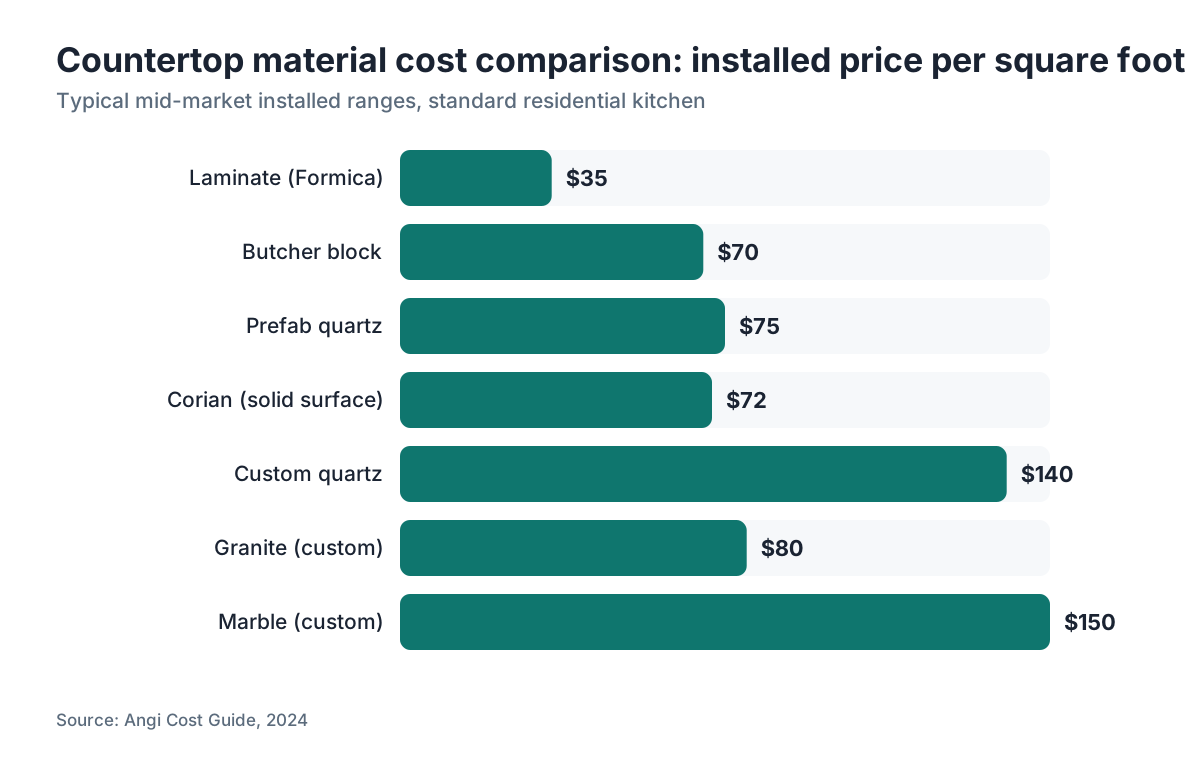
How does prefab quartz compare to other affordable countertop materials?
Prefab quartz isn't the only surface under $100/sq ft installed. Here's how the main alternatives compare:
Laminate countertops cost $20, $50 per square foot installed. High-definition printing has made them mimic stone convincingly. They scratch, they burn, they swell at seams if water gets under them, and up close they read as laminate. For a rental or a heavy-use mudroom, the math is hard to beat.
Formica countertops are the brand-name version of the above. Formica Group has made high-pressure laminate since 1912 and still holds real market share in commercial and entry-level residential work. Same durability tradeoffs as generic laminate.
Butcher block countertops run $40, $100/sq ft installed depending on wood species and thickness. They're warm, they sand out when scratched, and they look great as an accent next to stone. They need regular oil sealing and they don't belong near constant moisture unless you use a hard finish instead of raw oil.
Corian countertops (solid surface) cost $45, $100/sq ft installed. Seams nearly disappear because the material heat-welds. Scratches sand out. It's softer than quartz and shows knife cuts if you're careless.
Granite countertops in budget colors start at $50, $75/sq ft installed through volume fabricators. Granite is harder than quartz, laughs off heat, and every slab is unique. The catch: it needs periodic sealing, and the pattern is whatever the slab gives you.
For a homeowner who wants a stone look, real durability, and low maintenance without spending $150+/sq ft, prefab quartz or a value-tier custom quartz is the rational pick. Prefab makes the most sense when your layout is simple and the available edge options don't bother you.
What are the biggest mistakes people make buying prefab quartz?
Measure twice. Then measure again.
The most common mistake is buying prefab pieces off estimated measurements before cabinets are level and final. Cabinets shift. Walls aren't square. A 96-inch piece bought before install day can land half an inch too long or too short, and either way you've got a problem.
Second mistake: ignoring depth. Standard base cabinets are 24 inches deep. Add the door thickness and the face sits around 24.5 inches. A 25.5-inch piece gives you a 1-inch front overhang, which is correct. But if your cabinets are non-standard or older European sizes, verify before you buy.
Third mistake: assuming the piece drops right in. Prefab quartz still needs:
- A sink cutout (usually)
- A cooktop cutout if applicable
- Seams filled and polished
- Silicone on the cabinet tops
- Caulk at the wall joint
None of that is hard. None of it is free either. Put it in your real installed budget.
Fourth: skipping the return policy. Big-box stores vary on whether opened or installed pieces come back. Quartz is heavy and fragile in transit. Inspect the piece fully before you sign for a freight delivery. Hairline cracks near edges are common shipping damage and they spread under use.
Fifth: buying a prefab piece for a bathroom vanity without checking depth. Almost every standard vanity is 21 inches deep, so a 25.5-inch piece won't work without cutting. Marble countertops and most natural stone hit the same depth mismatch when you try to force big-box prefab into non-standard spots.
Does prefabricated quartz hold its value in a home resale?
The honest answer: nobody has solid data comparing prefab and custom quartz at resale specifically. What exists is broader research on kitchen remodel returns.
The National Association of Realtors' 2023 Remodeling Impact Report found a complete kitchen upgrade recovered 67% of its cost at resale, and a minor kitchen remodel returned even better on a relative basis. [8] Countertop material is one thing buyers notice, but agents consistently report buyers care more about a kitchen's overall finish level than the specific brand or fabrication method.
In a kitchen where everything else looks maintained and current, a well-installed prefab quartz top in a neutral color reads as "stone countertops" to most buyers. The seams might catch an inspector's eye. They won't sink a sale.
Where prefab hurts you is in a high-end kitchen. Put custom cabinetry and a pro range in, then install prefab with an eased edge and visible corner seams, and buyers at that price point notice the mismatch. Spend on custom in a premium kitchen. Use prefab in a value-tier update where nobody expects perfection.
And keep the whole house in view. Countertop quality, prefab or custom, matters less to resale than roof condition, HVAC age, and square footage. Remember that before you add $3,000 to a budget chasing a sliver of resale recovery.
What should fabricators know about competing with prefab quartz?
Prefab quartz has pulled market share from fabrication shops on small, simple jobs since roughly 2015. Home Depot and Lowe's made it easy: a homeowner with a plain galley kitchen walks out with a loaded cart under $800 in material and follows a YouTube video to set it.
Here's where prefab can't beat you: any kitchen with more than one angle, any island over 10 feet, any job needing an undermount sink (most custom buyers), any premium material, any complex edge, and any bathroom vanity under 24 inches deep. That's most of the residential market by dollar value, just not by job count.
Shops that run lean and price transparently win back the "I almost bought prefab" customer on two points: the final price is closer than they expected (they never counted all the prefab add-ons), and the custom piece fits with no compromise.
If you want to tighten quoting on simple jobs to stay in the fight, nesting software that cuts slab waste matters a lot. SlabWise is built for exactly this, showing real material cost per job before you commit to a quote. Better nesting on a straightforward kitchen can recover 8 to 15% in material cost, and that's often the difference between a quote that wins and one that loses to a big-box cart.
One more angle: offer prefab-competitive pricing on stock colors by buying those slabs in volume and templating fast. A one-week turnaround on a simple kitchen in a popular white, priced at $75/sq ft installed, beats prefab on every measure except for the customer who just wants to do it himself this weekend.
Frequently asked questions
How much does prefabricated quartz countertop installation cost per square foot?
Prefab quartz installed costs $50, $100 per square foot in most markets. The material alone runs $20, $45/sq ft at retail, and labor for a straightforward install adds $200, $400 for the job. Extras like sink cutouts ($100, $200), seam finishing ($75, $150 per seam), and backsplash pieces are usually separate. A 30 sq ft kitchen often lands between $1,500 and $2,500 all in.
What sizes do prefab quartz countertops come in?
The common depths are 25.5 inches (standard base cabinets with a 1-inch front overhang) and 36 inches for islands. Lengths sell as 4-foot, 6-foot, 8-foot, and occasionally 10-foot pieces. Thickness is almost always 3 cm, about 1.25 inches. Backsplash strips, sold separately, are usually 4 or 6 inches tall.
Can you cut prefabricated quartz countertops at home?
Yes, but it takes a wet saw with a diamond blade rated for engineered stone. Dry cutting throws off silica dust, which OSHA regulates as a serious respiratory hazard under 29 CFR 1926.1153. Minimum protection is an N95 respirator, and a P100 is better. The cuts also chip if the blade speed or feed rate is wrong. For anything past a simple trim, hiring a fabricator is safer.
Is prefab quartz the same quality as custom quartz?
The material is the same: roughly 90 to 94% ground quartz aggregate bound with polymer resins. The difference is fabrication. Prefab pieces are cut to fixed sizes in a factory; custom pieces are templated and cut to your exact measurements. Neither is a higher-grade material, but custom fabrication buys you edge profiles, precise fits, and sink cutouts that prefab can't offer.
Does prefab quartz need to be sealed?
No. Engineered quartz, prefab or custom, is nonporous and never needs sealing. The polymer resin fills the pore space natural stone leaves open. That's one of its main advantages over granite or marble, which need periodic sealing to resist stains. Clean quartz with mild soap and water, and skip abrasive pads and high-pH cleaners.
How do you handle seams in prefab quartz installations?
Installers fill seams with a two-part color-matched epoxy. The two pieces get pulled tight with seam clamps or biscuit joiners while the epoxy cures, then the joint is belt-sanded or hand-ground flush and polished. A good seam is visible up close but not distracting. Prefab jobs usually have more seams than custom because the pieces are fixed-width rectangles, not cut to your layout.
How does prefab quartz hold up against heat?
Worse than granite or quartzite. The polymer resins in engineered quartz can discolor or delaminate with sustained heat above roughly 300°F (149°C). Setting a hot pan straight off the burner is the main risk. Always use a trivet or hot pad. This applies to all quartz, prefab or custom. If your counters routinely see hot pots, granite or quartzite fits better.
What are the best colors and patterns available in prefab quartz?
Prefab lines lean toward popular neutrals: whites, light grays, and beiges, often with subtle veining or a speckled look. Pure whites in Calacatta-style patterns and simple gray-on-white veining are the most stocked. Dramatic bookmatched veining, bold colors, and distinctive patterns usually only come through custom slab programs. If you spotted a bold quartz design in a magazine, it's almost certainly a custom piece.
Can prefab quartz be used for bathroom vanities?
It can, but standard prefab pieces are 25.5 inches deep while most bathroom vanities are only 21 inches deep. That mismatch usually means ripping the piece down, which creates silica dust and needs wet-saw equipment. Some retailers sell 22-inch-deep prefab pieces made for vanities, so check first. A custom-cut vanity top from a local fabricator often costs only marginally more for a single-sink vanity.
How long does a prefab quartz installation take?
If the pieces are in stock and your cabinets are level, a prefab install on a typical kitchen can be done in one day. Material is available immediately at retail, versus one to three weeks for custom fabrication. The full timeline, including cabinet leveling, delivery, and seam curing, usually runs two to three days against ten to twenty-one days for a templated custom job. That speed is one of prefab's real advantages.
Is prefab quartz a good choice for a rental property?
It's a strong choice for rentals. The material is durable, stain-resistant, and needs no sealing. Lower cost matters when you're optimizing durability per dollar rather than looks. Stick to neutral whites and grays that photograph well and appeal to most tenants. The seams and limited edge options that feel like compromises in a high-end kitchen are invisible to most renters.
How do prefab quartz countertops compare to prefab granite?
Both sell in standard sizes at home centers, but prefab granite is less common. Where it exists, prefab granite runs about $45, $80/sq ft installed. Granite handles heat better than quartz and carries unique natural patterning, but it needs periodic sealing. Prefab granite color selection is even more limited than prefab quartz, because each natural slab varies and true standardization is hard.
What's the difference between prefab quartz and a quartz slab sold at a stone yard?
A stone-yard slab is raw material, typically 55 to 65 inches wide and 100 to 130 inches long, sold by the square foot or as a whole slab. A fabricator buys it, templates your kitchen, and cuts it to fit. A prefab piece is already cut to a fixed rectangle, polished on the edges, and sold retail. Slabs give you full design freedom; prefab gives you speed and lower cost.
Why does prefab quartz have more seams than custom quartz?
Prefab pieces come in fixed-width rectangles, so a corner or a long run gets covered by butting two standard pieces together instead of one piece cut to your exact layout. Custom fabrication cuts each piece to your kitchen, letting the fabricator place seams where they hide best and skip them where a single piece reaches. More fixed rectangles in a non-standard space equals more joints.
Sources
- Natural Stone Institute (formerly Marble Institute of America), Dimensional Stone Design Manual: Engineered stone defined as a factory-produced surfacing material made from natural stone or other mineral materials combined with a binder
- NSF International, NSF/ANSI 51 Food Equipment Materials Standard: Standard countertop slab thickness of 3 cm (approximately 1.25 inches) referenced in countertop material testing contexts
- Angi, Quartz Countertop Installation Cost Guide: Prefab quartz $50, $100/sq ft installed; sink cutout labor $100, $200; custom quartz $80, $200/sq ft installed
- U.S. Occupational Safety and Health Administration, 29 CFR 1926.1153 Respirable Crystalline Silica in Construction: OSHA action level 25 micrograms/m3 and PEL 50 micrograms/m3 as 8-hour TWA for crystalline silica in construction
- U.S. Geological Survey, National Minerals Information Center: Quartz: Quartz scores approximately 7 on the Mohs hardness scale
- Silestone by Cosentino, Product Technical Specifications: Engineered quartz polymer resins at risk of discoloration above approximately 300°F (149°C); trivet use recommended
- International Agency for Research on Cancer, IARC Monographs Volume 100C: Silica Dust: IARC classifies crystalline silica inhaled from occupational sources as a Group 1 carcinogen
- National Association of Realtors, 2023 Remodeling Impact Report: Complete kitchen upgrade had 67% cost recovery at resale in the 2023 NAR Remodeling Impact Report
- U.S. Bureau of Labor Statistics, Consumer Price Index: Countertop and stone flooring price index data used as context for material cost ranges
- MSI Surfaces, Q Premium Natural Quartz Product Line: MSI quartz available in prefab format through major home center retail channels
- Caesarstone, Technical Product Guide: Engineered quartz composition approximately 90 to 94% quartz aggregate with polymer resin binder
Last updated 2026-07-10