TL;DR
- Prefabricated granite countertops are pre-cut slabs, usually in standard 25.5-inch or 36-inch depths and 8- to 10-foot lengths, sold at home improvement stores or stone yards.
- They run $35 to $75 per linear foot installed versus $60 to $150+ for custom fabrication.
- You get real stone at a lower price.
- You accept fixed dimensions, few edge profiles, and no unusual cutouts.
What are prefabricated granite countertops, exactly?
Prefabricated granite countertops are granite slabs that arrive already cut to common kitchen dimensions, polished on top, and finished on one long edge before you ever see them. A fabricator or importer does the main milling overseas or in a central plant, then ships the pieces flat to distributors and big-box retailers. You buy what's on the shelf.
The standard depths are 25.5 inches (for base cabinet runs with an overhang) and 36 inches (for islands). Lengths typically come in 8-foot, 9-foot, and 10-foot pieces. Edge profiles are usually a simple eased edge or a basic bullnose, because complex profiles like ogee or waterfall need extra passes on a CNC machine that adds cost.
The top surface is fully polished. The underside is rough. One long edge, the one that faces into the room, is finished. The back edge that sits against the wall usually is not, because it's meant to butt against a backsplash tile or the wall itself.
This is real granite, not granite-look laminate or composite. The stone has the same hardness and heat resistance as a custom slab, and it needs the same periodic sealing. The fabrication just happens upstream, at scale, which is where the cost savings come from.
How much do prefabricated granite countertops cost?
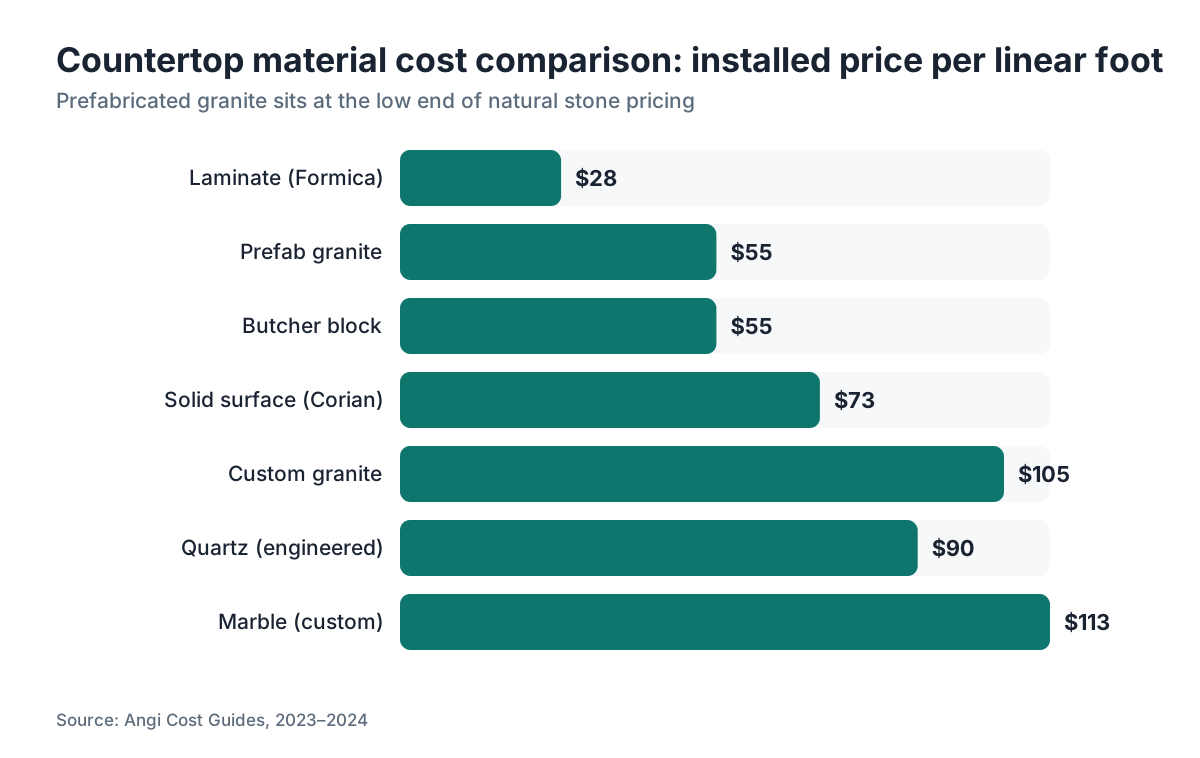
Installed, prefabricated granite typically runs $35 to $75 per linear foot. The number moves with your region, the stone color, and whether you buy from a big-box store or a local distributor [1]. That price usually covers basic installation: setting the pieces, applying silicone at seams, securing to the cabinet. It does not usually cover plumbing reconnection or demolition of the old surface.
For context, custom granite fabricated from full slabs runs $60 to $150 per linear foot installed, with some exotic stones or complex jobs hitting $200 or more [1]. The gap is real. For a basic kitchen with simple runs, prefab can save $1,000 to $3,000 or more on materials alone.
Material only, without installation, prefab granite sits around $15 to $35 per linear foot at retail. A typical 25-linear-foot L-shaped kitchen might run $900 to $2,000 in material before installation.
Here's what drives price variation inside the prefab category:
- Stone color and source. Black Galaxy and Santa Cecilia are mass-imported and cheap. Rarer colors cost more even in prefab.
- Thickness. Most prefab is 3/4-inch (2 cm). Some vendors offer 1.25-inch (3 cm), which is heavier and stronger but pricier.
- Edge complexity. Upgrading from eased to bullnose or beveled adds $5 to $15 per linear foot in some product lines.
- Retailer. Home Depot and Lowe's negotiate volume pricing. Local stone yards may charge more but carry better stock.
A small bathroom vanity top with a pre-cut sink hole is the cheapest prefab buy, sometimes as low as $150 to $400 for the piece. That price is genuinely hard to beat.
Prefabricated vs. custom granite: which one should you choose?
This comes down to your kitchen's geometry and your priorities. Prefab wins on price and speed. Custom wins on fit, edge options, and slab continuity.
| Factor | Prefabricated granite | Custom granite |
|---|---|---|
| Typical installed cost | $35, $75 per linear foot | $60, $150+ per linear foot |
| Lead time | Same day to 1 week | 1 to 3 weeks typical |
| Thickness options | Usually 2 cm (3/4") | 2 cm or 3 cm (1.25") |
| Edge profiles | 1 to 3 basic options | 10+ CNC profiles |
| Seams | More frequent (piece length limits) | Fewer, placed strategically |
| Cutouts | Pre-cut or no option | Any shape, precisely templated |
| Color/pattern matching across pieces | Variable | Fabricator matches from same slab |
| Unusual dimensions | Not available | Anything you need |
For a galley kitchen or a simple straight run under 8 feet, prefab makes a lot of sense. The fit is easier, the seams are fewer, and you save real money.
For an L-shaped or U-shaped kitchen with a peninsula, custom gets more attractive because prefab needs more seams, and each seam is a visible line and a potential weak point. A skilled fabricator templating a full slab can hold a complex layout to one or two seams.
Islands are where prefab often falls short. Standard prefab island pieces cap out at 10 feet long and 36 inches deep. An 8-by-4-foot island needs a 96x48-inch piece at minimum, and that's not a standard prefab product. You're into custom territory whether you want to be or not.
Then there's pattern continuity. Granite varies naturally. When a fabricator cuts adjacent pieces from the same slab, they can book-match or at least keep the pattern coherent across a seam. With prefab, two 8-foot pieces from two different batches may look noticeably different. For busy patterns like Giallo Ornamental this matters less. For a subtle gray or white granite it can be jarring.
For more on how granite countertops get fabricated start to finish, that article covers the full slab-to-kitchen process.
What are the standard sizes and dimensions of prefab granite?
Standard prefab granite comes in a narrow set of sizes because standardization is what makes mass production cheap. Here's what you'll commonly find:
Depth: 25.5 inches is the near-universal standard for base cabinet runs. It accounts for a 24-inch deep cabinet, a 1.5-inch overhang on the face, and a 0-inch overhang at the back (flush to wall). Island pieces often come in 36 inches or 42 inches deep.
Length: 8 feet (96 inches), 9 feet (108 inches), and 10 feet (120 inches) are the common lengths. Some distributors stock 6-foot pieces.
Thickness: 3/4-inch (2 cm) is most common. Some product lines offer 1.25-inch (3 cm). For 2 cm pieces on cabinet runs longer than around 30 inches, you typically need a plywood or MDF substrate to prevent flexing and cracking, especially at cooktop and sink cutouts [2].
Sink cutouts: Get this dimension right. Many prefab countertops arrive without a sink cutout made. You (or a professional) cut it on-site, or you order from a vendor that pre-cuts it. Pre-cut sink holes are usually sized for standard undermount sinks in 33-inch or 36-inch configurations. If you have a farmhouse (apron) sink or an unusual undermount, prefab with a pre-cut will not fit without modification.
Faucet holes for deck-mounted faucets are usually drilled separately, either at the store or on-site. Drilling granite yourself without a diamond core bit and water cooling is a bad idea. The stone will crack.
What types of granite are available in prefab?
The prefab market runs on a small set of high-volume stones that quarry, cut, and polish efficiently at scale. If you want one of these, you're in luck. If you want something else, you're probably going custom.
Common prefab granite colors include:
- Black Galaxy (India): black with gold and silver mineral flecks
- Santa Cecilia (Brazil): cream/gold background with burgundy and black flecks
- Giallo Ornamental (Brazil): light cream with darker brown and gray movement
- Uba Tuba (Brazil): dark green-black with gold, green, and blue flecks
- New Venetian Gold (Brazil): warm gold with burgundy veins
- Kashmir White (India): white-gray with dark flecks
- Absolute Black (India): pure black, very consistent pattern
- Tan Brown (India): brown with black and pink crystals
Those stones stay popular for a simple reason: they're abundant at the quarry and consistent batch to batch, so they ship in high volume. That consistency matters for prefab because a retailer wants to replace a damaged piece with a matching one from inventory.
What you generally won't find in prefab: leathered finishes, honed surfaces (though some vendors do stock these), exotic quartzites sold as granite, or any stone with dramatic veining that would make each piece look different from the last.
If your heart is set on a White Spring or a Blue Pearl or a Calacatta-look stone, you're shopping full-slab custom, and you should look at what a kitchen countertop project involves before you start.
How is prefab granite installed, and can I do it myself?
Prefab granite installation is DIY-possible in specific scenarios. Not all of them, but some.
The process goes like this: measure your cabinet run carefully (then measure again), order the pieces, have them delivered or pick them up, set them dry on the cabinets to check fit, mark and cut any on-site adjustments, apply silicone adhesive to the cabinet top edges, set the pieces, join any seams with color-matched epoxy, and secure to the cabinet face frame or with clips.
Where DIY gets complicated:
Weight. A 3/4-inch prefab granite piece at 8 feet long and 25.5 inches wide weighs roughly 120 to 140 pounds [3]. You need at least two people, ideally three. Dropping it onto a cabinet or a floor is a bad day.
Sink cutouts. Cutting granite on-site needs a 4-inch or 4.5-inch angle grinder with a diamond blade or a jigsaw with a diamond blade, plus a lot of water cooling and dust management. Silica dust from cutting granite is a serious respiratory hazard. Federal OSHA and California's OSHA division (Cal/OSHA) both regulate silica exposure in fabrication settings, and while a single DIY cut is not a regulated activity, the hazard is real [4]. Wear a P100 respirator at minimum.
Seam joining. Getting two pieces of granite to sit flush at a seam without a gap or a lip takes clamping, leveling, and the right two-part polyester or epoxy seam setter. It's achievable but not beginner-friendly.
For a simple straight run with no sink and no cutouts (say, a utility room or a laundry room), DIY prefab is genuinely feasible. For a full kitchen with a sink, I'd have a professional do the sink cutout and seam setting at least, even if you prep everything else.
For a full walkthrough of what professional countertop installation involves, including what to ask contractors before you sign, that guide has you covered.
How do prefab granite countertops hold up over time?
The stone itself is no different from a custom granite slab. Granite scores 6 to 7 on the Mohs hardness scale, so it resists scratching from most kitchen tools [5]. It handles heat well; you can set a hot pan on it without damaging the stone, though thermal shock is a theoretical risk on thinner 2 cm pieces.
The durability concerns with prefab live in the installation, not the stone:
Seams. More seams in a prefab layout means more epoxy joints. Those joints can discolor over years, especially if water infiltrates a poorly sealed seam. They can also crack if the cabinet substrate flexes. A custom layout with a single well-placed seam is structurally stronger than three prefab joints.
Thickness. The 2 cm standard is thinner than the 3 cm most custom fabricators use. Thinner stone needs full substrate support, and unsupported spans over sink openings or cooktop cutouts are where prefab chips and cracks show up [2]. If you're installing 2 cm prefab over an undermount sink, build a plywood support frame around the sink opening.
Sealing. Prefab granite needs the same sealing schedule as custom granite: a penetrating impregnating sealer applied every 1 to 3 years depending on the stone's porosity. The surface arrives pre-polished but, in most cases, not pre-sealed. Do it before first use.
With proper sealing and solid substrate support, a prefab granite countertop should last 20 or 30 years without issue. The stone doesn't care how it was cut. For sealing and stone care guidance, those routines apply equally to prefab and custom.
What are the real downsides of prefab granite?
I want to be honest here, because most coverage of prefab granite is either pure marketing or pure snobbishness, and neither helps you decide.
Seams are the main issue. In a real kitchen, you'll almost always have at least one seam with prefab, and often two or three. Each seam is a visual interruption and a maintenance point. If a continuous, unbroken run matters to you aesthetically, prefab is the wrong product.
Thickness at the edge looks different. Standard 2 cm prefab reads thinner at the edge than 3 cm custom. To hide that, some installers attach a granite lamination strip (a thin piece of the same stone) to the front edge, making it look like 3 cm. This adds cost and another potential crack point. Not a fatal flaw, but worth knowing.
Limited stone movement for dramatic kitchens. If your design is built around dramatic white veining or a specific slab's character, prefab will disappoint. The available stones are handsome, but they're the safe commercial choices.
Color variation between batches. Even within one stone type, different quarry runs look different. If you replace a prefab section years later, matching it exactly is very hard.
Sink options are constrained. Want a farmhouse sink, a trough sink, or any unusual undermount? You'll either need custom cutting on-site (more cost and risk) or you'll hit a wall with prefab's standard cutout sizes.
None of these are dealbreakers for the right kitchen. But they're real, and you should price them into the decision.
How does prefab granite compare to laminate, quartz, and other countertop materials?
Prefab granite occupies a specific price and performance band. Here's where it lands:
vs. Laminate: Laminate (Formica and similar) runs $15 to $40 per linear foot installed [6]. It's lighter, DIY-friendlier, and comes in far more patterns. It's also not heat-resistant and can chip at the edges. Prefab granite beats it on durability and on how buyers perceive it at resale. If budget is your only concern, laminate countertops are the alternative to know.
vs. Quartz: Engineered quartz (Cambria, Silestone, etc.) runs $60 to $120 per linear foot installed for custom slabs [7]. There's no mass-market prefab quartz at the same level as prefab granite, though some modular quartz pieces exist. Quartz doesn't need sealing and holds color and pattern more consistently. Prefab granite undercuts it on price. For what engineered quartz offers, Cambria countertops is worth reading.
vs. Marble: Custom marble starts around $75 to $150 per linear foot installed and demands much more maintenance [8]. Prefab granite is harder, more stain-resistant, and far cheaper. If you want the stone look without marble's maintenance headaches, prefab granite makes a legitimate case. Marble countertops covers what you'd be trading.
vs. Butcher block: Butcher block runs $30 to $80 per linear foot installed and works beautifully as a complement to stone, not a replacement [9]. Different aesthetics, different care. You can do an island in butcher block and perimeter runs in prefab granite and make both look intentional. See butcher block countertops for that angle.
vs. Corian/solid surface: Solid surface runs $45 to $100 per linear foot installed, repairs from scratches, and lets an installer integrate the sink into the counter as one continuous piece [10]. Prefab granite beats it on heat resistance and natural stone appearance. Corian countertops explains where solid surface wins.
For most budget-conscious homeowners who want natural stone, prefab granite is the honest best buy in its price range.
Where do you buy prefab granite countertops?
Three main channels:
Big-box retailers. Home Depot and Lowe's both carry prefab granite in common colors. You can often see the stone in person, which matters. Selection is limited to maybe 8 to 15 colors, but they're the high-volume ones most people want. Prices stay competitive because of volume buying. Installation can usually be arranged through their in-store services.
Local stone yards and distributors. Many granite importers sell prefab pieces alongside their full slab inventory. Selection is sometimes broader and prices are occasionally better, but you're dealing with trade customers as the primary audience. Some are B2B only. Others welcome homeowners. Call first.
Online retailers. MSI Surfaces and similar large importers sell prefab pieces through their dealer network and sometimes direct. You get a wider color selection, but you're buying a heavy stone product without seeing it in person, which is a real risk. Request a sample before ordering a full set.
For fabricators sourcing prefab stock to offer as an economy option alongside custom work, the economics work when you store a small inventory of the three or four most popular colors and turn pieces quickly. SlabWise's quoting tool lets you build separate price schedules for prefab versus custom work, so you're not accidentally underbidding prefab jobs that still need templating and installation labor.
One buying tip: measure your kitchen multiple times and add at least 5 to 10% for cuts and waste. Prefab pieces are not returnable once cut.
What should you ask before buying prefab granite?
Before you buy anything, get answers to these questions:
Is the sink cutout included, and what size? This is the most common source of problems. If the piece comes pre-cut for a 33-inch undermount and your sink is 30 inches, that hole is in the wrong place.
Is installation included in the quoted price? Some retailers quote material only and leave you to find an installer. Ask exactly what the installed price includes: delivery, setting, seaming, silicone. Plumbing reconnection is almost always extra.
What edge profile comes standard, and what do upgrades cost? If you want anything fancier than an eased edge, know the upcharge before you commit.
Is the stone sealed from the factory, or do I need to seal it? Most prefab is not pre-sealed. Seal it before use.
What is the return or exchange policy for damaged pieces? Stone ships on pallets and can crack in transit. Know your recourse before it arrives at your door.
What thickness is it? Ask for 2 cm or 3 cm explicitly. Do not assume.
Is there a support requirement for spans over the sink? If the retailer or installer doesn't raise this on a 2 cm piece, raise it yourself. An unsupported 2 cm granite span over a 33-inch sink opening will eventually fail.
How do you care for and seal prefab granite countertops?
The care routine for prefab granite is identical to custom granite. The stone doesn't know how it was cut.
Daily cleaning: Warm water and mild dish soap on a soft cloth. Skip acidic cleaners (vinegar, lemon-based products) because they can etch the polished surface over time. Skip abrasive pads. Wipe up spills, especially oil-based ones, promptly.
Sealing: Use a penetrating impregnating sealer, not a topical coating. Topical coatings sit on the surface and peel. Penetrating sealers soak in and protect from within. Apply before first use, let it penetrate, wipe off the excess, and let it cure. Re-seal every 1 to 3 years depending on the stone's porosity. A simple test: put a few drops of water on the surface. If it beads up, you're sealed. If it soaks in and darkens the stone within a few minutes, it's time to re-seal [11].
Avoiding damage: Don't use the countertop as a cutting board. Granite dulls your knives, and microcuts accumulate over years and create hiding spots for bacteria. Don't slam heavy pots on thin 2 cm pieces near unsupported spans.
For a detailed stone care guide, how to clean stone countertops covers the full routine for granite and related materials.
Sealing products widely available in the US include Aqua Mix Sealer's Choice Gold, Tenax Hydrex, and Stone Tech BulletProof, among others. Prices range from $25 to $80 per bottle. One bottle usually covers a full kitchen with a single application.
Frequently asked questions
Is prefabricated granite the same quality as custom granite?
The stone itself is real granite with the same hardness and heat resistance as custom slabs. Quality differences come from thickness (prefab is usually 2 cm vs. 3 cm custom), fewer edge profile options, and more frequent seams in complex layouts. The underlying mineral material is identical. What you're trading is fabrication flexibility, not stone quality.
Can prefab granite be cut to size on-site?
Yes, but it requires a diamond blade (angle grinder or jigsaw), water cooling to prevent cracking and manage dust, and a P100 respirator for silica protection. Straight cuts are manageable for a careful DIYer. Curved cuts, such as for a farmhouse sink, are much harder and carry a higher risk of cracking the piece. For sink cutouts especially, consider hiring a professional.
How long does prefab granite countertop installation take?
A professional can install a basic L-shaped kitchen in half a day to a full day, assuming all pieces are pre-measured and fit without significant on-site cutting. Custom granite templating adds 1 to 2 weeks to that timeline. Prefab's main speed advantage is eliminating the template-to-fabrication gap: you can often go from purchase to installed stone in the same week.
Do prefab granite countertops add home value?
Real granite, including prefab, generally reads positively to buyers compared to laminate. Whether prefab granite adds measurable resale value over laminate depends heavily on your market. Remodeling Magazine's Cost vs. Value data suggests mid-range kitchen remodels recoup around 70 to 80% of cost, but that's for the whole remodel, not granite specifically. Prefab granite is unlikely to hurt value; it may help in entry-level to mid-tier markets.
What is the difference between prefab granite and modular granite?
The terms are used interchangeably in most retail contexts. Some vendors use 'modular' specifically for pieces designed to combine in a tile-like grid pattern, while 'prefab' refers to longer pre-cut slabs. In practice, at Home Depot or a stone yard, prefab and modular mean the same thing: pre-cut, pre-polished stone pieces in standard sizes.
Can you use prefab granite for a bathroom vanity?
Yes, and bathroom vanity tops are where prefab granite offers some of the best value. Pre-cut vanity tops with a finished front edge and a pre-drilled or cuttable faucet hole run $150 to $400 for standard sizes. The spans are short, which eliminates the structural concerns of longer kitchen runs, and the sink cutouts on bathroom pieces are usually pre-fit for drop-in bowls.
How thick should prefab granite countertops be?
Most prefab is 3/4-inch (2 cm). This works fine with continuous cabinet support but needs a plywood or MDF substrate backer around any cutout, especially the sink opening. The 1.25-inch (3 cm) option is structurally stronger and doesn't need a substrate, but it's heavier and costs more. If you're choosing, 3 cm is better for sink runs; 2 cm is fine for backsplash returns or areas with no cutouts.
Does prefab granite need to be sealed?
Yes. Most prefab granite is sold polished but not sealed. Apply a penetrating impregnating sealer before first use. The water bead test tells you when to reapply: drop a few tablespoons of water on the surface; if it darkens and absorbs within 5 minutes, the sealer has worn and it's time to reapply. Most kitchens need resealing every 1 to 3 years.
What are the most popular colors of prefab granite?
The highest-volume prefab granite colors are Santa Cecilia (cream and gold), Black Galaxy (black with metallic flecks), Giallo Ornamental (warm cream with movement), Uba Tuba (dark green-black), New Venetian Gold, and Absolute Black. These are popular because they're abundant at the quarry, ship consistently batch to batch, and appeal broadly across kitchen design styles.
Is prefab granite good for outdoor kitchens?
Granite handles outdoor conditions reasonably well given its hardness and heat tolerance. The risks outdoors are freeze-thaw cycles in cold climates, which can infiltrate any micro-cracks, and UV exposure, which doesn't damage granite but can discolor the epoxy at seams over years. If you're building an outdoor kitchen, 3 cm custom granite with a silicone-only joint is a safer choice than thin prefab pieces with epoxy seams.
Can prefab granite be repaired if it chips or cracks?
Chips at edges can be filled with color-matched polyester or epoxy filler and polished. The repair is rarely invisible on close inspection but it's functional. Cracks through the slab are more serious; a hairline crack can sometimes be stabilized with epoxy injection, but a through-crack in an undermount sink area usually means replacing the piece. This is why substrate support around cutouts matters so much in 2 cm prefab.
Where can I find a contractor to install prefab granite?
Home Depot and Lowe's offer installation services through their in-store countertop programs. Local stone fabricators often install prefab as part of their service offerings, particularly for customers who want the natural stone look at a lower price point. General contractors and tile setters also sometimes install prefab granite. Get at least two quotes and confirm the installer has done granite specifically, more than laminate or tile.
How does prefab granite compare to Formica or other laminate?
Laminate costs less ($15 to $40 per linear foot installed vs. $35 to $75 for prefab granite) and is much easier to DIY. Granite beats it on heat resistance, scratch resistance, and perceived value. Laminate can be a better choice for rental properties or temporary situations where durability and resale impact matter less than upfront cost. See the Formica article for a full laminate breakdown.
Sources
- HomeAdvisor / Angi, Granite Countertops Cost Guide: Prefabricated granite installed runs $35, $75 per linear foot; custom granite runs $60, $150+ per linear foot
- Natural Stone Institute (formerly Marble Institute of America), Dimension Stone Design Manual: 2 cm stone requires a substrate (plywood or MDF) for support at cutouts and spans exceeding roughly 24 to 30 inches
- Engineering Toolbox, Density of Granite: Granite density approximately 160 to 170 lb per cubic foot; a 3/4-inch x 8-foot x 25.5-inch piece weighs approximately 120 to 140 pounds
- U.S. Occupational Safety and Health Administration, Crystalline Silica: Cutting granite generates respirable crystalline silica dust, which is regulated under OSHA's silica standard (29 CFR 1910.1053 for general industry)
- Natural Stone Institute, Care and Cleaning for Natural Stone: Granite scores 6 to 7 on the Mohs hardness scale and resists scratching from most kitchen tools
- HomeAdvisor / Angi, Laminate Countertops Cost Guide: Laminate countertops installed typically cost $15, $40 per linear foot
- HomeAdvisor / Angi, Quartz Countertops Cost Guide: Custom engineered quartz countertops installed typically run $60, $120 per linear foot
- HomeAdvisor / Angi, Marble Countertops Cost Guide: Custom marble countertops installed typically start at $75, $150 per linear foot
- HomeAdvisor / Angi, Butcher Block Countertops Cost Guide: Butcher block countertops installed typically run $30, $80 per linear foot
- HomeAdvisor / Angi, Solid Surface Countertops Cost Guide: Solid surface (Corian-style) countertops installed typically run $45, $100 per linear foot
- Natural Stone Institute, Care and Cleaning for Natural Stone: Water bead test: if water absorbs and darkens granite within minutes, resealing is needed; penetrating impregnating sealers are preferred over topical coatings
- Remodeling Magazine / JLC, Cost vs. Value Report: Mid-range kitchen remodels recoup approximately 70 to 80% of project cost at resale on national average
Last updated 2026-07-09