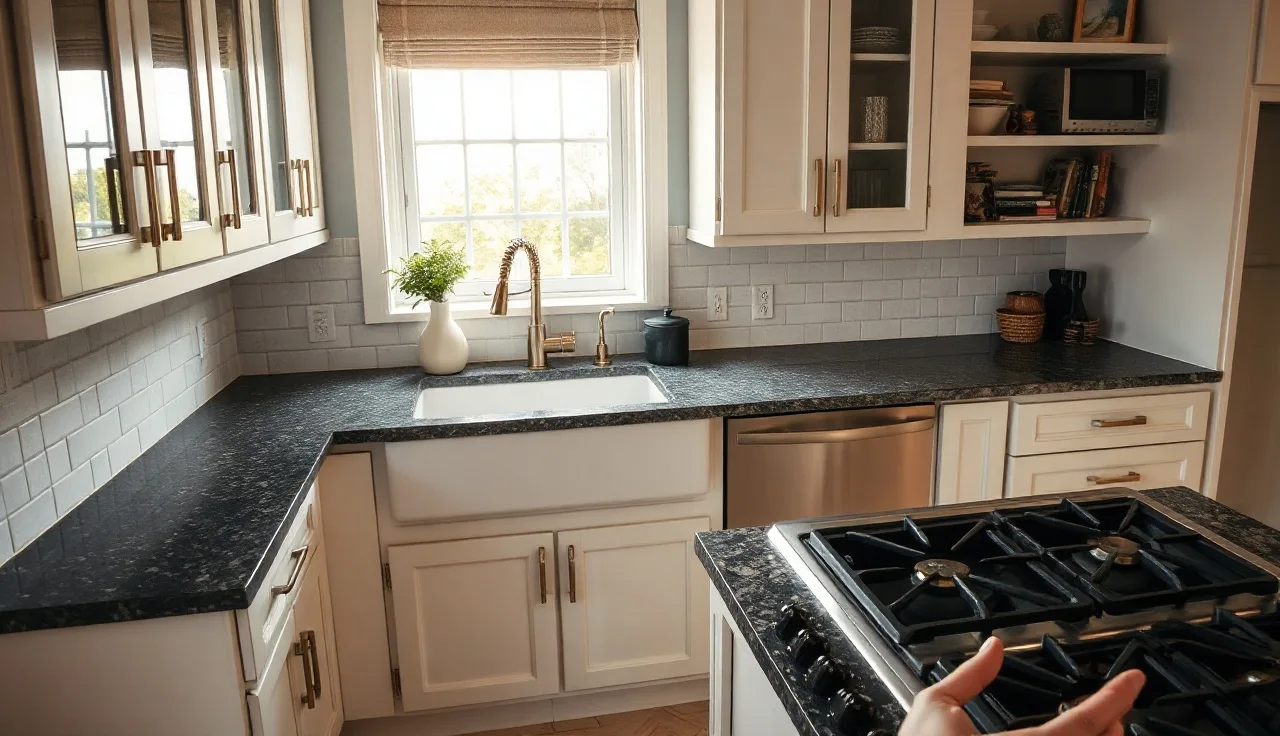
TL;DR
- Prefab granite countertops are pre-cut stone pieces, typically 96 inches by 25.5 inches, sold at big-box stores and stone yards for $15, $35 per square foot installed.
- They cost roughly half what custom slab work runs, but come in limited sizes, require visible seams in most kitchens, and can't handle unusual layouts.
- They're a legitimate choice for tight budgets and simple cabinets.
What exactly is a prefab granite countertop?
Prefab granite (short for prefabricated) is granite that has already been cut, edged, and polished at a factory, usually overseas, before you ever walk into a store. You're buying a finished piece off a shelf rather than commissioning a fabricator to cut your specific layout from a raw slab.
The standard prefab piece is 96 inches long and 25.5 inches deep, with a 1.5-inch backsplash already attached along the back edge. Some suppliers also stock 74-inch, 60-inch, and 36-inch pieces, plus corner sections. The edge profile is almost always a simple eased or beveled edge, occasionally a bullnose. You don't get to choose.
Thickness is typically 3/4 inch (roughly 18 to 20 mm), compared to the 3 cm (about 1.2 inches) standard for custom slab work. That thinner profile is why prefab pieces are lighter and cheaper to ship. It also means they're less rigid and more prone to cracking during installation if the substrate isn't dead flat.
Most prefab granite comes from quarries in Brazil, India, and China, then gets processed in large finishing plants. The stone itself is real granite. The savings sit in the fabrication labor, which has already happened at scale in a lower-cost market [1].
How much do prefab granite countertops cost?
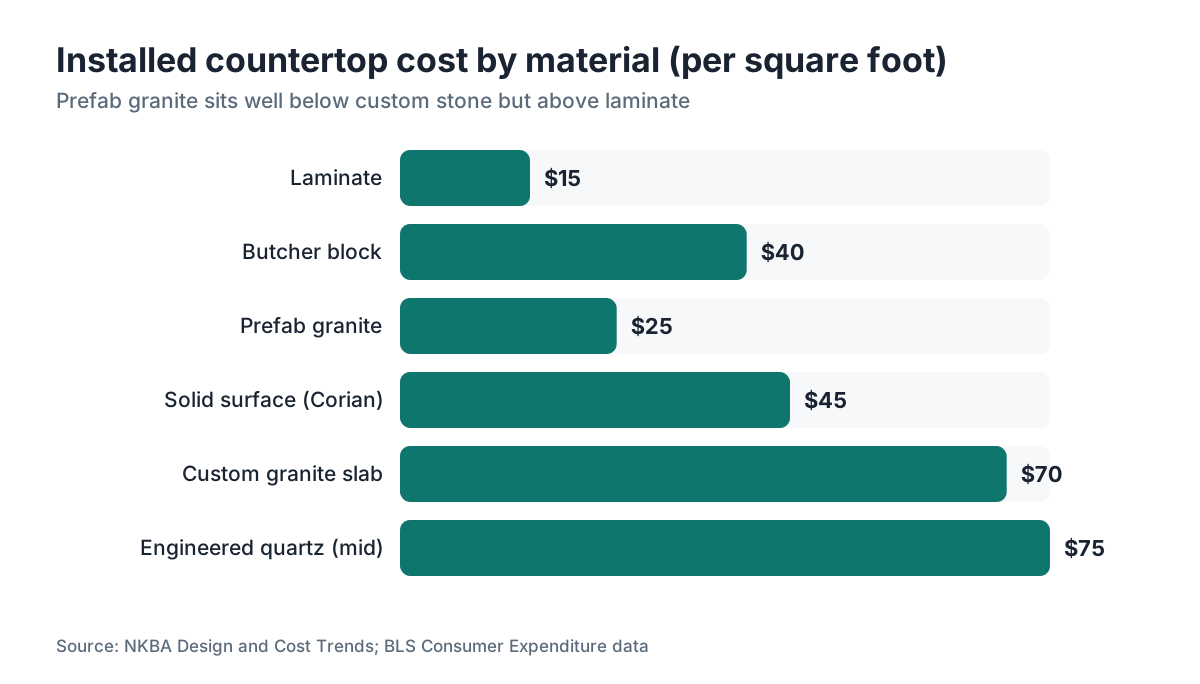
Material-only prefab granite runs roughly $5, $15 per square foot at home improvement stores like Home Depot and Lowe's, or at wholesale stone distributors. Add installation labor and you're typically looking at $15, $35 per square foot all-in, depending on your region and how many cuts the installer has to make [2].
Custom granite slab work, by comparison, generally runs $40, $100 per square foot installed for mid-tier stones, and well over $100 for exotic or book-matched material [2]. The gap is real.
Here's the catch: the cost comparison only holds if your kitchen actually fits standard prefab dimensions. Most kitchens don't. The average U.S. kitchen has multiple sections of varying length, corners, cooktop cutouts, and sink cutouts. Every extra cut you need from a prefab piece adds labor cost and waste. Once you're paying an installer for several hours of trimming and seaming, the price advantage shrinks fast.
A straightforward galley kitchen with simple runs might come in at $800, $1,200 installed with prefab versus $2,500, $4,000 for custom. An L-shaped kitchen with an island could easily require four or five prefab pieces with significant trimming, and suddenly you're at $1,800, $2,500 installed, while a sharp fabricator quoting custom might land closer to $3,500. The math still favors prefab, but not by as much as the sticker price suggests.
Some installers charge a flat per-piece rate ($150, $300 per piece is common) plus a per-cut fee ($25, $75 per cut). Others quote by the square foot. Get the full scope priced before committing.
Prefab vs. custom slab granite: what's the real difference?
The table below lays out the main tradeoffs side by side.
| Factor | Prefab granite | Custom slab granite |
|---|---|---|
| Price (installed) | $15, $35 / sq ft | $40, $100+ / sq ft |
| Stone thickness | ~3/4 in (18 to 20 mm) | ~1.2 in (3 cm), sometimes 2 cm |
| Edge profiles | 1 to 2 options | 10+ options |
| Color/pattern selection | Limited (30 to 60 SKUs) | Virtually unlimited |
| Fit for non-standard layouts | Poor | Excellent |
| Seams in average kitchen | Multiple, visible | Minimized by fabricator |
| Lead time | Days | 1 to 3 weeks typical |
| Installation DIY-friendly | Possible with care | Usually requires a pro |
| Resale perception | Lower | Higher |
The biggest practical difference is seam count. A custom fabricator lays out your kitchen digitally and optimizes cuts to keep slab joints to a minimum. With prefab, you're working with fixed-length pieces, so seams show up wherever the math forces them. Seams in granite, done well, are nearly invisible from a distance. Done poorly, or in a high-contrast stone, they jump right out at you.
The stone quality argument is more nuanced than prefab critics often admit. Prefab granite is real stone, quarried the same way. What you lose is selection, not material integrity. You'll choose from whatever the distributor stocks, usually the most popular neutral tones (Santa Cecilia, Uba Tuba, Giallo Ornamental, Tan Brown, and Black Galaxy are common). If you have a specific aesthetic or a bold color in mind, prefab almost certainly won't have it [3].
Thickness matters for durability. The 3/4-inch prefab pieces can handle normal kitchen use without issue if they're properly supported. But they're more vulnerable to impact at the edges and more likely to crack if the cabinets have any unevenness. Custom 3 cm slabs give you more margin for error during installation and everyday life.
Where can you buy prefab granite countertops?
The three main channels are big-box home improvement stores, wholesale stone distributors, and online suppliers.
Home Depot and Lowe's both carry prefab granite sections in-store and online, typically 10 to 20 colors in standard sizes. Prices as of mid-2025 run roughly $40, $80 per linear foot for material (that includes the 25.5-inch depth), which translates to about $19, $38 per square foot before installation. These are the easiest to return if something goes wrong, and they often bundle delivery.
Wholesale stone distributors sell directly to consumers in most states, often with a wider color selection and lower per-piece prices than big-box. You usually need to pick up in person or arrange freight delivery yourself. This channel is worth checking if you have a stone yard within driving distance.
Online suppliers like MSI Stone (msisurfaces.com) and others ship prefab sections via freight. The price can be competitive, but you're taking on the shipping risk. Granite chips and cracks in transit more often than retailers admit. Inspect every piece before signing the delivery receipt, and photograph any damage immediately.
For fabricators reading this: some of your residential customers will bring in prefab pieces they bought themselves and ask you to install them. That's a legitimate business model, though you should have a clear policy on liability for installer-supplied material. Pricing that work by the cut rather than by the square foot usually protects your margins better.
Can you install prefab granite yourself?
You can, but it's harder than YouTube makes it look. The pieces are heavy (a 96-by-25.5-inch prefab section at 3/4 inch thick weighs roughly 100 to 130 pounds depending on the specific stone), the silicone application has to be right, and the cabinets need to be perfectly level or you'll crack the stone trying to force it flat.
Here's what DIY installation actually requires: cabinets shimmed and leveled to within 1/8 inch across the full run, a clean substrate (usually 3/4-inch plywood over the cabinet tops), a jigsaw or diamond blade grinder for trimming length, a sink cutout that matches your sink exactly, a drill with a diamond hole saw for faucet holes, 100% silicone adhesive, and at least two people for every piece. One person cannot safely maneuver a 130-pound stone slab onto cabinets alone.
The sink cutout is where DIYers run into the most trouble. Cutting granite without cracking it takes a proper diamond blade, patience, and constant water cooling. The prefab pieces don't come with a pre-cut sink opening. If you miscut, the piece is scrap.
Cutting stone also throws respirable silica dust, which is a real health hazard. OSHA's construction silica standard (29 CFR 1926.1153) requires engineering controls or respiratory protection during dry cutting or grinding of stone [10]. Cut wet, wear a respirator, and do it outdoors.
If you're comfortable with basic carpentry, have done tile work or other heavy material projects, and have a helper, DIY prefab installation is doable. Budget an extra piece or two for potential mistakes. If you've never handled stone, hire an installer. The savings on labor don't add up if you crack two $200 pieces.
For context on how professionals approach stone installation sequencing, the countertop installation guide covers the general process in detail.
What are the pros and cons of prefab granite?
The honest answer is that prefab granite makes a lot of sense in some situations and a poor choice in others. Here's the real list.
Actual advantages: lower cost per square foot (often 40 to 60% less than custom), fast availability (you can have material in days instead of weeks), real stone with real durability, and no deposit-waiting-on-a-fabricator anxiety. For a rental property, a quick kitchen refresh, or a modest budget reno, those things matter.
Real drawbacks: limited color selection, seams are nearly guaranteed in any kitchen wider than eight feet, 3/4-inch thickness is less forgiving during install and slightly more vulnerable to edge damage over time, and the attached backsplash height (usually 1.5 inches) may not match your tile or wall treatment. That last point is underrated. If you're putting up a full tile backsplash above the counter, that short stone backsplash attached to the prefab piece creates a transition line that can look awkward.
The resale perception question comes up a lot. Real estate agents will sometimes say buyers notice the difference. Honestly, in the sub-$400,000 housing market, most buyers are happy to see any stone countertop versus laminate. In a higher-end home, a prefab granite install with visible seams in an exotic stone neighborhood would stand out negatively. Know your market.
One thing that doesn't get enough attention: sealer is still required. Prefab granite is real granite. It needs sealing on installation and re-sealing periodically, just like any other granite. The how to clean stone countertops guide covers maintenance for all natural stone including granite.
How does prefab granite compare to laminate and other budget options?
If your budget is under $20 per square foot installed, you're basically choosing between prefab granite (at the low end), laminate, or butcher block.
Laminate countertops run $10, $20 per square foot installed [4] and have improved dramatically in the last decade. Modern high-pressure laminate (HPL) from brands like Formica is reasonably durable, comes in hundreds of patterns including realistic stone looks, and is easy to DIY. The tradeoffs: it's not real stone, it can't be refinished, and hot pans will damage it. See the laminate countertops and formica countertops guides for a thorough look at that option.
Butcher block countertops run $20, $60 per square foot installed depending on species and thickness. They're warm, repairable, and genuinely beautiful in the right kitchen. They need more maintenance than stone and can't handle standing water near sinks without careful sealing.
Engineered quartz (Cambria, Silestone, and similar) starts around $50 installed at the low end and goes up fast. Cambria countertops are all-domestic, warrantied, and consistent, but they're not a budget play.
Corian and other solid surface materials run $25, $65 installed [4]. They're joined without visible seams, repairable, and softer than stone. The corian countertops guide covers that category.
For a kitchen where real stone matters (buyer perception, personal preference, or long-term durability) and budget is constrained, prefab granite is probably the most defensible choice among the under-$35 options. Laminate is cheaper and easier to install, but it's not stone.
What colors and styles are typically available in prefab granite?
Prefab granite stocks rotate, but the most consistently available colors across major suppliers are the same dozen or so stones that happen to be abundant, affordable to quarry, and appealing to the broadest market.
Common prefab granite colors include: Santa Cecilia (a warm gold and brown speckled granite from Brazil), Uba Tuba (dark green-black with gold flecks, also Brazilian), Giallo Ornamental (cream and brown, lighter than Santa Cecilia), Tan Brown (dark brown with black and burgundy, from India), Black Galaxy (black with gold or silver flecks, Indian), Kashmir White (light gray-cream, Indian), Bianco Romano (white and gray with dark specks), and New Venetian Gold (similar palette to Santa Cecilia but slightly cooler).
If your kitchen has white or gray cabinets and you want something neutral, you'll likely find a workable prefab option. If your designer has specified a particular stone by name, or you want anything unusual (blue pearl, quartzite-look, highly veined material), prefab won't have it.
Edge profiles in prefab are almost always eased (a simple broken edge), small bevel, or basic bullnose. The factory-applied polish is typically mirror-finish. Leathered or honed prefab granite is rare to nonexistent in standard stock.
For context on the broader world of granite countertops, including exotic slabs and what drives pricing differences between stones, that guide covers the full category.
How do fabricators and shops price prefab granite jobs?
If you're running a countertop shop and customers bring you prefab granite to install, or if you stock prefab for quick-turn residential jobs, pricing works differently than custom slab work.
Most shops handling prefab installation price by the piece plus cuts. A common structure: $150, $250 per piece for installation, $35, $65 per cut (straight cuts to length), $75, $125 per curved cut or inside corner, $100, $200 for a sink cutout. Seaming two pieces together typically adds $75, $150. That structure protects your labor margin because the job complexity scales with actual work rather than square footage.
For shops doing their own quoting on mixed custom and prefab jobs, the templating process for prefab is simpler (most pieces don't require a physical template, just measurements), but the installation is sometimes trickier because you're working with fixed sizes that need trimming to fit. Budget more installation time than you think you need the first few times until you get a feel for your crew's pace on prefab.
Shops using fabrication software to manage job costing and quoting, including the mixed custom-and-prefab residential workload, will often find that prefab jobs underperform on margin if priced carelessly. SlabWise's quoting tool lets you price prefab jobs by piece and cut count alongside custom slab work, so the numbers are accurate before you commit.
One mistake shops make: underpricing the delivery and handling of prefab because it seems simpler than slab work. A broken prefab piece on the job site is on you if you supplied the material. Build that risk into your material markup.
What should you watch out for when buying prefab granite?
A few things that come up repeatedly and don't get enough airtime.
Verify the actual piece before it leaves the yard. Prefab granite is photographed under controlled lighting and the photos often look better than the real thing. Colors vary between dye lots, and the stone pattern in prefab (especially highly figured stones like Santa Cecilia) can range from sparse to dense on different pieces from the same SKU. Ask to see your actual pieces in natural daylight before committing.
Measure your cabinets to the stud, not the tape. Cabinet runs that look like a standard 96 inches often aren't, especially in older homes. Measure twice, and account for the wall side. Prefab pieces have a finished front edge and a rough back edge meant to sit against the wall; you'll caulk or seal that gap, but it still needs to be close.
Ask about the return policy explicitly. Home Depot and Lowe's have return windows, but stone that's been cut is typically non-returnable. Stone that cracks in the parking lot while you're loading it can become a liability dispute fast.
The attached backsplash is almost always 1.5 inches tall on prefab. If your existing tile backsplash goes all the way to the counter, that stone lip will sit in front of it (or behind it, depending on sequence). Plan the transition before you buy.
Then there are seams. The seam between two prefab pieces is a glued joint with a color-matched epoxy. A good installer makes this seam tight and nearly invisible. A bad one leaves a gap or height mismatch. Ask installers to show you photos of their seam work before hiring.
Is prefab granite a good choice for a kitchen remodel?
It depends entirely on your priorities and your kitchen geometry.
Prefab granite is a genuinely good choice if: your budget is under $25 per square foot installed, your cabinet runs are close to standard lengths (multiples of 96 inches), your countertop layout is simple, you want real stone without the custom timeline, or you're renovating a rental or a home you expect to sell within a few years.
It's probably not the right call if: you have an island, complex L- or U-shapes, or any run that requires more than one seam in a visually prominent spot; your aesthetic requires a specific stone or edge profile; you're renovating a higher-end home where buyers expect full-slab work; or the stone selection in stock doesn't work with your design.
The honest middle answer, which fabricators and designers don't say often enough: prefab granite with a clean layout, well-matched pieces, and a good installer looks fine. It's not the premium choice, but calling it cheap or low-quality isn't accurate either. The stone is real. The limitation is fit and aesthetics, not material quality.
Still deciding between prefab and custom? Pull a quote for both. Knowing the actual dollar gap for your specific kitchen usually settles the question fast. The kitchen countertops guide covers the full decision-making framework across all material types if you want to compare your options more broadly. For homeowners wanting a fast number on custom granite, SlabWise's quote tool generates an instant estimate based on your kitchen dimensions.
Frequently asked questions
Is prefab granite real granite?
Yes. Prefab granite is genuine quarried stone, not synthetic. It comes from the same quarries as custom slab granite, primarily in Brazil, India, and China. The difference is that it's pre-cut and pre-finished at a factory before shipping, rather than being cut to your specific dimensions by a local fabricator. The stone's hardness, heat resistance, and porosity are the same as any comparable granite.
How thick is prefab granite compared to custom slab granite?
Most prefab granite is 3/4 inch thick (18 to 20 mm). Custom slab granite is typically 3 cm (about 1.2 inches) or occasionally 2 cm. The thinner prefab stock is lighter and cheaper to ship and handle, but it's more vulnerable to cracking during installation if cabinets aren't level, and slightly more prone to edge chips over time. For normal kitchen use, 3/4-inch granite holds up fine with proper support.
Can I cut prefab granite to fit my kitchen?
Yes, but it takes a diamond blade wet saw or angle grinder with a diamond wheel, and constant water cooling to prevent cracking. Straight cuts to shorten a piece are manageable for experienced DIYers. Sink cutouts require more care: a jigsaw with a diamond blade, starting from a drilled hole. Inside corners and curved cuts are harder. Most people hire a stone installer to make any cuts beyond simple length trimming.
Does prefab granite need to be sealed?
Yes. Prefab granite is natural stone, and all natural granite is porous to some degree. It should be sealed before use and resealed periodically, typically every one to three years depending on the stone and your use patterns. The factory polish doesn't act as a sealer. Use an impregnating stone sealer specifically formulated for granite. Test with a water bead: if water soaks in rather than beading, it's time to reseal.
What's the standard size of a prefab granite countertop piece?
The most common prefab granite piece is 96 inches (8 feet) long by 25.5 inches deep, with a 1.5-inch attached backsplash. Shorter pieces are also common: 74, 60, and 36 inches. Some suppliers stock corner sections for L-shaped layouts. The 25.5-inch depth fits standard 24-inch-deep base cabinets with roughly an inch and a half of overhang at the front.
How many seams will I have with prefab granite?
Nearly every kitchen requires at least one seam with prefab granite, and most require two or more. Any run longer than 96 inches needs a seam. L-shaped, U-shaped, and island layouts require multiple pieces and seams at corners. A good installer using color-matched epoxy can make seams tight and difficult to notice. High-contrast stones (Santa Cecilia, Black Galaxy) make seams more visible than uniform stones do.
Can I install prefab granite countertops myself?
You can, with caveats. The pieces are 100 to 130 pounds each, so you need at least two people. Cabinets must be shimmed and leveled to within 1/8 inch, and the substrate (usually 3/4-inch plywood) must be secure. Sink cutouts require a diamond blade and drill. Errors that crack a piece are expensive. If you've done heavy material projects before, it's manageable. If not, hiring an installer for $150, $250 per piece protects your investment.
Where do I buy prefab granite countertops?
Home Depot, Lowe's, and most regional home improvement chains sell prefab granite in standard sizes. Wholesale stone distributors often have more color choices and better prices but require pickup or freight delivery. Online stone suppliers like MSI ship nationwide via freight. Always inspect pieces before signing the delivery receipt and photograph any damage immediately, as damaged stone shipped without a noted claim is difficult to recover.
How do prefab granite countertops hold up over time?
Prefab granite holds up well under normal kitchen use. The stone itself is essentially the same material as custom slab granite: hard, heat-resistant, and scratch-resistant. The 3/4-inch thickness is slightly more vulnerable to edge chipping than 3 cm custom stone, especially near corners. Proper sealing prevents staining. The main long-term issue is seam stability: if the epoxy joint is poorly done, it can open over years of thermal expansion and contraction.
What colors are most commonly available in prefab granite?
The most common prefab granite colors are Santa Cecilia, Uba Tuba, Giallo Ornamental, Tan Brown, Black Galaxy, Kashmir White, Bianco Romano, and New Venetian Gold. These are all high-volume stones from Brazilian and Indian quarries. The selection covers warm neutrals, dark stones, and some lighter options, but if you want anything unusual, highly veined, or specified by name, custom slab is your only path.
Is prefab granite good for resale value?
It adds value over laminate but less than custom slab work. In mid-range housing markets (under $400,000), buyers typically appreciate any real stone countertop. In higher-end markets or neighborhoods where competitors have full custom slab installations, prefab granite with visible seams can be noticed and discounted. If you're renovating to sell, know your buyer pool before deciding whether the cost savings justify the perception gap.
How long does it take to get prefab granite installed?
Much faster than custom work. If you buy from a big-box store, you can have material in hand within days. Installation of a typical kitchen with two to four prefab pieces takes four to eight hours for an experienced installer, often same-day. Compare this to custom granite, which typically involves a template appointment, then a one-to-three-week fabrication lead time before installation. Prefab is the speed play.
Can prefab granite be used in bathrooms?
Yes, and it often works well there. Bathroom vanity tops are typically shorter than kitchen runs, so the 36-inch and 60-inch prefab pieces fit many standard vanities. The 25.5-inch depth is deeper than most vanity cabinets, so you'll need to trim the back or overhang. Some prefab pieces come with a pre-cut undermount sink opening sized for standard vanity basins, which simplifies bathroom applications considerably.
Sources
- U.S. Geological Survey, Mineral Resources Program: Stone (Dimension): Granite used in prefab countertops is quarried and processed primarily in Brazil, India, and China before export to the U.S. market.
- U.S. Bureau of Labor Statistics, Consumer Expenditure Survey: Home Improvement: Installed countertop costs vary significantly by material; granite custom slab typically runs $40, $100+ per sq ft installed versus $15, $35 for prefab.
- MSI Stone, Prefab Granite Overview: Common prefab granite colors available from major distributors include Santa Cecilia, Uba Tuba, Giallo Ornamental, Tan Brown, and Black Galaxy.
- National Kitchen and Bath Association (NKBA), Design and Cost Trends: Laminate countertops install for roughly $10, $20 per square foot; solid surface (Corian-type) runs $25, $65 installed.
- U.S. Department of Housing and Urban Development (HUD), Residential Rehabilitation Inspection Guide: Standard base cabinet depth is 24 inches; countertop overhangs of 1 to 1.5 inches at the front are typical in residential construction.
- Marble Institute of America (Natural Stone Institute), Care and Maintenance of Natural Stone: All natural granite requires sealing at installation and periodic re-sealing; an impregnating sealer is recommended, and frequency depends on stone porosity and use.
- U.S. International Trade Commission, Stone Product Imports Data: The United States imports significant volumes of processed dimension stone, including prefabricated granite countertop sections, from Brazil, India, and China.
- National Stone, Sand and Gravel Association (NSSGA), Industry Overview: Dimension granite is one of the most widely used natural building stones in residential kitchen applications in the United States.
- U.S. Census Bureau, American Housing Survey: Kitchen remodeling is among the most common home improvement projects; countertop replacement is a frequent component of kitchen updates in owner-occupied housing.
- Occupational Safety and Health Administration (OSHA), Silica in Construction Standard (29 CFR 1926.1153): Cutting natural stone including granite generates respirable silica dust; OSHA's construction silica standard requires engineering controls or respiratory protection during dry cutting or grinding of stone.
Last updated 2026-07-09