TL;DR
- Precision stone fabrication is the process of cutting, shaping, and finishing natural or engineered stone to tolerances typically under 1/16 inch, using CNC routers, waterjet cutters, and digital laser templating.
- For homeowners, it decides fit and finish quality.
- For fabricators, it drives throughput, material yield, and profit.
- Expect installed countertop prices of $50 to $200-plus per square foot depending on material and complexity.
What is precision stone fabrication?
Precision stone fabrication is the full chain of operations that turns a raw stone slab into a finished, installed countertop or surface. That chain runs from digital templating through cutting, edge profiling, polishing, and final installation. The word "precision" is doing real work here: a countertop that gaps at the wall by 3/8 inch, or a sink cutout that sits 1/4 inch off-center, is a fabrication failure. Quality shops hold tolerances of 1/16 inch or better on finished pieces [1].
The materials in play include granite, marble, quartzite, engineered quartz, porcelain slabs, soapstone, and quarry-direct limestone, among others. Each behaves differently under a blade or waterjet. Granite is abrasive and hard. Marble is softer but prone to chipping on thin profiles. Ultra-compact porcelain like Dekton or Neolith cuts beautifully on a CNC but shatters if the toolpath is wrong. The process has to match the material.
For homeowners, fabrication quality stays invisible until something goes wrong: a seam that opens up, an edge that chips within a year, a sink that never quite sits flush. For shop owners, precision is the difference between a job that comes back for warranty rework and one that goes out clean the first time. Rework on a single countertop can eat the margin on three others.
See also: kitchen countertops for a broad overview of material choices before you start the fabrication conversation.
What equipment does a precision stone shop use?
A modern precision fabrication shop runs four categories of equipment: templating tools, sawing equipment, CNC machining centers, and finishing lines. Miss any one and quality suffers somewhere down the chain.
Digital templating systems. Laser templating devices like those from Prodim or Laser Products Industries capture the exact geometry of a cabinet or wall layout and send it directly to CAD/CAM software. That kills the measurement transcription errors that plagued paper template methods. A laser template of a typical kitchen takes 20 to 40 minutes and produces a DXF file the CNC reads directly.
Bridge saws. A bridge saw is the workhorse for straight cuts. A calibrated CNC bridge saw (brands like GMM, Donatoni, or Prussiani are common in larger shops) holds a cut tolerance of plus or minus 0.5 mm on a 10-foot straight line [1]. Manual bridge saws are cheaper but depend entirely on the operator.
CNC machining centers. CNC routers and 5-axis machining centers handle curved cutouts, complex edge profiles, miter joints, and decorative carving. They run programmed toolpaths using diamond-tipped bits and a continuous water coolant stream. A 5-axis CNC produces a mitered waterfall edge or an ogee profile in under 15 minutes, work that would take a skilled hand-polisher hours.
Waterjet cutters. Waterjet uses a high-pressure stream of water mixed with garnet abrasive to cut stone cold, meaning no heat-affected zone and very little chipping risk. Cutting pressures typically run 60,000 to 90,000 PSI [2]. Waterjet is slower than a saw for straight cuts but indispensable for radius cuts, inlays, and materials like thin porcelain that can't handle saw blade vibration.
Polishing lines. After cutting, stone edges and surfaces move through a sequence of diamond abrasive pads at progressively finer grits, typically from 50-grit up through 3,000-grit or a resin finish pad, to hit the target sheen. Automated polishing conveyors handle flat surfaces. Edge polishing is done on a spindle polisher or by hand for complex profiles.
Smaller shops often lack a 5-axis CNC or a waterjet and outsource those operations. That's fine. But homeowners should ask about the subcontract chain so they understand lead times.
How does digital templating improve accuracy?
Old-school templating used luan plywood strips, hot-glue guns, and a lot of eyeballing. It worked well enough in skilled hands, but the dimensional data lived in a physical template that had to be transported, could warp, and had to be manually traced onto stone. Every transfer step added error.
Digital laser templating captures wall lines, appliance locations, sink positions, and backsplash heights as coordinate data. The Prodim Proliner, probably the most common device in North American shops, claims accuracy to 0.1 mm over a measured span [3]. That data goes into CAD software where the fabricator nests pieces, plans seams, and generates the CNC toolpath, all without touching a pencil.
The practical gains are real. A 2019 survey of fabrication shops by the Marble Institute of America (now Natural Stone Institute) found that shops using digital templating reported a 40 to 60 percent reduction in remakes attributed to measurement error [4]. That number comes from self-reported shop data, so treat it as directional rather than definitive. The direction matches what experienced fabricators describe.
For complex jobs, templating also captures reveal lines for undermount sinks, the exact location of cooktop cutouts, and the angle of walls that look square but aren't. Kitchens are almost never perfectly square. A wall that reads 90 degrees to the eye can measure 89.2 or 91.4 degrees, and that difference matters when a 10-foot piece has to fit flush against it.
What tolerances should precision-fabricated stone hold?
There is no single universal standard for stone countertop tolerances, which is a real gap in the industry. The Natural Stone Institute publishes installation guidance in its Dimension Stone Design Manual, the closest thing to an authoritative reference [5]. For fabricated countertop pieces, experienced shops work to these practical tolerances:
| Dimension | Acceptable tolerance | Notes |
|---|---|---|
| Overall length/width | +/- 1/16 in (1.6 mm) | Tighter on islands with exposed ends |
| Sink cutout position | +/- 1/8 in (3.2 mm) | Center-to-front-edge measurement |
| Edge profile consistency | +/- 1/32 in (0.8 mm) | Height of profile across full length |
| Miter joint gap | 0 to 1/32 in | Visible seams judged against natural light |
| Seam height mismatch | 0 to 1/16 in | Felt with fingertip, more than seen |
| Thickness variation (natural stone) | +/- 3/32 in | Material-dependent; quartzite varies more than engineered quartz |
Engineered quartz (brands like Cambria, Silestone, or MSI Q Premium) is manufactured to much tighter thickness tolerances than natural stone because it starts as a pressed slab. Natural stone, especially granite from certain quarries, can vary significantly within a single slab. Good fabricators account for this in the grinding and polishing steps.
For granite countertops specifically, thickness variation across a slab can run from 3/4 inch to 1-1/4 inches on the same piece in low-cost imported material. That complicates both cutting and polishing.
How much does precision stone fabrication cost?
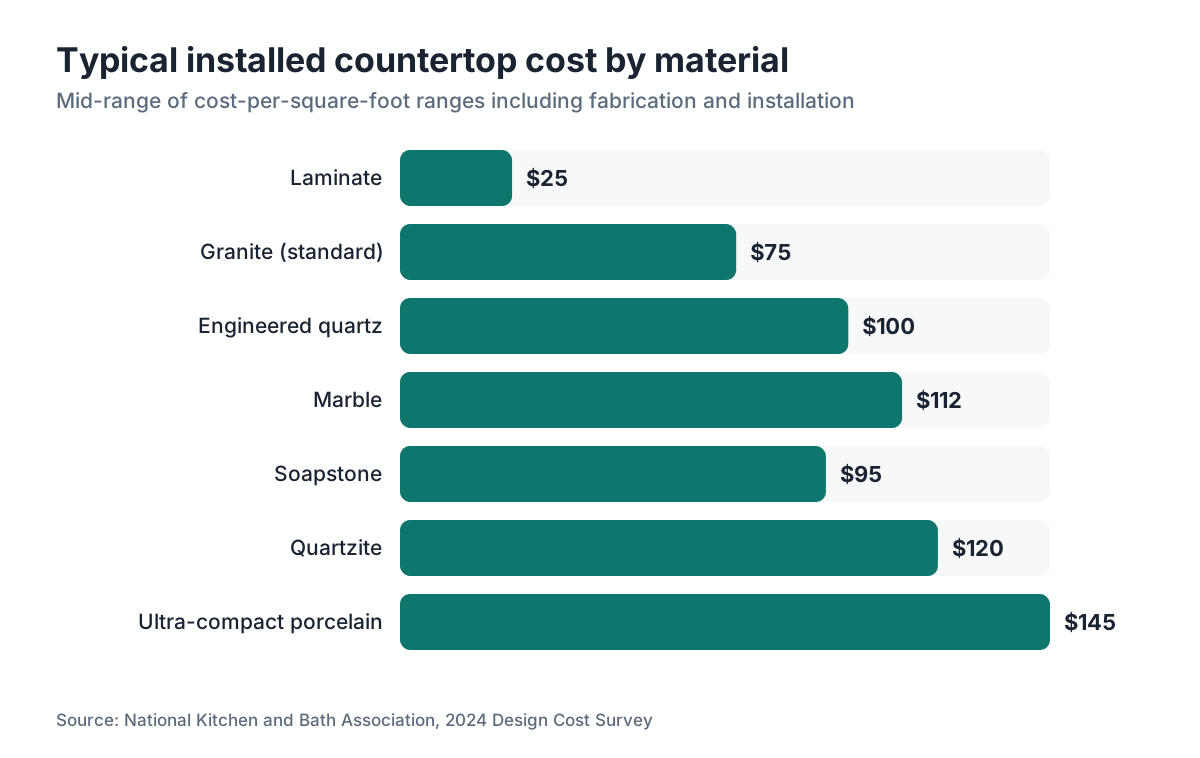
Fabrication cost depends on material, edge complexity, cutout count, and local labor rates. The numbers below are fabrication-and-installation costs (higher than the bare slab price), based on reported ranges from the National Kitchen and Bath Association and regional cost surveys as of 2024 [6].
| Material | Typical installed cost per sq ft | Notes |
|---|---|---|
| Laminate | $10-$40 | Not stone; included for reference |
| Granite (standard colors) | $50-$100 | Prices vary heavily by origin and thickness |
| Marble | $75-$150 | Soft material; edge complexity adds cost |
| Quartzite | $80-$160 | Harder to cut than granite; adds tool wear |
| Engineered quartz | $70-$130 | Consistent thickness; fast CNC throughput |
| Ultra-compact porcelain | $90-$200+ | High breakage risk; waterjet preferred |
| Soapstone | $70-$120 | Soft; hand-finishing often required |
Edge profiles add $10 to $40 per linear foot depending on complexity. A simple eased edge sits at the low end. A stacked ogee or mitered edge with a waterfall return sits at the high end. Each sink cutout typically adds $150 to $300 to the fabrication quote, and undermount cutouts that need precise reveal grinding cost more than drop-in cutouts.
Material waste matters too. A typical slab yields 60 to 80 percent usable countertop area after accounting for vein matching, seam placement, and cutouts [7]. Poor nesting (the process of laying out cuts on a slab to minimize waste) directly raises the cost per square foot of finished countertop. This is one of the real operational profit points in a shop: software-driven nesting consistently beats hand-drawn layouts. SlabWise's quoting and nesting tools, for example, are built to help fabricators model yield before committing to a slab purchase.
For comparison, laminate countertops and Formica countertops are fabricated through a completely different process (scoring, routing, laminate bonding) and carry much lower labor costs, but they sit outside the stone fabrication workflow.
What is slab nesting and why does it matter for cost and yield?
Nesting is the step where a fabricator lays out all the pieces for a job on a digital representation of a slab to find the most efficient cut layout. Get it right and you might fit a kitchen's worth of countertop onto one slab with 25 percent waste. Get it wrong and you need a second slab for a small remnant, which can add $400 to $800 to the job or force a stone match problem later.
Manual nesting, done by drawing piece outlines in chalk on a slab or arranging rectangles on paper, works but misses optimization the software finds easily. A piece rotated 4 degrees might nest next to another piece and save 3 square feet of material. A human eye doesn't catch that reliably under time pressure.
Automated nesting algorithms (included in fabrication-specific CAD/CAM packages and software like SlabWise) run hundreds of layout permutations in seconds. For shops doing 20 to 50 jobs per week, that yield improvement compounds fast. A 5 percent gain in material yield across a shop buying $2 million in stone annually is $100,000 in recovered material cost.
Nesting also has to respect vein direction when the homeowner has specified book-matching or directional veining. That constraint tightens the optimization problem considerably and is one reason quartzite and marble jobs need more careful (and sometimes more expensive) nesting than consistent-patterned granite.
How are seams handled in precision stone fabrication?
Seams are the joints where two pieces of stone meet, and they're the most visible sign of fabrication quality. A good seam, in the ideal case, comes close to invisible: the two pieces meet within 1/32 inch in height, the gap fills completely with color-matched epoxy, and the vein pattern transitions without an obvious hard break.
Real seams are never truly invisible in natural stone, and a fabricator who promises otherwise is being generous with the truth. The goal is to make them as unobtrusive as possible. Seam placement is a design decision: standard practice puts seams away from sink cutouts (to avoid stress concentration), away from cooktop cutouts for the same reason, and ideally in a spot where the eye has something else to focus on, like a transition from countertop to backsplash.
The seam itself is epoxied and color-tinted to match the stone. For light-colored stones like white marble, or marble countertops generally, seam coloring is hard because any variation shows. Dark granites are more forgiving. Quartzite with heavy patterning is the toughest to seam without a visible break.
A quality fabricator will show the homeowner the actual seam location on the templating drawings before cutting. If they don't offer this, ask for it. Relocating a seam after cutting costs real money.
What is the precision stone fabrication process from start to finish?
Here is the full sequence a countertop job moves through in a precision fabrication shop:
1. Consultation and material selection. The homeowner or contractor chooses the stone and selects a specific slab (slab selection matters more than most people realize; two slabs of the same granite SKU can look quite different). Good fabricators push the client to go to the slab yard and hand-pick.
2. Site measurement / digital templating. A templating technician visits the site after cabinet installation is complete and all appliances are confirmed. Templating before cabinets are set is a common source of expensive errors. The digital template captures every dimension.
3. CAD layout and approval. The fabricator draws the cutting layout, places seams, marks cutouts, and shares a drawing with the client for sign-off. This is the last inexpensive point to make changes.
4. Slab nesting and CNC programming. The piece layout from the CAD drawing gets nested onto the selected slab, and a CNC toolpath is generated. Operators review for tool changes, material-specific feed rates, and any manual operations like hand-polished sections.
5. Sawing and rough cutting. The bridge saw makes straight cuts to rough dimensions, leaving a small margin for CNC finishing.
6. CNC machining. The CNC router or 5-axis machine handles sink cutouts, edge profiles, radius corners, and any decorative work. For porcelain or thin-format slabs, waterjet replaces or supplements the CNC here.
7. Edge polishing and surface finishing. Edges go through the polishing sequence. Any surface damage from cutting gets addressed. Sealant is applied if the material requires it (granite and quartzite typically do; engineered quartz does not).
8. Quality check. A finished piece should be checked against the original template file for dimensional accuracy before it leaves the shop. Better shops do this routinely. Many don't.
9. Delivery and installation. Stone is heavy: a 3-cm granite countertop weighs roughly 18 to 20 pounds per square foot [8]. A 40-square-foot kitchen countertop weighs 700 to 800 pounds total, spread across multiple pieces. Crews of two or three are standard for a kitchen install. See countertop installation for what to expect on installation day.
The total timeline from template to install in a busy shop runs 7 to 14 days for standard work. Complex mitered edges, waterfall islands, or backlogged shops can push that to 3 to 4 weeks.
How do you evaluate a stone fabrication shop's quality?
The single most useful thing you can do is visit the shop. A fabrication facility tells you a lot. Is the floor wet-swept or covered in dry stone dust? Dry dust means they may be skipping the water cooling that extends tool life and produces cleaner cuts. Are finished pieces stored upright on padded A-frames, or lying flat on pallets where edge chipping is likely? Are the seaming epoxy and color-matching materials organized, or dumped on a shelf?
Ask these specific questions:
- What templating system do you use, and is it digital? (If they say "we use wood templates," that's not disqualifying, but it warrants more scrutiny.)
- What CNC equipment do you run, and when was it last calibrated?
- Who polishes the edges, a machine or a person, and how many grit steps?
- Do you show me the layout drawing before you cut?
- What is your remake rate, and what does it cover? (Most good shops don't track this formally, but a shop that has thought about it at all is more quality-focused than one that stares at you blankly.)
- Can I see finished examples of mitered edges or waterfall islands? (If you're ordering those profiles.)
Certification from the Natural Stone Institute (NSI) is a positive signal. The NSI Accreditation program evaluates shops on equipment, training, and quality practices [9]. Not every excellent shop is accredited, and not every accredited shop is excellent, but it's a reasonable screening filter.
For Cambria countertops and other engineered quartz brands, the brand itself sometimes maintains an authorized fabricator network. Buying through an authorized fabricator gives you a clearer warranty path.
What are the most common precision fabrication defects and how are they caused?
Knowing what can go wrong helps both homeowners and fabricators catch problems before they turn into warranty claims.
Chipping on edges or cutouts. Usually caused by a worn or wrong diamond tool, incorrect feed rate on the CNC, or inadequate water flow during cutting. Porcelain and marble are most susceptible. A small chip on an eased granite edge is a cosmetic warranty item. A chip on a sink cutout that propagates into the field is structural.
Seam height mismatch. When two pieces don't sit at the same height across a seam, you feel it every time you wipe the counter. Causes: cabinet out of level (installer problem), stone thickness variation (material problem), or insufficient grinding during fitting (fabrication problem). Worth negotiating who owns the fix before installation.
Oversize or undersize cutouts. A sink cutout 1/4 inch too large means the sink clips or mounting rails won't grip properly. A cutout 1/4 inch too small means the sink doesn't drop in. CNC programming errors or wrong sink template data are common causes.
Cracking during or after install. Stone cracks are almost always caused by point loading (too much weight on an unsupported span), improper support during transport, or a hidden fissure in the original slab that the fabricator didn't catch before cutting. Natural stone has fissures; they aren't the same as cracks, but a fissure running through a sink cutout corner is a stress concentration waiting to become a crack. Good shops fill fissures with stabilizing resin before cutting.
Poor seam coloring. Epoxy that doesn't match the stone background is a skill problem. Many fabricators mix epoxy color on-site using a small sample; some do it poorly. Ask to see seam samples on leftover pieces of your specific material before the job is cut.
How does stone fabrication differ by material?
Every material has its own fabrication personality.
Granite is the most forgiving to cut and polish, which is why it dominated stone countertops for decades. Hard and abrasive, it wears diamond tools faster than softer stones but doesn't chip easily. Most shops are set up for granite.
Marble is softer (Mohs 3-4 versus granite's 6-7) [10] and chips on thin profiles if the tool is wrong. The polished finish comes at lower grit steps because of the softness, but surface scratches show more easily too. Fabricators sometimes add a resin-filled step to marble edges to reduce micro-chipping.
Quartzite confuses people because the name sounds like engineered quartz. It's a natural metamorphic rock, typically harder than granite, with silica content that wears tools quickly. Beautiful material, genuinely harder than marble, but fabrication cost is higher. See how to clean quartzite countertops for care after fabrication.
Engineered quartz (Silestone, Caesarstone, Cambria, MSI Q Premium, etc.) is manufactured to consistent thickness and behaves predictably on a CNC. No vein-matching needed since the pattern is uniform, which simplifies nesting. Some quartz formulations are harder to polish to a high gloss than natural stone.
Ultra-compact porcelain (Dekton, Neolith, Lapitec) is the hardest to fabricate. It's brittle in a specific way: it handles compressive load well but is sensitive to flexural stress and vibration. Blade cutting requires very slow feed rates and sharp tools. Waterjet is often preferred. Miter cuts for waterfall edges are achievable but demand experienced operators. Breakage rates during fabrication run higher than for any other material.
Soapstone is exceptionally soft (Mohs 1-2) and cuts easily but needs more hand-finishing to reach consistent edge quality. See how to clean soapstone countertops for care context.
For how natural stone care follows from its fabrication traits, how to clean stone countertops covers the basics across material types.
What should homeowners ask their fabricator before signing a contract?
Get these answered in writing before you sign:
- Who does the templating, and what system do they use?
- Will you show me a layout drawing with seam locations before cutting?
- What is the lead time from template to install, in calendar days, not business days?
- What edge profiles are included in the base price, and what costs extra?
- Is sink cutout included, and for what type of sink (undermount, drop-in, farmhouse)?
- Does the price include sealing? What sealer? And how often do I need to reseal?
- What is your warranty on fabrication defects, and what does it exclude?
- Who installs, your crew or a subcontractor?
- What happens if a piece breaks during installation?
The last question matters more than most homeowners realize. Stone breakage during install is rare but not unheard of. A shop that says "that's on you" is telling you something about how they operate. A shop that says "we carry the risk through the install" is telling you something better.
For general planning context, the kitchen countertops guide covers how to think about the full countertop decision before you get into fabrication specifics.
Frequently asked questions
How long does stone countertop fabrication take from template to install?
Most shops complete standard granite or quartz jobs in 7 to 14 calendar days from templating. Complex work like mitered waterfall edges, book-matched marble, or ultra-compact porcelain can take 3 to 4 weeks. Backlog at busy shops is a real variable: spring and fall remodeling seasons often stretch lead times. Ask your fabricator for a firm calendar date, not a range, before signing.
What is a CNC bridge saw and how does it cut stone?
A CNC bridge saw is a computer-controlled machine that runs a diamond-tipped circular blade along programmed X and Y axes to make straight cuts in stone slabs. It uses continuous water flow to cool the blade and suppress silica dust. Modern CNC bridge saws hold tolerances of plus or minus 0.5 mm on a straight cut. They handle most straight cuts in a shop; curved cuts and complex profiles go to a CNC router or waterjet instead.
Is waterjet cutting better than saw cutting for stone countertops?
They serve different purposes. Saw cutting is faster and cheaper for straight cuts. Waterjet is better for curves, radius corners, inlays, and brittle materials like ultra-compact porcelain, because it cuts cold with no blade vibration. A well-equipped shop uses both. Waterjet adds cost: expect $50 to $150 per hour of cutting time on top of standard fabrication pricing, depending on the shop.
What causes stone countertop seams to open up or crack?
Seams crack or open for a few reasons: the epoxy bond failed because surfaces were not clean and dry when joined, the cabinet support shifted after install (seasonal wood movement is a real cause), or the seam was placed over an unsupported span. Seams should never span a cabinet void or run through a cutout corner. A seam that opens within the first year is typically a fabrication or installation workmanship issue, not a stone defect.
How do I know if a stone fabricator is experienced enough for my job?
Ask to see finished examples of the specific edge profile and material you're ordering, not photos on a website but physical samples or references you can visit. Ask whether they use digital templating. Ask about their remake rate. NSI accreditation is a useful screen but not the only one. A shop doing significant volume (20-plus jobs per week) has almost certainly worked through the common failure modes that trip up smaller operations.
What is slab yield and why does it affect my countertop price?
Slab yield is the percentage of a raw slab that becomes finished, installed countertop. The rest is waste from cuts, cutouts, and unusable edges. Typical yield runs 60 to 80 percent. Low yield raises your price because the fabricator has to charge for the full slab even if they use only part of it. Jobs with many sink cutouts, complex angles, or book-matched veining have lower yield. Ask your fabricator what yield they're budgeting for your job.
Do I need to seal stone countertops after fabrication?
Most natural stone countertops (granite, marble, quartzite, limestone) benefit from sealing because they are porous to varying degrees. Engineered quartz does not need sealing; its binder makes it non-porous. Soapstone doesn't seal in the traditional sense but is treated with mineral oil. A good fabricator applies an initial seal before delivery. For most granite and quartzite, resealing every 1 to 3 years is typical, though high-density granites may need it less often.
What is a 5-axis CNC and do I need a fabricator who has one?
A 5-axis CNC machining center moves the cutting tool in five directions at once, letting it cut angled faces, compound miter joints, and complex 3D profiles that a standard 3-axis machine can't produce in a single setup. You need a fabricator with 5-axis capability (or a reliable subcontractor who has it) if you're ordering mitered waterfall edges, thick-miter profiles, or any decorative 3D carving. For standard countertops with common edge profiles, a 3-axis CNC is perfectly adequate.
What is the difference between a fissure and a crack in stone?
Fissures are naturally occurring features in stone formed during geological cooling or metamorphism. They run through the crystal structure and are part of the material, not damage. Cracks are breaks caused by stress, impact, or improper support after fabrication. The practical distinction: a fissure is flat to the touch and doesn't widen over time under normal use. A crack has a perceptible gap or catches a fingernail. Fabricators should stabilize visible fissures with resin before cutting pieces that include them.
Can stone countertops be fabricated for outdoor kitchens?
Yes, but material selection matters significantly more outdoors. Granite, quartzite, and slate handle freeze-thaw cycles and UV exposure reasonably well. Marble stains and etches outdoors more than indoors. Engineered quartz is generally not recommended for direct sun exposure: resin binders can discolor or warp under sustained UV and high heat, and most quartz manufacturer warranties exclude outdoor use. Confirm with the brand before specifying quartz for an outdoor kitchen.
What does a fabrication warranty typically cover?
Most fabrication warranties cover defects in workmanship (dimensional errors, chipping from cutting, seam failures) for 1 year. They typically exclude damage from impact, thermal shock (hot pots), improper cleaning, or movement of the supporting structure after installation. Natural stone material defects like hidden fissures are often handled separately from fabrication workmanship. Read the exclusions before signing. A warranty that excludes 90 percent of realistic failure modes is not actually protective.
How are mitered waterfall edges fabricated?
A waterfall edge has the stone face cascading vertically down the side of a cabinet, meeting the countertop top at a mitered joint rather than a butt joint. Fabricating it requires cutting both the top piece and the side piece at precisely matching 45-degree angles (or compound angles for non-square cabinet sides), then gluing and polishing the joint so it reads as one continuous piece. A 5-axis CNC produces the most consistent miter angles. Hand-grinding is an option but takes significant skill and more time.
What silica dust exposure risks do stone fabricators face?
Dry cutting or grinding of stone releases respirable crystalline silica, which causes silicosis, an incurable lung disease. OSHA's permissible exposure limit for crystalline silica is 50 micrograms per cubic meter as an 8-hour time-weighted average, established in OSHA's 2016 silica rule (29 CFR 1910.1053 for general industry). Engineered quartz contains up to 93 percent silica and has been associated with accelerated silicosis cases in fabricators. Wet cutting, local exhaust ventilation, and respiratory protection are required controls, not optional.
How does the choice of edge profile affect fabrication time and cost?
Simple profiles like eased (a slightly rounded 90-degree edge) or beveled add minimal cost and machine time. Ogee, dupont, or triple pencil profiles require more CNC passes and polishing steps, adding $10 to $25 per linear foot. A mitered or waterfall edge is the most complex and expensive, adding $30 to $80 per linear foot or more depending on the shop. Edge complexity also interacts with material: a crema marfil marble ogee is harder to produce chip-free than a granite ogee, so expect a skill premium.
Sources
- Natural Stone Institute, Fabrication Best Practices Guide: Quality shops hold fabricated countertop tolerances of 1/16 inch or better; calibrated CNC bridge saws hold cut tolerance of plus or minus 0.5 mm on a 10-foot straight line
- OMAX Corporation, Waterjet Technology Overview: Waterjet cutting for stone uses pressures typically between 60,000 and 90,000 PSI with garnet abrasive
- Marble Institute of America (now Natural Stone Institute), 2019 Fabricator Survey: Shops using digital templating reported 40 to 60 percent reduction in remakes attributed to measurement error
- Natural Stone Institute, Dimension Stone Design Manual: The NSI Dimension Stone Design Manual is the primary published reference for stone installation tolerances and practices in North America
- National Kitchen and Bath Association (NKBA), 2024 Design Cost Survey: Installed countertop prices by material ranging from $50 per square foot for standard granite to $200-plus for ultra-compact porcelain
- Natural Stone Institute, Slab Yield and Waste Reduction Technical Bulletin: A typical slab yields 60 to 80 percent usable countertop area after accounting for vein matching, seam placement, and cutouts
- Marble Institute of America, Stone Weight Reference Table: 3-cm granite countertop weighs roughly 18 to 20 pounds per square foot
- Natural Stone Institute, NSI Accreditation Program: The NSI Accreditation program evaluates fabrication shops on equipment, training, and quality practices
- U.S. Geological Survey, Mineral Hardness Reference (Mohs Scale): Marble has a Mohs hardness of 3 to 4; granite has a Mohs hardness of 6 to 7
- OSHA, Occupational Exposure to Respirable Crystalline Silica Standard (29 CFR 1910.1053): OSHA permissible exposure limit for crystalline silica is 50 micrograms per cubic meter as an 8-hour time-weighted average; engineered quartz contains up to 93 percent silica
Last updated 2026-07-09