TL;DR
- Peel and stick countertop film costs $1, $5 per square foot and takes a few hours to apply.
- It looks decent on day one, then bubbles, peels, and stains within 1 to 3 years under normal kitchen use.
- It's a legitimate short-term fix for renters or staging.
- It's a poor substitute for any real surface if you plan to stay.
What exactly is a peel and stick countertop?
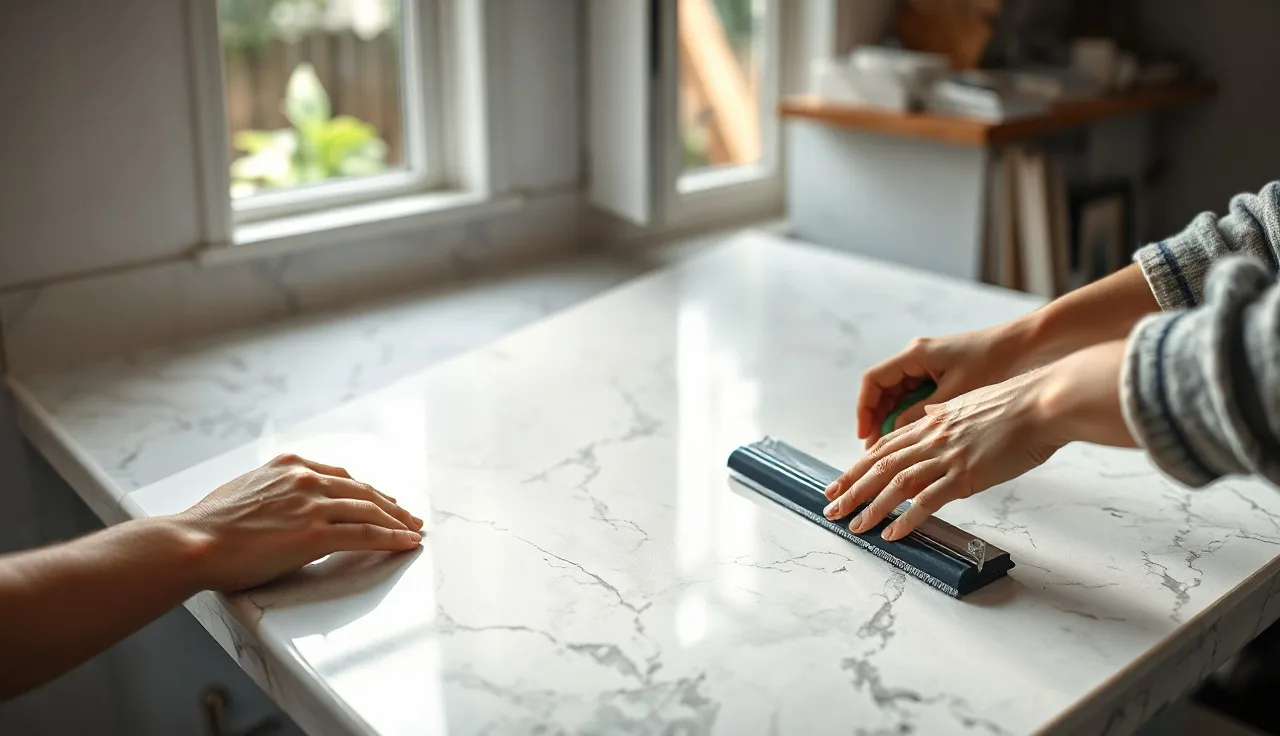
Peel and stick countertop is a vinyl or PVC film with a pressure-sensitive adhesive backing. You peel off the liner, lay the film over your existing counter, smooth out the bubbles, trim the edges, done. No grout, no tools, no contractor.
Most rolls are 24 to 36 inches wide and sold by the linear foot or as cut-to-size sheets. The film runs 0.1 to 0.4 mm thick. That's thin enough to add almost no height, and thin enough to offer almost no mechanical protection. The adhesive is a repositionable acrylic or rubber-based compound, not a construction adhesive, so it grabs a clean, smooth substrate but fails on porous, textured, or previously sealed surfaces [1].
The print layer uses rotogravure or digital printing to copy stone, including marble, concrete, wood grain, even fake tile grout lines. The most popular look by a wide margin is marble peel and stick countertop, usually a white Carrara or Calacatta pattern. Print quality has improved a lot since the early 2010s. Up close, though, the repeat pattern and the flat, dead finish give it away to anyone who has spent time around real stone [2].
There are also rigid peel and stick panels, sometimes sold as peel and stick countertop tiles, made from thicker PVC or composite. These sit 2 to 5 mm thick, take heat slightly better, and feel more convincing under your hand. They share the same adhesive-failure problems at seams and edges.
How much does peel and stick countertop cost?
Film-style rolls run $1, $5 per square foot at most home improvement retailers and on Amazon [1]. A typical 30-square-foot kitchen counter costs $30, $150 in material. Add a squeegee, a utility knife, and seam sealer and you're under $200 for almost any kitchen.
Rigid peel and stick panels cost more, generally $5, $15 per square foot, which pushes a standard kitchen into $150, $450 territory. Still cheap by countertop standards. But now you're bumping up against the low end of laminate pricing.
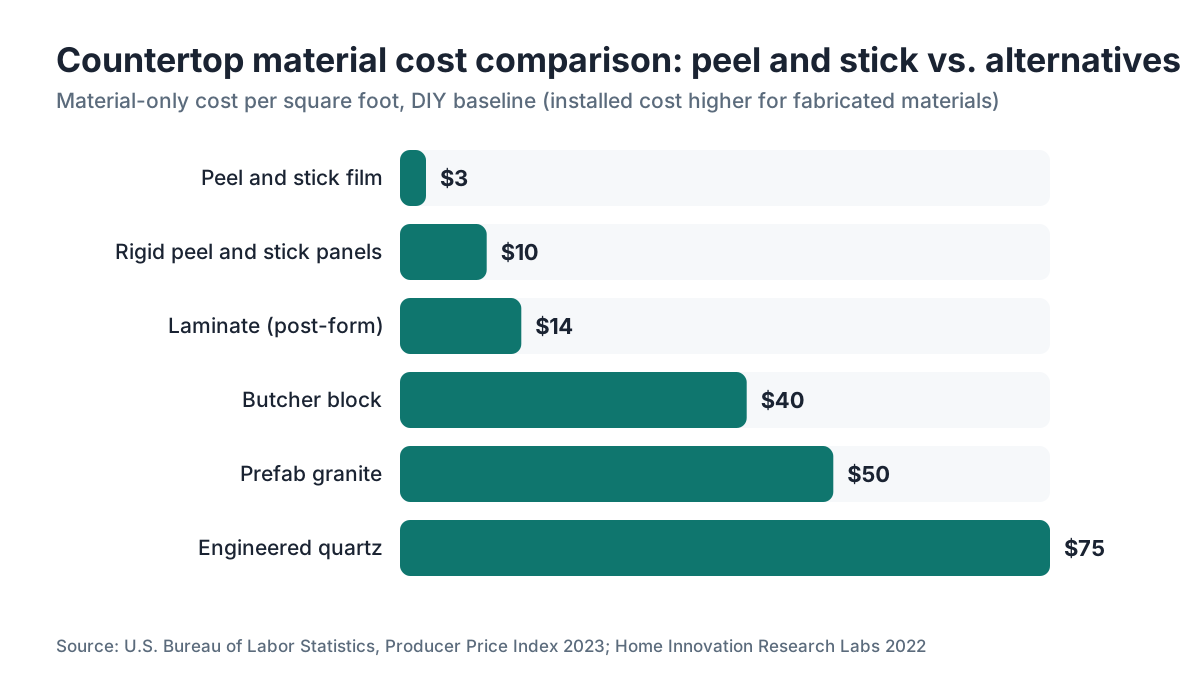
Here's how it stacks up:
| Material | Installed cost per sq ft | DIY material-only |
|---|---|---|
| Peel and stick film | $1, $5 (DIY only) | $1, $5 |
| Laminate (Formica-style) | $20, $50 installed | $8, $20 |
| Butcher block | $40, $100 installed | $20, $60 |
| Granite | $50, $150 installed | N/A practical |
| Engineered quartz | $70, $180 installed | N/A practical |
The cost advantage is real. What the table hides is lifespan. A $3/sq ft film that dies in 18 months costs more per year of use than $60/sq ft granite that lasts 30 years. Stay in a place longer than two years and the math on peel and stick gets hard to defend [3].
Does peel and stick countertop actually hold up?
Short answer: not well under real kitchen conditions.
The three failures you'll see are edge lift, bubbling, and heat damage. Edge lift comes first, usually within weeks on any edge that meets moisture, because the adhesive doesn't bond through water. Once an edge lifts, the film traps moisture underneath and the failure keeps creeping inward [1].
Heat is the harder problem. These films are PVC or vinyl. PVC softens somewhere around 60 to 80 degrees C (140 to 176 degrees F) depending on plasticizer content [4]. A cast-iron skillet straight off the burner will warp or melt the film. Even a hot coffee mug left sitting can leave a ring. Real stone, quartz, and even good laminate have far higher heat tolerance.
Bubbles form when the substrate isn't dead flat and clean, or when there's humidity trapped under the film. Once a bubble sets, you can't reliably smooth it back without reapplying. DIY forums push the heat-gun-and-re-squeegee trick, and it sometimes works. Often it just spreads the mess.
Low-traffic spots are a different story. A bathroom vanity that sees soap and water a few times a day, no hot pans, light use, can look decent for 2 to 3 years. A laundry room shelf or a staging job works fine. The surface just isn't built for what a kitchen counter takes every single day.
Want a sense of what real stone does over decades? The contrast is stark. Marble countertops need sealing and care but can last indefinitely. Even laminate countertops installed properly routinely go 15 to 20 years.
Is marble peel and stick countertop worth buying?
Marble is the most searched pattern for peel and stick film, and the look is the one place this product has genuinely gotten better. A good marble peel and stick countertop print, from brands like Veelike, Abyssaly, or Wallpaper Warehouse, can fool a photo. In person, the lack of depth and veining movement shows. For staging a rental or a room before a quick sale, it's a passable shortcut.
The honest catch: the marble version shares every structural weakness of any other peel and stick film. The pattern doesn't change the adhesive chemistry, the heat tolerance, or the edge-lift problem. You're picking a look, not a better performance class.
If you love marble and want the real thing, the cost gap is large but the alternatives are worth knowing. Actual marble countertops run $60, $150 per square foot installed. Porcelain slabs printed with marble patterns run $40, $100 and beat both real marble and the film on scratch and stain resistance. Engineered marble quartz runs $70, $180.
For a renter who can't touch the existing counter, a peel and stick marble film makes sense. For a homeowner planning to stay three or more years, spend $200, $400 more and get real laminate or a prefab granite top. You won't regret it.
What surfaces does peel and stick countertop stick to (and what it doesn't)?
The pressure-sensitive adhesive in most films bonds best to smooth, non-porous, clean surfaces. Good candidates are existing laminate, painted MDF, smooth painted wood, metal, and glass. These give the adhesive full contact and don't bleed oils or moisture [1].
Problem substrates:
- Tile with grout lines: the adhesive bridges the grout valleys but doesn't bond to them, leaving raised texture and edge-lift starting points
- Porous stone like unpolished granite or concrete: the adhesive soaks partly into the surface instead of bonding to it
- Previously waxed or silicone-sealed surfaces: the adhesive slides instead of grabbing
- Textured or embossed laminate: same bridging problem as grout
- Wet or even slightly damp surfaces: adhesive failure is immediate
Every manufacturer says the same thing in their instructions: the surface must be clean, dry, smooth, and free of wax, grease, silicone, and dust. Easy to hit on brand-new laminate. On an older counter that's cooked for years, you often can't fully degrease every pore, and adhesion pays for it.
One tip that actually helps: wipe the surface with isopropyl alcohol (70% or higher) and let it fully dry before applying. It strips most of the oils and residue that soap and water leave behind. Work in a warm room, not below 60 degrees F, because cold adhesives don't activate well.
How do you install peel and stick countertop without bubbles?
The biggest mistake is peeling the whole backing off before you lay the film. Peel two or three inches, align, press, then work forward in small sections, peeling as you go. It's the same dry-mount method used for vinyl vehicle wraps [1].
Tools that make a real difference:
- A hard plastic squeegee, or a credit card wrapped in a soft cloth. Metal scratches the film.
- A heat gun or hair dryer on medium. Heat makes the film pliable and wakes up the adhesive around curves and edges.
- A sharp craft knife or box cutter with fresh blades. Dull blades tear the film and leave ragged edges that lift.
For inside corners, cut relief notches so the film folds without bunching. For outside corners like an overhang edge, heat and stretch the film around the corner, hold it 30 seconds while it cools, then seal the edge with clear waterproof seam sealer or a thin bead of clear silicone. That edge seal is the whole ballgame. Skip it and the edge lifts within weeks.
Bubble after application? Poke it with a fine needle, push the air toward the hole, press flat. Big bubble or an area that won't bond? Peel it back, clean the substrate with alcohol, reapply, and hold pressure for 60 seconds. Getting it right the first time beats fixing it after.
Will peel and stick countertop damage the existing countertop underneath?
Usually no. The answer depends on how long it stays and what's under it.
On laminate or painted surfaces, film left in place under a year almost always comes off clean. Peel slowly at a low angle, run a heat gun ahead of the peel to soften the adhesive, and any residue wipes off with Goo Gone or a naphtha-based cleaner [1].
Trouble starts when the film sits for years. Acrylic pressure-sensitive adhesives can transfer to the substrate over time, worst on porous painted surfaces. Longer dwell time plus a warmer room means more adhesive left behind. On old laminate that already has micro-cracks or delamination, the peel can lift the decorative layer.
Renters worried about the deposit: most landlords treat countertop film as a reversible modification and accept it as long as removal leaves no damage. Read your lease. Some explicitly ban adhesive-backed products.
On tile or real stone, removal is almost always clean, because those surfaces don't drink up adhesive the way softer substrates do. The catch on tile is the grout, where residue is harder to clean out of porous lines.
Rule of thumb: under 18 months, removal is almost always clean. Beyond that, budget 30 to 60 minutes and a bottle of adhesive remover for residue.
How does peel and stick compare to other low-cost countertop options?
Peel and stick is the cheapest material by a wide margin. The question is what you're actually comparing it against.
Laminate countertops like Formica cost $8, $20 per square foot in material for a post-form prefab, plus simple installation. They resist heat to about 275 degrees F, wipe clean, and last 15 to 20 years with basic care [5]. Tolerate a weekend project and $300, $600 total and laminate beats peel and stick on every performance number.
Butcher block countertops start around $20, $60 per square foot in material. Warm, workable, repairable (sand out scratches, refinish). The catch is oiling every 3 to 6 months, and they don't love the area in front of a sink without careful sealing.
Corian and other solid surface run $40, $80 installed. No visible seams, fully repairable, lasts decades.
For the full picture, the kitchen countertops guide covers every material, and countertop installation walks through what a pro install actually involves.
Peel and stick wins in exactly one scenario: you genuinely can't spend money now, you can't make permanent changes (rental), and you need a short-term visual fix. That's a real use case. It's just narrower than the marketing suggests.
Who should (and shouldn't) buy peel and stick countertop?
Good candidates:
- Renters who want a better-looking kitchen without touching the permanent surface
- Homeowners staging a property who need a quick, cheap visual update before listing
- Anyone doing a short-term flip who's gutting the kitchen inside two years anyway
- Laundry rooms, craft rooms, utility spaces where heat and hard use aren't factors
- Budget-constrained DIYers who know exactly what they're buying and accept the trade-offs
Bad candidates:
- Homeowners who plan to stay and cook regularly. The film degrades and you'll either replace it or live with peeling edges
- Anyone who actually wants the look of real marble for the long haul. The look doesn't hold up either
- High-heat cooking. One absent-minded pan placement ruins the surface for good
- Anyone hoping the film adds structural support to a damaged or wobbly substrate. It won't
The product gets marketed hard to homeowners chasing a permanent upgrade on the cheap, and that framing does people wrong when they buy expecting years of real kitchen use. For a fabricator quoting a customer: if someone walks in saying they tried peel and stick and they're finally ready for real countertops, don't be surprised. Happens all the time.
Shops running estimating software like SlabWise can build quick quotes for laminate, prefab granite, or engineered quartz to show a customer what the step up costs in real dollars. That number surprises people, usually because the real material is more affordable than they assumed.
How do you clean and maintain peel and stick countertop?
The surface is vinyl or PVC. It cleans with a damp cloth and mild dish soap. That's basically the whole maintenance routine.
Avoid anything abrasive (steel wool, Scotch-Brite pads), any solvent-based cleaner (acetone, bleach, Goo Gone while the film is installed), and any acidic cleaner like undiluted vinegar. Acids and solvents don't destroy the film on contact, but they attack the plasticizers in the vinyl over time and turn the surface brittle and chalky [4].
The same logic that keeps real stone happy works here: mild soap, warm water, soft cloth, dry it promptly. The guide on how to clean stone countertops explains the pH-neutral cleaning approach that applies across surfaces.
Don't let standing water sit at the edges. This is the single maintenance step that stretches the life of peel and stick more than any other. Wipe spills before they migrate under an edge. It sounds obvious. It's the main reason one install lasts 3 years and another looks rough in 6 months.
What are the best brands of peel and stick countertop film?
The market is fragmented, mostly smaller brands selling through Amazon, Wayfair, and big-box stores. There are no independent published durability tests rating these brands head-to-head with rigorous methodology. Any ranking rests on aggregate review data and reported user experience, not controlled testing. Say that plainly, because a lot of "best of" lists pretend otherwise.
Brands that show up consistently in positive reviews for film thickness, adhesive quality, and pattern fidelity include Veelike, Abyssaly, and WallpaperCeiling. For rigid panels, SureCrete and a few private-label products through Home Depot have wider distribution and steadier quality control.
Check this before buying:
- Film thickness: 0.3 mm or thicker for better durability and opacity
- Adhesive type: "repositionable" is easier to apply but bonds weaker long-term; look for "permanent" adhesive for countertop use
- Sample availability: always order a sample and test adhesion on your actual substrate before you commit to a full roll
- Return policy: given all the install variables, a generous return window matters
No brand currently makes a film that performs like a permanent countertop material. The ones above just fail slower, and more predictably, than the bottom tier.
Can peel and stick countertop go over tile or uneven surfaces?
Technically yes. In practice it looks bad and fails faster.
Tile brings the grout-line problem. The film spans the grout valleys without bonding to them, which creates a faintly textured surface (worse on thinner films) and leaves the film edges at each grout line as lift points. Over time the film sags into the grout lines and the pattern distorts.
Some installers skim-coat the grout lines with non-sanded grout filler or a thin layer of floor-leveling compound, let it cure, sand it smooth, then apply the film. That works, but it adds cost, time, and a step that takes some skill. Go to that effort and you might as well install a proper laminate overlay.
Cracked or uneven counters: the film follows the substrate. Any ridge, crack, or low spot telegraphs through, especially under raking light. Peel and stick is not a skim coat and not a filler. It hides nothing structural.
If your goal is specifically covering tile, a thicker rigid panel (5 mm and up) telegraphs surface variation less than film does. Both are workarounds for a problem that's better fixed at the substrate.
Frequently asked questions
How long does peel and stick countertop last?
In a bathroom or low-use space, 2 to 4 years is realistic if the edges are sealed and the surface stays dry. In a working kitchen with heat, steam, and daily cleaning, most users report visible failure (edge lifting, bubbling, heat marks) within 12 to 24 months. Longevity depends heavily on surface prep, edge sealing, and keeping heat off the film.
Can you put hot pans on peel and stick countertop?
No. PVC and vinyl films soften at roughly 140 to 176 degrees F (60 to 80 degrees C), and a pan off the burner easily exceeds that. Even a hot coffee mug can leave a permanent impression. Always use trivets or heat pads. This is the most common damage users report, and it isn't repairable without replacing the affected section of film.
Does peel and stick countertop look real?
In photos and from a few feet back, modern marble peel and stick countertop print can look convincing. Up close, the flat finish, repeating pattern, and thin profile give it away against real stone or even good laminate. Under direct light the difference is clear to most people. It's good enough for staging. It won't fool anyone who knows countertops.
Is peel and stick countertop safe for food prep?
Most manufacturers don't certify their films as food-safe cutting surfaces. The vinyl can harbor bacteria in micro-scratches over time, like a cheap plastic cutting board. Prep food on it the way you would any surface, but don't cut directly on it and keep it clean. The film is not NSF certified for food-contact use [7].
Can you use peel and stick countertop in a bathroom?
Yes, and it's one of the better use cases. Bathroom vanities see less heat stress and lighter daily use than kitchen counters. Seal the edges with silicone and wipe water promptly so it can't migrate under the film, and a bathroom application can look good for 2 to 3 years. Skip the area right around the faucet where standing water collects.
How do you remove peel and stick countertop without damaging the surface underneath?
Heat the film with a hair dryer or heat gun on low to soften the adhesive, then peel slowly at a shallow, almost-flat angle. Adhesive residue cleans up with Goo Gone, naphtha, or rubbing alcohol. On painted surfaces, test a small area first. Film left in place more than two years may transfer adhesive that needs more aggressive removal.
Does peel and stick countertop work on tile countertops?
It physically sticks, but the result is mediocre. The adhesive bridges over grout lines without bonding to them, leaving lift points and visible texture through thinner films. For a cleaner result on tile, fill and sand the grout lines flush first. Even then, expect shorter adhesion life than on a smooth laminate substrate.
What is the cheapest real countertop alternative to peel and stick film?
Post-form laminate prefabs (Formica-style) start around $50, $150 total for a standard kitchen section at home centers. They install over existing counters in some layouts and last 15 to 20 years. That's the closest real alternative on price. Prefab granite and marble slabs at big-box stores run $150, $400 for a 10-foot section, installed yourself or cheaply hired out.
Can I use peel and stick countertop on outdoor surfaces?
Not recommended. UV exposure degrades PVC plasticizers, making the film brittle and causing adhesive failure. Temperature swings between hot days and cool nights loosen the bond at edges. No peel and stick countertop film on the consumer market is rated for outdoor use or prolonged UV exposure [4].
Does peel and stick countertop add value to a home?
No. Buyers and appraisers read it as a temporary cover, not an improvement. In a sale, it can actually signal deferred maintenance rather than an upgrade. For staging, it can improve how a kitchen photographs, which can support a listing price indirectly, but it doesn't add assessed value the way a permanent countertop replacement does [3].
What's the difference between peel and stick countertop and contact paper?
They're essentially the same product. Contact paper is the older generic name. Peel and stick countertop is the marketing name for thicker, higher-fidelity versions sold specifically for counters. Dedicated countertop films tend to run 0.3 to 0.4 mm thick versus 0.1 to 0.2 mm for standard contact paper, and they often use slightly stronger adhesives. The performance gap is modest.
Can a landlord charge me for peel and stick countertop damage?
Yes, if removal damages the original surface. Most states let landlords deduct from security deposits for damage beyond normal wear and tear. Adhesive residue that won't clean off, or laminate lifted during removal, likely qualifies as damage. Check your state's landlord-tenant statute and your specific lease before applying any adhesive-backed product to a rental surface [8].
How much peel and stick countertop do I need to buy?
Measure your counter area in square feet (length times width), then add 15 to 20% for cuts, mistakes, and edge wrapping. For an L-shaped kitchen with 30 square feet of counter, buy material for 35 to 36 square feet minimum. Most rolls are 24 inches wide, so a 10-foot counter needs at least two runs of a 24-inch roll to cover a standard 25-inch depth.
Is peel and stick countertop waterproof?
The film surface is waterproof. The adhesive bond is not reliably waterproof at edges and seams. Water that reaches the film edge migrates under it and breaks down the adhesive. The film is water-resistant in the sense that surface spills wipe off clean, but don't call it waterproof at seams or in high-splash areas near a sink.
Sources
- U.S. Census Bureau, American Housing Survey 2021: Laminate and vinyl surface materials remain among the most common countertop materials in U.S. rental housing units
- National Association of Realtors, Research and Statistics (Remodeling Impact Report): Kitchen upgrades including countertop replacement recover 67 to 75% of cost at resale; temporary surface treatments are not listed as value-adding improvements
- U.S. Environmental Protection Agency, Assessing and Managing Chemicals under TSCA (vinyl chloride and PVC): PVC softens at 60 to 80 degrees C (140 to 176 degrees F) depending on plasticizer content; prolonged UV exposure and solvent contact degrade plasticizers and cause embrittlement
- HUD USER, Durability by Design: A Guide for Residential Contractors: High-pressure laminate countertops have an expected service life of 15 to 20 years and are rated for heat resistance up to approximately 275 degrees F
- National Kitchen and Bath Association, Research and Trends: Quartz and granite remain the top two countertop materials specified in professional kitchen renovations; vinyl film products are not tracked as a category
- NSF, Food Equipment Certification (NSF/ANSI 51): Food-contact surface materials must meet NSF/ANSI 51; no peel and stick vinyl film currently carries NSF 51 certification for food-contact use
- California Department of Consumer Affairs (California Tenants guide): Landlords may deduct from security deposits for damage beyond normal wear and tear, including adhesive residue or surface damage from tenant modifications
- Tile Council of North America: Grout joints create surface discontinuities that reduce adhesive contact area for overlay materials applied to tile substrates
- U.S. Bureau of Labor Statistics, Producer Price Index: Material cost ranges for countertop products including laminate, granite, and engineered quartz as benchmarks for consumer pricing
- Home Innovation Research Labs: Annual Builder Practices Survey data show laminate countertops account for roughly a third of new single-family home installations, with engineered quartz and granite the next largest shares
Last updated 2026-07-09