TL;DR
- You can paint granite countertops, but the results are temporary and look nothing like real stone.
- DIY epoxy kits ($50 to $200) last 2 to 5 years with careful use.
- Professional refinishing runs $200 to $600 and holds 5 to 7 years.
- Neither is easy to reverse.
- If your granite is structurally sound, painting is usually a mistake.
- If it's damaged or you hate the color, it buys a few years before replacement.
Can you actually paint granite countertops?
Yes, you can paint granite. The real question is whether you should, and what you give up when you do.
Granite is a dense, low-porosity igneous rock. The surface is smooth, hard, and chemically inert, so paint has almost nothing to grip. Skip the mechanical prep and the right primer and any coating you put on granite peels, chips, or bubbles within months. That's not a guess. Paint bonds to surface texture and chemical affinity, and polished granite offers almost none of either.
People still do this constantly. Epoxy refinishing kits made for countertops, sold under names like Rust-Oleum Countertop Transformations and Giani Granite, are everywhere and they genuinely work for 2 to 5 years in low-traffic kitchens when you apply them right. They won't fool anyone up close. From across the room, a careful job reads as a solid-surface countertop rather than something you painted over a weekend.
Here's the honest framing. Painting granite is a cosmetic stopgap, not a renovation. It makes sense if you're renting, if you're selling and the kitchen needs to photograph better, or if replacement isn't in the budget yet. It makes no sense if your granite is beautiful and you're just bored, or if you expect the result to hold up for a decade.
What are the realistic options for painting or refinishing granite?
Four paths get used in the real world, and they split hard on cost, difficulty, and lifespan.
DIY epoxy countertop kits Products like Rust-Oleum Countertop Transformations and Giani Granite Paint are the common route. Each includes a bonding coat, a decorative color layer, and a clear topcoat. Cost runs $50 to $150 for a standard kitchen's worth of counter. Application eats a full weekend. Durability is 2 to 5 years with normal care, less if you cut on the surface or reach for harsh cleaners [8]. These kits do best on counters that are already smooth and in good shape.
Chalk paint or mineral paint Some homeowners reach for chalk paint (Annie Sloan, Fusion Mineral). It sticks to slick surfaces surprisingly well without heavy sanding, but it was never built for horizontal work surfaces. Without a very tough topcoat (several coats of water-based polyurethane or an epoxy sealer), chalk-painted counters scratch and stain within weeks. For a kitchen counter, this is a bad idea. It can work on a laundry-room top or a bathroom vanity that almost never sees moisture or abrasion.
Professional countertop refinishing A refinisher (also called a reglazer or resurfacer) uses commercial polyurethane or epoxy systems, spray equipment, and controlled cure conditions. Cost typically runs $200 to $600 for a standard kitchen, with high-end markets pushing toward $800 [1]. The finish comes out more uniform than a DIY kit and usually holds 5 to 7 years. This is the best version of the painted-granite idea. It's still not permanent.
Concrete or skim-coat overlays Some tile contractors and fabricators trowel a thin cementitious overlay over the existing counter, building a new surface on top of the granite. It's more involved (2 to 4 days of labor, 1 to 2 weeks of cure) and costs $300 to $700 installed. The result is tougher than paint and looks genuinely different, but it's irreversible and adds thickness that can fight your sink and appliances. You see this mostly in commercial and rental jobs.
The chart below puts cost and durability side by side.
How much does painting granite countertops cost?
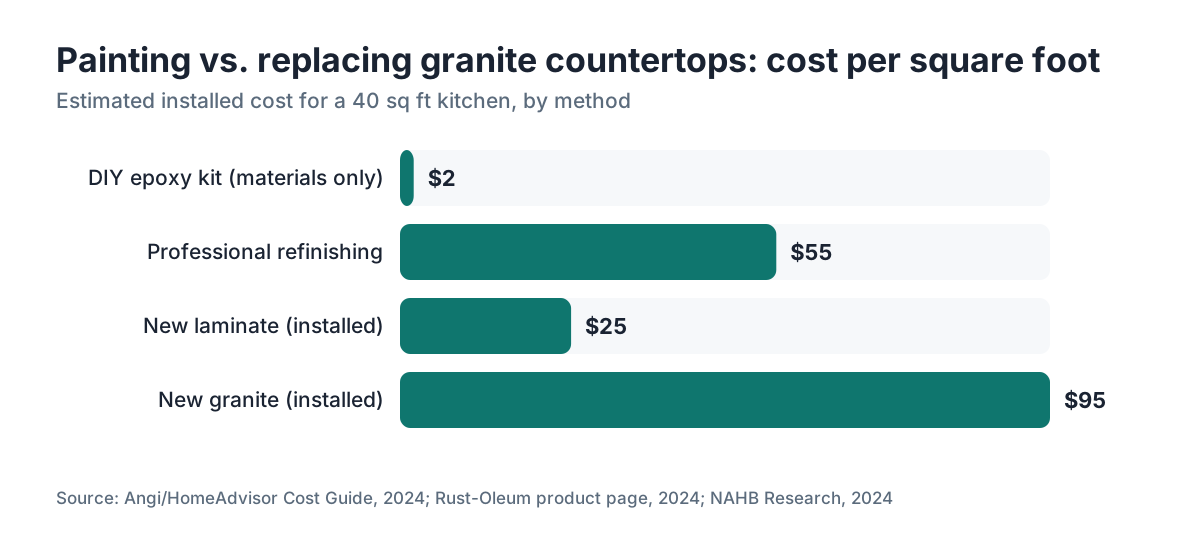
The range is wide, and the biggest variable is whether you do it yourself or hire it out. DIY lands around $100 to $300 in materials. Professional refinishing runs $200 to $600. New granite, for comparison, runs thousands.
A DIY countertop paint kit covers 30 to 50 square feet and costs $50 to $150 retail. Most kitchens have 30 to 60 square feet of counter, so budget $100 to $300 in materials for the whole thing. Add painter's tape, 220-grit sandpaper, a foam roller, and cleanup supplies, which run another $20 to $40.
Professional refinishing averages $35 to $75 per square foot installed in most U.S. markets, based on contractor estimates compiled by home improvement pricing guides [1]. A 40-square-foot kitchen comes to roughly $250 to $600 fully installed. Some refinishers hold a flat minimum of $200 to $300 no matter how small the job.
Rust-Oleum Countertop Transformations covers up to 50 square feet for about $80 to $100 at major retailers [2]. That's roughly $1.60 to $2.00 per square foot in materials, against $40 to $150 per square foot for new granite installed. Painting granite is dramatically cheaper than replacing it, and it isn't close.
The real question is whether the temporary, lower-quality result beats other budget options. Laminate countertops and Formica countertops install new for $10 to $40 per square foot and actually look finished, not faked.
What prep work is required before painting granite?
Prep is where most DIY paint jobs die. People skip it, the paint peels in six months, and they blame the product. The product was usually fine. The prep wasn't.
Granite's hard surface has to be mechanically abraded so the primer has something to bite. Scuff the whole surface with 120-grit sandpaper (or a sanding sponge), then follow with 220-grit to knock down the scratch marks. You're not grinding through the stone. You're dulling the polish until the surface has micro-texture.
After sanding, clean everything with isopropyl alcohol (70% or higher) to pull off dust, oils, and cleaner residue. Don't run a soap-based cleaner right before painting. It leaves a film that kills adhesion. Wipe with alcohol, let it dry fully (20 to 30 minutes minimum), then move to primer.
Apply a bonding primer rated for slick surfaces. Some epoxy kits include a dedicated bonding coat. If yours doesn't, Zinsser Bulls Eye 1-2-3 or a shellac-based primer holds well on stone. Let the primer cure to the manufacturer's spec before top-coating. Most products want 24 hours at 70 degrees Fahrenheit before the next coat.
Mask cabinets, walls, and sinks with painter's tape and plastic sheeting. Cured epoxy is miserable to remove from surfaces you didn't mean to hit.
The cleaning fundamentals for natural stone carry over here. The basics in how to clean stone countertops apply to the prep stage too.
How do you apply epoxy countertop paint kits step by step?
The process runs about the same across Rust-Oleum Countertop Transformations, Giani, and the rest. Prep and base coat on day one, decorative coat next, then two to three clear topcoats, with a hard 7-day cure before normal use.
Day 1: Prep and base coat
- Sand the surface (120-grit, then 220-grit).
- Wipe with isopropyl alcohol and let it dry.
- Roll on the bonding or base coat with a foam roller. Work one direction and keep a wet edge to avoid lap marks. Most kits want one coat. Let it dry 4 to 6 hours.
Day 1 evening or Day 2: Decorative coat This is where the faux-stone effect lives or dies. Kits usually give you a base color plus 1 to 3 accents applied with a sea sponge or a crumpled plastic bag. Layer the colors while the base is still slightly tacky (30 to 60 minutes after application) so they blend. Practice on cardboard first. The learning curve is real, and a bad decorative coat is the top reason these jobs look obviously painted.
Day 2 to 3: Clear topcoat Once the decorative layer is fully dry (12 to 24 hours), lay down 2 to 3 coats of the kit's clear epoxy sealer. This is the layer that protects everything under it. Keep the coats thin and even with a foam roller, and let each one cure 4 to 6 hours before the next. The final coat needs 72 hours before it can handle water or light use, and a full 7 days before it's hard enough for normal kitchen traffic [2].
Don't rush the cure. Cutting on the surface or setting a hot pan down during the cure window is the fastest way to wreck the finish for good.
How long does painted granite last, and how durable is it really?
Honest answer: not as long as you want. DIY epoxy kits run 2 to 5 years. Professional refinishing stretches to 5 to 7. Real granite, cared for, lasts 20 to 50 years [10]. The gap is the whole story.
DIY kits typically last 2 to 5 years under normal residential use before they show real wear at high-traffic spots, near the sink and along the front edge. Both those numbers assume you're not cutting on the surface, not setting hot pans on it, and not scrubbing with abrasive cleaners. On real granite you get away with all three. On painted granite you don't.
The weak points are edge wear, knife marks, and moisture around the sink. Edges chip when a pot clips them. Anywhere the topcoat gets breached, water sneaks under the paint and starts delamination. Once lifting begins at an edge or a seam, it spreads.
Repainting is possible. Most kits let you lay a fresh topcoat or redo the full system after a light sanding. The catch: the more times you go over the same surface, the thicker the buildup, and thick epoxy layers crack over time.
For what real granite looks like when it's maintained instead of painted, the granite countertops guide covers care and realistic lifespan.
Will painted granite hold up to heat, water, and daily kitchen use?
Not the way bare granite does. Heat is the hard limit. Cured epoxy handles roughly 300 to 350 degrees Fahrenheit before it yellows or deforms, while granite shrugs off far more. Always use a trivet on painted stone.
That 300-to-350 number sounds high until you check the pans. A cast-iron skillet off the burner sits at 400 to 500 degrees Fahrenheit. A pasta pot holds 212, but the steam and the hot base together will chew the coating over time. The operating rule for painted countertops is simple: trivet, every time, no exceptions.
Water resistance rides entirely on the topcoat. A fully cured epoxy seal handles standing water fine. But if the topcoat has any nicks or thin spots, water works underneath. That's most likely around the sink cutout and in the caulk joint at the backsplash. Keep those areas well caulked and don't let water pool.
For cutting, always use a board. An epoxy surface runs a Mohs hardness around 2 to 3, against granite's 6 to 7 [4]. A kitchen knife marks it easily.
Clean with mild dish soap and a soft cloth. No abrasive sponges, no bleach, no ammonia. Those strip the topcoat faster than anything else you'll do to it. That's stricter than caring for real granite, which tolerates the occasional stronger cleaner without much complaint.
Can you paint granite to look like a specific stone or color?
You can get close to broad stone looks, but not to a specific slab. Epoxy kits ship in fixed color families: black with silver veining, white with gray veining, tan with brown flecks. They evoke the idea of stone. They don't replicate a named variety.
Want something that reads as Calacatta marble or Absolute Black granite? A kit won't get you there. The sponging and dabbing creates organic variation, but to anyone who looks closely it reads as a decorative painted finish, not real stone.
If accurate stone appearance matters, look at marble countertops, or, for something genuinely durable and visually consistent, engineered stone like Cambria countertops.
Here's the move that actually works. Paint granite a solid matte color (deep charcoal, navy, forest green) using chalk paint plus a hard epoxy topcoat, and it can look intentional and modern instead of like an imitation. That approach ages better because it isn't trying to fake a material it can't.
Is painting granite countertops worth it, or is replacement smarter?
It depends entirely on your situation, and the money math is usually the deciding factor. Painting runs $100 to $600. New laminate runs $400 to $1,600 for a standard kitchen. New granite runs $1,600 to $6,000. Here's how to sort it.
Painting makes sense if:
- You're renting and can't or won't replace the counters
- You're selling in 1 to 2 years and the current color is hurting your listing photos
- You genuinely can't afford replacement yet and need to buy 3 to 5 years
- The granite is structurally sound (no cracks, no major chips) but a color you hate
Painting probably doesn't make sense if:
- Your granite is high quality and in good shape and you're just bored of it
- You're doing a full kitchen renovation anyway
- You expect durability on par with a real countertop material
- The granite has deep cracks, major chips, or active delamination at the edges (paint fixes zero structural problems)
Replacement costs swing hard. New laminate countertops start around $10 to $40 per square foot installed. New granite installed runs $40 to $150 per square foot depending on slab grade and region [5]. On a 40-square-foot kitchen, laminate replacement lands at $400 to $1,600 installed, new granite at $1,600 to $6,000, and painting at $100 to $600. Budget favors painting. But if you can stretch to laminate money, new laminate looks better, lasts longer, and asks nothing unusual of you.
Fabricators and shop owners pricing these jobs can use software like SlabWise to build a quick quote that shows a client what replacement actually costs. That single number often settles the paint-versus-replace debate on its own.
The kitchen countertops comparison lays out where granite sits against the full field of materials.
What are the risks and common mistakes when painting granite?
A handful of mistakes account for most bad results. Get these right and your odds jump.
Skipping mechanical abrasion. Sanding feels pointless on a surface that's already smooth, but it's mandatory. Without scuffing, bonding primer peels off in sheets. Don't skip it.
Using the wrong primer. Latex wall primer is not a bonding primer. It won't stick to slick, non-porous surfaces. Use a product labeled specifically for adhesion to tile, glass, or slick surfaces.
Applying too thick. Thick epoxy coats don't cure evenly. They stay tacky in the middle, trap air bubbles, and wrinkle as they set. Several thin coats beat one thick coat every time.
Rushing the cure. Using the surface before the topcoat fully cures (72 hours for water, 7 days for full hardness) is the single fastest way to ruin the finish. Schedule the job for a stretch when you can stay out of the kitchen for a few days.
Poor ventilation. Epoxy fumes are no joke. Work with windows open and a box fan pushing air out. Some two-part systems require respirator-grade PPE. Read the safety data sheet before you start [9].
Painting over damaged stone. Cracks, chips, and grout-line gaps telegraph right through paint. Fill and level them first with a two-part epoxy filler, not spackle, which soaks up moisture.
Ignoring the edges. Edges fail first. Give every edge and corner an extra topcoat pass. Some refinishers put 4 to 5 topcoat layers on edges while the field gets 2 to 3.
How do you remove paint from granite countertops if it goes wrong?
Removing cured epoxy from granite is genuinely difficult. The good news is granite is hard enough to survive both the chemicals and the mechanical effort. The bad news is the whole process is messy and slow.
For fresh, uncured paint (within 24 to 48 hours), acetone or paint thinner lifts most epoxy systems. Flood the area, let it sit a few minutes, scrub with a stiff nylon brush, repeat as needed. Ventilate heavily.
For fully cured epoxy (anything older than a week) you have two routes. Chemical strippers formulated for epoxy soften the coating in 30 to 60 minutes, after which you scrape it off with a plastic scraper. Look for methylene-chloride-free formulas. OSHA restricts occupational exposure to methylene chloride because of its cancer risk, and its rule states the substance "poses a significant risk of cancer, and other adverse health effects" [6]. Never use a metal scraper here. It scratches the granite.
Mechanical removal with an angle grinder and a diamond polishing pad cuts through epoxy fast, but it also dulls the granite's polish. Go that way and plan to have the stone professionally re-polished afterward.
If a pro applied the coating and it failed early, some refinishers will strip and redo the job. Ask about the warranty before you hire.
For natural stone care that skips paint entirely (usually the right call), the guide on how to clean stone countertops covers safe cleaning and maintenance.
Are there better alternatives to painting granite countertops?
Often, yes. The right alternative depends on your situation, and one of them costs nothing at all.
Do nothing and relearn to like it. Granite ages well. If your gripe is dated color (tan Bordeaux from 2005, say), changing the elements around it (cabinet paint, hardware, backsplash) can make the same counter look current without touching it.
Countertop overlays. A cementitious or concrete overlay laid by a skilled contractor gives a genuinely different look (matte, industrial, custom color) with more durability than epoxy paint. Cost is higher ($300 to $700 installed), but the finish holds up better.
New laminate over existing counters. Sometimes a fabricator can template and install new laminate directly over the granite, though it's uncommon and adds height. More often, demolition and full replacement is the cleaner path. Laminate countertops are the cheapest full-replacement option.
Sell and upgrade. If you're near a full renovation, donating your old counters to a reuse center (Habitat for Humanity ReStores accept granite [7]) offsets new material cost and keeps good stone out of the landfill.
For what solid natural stone options look like, the granite countertops and marble countertops guides both cover current pricing and trade-offs. Considering a totally different material? The kitchen countertops comparison walks the full field.
Fabricators can spin up replacement quotes fast with tools like SlabWise's quoting module, which pulls material costs and waste factors automatically. That makes it easy to show a client the real number for new counters against a paint-and-hope approach.
Frequently asked questions
Can you paint granite countertops white?
Yes. A solid white or off-white finish works with a white chalk paint or a white base coat from an epoxy kit, followed by 2 to 3 coats of clear epoxy topcoat. It won't look like Carrara marble, but it photographs cleanly and can modernize a kitchen fast. The same durability limits apply: no cutting on it, no hot pans, and expect to refresh it in 3 to 5 years.
Does Rust-Oleum Countertop Transformations actually work on granite?
It works, with caveats. The kit is built for laminate, tile, and painted wood, but it holds on granite if you scuff the surface thoroughly with the included abrasive pad and respect the cure time. The product cures to full hardness in 7 days [2]. Users who skip sanding or use the counter before full cure report peeling within months. Applied right, it reliably lasts 2 to 4 years.
How much does it cost to have granite countertops professionally refinished?
Professional countertop refinishing typically costs $200 to $600 for a standard kitchen in most U.S. markets, with some high-end urban markets pushing closer to $800. Most refinishers price per square foot ($35 to $75) or hold a flat minimum. The result is more durable and more uniform than a DIY kit and usually carries a 1 to 2 year warranty on the finish.
Is it safe to paint countertops used for food prep?
Once fully cured (7 days minimum), most epoxy countertop finishes are considered safe for incidental food contact. But these coatings are not FDA-approved food-contact surfaces, and any nick or scratch creates a spot where bacteria can settle. The practical rule: always use a cutting board and a clean surface. Don't prep raw meat directly on a painted counter.
Can you paint granite countertops without sanding?
Technically, some chalk-paint and bonding-primer systems claim adhesion without sanding. In practice, skipping mechanical abrasion is the top reason paint peels off granite. The surface is polished and chemically inert, and paint needs micro-texture to grip. At minimum, scuff the whole surface with 120-grit before any primer or base coat. It takes 30 to 45 minutes and saves hours of stripping failed paint later.
How long does painted granite need to dry before using the countertop?
Most epoxy kits call for 72 hours before light water exposure and 7 full days before normal kitchen use. Those are minimums, not suggestions. Temperature and humidity change the math: rooms below 65 degrees Fahrenheit slow curing a lot. If you have to use the kitchen, cover the counter with cardboard (not plastic, which traps humidity) for the first 72 hours and keep water away.
What's the best paint or kit for granite countertops?
For DIY, Rust-Oleum Countertop Transformations and Giani Granite are the most widely used and best-documented kits [8]. Both include everything for a full refinish. Rust-Oleum covers up to 50 square feet for $80 to $100 [2]. For professional results, two-component polyurethane or aliphatic epoxy systems used by refinishing contractors outperform consumer kits by a wide margin, but they need spray equipment and proper ventilation controls.
Can you paint over already-painted or previously refinished granite?
Yes, but prep gets harder. Sand the existing finish lightly to kill the gloss, check for any lifting or bubbling edges and scrape those down, then apply a bonding primer before recoating. If the existing coating is thick (more than 3 to 4 layers), strip to bare granite first. Thick paint buildups crack and peel sooner than thin, well-bonded systems on bare stone.
Does painting granite affect resale value?
Probably negatively, if buyers notice. Painted counters signal that the seller worked around a problem instead of solving it. In a competitive market, a listing with obviously painted granite can draw lower offers or inspection contingencies over countertop condition. Painting for photos before listing can help, but buyers who see it in person tend to discount accordingly.
Can you paint a granite countertop that has chips or cracks?
Repair them first. Fill chips and cracks with a two-part epoxy filler (not spackle or caulk) and sand flush before any paint or primer. Paint doesn't hide cracks. It highlights them. Unfilled chips turn into the first spots the coating fails. Structural cracks that run the full thickness are a separate problem, and paint is not a structural fix.
How do you maintain painted granite countertops?
Use mild dish soap and a soft cloth for daily cleaning. No abrasive pads, no bleach, no vinegar, no ammonia cleaners. Those strip the topcoat faster than normal wear does. Wipe spills promptly, especially acidic ones (coffee, citrus, red wine). Reapply a fresh topcoat every 2 to 3 years or whenever the surface shows wear. Trivets for hot pans and boards for knives extend the finish life a lot.
Is painting granite better than replacing it with laminate?
It depends on budget and timeline. Painting costs $100 to $600 (DIY to professional) and lasts 2 to 7 years. New laminate installed costs $400 to $1,600 for a standard kitchen and lasts 10 to 20 years with normal care. If you can stretch to laminate money, new laminate is the better long-term buy. If you truly need to stay under $200 and can do the work, a paint kit buys time without destroying the granite underneath.
Sources
- Angi (formerly HomeAdvisor) - Countertop Refinishing Cost Guide: Professional countertop refinishing costs $35 to $75 per square foot installed, with typical kitchen projects running $200 to $600.
- Rust-Oleum - Countertop Transformations Product Page: Rust-Oleum Countertop Transformations covers up to 50 square feet, costs approximately $80 to $100, and requires 7 days cure time before full hardness.
- U.S. EPA - Indoor Air Quality: Epoxy coatings release VOCs during application and cure; adequate ventilation is required to maintain safe indoor air quality.
- U.S. Geological Survey - National Minerals Information Center: Granite has a Mohs hardness of 6 to 7 due to its quartz and feldspar mineral composition.
- Angi - Granite Countertop Installation Cost Guide: New granite countertops installed run roughly $40 to $150 per square foot depending on slab grade and region.
- OSHA - Methylene Chloride Standard (29 CFR 1910.1052): OSHA restricts occupational exposure to methylene chloride, a common ingredient in older paint strippers, stating the substance 'poses a significant risk of cancer, and other adverse health effects.'
- Habitat for Humanity - ReStores: Habitat for Humanity ReStores accept donated building materials, including used countertops, for resale.
- Giani Inc. - Granite Paint Kit Instructions and Coverage: Giani Granite countertop paint kits include a primer, decorative paint layers, and a topcoat, designed for DIY application on existing countertop surfaces.
- U.S. Consumer Product Safety Commission: Manufacturers of epoxy-based consumer products are required to provide safety data sheets (SDS) disclosing hazardous components, required PPE, and ventilation needs.
- National Kitchen and Bath Association: The NKBA documents countertop material lifespan benchmarks, with natural granite typically lasting 20 to 50 years in residential kitchen applications.
Last updated 2026-07-09