TL;DR
- Painted marble countertops use faux-finish paint, epoxy, or chalk-based kits to mimic marble on existing laminate, wood, or concrete.
- DIY kits run $50 to $150.
- Professional faux finishes cost $200 to $800 for a typical kitchen.
- Durability is real but limited: most topcoats need a refresh every 2 to 5 years, and none survive the abuse actual stone does.
What exactly are painted marble countertops?
Painted marble countertops are existing counters, usually laminate, wood, concrete, or tile, that get a faux-marble finish applied with paint. They are not real marble. They are not engineered stone. They are a surface treatment built to look like marble for a fraction of the price.
The term covers a wide range. On one end you have basic chalk-style paint kits with a sponge technique for the veining. On the other, professional faux-finish artists work in oil paints with feathers and produce results that, in a photograph, are hard to tell from Carrara. In between sits the bulk of the market: two-part epoxy kits from brands like Rust-Oleum (their Countertop Coating line) and Giani, which use a layered roll-and-stipple method.
The substrate matters a lot. Laminate takes faux-marble paint well if you sand and prime correctly. Concrete is excellent because it's porous enough to grip a coating. Solid wood absorbs moisture and can push a topcoat into peeling over time. Existing marble countertops can technically be repainted, though anyone doing that is usually refreshing a damaged surface or changing the color, not pretending they don't have stone.
How much do painted marble countertops cost?
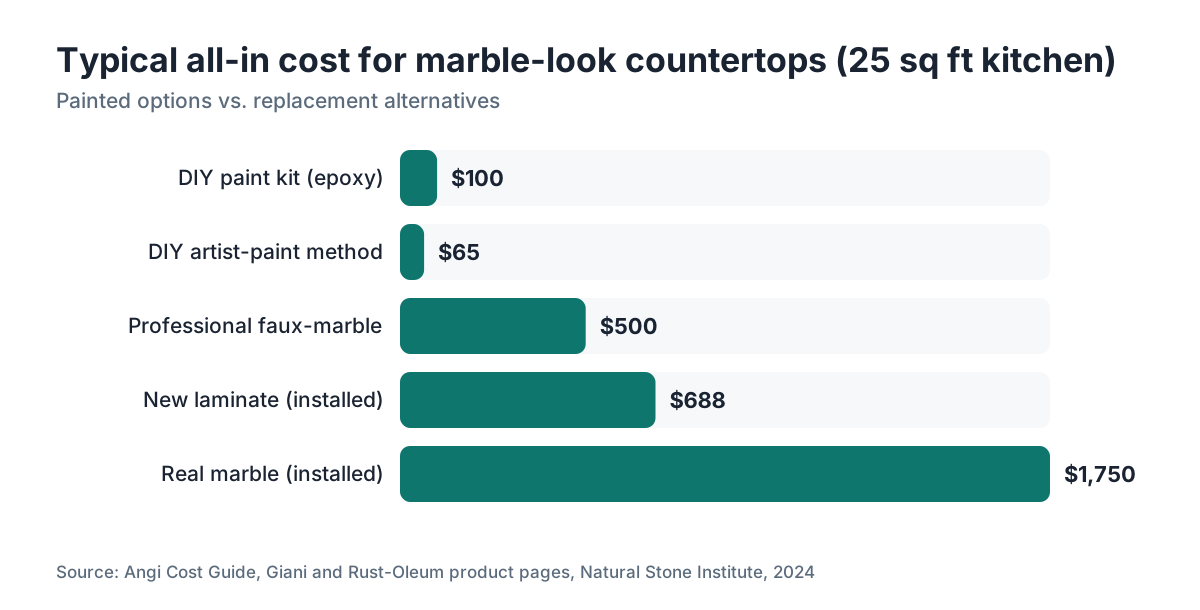
Cost depends almost entirely on whether you do it yourself or hire someone. DIY runs $50 to $150 in materials. A professional faux-marble finish runs $200 to $800 for a typical kitchen. That's the whole answer, and the rest is the detail behind it.
For DIY, the main expense is the kit. A standard epoxy countertop kit from Rust-Oleum covers roughly 50 square feet and retails for around $40 to $60 [1]. Giani's marble-specific kits run $80 to $130 for a similar coverage area [11]. Buy artist-grade paints and feather the veining yourself without a kit and materials might run $30 to $70, but your result rides entirely on technique.
Professional faux-finish work costs more because you're paying for skill. These painters charge by the square foot, and rates run roughly $3 to $12 per square foot for countertops depending on region and complexity [2]. A 25-square-foot kitchen counter might cost $75 to $300 in labor on the low end. Add prep (sanding, cleaning, primer), a clear topcoat, and materials, and the realistic all-in range for a typical kitchen lands at $200 to $800.
Compare that to other budget paths. Laminate countertops installed new run $15 to $40 per square foot. Formica countertops sit in the same range. Real marble starts around $40 to $100 per square foot installed, often more for premium slabs. Painted marble is the cheapest route to the marble look, even when you hire a pro.
| Option | Typical all-in cost (25 sq ft kitchen) |
|---|---|
| DIY epoxy kit | $50 to $150 |
| DIY artist paint method | $30 to $100 |
| Professional faux-marble finish | $200 to $800 |
| New laminate (installed) | $375 to $1,000 |
| Real marble (installed) | $1,000 to $2,500+ |
Those ranges reflect market conditions across 2024 and 2025. Local labor rates swing the professional number hard. Get at least two quotes.
What materials are used for a faux marble paint finish?
The common DIY system runs three layers: a base coat, a veining layer, and a clear protective topcoat. The topcoat does the durability work. The veining does the fooling-your-eyes work.
Base coats are usually a solid white or off-white in a flat or eggshell finish. Chalk paint works but it's porous, so it needs a sealer under the topcoat. Latex interior paint bonds fine on primed surfaces. Oil-based primer before any paint layer is the single best move you can make for adhesion.
Veining is where technique separates good from bad. Faux-marble artists traditionally use oil paint, a feather (a real feather, not a brush), and a light hand. The feather drags across wet paint at a diagonal, then twists slightly at irregular points to build the branching look of natural veining. Cheaper kits copy this with a sea sponge, which gives a diffuse, cloudy effect. Neither is wrong. They're just different looks.
The topcoat carries the load. Two-part epoxy topcoats (like Rust-Oleum's countertop line) are the toughest: they cure to a very hard surface that resists water, mild acids, and abrasion [1]. Standardized wear testing backs this up. Two-part epoxy coatings show much higher abrasion resistance than single-component latex or polyurethane in ASTM D4060 Taber Abraser tests [7]. Polyurethane topcoats apply easier and forgive more, but wear faster. Water-based polyurethane yellows slightly over time. Oil-based polyurethane is tougher but takes 24 to 48 hours to fully cure and needs good ventilation.
Some people use Minwax Polycrylic (water-based, non-yellowing) for the clear coat. It works well on light marble looks where yellowing would show [6].
For professional work, some finishers use a two-part water-based polyurethane with UV inhibitors, which stretches the life of the finish noticeably. That's not in a $50 kit.
How do you paint a marble countertop yourself, step by step?
Prep is what separates a finish that lasts three years from one that peels in six months. Spend the time there or don't bother.
Clean the surface first. Grease is the main enemy of adhesion. TSP (trisodium phosphate) or a TSP substitute cuts grease better than dish soap. Rinse fully and let it dry 24 hours.
Sand the surface lightly: 150-grit for laminate, 80-grit for anything already peeling or glossy. You're not removing the surface, just scuffing it so primer can grip. Wipe off all dust with a tack cloth.
Apply a bonding primer. Skip this on laminate and you will regret it. Zinsser Bulls Eye 1-2-3 adheres to slick surfaces like laminate and tile and recoats in about an hour [10]. KILZ Premium is another reliable pick. Let it dry fully, usually 1 to 2 hours, before touching it.
Apply your base coat. Two thin coats beat one thick one. Let each coat dry.
For veining, work small sections so the paint stays workable. Thin your veining paint slightly with water (latex) or mineral spirits (oil-based). Drag your feather or liner brush diagonally. Real marble veining runs in one general direction, not crossing at random angles, and it's never uniform in width. Vary the pressure. Step back often. Hovering close is how you get veins that look painted.
Once the veining dries, apply the topcoat. Most epoxy kits are self-leveling, so you pour and spread rather than brush. Follow the pot life instructions exactly: two-part epoxy has a working time of roughly 20 to 30 minutes before it sets [1]. Keep the room above 65 degrees during application and curing. Note that oil-based paints and polyurethanes release VOCs while curing, so ventilate the space well [5]. Let it cure the full time, usually 72 hours before light use and 7 days before anything heavy.
Here's a shop-side note worth knowing. Fabricators who quote and nest jobs in software like SlabWise don't paint counters, but homeowners ask them about faux marble all the time. The usual answer: a remnant slab often costs less than a professional faux job on your existing surface, and it's real stone.
How long do painted marble countertops last?
Depends on the topcoat, the traffic, and how careful you are. A well-applied two-part epoxy topcoat over properly primed laminate lasts 4 to 7 years before showing real wear in high-use zones like the sink and prep area [1]. Polyurethane topcoats typically need refreshing every 2 to 4 years. A chalk-paint finish with a wax topcoat, the most porous option, might hold up 1 to 2 years with careful use.
The big durability killers are heat, abrasion, and acid. Set a hot pan directly on a painted counter and it will leave a mark, almost certainly. Cutting directly on the surface, even over a topcoat, scratches it. Wine, citrus juice, and vinegar can etch or dull the finish if they sit.
Real marble has its own weakness here. It's a metamorphic rock made mostly of calcite, which acids dissolve, so acidic spills etch and dull the surface [3]. So painted marble and real marble share the acid problem. Real marble just wins on heat and abrasion by a mile. Granite countertops are harder and more stain-resistant than either.
Where you put the finish changes the math too. A bathroom vanity sees far less abuse than a kitchen counter. Painted vanity tops can last 6 to 10 years with light use, while the same product on a busy kitchen counter starts looking tired in 2 to 3 years.
What are the pros and cons of painted marble countertops?
Cost is the whole case for painting. No other method gets you a marble look under $200. If your laminate is structurally sound, you're renting, staging a home for sale, or on a tight renovation budget, painting is a defensible call.
It's also low commitment. Paint it and hate it, or watch it wear, and you can sand it back and redo it, or replace the surface underneath. That flexibility is worth something real.
The other side is honest too. Painted marble needs more maintenance than real stone. It's not heat-proof. It's not cut-proof. It reads as fake to anyone who knows countertops, especially up close. And the labor is real even for DIY: a full kitchen repaint is a weekend minimum, and you're out of the kitchen through cure time.
The durability ceiling sits below almost every other kitchen countertops option. If you're staying in the house 10 years, the total cost of repainting every 3 to 5 years starts creeping toward the cost of just replacing the counters with laminate or tile.
Then there's resale. Buyers notice painted counters. Some read it as a charming DIY touch. Many read it as a thing they'll replace. Nobody has clean data on the price effect; the honest answer is it probably matters less than the kitchen's overall condition. The National Association of Realtors' 2023 Remodeling Impact Report finds full countertop replacement outperforms cosmetic-only treatments in buyer perception [9].
How do you maintain and clean painted marble countertops?
Cleaning is simpler than real stone, mostly because there's no sealing to think about. Mild dish soap and water for daily cleaning. That's it. You don't need stone-specific cleaners.
Avoid abrasives (scrub pads, baking soda pastes); they dull the topcoat. Avoid bleach, which can discolor some topcoats. And avoid harsh kitchen degreasers unless the product lists your topcoat as compatible.
Wipe spills fast, especially wine, juice, and coffee. They don't soak in the way they would on unsealed stone, but they can stain if they sit for hours.
The guides on how to clean stone countertops and how to clean quartzite countertops show why painted finishes are actually easier day-to-day, even though they lose the long-term durability race.
For light scratches and dullness, a car-wax style polish often buffs them out. Deeper scratches may need a touch-up coat of polyurethane. A full re-topcoat every 2 to 3 years takes a few hours and costs $20 to $40 in materials. That single habit extends the finish life more than anything else you can do.
Can you paint over existing marble or laminate countertops?
Yes to both, with real differences in prep.
Painting over laminate is the common case and it works well. The surface is uniform, flat, and non-porous enough to hold primer. The main risks are bubbles from moisture underneath (make sure the laminate isn't delaminating) and edge peeling if you skip primer.
Painting over existing marble is possible but unusual. You'd do it to change the color of stained or damaged marble, or for a specific look. Sand the marble with 220-grit to scuff it, wipe clean, apply bonding primer, then proceed. Marble is porous, which helps adhesion, but it's cold and hard, so the paint film can be more brittle than on wood or laminate. It works. Expect slightly less durability.
Painting over tile is possible, but grout lines are the problem. They read through even thick topcoats unless you skim-coat the surface level first. That adds cost and time.
Painting over wood, including butcher block countertops, is generally a bad idea unless the wood is sealed first to stop moisture movement. Wood swells and shrinks with humidity, and paint films crack over time on unsealed wood. If the wood already has a polyurethane seal, getting new primer to stick is harder. Most faux-finish pros advise against painting butcher block.
How does painted marble compare to other budget countertop alternatives?
This is where the honest comparison gets interesting. Painted counters are cheaper upfront than any installed option. They also demand the most ongoing maintenance on this list, and the look doesn't hold up under close inspection like modern laminates do.
Laminate today is genuinely good. The marble-look sheets from Formica, Wilsonart, and others print digitally, so the veining is accurate and the depth shows. A new laminate install looks better than most DIY painted finishes and lasts 10 to 15 years with normal use. The installed cost is higher, but compare 10-year total cost and laminate often wins.
Corian countertops and other solid surfaces don't fake marble as convincingly, but they're repairable and durable. Cambria countertops are engineered quartz and look excellent, though they're real money at $70 to $120 installed per square foot.
The honest use case for painted marble is narrow. You're renting and can't touch the counters. You're staging a home fast and cheap. You're doing a short-term fix on a property you'll sell within two years. Outside those, the durability and appearance limits make other options smarter for most people.
Don't let anyone talk you into painting counters as a long-term substitute for replacement. As a short-term cosmetic fix, though? It genuinely works.
What are the best kits and products for DIY painted marble countertops?
Three products come up again and again in consumer reviews and pro discussions.
Rust-Oleum Countertop Coating is the most available option in the US, stocked at most home improvement stores. It's a water-based epoxy-polyurethane hybrid that rolls on, self-levels somewhat, and cures hard. Coverage runs about 50 square feet per quart. It comes in solid colors, not marble-look out of the box, so you add veining by hand over the base coat. Roughly $40 to $60 per quart [1].
Giani Marble Countertop Paint Kit is built for the marble look. The kit packs base paint, mineral powder for texture, veining paint, and a sealer topcoat, and it covers 35 to 40 square feet at $80 to $130 [11]. Done carefully, it mimics Carrara reasonably well. It costs more per square foot than the Rust-Oleum route, but the skill floor is lower because the kit does more of the work.
ArmorPoxy Countertop Kit is a two-part epoxy system, more common on garage floors but adapted for counters. It's the most durable of the three, with a cured hardness that resists chemicals and abrasion better than water-based systems. It's also the least forgiving: short pot life, exact mixing, immaculate prep. At $60 to $90 per kit, it's mid-range on cost.
For the topcoat specifically, Minwax Polycrylic (water-based, non-yellowing) is a solid choice on light marble finishes [6]. On darker or busier finishes where slight yellowing won't show, oil-based Varathane polyurethane is tougher.
Is painting your marble countertops worth it, or should you just replace them?
The math does most of the deciding here. If your existing counters are structurally sound (substrate not warped, waterlogged, or badly delaminated), painting is worth it for a short time horizon. A $100 DIY kit over a weekend transforms a kitchen for 2 to 4 years. That's a fair trade for a rental, a flip, or a year when replacement isn't in the budget.
Staying 5 or more years flips the calculus. You'll redo the finish at least once, and it will never look or perform like even a basic laminate replacement. At that point, saving up for a proper replacement makes more economic sense.
If the reason you're painting is damaged or stained marble, get a quote from a stone fabricator first. Marble can often be honed or repolished to lift surface stains and etch marks. The Natural Stone Institute puts that service at roughly $3 to $10 per square foot, and it restores the actual material instead of hiding it [4]. For a small bathroom vanity, that's maybe $50 to $150 total, less than a repaint and a better result.
Shops that quote countertop work in tools like SlabWise can hand you a real replacement number faster than you'd guess. An actual quote makes the comparison concrete instead of theoretical. If replacement is $600 and painting is $100 but needs redoing every 3 years, break-even lands around year 2 to 3. That's a real decision, not an obvious one.
What do professional faux-finish painters do differently from DIY?
The gap between a professional faux-marble finish and a kit job is significant, and it comes down to three things: prep time, paint quality, and technique.
Pros spend more time on prep than on painting. Full surface cleaning, light mechanical sanding, sometimes skim-coating to level an uneven substrate, and multiple primer coats. That foundation is what keeps the finish from peeling.
They use artist-grade oil paints for veining instead of the craft paints in consumer kits. Oil paint stays workable longer, blends differently, and gives the translucent depth that makes real marble read as marble. They apply it with actual feathers, liner brushes, and sometimes the artist's breath to soften edges.
The layering is more complex. Real marble has depth because the veins run through the stone, not across the surface. A professional faux finish copies that with multiple translucent layers, each a slightly different tone, so the veins appear to sit at different depths. A single-application kit can't do that.
The topcoat is often a water-based two-part polyurethane with UV stabilizers, applied in 3 to 4 thin coats rather than one thick one. The result is harder, clearer, and more even than most consumer-applied topcoats.
Paying $400 to $800 for a professional finish? Ask specifically about the topcoat product, the number of coats, and what the warranty covers. A pro confident in the work answers those questions directly.
Frequently asked questions
Can you paint over laminate countertops to look like marble?
Yes, and laminate is one of the best substrates for painted marble. Clean thoroughly, sand lightly with 150-grit to scuff the surface, apply a bonding primer, then follow your kit or artist-paint method. The flat, uniform surface holds paint evenly and doesn't have the grain movement that causes peeling on wood. Expect a finish that lasts 3 to 5 years with an epoxy topcoat.
Will painted marble countertops peel?
They can, but peeling is almost always a prep failure, not a product failure. Grease left on the surface, skipping bonding primer on smooth laminate, or painting over moisture-damaged substrate are the main causes. Apply bonding primer, let everything dry fully between coats, and use an epoxy topcoat rather than plain polyurethane. Done right, a painted counter shouldn't peel for several years under normal household use.
Is Giani marble paint worth the money?
For someone who's never done a faux finish, yes. The Giani kit ($80 to $130) packages base paint, mineral texture, veining colors, and topcoat in proportions that work together, which removes guesswork. Followed carefully, it produces a recognizable marble look. It costs more per square foot than buying components separately, but the skill floor is lower. If you're comfortable with painting and prep, buying components yourself saves money.
How long does it take to paint marble countertops?
Application time for an average kitchen (25 to 30 square feet) is roughly 4 to 8 hours over 2 days: one day for prep and base coats, a second for veining and topcoat. Then add 72 hours of cure before light use and 7 days before full use. Plan to be without your counter for 3 to 4 days minimum. A bathroom vanity is faster, often a single work day plus cure time.
Can you put hot pans on painted countertops?
No. This is the clearest limit of painted finishes. Even a well-cured two-part epoxy topcoat can discolor, bubble, or soften under a hot pan. Always use trivets. Same caution for slow cookers and electric griddles. Real marble has its own heat limit (thermal shock can crack it), but most stone options handle moderate heat far better than any painted surface.
What primer should I use for painted marble countertops?
For laminate, use a bonding primer specifically. Zinsser Bulls Eye 1-2-3 and KILZ Premium are both widely available and reliable. On wood or concrete, standard interior primer works but a bonding primer performs better. On tile, use a tile-specific bonding primer. Tinting the primer to a light gray or cream near your base coat color reduces the number of base coats you'll need.
Does painting countertops increase home value?
No real evidence supports that. Painted countertops are a visual improvement but a cosmetic treatment, not a material upgrade. Most buyers and appraisers recognize faux finishes and assume the underlying surface will need replacing. Where painting might help is staging: a fresh, consistent-looking kitchen photographs and shows better, which can matter in a competitive market. Don't count on a return beyond a faster sale.
Can you use chalk paint for marble countertops?
Chalk paint works as a base coat but it's very porous, so liquids penetrate if the topcoat has any pinholes or chips. It also grips less firmly than bonding primer plus latex, so edge peeling is more likely in high-traffic spots. If you use it, seal with two coats of water-based polyurethane or epoxy and stay vigilant about touching up damage quickly. It's workable, not ideal.
How do you get the veining right on a faux marble finish?
Use a feather or a fine artist's liner brush, not a regular paintbrush. Thin your veining paint slightly. Work at a diagonal. Vary the pressure so the line thickens and thins at intervals. Soften the edges with a dry brush or light breath right after drawing the line. Look at reference photos of real Carrara or Calacatta: the veining is organic and slightly branching, never perfectly straight. Stepping back every few strokes helps more than hovering close.
Can you paint over existing painted countertops?
Yes, as long as the existing paint is firmly stuck with no peeling or bubbling. Sand lightly, clean thoroughly, apply bonding primer, and proceed. If the existing finish is peeling, strip it back first or the new coat peels in the same spots. Painting over a failed finish almost never lasts. The time spent stripping and repriming is always worth it compared to a second failed finish.
What's the difference between epoxy countertop coating and paint?
Epoxy countertop coating is a two-part system (resin plus hardener) that chemically cures into a very hard, waterproof film. It's not technically paint. Regular paint dries by evaporation and stays somewhat flexible. Epoxy cures by polymerization and gets hard enough to resist chemical spills and abrasion. For counters, epoxy is much more durable. The trade-off is a short working time (20 to 30 minutes once mixed) and little forgiveness during application.
How do you touch up chipped painted marble countertops?
Small chips touch up with the original base and veining paint, then a thin coat of your topcoat. The tricky part is feathering new topcoat into the cured topcoat so the edge disappears. Lightly sand around the chip (320-grit) before applying touch-up paint. At high-traffic spots like around the sink, expect to touch up every 6 to 12 months. Large damaged areas are better handled with a full re-topcoat.
Is painted marble countertop better than peel-and-stick marble contact paper?
Paint is more durable and looks better in person. Contact paper is faster and cheaper to apply but shows seams, peels at edges over time, and struggles around sinks. For a rental where you need to restore the surface when you leave, contact paper is appealing because it removes without damage. For anything you'll live with more than a year or two, paint with a proper topcoat produces a better, longer-lasting result.
Sources
- Rust-Oleum, Countertop Coating product page: Rust-Oleum Countertop Coating covers approximately 50 square feet per quart, retails for $40 to $60, and has a pot life of roughly 20 to 30 minutes; it cures to a hard epoxy-polyurethane surface resistant to water and mild chemicals.
- Angi, Faux Finish Painting Cost Guide: Professional faux-finish painters typically charge $3 to $12 per square foot for countertop surfaces, depending on complexity and region.
- USGS, Mineral Resources Program (Marble): Marble is a metamorphic rock composed mostly of calcite, which makes it vulnerable to acidic substances that dissolve the calcite, causing etching and surface dulling.
- Natural Stone Institute, Care and Maintenance of Natural Stone: Stone honing and repolishing services to remove surface stains and etch marks from marble typically cost $3 to $10 per square foot.
- EPA, Indoor Air Quality (Volatile Organic Compounds): Oil-based paints and polyurethanes release volatile organic compounds (VOCs) during application and curing; adequate ventilation is required to avoid indoor air quality problems.
- Minwax, Polycrylic Water-Based Protective Finish product information: Minwax Polycrylic is a water-based, non-yellowing clear protective finish that can be applied over painted surfaces to protect against wear and water.
- ASTM International, Standard D4060 (Abrasion Resistance of Organic Coatings by the Taber Abraser): Two-part epoxy coatings demonstrate significantly higher abrasion resistance than single-component latex or polyurethane coatings in standardized Taber Abraser wear testing.
- U.S. Census Bureau, American Housing Survey: Kitchens are among the most renovated rooms in US homes, with countertop replacement among the most common individual renovation projects reported.
- National Association of Realtors, 2023 Remodeling Impact Report: Kitchen renovation projects, including countertop replacement, show moderate cost-recovery on home resale, with full replacement outperforming cosmetic-only treatments in buyer perception.
- Zinsser (Rust-Oleum brand), Bulls Eye 1-2-3 Primer product data sheet: Zinsser Bulls Eye 1-2-3 is a water-based bonding primer that adheres to slick surfaces including laminate and tile, and dries to recoat in about 1 hour.
- Giani Inc., Marble Countertop Paint Kit product page: Giani Marble Countertop Paint Kit covers 35 to 40 square feet, includes base paint, mineral powder, veining paints, and topcoat sealer, and retails for $80 to $130.
Last updated 2026-07-09