TL;DR
- Engineered stone (almost always quartz) is 90 to 95% crushed natural quartz bound with polymer resin and pigment.
- It costs $50, $120 per square foot installed, never needs sealing, and shrugs off most stains.
- It chips on sharp edges, yellows under prolonged UV, and scorches under high heat.
- For most kitchens, it's the most practical surface you can buy right now.
What is engineered stone, exactly?
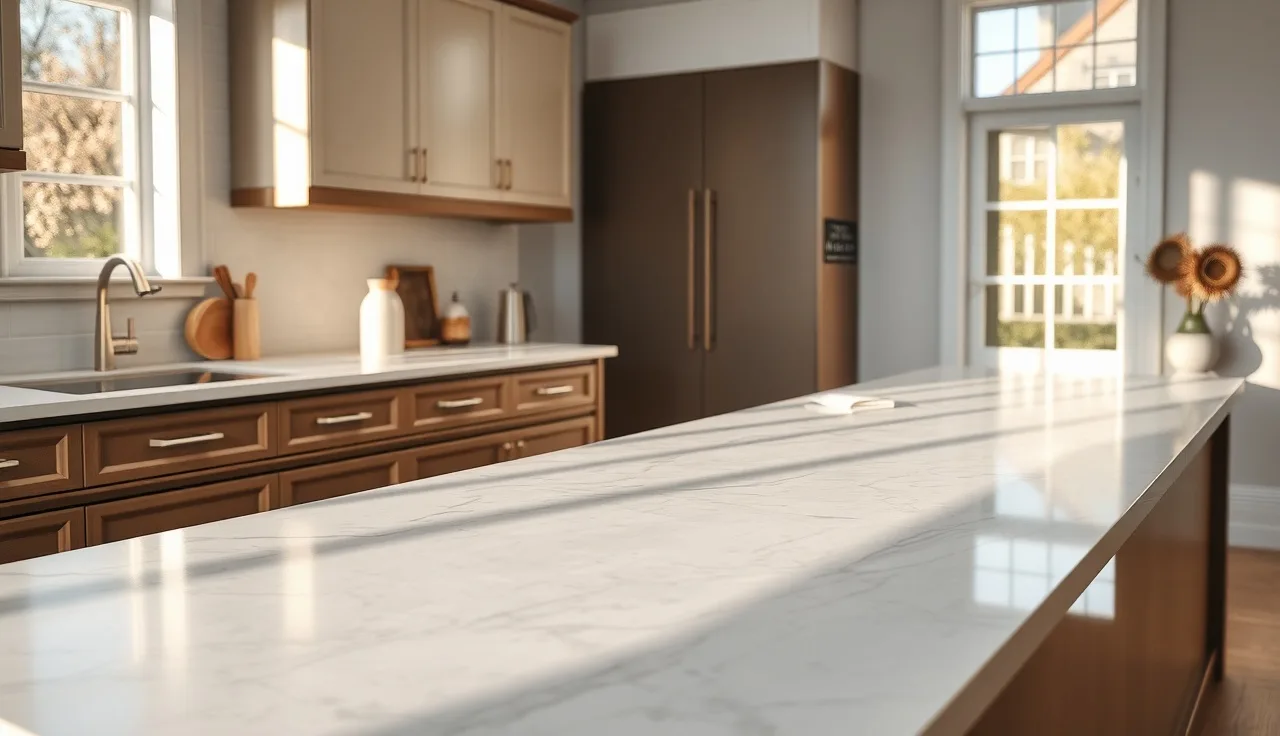
Engineered stone is a man-made slab built from roughly 90 to 95% ground natural quartz, bound with 5 to 10% polymer resin (usually polyester or epoxy) plus pigments and sometimes recycled glass or mirror chips. [1] The mix gets pressed under vacuum and vibration, then cured under heat into a dense, non-porous slab. It looks like natural stone. It behaves nothing like it.
Most people say "engineered stone" and "quartz countertop" to mean the same thing, and for residential work that's fair. Other engineered products exist (sintered porcelain, recycled glass composites), but when a kitchen designer says "engineered stone," they mean a quartz-resin slab. Caesarstone, Cambria, Silestone, and Vicostone all make the same fundamental product, though formulations vary.
The non-porous surface is the whole point. Granite and marble are porous to varying degrees, which is why they get sealed. Engineered stone skips that entirely. The resin fills every void between quartz particles, leaving no pathway for bacteria, wine, or oil to soak in. That's a real advantage in a kitchen, and it's the reason quartz took over.
How is engineered stone different from granite, marble, and other countertop materials?
Short version: engineered stone is manufactured, so its properties stay consistent batch to batch. Natural stone is quarried, so every slab is unique and performance shifts with the mineral makeup of that specific piece.
Here's how the main countertop materials stack up on the metrics that actually matter:
| Material | Porosity | Needs sealing | Heat resistance | UV resistance | Installed cost (per sq ft) |
|---|---|---|---|---|---|
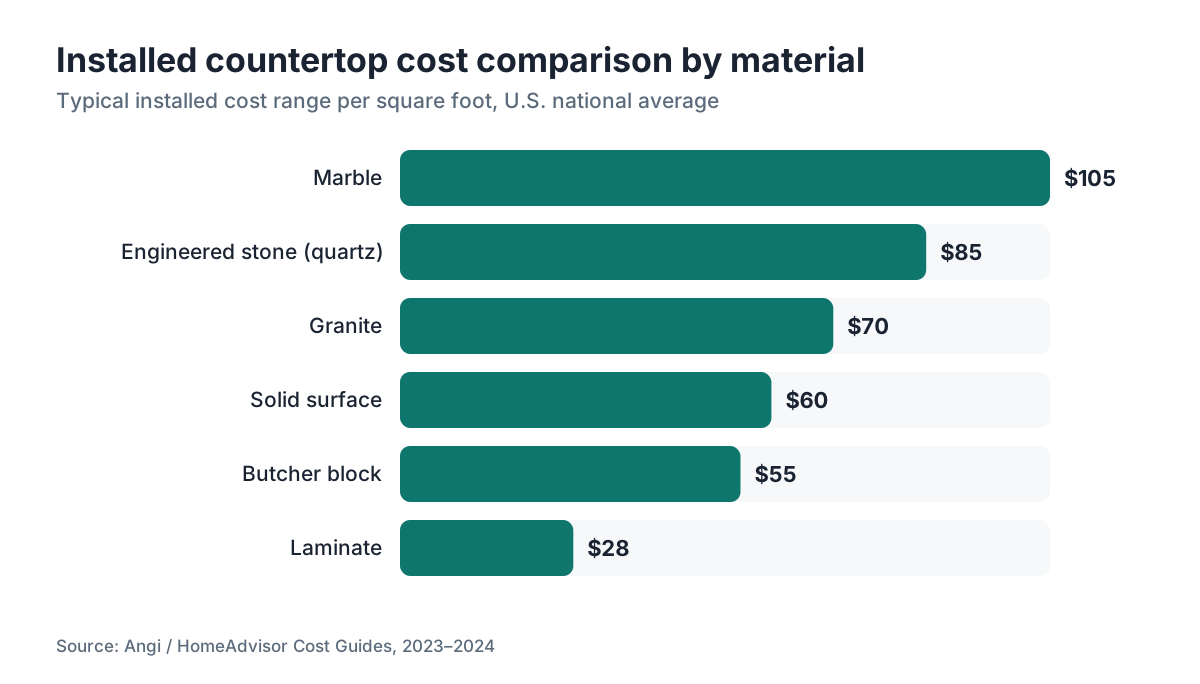
| Engineered stone (quartz) | Non-porous | No | Poor (resin scorches ~150°C) | Poor (resin yellows) | $50, $120 [2] |
| Granite | Porous (low, medium) | Yes, 1 to 3 yrs | Good | Good | $40, $100 [3] |
| Marble | Porous (high) | Yes, annually | Moderate | Good | $60, $150 [3] |
| Laminate | Non-porous | No | Poor | Moderate | $15, $40 [4] |
| Butcher block | Porous (high) | Yes, monthly | Moderate | Good | $30, $80 [5] |
| Solid surface (Corian-type) | Non-porous | No | Poor | Good | $40, $80 [6] |
Granite is the closest competitor. Both are hard, dense, and expensive. The differences that matter in daily life: granite needs sealing (a 15-minute annual job, not a big deal), takes direct heat from pots better, and shows veining that no two slabs repeat. Engineered stone looks more uniform and never needs sealing, but it'll scorch or crack under a 500°F Dutch oven set straight on the surface.
Marble is gorgeous and etches if you look at it wrong. Lemon juice, wine, coffee, tomato sauce, all of them chemically etch marble, leaving dull marks that sealing does nothing to prevent. If you cook heavily, marble is a bad call for the main prep surface. Engineered stone has zero etching risk because the resin doesn't react to acid.
For more on granite countertops and how natural stone compares in detail, that article breaks down granite grades and slab pricing.
What does engineered stone cost, and what drives the price?
Installed engineered stone countertops run $50, $120 per square foot in most U.S. markets, with the national average around $75, $85 per square foot all-in. [2] The range is wide because several real variables push the number around.
Material tier moves it the most. Entry-level quartz (simple patterns, more resin, often imported) starts near $50 installed. Premium slabs, particularly from Cambria (the only major brand that quarries its own quartz in the U.S.) or the high-end Silestone and Caesarstone lines, hit $100, $120 installed without much trouble. [7]
Edge profiles add cost. A standard eased edge is usually baked into the base price. A mitered waterfall edge, a thick laminated edge, or a hand-carved ogee tacks on $15, $40 per linear foot. On a U-shaped kitchen with 25 linear feet of edge, that's real money.
Cutouts cost too. Each sink cutout typically runs $100, $200 depending on sink type (undermount takes longer than drop-in). Cooktop cutouts and outlet cutouts for pop-ups all pile onto the final invoice.
Fabrication complexity is the hidden variable. Open layouts with large, uninterrupted runs are cheap to fabricate. Angled walls, radius corners, and multiple seams around a curved island mean more saw time, more polishing, and more risk of waste. A simple galley kitchen and a sprawling L-shaped island with a waterfall edge can carry the same square footage and wildly different fabrication costs.
If you run quartz jobs, slab nesting efficiency is a serious cost lever. Poor nesting on a $900 slab burns real margin. Software like SlabWise is built to optimize material yield during quoting and nesting, which is where a lot of shops quietly lose money.
Does engineered stone need to be sealed?
No. This is one of the most misunderstood points about quartz countertops. The resin binder fills all the space between quartz particles, so the slab has no pore structure for a sealer to soak into. A topical sealer does nothing useful and can leave a hazy film. [1]
Some fabricators or retailers offer to seal it as an upsell. Skip it. It's not harmful. It's money for nothing.
What quartz does need is simple: warm water, mild dish soap, a soft cloth. For stuck food, a plastic scraper works. For disinfecting, a diluted isopropyl alcohol solution (70% or below) is safe. Manufacturer cleaning guidance generally warns against bleach concentrations above 3% and strongly discourages abrasive pads or powders, which dull the polished surface over time. [8]
See how to clean stone countertops for a broader guide covering both natural and engineered surfaces.
What are the real weaknesses of engineered stone countertops?
Heat is the big one. The polymer resin that makes quartz non-porous starts to soften and discolor around 150°C (302°F). [1] A cast-iron skillet pulled straight from a 450°F oven and set on the counter can leave a permanent scorch mark or, in bad cases, a thermal crack. Use trivets. Every time. Fabricators see this damage regularly, so it's not a theoretical risk.
UV exposure causes yellowing. The resin in engineered stone is not UV-stable. A counter under a big south-facing window yellows noticeably over years of direct sun. Outdoor kitchens see it worst, but interior kitchens with heavy sun get it too. Some manufacturers sell UV-resistant formulations, but the base product is vulnerable, and standard quartz outdoors is asking for trouble.
Edges chip. Quartz is hard but brittle. Square and eased edges chip more easily than beveled or bullnose profiles under impact. Drop a cast-iron pan on an eased corner and you can take a chunk out. It's repairable with color-matched epoxy, but it's never invisible.
Color and pattern have limits. Because it's manufactured, quartz mimics marble veining and granite movement well, but a trained eye can usually tell. Patterns repeat across slabs in some product lines, which shows on large islands where two slabs butt together. Natural veining is random; engineered veining often has a subtle rhythm. If you're chasing a specific natural stone look exactly, quartz gets you close, not all the way.
Weight matches natural stone. A 3cm (roughly 1.25-inch) quartz slab weighs about 18 to 20 lbs per square foot. Cabinet boxes need to be in good shape to carry it. That's not unique to engineered stone, but keep it in mind on cabinet renovations where the boxes are older.
Is engineered stone safe? What about silicosis concerns?
This is a serious and evolving public health issue, but the risk is for the people who fabricate the slab, not the people who live with it. Cutting, grinding, and polishing engineered stone throws off respirable crystalline silica dust at concentrations well above natural stone fabrication. A 2019 study in JAMA Internal Medicine found engineered stone accounted for 46% of silicosis cases among stone countertop workers in California, despite holding a much smaller share of the market than granite. [9]
OSHA's silica standard puts it plainly: "Workers who inhale very small crystalline silica particles are at risk of developing serious, sometimes fatal, silica-related diseases, including silicosis." [10] OSHA's permissible exposure limit for respirable crystalline silica is 50 micrograms per cubic meter as an 8-hour time-weighted average. [10]
For fabricators and installers, that means wet cutting is mandatory, not optional. Dry cutting engineered stone without engineering controls is effectively prohibited under OSHA's silica rule (29 CFR 1926.1153 for construction, 29 CFR 1910.1053 for general industry). [10] N95 respirators alone aren't enough for heavy fabrication. Half-face respirators with P100 cartridges, or powered air-purifying respirators (PAPRs), are the right call.
For homeowners, installed countertops are safe. The hazard lives entirely in the cutting and grinding process, not in a finished slab. Normal use, cleaning, and even light repair grinding with proper controls at home generates negligible exposure.
How does engineered stone hold up over time?
In normal residential use, durability is genuinely excellent. Quartz has a Mohs hardness of 7, so everyday items won't scratch it, though ceramic dishes and knife tips technically can leave fine marks if dragged. In practice most people use cutting boards (as they should) and never see scratching.
The surface doesn't need repolishing the way marble does. A well-maintained quartz counter installed in 2010 looks essentially the same in 2025, assuming no heat damage, no heavy bleach, and no impact chipping. That's a track record now, not a marketing line.
Warranties are strong. Most major brands offer limited lifetime warranties for residential use. Cambria, for one, covers defects in materials and workmanship for life. [7] These warranties are generally non-transferable and exclude damage from misuse (heat, impacts, improper cleaning). Read the fine print, but the coverage is real.
Stain resistance is very good, not absolute. Oil-based pigments like turmeric, permanent marker, and some food dyes can stain the resin if left long enough. Prompt cleaning handles almost everything. A stain sitting overnight is a different problem than one wiped up in minutes.
What should you know about engineered stone installation?
Quartz installation follows the same path as natural stone: measure, template, fabricate, deliver, set. The weight (18 to 20 lbs/sq ft for 3cm) means a two-person minimum for delivery and setting. [3]
Templating is the step that decides everything. A digital template (tools like Laser Products Industries' LT-2D3D or similar) captures exact dimensions including wall irregularities, which is how you avoid gaps and bad seam placement. If a fabricator wants to skip templating and measure a complex layout by hand with a tape, that's a yellow flag.
Seams are inevitable on runs longer than the slab. Standard quartz slabs run about 55 to 65 inches wide and 110 to 130 inches long. Any continuous run past those dimensions gets a seam. Seams are filled with color-matched epoxy and polished flat. A skilled fabricator makes them nearly invisible. A rushed one leaves a visible line. Ask to see examples of their seam work before you sign.
Support requirements matter for overhangs. Quartz cantilevers up to about 12 inches without support, depending on thickness and the specific slab. Beyond that you need corbels, steel brackets, or cabinet support. For large island overhangs (common for bar seating), sort out support with your fabricator upfront.
The countertop installation article covers the full process, including how to prep your cabinets and what to expect on install day.
How do you pick the right engineered stone brand or product?
Brand selection comes down to four things: where it's made, what the warranty actually covers, whether your fabricator has the slab in stock, and what the pattern looks like in person.
Domestic vs. imported. Cambria is made entirely in the U.S. (Le Sueur, Minnesota). [7] Caesarstone manufactures primarily in Israel with a U.S. plant in Richmond Hill, Georgia. Silestone is Spanish (Cosentino). Many entry-level brands come from China or Vietnam, which isn't automatically a quality problem, but consistency and warranty support can vary. If country of origin matters to you, Cambria is the clear domestic pick.
Slab variation matters on large surfaces. Some quartz lines have short pattern repeats, so two slabs side by side on a big island visibly mirror each other. Higher-end lines built for large-format work use longer or randomized repeats. Ask your fabricator to lay two slabs of the same batch side by side before you commit.
Thickness options: 2cm (3/4 inch) and 3cm (1.25 inch) are standard. Most residential kitchens use 3cm for strength and a heavier look. 2cm is lighter and cheaper but usually needs a plywood substrate for support. Some decorative applications use 1.2cm for thin profiles.
If you're weighing quartz against the look of marble, see marble countertops for an honest read on the tradeoffs. For the Cambria brand specifically, cambria countertops goes deep on their product line and colors.
Can you use engineered stone outdoors?
Standard engineered stone is not rated for outdoor use by any major manufacturer, and the reasons are practical. UV yellows the resin. Freeze-thaw cycles in cold climates crack it as resin and quartz expand and contract at different rates. Rain and pooled water don't penetrate the non-porous surface, but they work into joints and seams.
Some brands, Silestone among them, sell products marketed for outdoor use with UV-stable resin, but even those carry restrictions around climate extremes. For a durable outdoor countertop, sintered porcelain or granite are better choices. Granite's mineral structure is inherently UV-stable and takes freeze-thaw far better.
For an outdoor grill surround or bar top in a covered area with limited direct sun, a homeowner might get years out of standard quartz. That's a risk-tolerance decision, not a manufacturer-endorsed one.
What do fabricators need to know about working with engineered stone?
Quartz is harder than granite in Mohs terms (7 vs. 6 to 6.5 for most granites) but more brittle because of the resin matrix. Blade selection matters more than a lot of shops realize. A blade tuned for granite works on quartz but wears faster and risks micro-fracturing at the edge. Blades built for engineered stone use a softer bond that releases grit faster, which cuts heat buildup at the kerf.
Feed rate and water flow during cutting cause most quality problems. Too fast a feed with too little water gives you heat stress, edge chipping, and cracked slabs. Engineered stone runs best at slower, steady feed rates with high water volume. That's especially true on cutouts, where the blade works in a constrained path.
Polishing quartz is generally faster than marble, which needs more progressive grit steps to reach a mirror finish. Quartz usually responds well at 400, 800, and 1500 grit with a resin pad, finished with a buffing compound. The exact sequence depends on brand, specified surface finish, and your equipment.
Material yield and waste are genuine cost concerns. Slabs are expensive, and complex layouts with multiple cutouts can waste 30 to 40% of a slab. Accurate nesting during the quote phase, before you order slabs, directly drives job profitability. This is where digital quoting and nesting tools like SlabWise pay for themselves: figuring out which pieces come from which slab before you make a single cut.
For disposal, check your local rules. Quartz offcuts aren't hazardous waste, but the silica content means cutting slurry may need specific handling under local stormwater regulations. [10]
How does engineered stone compare to laminate and solid surface countertops?
Laminate (Formica and similar) is the budget option. At $15, $40 per square foot installed, it's cheap, comes in hundreds of patterns, and some forms are DIY-friendly. [4] It also scratches easily, can't be repaired invisibly, and has a hollow sound when you tap it that gives the game away. Engineered stone costs two to four times as much and lasts dramatically longer under hard use.
Solid surface (Corian and similar) sits between laminate and quartz on price, roughly $40, $80 installed. [6] Its main edge is repairability: scratches and burns sand out and the surface refinishes. Quartz can't be refinished in the field. Solid surface is softer than quartz, so it scratches more readily, but the ability to fix damage in place is genuinely useful, especially for rentals or high-traffic commercial spaces.
For a detailed look at the budget end, laminate countertops and formica countertops cover that ground. For corian countertops, that article gets into the solid surface repair advantage.
The honest view: for most primary kitchen surfaces in owner-occupied homes, engineered stone is the strongest all-around choice of the three. For rentals, solid surface's repairability is a reasonable argument. For tight budgets, laminate has gotten a lot better than its reputation.
Frequently asked questions
Is engineered stone the same thing as quartz countertops?
For practical purposes, yes. In the countertop trade, "engineered stone" almost always means quartz-resin slabs from brands like Caesarstone, Cambria, or Silestone. Technically engineered stone includes other manufactured products, but quartz dominates the residential market so completely that fabricators, designers, and retailers use the terms interchangeably.
How long do engineered stone countertops last?
With normal use, engineered quartz lasts 20 to 30 years or more without structural degradation. The main failure modes are heat damage (scorching or cracking from hot pans), edge chipping from impact, and UV yellowing near direct sun. None of these are wear in the traditional sense; they're damage from specific causes. The material itself doesn't degrade with age the way laminate or butcher block does.
Can engineered stone countertops be repaired if they chip or crack?
Yes, but not perfectly. Color-matched epoxy or acrylic repair kits fill chips and hairline cracks, and a skilled fabricator can polish the repair to reduce visibility. It's rarely invisible under close inspection. For a major crack running through the slab, full or partial replacement is the realistic answer. That's a real limitation compared to solid surface, which sands and refinishes.
Does engineered stone stain?
Rarely, and usually only from pigmented substances left to sit for hours. Turmeric, red wine, permanent marker, and certain food dyes can stain the resin if not cleaned promptly. In daily use, quick wiping handles almost everything. For stuck stains, a paste of baking soda and water or a 70% isopropyl alcohol solution usually clears it without damaging the surface.
What's the difference between 2cm and 3cm engineered stone?
2cm (about 3/4 inch thick) is lighter and cheaper but needs a full plywood substrate for support and cracks more easily on unsupported spans. 3cm (about 1.25 inches) is self-supporting on standard cabinet spans up to about 24 inches, looks more substantial, and is the residential standard in most U.S. markets. The price gap is typically $5, $15 per square foot.
Can I cut directly on an engineered stone countertop?
You can without immediately damaging it, since quartz is harder than most knife blades. But over time you get fine scratches in the polished finish and dulled knives. Use a cutting board. More to the point, cutting boards are standard kitchen hygiene, and a countertop surface isn't clean enough for food prep anyway after daily use.
Why is silicosis a concern for engineered stone specifically, more than granite?
Engineered stone is 90 to 95% crystalline silica, compared to granite at typically 25 to 30% silica by composition. More silica in the slab means more silica-containing dust per cut. A 2019 JAMA Internal Medicine study found engineered stone accounted for 46% of silicosis cases among California stone countertop workers despite lower market share than granite, reflecting that disproportionate dust hazard during fabrication.
Does engineered stone add value to a home?
Quartz countertops regularly show up on real estate agents' lists of kitchen features that help homes sell faster, though isolated resale value data is hard to pin down. The National Association of Realtors' 2022 Remodeling Impact Report ranked kitchen upgrades among the top renovations for buyer appeal, though ROI varies a lot by market, budget, and what was there before. [11]
What cleaning products are safe for engineered stone?
Mild dish soap and warm water handle daily cleaning. A 70% isopropyl alcohol solution works for disinfecting. Avoid bleach concentrations above about 3%, abrasive powders or scrubbing pads, and drain or oven cleaners, which degrade the resin binder. Most manufacturer guides (Caesarstone, Cambria, Silestone) agree on these restrictions, but always check your specific brand's published care guide.
How is engineered stone installed, and can I DIY it?
Engineered stone installation needs templating, professional CNC or wet-saw cutting, polishing, and setting with silicone adhesive. At 18 to 20 lbs per square foot for 3cm slabs, safe handling takes at least two people and usually a suction cup carrier. DIY installation is extremely difficult without fabrication equipment. A homeowner can sometimes save money doing demo and cabinet prep, but fabrication and setting are almost always professional work.
Is engineered stone good for bathroom vanities?
Yes, engineered quartz suits bathroom vanities well. The non-porous surface resists moisture, toiletries, and common bathroom chemicals. UV yellowing is less of a concern in bathrooms without direct sun. Heat damage risk is minimal. Vanity tops are smaller than kitchen counters, which usually means lower cost and easier templating. Many of the same brands and color lines run across kitchen and bath applications.
How do I get an accurate quote for engineered stone countertops?
Measure your countertop area in square feet, count your edge linear footage, and identify the number and type of cutouts (sinks, cooktops). Get at least three quotes from fabricators with references. Make sure each quote names the slab brand and series, thickness (2cm vs 3cm), edge profile, and whether templating and installation are included. Material-only quotes from big box stores often leave out fabrication labor, which is a big chunk of the total.
Sources
- Silestone by Cosentino, Product Technical Specifications: Engineered stone composition: 90-95% natural quartz aggregate bound with polymer resin; non-porous surface requires no sealing; heat resistance threshold of approximately 150°C for resin binder
- HomeAdvisor (Angi), Quartz Countertop Cost Guide: Installed engineered stone / quartz countertops cost $50, $120 per square foot nationally, with an average near $75, $85 per square foot
- HomeAdvisor (Angi), Granite and Marble Countertop Cost Guide: Granite countertops cost $40, $100 per square foot installed; marble countertops cost $60, $150 per square foot installed; stone slabs weigh approximately 18 to 20 lbs per square foot at 3cm thickness
- HomeAdvisor (Angi), Laminate Countertop Cost Guide: Laminate countertops cost $15, $40 per square foot installed
- HomeAdvisor (Angi), Butcher Block Countertop Cost Guide: Butcher block countertops cost $30, $80 per square foot installed
- HomeAdvisor (Angi), Solid Surface Countertop Cost Guide: Solid surface countertops cost $40, $80 per square foot installed
- Cambria, Warranty and About Pages: Cambria is the only major quartz brand that quarries its own quartz in the U.S. (Le Sueur, Minnesota) and offers a limited lifetime residential warranty
- Caesarstone, Care and Maintenance Guide: Manufacturer cleaning guidance: avoid bleach concentrations above 3%, abrasive cleaners, and abrasive pads; recommended cleaners include mild soap and isopropyl alcohol up to 70%
- JAMA Internal Medicine, Silicosis Among Immigrant Engineered Stone Countertop Workers (2019): Engineered stone accounted for 46% of silicosis cases among stone countertop workers in California in the study period despite lower market share than granite, due to higher crystalline silica content in engineered stone slabs
- OSHA, Crystalline Silica Standard Overview and 29 CFR 1926.1153 / 1910.1053: OSHA permissible exposure limit for respirable crystalline silica is 50 micrograms per cubic meter (8-hour TWA); OSHA states 'Workers who inhale very small crystalline silica particles are at risk of developing serious, sometimes fatal, silica-related diseases, including silicosis'; dry cutting without engineering controls is prohibited under the silica standard
- National Association of Realtors, 2022 Remodeling Impact Report: Kitchen upgrades rank among the top renovation projects for appeal to homebuyers according to the 2022 NAR Remodeling Impact Report
- CDC / NIOSH, Silica page: NIOSH identifies respirable crystalline silica exposure during stone fabrication as a cause of silicosis and recommends wet methods and respiratory protection to control dust
Last updated 2026-07-10