TL;DR
- Matte quartz countertops run $60 to $120 per square foot installed, about 5 to 10% more than polished quartz of the same material.
- They hide fingerprints and minor scratches better than polished surfaces but are harder to keep spot-free if hard water or soap film settles into the texture.
- Most homeowners who want a softer, modern look find the tradeoff worth it.
What is a matte quartz countertop, exactly?
A matte quartz countertop is engineered stone finished to a flat, non-reflective surface instead of a mirror shine. The material is the same either way: roughly 90 to 93% crushed quartz aggregate bound with polymer resins and pigments [1]. Only the surface treatment changes. Polished slabs run through progressively finer abrasive wheels until they're bright. Matte or honed slabs stop at a lower grit, which leaves a flat surface that scatters light instead of bouncing it back.
Some brands call this finish "honed," some call it "matte," and a few use "leathered" for a subtly textured variant. There is no industry-standard grit cutoff, so a matte finish from one manufacturer can look different from another's. Cambria, for example, calls its non-polished option "matte" and it reads as a very soft satin [2]. Silestone uses "Loft" textures that add physical micro-relief. Worth knowing before you order samples.
The resin binder is what makes engineered quartz non-porous, and that doesn't change with the finish. Both polished and matte quartz absorb water at a rate below 0.1%, lower than most granites [3]. The finish is purely aesthetic and tactile, not structural.
How much do matte quartz countertops cost?
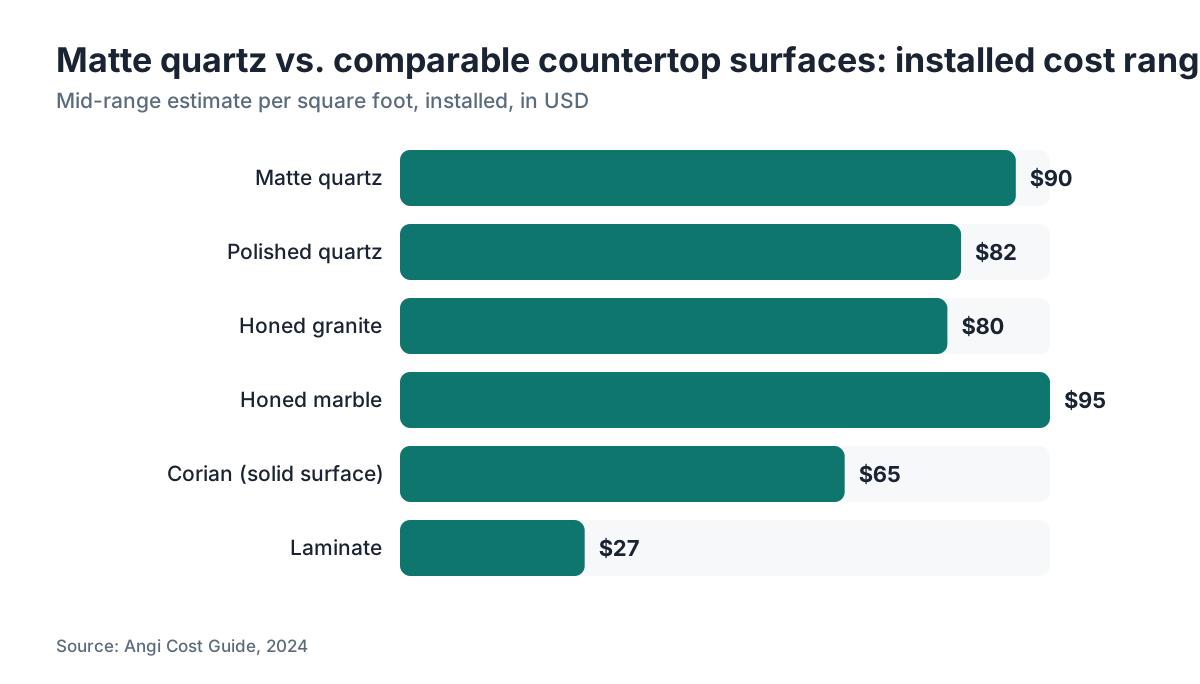
Installed matte quartz runs $60 to $120 per square foot, including material, fabrication, and basic installation [4]. The finish itself adds roughly $5 to $10 per square foot over the same slab in polished, because a matte surface takes more production time and yields can run slightly lower.
Here's how the main cost drivers break down:
| Cost factor | Typical range |
|---|---|
| Matte quartz material (slab only) | $25, $70/sq ft |
| Fabrication (cut, edge, polish edges) | $15, $30/sq ft |
| Installation labor | $10, $20/sq ft |
| Edge profile upgrades | $5, $25/linear ft |
| Cutouts (sink, cooktop) | $50, $150 each |
Those numbers spike in high-cost metro areas. A kitchen with 40 square feet of counter, a standard undermount cutout, and a simple edge lands somewhere between $2,400 and $5,000 all-in for mid-range matte quartz. Premium designer slabs from Cambria or Caesarstone push toward the top of the range or past it.
If budget is the deciding factor, compare matte quartz against alternatives. Laminate countertops cost $15 to $40 installed and some now mimic the matte stone look reasonably well. Granite countertops can be honed for a similar soft finish, often at comparable or lower material cost, but granite needs sealing that quartz does not.
Fabricators: if you're quoting a matte slab job and want to nail your material cost before the slab arrives, the nesting and quoting tools at SlabWise save you from the usual back-of-napkin math on remnant waste and cutouts.
Does a matte finish hide scratches and fingerprints better than polished?
Yes, and it's the single most cited reason homeowners pick matte. On a polished surface, every fingerprint reflects light straight back at you. On a matte surface, that same light scatters, so the print goes nearly invisible. Same physics for minor abrasions: a small scratch on polished quartz catches light and stands out, while on matte it blends into the existing texture.
Matte quartz still isn't scratch-proof. Quartz rates 7 on the Mohs hardness scale [3], so most kitchen knives (steel, around 6) won't mark it, but ceramic and diamond-tipped tools will. A granite tile dragged across any quartz surface leaves a mark. The matte finish makes those marks less visible, not absent.
Fingerprint resistance is genuinely better on matte. That's a real advantage in households with kids or around cooking areas where greasy hands are the norm. Under strong directional lighting, polished quartz can look perpetually smudged. Matte sidesteps that entirely.
One honest caveat: matte can show water spots and dried soap more than polished. Hard water minerals don't wipe as cleanly off a slightly textured surface. In places with water hardness above 200 mg/L (common in the Mountain West and parts of the Midwest), you may need to dry the counter after heavy water contact more than you would with polished [5].
Is matte quartz harder to clean than polished?
Day-to-day, cleaning is about the same. A damp cloth with a little dish soap handles most spills on either finish. The difference shows up in two situations.
First, staining time. If turmeric, beet juice, or red wine sits a while, a polished surface's glassy top gives you slightly more margin to wipe it up, because there's less micro-surface area for pigment to contact. Matte surfaces have more microscopic texture, so a stain can settle deeper if left alone. The NSF International standard for food-zone surfaces (NSF/ANSI 51) doesn't differentiate by finish, and quartz in both forms passes easily [6]. In practice, speed matters more with matte.
Second, cleaning products. Abrasive scrubbers are a bad idea on polished quartz (they dull the finish) and a worse idea on matte (they alter the texture unevenly). Stick to non-abrasive, pH-neutral cleaners. The Marble Institute of America recommends avoiding cleaners with pH below 5 or above 9 on engineered stone, which rules out bleach-heavy products and most oven cleaners [7].
For cleaning protocols that translate well to quartz, the guide on how to clean stone countertops covers the neutral-cleaner approach in depth.
Does matte quartz need to be sealed?
No. This is one of the clearest practical wins for quartz over natural stone. The resin binder makes quartz non-porous at the factory, so it doesn't need topical sealers the way marble, granite, or quartzite does. True of polished and matte quartz alike.
For comparison, marble countertops and quartzite typically need sealing every 1 to 3 years depending on use and the specific stone. Skip that on natural stone and you risk staining that penetrates below the surface. With quartz, staining risk lives entirely at the surface, not underneath.
Some fabricators or salespeople recommend a quartz-specific surface protectant on matte quartz to improve wipe-down performance. That's a real product category, but it's optional, not maintenance-mandatory. If someone tries to sell you annual sealing service on a quartz countertop, that's not a requirement any manufacturer would endorse.
How does matte quartz hold up to heat?
Not as well as most people expect. The resin in quartz can start to discolor or crack above roughly 150°C (302°F) [1]. A hot pan straight from the stove or oven can cause permanent thermal shock damage, and that applies equally to matte and polished quartz.
Every major quartz manufacturer, including Caesarstone and Cambria, excludes heat damage from their warranties [2]. Trivets are necessary, not optional theater. This is a real difference from granite countertops or soapstone, both of which take direct heat far better because they contain no polymer binders.
With matte quartz specifically, heat damage can look different than on polished. On polished, you usually see a clearly demarcated discolored circle where the finish changed. On matte, the damage can show up as a subtle textural change, a smoother patch in the otherwise diffuse surface. Harder to spot, but also harder to repair.
What are the best matte quartz brands and color options?
The major engineered quartz brands all offer matte or honed options, but collection depth varies a lot. Cambria, Caesarstone, and Silestone lead the field in North America, and each handles the finish differently.
Cambria has one of the largest matte collections in North America, with over 30 designs offered in a matte finish as of their current catalog [2]. Their matte surfaces feel very close to honed stone, with minimal texture variance.
Caesarstone offers an "Honed" series, and their "Rough Concrete" and "Airy Concrete" lines hit the matte look through surface texture as well as finish. Their warranty covers manufacturing defects, not heat or impact damage [8].
Silestone's Loft series is a hybrid: the surface carries both a matte finish and subtle physical texture, more like leathered granite than a flat hone. It reads differently in different lights, so get a large sample before you commit.
Color availability in matte runs heavily toward whites, grays, soft beiges, and concrete tones, which suits the minimalist kitchens that drive most matte purchases. Deep blacks and charcoals are common. Bright or heavily variegated patterns show up less often in matte, because the finish tones down the visual drama of those designs, though they exist.
For brand-specific details on one of the major North American lines, the Cambria countertops guide covers their collections and warranty in depth.
How does matte quartz compare to polished quartz, granite, and other materials?
Here's a direct comparison of the finishes and materials homeowners most often weigh against matte quartz:
| Feature | Matte quartz | Polished quartz | Honed granite | Honed marble |
|---|---|---|---|---|
| Installed cost | $60, $120/sq ft | $55, $110/sq ft | $50, $110/sq ft | $60, $130/sq ft |
| Sealing required | No | No | Yes (annual) | Yes (1 to 2x/year) |
| Fingerprint visibility | Low | High | Medium | Medium |
| Heat resistance | Poor (trivet req.) | Poor (trivet req.) | Good | Good |
| Scratch resistance | Good | Good | Very good | Fair |
| Stain resistance | Good | Very good | Medium | Low |
| Unique natural look | No | No | Yes | Yes |
Honed granite gets close to the visual mood of matte quartz, costs about the same, and holds up to heat far better. The real reason to choose matte quartz over honed granite is maintenance: no sealing ever, more consistent color and pattern across slabs, and tighter manufacturing tolerances. Granite countertops are a genuinely different product for different priorities.
Corian countertops and Formica countertops both offer matte-look surfaces at lower price points. They're softer (more scratch-prone) and can't be polished back the way engineered stone gets refinished professionally. For a rental property or a tight renovation budget, they're honest alternatives worth a look.
For a broader view across materials, the kitchen countertops guide runs through the full field.
Can matte quartz be repaired if it chips or scratches?
Chips can be repaired with color-matched epoxy filler, which most fabricators apply routinely. The result isn't invisible on close inspection but reads fine from normal viewing distance. Same repair approach as polished quartz, but matching the texture of a matte finish is harder. You fill and cure the epoxy the same way, then abrade the repaired area to match the surrounding matte texture. A skilled fabricator can do it. A homeowner doing it for the first time often ends up with a patch that's noticeably smoother than the rest.
Scratches are a different story. On polished quartz, a scratch changes the finish visibly. On matte quartz, light scratches often blend into the existing texture and become hard to see. Deeper scratches that create a groove can be abraded and re-textured by a professional stone restoration company, but that's not a common repair and costs vary widely.
The clearest limitation: quartz warranties from major brands cover manufacturing defects, not chips, scratches, or heat damage from use [2][8]. That's industry standard, not a gotcha. Treat it like the solid manufactured surface it is.
Is matte quartz a good choice for bathrooms?
Yes, and in some ways it fits bathrooms better than kitchens. The fingerprint resistance matters a lot around a vanity, where cosmetics, lotions, and hands are constant. The matte surface reads calmer and more spa-like than polished, which fits most bathroom design directions right now.
Heat exposure barely registers in a bathroom (no hot pans), which removes the biggest quartz drawback. Hard water spotting is still a concern around the sink, and in a bathroom that concern is real, because water sits on the surface after every use. Wiping down around the faucet regularly is genuinely good practice with matte quartz in a bathroom.
Bathroom vanity tops usually run 20 to 40 square feet of material, so a matte quartz vanity is a much smaller investment than a full kitchen. It's a reasonable place to test the finish if you're unsure about committing to it throughout the house.
For natural alternatives in the bathroom, the guides on how to clean quartzite countertops and how to clean soapstone countertops show what the maintenance commitment looks like with those materials.
What edge profiles work best with matte quartz?
Matte quartz pairs best with simple, clean edge profiles. The eased edge (slightly softened square) and the full-thickness square mitered edge are the most popular choices right now, because they reinforce the understated, modern look. A heavily decorative edge like an ogee or a cove dupont can look out of place on a surface meant to read quietly.
Thick countertop edges (1.5 inch or 2 inch mitered) look especially good with matte quartz, because the edge picks up the same diffuse light quality as the top. On polished, a thick mitered edge is dramatic. On matte, it reads more architectural and grounded.
The edge profile drives fabrication cost. A simple eased or straight edge is included in most fabricators' base pricing. Waterfall edges, full-height mitered edges on islands, and specialty profiles add $15 to $50 or more per linear foot depending on complexity and equipment. If you're collecting competitive bids, make sure the edge profiles are specified the same way across bids so you're comparing equivalent work.
Fabricators quoting complex matte slab jobs with thick mitered islands can generate accurate material and edge-foot estimates much faster with dedicated countertop quoting software. SlabWise is built for that workflow, handling remnant tracking alongside the quote.
How long do matte quartz countertops last?
Engineered quartz has a realistic service life of 20 to 30 years in residential use when treated reasonably. Major brands like Cambria offer limited lifetime warranties to the original purchaser for residential use [2]; Caesarstone offers a 25-year limited warranty [8]. The finish, matte or polished, doesn't shorten the service life.
What ends a quartz countertop's useful life early is usually heat damage (thermal cracking), a major impact (a heavy cast iron pan dropped directly on the surface), or edge chipping that piles up over years. None of those are finish-dependent. A matte surface that's treated well, kept away from direct heat, and cleaned with appropriate products should look good for the better part of two decades with no intervention beyond routine cleaning.
For context, butcher block countertops can last just as long but need oiling, sanding, and more active maintenance. The low-maintenance profile of matte quartz is a real long-term advantage for people who don't want to think about their countertops.
Frequently asked questions
Is matte quartz more expensive than polished quartz?
Matte quartz runs about $5 to $10 per square foot more than polished quartz of the same slab line, installed. The difference comes from extra processing time and slightly lower production yields on matte surfaces. On a typical 40-square-foot kitchen, that's a $200 to $400 premium. Some brands charge more depending on which collections offer the matte finish.
Can you make polished quartz matte, or do you have to order it that way?
You can have a polished quartz surface professionally honed to a matte finish by a stone restoration company. It's done with diamond abrasive pads, the same process used on natural stone. Cost runs $8 to $15 per square foot typically. The result is permanent and looks similar to factory-matte. If the slab already has heat damage or chips, though, those become more visible after honing.
Does matte quartz stain more easily than polished quartz?
Technically yes, though the difference is smaller than many fear. Both finishes are non-porous, so staining is a surface event. Matte surfaces have more microscopic texture, which gives pigments like turmeric or red wine slightly more contact area to settle into before you wipe them up. Clean spills promptly on matte quartz and you'll rarely have a real stain problem.
What's the difference between matte, honed, and leathered quartz finishes?
Matte and honed are used interchangeably by most brands and mean a flat, non-reflective surface produced by stopping the polishing at a lower grit. Leathered is a distinct texture that adds subtle physical relief, a slightly pebbly feel, along with the reduced sheen. Leathered surfaces are more common on granite than quartz, but some quartz lines like Silestone's Loft series offer a similar effect.
Will matte quartz show water spots?
Yes, more than polished in some conditions. Hard water minerals dry and leave a white film on any surface, but the slightly textured matte finish can hold that residue rather than letting it wipe off as cleanly as glass-smooth polished does. In hard water areas, wiping the counter dry after heavy water contact is good practice. A damp microfiber cloth removes most water spots easily.
Is matte quartz good for a white kitchen?
It works very well. White matte quartz reads softer and more plaster-like than polished white, which can look clinical under bright lighting. Caesarstone and Cambria both offer multiple white options in matte finishes. One thing to watch: white matte surfaces can show dark grime in the texture if cleaning is infrequent. Weekly wiping keeps them looking clean.
Can I use Windex or bleach on matte quartz?
Windex occasionally is fine, but habitual use of ammonia-based cleaners can dull the surface over time. Bleach is a bigger problem: it can discolor quartz resins, and the Marble Institute of America recommends avoiding cleaners with pH above 9 on engineered stone. Stick to pH-neutral dish soap and water for daily cleaning. Stone-specific cleaners are available and safe, but rarely necessary.
How do I choose between matte quartz and honed granite?
If you never want to think about sealing, choose matte quartz. If you want truly unique natural movement in the stone and don't mind sealing once a year, honed granite is worth considering at comparable cost. Honed granite also handles heat better, which matters if you tend to set hot pans down. Both finishes hide fingerprints well and deliver a similar soft, modern look.
Does the matte finish affect the quartz warranty?
No. Cambria and Caesarstone offer the same warranty terms on matte as on polished finishes, covering manufacturing defects for residential use (lifetime for Cambria, 25 years for Caesarstone). Neither warranty covers heat damage, chips from impact, or damage from improper cleaners, regardless of finish. Read the specific exclusions before purchase so there are no surprises.
Is matte quartz suitable for outdoor kitchens?
Quartz is generally not recommended for outdoor use, and this applies to both matte and polished. The resin binders in engineered quartz can break down with prolonged UV exposure, leading to fading and surface degradation over time. Most major brands void their warranty on quartz installed outdoors. For outdoor kitchens, porcelain slabs or natural granite hold up better because they're UV-stable.
What colors of matte quartz are most popular?
Cool grays, warm whites, and concrete-tone taupes dominate matte quartz sales. Matte black is a smaller but steady niche, especially for kitchen islands used as a contrast element. Heavily veined patterns show up less often in matte, because the finish reduces the contrast that makes veining dramatic. If you want bold movement in the stone, polished is likely the better choice.
How do I get an accurate quote for matte quartz installation?
Ask fabricators to quote based on total installed square footage, with edge profile, sink cutout, and any cooktop cutout specified explicitly. Get at least three bids. The material line item should list the specific slab name and finish so bids are comparable. Matte slab pricing can vary a lot even within one brand depending on which collection the finish appears in.
Sources
- U.S. Geological Survey, Minerals Yearbook: Stone, Dimension: Engineered quartz countertop composition: roughly 90 to 93% crushed quartz aggregate bound with polymer resins, and heat resistance limitations of the resin component
- Cambria, Warranty and Matte Collection: Cambria offers lifetime limited warranty to original residential purchaser and has over 30 matte finish designs in its collection; heat damage is excluded from warranty
- Marble Institute of America, Care and Maintenance of Stone Surfaces: Quartz rates 7 on the Mohs hardness scale; engineered quartz has water absorption below 0.1% due to resin binder
- HomeAdvisor / Angi, Countertop Installation Cost Guide: Installed quartz countertop costs typically range $60, $120 per square foot including material, fabrication, and installation
- U.S. Geological Survey, Water Hardness Data: Hard water conditions above 200 mg/L are common in the Mountain West and parts of the Midwest, affecting mineral spotting on surfaces
- NSF International, NSF/ANSI Standard 51: Food Equipment Materials: NSF/ANSI 51 covers food-zone surface safety; engineered quartz in both polished and matte finishes meets food-contact safety requirements
- Marble Institute of America, Stone Cleaning Guidance: MIA recommends avoiding cleaners with pH below 5 or above 9 on engineered stone surfaces, ruling out bleach-heavy products and most oven cleaners
- Caesarstone, 25-Year Residential Warranty: Caesarstone offers 25-year limited residential warranty on engineered quartz; warranty excludes heat damage, chips, and damage from improper cleaners
Last updated 2026-07-10