TL;DR
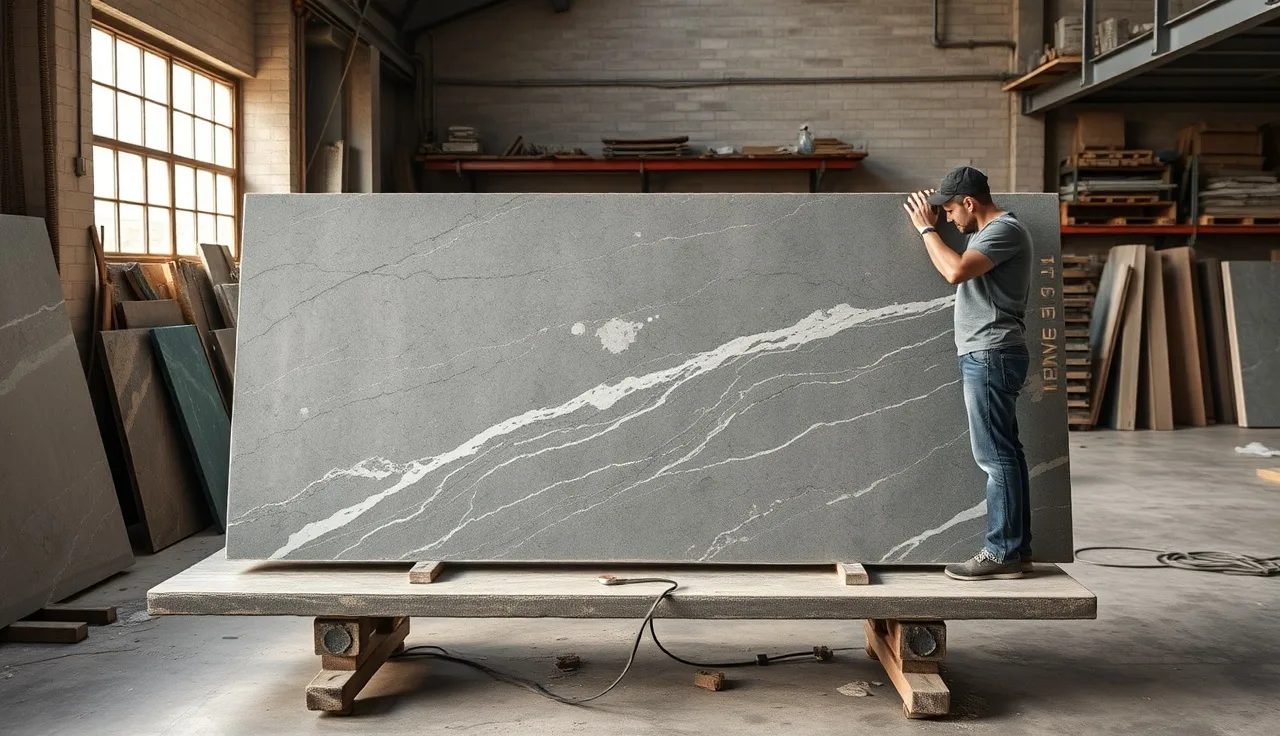
- Marble and granite countertops start as rough quarry slabs, get templated in your home, cut and polished in a fab shop, then installed with adhesive and mechanical fasteners.
- Total project time runs 1 to 3 weeks.
- Installed cost typically lands between $40 and $200 per square foot depending on stone, edge complexity, and region.
What actually happens between a quarry and your kitchen?
Most homeowners think of countertop fabrication as one step. It isn't. There are at least seven distinct handoffs between the block of stone in an Italian or Brazilian quarry and the finished surface in your kitchen, and a problem at any one of them can cost you money or push your project back by weeks.
The chain goes like this: a quarry extracts a block, a gang saw slices it into slabs roughly 3/4 inch (2 cm) or 1.25 inches (3 cm) thick, the slabs are polished on one face, sorted by bundle, loaded onto ISO shipping containers, cleared through customs, and distributed to slab yards in the U.S. From the yard, a fabricator buys the specific slabs you choose, stores them, templates your counters after your cabinets are set, programs the cuts into a CNC or waterjet machine, cuts and edges the pieces, and sends a crew to install them.
Each step has a cost attached. Shipping from quarry to U.S. port adds roughly $5 to $10 per square foot before the stone ever touches a fabricator's floor [1]. That's why an exotic marble from Carrara costs more than a domestic granite from Georgia even when the raw stone quality is similar.
The fabricator's actual work (templating, cutting, edging, polishing, installing) usually accounts for 40 to 60 percent of your final installed price [2]. The stone material is the other 40 to 60 percent. That split matters because it tells you where you have negotiating room (material choice) and where you mostly don't (skilled labor).
What are the real differences between marble and granite for countertops?
Marble and granite are both natural stones cut from the earth, but they behave very differently on a countertop and force different fabrication decisions.
Granite is an igneous rock, meaning it cooled from magma. It is hard (Mohs 6 to 7), resists scratching well, and is less porous than marble [8]. Granite countertops still need sealing, but a good penetrating sealer on granite can last 3 to 5 years before reapplication. Fabricators find granite predictable to cut. It doesn't fracture along hidden crystal planes the way some stones do.
Marble is a metamorphic rock. Heat and pressure turned limestone into calcite crystals, which is why marble countertops feel cool and look luminous. That calcite is also why marble etches when it touches acidic foods or cleaners. Lemon juice, wine, tomato sauce, anything below about pH 7 will dull a polished marble surface even if the stone is sealed. Sealing slows moisture penetration. It does not prevent etching.
| Property | Granite | Marble |
|---|---|---|
| Hardness (Mohs) | 6 to 7 | 3 to 4 |
| Porosity (typical) | Low, medium | Medium, high |
| Etch risk from acids | Very low | High |
| Scratch resistance | High | Moderate |
| Typical slab thickness | 2 cm or 3 cm | 2 cm or 3 cm |
| Typical installed cost (U.S. avg.) | $45, $175/sq ft | $50, $200/sq ft |
| Sealer reapplication interval | 3 to 5 years | 1 to 2 years |
Both stones cut and polish on similar equipment. The real difference is how fussy the installer has to be about seam placement. Marble, especially book-matched marble with prominent veining, needs careful planning so veins align across seams. That alignment work adds shop time and demands a more experienced crew. Most fabricators charge more for book-matched installs, often $15 to $30 per linear foot extra for seam matching [3].
How do fabricators price marble and granite countertops?
Fabricators price countertops using square footage as the base, then add line items for edges, cutouts, and complexity. A bare square-foot price tells you almost nothing on its own.
Here is how the math usually works. The fabricator measures your countertop footprint (length times width for each run), converts that to square feet, and multiplies by a material-plus-labor rate. Then they add charges for:
- Edge profiles: a simple eased edge is often included; a full bullnose, ogee, or waterfall edge can add $20 to $50 per linear foot.
- Sink cutouts: $100 to $250 per cutout depending on sink type. Undermount sinks need a polished reveal and take longer than drop-in.
- Cooktop cutouts: $75 to $200 depending on size.
- Seams: some shops include one seam in their base price; additional seams can add $50 to $150 each.
- Material overrun: fabricators buy slabs in fixed sizes. If your job needs 42 square feet of stone and the slabs run 55 square feet each, you usually pay for at least 45 to 50 square feet because of falloff (offcuts the shop keeps or discards).
- Delivery and installation: often a flat fee of $200 to $500, or folded into the per-square-foot price.
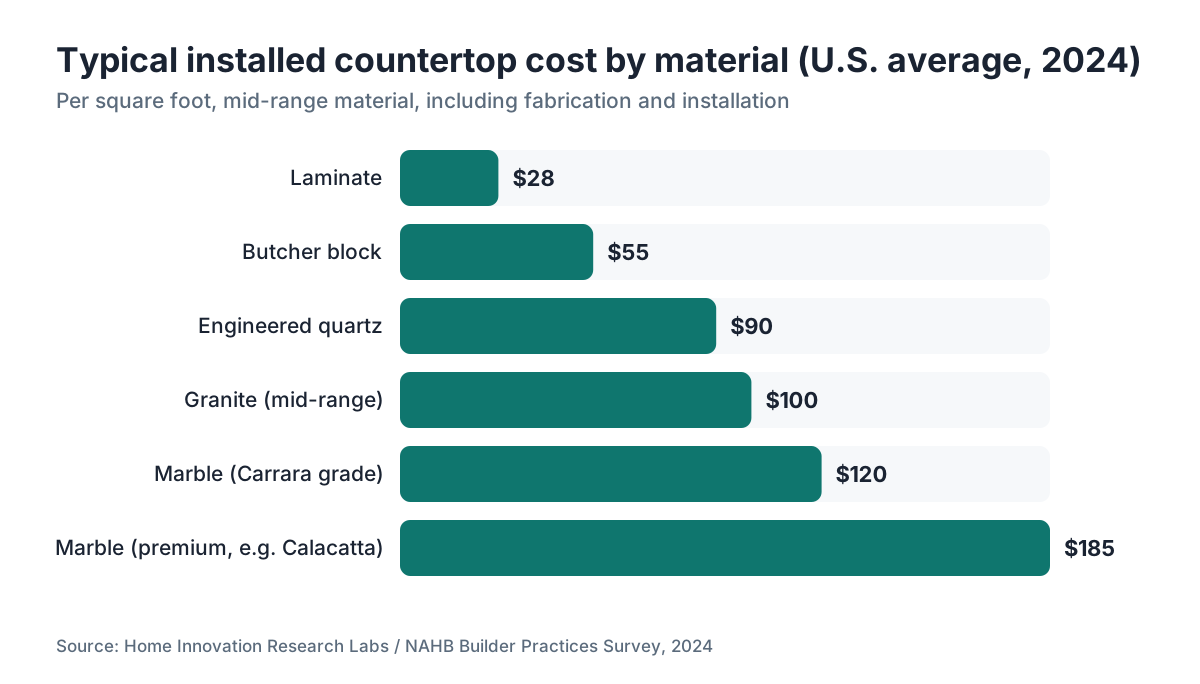
The national average installed cost for granite countertops in 2024 ran roughly $75 to $125 per square foot for mid-range material, according to data compiled by Home Innovation Research Labs [2]. Marble ran slightly higher, $85 to $150 per square foot for common Carrara grades, with premium marbles like Calacatta Gold pushing $200 or more.
Shops that do high volume use quoting software to price jobs fast and cut estimating errors. SlabWise, for example, lets fabricators build material and labor rate tables so every quote uses consistent numbers instead of back-of-envelope math. Here's something worth knowing if you're comparing quotes from multiple shops: ask each fabricator to break out material cost, fabrication labor, and installation separately. Shops that won't do this are harder to compare honestly.
One honest caveat. Regional variation is huge. The same Bianco Romano granite slab costs 30 to 40 percent more installed in San Francisco than in Atlanta, mostly because of shop overhead and installer wages [2].
What happens during the templating visit?
Templating is the step most homeowners underestimate. A bad template means stone cut to the wrong shape, and that mistake can't be undone. It's expensive.
The templating appointment happens after your cabinets are fully set and leveled, your sink is on-site (so the fabricator can verify the cutout dimensions), and any appliances that need a precise fit are confirmed. Do not schedule templating before your cabinets are done. Stone cut to an out-of-level or shifted cabinet line will not fit.
Traditional templating uses thin strips of luan plywood or a proprietary template material traced along your walls and cabinet edges. The templater marks seam locations, notes overhangs (typically 1.5 inches over base cabinets, 0 inches against walls unless you specify), and photographs the space [10].
Digital templating, using a laser device like the Prodim Proliner or Laser Products LT-2D3D, has replaced physical templates in many shops. The laser records thousands of points, builds a digital file, and sends it straight to the CNC saw with no human re-entry of measurements. That cuts error and speeds things up. Shops with digital templating can sometimes go from template to installation in 3 to 5 business days instead of 7 to 10 [4].
Expect the visit to take 30 to 90 minutes depending on how complex your kitchen is. A simple galley with one sink goes fast. An L-shape with an island, a prep sink, and a cooktop takes longer.
After templating, the fabricator creates a layout drawing showing exactly where each slab piece lands and where seams fall. Review this drawing before you approve it. Ask to see which part of the slab each piece comes from, especially if you have strong veining you want to match or avoid.
How is stone actually cut and finished in the shop?
Once the template is approved, the shop lays out the cut plan on the actual slabs. This step is called nesting, and it matters more than most people realize. Good nesting cuts stone waste, controls where seams land, and makes sure veins run the direction you want. A shop that's sloppy about nesting can waste 15 to 25 percent more material than needed, and you paid for that stone.
Cutting happens on one of three types of equipment.
A bridge saw (also called a slab saw) uses a diamond blade on a gantry arm and is the workhorse of most shops. It makes straight cuts precisely. Curved cuts and sink cutouts need extra setups or a separate router.
A CNC (computer numerical control) machine combines a saw or router with computer-driven positioning. The shop loads the digital template file, and the machine cuts, routes, and sometimes polishes the edges on its own. CNC shops cut faster and with less hand-skill variation, which helps on complex jobs.
A waterjet cutter uses a high-pressure stream of water mixed with abrasive garnet to cut stone without heat. Waterjet handles fine detail and materials that might crack under the heat stress of a diamond blade. It's slower and pricier, so most shops save it for decorative inlays or unusual shapes.
After cutting, edges get profiled with diamond-tipped router bits. An eased edge (a slightly softened 90-degree corner) is the fastest. A full bullnose or ogee takes multiple passes with progressively finer bits, then hand polishing. That is where edge charges come from. It's real labor time.
The finished pieces are polished, inspected for pits or cracks, and staged for delivery. Any natural pits or voids in the stone (common in some granites) get filled with a color-matched epoxy resin at this stage. Shops that do this dry cutting and grinding also have to meet OSHA's crystalline silica rule, which sets a permissible exposure limit of 50 micrograms per cubic meter of air over an 8-hour shift [11].
What does countertop installation actually involve?
Installation day is the part homeowners see, and it's faster than most expect once the shop work is done right. A typical kitchen countertop installs in 2 to 5 hours. The number of pieces and the seam work drive the time.
The crew arrives with the cut pieces strapped to an A-frame rack in a cargo van or box truck. Stone is heavy. A 3 cm granite slab at 55 square feet weighs roughly 480 pounds [5], so two to three people are standard. Expect them to need clear access, the cabinet doors below the counter area removed, and a clean path from the truck to the kitchen.
Installation steps in order:
- The crew dry-fits each piece to check gaps and alignment before any adhesive goes down.
- Cabinet tops are cleaned and any shims needed for leveling are placed.
- Silicone adhesive beads are applied to the cabinet tops. Some shops also use mechanical clips for extra security on large pieces.
- Pieces are set, seams are joined with color-matched epoxy (two-part, mixed in a cartridge gun on-site), and seam lines are scraped clean before the epoxy cures.
- The countertop is left to cure undisturbed, usually 24 hours before full use.
- Silicone caulk is applied where the counter meets the backsplash and around the sink perimeter.
For countertop installation across other materials, the sequence is similar but the adhesive and support requirements differ. Stone, unlike laminate, can't flex at all. If the cabinets aren't level, the stone will either crack or sit with visible gaps. A good installer shims and levels before setting any stone.
The plumber installs the sink and connects supply lines after the stone is in and cured. Do not let a plumber hook up an undermount sink before the countertop is set. The sink attaches to the underside of the stone with clips and epoxy during installation.
Where should seams be placed, and can they be avoided?
Seams are unavoidable on any countertop run longer than about 10 feet, since most granite and marble slabs top out at 9 to 10 feet in usable length. Even on shorter runs, an L-shape or a peninsula usually needs at least one seam.
Placement rules experienced fabricators follow:
Never put a seam over a dishwasher or a cabinet void. The stone needs continuous support beneath it, and an unsupported seam over a void will crack under load.
Avoid seams at the inside corner of an L-shape. That corner concentrates stress. If a seam has to go near a corner, put it at least 6 inches from the corner miter.
Seams at or near a sink are sometimes unavoidable in small kitchens. If you have one, the epoxy joint must be watertight. A seam that weeps water will stain the cabinet below and may delaminate over time.
For marble with strong directional veining, diagonal seam cuts (sometimes called miter seams or skewed seams) can make the joint less visible than a straight 90-degree cut across the vein pattern. It's more labor-intensive, but worth asking about if veining matters to you.
A quality seam in granite, filled with color-matched epoxy and polished flush, is nearly invisible from standing height. Marble seams are harder to hide because the veining rarely lines up perfectly even with book-matching. Expect a marble seam to be visible on close inspection. That's normal, not a defect.
What edge profiles are available and which are worth the extra cost?
Edge profiles are one of the biggest cost variables in a fabrication job, and they're largely a matter of taste. Here is the honest rundown.
Eased edge: a 90-degree corner with a slight softening. Almost always included in the base price. Clean and modern. Chips less than a sharp arris. This is what I'd pick for a busy kitchen.
Bevel edge: the top corner cut at 45 degrees. A bit more formal. Still fast to produce and often included or barely upcharged.
Bullnose: the top edge fully rounded into a half-circle. Soft and traditional. Adds $10 to $25 per linear foot in most shops because it takes multiple router passes and hand finishing.
Double bullnose or dupont edge: rounded on both top and bottom. Common in traditional kitchens. Cost similar to bullnose.
Ogee: an S-curve profile, formal and ornate. Takes several router passes and hand polishing. Expect $25 to $50 per linear foot upcharge. Honestly, ogee edges collect crumbs and are a pain to clean. I'd skip them on a working kitchen.
Waterfall edge: the countertop material wraps vertically down the side of an island all the way to the floor. This is almost always quoted separately because it needs a full extra slab face cut and polished. It can add $500 to $2,000 or more depending on island size.
Mitered thick edge (laminated): two pieces of stone mitered at 45 degrees and glued to create a 3-inch or 4-inch thick visual edge from a standard 3/4-inch or 1.25-inch slab. This is how you get the look of a 4-inch thick island without paying for a 4-inch slab. Labor-intensive. Expect $40 to $80 per linear foot.
How long does the full fabrication and installation process take?
This is the question homeowners ask most, usually while trying to sequence a kitchen remodel. The honest answer is 1 to 3 weeks from template to installation for most granite and marble jobs, but a few things stretch that out.
A typical timeline looks like:
- Day 0: you approve your slab selection at the yard.
- Day 1 to 3: cabinets finish installation, you call the fab shop to schedule templating.
- Day 3 to 5: templating visit (usually 1 to 2 days after cabinet completion, depending on shop schedule).
- Day 5 to 10: fabrication (cutting, edging, polishing). Simple jobs in a busy CNC shop can turn in 3 to 4 days. Complex jobs with lots of seams, heavy edge work, or premium materials take 5 to 8 days.
- Day 10 to 15: installation.
What delays jobs: the slab you chose is out of stock and needs to be reordered (2 to 6 weeks if it has to come from overseas); the shop has a backlog (very common in spring and early summer remodeling season); your cabinets aren't level and the installer sends the crew home to come back after a shim correction; or you change your mind about an edge profile after the template is approved.
If your project has a hard deadline (a holiday gathering, a home sale), tell the fab shop at first contact. Good shops can schedule around deadlines when they know early. Springing a deadline two days before installation is when things go wrong.
What maintenance do marble and granite countertops need after installation?
Installation isn't the end of the job. Both stones need sealing and ongoing care to keep looking good.
Sealing: a penetrating impregnator sealer fills the microscopic pores in the stone to slow liquid absorption. The Marble Institute of America recommends a water absorption test before sealing. Put a tablespoon of water on the stone. If it absorbs in under 5 minutes, seal immediately. If it beads for more than 30 minutes, the stone is dense enough that sealing can wait [6]. Most granite needs sealing once every 3 to 5 years. Marble, softer and more porous, needs it every 1 to 2 years.
For daily cleaning, warm water and a stone-safe pH-neutral cleaner are the right choice. Avoid anything acidic (vinegar, lemon-based cleaners) on marble. Skip abrasive scrubbers on polished surfaces of either stone. How to clean stone countertops covers the full cleaning protocol in detail.
Etching on marble: if a lemon slice sits on polished Calacatta for 10 minutes, it leaves a dull ring. That ring isn't a stain. It's a chemical change in the surface polish. Light etching can be polished out by a stone restoration professional. Deep etching means a professional re-honing and re-polishing of the surface, which costs $200 to $600 depending on area [7].
Chips: both stones can chip at corners and edges, especially thin (2 cm) slabs. Color-matched epoxy repairs are possible but rarely invisible. Buying 3 cm slabs costs more upfront but produces meaningfully more chip-resistant edges.
Seam care: the epoxy at seams isn't permanent against standing water. If water pools at a seam consistently, it will work into the joint over years. Keep seams dry and re-caulk the sink perimeter every year.
How do marble and granite compare to other countertop materials?
Plenty of homeowners show up at the fabricator having already picked marble or granite, but the choice is worth testing against the alternatives.
Engineered quartz (brands like Cambria, Silestone, Caesarstone) is ground quartz bound in resin. It doesn't etch, doesn't need sealing, and holds consistent color. Cambria countertops in particular resist scratching well. The tradeoff: quartz can scorch near heat, and the resin can fade under prolonged direct UV. Cost is similar to mid-range granite.
Soapstone and quartzite are natural stone alternatives that sometimes get confused with marble and granite. Quartzite (not to be confused with quartz) is actually harder than granite on the Mohs scale and resists acids better than marble, which makes it a favorite for people who want the marble look with less etching risk. How to clean quartzite countertops explains the differences in daily care.
Laminate and Formica are the budget end. Laminate countertops and Formica countertops cost $15 to $40 per square foot installed, need no sealing, and have improved a lot in appearance, but they can't be re-polished if scratched, they aren't heat-proof, and they don't add the same resale value as stone.
Butcher block is warm, renewable, and repairable. Butcher block countertops average $30 to $80 per square foot installed. They need regular oiling and will show knife marks over time, but those marks can be sanded out.
Corian and other solid surface materials sit between laminate and stone in price. Corian countertops can be repaired by sanding, seams are nearly invisible, and they work well for unusual shapes, but they scratch and scorch more easily than stone.
Want the most durable natural stone for a high-traffic kitchen? Granite with a honed finish is hard to beat. Want the most visually dramatic natural stone and willing to maintain it? Marble is the choice. Want marble looks without the acid vulnerability? Quartzite or a high-quality engineered quartz gets you close.
What should homeowners ask before hiring a fabricator?
Picking a fabricator is about more than price. A shop with cheap square-foot pricing can end up costing more through waste, poor seam work, or installation damage to your cabinets.
Questions worth asking every shop you consider:
Do you have your own installation crew or do you subcontract? Subcontracted installation isn't automatically bad, but you want to know who is accountable when something goes wrong.
Can I see my slab before it's cut? Yes should be the answer. Any reputable yard lets you walk the slabs and mark the one you want.
What thickness do you recommend for my job? For most residential kitchens, 3 cm (about 1.25 inches) beats 2 cm. It's stronger, chips less, and doesn't need a plywood underlayment to support it. Some shops push 2 cm because their material cost is lower.
How do you handle a slab that cracks during fabrication? Cracks during cutting are rare but they happen. A good shop replaces the slab from inventory and eats the cost. A bad shop argues that natural stone defects aren't their fault.
What is your lead time right now? Get this in writing. A verbal promise of 10 days that turns into 3 weeks is a common complaint.
Do you provide a written quote and a written contract? The quote should itemize material, fabrication, cutouts, edge profiles, and installation. The contract should name the slab (by bundle number if possible), dimensions, and a delivery window. If a shop only offers a verbal estimate, walk away.
Shops that use structured quoting software, like SlabWise for their internal estimates, tend to produce itemized quotes automatically instead of leaning on individual estimators to remember every line item. That helps you as a customer because the quote is defensible.
Get at least three quotes. The lowest isn't always wrong, but if it's 30 percent below the other two, ask why.
Frequently asked questions
How much do marble and granite countertops cost per square foot installed?
Granite averages $45 to $175 per square foot installed depending on material grade and region, with mid-range slabs landing around $75 to $125. Marble runs $50 to $200 or more for premium grades like Calacatta. Edge profiles, cutouts, and seam complexity add to the base price. Get an itemized quote that breaks out material, fabrication labor, and installation separately.
How long does granite and marble countertop fabrication take?
Most residential jobs go from templating to installation in 7 to 14 days. Digital templating shops with a CNC saw can sometimes compress that to 5 to 7 days. Delays usually come from slab availability, shop backlog (spring and summer are busiest), or cabinet leveling issues that must be fixed before stone can be set.
Can countertop seams be made invisible?
Granite seams filled with color-matched epoxy and polished flush are nearly invisible from standing height in most lighting. Marble seams are harder to hide because veining rarely aligns perfectly across a joint even with book-matching. Diagonal-cut seams can reduce visibility. Expect a marble seam to be detectable on close inspection; that is normal for the material, not a workmanship defect.
What slab thickness should I choose: 2 cm or 3 cm?
For most kitchen countertops, 3 cm (about 1.25 inches) is the better choice. It is self-supporting without a plywood underlayment, chips less at edges, and handles stress from sinks and appliances better. Two-cm slabs cost a bit less but require a plywood substrate and produce thinner, more vulnerable edges. The extra cost of 3 cm is usually worth it for a kitchen that sees daily use.
Does marble etch and can etching be repaired?
Yes, marble etches from contact with acids including lemon juice, wine, vinegar, and many household cleaners. Etching dulls the polished surface and is a chemical change, not a stain, so sealing does not prevent it. Light etch marks can be polished out by a stone restoration professional. Severe etching requires re-honing and re-polishing, which typically costs $200 to $600 depending on the affected area.
How do I choose between marble and granite for a kitchen?
Granite is harder, resists acids and scratches better, and needs sealing only every 3 to 5 years. It is the more practical choice for high-traffic kitchens where spills are common. Marble offers a distinctive look and cool surface but etches from acidic foods and needs sealing every 1 to 2 years. If you cook heavily and prioritize durability, granite or quartzite makes more sense. If aesthetics are the priority and you are willing to maintain the surface, marble is worth it.
Do I need to be home for countertop templating and installation?
Yes for both. At templating, the tech needs to access all cabinet runs, confirm sink placement, and ask about seam locations and overhangs. You should make decisions on the spot. At installation, someone needs to be home to confirm the placement before epoxy is applied, and to inspect the finished job before the crew leaves. Approving work remotely based on photos is not a substitute.
What is book-matched stone and when should I ask for it?
Book-matching means two adjacent slabs from the same bundle are opened like a book so their veining mirrors each other across a seam. It produces a dramatic symmetrical pattern on large surfaces like islands or feature walls. Book-matching costs more because seam alignment requires careful cutting and extra shop time, often $15 to $30 extra per linear foot. It is worth asking about on prominent marble islands where veining is the design feature.
What causes countertops to crack after installation?
Most post-installation cracks come from inadequate cabinet support, especially unsupported spans over dishwashers or large cabinet voids. A seam placed directly over a void is a common failure point. Thermal shock from hot pots placed directly on cold stone can also cause cracking, particularly in 2 cm material. Using trivets for hot pots and ensuring continuous cabinet support under seams prevents most cracks.
How often should I seal my granite or marble countertop?
Granite typically needs a penetrating impregnator sealer every 3 to 5 years, though dense granites may go longer. Marble needs sealing every 1 to 2 years because it is more porous. Test by placing a tablespoon of water on the surface: if it absorbs in under 5 minutes, it is time to seal. Use a stone-specific impregnator, not a topical coating, and follow the manufacturer's dwell time instructions.
Can existing countertops be replaced with marble or granite without changing the cabinets?
Usually yes, with two caveats. First, confirm the cabinets are level, since stone cannot flex to accommodate cabinet irregularities. Second, stone is heavy: 3 cm granite weighs roughly 18 to 20 pounds per square foot, so cabinets built for laminate countertops should be checked for structural adequacy. Most standard base cabinets handle the weight fine, but old or custom cabinets may need reinforcement.
What is the difference between honed and polished stone finishes?
Polished finish has a high-gloss reflective surface produced by progressive buffing with finer diamond abrasives. It shows depth and color well and is the most common choice. Honed finish stops short of the final gloss stage and produces a matte or satin surface. Honed surfaces show fingerprints and water spots less but may absorb stains more readily and require more frequent sealing. Both are available on granite and marble from most fabricators.
Is it cheaper to buy slabs directly from a stone yard?
You can sometimes save 10 to 20 percent on material cost by purchasing slabs directly from a wholesale yard rather than through the fabricator's markup. However, some fabricators will not work with customer-supplied stone, and if they do, they typically charge more for fabrication labor since they carry no material warranty. The savings rarely exceed the hassle unless you are buying a large quantity of high-priced exotic stone.
What permits or inspections are required for countertop installation?
In most U.S. jurisdictions, replacing countertops does not require a building permit because it is cosmetic work that does not affect structure, electrical, or plumbing. However, if you are moving or adding a sink, you may need a plumbing permit. Requirements vary by city and county. Check with your local building department before starting if you are doing any work beyond a straight countertop swap. The fabricator is not responsible for permits on plumbing work.
Sources
- U.S. International Trade Commission, Stone Products Import Data: Shipping and import costs for natural stone slabs add roughly $5 to $10 per square foot to landed cost before reaching a U.S. fabricator
- Home Innovation Research Labs, U.S. Builder Practices Survey (NAHB): National average installed granite countertop cost 2024 and regional price variation of 30 to 40 percent between high- and low-cost metros
- Marble Institute of America, Natural Stone Installation Standards: Book-matched seam alignment adds fabrication and labor cost, with seam-matching work typically adding $15 to $30 per linear foot
- Natural Stone Institute, Dimension Stone Design Manual: Digital laser templating reduces measurement error and can shorten the template-to-install window to 3 to 5 business days
- Natural Stone Institute, Stone Weight Reference Guide: A 3 cm granite slab at 55 square feet weighs approximately 480 pounds
- Marble Institute of America, Care and Maintenance of Natural Stone: Water absorption test: if water absorbs in under 5 minutes, seal immediately; if it beads for over 30 minutes, the stone is dense enough to wait
- Natural Stone Institute, Stone Restoration and Maintenance Guidelines: Professional re-honing and re-polishing of etched marble surfaces typically costs $200 to $600 depending on area
- USGS National Minerals Information Center, Dimension Stone: Granite is classified as an igneous rock with Mohs hardness of 6 to 7; marble is metamorphic with Mohs hardness of 3 to 4
- U.S. Customs and Border Protection, HTS Chapter 68 Natural Stone Tariff Schedules: Natural stone slabs for countertops are classified under HTS 6802 and subject to specific import duty rates and country of origin rules
- National Kitchen and Bath Association, Design and Installation Standards: Standard countertop overhang over base cabinets is 1.5 inches; island overhangs for seating typically require mechanical support at 12 inches or more
- Occupational Safety and Health Administration, Silica Standard for Construction (29 CFR 1926.1153): Stone fabrication shops must comply with OSHA's crystalline silica standard, which sets a PEL of 50 micrograms per cubic meter of air as an 8-hour TWA for construction
Last updated 2026-07-10