TL;DR
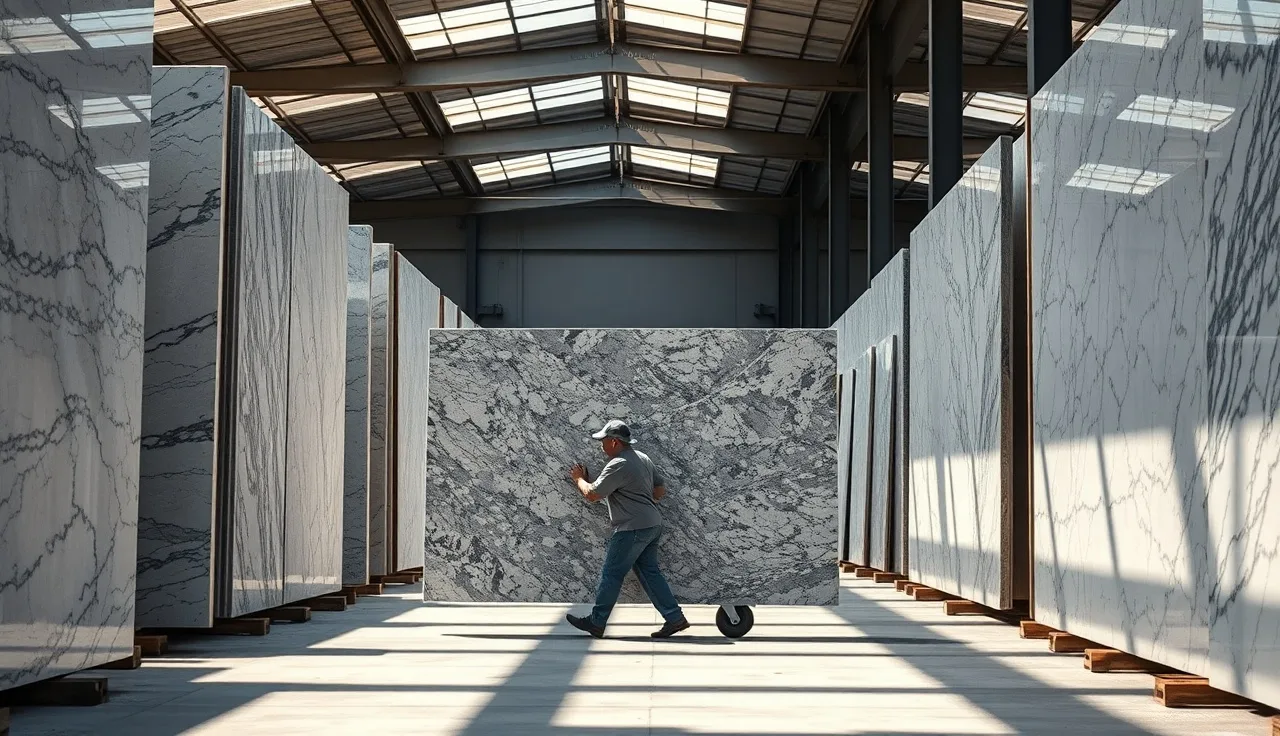
- A granite countertop slab is quarried stone cut to roughly 9 to 10 ft by 5 to 6 ft and polished flat.
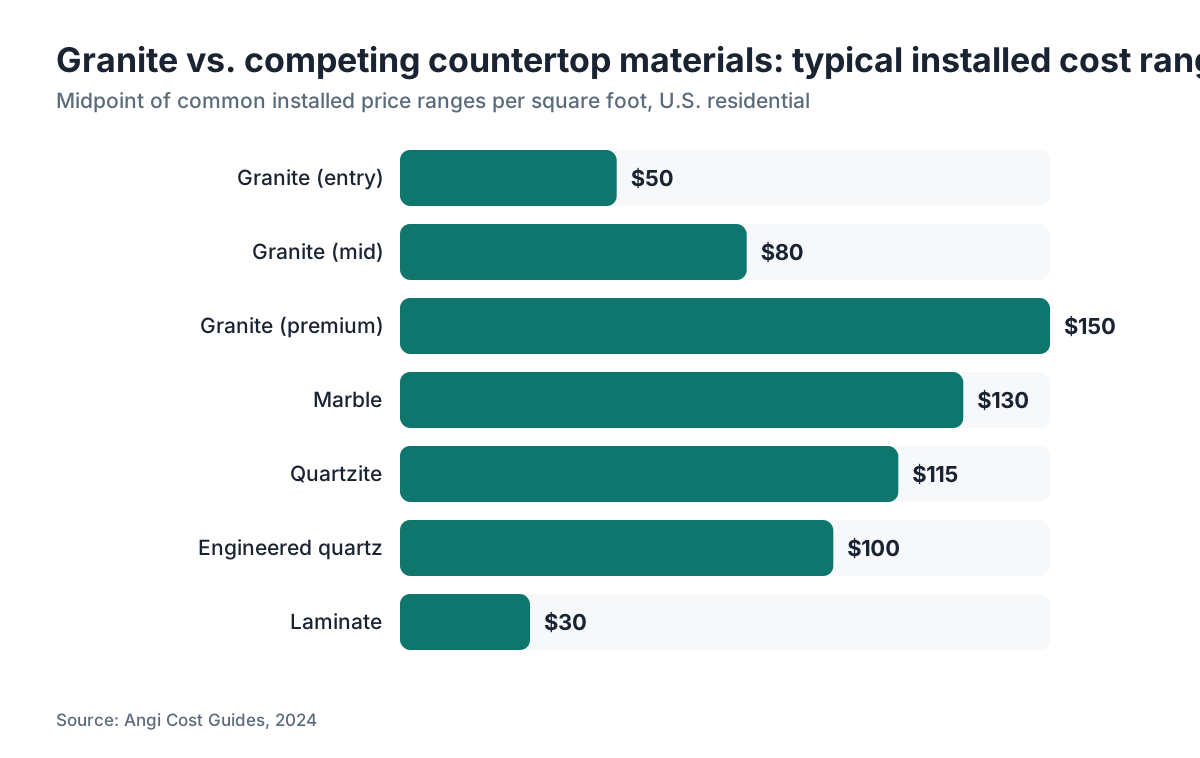
- Installed cost runs $40 to $200 per square foot, with most kitchens landing at $60 to $100.
- Rarity, thickness, and finish drive the price.
- Knowing how slabs are graded and sized before you walk into a stone yard saves you hundreds.
What is a granite countertop slab and how is it different from tile or modular pieces?
A granite slab is one continuous sheet of stone cut from a quarried block, then polished flat. You pick one piece (or two matched pieces for a big kitchen), and a fabricator cuts your counter shapes out of it. That continuity is the whole point. No grout lines, no seams except where geometry forces them, and a pattern that runs across your counter without interruption.
Tile and modular granite come from the same rock, cut into small squares or pre-sized panels. They cost less upfront. They also give you grout lines that stain, tile edges that chip, and a look most buyers eventually regret on a kitchen counter. On floors, tile granite is fine. On countertops, slabs earn the extra money if you can swing it.
Slab granite is the default in the fabrication trade. When a fabricator quotes you granite countertops, they mean slabs unless they say otherwise.
How big are granite slabs and does slab size matter for your project?
Standard granite slabs run about 9 to 10 feet long and 5 to 6 feet wide, though it varies by quarry and the specific block [9]. Jumbo slabs push past 10 ft by 6 ft. Usable yield depends on how your fabricator nests the cut pieces and how much clean material sits inside the slab's natural edges.
Slab size matters for three reasons. A small kitchen (under 40 square feet of countertop) will almost always fit on one slab, which buys you a continuous pattern. A larger kitchen often needs two slabs, and matching them so the veining looks intentional takes skill and money. Jumbo slabs waste less because there's more room to maneuver cut shapes, so your price per finished square foot can drop a little. And an island longer than about 8 feet may force a seam no matter the slab size, which you want to know before you design a 10-foot island expecting it to look like one piece.
Thickness comes in two options: 3/4 inch (2 cm) and 1.25 inch (3 cm). Most residential projects now use 3 cm because it skips the plywood buildup underneath, feels more solid, and costs roughly the same once you subtract the backer material [9]. The 2 cm slabs are lighter and still show up in bath vanity work.
For a fuller look at everything that goes into a finished counter, see kitchen countertops.
What do granite slab grades mean, and how do fabricators assign them?
There is no industry-wide grading standard for granite. Labels like Level 1, Level 2, Level 3 (sometimes Entry, Mid, Premium, or Commercial, Builder, Designer) are invented by each supplier or fabricator on their own. Two yards can file the same stone under different grades. The pricing logic behind the grades stays consistent even when the labels don't.
What pushes a stone into a higher grade and a higher price:
- Color rarity. Common gray and black granites come out of Brazil and India in huge quantities, so supply is high and prices stay low [8]. Exotic blues, greens, and multi-color stones with complex movement come from smaller quarries in more remote spots.
- Pattern movement. Stones with dramatic veining or unusual color flow cost more because they read like marble instead of speckled rock.
- Soft mineral content. Some granites carry mica or feldspar concentrations that look gorgeous but pit more, and fabricators build in extra finishing time.
- Quarry origin and shipping distance. Brazilian Blue quartzite, Norwegian larvikite, and Georgia white granite all land at different costs.
A Level 1 entry granite at a big box store runs roughly $40 to $60 per square foot installed [1]. A Level 3 exotic from a specialty importer runs $80 to $150 or more [1]. True rarity pieces, like some peacock-green granites from Madagascar, can push past $200 installed, though those are unusual.
Here's the move: ask your supplier what specifically makes a stone a Level 3 at their yard. If the answer stops at "it costs more," get a second opinion.
What does granite cost per square foot, and what drives the price up or down?
Installed granite countertops in the U.S. run $40 to $200 per square foot, with most residential kitchens landing at $60 to $100 [1]. That number covers the slab, fabrication (cutting, edging, polishing cutouts), and installation. It does not cover demo of old countertops, plumbing disconnect and reconnect, or backsplash work.
Here's how each cost piece tends to break down on a mid-grade granite job:
| Cost component | Typical share of total |
|---|---|
| Raw slab material | 30 to 40% |
| Fabrication labor (cutting, polishing) | 35 to 45% |
| Installation and delivery | 15 to 20% |
| Edge profiles, sink cutouts, extras | 5 to 15% |
Edge profiles are where fabricators quietly pad margin. A standard eased or beveled edge is usually included. An ogee, waterfall, or triple-pencil edge adds $10 to $20 per linear foot [2]. A kitchen with 30 linear feet of edge picks up $300 to $600 just from the profile upgrade. Pick the edge that matters to you, not the priciest one on the sample board.
Overage material (the slab remnant after cutting) stays with the fabricator in most contracts unless you negotiate. Remnants have value. A big remnant off an expensive exotic can be resold for bathroom vanities or bar tops. If you're buying a pricey slab, ask up front who owns the remnant.
Some homeowners find that working through an installer who runs fabricator quoting software that optimizes slab nesting reduces material waste, which can translate to a lower quote on exotic stone where every square inch costs money.
See also: countertop installation for the full install process and what you should inspect before signing off.
What are the most popular granite colors and patterns, and do they affect durability?
Color does not directly affect durability. Durability comes from the mineral composition and how tightly those minerals bond, and that varies more by quarry location than by surface color.
A few popular choices worth knowing:
Black granites (Absolute Black, Black Galaxy, Black Pearl) are almost always the most uniform in pattern and the easiest to fabricate cleanly. They hide seams well. Black Galaxy sparkles from feldspar crystals. Absolute Black from India is technically not granite in the geological sense, it's a fine-grained diabase, but fabricators and retailers call it granite and it performs the same way [3].
White and gray granites (Colonial White, Bianco Romano, Alaska White, Viscount White) are everywhere because Brazilian quarries produce them by volume [8]. They're affordable. Colonial White carries a heavy burgundy-and-gray pattern that some people love and others find busy.
Blue granites (Blue Pearl from Norway, Blue Bahia from Brazil) shimmer from feldspar. Blue Bahia is expensive because the quarry yield is limited. Blue Pearl is easier to find.
Warm tones (Santa Cecilia, Venetian Gold, Giallo Ornamental) come from Brazil and rank among the most sold granites in North America over the past 20 years, mostly because they pair with the cream and maple cabinetry that ruled the 2000s and 2010s.
Exotic stones like leathered quartzite, Calacatta-look granites, and green Brazilian granites get mislabeled as granite in yard inventory all the time. Ask your supplier for the actual geological name if you want to know what you're buying. The difference between granite and quartzite changes how you seal and maintain it. For stone that might actually be quartzite, see how to clean quartzite countertops.
How do fabricators cut and finish granite slabs?
The shop workflow starts with a digital template of your countertop space (laser-measured or built physically), then that template gets transferred to the slab for layout. The fabricator traces the cut shapes onto the stone, matching veining across pieces and minimizing waste. A CNC bridge saw or waterjet cuts the slab.
After cutting, edges get profiled on a CNC edge polisher, or by hand for complex profiles. Sink cutouts are routed with a CNC or hand-cut with an angle grinder in smaller shops. The finished pieces get polished, cleaned, and loaded for delivery.
Surface finishes change both the look and the maintenance:
- Polished: High gloss, mirror-like. Shows fingerprints and water spots more, but seals easily because the surface is densest.
- Honed: Matte or satin. Very popular right now. More porous at the surface than polished, needs sealing more often.
- Leathered (or brushed): Textured with peaks and valleys. Hides fingerprints and smudges. Harder to clean into the texture, but many homeowners find daily upkeep easier because stray crumbs and smudges barely show.
- Flamed: Rough, crystalline surface. Used almost only outdoors.
Most residential kitchens go polished or honed. Leathered has grown a lot since around 2018 and now turns up in showrooms carrying mid-to-high-end stock.
Shops running larger volumes lean on nesting software to squeeze more finished pieces out of a single slab. SlabWise is one platform built for this, handling quote generation and slab nesting in one tool. On expensive stone, tighter nesting hits margin directly.
How many seams will your granite countertop have, and where should they go?
Seams show up when your counter run runs longer than the slab (typically over 9 to 10 feet), when an L-shape or U-shape creates a corner, or when an island is wider than the slab. They're unavoidable in most real kitchens.
A good fabricator puts seams where they hide: not in the middle of a busy run, not right in front of the sink, and ideally at a transition your eye skips past. Corners where one run meets another are common seam spots and usually look fine.
Seam quality rides almost entirely on the fabricator's skill and how well adjacent pieces get matched. Good seams on a busy pattern nearly disappear. Bad seams on even a uniform stone read like cracks.
When you visit the stone yard, ask to see the two slab faces that will meet at your seam. Fabricators doing quality work lay out the bookmatch or straight-match for your approval before cutting. If yours doesn't offer it, ask for it by name.
Seam filler (epoxy tinted to match the stone) matters too. A good color match takes minutes. A bad one is permanent. Inspect the epoxy match in daylight, more than under showroom lighting.
Does granite need to be sealed, and how often?
Yes, almost all granite needs sealing, though the frequency depends on the stone. The test is simple: drop a little water on the surface and wait 15 minutes. If the stone darkens where the water sat, it absorbed moisture and needs sealer. If the water beads, the seal is holding [4].
The U.S. Geological Survey describes granite as composed mainly of quartz, feldspar, and mica, minerals with varying porosity [3]. Stones heavier in feldspar and mica tend to be more porous than tight, quartz-dominant granites.
Most residential granite needs resealing every 1 to 3 years depending on use and sealer quality. Penetrating sealers (also called impregnating sealers) are the standard residential pick. They soak into the pore structure instead of sitting on top. Topical sealers form a film on the surface and wear off faster.
Application is straightforward. Clean the surface, let it dry completely (24 hours from last use), apply sealer, let it absorb for the time on the product label, and wipe the excess before it hazes. Don't let sealer dry on the surface. Most DIY sealing takes under an hour.
For general stone cleaning guidance, see how to clean stone countertops.
How does granite compare to marble, quartzite, and engineered quartz?
People mix these up constantly, partly because suppliers use the terms loosely. Here's what actually separates them:
| Material | Composition | Hardness (Mohs) | Acid resistance | Typical installed cost |
|---|---|---|---|---|
| Granite | Feldspar, quartz, mica | 6 to 7 | Good | $40, $200/sq ft |
| Marble | Calcite/dolomite | 3 to 4 | Poor (etches) | $60, $250/sq ft |
| Quartzite | Sandstone metamorphosed to quartz | 7+ | Good (varies) | $70, $200/sq ft |
| Engineered quartz | Quartz aggregate + resin | ~7 | Very good | $55, $150/sq ft |
Granite is harder than marble and shrugs off acid etching from lemon juice, wine, and vinegar much better. That makes it more practical for a kitchen where spills happen. Marble etches on any acid contact. If you want the white marble look without the upkeep, some granites (Fantasy Brown, River White) read similarly in photos.
Quartzite is harder than granite but gets misidentified often. True quartzite (not a soft limestone sold as quartzite) is excellent for kitchens. Engineered quartz (Silestone, Cambria, Caesarstone) has no pores, so it never needs sealing, but the resin binders can yellow in direct sun and the pattern is machine-repeated, not one-of-a-kind like a natural slab. For one branded engineered quartz option, see cambria countertops.
For the marble comparison in full, see marble countertops.
What should you look for when buying a granite slab at a stone yard?
Go in person. Photos of stone lie. Lighting, photo editing, and the gap between a wet slab and a dry one mean what you see on a screen is genuinely not what lands in your kitchen.
At the yard, do this:
Ask them to wet the slab. Water reveals the true color and pattern of polished granite, close to what the finished counter looks like. A dry slab can look dull and flat. Wet, you see the real depth.
Check for existing fissures. Granite fissures are natural separations in the mineral structure. They aren't cracks and they won't make the stone fail, but they can show in the finished counter. Fissures running against your longest cuts are fine. Fissures running parallel to a 9-foot run could theoretically spread under stress, though with properly supported countertops that's rare.
Look at both faces of the slab. The back shows the raw stone and any natural voids or pitting the polished face hides. Big voids on the back can mean the stone is thinner in spots.
Confirm the slab dimensions before your fabricator quotes from them. Slab sizes swing 6 to 12 inches off the nominal spec, and that swing can flip a one-slab job into a two-slab job.
Ask about bundled slabs. Quarries cut blocks into multiple slabs that share the same color variation and ship as a set. On a large project, buying multiple slabs from the same bundle is how you get matching.
Before you commit, if budget is a hard constraint, compare against non-stone options: see laminate countertops and formica countertops.
What radon risk, if any, comes from granite countertops?
This comes up often enough that it needs a straight answer. Some granites hold naturally occurring uranium, which decays into radon gas. The question is whether the concentrations are high enough to matter inside a home. They aren't, in almost every case.
The U.S. Environmental Protection Agency addressed this directly. Per the EPA, "the types of granite sold as countertops are not a significant source of indoor radon" [5]. The agency tested and found most granite countertops release radon far below the EPA action threshold of 4 picocuries per liter (pCi/L) [5].
The Health Physics Society, the professional body for radiation safety specialists, reached the same conclusion [6]. Radon seeping up from soil beneath a home's foundation is the dominant indoor source in essentially every U.S. home.
If your home already tests high for radon from soil and you're adding an exotic granite, testing the specific slab is cheap and easy with a short-term radon kit (under $30 at hardware stores). The EPA recommends testing any home where the level is unknown, regardless of countertop material [10].
So the practical answer: this is not a reason to skip granite. It's a reason to test your home's overall radon level, which you should do anyway.
How do you get an accurate quote for granite slab countertops?
Fabricator quotes vary more than they should, mostly because measuring and material assumptions differ. To get quotes you can actually compare:
Measure your own countertop footprint in square feet before you call anyone. Length times depth in feet, summed across all runs. Count the island separately. Most shops have a minimum square footage charge (often 15 to 20 sq ft regardless of your real measurement), so tiny vanities feel expensive per square foot.
Ask for an itemized quote that separates material from fabrication and installation. A quote that just reads "$4,200 total" tells you nothing about where to negotiate.
Specify the edge profile you want in the quote request. Switching from eased to ogee after signing typically costs $200 to $600 more on a standard kitchen.
Ask what the quote assumes about seams. Some shops assume one seam for an L-kitchen, others assume two. The seam count changes labor time.
Get at least three quotes. On a mid-size kitchen ($60 to $100 per square foot installed), the spread between the lowest and highest bidder for identical stone runs $800 to $2,000 easily. The cheapest isn't always wrong and the priciest isn't always best. Look at the fabricator's past work.
Ask about remnant ownership, and whether the slab price drops if the fabricator can resell the remnant on another job. Some shops discount material a little if you let them keep it.
For broader context on how countertop materials compare on price and upkeep, see granite countertops.
Frequently asked questions
How much does a full granite slab cost before fabrication?
A single raw granite slab (roughly 50 to 60 square feet of surface) costs $200 to $1,500 or more depending on color and origin, before any cutting or finishing. Entry-level Brazilian and Indian granites start around $200 to $400 per slab. Exotics from small quarries in Brazil, Norway, or Madagascar can run $800 to $2,000 or more for the raw slab alone. Homeowners rarely buy raw slabs; you typically pay the fabricator's all-in price.
Can I use a granite countertop remnant for my bathroom vanity?
Yes, and it's often the smartest way to get expensive stone in a small space. Fabricators keep remnant piles from cut jobs and sell them well below slab price, sometimes $10 to $30 per square foot of material. A standard bathroom vanity under 15 square feet fits comfortably on most remnants. Call local fabricators and ask to see their remnant yard. Quality varies, so inspect the piece in person before buying.
Is granite actually scratch-resistant and heat-resistant?
Granite rates 6 to 7 on the Mohs hardness scale, which means most kitchen knives (Mohs 5.5 to 6.5) won't scratch it under normal use. You can set a hot pan on granite without cracking it in most cases, but rapid temperature swings can theoretically cause thermal shock in stones with significant fissures. Neither is a good daily habit. Use a cutting board and a trivet. The granite survives both, but your knives dull and your pans may leave marks.
What is leathered granite and is it harder to maintain?
Leathered (also called brushed) granite has a textured surface made by running diamond-tipped brushes across honed stone. It looks matte with a slight sheen and hides fingerprints and water spots better than polished. Cleaning into the texture takes a bit more attention; a soft brush or textured cloth works better than a flat wipe. Sealing is the same as polished stone. Most people who switch to leathered like the maintenance tradeoff.
How long does granite countertop installation take?
The physical install of pre-fabricated granite usually takes two to four hours for a standard kitchen. The full timeline from signed quote to installed counter runs two to four weeks: about a week for templating scheduling, a week or more in the fabrication queue, then delivery and install. Rush jobs exist but cost more. If you're on a renovation timeline, book your fabricator before your cabinets go in so you're in the queue early.
Do all granite slabs from the same color have the same pattern?
No. Granite is a natural material and every slab varies. Two slabs labeled "Santa Cecilia" from the same supplier can have noticeably different pattern density and color warmth depending on where in the quarry block they were cut. If you care about matching multiple slabs (large kitchen, island, adjacent surfaces), ask to see the specific slabs that will be cut for your job and confirm they're from the same bundle.
Can granite countertops crack, and what causes it?
Granite can crack under specific conditions: a sharp impact on an unsupported overhang, lifting or flexing a slab during installation, or an existing fissure that spreads under weight or thermal stress. In practice, cracking after proper installation is rare. Overhangs longer than about 10 to 12 inches without corbel or bracket support are a known risk point. Inspect any overhang design with your fabricator before cutting.
What is the difference between granite and quartzite slabs?
Granite is an igneous rock formed from cooled magma; it holds feldspar, quartz, and mica in a granular crystalline structure. Quartzite is a metamorphic rock formed when sandstone hits heat and pressure, converting it to nearly pure quartz. Quartzite is generally harder (Mohs 7+) with a more flowing, veined pattern similar to marble. Both are good kitchen surfaces. The naming confusion is rampant; sellers sometimes label quartzite as granite and vice versa.
How do I know if a granite slab has been repaired or filled?
Look at the back of the slab under good light. Epoxy fills used to repair natural voids or pits show up as slight color or sheen differences, especially on the rough back face. Ask your supplier directly if the slab has been filled. Filling isn't a defect in itself, it's normal practice for natural stone, but large fills near the edge of a sink cutout could be a concern, and your fabricator should know about them before cutting.
Is granite a good choice for outdoor kitchens?
Granite works well outdoors. It handles UV exposure without fading or resin breakdown the way engineered quartz does (quartz binders can yellow and weaken in direct sun). It also handles grill heat and the freeze-thaw cycle better than marble. You'll need to seal it more often outdoors, probably annually, since rain and temperature swings speed up sealer degradation. Use a flamed or brushed finish outdoors for better grip when wet.
What edge profile should I pick for granite countertops?
For most kitchens, an eased edge (slight 45-degree softening) or a simple bevel is the practical pick. It's included in most quotes, looks clean with almost any cabinet style, and wipes down easily. Ogee and cove-and-ogee profiles look elegant but collect crumbs in the grooves. Waterfall edges on thick slabs look striking but add $15 to $25 per linear foot. Pick an edge that suits your cabinets, not the one that looks most impressive in a showroom.
Does granite add resale value to a home?
Real estate data on this is inconsistent and hard to isolate, since kitchen quality correlates with many other renovation variables. The National Association of Realtors has reported that kitchen upgrades generally recoup 50 to 80% of their cost at resale, but granite specifically isn't broken out in most studies [7]. Practically, granite reads as a premium material to buyers in most U.S. markets, and a kitchen with quality stone photographs and shows better than one with laminate or tile.
What questions should I ask a granite fabricator before signing a contract?
Ask: Who owns the remnant after cutting? What specific slabs will be used, and can I see them? Where will seams go, and will I approve the layout? What's the warranty on fabrication (not the stone, which has no warranty)? Is edge profiling included? What's the timeline from template to install? How do you handle a slab that cracks during fabrication? A fabricator who answers all of these confidently is almost always more reliable than one who gets evasive.
Sources
- HomeAdvisor (Angi), Granite Countertops Cost Guide: Installed granite countertops run $40, $200 per square foot in the U.S.; Level 1 entry granite starts around $40, $60 installed
- HomeAdvisor (Angi), Countertop Edge Profiles Cost: Upgraded edge profiles (ogee, waterfall) add $10, $20 per linear foot over standard eased or beveled edges
- U.S. Geological Survey, What is granite? (FAQ): Granite is composed primarily of quartz, feldspar, and mica; Absolute Black is a diabase, not a true granite geologically
- Natural Stone Institute, Care and Maintenance of Natural Stone: Water-absorption test: if stone darkens within 15 minutes of water contact, it requires sealing
- U.S. Environmental Protection Agency, Granite Countertops and Radiation: The EPA states granite countertops are not a significant source of indoor radon; the EPA action threshold is 4 pCi/L
- Health Physics Society, Granite Countertops Position Statement: The Health Physics Society concluded that granite countertops do not pose a significant radiation risk to homeowners
- National Association of Realtors, Remodeling Impact Report: Kitchen upgrades generally recoup 50 to 80% of their cost at resale according to NAR remodeling impact research
- U.S. Geological Survey, National Minerals Information Center (Dimension Stone): Brazil and India are the dominant exporters of dimension granite to the U.S., explaining the high availability and lower cost of common colors
- Natural Stone Institute, Dimensional Stone Design Manual: Standard slab dimensions for granite are approximately 9 to 10 ft by 5 to 6 ft; 3 cm thickness is standard for residential countertop applications
- U.S. EPA, Radon: EPA recommends testing every home for radon regardless of construction type or countertop material
Last updated 2026-07-10