TL;DR
- Marble countertops come in white, cream, gray, black, green, red, and yellow-gold families.
- Price runs from roughly $40 per square foot installed for basic Carrara to $200-plus for rare slabs like Calacatta Paonazzo or Nero Portoro.
- Color tracks quarry origin, porosity, and maintenance.
- The right pick depends on your kitchen's light, cabinet finish, and how much upkeep you'll actually do.
What colors does marble actually come in?
Marble forms when limestone gets buried and recrystallized under heat and pressure. The base color of that limestone, plus whatever minerals got cooked into it, decides what the finished slab looks like. Iron oxides make gold and red. Chlorite and serpentine push toward green. Pure calcite with almost no impurities gives you white. Carbon makes gray and black.
The commercial palette breaks into seven broad families:
- White and cream (Carrara, Calacatta, Statuario, Thassos)
- Gray (Bardiglio, Silver Shadow, Grigio Carnico)
- Black (Nero Marquina, Nero Portoro, Black Levadia)
- Green (Verde Alpi, Verde Guatemala, Ming Green)
- Red and pink (Rosso Verona, Rojo Alicante, Pink Portugal)
- Gold and yellow (Giallo Siena, Onyx Gold, Crema Marfil, though some classify Crema as limestone)
- Beige and ivory (Botticino, Crema Marfil, Jerusalem Stone)
That list has real overlap and real marketing noise. A quarry in Turkey markets its beige limestone as marble. A quarry in Brazil calls its serpentinite green marble. Both claims hold up fine in the stone trade. Geologists define marble as metamorphosed carbonate rock, but in fabrication shops the word covers a wider category of soft-to-medium stone that cuts and polishes like marble. Know what you're buying before you commit [1].
Within any color family the variation is huge. Two slabs of Calacatta Gold from the same quarry block can look nothing alike, because the veining isn't uniform. Pick the actual slab you're going to install. Never buy off a 12-inch sample tile.
Which white marble colors are most popular, and what are the differences?
White marble owns kitchen countertop searches, and for good reason. It reads clean against almost any cabinet color and bounces light around in darker rooms. But white marble is not one product. It's four or five very different stones sharing a category.
Carrara is the workhorse. Quarried in the Apuan Alps in Tuscany, it has a cool gray-white base with feathery blue-gray veining that runs in a fine, fairly consistent pattern [2]. It's the most available and the cheapest white marble in North America, usually $40 to $80 per square foot installed for standard slabs. Porosity is moderate. It scratches and etches from acid, but touch-up polishing is straightforward.
Calacatta comes from a tighter zone inside the same mountain range and gets quarried in lower volume. The base is brighter white, the veins are bolder and more dramatic, and most designers read it as the more luxurious look. Calacatta Gold carries warm gold veining. Calacatta Borghini has a denser, more tangled vein structure. Calacatta Paonazzo shows purple and gold veining that's genuinely rare. Expect $100 to $200 per square foot installed, with the rare stuff going higher [3].
Statuario sits between Carrara and Calacatta. Fewer quarries produce it, the white background is very bright, and the gray veins are thick and bold without gold tones. Plenty of designers call it the purest expression of classical Italian marble.
Thassos is a Greek white that's almost pure calcite. It reads nearly snow-white with barely any veining. It shows etching and staining faster than Carrara, because the surface has so little going on visually that any mark stands out.
Here's how the main whites compare:
| Marble | Base color | Vein character | Relative price | Porosity risk |
|---|---|---|---|---|
| Carrara | Cool gray-white | Fine, feathery, gray-blue | $ | Moderate |
| Calacatta | Bright white | Bold, dramatic, gold or gray | $$-$$$ | Moderate |
| Statuario | Bright white | Thick, bold, gray | $$-$$$ | Moderate |
| Thassos | Snow white | Minimal | $$ | Higher (shows everything) |
| Arabescato | White | Dense, arabesque gray | $$ | Moderate |
What are the best gray marble options for countertops?
Gray marble is the quiet alternative to white, and it hides etching better because the background is already mid-toned. That's a real practical advantage in a kitchen that gets used hard.
Bardiglio is an Italian gray with a blue-gray background and fine white veining. It's dense and relatively dark. Fabricators like it because the color runs consistent and it doesn't broadcast fingerprints and water marks the way bright white does.
Silver Shadow (sometimes sold as Grigio Billiemi) comes from Turkey with a lighter silver-gray base and subtle white veining. It's popular on big island tops where you want softness without going full white.
Grigio Carnico is an Austrian gray with pronounced brown and red veining over a medium gray field. It's striking and rare in residential work. Depending on your market, that's either the appeal or the headache.
Gray marble usually prices near mid-tier Carrara, around $50 to $100 per square foot installed. Imported specialty grays can run higher.
One honest caveat. Gray marble can read blue in certain light, especially cool LED. Pull a large sample (at least 12x12) into your actual kitchen and look at it morning, afternoon, and night before you order a slab.
Are black marble countertops practical, or are they more trouble than they're worth?
Black marble is dramatic and it works beautifully in the right room. It's also the most demanding color to keep looking good, because it shows water spots, fingerprints, and light-colored etch marks against a dark background. Every mistake shows.
Nero Marquina from Spain is the standard black in North American shops. Jet-black base, fine white veining, sharp elegant contrast. It runs around $70 to $130 per square foot installed.
Nero Portoro is an Italian black with bold gold and white veining. It's rarer, pricier, and the veining swings wildly slab to slab. If you want it, plan to visit a slab yard and hand-select.
Now the maintenance reality. Black marble is porous and it etches from citrus, vinegar, wine, and other acids. The etch shows up as a lighter, matte spot on the polished surface. On Carrara that spot often blends into the natural gray tone and you barely see it. On Nero Marquina it jumps out. A honed finish (matte from the factory) cuts the visual contrast of etching way down, and most designers push honed for black marble in kitchens [4].
I'd take a honed Nero Marquina over a polished one for any kitchen that gets real use, every time. You lose a little drama. You gain a countertop you won't resent by month three.
Sealing black marble isn't optional. The USDA Forest Products Laboratory notes that penetrating sealers slow liquid absorption in porous stone but do not make it stain-proof. Say that plainly to any homeowner who thinks a sealed black slab is bulletproof [5].
What green, red, and gold marble colors exist for countertops?
These are the minority picks, which means most guides skip them and most stone yards confuse buyers about them. Here's the straight version.
Green marble is almost always serpentinite or verde antique (marble with green serpentine inclusions), not technically metamorphosed limestone. Verde Guatemala has a deep hunter-green base with white veining. Verde Alpi runs darker, almost forest green, with tight white veins. Ming Green is a softer sage with gray veining. These shine in bathrooms and accent spaces. In a kitchen, green marble makes a statement not every future buyer will love, so weigh that before you commit.
Red and pink marble covers Rosso Verona (a red and white Italian breccia), Rojo Alicante (a Spanish deep red with white veins), and various pinks from Portugal and Iran. Bold choices. They work in bathrooms, fireplace surrounds, and bar tops. On kitchen counters, red tends to split a room.
Gold and yellow marble centers on Giallo Siena, an Italian stone with a warm honey-gold background and orange and brown veining. It carries centuries of history in high-end classical interiors. Onyx (technically a travertine-related calcium carbonate) in amber and gold tones reads translucent and can be backlit, which is a specialty job on its own.
Specialty pricing swings hard. A Verde Guatemala countertop might run $80 to $150 per square foot installed. Rare reds and golds from Italy can top $200 per square foot for the stone alone, before anyone touches it.
For any specialty marble, confirm your fabricator has actually cut that material before. Some serpentinites are brittle and want different blade speeds and water cooling than standard calcite marble. A shop learning on your slab is a shop cracking your slab.
How does marble color affect price?
Color and price move together, but not in the obvious way. A few things drive the premium, and none of them is the color itself.
Quarry output volume. Carrara has been quarried in massive quantities for centuries, so supply holds prices down. Calacatta comes from a smaller production zone in the same mountains. Scarcity pushes the price up.
Transport origin. Italian marble carries shipping from Europe. Turkish and Chinese marble (often sold under Italian-sounding names) costs less, partly on shipping routes and partly on lower quarry-country labor costs.
Slab size and vein consistency. A Calacatta slab with clean, dramatic, book-matchable veining commands a premium over a slab from the same block with irregular veining or small fissures.
Finish type. Polished is standard. Honed adds a modest upcharge (often $5 to $15 per square foot at fabrication) because the polishing wheels get swapped. Leathered finishes are less common on marble than on granite.
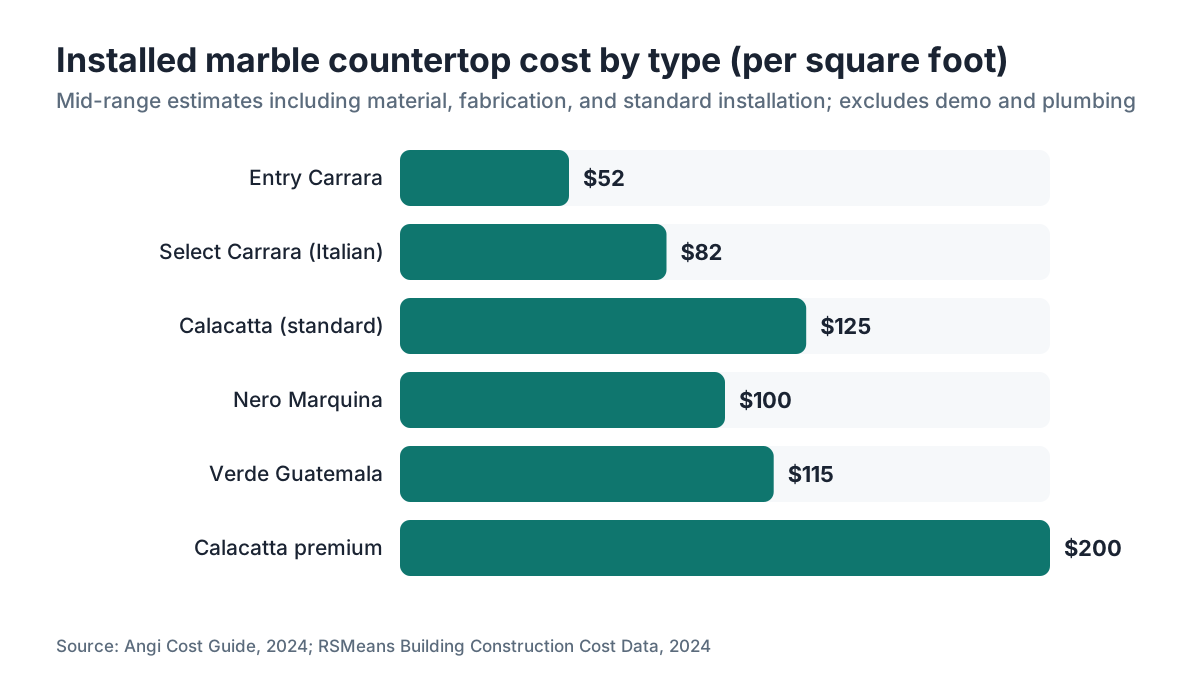
Here's a realistic installed range, including fabrication and basic installation but not old-counter removal or plumbing reconnection [3][6]:
| Marble type | Installed price range (per sq ft) |
|---|---|
| Entry Carrara (import, standard slabs) | $40 to $65 |
| Mid Carrara (Italian quarry, select slabs) | $65 to $100 |
| Calacatta (standard grades) | $100 to $150 |
| Calacatta premium (Borghini, Paonazzo) | $150 to $250+ |
| Nero Marquina | $70 to $130 |
| Verde Guatemala | $80 to $150 |
| Rare specialty (Portoro, Giallo Siena, etc.) | $150 to $300+ |
These ranges come from industry distributor pricing and fabricator surveys for 2024 and 2025. Regional variation is real. Markets near major ports (Los Angeles, New York, Miami) tend to price imported stone better.
Want a ballpark before you call a shop? The SlabWise instant quote tool takes your dimensions and material type and gives you a rough number, no appointment required.
Does marble color affect how much maintenance the countertop needs?
Yes, and this is the most underrated part of the whole color decision.
Marble etches from acid. When an acidic liquid (lemon juice, coffee, wine, vinegar dressing) sits on a polished marble surface, it reacts with the calcium carbonate and dissolves a thin layer, leaving a matte ring or spot. That's not a stain you can wipe off. It's a physical change to the surface texture, and removing it fully means re-polishing.
How much the etch bothers you depends on base color and finish:
- White marble, polished: The etch reads as a matte spot against the shine. On Carrara the light gray etch often blends into the veining and hides unless you catch it at an angle.
- Bright white Calacatta or Thassos, polished: More visible, because the untouched background is so uniform and bright.
- Black polished marble: The etch shows clearly as a lighter matte mark against the dark surface. Worst case for visibility.
- Honed marble, any color: Far less visible. The etch still happens chemically, but there's no shine for it to contrast against.
- Gray marble: Mid-toned backgrounds hide etching better than either extreme.
Staining is a separate problem from etching. True stains come from liquids that soak into the pores (red wine, olive oil, some foods). Penetrating sealers slow that absorption in a way you can measure. The Marble Institute of America recommends sealing marble with a quality impregnating sealer and reapplying annually, or whenever water stops beading on the surface [7].
Want the marble look with less etch anxiety? Look at quartzite (a true metamorphic quartzite, not sandstone sold as quartzite) or engineered quartz. For keeping real marble clean once it's in, see our guide on how to clean stone countertops.
How do I match marble color to my kitchen cabinets and lighting?
This is where most homeowners get burned. They pick a marble off a small sample in a showroom lit by warm incandescent, then install it in a north-facing kitchen with cool LED strips and hate it on day one.
A few rules that actually hold up:
Match the undertone before the dominant color. Carrara has a cool blue-gray undertone. If your white cabinets lean yellow or cream, Carrara can look too stark beside them. A cream Botticino or a warm Calacatta Gold blends better. Hold real samples against your real cabinet door.
Respect your light source. North-facing kitchens get cool, bluish daylight, and gray marble can read almost purple in it. South-facing kitchens get warm daylight that flatters cream and gold. LED color temperature matters too. 2700K LEDs are warm and make white marble look creamy. 4000K LEDs are neutral to cool and make the same slab look starker.
Scale the vein pattern to the room. A busy Calacatta Borghini with huge sweeping veins looks incredible on a large island with slab-front cabinetry. Put that same slab in a small galley kitchen with fussy hardware and it fights everything. Carrara's fine veining forgives tight spaces.
Watch the floor. A dark walnut floor under a black marble counter reads strong, but if the upper cabinets go dark too, the room turns into a cave. Light floors give dark marble room to breathe.
Get a big sample. Most yards will rent or lend you a 12x24 or larger piece of your candidate slab. Bring it home, set it on the counter base, and live with it a day. A tile chip won't tell you the truth.
Fabricators, listen up. The biggest friction point in color selection is customers deciding off 4-inch samples. Shops that arrange slab-viewing time before templating have far fewer "I wish we'd gone with something else" conversations after install. SlabWise helps by tracking which slabs are allocated to which jobs, so the slab a customer approved doesn't get sold out from under them before their template date.
What are the most timeless marble colors for resale value?
Real estate agents will tell you to stay neutral, and on marble countertops they're basically right, with a little nuance.
White and light gray marble (Carrara, Calacatta, Statuario, Silver Shadow) reads well to the broadest set of buyers. These colors have run popular in kitchens for decades with no sign of fading. A well-kept Calacatta counter is a genuine asset on a listing.
Black marble is a tougher call. It pulls a subset of buyers hard and pushes others away just as hard. In a luxury home with a cohesive dark design, Nero Marquina reads intentional and sophisticated. In a mid-market home where the buyer wants a bright, practical kitchen, it reads as extra work.
Green, red, and gold marble carry the most resale risk for kitchens. They narrow the buyer pool. That doesn't make them wrong, especially in a home you plan to own for decades, but go in with your eyes open.
The National Association of Realtors' 2023 Remodeling Impact Report found that a kitchen upgrade with new countertops recovered roughly 85% of the project cost at resale. That figure covers mid-range countertop materials broadly, not specialty marble specifically [8]. Marble's resale bump is hard to pull apart from the overall quality of the remodel around it.
For how marble stacks up against other surfaces in a kitchen, see our overview of kitchen countertops and our breakdown of marble countertops covering maintenance and fabrication.
How do I read a marble slab and know if the color is consistent?
Reading slabs is a skill fabricators build over years, but homeowners can learn the basics in an afternoon at the yard.
Start with orientation. Most yards display slabs upright in A-frames. Vein direction, shading, and any cloudy zones read differently vertical (as on a wall) versus flat (as on a counter). For a countertop, lay the slab flat if the yard allows it. It changes everything about how the pattern flows.
Check for color shading. Some slabs run a gradient, lighter on one end and darker on the other. That's not a defect, but it changes how the finished counter looks, especially on a large island.
Check for fissures versus cracks. Fissures are natural formations, narrow and usually filled with mineral deposits. They can feel smooth and are generally stable. Cracks cut through the stone and are structural weak points. A fabricator should flag cracks. Fissures are normal.
Check the back of the slab. If it's mesh-backed (fiberglass mesh epoxied to the back), that's sometimes done to stabilize stone with lots of fissures or a fragile structure. Not automatically a dealbreaker, but know you're buying stabilized stone.
For book-matched work (two slabs opened like a book to mirror the veining), confirm you're buying matched pairs from the same block number. The yard should have this in its inventory records.
Some shops use digital slab imaging so you can see your actual slab in a layout before anyone cuts. If your shop offers it, use it.
What finishes are available for marble countertops, and how do they affect the look?
Finish is separate from color, but it changes how the color reads, how the surface feels, and how well it hides wear. Same slab, two finishes, two different countertops.
Polished: High-gloss, mirror surface. Colors look deepest, veining looks most vivid, light bounces. Shows fingerprints and etching most clearly. This is the default for most marble installs.
Honed: Satin or flat matte. Colors look softer and a touch lighter. Veining still reads, just less dramatic. Fingerprints and etching fade way down. This is the finish I'd recommend for black marble kitchens and for anyone honest about not wanting to baby a countertop.
Brushed or antique: A slightly textured, aged look from wire brushing or antiquing pads. Uncommon on marble counters, used in some high-end European-style kitchens.
Leathered: Made by running the slab under diamond-tipped brushes to raise the surface slightly. More common on granite and quartzite. Hides fingerprints well. Some marbles don't take a leathered finish cleanly because of their crystalline structure.
Going polished to honed usually adds $5 to $15 per square foot in fabrication, depending on the shop and the stone. Not every marble hones to the same quality. Dense, uniform marbles like Bardiglio hone beautifully. Softer, more porous ones can come out patchy.
For lower-maintenance surfaces that mimic marble, our guides on Cambria countertops, Corian countertops, laminate countertops, and Formica countertops are worth a look before you decide.
Can marble countertop color fade or change over time?
True marble doesn't fade the way paint or wood stain does. The color is mineral-based and baked in over geological time. What looks like color change is almost always one of these four things.
Patina from use. Marble that gets daily kitchen use develops a surface patina from micro-etching, tiny scratches, and years of cleaning and cooking. On light marble this reads as a slightly warmer, softer look over decades. Plenty of people find it beautiful. It's why old Italian kitchens with Carrara counters look the way they do.
Yellowing from sealer buildup. Some oil-based sealers on white marble yellow slightly over time, especially when coats stack up. Use a water-based impregnating sealer and don't over-apply.
Iron oxidation. Some white marbles carry trace iron that can rust after repeated standing water over many years, showing as rust-colored staining from inside the stone. Carrara is relatively low-risk. Some imported whites carry more iron. Ask your distributor about iron content if it worries you.
Darkening from oil absorption. Oily products (cooking oil, some hand creams) soaked into unsealed marble can darken those spots. Sealing and quick cleanup prevent it.
The Marble Institute of America notes that properly sealed and maintained marble can last the lifetime of a building, pointing to historical architecture where marble has held up for centuries [7]. Countertop conditions are gentler than exterior cladding, so longevity isn't the real worry. Appearance is.
What marble colors work best in bathrooms versus kitchens?
The same stone behaves differently room to room, because the stressors change. Match the color to the abuse.
In a bathroom, acid etching from citrus and vinegar barely comes up. Soap scum and hard water deposits are the real maintenance challenge. Nearly any marble color works on a vanity. Dark marbles like Nero Marquina look striking in a bathroom where the etch risk is low. White and cream marbles (Thassos, Carrara, Botticino) are classic and pair with almost any tile. Green marble in a bathroom reads boutique-hotel rather than kitchen-risky.
Bathroom vanity tops are thinner (usually 3/4 inch or 3 cm), often carry an integral backsplash, and take less daily abuse than a kitchen counter. Sealing is still recommended.
In a kitchen, acid etching dominates the material question. Lighter gray marbles and honed surfaces forgive more. Heavy-vein Calacatta on an island looks extraordinary but demands a client who accepts imperfection and uses cutting boards. Light-colored marbles hide normal etching better than bright white or black.
For kitchen backsplash tile (not counter), marble is almost always fine regardless of color, because a backsplash never faces the acid and impact a horizontal work surface does.
For lower-maintenance kitchen surfaces, see our guides on granite countertops, butcher block countertops, and laminate countertops.
Frequently asked questions
What is the most popular marble color for kitchen countertops?
Carrara white is the most commonly installed marble color in North American kitchens. Availability, relative affordability ($40 to $80 per square foot installed), and a neutral cool gray-white tone that pairs with almost any cabinet color drive that. Calacatta in its various grades is the top choice for higher-budget projects where a more dramatic look is the goal.
What is the difference between Carrara and Calacatta marble?
Both come from the Apuan Alps in Tuscany, but Calacatta is quarried in a smaller zone at lower volume, which raises the price. Carrara has a cool gray-white base with fine, feathery gray-blue veining. Calacatta has a brighter white background with bolder, more widely spaced veining, sometimes with gold tones. Calacatta typically costs two to three times entry-grade Carrara.
Does marble color affect how easy it is to clean?
Yes, indirectly. Color changes how visible etching, water spots, and staining are. Black polished marble shows every water spot and etch mark clearly. Light gray marble hides etching better than bright white or black. Honed finishes on any color forgive more than polished, because the surface is already matte. Cleaning the stone itself is the same regardless of color: mild pH-neutral soap and water.
Is white marble or black marble more expensive?
Premium Calacatta white is generally more expensive than Nero Marquina black, though both have wide ranges. Mid-range Nero Marquina runs $70 to $130 per square foot installed. Mid-range Calacatta runs $100 to $150. Rare Italian blacks like Nero Portoro can top $200 per square foot, so at the high end, premium black can outprice standard white.
What marble color hides etching and stains the best?
Mid-toned gray marble with a honed finish hides etching better than any other combination. Fabricators often name honed Bardiglio for this. On the white side, Carrara's busy veining camouflages light etching better than uniform Thassos or bright Calacatta. Avoid polished black marble in a working kitchen if low-maintenance appearance is a priority.
Can I get marble in green or other non-traditional colors?
Yes. Verde Guatemala, Verde Alpi, and Ming Green are widely stocked green options at major distributors. Red marbles like Rojo Alicante and gold marbles like Giallo Siena come through specialty importers. Many of these need longer lead times and may have to be sourced from a regional slab yard rather than a local supplier. Budget for $80 to $200-plus per square foot installed.
Does marble color matter for outdoor countertop applications?
Marble is generally not recommended for outdoor horizontal surfaces in freeze-thaw climates, regardless of color. Calcite marble is porous, and water that freezes inside the pores expands and causes spalling. In warm, dry climates some outdoor marble works fine. Color matters less than the material's suitability for outdoor conditions. Quartzite or porcelain are better outdoor countertop choices.
What marble colors are best for a small kitchen to make it feel larger?
Light-colored marble with minimal veining helps a small kitchen feel open. A honed or polished Carrara or a Thassos white reflects light and cuts visual clutter. Choosing a marble whose background color sits close to your cabinet color (light on light) lowers contrast and makes the room read larger. Dark or heavily veined marble in a small kitchen tends to make it feel busier and more closed in.
Is it hard to find matching marble for repairs or replacements after installation?
Extremely hard, especially for rare colors. Marble is a natural product and no two blocks match exactly. Even abundant Carrara varies in shade and vein character between quarry runs. For high-end or unusual colors, many fabricators recommend buying extra slab material at install time and storing it for future repairs. Without a stored match, a section replacement will almost always be visible.
What's the difference between marble and quartzite in terms of color options?
Quartzite comes in whites, grays, golds, and pinks but runs a narrower commercial color range than marble. True quartzite (Super White, Taj Mahal, Sea Pearl, Macaubas) lacks the pure jet blacks and deep greens marble offers. Quartzite is harder and more acid-resistant than marble, making it a better kitchen surface for people who want a natural stone look without marble's etching problem. See our guide on how to clean quartzite countertops for maintenance details.
How do I know if I'm buying real marble and not a look-alike stone?
Ask for the country of origin and quarry name in writing from the distributor. Real marble should come with documentation. You can also run a simple acid test: put a drop of white vinegar on an inconspicuous spot. True calcite marble fizzes slightly as the acid reacts with the calcium carbonate. Quartzite won't react. Some porcelain and engineered products sold as marble-look won't react either. The test won't sort quality grades, but it confirms the stone type.
Are there marble colors that are naturally more durable than others?
Darker marbles like Bardiglio and Nero Marquina tend to be denser and slightly less porous than some whites, which gives marginally better stain resistance. But all calcite marble etches from acid regardless of color, because the reaction depends on calcium carbonate, not the coloring minerals. Hardness differences between marble varieties are minor next to the gap between marble and harder stones like quartzite or granite.
Sources
- USGS, National Minerals Information Center (dimension stone data, including marble and serpentinite): Geological definition of marble and commercial classification of dimension stone types including serpentinite marketed as green marble
- Natural Stone Institute (formerly Marble Institute of America), Stone Resource Library: Carrara marble origin in the Apuan Alps, Tuscany, and its characteristic blue-gray veining
- Angi, Marble Countertop Cost Guide: Installed marble countertop price ranges: Carrara $40-$80, Calacatta $100-$200 per square foot
- Natural Stone Institute, Care and Maintenance Guidelines: Honed finishes on dark marble reduce the visual appearance of etching compared to polished finishes
- USDA Forest Products Laboratory: Penetrating sealers slow liquid absorption in porous stone but do not make stone stain-proof
- RSMeans, Building Construction Cost Data, 2024 Edition: Installed stone countertop cost data including fabrication and standard installation labor for specialty marble types
- Natural Stone Institute, Dimensional Stone Design Manual and care guidelines: Recommendation to seal marble annually with impregnating sealer; reference to marble longevity in historical architectural applications
- National Association of Realtors, 2023 Remodeling Impact Report: Kitchen upgrade with new countertops recovers approximately 85% of project cost at resale based on 2023 NAR survey data
- ASTM International, Standard C503 Specification for Marble Dimension Stone: ASTM C503 defines physical requirements for marble used in dimension stone applications including absorption and flexural strength standards
- Penn State Extension, Home and Garden resources: Guidance on acid etching of marble surfaces and the role of calcium carbonate reactivity in all marble colors
Last updated 2026-07-09