TL;DR
- Lowe's sells butcher block countertops mainly in hard maple, acacia, and walnut, starting around $35 per square foot for standard widths up to 25 inches.
- They're a real value for a budget kitchen.
- But the species list is short, panels top out at 8 feet long, and you still finish, seal, and maintain them yourself.
What butcher block countertops does Lowe's actually sell?
Lowe's carries butcher block panels in its building materials and kitchen department, stocked in-store and shippable through its website. As of 2025 the core lineup runs hard maple, acacia, and walnut in edge-grain and end-grain builds, depending on the SKU.[1] You won't get the depth a dedicated hardwood dealer offers. What they do carry is genuinely usable for a kitchen remodel.
The most common size is 25 inches wide by 6 or 8 feet long, which fits most standard base cabinet runs. Thickness is usually 1.5 inches, the norm for residential counter work. A few products hit 2 inches, and Lowe's stocks some 4-foot widths for islands, though that varies by region and season.
Lowe's doesn't always publish the mill source on the product page, and the supplier mix shifts over time. Call your store if provenance matters to you.
Want a wider look at butcher block countertops beyond what any one retailer stocks? That context helps before you commit to a specific panel.
How much do Lowe's butcher block countertops cost?
Panels run roughly $35 to $80 per square foot, depending on species and build.[1] Hard maple edge-grain sits at the low end. Walnut and wide end-grain slabs push toward the top. That's the raw panel only, before finishing, fabrication, or install labor.
Real numbers help. A 25-inch-wide, 8-foot panel covers about 16.7 square feet. At $40 per square foot that's $667 for one run. A typical 10-foot L-shaped kitchen needs 30 to 40 square feet of panel, putting material cost at $1,050 to $3,200 depending on what you pick.
Installation adds more. A skilled carpenter or countertop installer charges $40 to $80 per hour, and a basic butcher block install with one sink cutout runs 4 to 8 hours.[2] Budget $200 to $600 for labor on a modest kitchen. Finish materials (food-safe oil, polyurethane, or hard-wax oil) add $30 to $80.
For comparison, laminate at Lowe's starts around $15 to $30 per square foot installed. Granite runs $50 to $100+ per square foot installed. Butcher block sits in the middle tier of the kitchen countertops market.
One honest note: Lowe's pricing tracks lumber markets. Maple in particular rode commodity trends up in 2021-2022 and came back down in 2023-2024.[3] Check the current online price before you build a budget.
Is the hard rock maple butcher block at Lowe's any good?
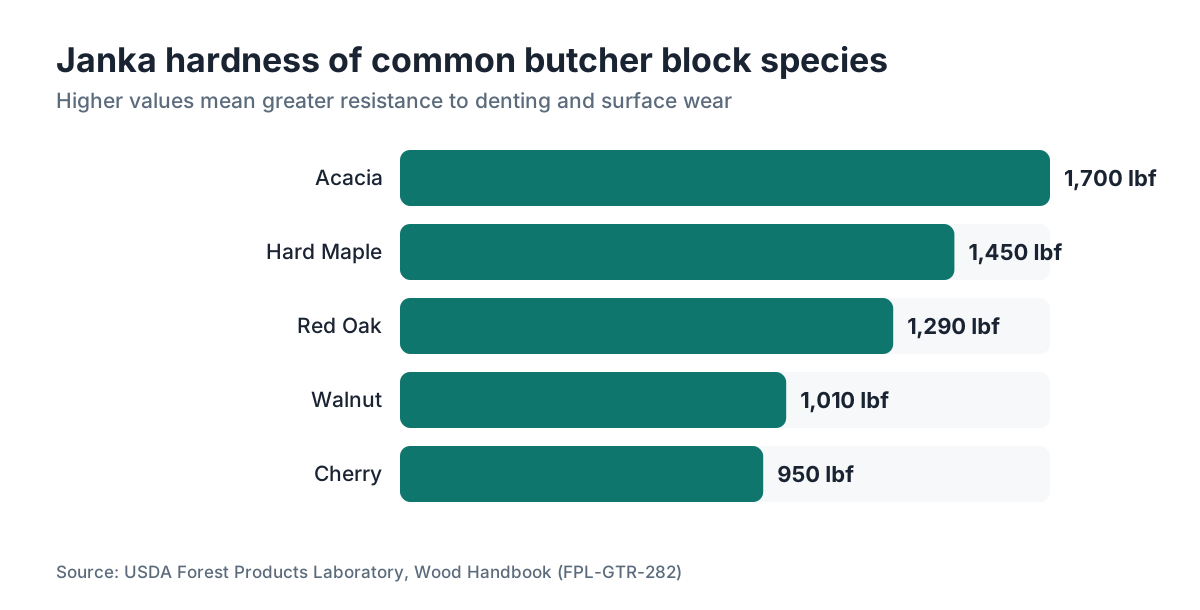
Yes. Hard maple (Acer saccharum, also called sugar maple or hard rock maple) is the species most butcher block pros reach for first, and Lowe's panels are cut from real closed-grain hard maple, not soft maple or a hybrid.[4] Its Janka hardness is 1,450 lbf, which sits above cherry (950 lbf), walnut (1,010 lbf), and red oak (1,290 lbf).[5] That hardness is why the surface resists knife marks and dents longer.
The edge-grain construction Lowe's uses for most maple panels is the right call for a countertop. Edge-grain exposes the long face of the fibers, so it absorbs less moisture and moves less than end-grain. End-grain is prettier and kinder to knife edges, but it costs more and needs oiling more often.
What you give up at a big-box store is grade control and custom sizing. Lowe's panels are Select or Better grade, so few knots and consistent color, though you'll still see some board-to-board variation in a glue-up. That's normal. The face usually comes sanded to 120-grit, so hand-sand to 180 or 220 before finishing.
Short version: Lowe's hard rock maple butcher block is a legitimate product that does the job. It's no custom heirloom slab. It's the right species, the right build, and the right thickness for kitchen work.
How do Lowe's butcher block countertops compare to custom fabricated ones?
Size flexibility is the clearest split. A custom fabricator cuts a panel to any width, length, or shape you need. Lowe's panels max out at 25 inches wide for standard depth and 8 feet long, so any run over 8 feet needs a seam, and any island deeper than 25 inches needs a custom piece.
Finish quality is the next gap. Custom shops often sell panels pre-finished with food-safe hard-wax or penetrating oil, ready to install. Lowe's panels arrive unfinished or with a light protective coat you're expected to sand back and refinish. That's a cost trade-off, not a flaw. It's still more work on your end.
Joinery and cutouts get handled differently too. A fabricator quotes and cuts your sink opening, drills faucet holes, and can add waterfall edges or live-edge details. With a Lowe's panel, you do those cuts or hire a carpenter for them. A jigsaw with a fine-tooth blade and a router with a flush-trim bit handles most of it. It takes time and a steady hand.
Shops that price dozens of butcher block jobs a month often run quoting software to keep material waste and labor tight. SlabWise (slabwise.com) is one tool for that nesting and quoting work, worth knowing about if you're a shop owner weighing retail panel costs against custom margins.
Here's the honest math for homeowners. If your kitchen is a standard layout that fits inside Lowe's standard sizes, the big-box route saves real money. If you need custom dimensions, an unusual species, or thick end-grain, a local fabricator earns the premium. Our guide on countertop installation covers what that process looks like.
What species options does Lowe's carry and which is best?
Hard maple, acacia, and walnut are the main species as of mid-2025. Stock varies by store and changes seasonally, so treat this as a likely-to-find guide, not a guaranteed list.[1]
| Species | Janka Hardness (lbf) | Typical Price Range ($/sq ft) | Best For |
|---|---|---|---|
| Hard Maple | 1,450 | $35-$50 | Heavy-use kitchens, light color palette |
| Walnut | 1,010 | $60-$80 | Warmer dark tones, lower-traffic areas |
| Acacia | 1,700+ | $40-$60 | High traffic, exotic look, varied color |
Hard maple is the workhorse. Lightest in color, best under daily cutting and impact, and easiest to sand and refinish when it looks tired after a few years.
Walnut is beautiful but softer, and it costs more at Lowe's without paying you back in durability. Save it for an accent piece or island top where you're not doing heavy prep.
Acacia is a wild card. Genuinely hard, dramatic grain, but the color swing can be extreme and boards don't always match across a long run. Some people love that. Others find it busy.
Want to weigh hard maple against stone? The granite countertops article covers how those two categories compete on durability and maintenance.
How do you finish and seal a Lowe's butcher block countertop?
This is where most DIYers go wrong. Your finish decides how the counter performs for the next 5 to 10 years, and the wrong pick can ruin an otherwise good panel.
There are two camps: penetrating oils and film-forming finishes.
Penetrating oils (food-safe mineral oil, linseed oil, tung oil, or products like Watco Butcher Block Oil) soak into the fibers and leave no surface film. They're easy to apply, easy to redo, and they let the wood breathe and move. The downside is weaker water resistance, plus reapplication every 2 to 4 months at first, tapering to once or twice a year once the wood is saturated.[6] If you'll actually cut on the surface, this is the category to use, since it's food-safe and repairable.
Film-forming finishes (polyurethane, conversion varnish, hard-wax oil) sit on top and build a harder, more water-resistant barrier. Polyurethane is the most durable and the most divisive. It holds up well, but when it fails it peels in sheets and you strip the whole surface to refinish. Hard-wax oil splits the difference: tougher than straight mineral oil, easier to repair than poly.
For a Lowe's panel headed into a working kitchen, here's what I'd do. Sand the face to 180-grit, wipe clean, and lay down three coats of a food-safe hard-wax oil like Rubio Monocoat or Osmo Polyx. Let each coat cure fully. Then maintain it once a year or when the wood looks dry. You get water resistance, repairability, and no bubbling or peeling.
One thing to never do: use cooking oils from your pantry. Olive, vegetable, and coconut oil go rancid in wood and eventually smell terrible.[6]
Around the sink, add extra finish coats and run a bead of food-safe silicone along the back edge where the panel meets the wall. Water intrusion at seams is the number-one reason butcher block counters fail early.
Can you install Lowe's butcher block countertops yourself?
Yes, and plenty of people do. Butcher block is among the more DIY-friendly counter materials because it cuts with standard woodworking tools and skips any stone fabrication gear.
You'll want a circular saw or jigsaw for length cuts, a belt or random orbital sander for face prep, a router with a straight or flush-trim bit for the sink cutout, and clamps to hold the panel while construction adhesive sets.[2] Most of the job is direct: level the cabinets, set the panel, mark and cut the sink opening from below with the sink template, then screw up through the cabinet corner brackets or use figure-8 fasteners that allow for seasonal movement.
That last point matters more than people expect. Wood moves with humidity. A panel glued solid across its width will crack in a dry winter. Use fasteners that let the panel expand and contract across the grain.[10] Lowe's panels usually ship with guidance on this. It's easy to skip and regret.
Sink installation is where DIYers most often call for help. The cutout has to be accurate, and the edges have to be sealed immediately before the sink goes in, or you'll see water damage within a year. Confident with a router? Do it yourself. If not, pay a carpenter for that one step.
A skilled DIYer installs a basic single-run counter in a half-day. Add a few hours for an L-shape with a sink cutout. Read the full countertop installation walkthrough before you start.
How do you maintain and clean a butcher block countertop from Lowe's?
Daily cleaning is simple: warm water, dish soap, a rag. Dry the surface promptly. Don't let water pool anywhere, especially near the sink.[6]
Cutting on the surface? A regular oiling schedule keeps the wood from drying out and splitting. Once a month for the first year, then quarterly, is the common recommendation from wood finish makers.
When scratches and knife marks build up enough to bug you, sand the face with 100-grit to knock down high spots, step to 150 and 180, then refinish. This is a real edge over stone or solid surface: you can bring a butcher block counter back to near-new several times over its life.
Stains from beets, berries, or turmeric respond to a paste of baking soda and water left on for 10 minutes, then a light sand if needed. Heat marks from pots are tougher. You sand those out too, but scorch takes more aggressive grit.
The worst long-term enemies are standing water, harsh chemical cleaners (bleach, ammonia-based sprays), and dishwasher exposure. Never put a butcher block panel in a dishwasher, and keep those cleaning sprays off the wood. They strip finish faster than normal wear does.[6]
What are the biggest drawbacks of buying butcher block at Lowe's vs. other sources?
The selection ceiling is the main limit. Lowe's carries maybe 8 to 15 SKUs at a time. A specialty hardwood dealer or custom fabricator sources dozens of species in custom thicknesses, widths, and grain orientations. Want 3-inch-thick end-grain maple for a true prep station? You won't find it at Lowe's.
Size constraints hit larger kitchens. The 8-foot maximum length means any longer run needs a seam, and seams in butcher block are visible and demand careful work to keep water out. Manageable, but a real consideration.
Quality is generally good, but returns and exchanges on counter panels beat returning a light fixture. If a panel shows up cupped or defective, you're working a big-box return process, not a local craftsman who can cut you a replacement the same week.
And Lowe's panels need more work before they're usable than a finished panel from a specialty supplier. Fine if you enjoy the process and own the tools. A hidden cost if you don't.
Weighing all the options together? Comparing butcher block against laminate countertops or formica countertops helps, since those need even less maintenance at a lower price.
How does Lowe's butcher block hold up long-term?
A properly finished and maintained hard maple panel from Lowe's lasts 20 to 30 years with periodic refinishing.[7] That's not marketing. It reflects how hard maple performs as a species. The USDA Forest Service notes that hard maple has excellent machining and steam-bending properties and shows up in heavy-duty flooring and bowling alley lanes precisely for its durability.[4]
Three things shorten the life most: around-sink moisture, skipped oiling cycles that let the wood dry and crack, and heat damage from hot pans set straight on the surface. Use trivets. Seriously.
Refinishing buys years. A counter sanded and re-oiled every 3 to 5 years looks fresh for decades. One neglected for 10 years and left wet ends up warped, cracked, or black with mold around the sink and needs replacing.
Some homeowners replace after 10 to 15 years not because the wood failed but because styles changed. Since Lowe's panels run $600 to $1,500 for a typical kitchen's worth of material, replacing them after 15 years still pencils out against natural stone at $3,000 to $7,000+ for the same footprint.
For the opposite end of the maintenance spectrum, marble countertops and cambria countertops shrug off water but can't be refinished when they scratch.
What do fabricators and shop owners need to know about competing with Lowe's butcher block?
Worth saying plainly: Lowe's panels do pull some business from local shops. The customers buying them are price-driven, comfortable with DIY, and working standard layouts. They were never your most profitable customers.
Custom fabricators win consistently on non-standard sizes, edge profiling, multi-piece layouts with matched grain, thick end-grain, and integrated sink work. A shop that quotes a 36-inch-wide island top in 2.5-inch end-grain walnut with a waterfall edge won't lose that job to Lowe's. That job simply doesn't exist at a big-box store.
The pricing conversation matters too. When a homeowner sees Lowe's at $40 per square foot for a maple panel and your quote lands at $85 per square foot installed, they need to understand the difference: precise sizing, professional cutouts, finished edges, and one point of accountability if anything goes wrong. Explained clearly, that premium is worth it to a lot of buyers.
Shops running butcher block alongside stone can manage quoting across both material types with purpose-built tools. SlabWise offers nesting and quoting software for countertop fabricators that handles multiple materials in one workflow, which helps shops stay competitive on price while tracking real cost per job.
Positioning butcher block against other materials in customer talks? Point clients to the kitchen countertops comparison guide.
Frequently asked questions
Does Lowe's cut butcher block countertops to size in-store?
Some Lowe's locations offer in-store panel cutting, but the service is inconsistent and not every store has staff trained on countertop-grade cuts. Call your local store before relying on it. Even with a rough length cut, you'll still do finish cuts, sink openings, and edge work at home or hire it out. Don't count on in-store cutting as part of your install plan.
What's the difference between edge-grain and end-grain butcher block at Lowe's?
Edge-grain panels expose the side of the wood fibers and are what Lowe's mostly carries. They're more stable, absorb less moisture, and suit kitchen counters well. End-grain panels expose the cut ends of the fibers, look like a checkerboard, are gentler on knife edges, but cost more and need more frequent oiling. Lowe's stocks limited end-grain; a specialty supplier is a better bet for it.
Can Lowe's butcher block countertops go next to a sink?
Yes, with extra attention to waterproofing. Apply extra finish coats to all cut edges, especially around the sink opening, before the sink drops in. Run silicone caulk along the back and any exposed edges against the wall. Seal the sink perimeter with a bead of food-safe silicone under the rim. Around-sink moisture is the primary cause of early failure, so don't skip these steps.
How long does Lowe's butcher block countertop installation take?
A single straight run with no sink takes a competent DIYer 2 to 4 hours including leveling, cutting to length, and securing. Add a sink cutout and you're at 4 to 6 hours. An L-shape with two seams and a sink is a full-day project. Hiring a carpenter, expect 3 to 5 hours of labor for a typical kitchen, billed at $40 to $80 per hour depending on region.
Is Lowe's butcher block countertop food safe?
The raw wood is food-safe. Whether the finished counter is depends on your finish. Mineral oil, linseed oil, and products labeled food-safe are fine for surfaces you'll cut on. Standard polyurethane isn't recommended for direct food contact once cured, though incidental contact is generally low-risk. If food safety matters, finish with food-grade mineral oil or a food-safe hard-wax oil and skip polyurethane.
What's the return policy for butcher block countertops at Lowe's?
Lowe's standard policy allows returns within 90 days with a receipt for most products in original condition. Countertop panels that have been cut, finished, or installed are typically not returnable. Since it's so easy to alter a panel, inspect it thoroughly in-store before loading it. Flag defects like cupping, checking, or heavy color variation before purchase, not after you've cut it.
How thick are butcher block countertops at Lowe's?
Most panels are 1.5 inches thick, the standard for residential counters and a match for most prefabricated countertops. Some products come in 2-inch thickness for a heavier look. If you want 3-inch or thicker panels for a professional-grade prep station, source from a specialty hardwood dealer or custom fabricator, since Lowe's doesn't stock that thickness.
Can I use Lowe's butcher block as an actual cutting board?
You can, depending on the finish. Apply food-safe mineral oil or hard-wax oil, and cutting directly on the surface is fine. That's the original purpose of butcher block. Use polyurethane and cutting chips the film, leaving an uneven surface over time. Most design-forward kitchens treat butcher block as a counter surface and use separate cutting boards on top to keep it looking clean longer.
How does Lowe's maple butcher block compare to John Boos butcher block?
John Boos is the benchmark brand in residential butcher block, using hard maple from managed U.S. forests with tight quality control and a consistent finish. Lowe's carries panels from various suppliers, generally solid but without the same provenance guarantee. John Boos panels often ship pre-oiled and in more sizes, costing more, typically $60 to $120 per square foot from specialty retailers. For most kitchens Lowe's maple performs comparably; for heirloom work, John Boos earns the premium.
Will butcher block countertops from Lowe's warp or crack?
They can, if installed or maintained wrong. Warping happens when one face absorbs moisture faster than the other, which is what you get finishing the top but not the underside or edges. Apply the same number of coats to all surfaces, bottom and ends included. Cracking comes from dryness (fix with regular oiling) or from fastening the panel rigidly. Use floating fasteners, not screws driven solid through the cabinet.
Does Lowe's offer butcher block for kitchen islands?
Lowe's carries some wider panels up to 48 inches for islands, though stock varies by store. A 25-inch standard panel won't work for most islands, which run 36 to 48 inches deep. Check the Lowe's website for current island-width SKUs in your zip code before planning around them. If the width you need isn't stocked, a local hardwood dealer or custom fabricator is the more reliable path for island tops.
What oil should I use to finish a Lowe's butcher block countertop?
Food-safe mineral oil is the cheapest and most foolproof start. It's sold at Lowe's and pharmacies for a few dollars a quart. Apply liberally, let it soak 20 minutes, wipe the excess, and repeat daily for the first week. After that, monthly for a few months, then quarterly. For more durability, step up to a commercial hard-wax oil like Rubio Monocoat or Osmo Polyx-Oil, which cure harder and need less frequent reapplication.
How much does it cost to have Lowe's install a butcher block countertop?
Lowe's offers installation through third-party contractors in many markets. Pricing typically runs $200 to $500 for a standard kitchen layout on top of the panel cost, varying by region and complexity. Sink cutouts and custom edge work usually cost extra. Get the quote in writing before delivery, and clarify what's included. Leveling, cutouts, sealing, and cleanup all get different answers at different Lowe's installation partners.
Sources
- Lowe's Companies, Inc. - Butcher Block Countertops product category page: Lowe's carries butcher block countertop panels in hard maple, acacia, and walnut, priced from approximately $35 to $80 per square foot depending on species and configuration.
- U.S. Bureau of Labor Statistics - Occupational Outlook Handbook: Carpenters: Carpenters and finish woodworkers in the U.S. charge roughly $40 to $80 per hour for skilled labor, informing estimated installation labor costs.
- USDA Forest Service - Forest Products Laboratory: Wood as an Engineering Material: Hardwood commodity pricing, including hard maple, is subject to market fluctuation tied to lumber supply chains and regional availability.
- USDA Forest Service - Forest Products Laboratory: Wood Handbook, Chapter on Hardwood Species: Hard maple (Acer saccharum) has excellent machining properties and is used in heavy-duty flooring and bowling alley lanes due to its durability; it is the species widely used for commercial butcher block.
- USDA Forest Products Laboratory - Wood Handbook: Wood as an Engineering Material (Gen. Tech. Rep. FPL-GTR-282): Janka hardness values: hard maple 1,450 lbf; walnut 1,010 lbf; red oak 1,290 lbf; cherry 950 lbf.
- NSF International - Food Equipment Standards and Wood Surface Safety Guidance: Food-safe mineral oil and hard-wax oil products are appropriate for food-contact wood surfaces; cooking oils like olive or vegetable oil are not recommended as they become rancid in wood. Harsh chemical cleaners strip wood finishes and are not recommended for butcher block surfaces.
- University of Minnesota Extension - Wood Countertop Care and Maintenance: A properly finished and maintained hard maple butcher block countertop can last 20 to 30 years with periodic refinishing.
- U.S. Environmental Protection Agency - Safer Choice: Identifying Safer Chemical Products: Food-safe mineral oil and products meeting EPA Safer Choice standards are appropriate for use on food-contact surfaces including wood countertops.
- National Kitchen and Bath Association (NKBA) - Kitchen and Bath Market Index: Butcher block and wood countertops occupy the mid-tier price segment of the kitchen countertop market, above laminate and below natural stone, and remain among the top five countertop materials selected in residential kitchen remodels.
- USDA Agricultural Research Service - Wood Properties of North American Hardwoods: Hard maple is classified as one of the densest and hardest commercially available North American hardwoods, with moisture-related movement properties that require floating installation methods to prevent cracking.
Last updated 2026-07-09