TL;DR
- Low cost quartz countertops run $40, $60 per square foot installed for entry-level slabs, versus $80, $150 for premium lines.
- Cut costs with builder-grade quartz, simple edge profiles, few cutouts, and a box store or remnant pile.
- Durability holds up across price tiers.
- Color choices narrow fast.
What do low cost quartz countertops actually cost per square foot?
Entry-level quartz lands in the $40, $60 per square foot range installed, based on national average data from HomeAdvisor and Fixr [1][2]. That covers slab material plus fabrication and standard installation. It does not cover sink cutouts, complex edge profiles, or removing your old countertop. Those add to the invoice.
Mid-grade quartz runs $60, $80 installed. Premium lines like Cambria, Silestone's higher collections, or designer-series MSI climb to $100, $150 per square foot or more [1]. When fabricators say 'entry-level' quartz, they mean specific SKUs from those same brands with simpler patterns and lower wholesale costs.
For a typical 30-square-foot kitchen (a small galley), budget $1,200, $1,800 at the low end. A more common 50 to 55 square foot kitchen lands at $2,000, $3,300 installed. Those are real ballpark numbers. Your exact quote depends on your city's labor market, the shop's overhead, and what edge and sink options you pick.
Here's what most homeowners miss. Quartz gets quoted differently at retail than at a fabricator. Big-box stores like Home Depot and Lowe's sell installed quartz through third-party installers and run promotions that drop entry-level material to $40, $45 per square foot installed, sometimes lower during holiday sales [3]. Independent fabricators may match or beat that on material but charge separately for labor, demo, and haul-away.
How does low-end quartz compare to other budget countertop materials?
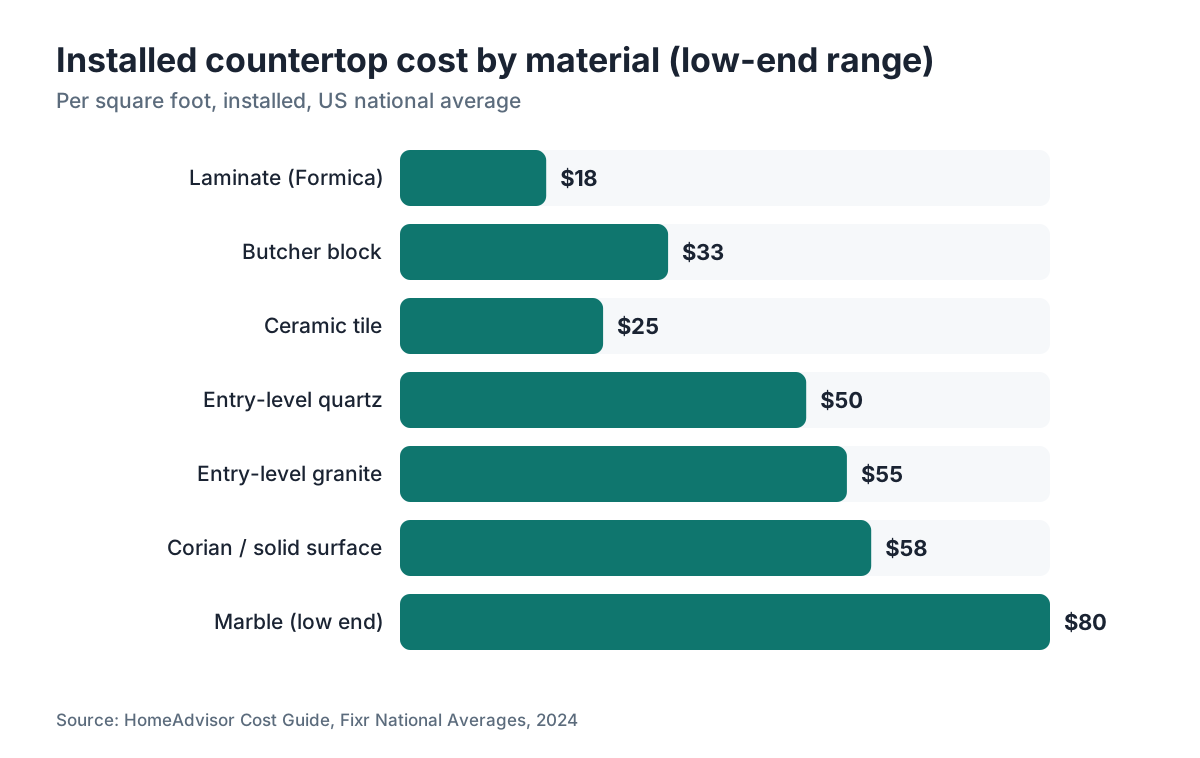
Quartz is not the cheapest surface you can buy, but it's the cheapest one that needs zero sealing and shrugs off stains. Here's the low end of each common material, installed, so you're comparing the same thing:
| Material | Low-end installed cost (per sq ft) | Durability | Maintenance |
|---|---|---|---|
| Laminate (Formica) | $10, $25 | Moderate | Low |
| Butcher block | $20, $45 | Good (with care) | Medium |
| Ceramic tile | $15, $35 | Good | Medium |
| Entry-level quartz | $40, $60 | Excellent | Very low |
| Entry-level granite | $45, $65 | Excellent | Low (needs sealing) |
| Corian / solid surface | $45, $70 | Good | Low |
| Marble | $60, $100+ | Moderate | High |
Sources: HomeAdvisor cost data [1], Fixr national averages [2].
Laminate is cheaper, full stop. Formica countertops and laminate countertops cost a fraction of quartz. If price is the only variable, laminate wins. But quartz beats laminate on scratch resistance, heat resistance (to a point), and resale appeal. Butcher block countertops bring warmth quartz can't touch, though they need regular oiling and can't handle standing water near the sink without swelling.
Granite countertops sit in a similar price band to entry quartz. The practical difference: granite needs sealing (once a year is the common recommendation), quartz never does. For a rental or a flip where long-term maintenance isn't your problem, granite remnants can undercut entry-level quartz on total cost.
Corian countertops deserve a look too. Solid surface is repairable in ways quartz isn't. Scratches sand out, and integrated sinks are possible. The trade-off is lower heat resistance and a look that reads less like stone to buyers.
What makes some quartz slabs cheaper than others?
Quartz is engineered stone, roughly 90 to 95% ground quartz crystal bound with polymer resins and pigments [4]. Every slab shares that recipe. Price differences come from pattern complexity, brand licensing, thickness, and where a shop sits in the supply chain.
Simple patterns cost less. A solid white or solid gray quartz with no veining is cheap to produce because the pigment load is uniform and there's no complex printing or layering. The moment a manufacturer tries to fake Calacatta marble with dramatic veining, the process gets expensive: more pigment, tighter quality control to hit consistent pattern registration, sometimes multiple press passes.
Thickness matters too. Most residential quartz comes in 3/4 inch (2 cm) and 1.25 inch (3 cm). Three-centimeter slabs cost more because there's more material. Some budget installs use 2 cm slabs with a built-up front edge to mimic 3 cm. It's a legitimate technique, and most homeowners never notice, but ask about it.
Brand premiums are real. Cambria is the only major quartz brand manufactured entirely in the US, and they price accordingly [5]. Cambria countertops carry a premium over comparable-looking MSI or Vadara slabs. You're paying for domestic production and marketing. On a budget project, that premium isn't worth it unless the exact color matters to you.
Supply chain position matters last. Distributors like MSI and Vicostone sell through fabricators at wholesale. If your fabricator has a volume relationship with one brand, their cost of goods on that brand is lower, and they may pass some through. Ask what brands your fabricator buys most. Those are usually your best deals.
Which quartz brands offer the best low-end options?
A handful of brands live in the affordable tier year after year. MSI Q Premium Natural Quartz has entry colors in the $30, $45 per square foot material range before fabrication and install [1]. Vadara, sold through distributors, carries solid-color and simple-pattern slabs that compete on price. Silestone's entry colors have come down as the brand expanded its line.
For box-store buyers, Home Depot sells quartz under the Stonemark and MSI banners, and Lowe's carries its own Viatera line (made by LX Hausys). Both retailers negotiate volume pricing that independent fabricators rarely match on material alone. If you don't care about color precision and just want a clean white or gray, the box-store installed price is often the cheapest you'll find.
Remnants are the real secret weapon. When a fabricator cuts a slab for a large island, they're left with pieces that won't fit the next job. Those remnants often sell for $200, $600 per piece, enough to cover a bathroom vanity or small kitchen, at a material cost far below the standard per-square-foot rate. Call local shops and ask if they have a remnant pile. Most do. Almost none advertise it.
One brand to know: IKEA sells its own quartz countertops (the Hällestad line in recent years) at aggressively low prices, though you're expected to use their installation partners and the color range is narrow [6]. For IKEA kitchen buyers, this can be the cheapest path to real quartz.
What hidden costs push the total price up?
The per-square-foot number almost always understates what you'll pay. Here's where the budget surprises hide.
Sink cutouts run $100, $200 each. A standard undermount cutout on a $50-per-square-foot job can add 10 to 15% to a small kitchen's total. Undermount cutouts take more time and precision than drop-in holes.
Edge profiles are priced per linear foot of exposed edge. Eased (square with a light break) is usually included. Beveled and half-bullnose are modest upgrades, usually $5, $15 per linear foot. Ogee, waterfall, or miter-folded edges can hit $30, $60 per linear foot. On a kitchen with 20 feet of exposed edge, that's real money.
Old countertop removal, if the fabricator handles it, typically adds $100, $300. Some shops won't touch demo. Others charge a flat fee. Confirm before signing.
Templating fees sometimes show up as a separate line, usually $50, $150 for a third-party templater, or built into shops that template their own. Digital templating (laser measurement) is more precise and has largely replaced cardboard templates at quality shops [7].
Delivery and installation of heavy slabs is labor-intensive. Most quotes include it, but remote addresses or upper-floor installs with no elevator draw a surcharge.
Plumbing reconnection after install is the homeowner's job unless you arrange a plumber. Budget $150, $300 if you're hiring that out.
The countertop installation process has more moving parts than most homeowners expect. An itemized quote that breaks out material, fabrication, edge profile, cutouts, demo, and install is the only way to compare shops honestly.
How do you get the lowest possible price on quartz countertops?
A few tactics actually move the number.
Buy during slow season. Fabrication shops slow down in January, February, and July across most US markets. Hungry shops sharpen their pencils on material and labor. Nobody publishes data on this, but any fabricator will tell you it's real.
Choose a simple slab with a simple layout. Rectangular runs with no curves, no islands, and one cutout are cheapest to template, cut, and install. Every inside corner, radius, and cutout adds setup and cutting time.
Stick to eased or beveled edges. The edge upgrade is where many shops make margin. Eased edges run fast and often come included. Upgrading every linear foot to an ogee or mitered edge is expensive and visible only up close.
Shop remnants. A remnant from a quartz slab can cover a bathroom vanity for $300, $500 total, material included, when the same footage at full price would run $600, $900 [8].
Get at least three quotes. Fabricator pricing swings more than most homeowners realize, sometimes 20 to 30% for the same material and scope, depending on the shop's overhead, current workload, and supplier relationships. No consumer-protection law requires any particular pricing disclosure in countertop quotes. The burden is on you to compare.
For fabricators reading this: shops using quoting software like SlabWise can generate accurate, itemized quotes in minutes. Slow quotes lose jobs, and fast quotes without proper nesting waste material. A fabricator who knows their true material cost can price confidently at the low end without giving up margin.
Consider a box store for simple jobs. On a straightforward small kitchen with standard dimensions and a common color, Home Depot or Lowe's installed pricing can honestly be the best deal. The trade-off is less flexibility on edge and color, plus a subcontracted install, so quality control varies by market.
Does cheap quartz hold up as well as expensive quartz?
For most practical purposes, yes. The specs that matter most, scratch resistance, stain resistance, and non-porosity, barely change between an entry-level slab and a premium slab from the same manufacturer [4]. Both are engineered from quartz crystal and polymer resin. Neither needs sealing. Both resist most household stains.
Where premium quartz earns its price:
Pattern consistency is better in premium lines. A $120-per-square-foot slab with marble-like veining will look more realistic and less repetitive than a $45 slab chasing the same effect. If the look matters, spend on color.
Thicker slabs (3 cm vs 2 cm) at the high end mean less risk of cracking during transport or across long unsupported spans. Entry-level quartz sometimes comes in 2 cm with a laminated edge to simulate 3 cm. Ask.
Warranty terms differ. Silestone offers a limited lifetime warranty through authorized dealers [9]. Some entry-level brands offer 10 or 15 years. Read the warranty on any slab you're considering.
Heat resistance is where people get fooled. Quartz is not heat-proof. The polymer resin can discolor or crack from a hot pan regardless of price tier [4]. Always use trivets. You cannot spend your way out of this one.
For a rental, a builder spec, or any project where you need durable and low-maintenance without paying for looks, low-end quartz is a genuinely good choice. For a forever kitchen where the look matters, spend on the slab color you actually want.
What questions should you ask a fabricator before buying budget quartz?
Before you sign, get clear answers on these.
Is the price per square foot for 2 cm or 3 cm material? If 2 cm, will the front edge be laminated to look like 3 cm, and what does that add?
What edge profile is included in the base price, and what do upgrades cost per linear foot?
How do you charge for cutouts, separate line or included? Cooktop cutouts differ from sink cutouts. Ask about both if relevant.
Does the quote include removal and haul-away of existing countertops? If not, what's the add-on?
What's the lead time from signed contract to installation? Entry-level shops range from one week to four weeks depending on workload.
Who does the template, and is it laser or manual? Digital templating is faster and more accurate. It matters on complex layouts.
What's the warranty on the slab and on the fabrication? Seam separation or cracking near a cutout is a fabrication defect, not a material defect, and coverage varies.
Can I see the actual slab I'm buying before it's cut? You should be able to visit the yard and approve the specific slab, more than a sample chip. Color and pattern vary within a product line.
Are there low-cost quartz options for bathroom vanities and small projects?
Bathroom vanities are the sweet spot for budget quartz. A standard 24x21-inch vanity top is under 4 square feet of material. Even at $60 per square foot installed, that's under $250 for the countertop. Because the footage is small, you're often in remnant territory, where the economics flip in your favor.
Many fabricators sell pre-cut vanity tops in standard sizes (25-inch, 31-inch, 37-inch, 49-inch wide) with an integrated backsplash and a pre-drilled faucet hole. These stock tops skip the templating and custom fabrication fee entirely and sell for $150, $350 at many distributors and home improvement stores. The color selection is limited, usually white or gray, but for a guest bath or rental, that's fine.
For kitchen countertops in small rentals or investment properties, remnants from commercial or large residential jobs can supply a small galley for $400, $800 total, material cost only, if you're willing to pick up from the shop and have the job installed by a fabricator who charges by the hour. It's more work to coordinate, but the savings are real.
Laundry rooms and craft rooms are another good fit for budget or remnant quartz. The material performs the same, and nobody cares about the exact pattern.
What do low-end quartz countertops look like, and will they look cheap?
Honestly, most entry-level quartz looks fine. The stuff that looks cheap is the stuff faking something it isn't, a $45 slab pretending to be Calacatta Gold. The veining runs too regular, the contrast too flat, and anyone who's seen real marble notices in a second.
The quartz that looks best at a low price owns its nature: a clean white (Blanco Zeus, Arctic White, a Carrara-style white), a solid gray in a concrete tone, or a black. These patterns don't need complexity to look intentional, and they photograph well, which matters for resale.
The patterns to avoid at a low price: anything with dramatic bold veining meant to replicate high-end marble. Up close it looks printed, because it essentially is. If you want the marble look, spend on a better slab or consider actual marble countertops on a remnant basis, where you can sometimes get real marble for less than premium quartz.
Finish matters too. Polished quartz is the standard and shows color most vividly. Honed or matte finishes are an upgrade on most entry lines and cost more. Stick with polished if budget is primary.
One genuine design tip: pair a simple, solid-color quartz with a good tile backsplash and the kitchen reads more expensive than it is. The eye averages across the surfaces. A plain white quartz with a handmade-look subway tile looks right in photos and in person.
How do fabricators price low-end quartz jobs, and where is the margin?
This section is for shop owners and fabricators. Homeowners can skip to the FAQs.
On entry-level quartz, material cost to a fabricator with a distributor account runs $18, $30 per square foot at wholesale, depending on volume and brand [8]. The gap between wholesale material and the $40, $60 retail installed price covers templating labor, saw time, edge work, install labor, overhead, and margin. On a simple job, that spread works. On a complex job with multiple cutouts, inside corners, or a full-height backsplash in the same material, it compresses fast.
The common mistake on budget jobs: quoting by the square foot without accounting for complexity. A 30-square-foot L-shaped kitchen with an undermount sink and a 15-foot island seam is harder than a 60-square-foot rectangle. Flat per-square-foot pricing punishes you on the complex ones.
Accurate material nesting matters most on thin-margin work. If you buy a slab to cover 28 square feet and your template wastes 30% of the slab to poor nesting, you've eaten your margin. SlabWise's quoting and nesting tools are built for exactly this: you input the template dimensions and the software finds the most efficient cut layout before you commit to a slab, so you're not guessing on remnant waste.
On budget jobs, consider quoting flat prices on standard-size vanity tops from your remnant pile. You move remnants at good margin while handing homeowners a lower total. Everyone wins.
Frequently asked questions
What is the cheapest quartz countertop brand?
MSI Q Premium and Vadara consistently sit at the low end, with material around $18, $30 per square foot wholesale and retail pricing starting near $40 per square foot installed. Box-store brands like Home Depot's Stonemark and Lowe's Viatera are also priced aggressively, often the cheapest path for simple color choices and standard layouts.
Can you get quartz countertops for under $1,000?
Yes, for small bathrooms. A 24-to-37-inch vanity top in quartz can come in under $1,000 installed, sometimes well under. For a kitchen, $1,000 is tight but possible if you buy a remnant for a small galley layout (under 20 square feet) and find a shop willing to work with your piece. Full kitchen installs in the $1,000, $1,500 range are rare but not impossible in lower-labor-cost markets.
Is quartz or granite cheaper for budget countertops?
They're close. Entry-level granite runs $45, $65 per square foot installed; entry-level quartz runs $40, $60. Granite remnants can undercut quartz on very small jobs. The practical difference is maintenance: granite needs annual sealing, quartz does not. For a rental or flip where you won't be sealing it, granite remnants may be the better value. For a permanent home, quartz's no-seal benefit is real.
What is the difference between cheap quartz and expensive quartz?
Mostly pattern complexity and brand premium. Entry-level quartz uses simpler, uniform pigment patterns. Premium quartz replicates complex natural stone veining more convincingly. Core performance specs (scratch and stain resistance, non-porosity, no sealing) are similar across price tiers. Thickness sometimes differs: high-end lines more commonly use 3 cm, while some budget slabs are 2 cm with a laminated front edge.
Does quartz countertop quality go down with lower price?
Not much, for functional performance. What changes is aesthetic: pattern realism, color depth, and consistency. A $45-per-square-foot quartz resists stains and scratches nearly as well as a $100 one. Where you lose is pattern sophistication and slab-to-slab consistency. For a utility application like a laundry room or rental kitchen, budget quartz is a fully rational choice.
Where is the best place to buy low cost quartz countertops?
Big-box stores (Home Depot, Lowe's) for the absolute floor price with standard colors. Local fabricator remnant piles for small projects at below-market pricing. Direct distributor deals through a fabricator who buys volume from one brand. IKEA if you're buying an IKEA kitchen. Each channel trades off color selection, install quality control, and customization. None is universally best.
How do I find quartz countertop remnants near me?
Call local stone fabricators directly and ask if they sell remnants. Most shops have a pile and none advertise it well. Check Craigslist, Facebook Marketplace, and Nextdoor too, where fabricators and homeowners occasionally sell leftover pieces. Bring your template measurements when you go to check fit. Remnants are priced per piece, not per square foot, usually $200, $600 depending on size.
What edge profile is cheapest for quartz countertops?
Eased (also called straight or square) is the cheapest and often included in the base install price. It's a clean, modern look that works with almost any kitchen style. Beveled is one small step up and similarly affordable. Avoid ogee, dupont, or waterfall edges if budget is the priority; those add $20, $60 per linear foot and require more machine time.
Can I install quartz countertops myself to save money?
You can remove old countertops yourself to save the demo fee ($100, $300), and that's worth doing. DIY installation of the quartz itself is not practical for most homeowners: slabs are heavy (15 to 20 lbs per square foot for 3 cm), require precise leveling and shimming, and cracks during handling are your loss. Most fabricators won't sell uninstalled slabs at retail anyway. Do the demo, let the shop install.
Does low-end quartz affect home resale value?
Not meaningfully, compared to mid-grade quartz, as long as it's in good condition and looks clean. Buyers notice 'stone countertops' as a category more than the specific brand or pattern. Going from laminate to quartz at any price point has more resale impact than going from budget quartz to premium quartz. Spend where it shows: a plain-but-clean quartz beats stained or chipped premium stone every time.
What quartz colors are cheapest?
Solid whites, solid grays, and solid blacks are cheapest across brands because they need the least complex pigment work. Simple two-tone patterns (white with light gray veining) are also affordable. Complex multi-tone veining meant to replicate Calacatta, Statuario, or Taj Mahal quartzite costs more to produce and is priced accordingly. If budget is the constraint, pick a simple color and put your design energy elsewhere.
Is quartz worth it over laminate for a rental property?
Probably not on price alone. Laminate installs for $10, $25 per square foot, a third of budget quartz. For a rental where tenants aren't careful and you replace surfaces every 10 to 15 years, laminate makes financial sense. Quartz wins if you want a surface that photographs well for listings, resists tenant stains without sealing, and doesn't need replacement as often. It's a judgment call on your tenant base and turnover expectations.
How long does low-end quartz last?
Quartz is one of the more durable countertop materials at any price tier. With normal residential use, a properly installed quartz countertop should last 20 to 30 years or the life of the kitchen. The polymer resin can discolor from sustained heat or long UV exposure in very sunny kitchens, but that's a material trait of all quartz, not a quality-tier issue. Keep hot pans off any quartz.
Sources
- HomeAdvisor, Quartz Countertops Cost Guide: Entry-level quartz installed nationally averages $40, $60 per square foot; premium lines reach $100, $150 per square foot
- Fixr, Quartz Countertops Cost: National average installed quartz countertop cost ranges and material breakdowns by tier
- The Home Depot, Countertop Installation Services: Box-store installed quartz pricing and promotion structure for entry-level colors
- NSF International, Hard Surface Countertop Standards (NSF/ANSI 51): Quartz countertops are engineered from approximately 90 to 95% ground quartz crystal bound with polymer resins; heat resistance limitations apply across all quartz regardless of price tier
- Cambria, About Cambria (company origin and US manufacturing claim): Cambria is the only major quartz surface brand manufactured entirely in the United States
- IKEA USA, Kitchen Countertops: IKEA sells Hällestad quartz countertops at competitive installed prices through its installation partner network
- Natural Stone Institute (formerly Marble Institute of America), Dimension Stone Design Manual: Digital laser templating has largely replaced manual cardboard templates in quality stone fabrication shops for improved accuracy
- U.S. Environmental Protection Agency, Reducing and Reusing Basics: Reuse of leftover fabricated stone (remnants) reduces material waste, supporting the economics of buying remnant pieces for small projects
- Silestone by Cosentino, Warranty Information: Silestone offers a limited lifetime warranty on its quartz products when purchased through authorized dealers
- U.S. Bureau of Labor Statistics, Producer Price Index: Stone Products: Producer-level price trends for fabricated stone products including engineered quartz used to contextualize material cost ranges
- National Institutes of Health, National Institute for Occupational Safety and Health (NIOSH) engineered stone hazard guidance: Engineered stone (quartz) contains high crystalline silica content, confirming the ground-quartz-plus-resin composition described for all quartz slabs
- National Kitchen and Bath Association (NKBA), Kitchen and Bath Market Index: Countertop material selection trends and price sensitivity data for residential kitchen and bath remodels
Last updated 2026-07-09