TL;DR
- Quartz countertops run $50 to $150 per square foot installed, with most kitchen projects landing between $1,800 and $5,000 total depending on slab grade, edge profile, cutouts, and your region.
- Budget-grade quartz starts around $50/sq ft; premium brands like Cambria push past $130.
- Granite is often $10 to $30/sq ft cheaper on material but can close that gap fast with sealing and finishing costs.
How do you calculate the cost of a quartz countertop?
Multiply your total countertop square footage by the installed price per square foot for the slab grade you want. Then add line items for edge profiles, sink and cooktop cutouts, backsplash, tear-out of the old counters, and any tricky seams. That's the whole calculation.
Here's the formula in plain English: (length in inches × width in inches) ÷ 144 = square footage per run. Do that for each section, add them up, then round up by about 10 percent for waste and cuts. A standard U-shaped kitchen with 30 square feet of counter space is common. Many kitchens run 40 to 60 square feet once you include the island.
Fabricators quote in square footage but bill the job in total dollars after those extras. If a shop quotes you $75/sq ft "installed" and your kitchen measures 45 square feet, expect a rough number around $3,375 before cutouts. Each sink cutout adds $100 to $250. An undermount sink adds another $50 to $150 for the labor of polishing the exposed edge inside the bowl opening. A waterfall island edge can run $300 to $700 extra on its own [1].
The biggest variable most homeowners miss is the tier of quartz. Engineered quartz (the correct term for brands like Cambria, Silestone, and Caesarstone) is graded roughly as entry-level, mid-range, and premium. Entry-level slabs from a local distributor might wholesale for $28/sq ft. A premium Cambria pattern can wholesale for $75/sq ft or more [2]. Both get marked up by the fabricator. That markup, plus installation, is where the spread comes from.
What is the average cost of quartz countertops per square foot?
Installed quartz runs $50 to $150 per square foot across most of the U.S., with mid-range material landing near $90 [1][3]. Those installed numbers cover templating, fabrication labor, and standard installation with one straight edge. They leave out demolition, plumbing, and tile backsplash.
| Quartz tier | Material only (per sq ft) | Installed (per sq ft) |
|---|---|---|
| Entry-level / builder grade | $25, $45 | $50, $75 |
| Mid-range | $45, $70 | $75, $110 |
| Premium (Cambria, designer patterns) | $70, $100+ | $110, $150+ |
Region moves the number hard. Shops in New York City, San Francisco, and Seattle run 20 to 35 percent above the national midpoint. Rural Midwest and Southeast markets come in at the low end or below [3]. Labor rates vary, shop overhead varies, and how close your distributor sits to manufacturing plants changes the base slab cost.
A realistic typical kitchen (40 sq ft, mid-range quartz, one sink cutout, eased edge) lands around $3,500 to $4,500 installed. An island-heavy kitchen in premium material can hit $8,000 to $12,000. Small bathrooms (8 to 12 sq ft) often run $800 to $1,800 installed, but minimum-charge policies at many shops mean you pay for at least 15 to 20 square feet no matter how small the actual top is.
How does quartz compare to granite in cost?
Granite and quartz cost about the same at mid-range grades, within $5 to $20 per square foot installed. "Granite is cheaper" holds true only for standard grades on the lower half of each spectrum, and the gap often closes once you count granite's sealing.
Granite material overlaps heavily with quartz. Common granite slabs wholesale for $20 to $60 per square foot, the same territory as mid-range quartz. Exotic imported granites (Blue Bahia, Titanium, Lemurian Blue) run $60 to $100/sq ft or more at wholesale [4]. So the cheaper-material claim only works at the bottom of the range.
| Material | Installed low | Installed mid | Installed high |
|---|---|---|---|
| Quartz (engineered) | $50/sq ft | $90/sq ft | $150+/sq ft |
| Granite (natural stone) | $45/sq ft | $80/sq ft | $140+/sq ft |
| Marble | $60/sq ft | $100/sq ft | $200+/sq ft |
| Laminate | $15/sq ft | $30/sq ft | $50/sq ft |
The real divergence in total project cost is maintenance. Granite is porous and needs sealing at install and periodically after. A professional seal runs $100 to $300 per application [4]. Quartz is non-porous and never needs sealing, which saves money over time. Granite's natural variation cuts the other way: you can sometimes get a dramatic slab at a mid-range price, while quartz at the same price is more consistent but rarely as striking.
Apples to apples on a 40 sq ft kitchen with mid-range options: granite might come in at $3,000 to $3,800 installed, quartz at $3,400 to $4,400. That $400 to $600 gap narrows or vanishes once you factor in the first sealing of the granite. Read more about natural stone in our granite countertops guide.
Deciding on price alone? Get quotes on both from the same fabricator using slabs in your target range. The per-material comparison matters less than the actual quote for your specific job.
What factors drive quartz countertop prices up or down?
Seven things move the number, in rough order of impact:
-
Slab grade and brand. A Cambria Brittanicca slab costs two to three times what a builder-grade white quartz costs at wholesale. The fabricator's markup percentage is often similar, so the final price difference to you is large [2].
-
Square footage. More surface area is more money, full stop. Islands are the biggest adder in most kitchens.
-
Edge profiles. A standard eased or straight edge is usually in the base quote. A full bullnose, ogee, or dupont edge adds $10 to $30 per linear foot. A mitered waterfall edge on an island is a separate negotiation.
-
Cutouts. Sink (undermount or drop-in), cooktop, and soap dispenser holes each cost $100 to $250 depending on shape and whether the edge inside the cutout needs polishing.
-
Seams. Every seam takes extra labor and a color-matched epoxy. Complex L-shapes and islands mean more seams. A typical seam runs $75 to $200 in labor.
-
Demolition and haul-away. Removing old laminate is usually $100 to $300. Removing old tile or stone is harder and runs $300 to $600 because of the time and disposal cost [1].
-
Plumbing disconnect and reconnect. Fabricators don't touch plumbing. If your installer's quote says "installed" but not "plumbing reconnection," budget an extra $150 to $350 for a plumber to pull and reset the sink.
Things that don't move the price much: counter height (standard is 36 inches, no premium), color within the same slab tier (white, gray, and black quartz of the same grade cost the same), and basic template complexity in a square or rectangular kitchen.
How do you measure countertops to get an accurate quote?
Measure each section: length in inches times depth in inches, divided by 144, gives square feet. Kitchen counters are usually 25.5 inches deep. Add 10 percent for waste. Your fabricator sends a template crew before cutting, so your job is a solid ballpark, not a perfect cut list.
For a straight run, measure the length along the wall and multiply by the depth. For an L-shape, measure each leg separately and add them. For an island, measure length times width.
A 10-foot run of kitchen counter: 120 inches × 25.5 inches = 3,060 sq in ÷ 144 = 21.25 sq ft. Add 10 percent for waste: 23.4 sq ft. At $90/sq ft installed, that single run is about $2,100 before cutouts.
For a bathroom vanity, the same math applies. Most vanities are 22 inches deep, so a 48-inch double vanity top is 48 × 22 = 1,056 sq in ÷ 144 = 7.3 sq ft. Most shops have a minimum charge of 15 to 20 sq ft, so you pay for at least that much even on a small vanity.
Shops using digital templating (laser scanning and CNC output) beat hand-templating on irregular walls. If a fabricator skips templating entirely and quotes straight off your measurements, treat it as a yellow flag for a less careful operation.
Once you have your measurements, tools like the SlabWise instant quote calculator let you plug in square footage and edge choices to get a real-time range before you walk into a showroom.
What does quartz countertop installation cost separately from materials?
Labor and installation together run $25 to $50 per square foot on top of material, depending on region and job complexity [1][3]. That covers templating, fabrication (cutting, edging, polishing), delivery, and setting the slabs.
Some fabricators quote an all-in "installed" price that bundles material and labor. Others quote them separately. When comparing quotes, always confirm whether the number is material-only or all-in.
Installation costs to watch for:
- Support structures: A long unsupported span (an island overhang past 12 to 14 inches) usually needs corbels or steel supports. These add $100 to $400 depending on span and material.
- Leveling: Unlevel cabinets take extra shimming and time. In older homes this is common and adds $100 to $200.
- Backsplash: A 4-inch quartz backsplash strip along the wall is often quoted separately at $15 to $30 per linear foot. A full-height quartz backsplash costs a lot more.
DIY quartz install is not realistic for most homeowners. Slabs are heavy (a 3 cm slab weighs about 18 to 20 pounds per square foot), need specialized handling gear, and are expensive to replace if they crack going in. The labor cost is worth it. For a broader look at what countertop installation involves across all materials, that guide breaks down each step.
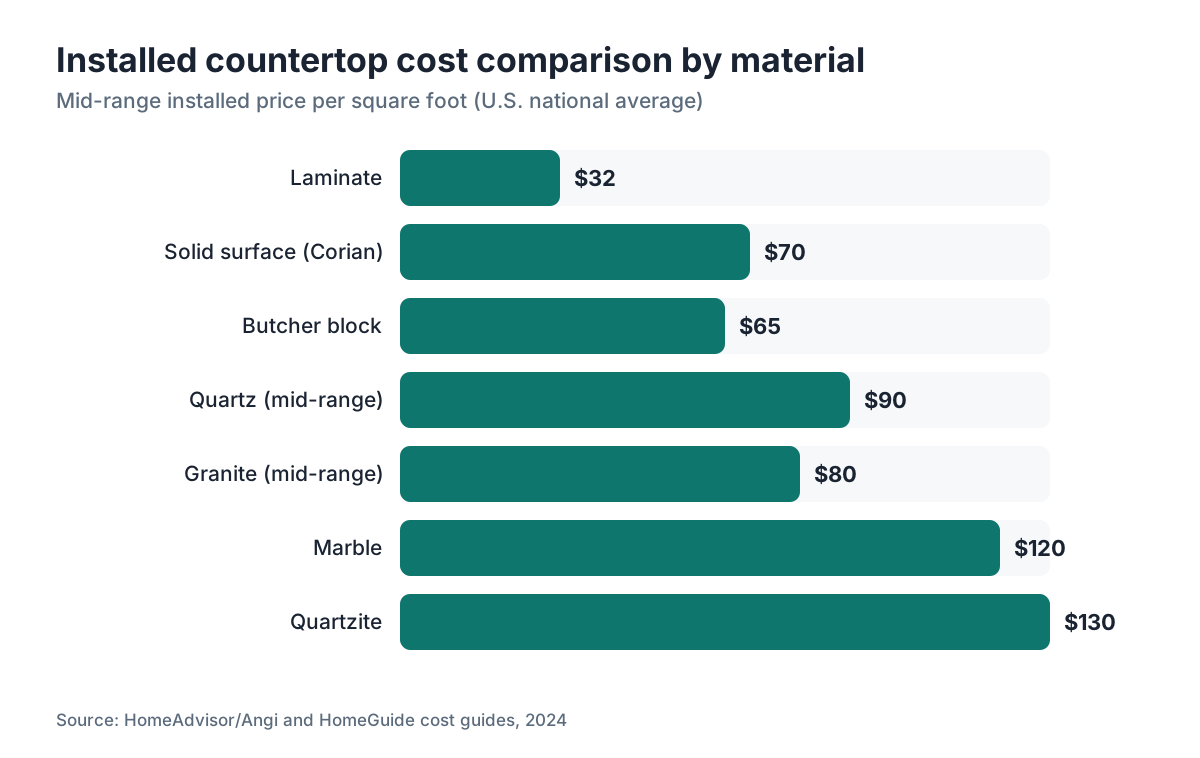
How does quartz compare to other countertop materials in total cost?
Shopping with a real budget? Here's how quartz stacks up against the full range of options [1][3][5]:
| Material | Installed range (per sq ft) | Notes |
|---|---|---|
| Laminate | $15, $50 | Lowest cost, limited durability |
| Butcher block | $35, $100 | Natural warmth, needs oiling |
| Formica | $20, $50 | Brand of laminate, same range |
| Corian (solid surface) | $45, $100 | Repairable, matte look |
| Quartz (engineered) | $50, $150 | Non-porous, consistent look |
| Granite | $45, $140 | Natural variation, needs sealing |
| Marble | $60, $200 | High-end look, high maintenance |
| Quartzite | $70, $200 | Harder than marble, also natural |
Quartz sits in the middle of the premium tier. It costs more than laminate and solid surface, lands near granite, and comes in below exotic natural stones. The non-porous surface and manufacturer warranties (typically 10 to 15 years limited for major brands [2]) appeal to people who want low maintenance with a premium look.
On a tighter budget, laminate countertops have improved a lot in print quality and are worth a look. If you love natural variation and don't mind periodic sealing, read our granite countertops guide before you commit to either material.
Are there hidden costs in a quartz countertop quote?
Yes, several, and they're predictable enough that you can ask about each one upfront.
Tear-out and disposal is almost never in the base quote unless spelled out. Ask directly. Replacing existing stone is its own line item.
Plumbing is always separate. Your fabricator sets the stone; a licensed plumber reconnects the sink. Depending on local rates and whether you're in a licensed-trade state, plumber reconnection runs $150 to $400 [6].
Permits are rarely required for countertop replacement alone. If you're reconfiguring the kitchen layout or adding a new sink, check with your local building department. Most jurisdictions don't require a permit for a straight countertop swap [6].
Sink compatibility is a real issue. An existing drop-in sink may not work with a new countertop. Switching to undermount, which most quartz buyers prefer, often means buying a new sink. Budget $150 to $600 for a decent undermount stainless or composite sink.
Delivery scope. Some fabricators handle delivery and installation in one crew visit. Others deliver and then schedule a separate installation day. Ask how many visits are involved and what happens if they damage the countertop during installation. Most reputable shops replace it at no cost, but confirm it in writing.
Fabrication minimums. If your bathroom vanity is 8 sq ft, you still pay for 15 or 20 sq ft minimum. That's standard in the trade, not a scam, but put the real number in your budget.
Color-matched seam epoxy is usually included but worth confirming. A visible seam that doesn't match the stone is one of the most common complaints in countertop projects.
How do regional prices affect your total quartz countertop cost?
Where you live can shift your total project cost by 30 to 50 percent against the national median. This is real and tracked by home-improvement cost databases that pull actual project invoices [3].
Highest-cost markets: New York City, San Francisco, Seattle, Boston, and Los Angeles. Installed quartz in these metros regularly runs $100 to $150/sq ft for mid-range material because of higher labor rates, shop overhead, and delivery costs.
Lowest-cost markets: parts of the rural Midwest, Southeast, and South Central U.S. Competent independent fabricators quote mid-range quartz at $60 to $80/sq ft installed in markets like Oklahoma City, Memphis, or smaller cities in Ohio and Indiana.
The regional gap is almost entirely labor, not material. Slab prices from national distributors stay consistent across the country because they're set at the distributor level. A Cambria Brittanicca slab costs roughly the same at a Dallas distributor as it does at one in Boston. What changes is the fabricator's hourly rate and overhead.
So get at least three local quotes. Online average data is fine for sanity-checking, but the real number is what fabricators in your zip code charge. A shop 30 miles outside a major city can save you 15 to 20 percent with no meaningful drop in quality.
What should a quartz countertop quote include to be comparable?
A comparable quote itemizes square footage, slab brand and product name, thickness, edge profile, cutouts, seams, demolition, delivery, payment terms, and warranty. A bid that looks $800 cheaper often just left things out.
A complete, comparable quartz quote should list [1]:
- Total square footage quoted (confirm it matches your measurement)
- Slab brand and product name (so you can verify tier)
- Thickness: 2 cm or 3 cm (3 cm is standard for kitchens and stronger for overhangs)
- Edge profile type and linear footage
- Number and type of cutouts (sink, cooktop, outlets)
- Seam locations and count
- Demolition and haul-away: included or not
- Delivery and installation: included or not
- Payment terms and deposit amount
- Warranty terms
If a quote is one line item with a total, ask for the breakdown. Reputable shops hand it over without hesitation. Shops that resist itemizing are often hiding the markup on extras or dodging a direct comparison.
Fabricator software like SlabWise (used by many mid-size shops) produces itemized quote documents showing slab cost, fabrication labor, and installation separately. If your fabricator runs a professional quoting system, you should see that detail automatically.
Deposit norms vary. Most shops ask for 50 percent at contract signing and 50 percent on installation day. Paying 100 percent upfront is unusual and unnecessary. Don't agree to it.
How long do quartz countertops last compared to their cost?
Quartz lasts 25 years or more under normal use, which puts its cost per year near or below cheaper materials once you count replacement. The resins that bind the crushed quartz make the surface harder and more chip-resistant than many natural stones [7]. Some installations from the early 2000s, when engineered quartz first went mainstream, are still in service.
The cost-per-year math favors quartz over budget options. Pay $4,000 for quartz that lasts 25 years and that's $160/year. A laminate countertop at $1,200 replaced in 10 years costs $120/year, close on paper, but with more disruption and labor at replacement. Over 25 years, two laminate replacements plus their install labor often beats the original quartz spend.
The main failure modes are thermal shock (a very hot pot set directly on the surface can crack it) and UV exposure (direct sunlight makes some quartz formulations yellow or discolor over time) [7][2]. Outdoor quartz is generally not recommended. For kitchen countertops that catch direct window sun, ask your fabricator or brand rep about UV stability before picking a slab.
Manufacturer warranties range from 10-year limited (most mid-range brands) to lifetime limited (Cambria offers a lifetime warranty on its product [2]). These cover manufacturing defects, not chips, thermal damage, or normal wear. Read the warranty document before you buy.
Should you buy quartz or granite? Which is the better value?
This is an opinion question, and the honest answer depends on what you value.
Want zero maintenance and a consistent look? Quartz wins. It skips sealing, resists staining better than polished granite, and looks predictable because it's manufactured.
Want natural character and possibly lower material cost? Granite is worth a hard look, especially on mid-range projects where both materials land in a similar band. A granite slab with real movement and depth can cost less than a comparable-looking quartz in some markets.
Reselling in the next five years? Both quartz and granite read as premium to buyers, and neither gives you a clear resale edge over the other according to the National Association of Realtors [8]. Overall kitchen condition and layout matter more.
Worried about bacteria and hygiene? The CDC doesn't treat countertop material as a meaningful factor in home foodborne illness risk. Both quartz and sealed granite count as non-porous enough for food prep. Clean either with soap and water [9].
My actual opinion: for most people doing a kitchen they'll live with for 10-plus years, mid-range quartz is the lower-stress choice. You pick it, install it, and forget about it. Granite has more character but asks you to care about sealing. If you enjoy the ritual of maintaining your home, granite is great. If you want the thing to just work, quartz is the answer.
Frequently asked questions
How much does a quartz countertop cost for an average kitchen?
An average kitchen with 40 to 50 square feet of counter space, mid-range quartz, one sink cutout, and a standard edge profile runs $3,500 to $5,500 installed. Larger kitchens with islands or premium slabs can reach $8,000 to $12,000. Very small kitchens can come in under $2,500, but fabrication minimums usually keep prices from dropping much below $1,800 to $2,000 even for minimal surfaces.
Is quartz or granite cheaper for countertops?
At mid-range grades, granite and quartz sit within $5 to $20 per square foot of each other installed. Entry-level granite is slightly cheaper than entry-level quartz. Premium exotic granites cost as much as or more than premium quartz. Over the life of the countertop, quartz often costs less once you count granite's periodic sealing at $100 to $300 per application.
How do I calculate how much quartz I need?
Measure each countertop section: length in inches times depth in inches, divided by 144, gives square feet. Add 10 percent for waste and cuts. A standard kitchen runs 30 to 60 square feet. Include islands and peninsulas. Give those numbers to your fabricator and they template the actual job before cutting, so your estimate just needs to be close enough to get an accurate quote.
What is the cheapest quartz countertop option?
Builder-grade quartz from distributors like MSI or local importers starts around $50 per square foot installed, sometimes less in lower-cost labor markets. Brands sold through big-box stores (Silestone, Viatera, Allen + Roth) often have entry-level options in this range. The tradeoff is fewer colors, thinner veining patterns, and shorter warranty coverage compared to premium brands.
Does quartz countertop price include installation?
It depends on how the shop quotes. Many fabricators give an all-in installed price that includes material, fabrication, delivery, and setting. Others quote material separately. Always ask. Installation labor alone runs $25 to $50 per square foot on top of material. When comparing quotes from different shops, confirm whether each number is material-only or fully installed before deciding which is lower.
How much does a bathroom quartz countertop cost?
Bathroom vanity tops in quartz run $800 to $2,000 installed for a standard single or double vanity. The catch is fabrication minimums: most shops charge for at least 15 to 20 square feet even if your vanity is only 7 or 8. A 48-inch double vanity top with two rectangular undermount cutouts and a straight edge is a common project and usually lands around $900 to $1,400.
What edge profiles cost extra on quartz?
A straight or eased edge is typically in the base price. Beveled edges add roughly $5 to $15 per linear foot. A full or half-bullnose adds $10 to $20 per linear foot. Ogee and dupont profiles add $20 to $35 per linear foot. A mitered waterfall edge on an island is custom work priced per project, often $300 to $700 or more depending on the number of mitered corners and slab thickness.
Can I install quartz countertops myself to save money?
Technically possible, not advisable. Quartz slabs at 3 cm weigh 18 to 20 pounds per square foot, so you need multiple people and lifting gear. A seam done wrong is visible and structural. Drop or flex a slab during installation and it cracks, and you own that cost. Most fabricators won't sell raw slab to homeowners for DIY because of the liability. The $25 to $50 per square foot install cost is worth it.
How do quartz countertop prices compare to quartzite?
Quartzite is a natural metamorphic stone, not the same as engineered quartz. Quartzite starts around $70 per square foot installed and reaches $200 or more for exotic varieties. It's harder than marble and often mistaken for it. Engineered quartz is $50 to $150 installed. Quartzite needs sealing like granite; engineered quartz does not. For a deeper look at natural stone care, the how to clean quartzite countertops guide covers maintenance.
Do big-box stores like Home Depot or Lowe's offer cheaper quartz?
Sometimes, not always. Big-box retailers carry quartz brands (Silestone, Viatera) and sell them with in-house installation, usually subcontracted to local fabricators. Their prices are often competitive with independent shops at the entry-level and mid tier. The limit is slab selection: you choose from stocked inventory rather than a full distributor slab yard. For standard white or gray quartz, the big-box route is worth a quote. For unique patterns or premium brands, an independent fabricator gives you more options.
What warranty do quartz countertops come with?
Major brands offer limited warranties of 10 to 15 years for most manufacturers, with Cambria offering a lifetime limited warranty on its product. These cover manufacturing defects such as structural failure under normal use. They do not cover chips from impact, thermal cracking from hot pots, UV discoloration, or damage from improper installation. Keep your purchase documentation, because warranty claims go through the brand, not the fabricator.
How accurate are online quartz cost calculators?
Online calculators give reasonable ballpark figures for budgeting, typically within 20 to 30 percent of actual quotes. They can't account for your local labor market, your distributor's specific slab pricing, or job complexity. Use them to set a budget range, then get two or three real fabricator quotes before committing. The closer the calculator is to your market and your job details, the more useful it is.
Is quartz worth the cost over laminate?
For most people planning to stay 10-plus years, yes. Quartz's durability, non-porous surface, and appearance hold up without resealing or replacing. Laminate at $15 to $50 per square foot installed is far cheaper upfront but shows wear sooner and limits your look options. Renovating to sell fast or working with a very tight budget? Quality laminate is a legitimate choice. Outfitting a long-term home? Quartz's cost per year over its lifespan is competitive.
Sources
- HomeAdvisor (Angi), Countertop Installation Cost Guide: Installed quartz countertop prices range from $50 to $150 per square foot; demolition of old counters runs $100 to $600; cutouts add $100 to $250 each
- Cambria, Warranty and Product Information: Cambria offers a lifetime limited warranty on their engineered quartz products; premium Cambria slabs retail at the high end of the quartz price range
- HomeGuide, Countertop Installation Cost Data: Regional labor rates and market location shift total countertop project costs by 30 to 50 percent versus the national median
- Natural Stone Institute, Stone Countertop Care and Maintenance: Natural stone including granite requires periodic sealing; professional sealing runs $100 to $300 per application; engineered quartz does not require sealing
- HomeAdvisor (Angi), Cost to Install Countertops by Material: Laminate countertops install for $15 to $50 per square foot; solid surface (Corian) for $45 to $100; marble for $60 to $200
- U.S. Department of Housing and Urban Development: Countertop replacement alone typically does not require a building permit in most jurisdictions; permit requirements vary by municipality
- NSF International, Countertop Material Standards for Food Safety: Engineered quartz surfaces are non-porous and meet NSF standards for food-contact surfaces; UV exposure is a documented cause of discoloration in some quartz formulations
- National Association of Realtors, Remodeling Impact Report: Kitchen remodels including countertop upgrades have broad resale appeal; neither quartz nor granite shows a clear resale advantage over the other in NAR survey data
- CDC, Food Safety at Home: CDC guidance on food safety in the home does not distinguish countertop material as a meaningful risk factor; soap and water cleaning is recommended for all food-contact surfaces
- Consumer Reports, Kitchen Countertop Buying Guide: Quartz ranked among top performers for durability and stain resistance; granite requires sealing to achieve comparable stain resistance
Last updated 2026-07-09