TL;DR
- Butcher block countertops cost $40, $100 per square foot installed.
- Quartz runs $75, $200 per square foot installed.
- Butcher block is cheaper upfront but needs annual oiling and hates standing water and hot pans.
- Quartz costs more and asks almost nothing of you after install.
- Your best pick depends on how you cook, your budget, and how long you plan to stay in the house.
What does butcher block actually cost, installed?
Butcher block countertops land between $40 and $100 per square foot installed, and that range hides a lot [1]. A basic edge-grain maple slab from a big-box store might come in at $35, $50 per square foot before installation. End-grain walnut from a specialty woodworker can hit $150 per square foot or more once you add templating, cutouts for sinks, and labor.
Wood species drives cost more than almost anything else. Maple and birch are the workhorses: affordable, hard (maple sits at 1,450 on the Janka hardness scale), and easy to find [2]. Walnut runs roughly 50 to 80% more than maple. Teak sits high partly because sustainable sourcing has tightened supply. Exotic species like bamboo composites or reclaimed timber can land anywhere.
Edge grain vs. end grain matters for price too. End-grain blocks show the cut faces of the wood, which makes them gentler on knife edges and more striking to look at, but they use more material and take longer to build. Expect to pay 30 to 50% more for end-grain over comparable edge-grain in the same species.
Installation labor for butcher block runs lower than for stone. A carpenter or experienced installer handles it with woodworking tools rather than diamond blades and wet saws. Labor typically adds $10, $30 per square foot depending on your region and the layout. Undermount sinks need precise routing and add cost. A basic drop-in sink cutout might be $50, $75. Undermount routing in hardwood can run $150, $250 per cutout.
For a typical 40-square-foot island or counter run, expect a total installed cost of $1,600, $4,000 for butcher block. Most homeowners land in the $2,000, $3,000 range for standard species and edge-grain construction [1].
What does quartz cost, installed?
Quartz (engineered stone, not to be confused with quartzite, which is natural stone) runs $75, $200 per square foot installed for most residential projects [3]. That wide range reflects brand tier, slab thickness, edge profile, and regional fabrication costs more than it reflects raw material differences.
Entry-level quartz from manufacturers like MSI or Vadara starts around $55, $75 per square foot for the material alone. Mid-range Silestone or Caesarstone runs $80, $120 per square foot installed. Premium brands like Cambria or Dekton (a sintered surface, technically) can push $150, $200+ per square foot once you add complex edges, sink cutouts, and mitered waterfall details.
Fabrication and installation for quartz is more involved than for wood. Stone shops run CNC routers, diamond saw blades, and polishing equipment that cost real money to buy and maintain. That cost flows through to you. A standard kitchen with 45 square feet of countertop, one undermount sink cutout, and an eased edge typically costs $3,375, $6,750 installed in quartz, with most mid-range projects landing around $4,500.
Edge profiles add $15, $50 per linear foot over a basic eased edge. A full bullnose or ogee profile on a 30-linear-foot kitchen perimeter can add $450, $1,500 to the bill. Mitered waterfall edges on an island add more, sometimes $1,000, $2,500 for a single waterfall side depending on slab matching and labor time.
The gap between butcher block and quartz widens at the premium end. A high-end quartz kitchen can cost three times what a mid-grade butcher block install costs. At the entry level the gap shrinks, maybe 30 to 50%, but quartz still costs more.
Side-by-side cost comparison: butcher block vs quartz
The table below uses realistic installed cost ranges for a standard 40-square-foot project with one sink cutout and a basic edge profile. Numbers reflect U.S. national averages. Your local market can shift these 15 to 25% either way [1][3].
| Factor | Butcher Block | Quartz |
|---|---|---|
| Material cost (per sq ft) | $20, $80 | $50, $150 |
| Installation labor (per sq ft) | $10, $30 | $20, $50 |
| Total installed (per sq ft) | $40, $100 | $75, $200 |
| 40 sq ft project (total) | $1,600, $4,000 | $3,000, $8,000 |
| Sink cutout (undermount) | $100, $250 | $150, $350 |
| Annual maintenance cost | $20, $60 (oil) | Near zero |
| Refinishing / resurfacing | $200, $600 (every 5 to 10 yrs) | Not applicable |
| Expected lifespan (well-maintained) | 20 to 50+ years | 25 to 30+ years |
Sticker price isn't the whole story. Butcher block you sand and refinish every decade can outlast the kitchen it lives in. Quartz can chip at edges, and while the surface itself never needs sealing, chips and cracks are hard to repair invisibly. A chipped quartz edge near a sink often means living with it or replacing the whole slab.
Comparing butcher block countertop vs granite cost? Granite falls between quartz and high-end butcher block: $60, $150 per square foot installed, with the same stone-shop fabrication overhead as quartz [4]. See our full guide to granite countertops for a breakdown of granite-specific pricing factors.
Which material holds up better day to day?
Durability is where the real cost conversation happens. A cheaper material that fails in five years isn't cheaper.
Quartz is hard, non-porous, and basically stain-proof with no sealing. It scores around 7 on the Mohs hardness scale [3]. Wipe coffee, wine, and tomato sauce off with a damp cloth and forget about it. The weakness is heat: quartz resins can discolor or crack under sustained heat above roughly 300°F (150°C), so a pan straight from the oven is a real risk. Thermal shock from a cold slab meeting sudden heat can crack it too.
Butcher block is softer (maple sits around 1,450 lbf on the Janka scale, while quartz reads as effectively unmeasurable as a composite) [2]. It scratches. It stains if you leave standing water or red wine on it. It cracks or warps if it gets saturated with water again and again, which is why putting butcher block next to or wrapping a kitchen sink is a choice you should make with eyes open. The upside: heat from a pan doesn't hurt it the way it hurts quartz. And surface scratches sand out. A quartz scratch is permanent.
For households with kids who bang things, a busy prep surface with lots of knife work, and strong feelings about never sealing anything, quartz wins on durability. For someone who cooks seriously, loves a natural material, and will oil the surface every three to six months, butcher block is a legitimate long-term choice. The USDA's Food Safety and Inspection Service says properly maintained wood surfaces are safe for food contact when cleaned correctly, though it warns against leaving raw meat juices on any wooden surface for long stretches [5].
Water is the daily stressor for butcher block. Kitchens with a farm sink or heavy prep that throws a lot of splash will wear butcher block much faster than a dry prep area or an island set away from the sink.
How does maintenance affect total cost over time?
Maintenance is one of those cost categories homeowners keep underweighting when they compare materials.
Butcher block needs oil. Food-safe mineral oil costs about $10, $20 per quart, and a typical countertop takes one to two applications per year once the initial conditioning phase is done (most fabricators recommend weekly oiling for the first month after install). Over ten years that's maybe $100, $200 in materials and a couple hours of your time annually. A beeswax-and-oil finish like board butter costs about the same. Refinish by sanding and re-oiling every seven to ten years and you add $200, $600 for a professional job, or a weekend of your own labor.
Quartz maintenance is close to zero. No sealing, no oiling, just regular cleaning. Harsh abrasives and highly alkaline or acidic cleaners can dull the finish over time, so you skip those, but that costs nothing. The one surprise cost with quartz is chip repair: a dropped cast-iron pan can chip an edge, and professional chip repair runs $100, $300 depending on size and location. Results are usually good but not invisible.
Over a fifteen-year ownership window, a mid-grade butcher block counter with routine care might cost $500, $800 more in maintenance than quartz, mostly in refinishing labor. That narrows the upfront cost advantage. It still leaves butcher block cheaper in most scenarios.
Fabricators tracking job profitability on quartz vs. wood installs run a different cost model too. Quartz jobs carry higher material costs but predictable margins once CNC programming and fabrication times are dialed in. Shops using software like SlabWise can run nesting and quoting on quartz slabs to cut offcut waste, which feeds straight into job margin. Wood countertop jobs tend to be simpler on the shop floor but need different tooling.
Does butcher block or quartz add more home value?
Resale value is one of the most overhyped factors in the countertop conversation, and the honest answer is that the data is weak.
Remodeling Magazine's Cost vs. Value report tracks kitchen remodel ROI, and a major kitchen remodel (which includes countertops) recouped about 38 to 48% of its cost at resale in recent years depending on region and project scope [6]. That's for the whole kitchen, not countertops alone, so pulling out countertop material as a line item is basically impossible from published data.
What agents and appraisers say anecdotally: quartz reads as a premium material to most buyers because it's the dominant high-end surface in new construction and staged homes right now. Butcher block reads as a stylistic choice that some buyers love and others see as work. In a luxury listing, butcher block on an island paired with quartz perimeter counters can be a selling point. Butcher block as the only surface in a $600,000 home might give some buyers pause.
Renovating to sell in the next two years? Quartz is the safer bet for broad appeal. Renovating for yourself and planning to stay ten or more years? Pick what you actually want to live with, because countertop trends shift faster than ownership cycles anyway.
What are the best situations for choosing butcher block?
Butcher block makes the most sense in a few specific spots.
An island or prep area away from the primary sink is where butcher block shines. You get the warmth, the knife-friendly surface, and you dodge the water saturation problem that shortens its life near a sink. Many kitchens pair butcher block on the island with quartz or granite countertops on the perimeter, and that combination is both practical and good to look at.
Budget-constrained full kitchen renovations are another strong case. If you've got $3,000 total for countertops and the kitchen has 50 square feet of counter space, quartz simply isn't in the budget at $75, $200 installed. Butcher block at $40, $70 per square foot makes the project work. Laminate countertops are cheaper still, but butcher block offers a quality and refinishability laminate can't match.
Renters or homeowners doing a temporary renovation before a larger remodel sometimes pick butcher block because it's easier to remove and cheaper to write off. It can also go in as a DIY project for someone with basic woodworking skills, which is genuinely hard with quartz (cutting and polishing quartz safely needs specialized tools and silica dust controls).
Historic or farmhouse-style kitchens often look off with the flat, uniform surface of engineered quartz. Butcher block fits the aesthetic without forcing it.
What are the best situations for choosing quartz?
Quartz earns its premium in high-use kitchens where nobody wants to think about maintenance.
Families with young kids who wipe everything with a damp cloth and never want to oil or seal anything will be happier with quartz. The non-porous surface means spills that sit overnight (and they will) don't soak in and stain. Busy households that cook hard and have the budget will find the durability-to-effort ratio tough to beat.
Kitchens with integrated or undermount sinks in the counter run itself (not an island) are where butcher block most often fails. Around a sink, even well-oiled wood swells, cracks, and eventually delaminates once water gets under the finish. Quartz around a sink shrugs off water completely.
Large, open-plan kitchens where visual consistency across 80 to 100+ square feet of counter matters tend to favor quartz. Wood has natural variation, which some love, but it's harder to match across multiple slabs or sections. Quartz comes engineered for consistency. Cambria countertops in particular are known for tight color matching between slabs, which matters for large runs.
Buyers aiming at the top of their local market for resale should lean quartz. The material signals quality to the widest audience in most U.S. markets right now, and it photographs well for listings.
How does the cost compare to other countertop materials?
Setting butcher block and quartz against the full countertop field helps you calibrate the decision.
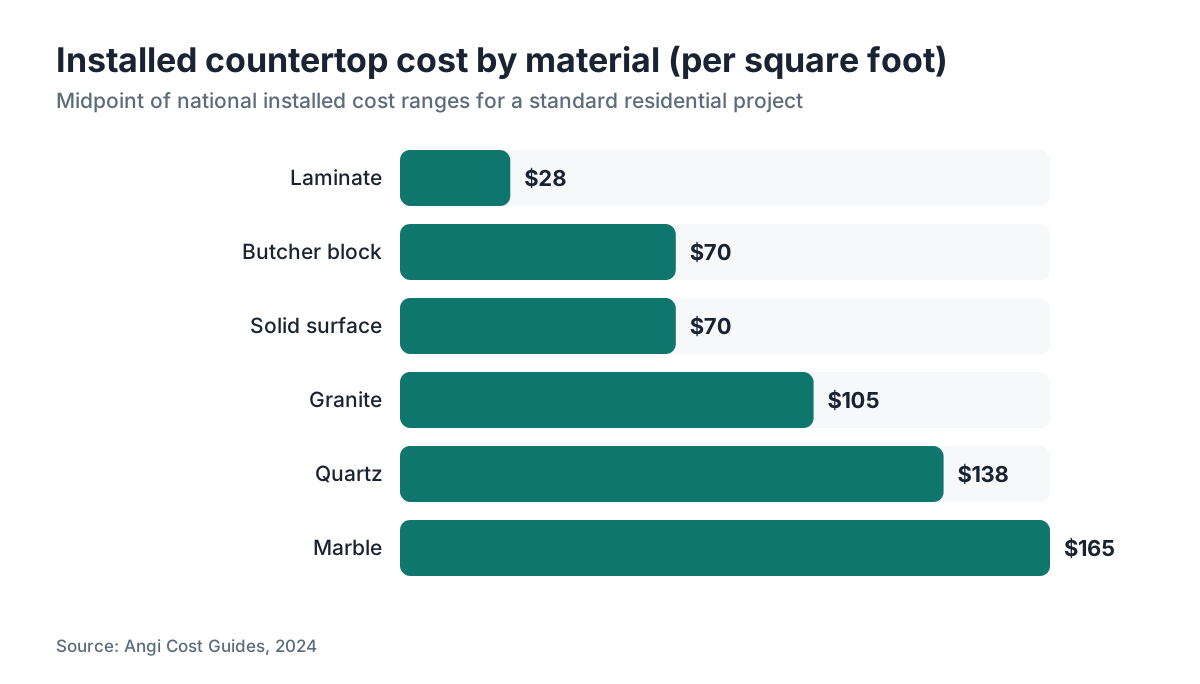
Laminate (Formica being the most recognized brand) is the cheapest option: typically $15, $40 per square foot installed [7]. It's far cheaper than either butcher block or quartz, but it can't be refinished, edges chip, and it reads as a budget material to most buyers.
Granite sits in a range that overlaps a lot with quartz: $60, $150 per square foot installed depending on slab grade and local market [4]. Natural granite needs periodic sealing (every one to three years) and carries the same fabrication overhead as quartz. Some grades of granite cost less than entry-level quartz from premium brands. Our granite countertops guide covers slab grading and pricing in detail.
Marble runs more than both: $100, $200+ per square foot installed, and it needs more careful maintenance than granite [8]. See our marble countertops guide for the full picture.
Corian and other solid-surface materials fall between laminate and butcher block: $45, $95 per square foot installed, with the advantage of sinks that integrate without a visible joint and repairs that are easier than stone [9]. Our Corian countertops guide has more.
| Material | Installed cost range (per sq ft) | Maintenance |
|---|---|---|
| Laminate | $15, $40 | Very low |
| Butcher block | $40, $100 | Moderate (oiling) |
| Solid surface (Corian) | $45, $95 | Low |
| Granite | $60, $150 | Low (periodic sealing) |
| Quartz | $75, $200 | Very low |
| Marble | $100, $200+ | Moderate (sealing + care) |
For a complete look at all kitchen countertops, including the less common materials, the linked guide compares the full field.
What questions should you ask before getting a quote?
Getting an accurate quote, for either material, starts with knowing a few things before you call anyone.
Measure your square footage yourself first. Length times width for each section, add them up. Don't forget the backsplash if you're including it. Most shops quote in square feet (often with a minimum, commonly 15 to 25 square feet for quartz fabrication), and having your own number lets you sanity-check the quote [10].
Know your sink type and location. Undermount sinks cost more to cut for in any material. Drop-in (overmount) sinks are cheaper and easier. Farmhouse (apron-front) sinks need specific front-edge treatment and may change how much counter material you need.
Ask about edge profiles and what's in the base price. Many quartz fabricators include a basic eased or straight edge in the quoted price. Upgraded profiles (ogee, waterfall, mitered) are add-ons. Same with butcher block: standard square edges are cheapest, routed or radius edges cost more.
For butcher block, ask whether the shop seals or oils the surface before delivery or whether that's on you. Some suppliers deliver unfinished slabs. Ask what finish they recommend and what the warranty looks like if you use a different one.
For quartz, ask about lead time. Custom quartz from a fabrication shop commonly takes two to six weeks from template to installation [10]. Prefab butcher block from a big-box store can be cut and installed in days.
Fabricators running quoting software can generate line-item breakdowns instantly, which makes it much easier for homeowners to see what they're paying for. If a quote shows up as a single lump sum with no breakdown, it's fair to ask for itemization. SlabWise's quoting tool, built for fabricators, produces exactly that kind of transparent line-item estimate, which some shops share directly with customers.
Can you DIY butcher block or quartz installation?
DIY installation is realistic for butcher block and basically not recommended for quartz.
Butcher block weighs roughly 15 to 25 pounds per square foot depending on species and thickness, manageable for one or two people. Cut it with a circular saw and a sharp blade, rout edges with a standard router, and fasten it to cabinets with figure-8 fasteners or clips that let the wood move. The main cautions: leave room for seasonal wood movement (wood expands and contracts with humidity), don't glue the slab rigidly to the cabinets, and make sure the cabinets are level before you start. Many manufacturers publish install guides that cover these steps.
Quartz is a different story. Slabs weigh 18 to 25 pounds per square foot for 3cm material, so a 50-square-foot kitchen counter can weigh 900 to 1,250 pounds total. Cutting quartz needs diamond blades and usually a wet saw or CNC router to keep it from overheating and cracking. More to the point, cutting quartz throws off crystalline silica dust, a serious inhalation hazard. OSHA's permissible exposure limit for respirable crystalline silica is 50 micrograms per cubic meter as an 8-hour time-weighted average [11], and dry cutting without proper controls can blow past that fast. Engineered stone fabrication has been linked to an outbreak of accelerated silicosis in young workers, which has drawn OSHA enforcement attention and pushed California to restrict dry cutting entirely [12]. For a homeowner doing a one-time install, the risk is lower than for a daily production worker, but the need for wet cutting and a respirator is real.
Bottom line: DIY butcher block is a legitimate weekend project for someone with basic skills. DIY quartz belongs with a shop that has proper equipment and dust controls. The savings from DIY install ($10, $30 per square foot) rarely justify the risk with quartz.
How do fabricators think about the cost difference?
If you're a fabricator reading this, the butcher block vs. quartz question comes up in customer conversations constantly, and knowing the real cost structure helps you give honest advice that builds trust.
Quartz jobs have higher material costs but very predictable shop labor once you've got CNC programming dialed in. The margin killer is slab waste: a complex layout with lots of cutouts and non-rectangular runs can waste 30 to 40% of a slab, and that waste costs you money if you're not nesting efficiently. Quartz slabs typically run 55 to 65 square feet, and poor nesting on a $500 slab adds up across a week's worth of jobs.
Wood jobs are simpler on the floor but need different equipment and skills. Edge routing on hardwood is fast. Undermount sink cutouts in wood take care and the right tooling. Lead times are generally shorter because you're not waiting on stone shop scheduling. The downside is that wood is harder to systematize at volume, and callbacks for cracking or delamination near sinks are a real risk if customers aren't warned about water.
For shops doing both materials, the countertop installation workflow differs enough that many shops specialize in one or the other instead of running both at volume. If you're trying to nail down your cost-per-job for quartz vs. wood installs, tracking actual shop time per square foot by material type for a month tells you more than any industry average.
Frequently asked questions
Is butcher block cheaper than quartz countertops?
Yes, in most cases. Butcher block runs $40, $100 per square foot installed; quartz runs $75, $200 per square foot installed. For a typical 40-square-foot kitchen, butcher block saves $1,400, $4,000 upfront compared to quartz. Maintenance costs for butcher block (oiling, occasional refinishing) narrow the gap slightly over a fifteen-year period but rarely erase it.
How much does butcher block cost compared to quartz per square foot?
Butcher block material costs $20, $80 per square foot depending on species and grain type, plus $10, $30 per square foot for installation. Quartz material costs $50, $150 per square foot, plus $20, $50 per square foot for fabrication and installation. The all-in installed cost difference is typically $30, $100 per square foot in favor of butcher block.
Does butcher block increase home value as much as quartz?
Quartz generally appeals to a broader range of buyers and is the dominant premium surface in new construction, so it tends to score higher in broad-market resale scenarios. Butcher block can be a selling point in farmhouse or transitional kitchens, especially on an island paired with stone perimeter counters. Neither material has rigorous independent resale ROI data specific to countertop choice alone.
How long does butcher block last compared to quartz?
Well-maintained butcher block can last 20 to 50 years or more because it can be sanded and refinished as surface wear builds up. Quartz typically lasts 25 to 30+ years but cannot be refinished; chips and deep scratches are permanent. The practical lifespan of either material in a real kitchen depends heavily on use intensity and whether you follow the manufacturer's care guidelines.
Can you put butcher block next to a sink?
You can, but it's a risk. Repeated water exposure near a sink will make butcher block swell, crack, and eventually delaminate at seams or around cutouts unless it's carefully sealed and kept dry. Many designers and fabricators recommend using quartz or granite around the sink and saving butcher block for islands or dry prep areas away from the primary water source.
What is the cheapest countertop option if butcher block and quartz are both over budget?
Laminate (Formica and similar) is the most affordable option at $15, $40 per square foot installed. It handles moisture better than butcher block and costs far less than quartz, but it can't be refinished and chips at edges. Solid-surface materials like Corian fall in the $45, $95 per square foot range and let sinks integrate without a visible joint. Both are legitimate choices for budget-driven projects.
How often does butcher block need to be oiled or refinished?
Most fabricators recommend oiling new butcher block weekly for the first month, then monthly for the first year, then as needed, typically once every three to six months for an active kitchen. A full sand-and-refinish is usually needed every seven to fifteen years depending on how hard the surface is used. Food-safe mineral oil costs $10, $20 per quart and a typical countertop uses a fraction of that per application.
Is quartz worth the extra cost over butcher block?
For high-traffic kitchens with kids, heavy cooking, or an integrated sink in the counter run, quartz's low maintenance and water resistance usually justify the extra cost. For a dry prep island, a budget-focused project, or a homeowner who likes natural materials and doesn't mind annual maintenance, butcher block is a perfectly rational choice. The premium for quartz is real, typically $35, $100 more per square foot installed.
Can butcher block countertops be repaired if they get scratched or stained?
Yes, and this is one of butcher block's genuine advantages. Light scratches sand out with 120 to 220 grit sandpaper followed by re-oiling. Deeper gouges can be filled or sanded down more aggressively. Stains that haven't penetrated deeply often sand out too. Quartz scratches and chips cannot be repaired invisibly; the best you get with a chip repair kit is a close match that's usually visible under direct light.
How does butcher block cost compare to granite?
Granite typically costs $60, $150 per square foot installed, putting it between mid-range butcher block and mid-range quartz. Entry-level granite can be competitive with premium butcher block on price. Unlike butcher block, granite needs periodic sealing every one to three years. Unlike quartz, granite is a natural stone with unique veining in every slab. See the full granite countertops guide for slab grade details.
How long does it take to get butcher block vs quartz installed?
Prefabricated butcher block from a big-box store can be cut and installed in one to two days. Custom butcher block from a woodworker takes one to three weeks. Quartz from a fabrication shop typically takes two to six weeks from template to installation: a templating appointment, a week or more for fabrication, then the installation day. Rush fabrication is sometimes available at a premium.
Is DIY installation realistic for butcher block or quartz?
Butcher block is a realistic DIY project for someone with basic carpentry skills and the right tools. Quartz is not recommended for DIY: slabs are extremely heavy (900+ pounds for a typical kitchen), cutting requires diamond blades and wet saws, and dry cutting generates hazardous silica dust. OSHA's permissible exposure limit for crystalline silica is 50 micrograms per cubic meter as an 8-hour average, a threshold easily exceeded without proper controls.
What wood species is best for butcher block countertops, and does it affect cost?
Maple and birch are the best value: hard, affordable, widely available, and food-safe. Maple costs $20, $50 per square foot for the material. Walnut is more expensive, roughly $50, $100+ per square foot, with a darker color that many find more dramatic. Teak and other exotic species run higher still. End-grain construction in any species costs 30 to 50% more than edge-grain because it uses more material and takes longer to build.
Do quartz countertops need to be sealed?
No. Quartz is an engineered material with a non-porous resin binder, so it does not need sealing. This is one of the main practical differences from natural stone: granite and marble need periodic sealing, quartz never does. The tradeoff is that quartz can be damaged by sustained heat above roughly 300°F and by some harsh chemical cleaners. Regular cleaning with mild soap and water is all the maintenance quartz needs.
Sources
- HomeAdvisor / Angi, Butcher Block Countertops Cost Guide: Butcher block countertops cost $40, $100 per square foot installed on average; total installed project costs for a standard kitchen typically run $1,600, $4,000
- USDA Forest Products Laboratory, Wood Handbook (Chapter 5: Mechanical Properties of Wood): Hard maple (Acer saccharum) has a Janka hardness of approximately 1,450 lbf, making it a standard benchmark for hardwood durability
- HomeAdvisor / Angi, Quartz Countertops Cost Guide: Quartz countertops cost $75, $200 per square foot installed; quartz rates approximately 7 on the Mohs hardness scale as an engineered composite
- HomeAdvisor / Angi, Granite Countertops Cost Guide: Granite countertops cost $60, $150 per square foot installed depending on slab grade and regional fabrication costs
- USDA Food Safety and Inspection Service, Food Safety at Home: USDA guidance notes that properly maintained wood surfaces are safe for food contact when cleaned correctly, recommending against leaving raw meat juices on wooden surfaces for extended periods
- Remodeling Magazine, Cost vs. Value Report: A major kitchen remodel recouped approximately 38 to 48% of its cost at resale in recent report years depending on region
- HomeAdvisor / Angi, Laminate Countertops Cost Guide: Laminate countertops cost $15, $40 per square foot installed, making them the most affordable common countertop option
- HomeAdvisor / Angi, Marble Countertops Cost Guide: Marble countertops cost $100, $200+ per square foot installed and require more careful maintenance than granite
- HomeAdvisor / Angi, Solid Surface Countertops Cost Guide: Solid-surface countertops such as Corian cost $45, $95 per square foot installed
- National Kitchen and Bath Association, Kitchen and Bath Market Index: Custom quartz fabrication from template to installation typically takes two to six weeks; most shops use a minimum square footage requirement for quartz jobs, commonly 15 to 25 square feet
- OSHA, Occupational Exposure to Respirable Crystalline Silica (29 CFR 1926.1153): OSHA's permissible exposure limit for respirable crystalline silica is 50 micrograms per cubic meter as an 8-hour time-weighted average
Last updated 2026-07-09