TL;DR
- Laminate kitchen countertops run $20 to $60 per square foot installed, the cheapest countertop you can buy.
- Modern laminate copies stone, wood, and concrete well enough to fool a listing photo.
- It shrugs off stains and never needs sealing, but it scratches, blisters under a hot pan, and can't be repaired.
- Best for tight budgets, rentals, and secondary kitchens.
What are laminate kitchen countertops and how are they made?
Laminate countertops start as layers of kraft paper soaked in phenolic resin, stacked under heat and pressure, then bonded to a particleboard or MDF substrate. The top decorative layer is a printed sheet sealed under a melamine wear layer. That wear layer is the part you touch every day.
The print underneath can look like granite, marble, butcher block, concrete, or a flat solid color. Manufacturers photograph real stone slabs or wood grain at high resolution, then reproduce those images at whatever repeat pattern their tooling allows. Better lines use longer repeats so the pattern doesn't obviously loop, which makes seams harder to spot.
The whole assembly is a high-pressure laminate (HPL) when it's built at 1,000 to 1,500 psi, or a low-pressure laminate (LPL) when it's bonded at lower pressures. HPL is thicker, denser, and tougher. Quality kitchen work uses HPL [1].
The finished product shows up two ways. Post-form countertops arrive from the factory with the laminate already bonded to the substrate and a curved front edge built in. Flat laminate sheet stock is what a fabricator glues to a custom substrate on-site. Post-form is cheaper and faster. Custom sheet work costs more labor but buys you square edges, waterfall profiles, and odd dimensions.
How much do laminate kitchen countertops cost?
Material and installation together land between $20 and $60 per square foot. On a 40-square-foot kitchen (roughly a 10-foot run of 25-inch-deep counter), that's $800 to $2,400 all in. No other countertop material gets you a finished kitchen at that number.
Here's the breakdown. Post-form laminate sheet at a home center runs $15 to $30 per linear foot for a standard 25-inch-deep slab, so a 10-foot section is $150 to $300 in material. Flat sheet stock sold as a 4x8 panel costs $50 to $200 depending on brand and finish. Labor to cut, edge, and install runs $30 to $40 per linear foot through most fabricators.
At Lowe's, in-stock post-form sections run roughly $18 to $25 per linear foot, and their installation packages run $35 to $60 per linear foot including removal of the old counter [2]. Home Depot's numbers track close.
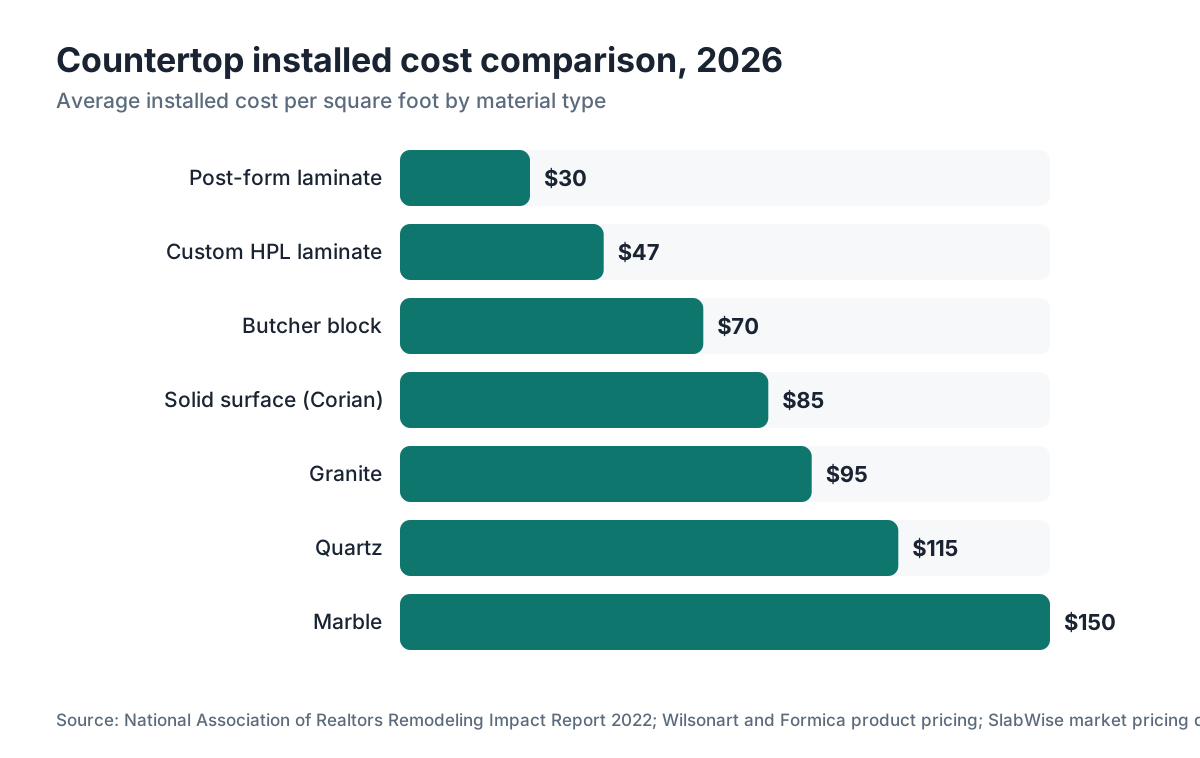
Compare that with quartz at $80 to $150 installed, granite at $60 to $130, or marble pushing $100 to $200. Laminate isn't the cheap end of the same category. It's a different category.
What pushes laminate pricing up? Edges, mostly. A basic eased or post-form curved edge is baked into the slab price. A square stacked edge with solid backing strips, or a custom ogee routed from laminate, adds labor. Matte suede and leathered stone textures run $10 to $20 more per sheet. Special-order colors add two to four weeks of lead time.
| Material | Avg. installed cost per sq ft | Scratch resistance | Heat resistance | Repairability |
|---|---|---|---|---|
| Post-form laminate | $20, $40 | Low-medium | Low | Poor |
| Custom HPL laminate | $35, $60 | Medium | Low | Poor |
| Quartz | $80, $150 | High | Medium | Poor |
| Granite | $60, $130 | Very high | Very high | Medium |
| Butcher block | $40, $100 | Low | Medium | Excellent |
| Solid surface (Corian) | $50, $120 | Medium | Medium | Good |
What laminate countertop brands are worth knowing?
Formica is the name people reach for, and it earned that. The company has made HPL since 1913 and still ships to hundreds of fabricators. Their 180fx line uses a long-repeat pattern that does a decent job faking granite veining. Formica countertops sell through most sheet distributors and big-box stores.
Wilsonart is the other heavyweight. Their Wilsonart HD line uses a textured surface that cuts glare and hides fingerprints. Their Compact series runs 12mm thick instead of the standard decorative thickness, which makes it popular for commercial work and waterfall edges that need structural rigidity without a substrate.
Nevamar and Pionite fill out the big domestic suppliers. All four ship similar core product, but their pattern libraries don't match. Hunting a specific stone look? Flip through catalogs from at least two brands before you settle.
Here's a thing most people don't know. Much of the post-form at Lowe's and Home Depot comes from domestic manufacturers who buy HPL rolls from Formica or Wilsonart, then laminate them to particleboard at their own plants. The label may say the store's private brand. The decorative sheet underneath often came from those same two makers.
On the budget end, some imported laminate runs cheaper, but wear-layer quality control gets spotty. For a kitchen that sees daily use, I'd stick with a named brand.
How durable is laminate compared to stone and solid surface?
Laminate earns honest marks in some areas and honest demerits in others. Here's where it lands.
Stain resistance is genuinely good. The melamine wear layer is non-porous, so coffee, wine, and tomato sauce wipe off clean if you catch them within an hour or two. Laminate never needs sealing. That alone makes it lower-maintenance than granite or quartzite, which need periodic sealing to stay stain-resistant [3].
Heat is where laminate loses. Set a hot pan straight on the surface and you get a permanent blister or discoloration. The substrate is particleboard or MDF, and the adhesive bond fails at temperatures a cast iron skillet hits in 30 seconds. Use trivets. Every time.
Scratching is a real weakness too. A knife dragged across laminate leaves a mark. Butcher block sands back. Solid surface buffs out. Laminate does neither. When it's damaged, it stays damaged, and you replace it.
Water at seams and edges is the other failure mode. The laminate itself is waterproof, but the particleboard under it swells when it gets wet. Seams near sinks, chipped edges, and cutouts with weak caulk are all entry points. Installed well, with silicone at every seam and a proper front-edge seal, a laminate counter runs 10 to 15 years easy. Installed poorly, it starts swelling in two or three.
Impact resistance is middling. Drop a heavy pot on a corner and you can chip the substrate or crack the top layer. That chip is forever.
So: laminate handles everyday prep and cleanup better than its price suggests. It fails at heat, sharp edges, and water. All three are manageable if you install and use it with a little care.
What styles and finishes can you get in laminate countertops?
The pattern library from major brands runs into the hundreds now. You can get laminate that reads as Calacatta marble, black absolute granite, reclaimed barn wood, or poured concrete. How convincing it looks comes down to the repeat length and how well the surface texture matches what it's imitating.
Finish matters as much as pattern. Gloss looks bright and modern but shows fingerprints and micro-scratches fast. Matte hides daily wear but can look flat under some lighting. Suede and leathered textures split the difference, and they've become the default kitchen pick over the last few years for exactly that reason.
Edge profiles are the other design lever. Post-form comes with a gentle coved backsplash and a rounded front nose built in. That profile reads dated to a lot of people. Custom laminate lets you run square edges, bevels, or routed profiles. For a square stacked edge, the fabricator builds up the front with strips of matching laminate glued to a thicker substrate, then wraps it. Done right, it looks sharp and current.
Color-core laminate (sometimes called solid-core) is worth knowing. Standard laminate has a brown core that shows as a thin line at cut edges. Color-core material is tinted through its full thickness to match the face, so that brown line disappears. It costs more and looks cleaner on any exposed edge.
Length limits are real. Standard sheets run 4x8 or 4x12 feet. Go longer than that and you get a seam. A good installer puts the seam where you'll notice it least and fills it with color-matched caulk. A seam is still a seam.
Can you install laminate countertops yourself?
Post-form installation is genuinely DIY-friendly. The skills you need: cutting with a circular saw or jigsaw, routing the sink cutout, scribing the backsplash to an uneven wall, and pulling mitered corners together with draw bolts. None of that is beyond a patient weekend DIYer.
The miter joint at an inside corner is the hard part. Home centers sell pre-mitered end caps, but a full miter joining two pieces needs a biscuit joiner or a router jig to get the faces flush. A misaligned miter jumps out and hides badly.
Custom flat-sheet work is another animal. Gluing laminate to a substrate cleanly means contact cement, a good roller, and the knowledge that contact cement grabs on first touch with zero repositioning. One crooked press and the sheet is scrap. Fabricators use slip sheets to position the laminate before it touches down, a trick worth practicing before you try it on your kitchen.
For countertop installation of any material, measuring is where mistakes get expensive. Cabinets are rarely square. The wall behind the counter is rarely flat. Scribing, shimming, and working around out-of-square corners is what separates a clean result from one with visible gaps.
Basic straight run, pre-made post-form slab, simple sink cutout? DIY makes sense. L-shapes, odd angles, or custom edges? Hire a fabricator.
How do fabricators quote and cut laminate countertops?
For a shop, laminate is lower-margin than stone but faster to run. No waterjet, no diamond blade, no polishing line. A table saw, a router table, and a laminate trimmer handle most of it.
Quoting means measuring the job in square feet or linear feet, specifying the sheet product and substrate, adding edge-build labor, and pricing any field miters or complex cutouts. Most shops quote post-form by the linear foot because that's how the material comes. Custom sheet work gets quoted by the square foot with separate line items for edges.
Nesting isn't the concern it is with stone slabs, since laminate sheet comes in standard sizes and you buy full sheets. A fabricator still plans cuts to hold down waste, especially on multi-run jobs using one pattern, because the repeat has to align at the miters.
Shops running quoting software (SlabWise, for one, has laminate modules alongside its stone tools) can template these jobs digitally and spit out a cut list. Most laminate work is simple enough that experienced hands still do it on paper.
Turnaround on custom laminate work is typically 3 to 7 days, quicker than stone. Special-order sheet lead time is the usual holdup.
Margins on laminate installation run 30 to 45% for shops that price it right. The trap: underpricing labor on complex edges because the material is cheap. That's where shops lose money on laminate.
How do you maintain and clean laminate countertops?
Daily cleaning is warm water and dish soap on a soft cloth. Rinse, dry, done. Laminate is non-porous, so there's nothing to sanitize past the surface.
For stubborn stains, a paste of baking soda and water left on for a few minutes usually lifts it. Skip abrasive scrubbers. Steel wool and scouring powders scratch the wear layer and leave microscopic grooves that trap dirt and go dull.
Bleach cleaners and acetone can strip or discolor some finishes, matte surfaces especially. Check the manufacturer's care guide before you reach for anything stronger than dish soap.
The one maintenance habit that matters: keep water off seams and edges. Wipe puddles around the sink. Don't let water pool at the base of the backsplash. Recaulk seams when the silicone starts pulling away, usually every 3 to 5 years.
There's no refinishing option. Laminate doesn't sand back, reseal, or polish. When it looks worn or scratched, you replace it. That's the honest cost of the low price.
What are the most common problems with laminate countertops?
Swelling is the top failure. Water gets under the laminate at a seam, edge, or cutout, the particleboard drinks it up, and the counter lifts and bubbles. Once it starts, replacing that section is the only real fix.
Heat blistering is second. A hot pan, a slow cooker running for hours, even a coffee maker parked in the same spot can pop the adhesive loose and lift a bubble. Not fixable.
Edge delamination happens when the edge strip wasn't bonded right or the bond fails over time from moisture cycling. Catch it early and you re-glue with contact cement. Wait too long and the substrate is already damaged, so it's replacement.
Color fading is rarer with modern laminate than it was 20 years ago, but direct UV (a counter under a south-facing window with no shade) can shift lighter colors over a decade.
The overlooked one is post-form warping near heat sources. Slabs next to dishwashers, which vent hot steam, sometimes warp at the front edge over time. Part installation issue (the installer should leave a small gap), part material limit.
None of these are unique to cheap laminate. They hit mid-grade material too when the install is bad or the kitchen habits are rough. Good installation heads off most of them.
Is laminate a good choice for a kitchen renovation?
It depends on what you're trying to do. Here's how I'd think it through.
Budget under $3,000 for a whole kitchen counter? Laminate is your only realistic path to a complete, clean result. Quartz or granite at that number buys you one short run, not a full kitchen.
Renovating a rental? Laminate is the obvious call. Cheap to replace when tenants beat it up, and modern stone-look patterns photograph well enough for a listing.
Selling in two or three years? This is where it gets interesting. Appraisers and buyers in upper-mid and high-end markets may ding laminate in a kitchen that otherwise has new appliances, cabinets, and floors. A National Association of Realtors report found that kitchen upgrades including countertops recoup a meaningful share of cost at resale, but the return swings hard by market [4]. Where the comps have quartz, laminate can push buyers toward the other listing.
Cook heavily? Own a stand mixer, pull heavy pots off the stove, work at the counter for hours? The scratch and heat weaknesses will wear on you. Granite or marble countertops take abuse better. Butcher block takes heat better and sands clean.
Secondary kitchen, laundry room counter, kids' craft space, or anywhere you want clean and functional without spending much? Laminate is exactly right. I wouldn't talk anyone out of it there.
How does laminate compare to Formica, Corian, and other alternatives?
"Formica" is to laminate what "Kleenex" is to tissue. Formica is a brand of HPL. When someone says their kitchen has Formica counters, they mean laminate. Same product category, one just a brand name that went generic [5].
Corian is a different thing entirely. It's a solid surface material made from acrylic polymer and alumina trihydrate, homogenous through its full thickness, which means scratches and burns actually sand out. It costs more ($50 to $120 installed) but buys real repairability that laminate can't touch. Corian countertops are worth a look if you want a synthetic material with durability closer to stone.
Quartz and granite are stone-category products. They share laminate's non-porous quality (quartz) or near-non-porous quality (granite when sealed) but cost two to three times more. They beat laminate on heat and scratching. They're harder to DIY because of weight.
Concrete counters give you a custom look but need sealing, can crack, and run $80 to $150 installed. Not a budget play.
For the wider view of the material landscape, see the kitchen countertops overview, or the laminate countertops material guide if you want to go deeper on the material science.
Where can you buy laminate countertops and what should you ask for?
For post-form slabs, home centers are the easy source. Lowe's carries pre-cut lengths in standard depths (25 inch for base cabinets) and standard lengths (4, 6, 8, 10, 12 foot), plus end caps, backsplash strips, and draw bolts. Buy it and take it home the same day for a straightforward job.
Home Depot stocks similar inventory. Both stores offer measure-and-install service where a third-party installer templates the space and comes back with a fabricated post-form counter. That service runs $300 to $600 for an average kitchen on top of materials, and quality rides on the local contractor they use.
For flat sheet stock, go to a laminate distributor or a kitchen-and-bath supply house. They stock full 4x8 and 4x12 sheets from Formica, Wilsonart, Pionite, and Nevamar. Minimum order is usually one sheet. These distributors also sell the contact cement, substrate, and edge banding you'll need.
Custom fabrication (cut to size, custom edges, built-in substrate) comes from a local countertop shop. Search for fabricators in your area who handle laminate specifically. Stone-only shops sometimes decline laminate work or farm it out. A shop that does laminate regularly has a router table, post-form bending equipment, and the pattern books from the major manufacturers.
When you call, ask three things: do you do HPL custom work, what's your lead time, and can I see samples. Any competent shop has a sample library. Ask to see the finish on a scrap before you commit to a pattern. Screen colors lie.
Frequently asked questions
How long do laminate kitchen countertops last?
With good installation and reasonable care, laminate countertops last 10 to 20 years. The main threats are water infiltration at seams and edges, which swells the particleboard substrate, and heat damage from pots and slow cookers. Kitchens that use trivets consistently and keep seams caulked reach the upper end of that range. Scratches accumulate over time and don't reverse.
Can laminate countertops be repaired if they're scratched or chipped?
Scratches and chips are essentially permanent. You can fill a chip with color-matched laminate filler compound, which helps cosmetically but doesn't restore the surface. Scratches don't sand out the way wood does. This is the sharpest practical difference between laminate and solid surface materials like Corian, which buff and sand clean. When laminate looks worn, replacement is the real answer.
What is the difference between post-form and custom laminate countertops?
Post-form countertops arrive pre-built from a factory with the laminate already bonded to the substrate, a curved front nose, and often a coved backsplash. They're cheaper and faster to install. Custom laminate work uses flat HPL sheet stock glued to a cut-to-size substrate, which allows square edges, unusual dimensions, and more design flexibility. Custom work costs more in labor but looks less dated.
Can you put a hot pan directly on laminate countertops?
No. Heat is laminate's worst weakness. Hot pans, slow cookers, and even a coffee maker running in the same spot daily can blister the laminate or pop the adhesive bond loose, lifting the surface. The damage is permanent. Always use trivets and hot pads. This is a non-negotiable part of living with laminate, and anyone who glosses over it is doing you a disservice.
Is laminate countertop installation a DIY job?
Straight runs with pre-made post-form slabs are genuinely DIY-friendly. You need a jigsaw for the sink cutout, a circular saw for length cuts, and patience for scribing to the wall. Inside-corner miters are the hard part and need either pre-mitered sections or a router jig. Custom flat-sheet work (gluing HPL to a substrate with contact cement) is harder and unforgiving; one crooked press and the sheet is scrap.
How do you prevent laminate countertop seams from showing?
A tight miter joint starts with accurate cuts. The two faces have to align perfectly before the draw bolts pull them together. After assembly, a bead of color-matched laminate seam filler pressed into the joint and wiped flush cuts visibility. Longer-repeat print patterns help because the pattern mismatch at the seam is less obvious. Placing seams away from eye-level sight lines and high-traffic zones is the most practical move.
What are the most popular laminate countertop colors and patterns in 2026?
Warm neutrals dominate orders now: greige concrete looks, warm white marble patterns, and walnut wood grain are the top three categories at most distributors. The Calacatta-style white-with-gold-vein pattern has held demand for five years with no sign of fading. Matte and suede finishes have largely replaced gloss as the kitchen default. Solid dark colors like charcoal and navy have a smaller but loyal following in modern and industrial designs.
Do laminate countertops need to be sealed?
No. Laminate's melamine wear layer is non-porous and needs no sealer, ever. This is one of its genuine advantages over natural stone. Granite and quartzite need periodic sealing to stay stain-resistant; laminate doesn't. The only ongoing maintenance is keeping silicone caulk intact at seams and edges so water never reaches the substrate.
How much does it cost to replace laminate countertops with quartz?
Replacing laminate with quartz typically adds $60 to $110 per square foot to your budget (quartz installed at $80 to $150 vs. laminate at $20 to $60). On a 40-square-foot kitchen, that's an extra $2,400 to $4,400. Removing the existing countertops adds $200 to $500 depending on how they're attached. Whether it's worth it depends on how long you plan to stay and whether buyers in your market expect quartz.
Can you install laminate countertops over existing countertops?
Not recommended in most cases. Laminate-over-laminate fails because contact cement doesn't bond well to an existing wear layer. Laminate over tile can work if the surface is perfectly flat and the tiles are flush, but grout lines telegraph through and cause cracking over time. The right move is to remove the old countertop, check the cabinet substrate for level and square, and install fresh. The labor you save skipping removal isn't worth the failure risk.
What is the best edge profile for laminate countertops?
For a contemporary kitchen, a square stacked edge (a square build-up) looks cleanest. It needs a fabricator to build the edge thickness with substrate strips and wrap them in matching or contrasting laminate. For a budget DIY job, the post-form rounded nose is functional and forgiving. Avoid very thin knife-edge profiles because they chip easily. Color-core laminate helps any profile by killing the brown substrate line at the edge.
Are laminate countertops bad for resale value?
In most mid-to-upper price-tier markets, laminate reads as a negative signal to buyers comparing your home to others with quartz or granite. The National Association of Realtors tracks that kitchen upgrades including countertops return a meaningful share of cost at resale, but the signal effect of laminate depends heavily on your market. In entry-level neighborhoods where comps also have laminate, it's a non-issue. Where quartz is standard in that price range, laminate can hurt your listing.
What thickness of laminate sheet is right for countertops?
Standard decorative HPL for countertop faces runs 0.028 to 0.048 inch thick (roughly 0.7 to 1.2 mm). It bonds to a 3/4-inch particleboard or MDF substrate, and the total assembly is about 1.5 inches with a build-up edge. Wilsonart's Compact series runs 12mm (about 1/2 inch) through its full thickness, which allows waterfall edges without a separate substrate. Thicker compact laminate costs more but gives fabricators more design options.
How do laminate countertops affect indoor air quality?
Particleboard and MDF substrates under laminate can off-gas formaldehyde, especially when new. The EPA limits formaldehyde emissions from composite wood products used indoors under the Toxic Substances Control Act (TSCA) Title VI [6]. Products certified to TSCA Title VI or CARB Phase 2 standards meet those limits. When buying, ask whether the substrate is TSCA Title VI compliant. Most products sold in the US market after 2019 are.
Sources
- Formica Group, High Pressure Laminate Technical Data: HPL is manufactured at 1,000 to 1,500 psi with heat and phenolic resin, producing a denser, more durable sheet than low-pressure laminate
- Lowe's Companies, Countertop Installation Services: Post-form laminate countertops at Lowes run roughly $18, $25 per linear foot for materials, with installation packages available
- University of Minnesota Extension, Selecting Kitchen Countertops: Natural stone countertops including granite and quartzite require periodic sealing to resist staining; laminate is non-porous and requires no sealing
- National Association of Realtors, 2022 Remodeling Impact Report: Kitchen upgrades including countertop replacement recoup a meaningful portion of cost at resale; the return varies by market and material
- Formica Group, About Formica: Formica is a brand of high-pressure laminate; the brand name has become a generic term for laminate countertop products
- U.S. EPA, Toxic Substances Control Act Title VI, Formaldehyde Standards for Composite Wood Products: TSCA Title VI sets emission limits on formaldehyde from composite wood products including particleboard and MDF used in interior applications
- Wilsonart, HPL Product Specifications: Wilsonart's Compact series laminate runs 12mm through its full thickness, suitable for waterfall edges without a separate substrate
- U.S. Census Bureau, American Housing Survey: Laminate countertops remain among the most common countertop materials in U.S. housing stock, particularly in homes built before 2005
- Home Innovation Research Labs, Builder Practices Survey 2023: Quartz has surpassed laminate as the most common countertop material specified in new single-family construction; laminate remains dominant in multifamily and affordable housing
- California Air Resources Board, Composite Wood Products Program: CARB Phase 2 standards set stringent formaldehyde emission limits for particleboard and MDF, adopted as the federal baseline under TSCA Title VI
Last updated 2026-07-09