TL;DR
- Laminate countertops cost $15 to $40 per square foot installed, so the average kitchen project runs $300 to $1,800 depending on layout complexity, edge profile, and local labor rates.
- That is roughly one-third to one-fifth the installed cost of granite or quartz.
- Post-form slabs are cheapest.
- Custom sheet laminate with built-up edges costs more but still beats stone by a wide margin.
What does laminate countertop installation cost in 2025?
For a typical kitchen with 30 to 50 square feet of countertop, expect to pay $450 to $1,500 all-in. That range covers material and labor but assumes a straightforward layout with one or two straight runs and a standard post-form edge. Complex L-shapes, peninsula cutouts, or undermount sink cutouts push the number toward the high end. Very small jobs, like a bathroom vanity or laundry room counter, can run as low as $200 to $350.
The installed price per square foot breaks down like this: materials run $5 to $25 per square foot depending on whether you choose stock post-form slabs or custom sheet laminate, and labor runs $10 to $20 per square foot in most U.S. markets. High cost-of-living metros like San Francisco or New York can push labor to $25 per square foot or more. Rural markets sometimes come in below $8.
Those numbers align with what cost-tracking platforms consistently report. HomeAdvisor's 2024 cost data puts the national average cost to install new countertops (all materials combined) at roughly $3,000, but laminate projects cluster at the lower end of that distribution because material cost is so much lower than stone [1].
The single biggest variable most homeowners underestimate is tearout. Removing old countertops adds $50 to $150 to most jobs, and that fee is often listed as a line item rather than baked into the square-foot rate. Ask your installer specifically.
What drives the price up or down?
Material grade is the first lever. Post-form laminate, the kind that comes pre-bonded to particleboard with a rounded front edge and a small backsplash already attached, costs $5 to $10 per square foot in materials alone. You buy it in standard widths (25 inches for base cabinets) and your installer cuts it to length. It is cheap because the factory has already done most of the work.
Custom sheet laminate costs $12 to $25 per square foot in materials because the installer bonds the laminate to a substrate of their choice, routes the edge profile, and builds up thicker edges if you want a modern look. Brands like Formica and Wilsonart sell the sheet stock; fabricators do the rest. You can see the full range of Formica countertops styles and grades if you want to understand what the brand naming means in practice.
Edge profiles matter more than most people think. A simple eased edge costs nothing extra. A waterfall edge or a laminate-wrapped thick edge can add $10 to $25 per linear foot because of the extra fabrication time. On a 20-foot perimeter, that edge upgrade alone is $200 to $500.
Cutouts are priced per opening. A drop-in sink cutout typically runs $50 to $100. An undermount sink is harder with laminate because the substrate needs to be sealed carefully, so that cutout can run $100 to $175. Cooktop cutouts are similar. Odd-angle miters for diagonal corners or angled islands add labor time and material waste, which shows up as a higher square-foot rate or a separate line item.
Substrate quality is worth a conversation with your installer. Moisture-resistant (MR) particleboard costs a little more than standard particleboard but is worthwhile near sinks and dishwashers. Plywood substrates cost more still but hold screws better if the cabinets ever need to be repositioned. In a rental or flip context, standard particleboard is probably fine. In a house you plan to own for 20 years, the upgrade is worth it.
How does laminate compare to granite on cost?
This is the most-searched comparison in countertop cost research, so let's be direct.
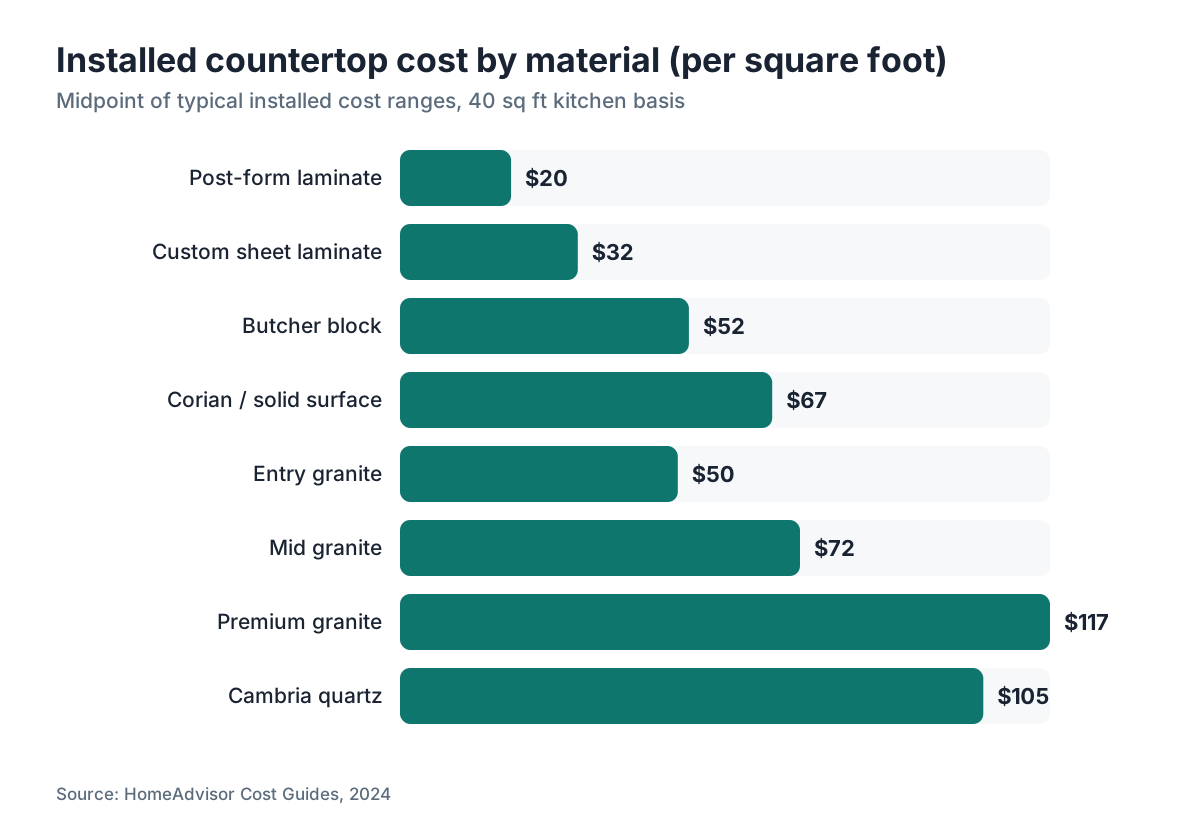
Laminate installed runs $15 to $40 per square foot. Granite installed runs $40 to $100 per square foot for standard slabs, and premium granites with complex edge work or extra-thick profiles push past $150 [2]. On a 40-square-foot kitchen, that gap is $1,000 to $3,000 in real money.
The table below summarizes the cost-of-laminate-vs-granite comparison across the full range:
| Material | Installed cost (per sq ft) | 40 sq ft kitchen estimate |
|---|---|---|
| Post-form laminate | $15, $25 | $600, $1,000 |
| Custom sheet laminate | $25, $40 | $1,000, $1,600 |
| Entry-level granite | $40, $60 | $1,600, $2,400 |
| Mid-range granite | $60, $85 | $2,400, $3,400 |
| Premium granite | $85, $150+ | $3,400, $6,000+ |
For a full breakdown of granite pricing and what moves that number, the granite countertops guide covers slab grading, thickness, and edge pricing in detail.
The laminate vs granite countertop cost gap does narrow when you account for longevity. Granite, sealed properly, can outlast laminate by decades. High-quality laminate realistically lasts 15 to 25 years before it chips, delaminates, or looks dated. Granite in a kitchen that gets heavy use can last 50 years with periodic resealing. So the per-year cost of ownership is closer than the upfront price suggests, though laminate still wins on a pure dollars-per-year basis unless you're extremely confident you'll keep the countertop that long.
For budgets under $1,200, laminate is almost always the right answer. For budgets over $2,500, stone starts to make sense. The middle zone is where the decision gets genuinely interesting, and personal aesthetic preference usually tips it.
What does labor cost, and what does the installer actually do?
Labor for laminate countertop installation runs $10 to $20 per square foot in most U.S. markets. On a 40-square-foot kitchen that is $400 to $800 in labor, which is a real chunk of the total bill.
What are you paying for? The installer measures and cuts the countertop sections to fit your space, makes the miter joints at corners (these need to be tight and flat or they look terrible), cuts out sink and cooktop openings, applies silicone or construction adhesive to seat the counter on the cabinet tops, and secures it from below with screws through the cabinet stretchers. A skilled installer also scribes the back edge to fit against a wall that is not perfectly straight, which requires a planer or belt sander and takes real time.
Post-form installs go faster than custom sheet work. An experienced installer can complete a straightforward post-form kitchen in two to four hours. Custom sheet laminate with built-up edges and a complex layout might take six to eight hours, which explains much of the price difference.
Most installers will not reconnect your plumbing. That is a separate plumber call that costs $100 to $250 for a basic reconnect. Some general contractors bundle it; most countertop-only installers do not. Ask before you book.
You can find more detail on what the full installation process looks like, regardless of material, in the countertop installation guide.
Can you DIY laminate countertop installation, and what does that save?
Yes, and it is one of the more DIY-accessible countertop projects. Post-form laminate is particularly forgiving because you are mostly cutting straight lines with a circular saw (blade facing down to avoid chipout) and making miter joints with a jigsaw or router. The main tools you need are a circular saw with a fine-tooth blade, a jigsaw for cutouts, a belt sander for scribing, a miter bolt kit for joining sections, and basic caulk tools.
A successful DIY post-form install saves roughly $400 to $800 in labor on a standard kitchen. That is real money. The risk is the miter joint: if it is not flat and tight, it will gap and collect water and bacteria, and it looks obviously wrong. Practice on scrap first if you have never made one.
Custom sheet laminate DIY is harder. Bonding sheet laminate to a substrate with contact cement means working fast and accurately, and you cannot reposition once the two glued faces touch (contact cement grabs on first contact). Routing the edge profiles requires a router table or steady freehand skill. Most people who attempt DIY custom sheet laminate for the first time end up with at least one panel they redo, which means extra material cost.
Material cost for a DIY post-form kitchen: roughly $200 to $500 in materials for a 40-square-foot job, depending on grade and brand. Home Depot and Lowe's stock common widths and colors; custom colors and widths usually require ordering from a specialty distributor.
The Bureau of Labor Statistics wage data for 2023 shows tile and stone setters earn a median wage of about $21 per hour nationally, which helps explain why labor quotes come in where they do [3].
What does a laminate countertop cost broken down by project type?
Not all rooms are kitchen-sized, and not all kitchens are the same. Here is a realistic breakdown by project type:
Small bathroom vanity (8 to 15 sq ft): $150 to $450 installed. The small size works against you on labor minimums; many installers charge a flat $150 to $200 minimum trip charge regardless of how small the job is.
Standard kitchen (25 to 45 sq ft): $400 to $1,500 installed. This is the most common range and the one most national cost averages reflect.
Large kitchen with island (60 to 90 sq ft): $900 to $2,800 installed. The island adds a separate countertop section with four finished edges, which costs more per square foot than a perimeter run.
Laundry room or utility counter (10 to 20 sq ft): $200 to $600 installed, again subject to trip-charge minimums.
Full home refresh (multiple rooms, 100+ sq ft): Buying multiple rooms at once sometimes earns a 10 to 15 percent discount on materials and may spread the trip charge across more square footage, lowering effective cost per square foot.
If you are comparing laminate to other budget-friendly options, butcher block countertops run $35 to $70 per square foot installed, which is higher than laminate but brings real wood warmth. Corian countertops run $45 to $90 per square foot installed. Both are more than laminate but below granite.
How much does laminate countertop material cost on its own?
If you are buying materials only (DIY install or supplying to your own contractor), here is what to budget:
Stock post-form laminate at home improvement stores runs $20 to $60 per linear foot for the standard 25-inch width. A 10-foot run costs $200 to $600 in material. Colors and finishes vary by store stock; standard whites, grays, and woodgrains are almost always in stock, while specialty patterns usually require a special order.
Sheet laminate (the raw sheet you bond to your own substrate) runs $0.50 to $2.50 per square foot for the laminate sheet itself, but you also need the substrate (particleboard or plywood at $1 to $3 per square foot) and contact cement ($0.50 to $1 per square foot applied). Total material cost for custom sheet laminate DIY is roughly $5 to $15 per square foot before labor, which explains why hired custom sheet work runs $25 to $40 all-in.
Wilsonart and Formica are the two dominant brand names. Both sell through specialty distributors and big-box stores. Wilsonart's HD line and Formica's 180fx line (which mimics stone grain patterns) are popular upgrades that run 20 to 40 percent more than standard grades. They look noticeably better, especially at close range, and are worth considering if the rest of your kitchen has been updated.
For comparison, Cambria countertops (a premium quartz brand) run $80 to $130 per square foot installed. That context makes the material cost gap vivid.
What add-on costs should you budget for?
A few line items catch homeowners off guard:
Tearout and haul-away: $50 to $200 depending on the old material. Stone countertop tearout is at the high end because slabs are heavy and disposal is awkward.
Plumbing disconnect and reconnect: $100 to $300. Your installer almost certainly does not do this. Budget it separately.
Cabinet leveling: If your cabinets are not level, the countertop will not sit flat, and seams will be visible. Leveling can add $50 to $150 and is often discovered on installation day.
Backsplash work: If you remove a tile backsplash to install new counters, you often expose bare drywall that needs patching and repainting. Budget $100 to $300 for that work if you plan to change the backsplash too.
Permit fees: Countertop-only replacement almost never requires a permit in U.S. jurisdictions. If the project involves moving plumbing, a permit may be required. Check with your local building department; the relevant authority is typically your city or county building and safety office [4].
If you want to understand the full kitchen countertops decision, from material selection through installation, the broader guide covers the whole landscape.
How do you get an accurate quote for laminate countertop installation?
An accurate countertop quote rests on a real measurement, a written spec for material grade and edge, and a clear list of what is and is not included.
For measurements, either the installer visits and measures (usually free for jobs over a certain size) or you measure yourself. Measure the depth of each run and the total linear footage along the back wall. For L-shapes, measure each leg separately. Note the location and size of your sink and any cooktop cutouts.
Spec the job before you call for quotes. Know which post-form color you want, or which laminate grade, so installers are quoting the same thing. Vague quotes are useless for comparison.
Ask every installer specifically: Does the quote include tearout? Does it include sink cutout? Does it include caulking at the wall and sink? Will you reconnect my plumbing or do I need a plumber? These questions surface the hidden costs before, not after, you sign.
For fabricators running multiple laminate jobs, tools that automate the quoting step, including material cost and labor by job type, cut the time spent on each bid significantly. SlabWise's quoting module handles exactly this, letting shops price post-form and custom sheet jobs without rebuilding the math from scratch every time.
Get at least three quotes. On a $500 to $1,500 job, a quote spread of $200 to $400 is common. The lowest quote is not always the best; check reviews specifically for laminate installation work, because the miter joint quality separates good installers from mediocre ones.
Is laminate a good long-term value, or should you spend more?
Laminate is genuinely good value for the right situation. It is not a compromise material anymore; modern textured laminates with matte finishes and realistic stone or wood patterns are hard to distinguish from the real thing at a glance. Consumer Reports has rated mid-range laminate countertops as competitive with entry-level solid surface on durability for normal kitchen use [5].
The weak points are real, though. Laminate chips at edges, especially on corners. It cannot handle a hot pan directly (it will scorch or bubble). The surface scratches, and the scratches are permanent. You cannot sand and refinish it the way you can wood.
For a rental property, a first home, or a kitchen you plan to renovate in five to ten years, laminate is probably the smart call. For a forever home where you will see the counters every day for 20 years, the extra spend on quartz or granite starts to look reasonable, not extravagant.
The middle path that often gets overlooked: laminate perimeter counters paired with a butcher block island, or laminate in secondary bathrooms and quartz in the primary kitchen. You get the wow material where you use the space most and save money everywhere else. That strategy can cut total project cost by 30 to 40 percent compared to putting quartz throughout.
For anyone curious where laminate sits in the full material ecosystem, the laminate countertops overview covers durability, maintenance, and design options in detail. The kitchen countertops guide covers the whole comparison across stone, solid surface, wood, and laminates.
How do you maintain laminate countertops to get the most years out of them?
Maintenance is simple, which is part of the appeal. Wipe up spills promptly, especially acidic ones like lemon juice or vinegar, which can dull the finish over time. Clean with a damp cloth and mild dish soap. Avoid abrasive scrubbers; they scratch the surface and make it harder to keep clean.
Never cut directly on laminate. Use a cutting board every time. The scratch resistance of laminate is decent but not knife-proof, and cuts in the surface create paths for moisture to work into the substrate.
The edges are the vulnerability. Once an edge chips or the laminate starts to peel at a seam, water infiltrates the particleboard and it swells, which speeds up failure. A small chip can be repaired with color-matched laminate repair paste (around $8 to $15 at hardware stores); a delaminating seam usually signals that the section needs replacement.
Pay attention to the area around the sink. Even with a good caulk bead, that joint needs to be checked and refreshed every year or two. Silicone caulk is flexible and water-resistant; latex caulk is the wrong choice at the sink-to-countertop joint. A tube of silicone runs $5 to $10 and an hour of work extends countertop life by years.
With reasonable care, good-quality laminate realistically lasts 15 to 25 years. Post-form laminate in a rental with rough use might need replacement in 10 years. Custom sheet laminate with a thick substrate in a careful household can go 30 years.
Frequently asked questions
What is the average cost to install laminate countertops in a standard kitchen?
For a kitchen with 30 to 50 square feet of countertop, the installed cost runs $450 to $1,500. That covers both materials and labor. The low end reflects post-form laminate in a simple layout; the high end reflects custom sheet laminate with edge profiles and multiple cutouts. National averages from cost-tracking platforms put laminate consistently at the lower end of the countertop price spectrum.
How much does laminate countertop installation cost per square foot?
Post-form laminate runs $15 to $25 per square foot installed. Custom sheet laminate runs $25 to $40 per square foot installed. Materials account for roughly $5 to $15 of that; labor makes up the rest. High cost-of-living markets like New York or San Francisco push toward the top of those ranges; rural markets often come in below them.
How much cheaper is laminate than granite?
Granite installed runs $40 to $150 per square foot depending on slab grade and edge profile. Laminate runs $15 to $40 installed. On a 40-square-foot kitchen, that is a savings of roughly $1,000 to $3,500. The per-year cost gap narrows because granite lasts significantly longer, but laminate still wins on upfront cost by a wide margin.
Can I install laminate countertops myself to save money?
Yes, especially with post-form laminate, which involves straight cuts and a miter bolt joint. A successful DIY install saves $400 to $800 in labor on a standard kitchen. The skill requirement is moderate; the miter joint is the hardest part. Custom sheet laminate with contact cement bonding is harder and less forgiving for beginners. Budget extra material for practice pieces.
Does laminate countertop installation require a permit?
Replacing countertops without moving plumbing almost never requires a permit in U.S. jurisdictions. If the project involves relocating drain lines or water supply, a plumbing permit may be required. The authority is your local building department. When in doubt, a quick call to the city or county building office clarifies it in minutes and costs nothing.
What is included in a laminate countertop installation quote?
It varies by contractor, which is why you should ask explicitly. A complete quote should include cutting and fitting the countertop, miter joints at corners, sink and cooktop cutouts, adhesive and fastening, and caulking at the wall. Tearout of the old countertop, plumbing disconnect and reconnect, and backsplash patching are usually separate line items. Get every scope item in writing before signing.
How long does laminate countertop installation take?
A post-form laminate kitchen installs in two to four hours for an experienced installer. Custom sheet laminate with complex layouts, built-up edges, or multiple cutouts takes four to eight hours. The kitchen is typically usable the same day once adhesive cures, though you should wait 24 hours before putting heavy items on the counter and re-caulk around the sink after 48 hours.
How long do laminate countertops last?
With reasonable care, 15 to 25 years is a realistic expectation. Post-form laminate in a high-traffic rental might need replacement in 10 years. Good-quality custom sheet laminate on a plywood substrate in a careful household can last 30 years. The edges and the area around the sink fail first. Keeping the sink caulk fresh and avoiding direct knife cuts significantly extends service life.
What is the cost difference between post-form and custom laminate countertops?
Post-form laminate runs $15 to $25 per square foot installed. Custom sheet laminate runs $25 to $40. The gap comes from fabrication time: post-form arrives pre-bonded with edge treatment done; custom sheet laminate requires bonding, edge routing, and more skilled labor. The custom route gives you more edge options, a thicker look, and any laminate pattern or color available, more than stock items.
Is laminate worth it, or should I spend more on quartz or granite?
For budgets under $1,200, laminate is almost always the right answer. For forever homes where the kitchen sees heavy daily use, spending $2,500 to $4,000 on quartz or granite starts to make sense on a per-year cost basis. The middle strategy many homeowners overlook: laminate in secondary spaces (bathrooms, laundry) and stone in the primary kitchen, cutting total project cost 30 to 40 percent.
What affects the cost of laminate countertop installation the most?
Material grade (post-form vs. custom sheet) is the biggest variable. Edge profile choice adds $10 to $25 per linear foot for anything beyond a basic edge. Cutouts for sinks and cooktops add $50 to $175 each. Local labor rates vary significantly by market. Tearout of the old countertop adds $50 to $200. Complex layouts with multiple corners or angles increase labor time and material waste.
How do I get the best price on laminate countertop installation?
Get at least three quotes with the same scope spelled out in writing. Specify the exact material, edge, and whether tearout and plumbing are included. Buying more square footage at once sometimes earns a 10 to 15 percent materials discount. Scheduling in off-peak months (typically late winter) may get you a better labor rate. Do not automatically pick the lowest bid; check installer reviews specifically for laminate miter joint quality.
Can you put laminate countertops over existing countertops?
Installing laminate directly over existing countertops (overlay install) is possible but not usually recommended. It raises the counter height, which may affect appliance fit, and any unevenness in the old surface telegraphs through. If the existing counter is solid and level, some installers will do it and you save the tearout fee. Most prefer a clean substrate for a flat, watertight result. Ask your installer for their recommendation after they see the existing surface.
What brands of laminate countertops are most common?
Formica and Wilsonart are the two dominant sheet laminate brands in the U.S. Both sell through home improvement stores and specialty distributors. Formica's 180fx line and Wilsonart's HD line are their premium tiers, mimicking stone patterns convincingly and running 20 to 40 percent more than standard grades. For post-form slabs, most home improvement stores sell their own branded or white-labeled post-form products alongside name-brand options.
Sources
- HomeAdvisor, Countertop Installation Cost Guide (2024): National average cost to install countertops across all materials is approximately $3,000, with laminate projects clustering at the lower end of that range.
- U.S. Bureau of Labor Statistics, Occupational Employment and Wage Statistics: Tile and Stone Setters (SOC 47-2044), May 2023: Tile and stone setters (which includes countertop installers) earned a national median hourly wage of approximately $21 in the most recent BLS Occupational Employment and Wage Statistics survey.
- U.S. Department of Housing and Urban Development, Local Building Codes and Permits: Building permits for countertop replacement without moving plumbing are rarely required; permit requirements are governed by local city and county building departments.
- Formica Corporation, Product Specification Data: Formica and Wilsonart are the two dominant brand names in U.S. sheet laminate; premium lines such as Formica 180fx and Wilsonart HD are priced 20 to 40 percent above standard grades.
- National Kitchen and Bath Association (NKBA), Kitchen and Bath Market Index 2024: Countertop material selection data and installed price benchmarks for U.S. kitchen renovation projects.
- Wilsonart, HD Laminate Product Guide: Wilsonart HD laminate is sold through home improvement stores and specialty distributors; it runs at a premium price tier versus standard laminate grades.
- U.S. Environmental Protection Agency, Indoor Air Quality: Building Materials: Laminate substrate materials including particleboard may off-gas formaldehyde; moisture-resistant (MR) particleboard is available as an upgrade for wet-area applications.
- National Association of Home Builders (NAHB), What Home Buyers Really Want 2023: Kitchen countertop material preferences and renovation budget benchmarks for U.S. homeowners.
Last updated 2026-07-09