TL;DR
- Stone countertops for kitchens run roughly $40 to $200+ per square foot installed, depending on the material, edge profile, and your region.
- Granite is the most widely installed natural stone.
- Quartzite and marble look similar but behave very differently.
- Engineered quartz costs about the same as mid-grade granite but needs no sealing.
- Every stone has real trade-offs worth knowing before you buy.
What types of stone countertops can you put in a kitchen?
The short answer: more than most showrooms carry. The materials that show up most often in kitchens are granite, marble, quartzite, soapstone, and engineered quartz (sometimes called quartz composite). Slate and limestone appear occasionally, usually in farmhouse or historic renovations. Each of these is a genuinely different material, more than a different look.
Granite is an igneous rock, meaning it formed from cooled magma. It's hard, resists scratching well, and takes a polished finish beautifully. Granite countertops goes deep on grades and pricing if granite is your front-runner.
Marble is a metamorphic rock made mostly of calcite. It etches from acids, including citrus juice and vinegar, which leaves dull spots. Those spots are chemically dissolved stone, not a stain you can wipe off. Beautiful, but unforgiving in a working kitchen. More on that at marble countertops.
Quartzite confuses people constantly because it sounds like engineered quartz but is completely different. True quartzite is a metamorphic rock formed from sandstone under heat and pressure. It's harder than marble and doesn't etch as easily, though softer quartzite varieties still can. See how to clean quartzite countertops for the daily-use details.
Soapstone is a talc-rich metamorphic stone, very soft on the Mohs scale (typically 1 to 2), but it doesn't etch from acids. It scratches, and those scratches sand right out. Over time it builds a patina that most owners end up loving. How to clean soapstone countertops covers the oiling routine.
Engineered quartz is 90 to 94 percent crushed quartz bound with polymer resin [1]. It's manufactured to be consistent, non-porous, and low maintenance. Brands like Cambria and Silestone dominate this category. Read a brand-specific breakdown at Cambria countertops.
For a side-by-side look at stone versus non-stone alternatives like laminate or solid surface, read kitchen countertops and laminate countertops together.
How much do stone countertops cost installed?
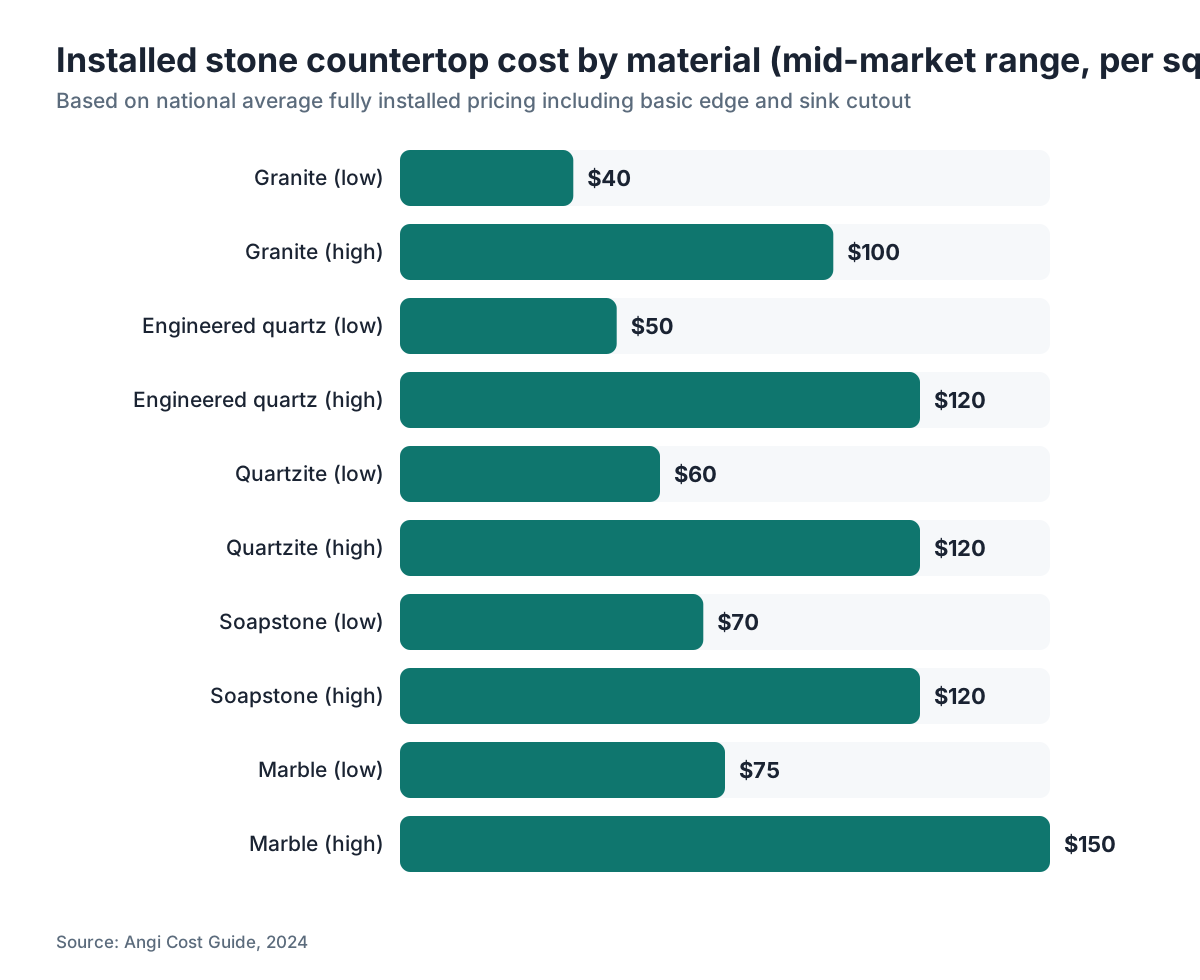
Prices move a lot by region, by stone grade, and by how complicated your kitchen layout is. Here are honest mid-market ranges for fully installed stone countertops in the U.S. as of 2024 to 2025, drawn from fabricator pricing surveys and consumer cost tracking like the HomeAdvisor/Angi cost database and the National Kitchen and Bath Association.
| Material | Installed cost range (per sq ft) | Sealing required? | Etch risk |
|---|---|---|---|
| Granite | $40 to $100 | Yes, every 1-3 years | Low |
| Marble | $75 to $150 | Yes, every 6-12 months | High |
| Quartzite | $60 to $120 | Yes, every 1-2 years | Low to medium |
| Soapstone | $70 to $120 | No (oil instead) | None |
| Engineered quartz | $50 to $120 | No | None |
| Slate | $50 to $90 | Yes | Low |
These ranges assume a basic edge profile (eased or beveled), a standard sink cutout, and a straightforward layout. Add $10 to $30 per linear foot for waterfall edges. Ogee and other decorative profiles add $15 to $40 per linear foot [2]. A mitered waterfall on a 10-foot island can add $800 to $2,000 to a job.
The average U.S. kitchen has roughly 30 to 50 square feet of countertop surface [2]. At $70 per square foot installed, a 40-square-foot kitchen in mid-grade granite runs about $2,800 before any extras. At $110 per square foot for quartzite, the same kitchen is $4,400.
Removal of old countertops usually costs $200 to $500 extra. A plumbing disconnect and reconnect for a sink adds $150 to $400 depending on your plumber's rates [3].
Which stone countertop is the most durable for everyday kitchen use?
Durability in a kitchen has three separate dimensions: scratch resistance, heat resistance, and stain or etch resistance. No single stone maxes out all three.
For scratch resistance, granite and hard quartzite rank highest among natural stones. Both sit around 6 to 7 on the Mohs hardness scale [4]. Engineered quartz is similarly hard. Soapstone is soft but self-healing; you sand scratches out with 220-grit paper and re-oil. Marble sits in the middle on hardness and loses badly on etch resistance.
For heat resistance, natural stone generally handles brief contact with hot pots better than engineered quartz. The polymer resin binders in quartz composites can discolor or crack under sustained heat above about 300 degrees Fahrenheit [5]. Trivets cost almost nothing. Use them regardless of material.
For stain resistance, engineered quartz wins because it's non-porous by construction. Granite, quartzite, and marble all have micro-porosity that absorbs liquids left to sit. A properly applied penetrating sealer slows this a lot but never stops it forever. The Marble Institute of America (now part of the Natural Stone Institute) recommends a water test to check when a stone needs resealing: pour a tablespoon of water on the surface, wait 30 minutes, and see if it darkens the stone [6].
If someone in your house regularly leaves olive oil, coffee, or red wine sitting overnight, granite with a quality sealer or engineered quartz forgives you far more than marble will.
Does stone increase home resale value?
Realtors consistently report that stone countertops, especially granite and quartz, help sell kitchens faster and sometimes at higher prices. But hard numbers are slippery here. Nobody has clean controlled data isolating countertop material from the rest of a kitchen renovation.
The closest real-world benchmark comes from Remodeling Magazine's annual Cost vs. Value report, which surveys contractors and real estate agents across the U.S. The 2024 report found that a minor kitchen remodel (which includes new countertop surfaces) returned about 96 percent of project cost at resale on the national average, the highest recoup rate of any interior remodel category tracked [7]. A major kitchen remodel returned only about 49 percent. The lesson: modest upgrades to countertops in an otherwise functional kitchen recoup better than gutting the whole room.
Stone countertops are now so common in mid-range and higher homes that their absence can flag a house as dated to buyers. A 2023 survey by the National Association of Realtors found that updated kitchens ranked among the top three features buyers cited as influencing their offer [8]. Countertops specifically were mentioned by 81 percent of buyers surveyed who described the kitchen as a deciding factor.
My honest take: if you're installing stone purely as an investment play, don't spend $8,000 on exotic quartzite. Mid-grade granite or a solid engineered quartz buys you the perception of quality at a price that actually pencils out.
What are the real maintenance requirements for stone countertops?
Maintenance is where people underestimate the gap between stone types.
Granite needs a penetrating sealer once a year to once every three years, depending on the stone's porosity and the product used. Application takes about 20 minutes: clean the surface, apply the sealer with a cloth, let it absorb for the time on the product label, then wipe off the excess. Most granite sealers sold today are fluorocarbon-based and carry a 1-year to 15-year warranty, though the longer-warranty products still earn a test every couple of years [6].
Marble needs sealing more often (every 6 to 12 months) and still etches even when sealed. Sealing prevents staining but does nothing for etch marks, which come from acid dissolving the calcite in the stone. To remove an etch mark, you either live with it or hire a stone restoration company to re-hone or re-polish the surface. Professional honing runs $5 to $15 per square foot [9].
Engineered quartz needs no sealing. Wipe it with mild dish soap and water. Avoid abrasive cleaners, which dull the finish over time, and avoid prolonged UV from direct sunlight, which can yellow the resin binders [5].
Soapstone owners typically rub the stone with mineral oil every few weeks when it's new, then taper to once or twice a year once the stone has fully oxidized to its dark gray patina. The oiling isn't strictly needed for protection, but it evens out the color.
For general daily cleaning guidance across materials, how to clean stone countertops is the right reference.
How is stone countertop fabrication and installation done?
Most homeowners never see this part, but understanding it helps you dodge expensive surprises.
Fabrication starts with a template. A technician visits your kitchen before the stone is cut and takes precise measurements, either with a digital templating arm or a laser system. That template drives the cut layout on the actual slab, a process called nesting. Good nesting minimizes waste on expensive stone, which matters most on figured materials like bookmatch marble or exotic quartzite where every square inch has character.
The slab is then cut on a CNC bridge saw, the edges are profiled on an edge machine, and the finished pieces are polished. A typical granite or quartz job goes from template to installation in 5 to 10 business days for most shops, though complex material or a heavy backlog can stretch that to 3 weeks [10].
Installation itself usually takes 2 to 6 hours for a standard kitchen. The pieces get set on cabinet bases with epoxy or silicone adhesive, seams are color-matched and epoxied together, and the sink cutout is finished. Undermount sinks attach to the underside of the stone with epoxy and clip brackets.
Fabricators who use modern quoting software, like the tools at SlabWise, can generate itemized quotes straight from the template measurements and send them to you digitally before a stone leaves the yard. That makes comparing bids much easier.
After installation, the fabricator typically asks you to wait 24 hours before using the sink and 48 to 72 hours before setting heavy objects on new seams [10]. Check your specific installer's instructions; epoxy cure times vary by product.
What stone countertop edges should you choose?
Edge profiles are partly looks, partly practical. They also change the price.
The most common choices:
Eased edge: a simple 90-degree corner with the sharp edge softened. Almost every fabricator includes this in the base price. Clean, modern, easy to wipe down.
Beveled edge: the top corner cut at a 45-degree angle. A little more visual interest than eased, same base price at most shops.
Bullnose: fully rounded top and bottom. Classic look, especially on thicker slabs. Adds $5 to $15 per linear foot depending on the shop.
Ogee: an S-curve profile, traditional and formal. More machining time means $15 to $40 per linear foot added to the bill.
Waterfall: the countertop material runs vertically down the side of the island or cabinet face. This is a design choice more than an edge profile. It needs extra slab material (sometimes a full second slab) and careful grain-matching. Add $800 to $3,000 or more for a full island waterfall [2].
Mitered edge: two pieces of stone cut at 45 degrees and glued together to fake a 3-inch or 4-inch thick slab from a standard 3-cm (about 1.2-inch) slab. More work, more material, but dramatic on islands.
For a family kitchen, eased or beveled makes the most sense. Ogee and bullnose look dated in very modern rooms. Waterfall is expensive and impressive, but I'd only spend on it if the island is genuinely the focal point.
How do you pick the right stone slab at the yard?
This is where homeowners leave a lot of value on the table. If you care how it looks, picking your slab in person at the yard is not optional. Samples and photos mislead constantly because stone is naturally variable, and the slab you actually get can look nothing like the display chip.
Call ahead to confirm the yard lets consumers visit (most do). Bring your cabinet door sample or a photo of your flooring so you can check undertones under real light. Move slabs into natural light if you can; showroom lighting hides warm and cool tones.
For a kitchen with a complex layout, ask the fabricator to book two adjacent slabs from the same lot so the veining can be book-matched across seams. That's standard practice for marble and exotic quartzite. It costs more (you're buying two full slabs instead of one) but looks dramatically better.
Ask about the remnant yard too. Smaller pieces left over from a previous job can cover a laundry room, a bathroom vanity, or a small kitchen at a real discount, sometimes 40 to 60 percent off full slab pricing.
One practical note: verify the thickness before selecting. Most U.S. kitchens now use 3-cm (about 1.2-inch) thick slabs. Some import yards still carry 2-cm slabs, which need a plywood substrate underneath and show a thinner edge. Know what your fabricator works with before you fall in love with a 2-cm slab.
How does stone compare to laminate or solid surface countertops?
Stone isn't right for every kitchen or every budget. The honest comparison matters.
Laminate (Formica and similar products) costs $10 to $40 per square foot installed, scratches more easily, and can't be re-polished. But modern designs are genuinely convincing and have improved a lot in the last decade. If budget is tight, Formica countertops and laminate countertops show what's possible.
Solid surface materials like Corian are non-porous, repairable (scratches and minor burns sand out), and continuous around sinks with no visible joint. They feel less substantial under your hand, though, and sharp objects can dull them. See Corian countertops for that side of the comparison.
Butcher block is warm, renewable, and great next to a prep area, but it needs regular oiling and isn't ideal next to a sink over the long run. Butcher block countertops has the honest maintenance picture.
For most people remodeling a kitchen they plan to live in for 10 or more years, granite or engineered quartz in the $50 to $100 per square foot installed range hits the sweet spot of durability, appearance, and cost. Spend up to quartzite or marble only if you understand and accept their specific maintenance demands.
What should you ask a fabricator before signing a quote?
Most people get one or two quotes and sign the first one that sounds reasonable. Getting three quotes from licensed fabricators, then asking specific questions, works much better.
Ask for an itemized quote that breaks out material, fabrication labor, edge profiles, sink cutout, and installation separately. That lets you compare apples to apples across bids.
Confirm whether the price is for the slab you selected or for a generic material. Some shops quote a material category, then give you whatever slab is in stock. Ask to see and approve the actual slab before fabrication begins.
Ask about the seam locations. On a large kitchen, seams are unavoidable on natural stone (slabs are typically 5 to 6 feet wide). You want seams away from the primary workspace and cooking area, not in the middle of an island.
Ask about warranty. Fabrication defects (a bad seam, an edge chipped during install) are the fabricator's responsibility. Stone defects from the manufacturer are usually a separate issue. Know who covers what.
Shops that use transparent quoting software, such as SlabWise, tend to produce more detailed quotes automatically, which makes the conversation easier from the start. You can also ask for the total square footage they're billing and compare it to your own rough measurement to check the numbers.
One more thing: verify the fabricator is licensed and insured in your state. Requirements vary, but most states require a contractor's license for work above a certain dollar threshold. Check your state contractor licensing board's website directly [11].
Are there health or safety considerations with stone countertops?
Two issues come up regularly: radon emissions and silica dust.
On radon, some granite does emit trace amounts of radon, a naturally occurring radioactive gas. The EPA has studied this and concluded that granite countertops add extremely little to indoor radon levels compared with radon entering from the soil and foundation. The EPA states directly: "EPA believes that the radon levels associated with granite countertops are not a health concern" [12]. If you're worried about indoor radon (and most people in high-radon-risk zones should test regardless of countertop type), test your home's overall air rather than singling out the countertops.
Silica dust is a real and serious issue, but it's a fabrication workplace hazard, not a homeowner use hazard. Workers who cut, grind, or polish engineered stone products without proper respiratory protection face elevated risk for silicosis, a serious lung disease. OSHA published a specific hazard bulletin on engineered stone (quartz composite) fabrication in 2019, noting crystalline silica content of 90 percent or higher in these products [13]. If you run a shop: wet cutting, local exhaust ventilation, and proper respirators are required. This is not optional.
Once stone is installed in your home, there is no ongoing silica dust exposure from normal use. You're not sanding it.
Frequently asked questions
What is the cheapest natural stone countertop?
Granite is usually the most affordable natural stone countertop installed, with common grades starting around $40 per square foot fully installed. Soapstone and slate can also hit that low end in some markets. Exotic granites with heavy veining or unusual coloring cost considerably more, sometimes $100 per square foot or higher, so the specific stone you choose within a category matters as much as the category itself.
Does marble work in a kitchen or is it too high maintenance?
Marble works in kitchens, but it etches from acids (citrus, vinegar, tomato) and needs sealing every 6 to 12 months. Etch marks are permanent without professional refinishing. It's a poor fit for households that cook heavily and clean quickly. It's a realistic choice if you love the look, seal often, and accept that patina and marks come with it. Many people use marble on a low-traffic island and a tougher stone elsewhere.
Is quartzite the same as quartz?
No. Quartzite is a natural metamorphic rock formed from sandstone. Engineered quartz (quartz composite) is a manufactured material made of about 90 to 94 percent crushed quartz mineral bound with polymer resin. They can look similar and the names are confusingly close, but they behave differently: quartzite is porous and needs sealing, engineered quartz is non-porous and does not. Make sure you know which one you're buying.
How long do stone countertops last?
Properly installed and maintained stone countertops last the life of the house. Granite and quartzite installed decades ago still look good with basic care. The practical limit is usually the surrounding cabinetry or the homeowner's taste, not the stone itself. Engineered quartz has a shorter track record since it's a newer product, but there's no evidence of premature failure in residential use when UV exposure and heat stress are avoided.
Can you cut on stone countertops?
You can physically cut on granite or quartzite without damaging the stone since both are harder than most knife steel. But it dulls your knives fast. On marble, cutting can leave scratches on top of dulling the blade. On engineered quartz, cutting can leave light scratches on the surface finish over time. Use a cutting board regardless of your stone. It protects your knives and keeps your countertop looking better longer.
How thick should kitchen stone countertops be?
The U.S. residential standard is 3 cm (about 1.2 inches). Some imported stone still comes in 2 cm thickness, which needs a plywood buildup underneath and shows a thinner edge profile. For most kitchen applications, 3 cm is preferable: it's stronger, edges look more substantial, and it skips the extra substrate. If you're considering a 2 cm slab, confirm your fabricator is experienced with that thickness.
What is the best edge profile for a kitchen island?
Eased or beveled edges are the most practical for islands because they're easy to clean and don't chip as readily as sharp profiles with narrow points. If you want visual impact, a thick mitered edge (creating the look of a 4-inch slab) or a waterfall side panel does more for a room than an ornate profile. Ogee edges have fallen out of fashion in contemporary kitchens and often cost more than the aesthetic improvement warrants.
Does engineered quartz need to be sealed?
No. Engineered quartz is non-porous because of its resin binder content (6 to 10 percent of the material by weight). It doesn't absorb liquids and doesn't need sealing. Avoid applying sealers meant for natural stone to quartz; they can leave a film or residue on the surface. Clean quartz with mild soap and water. The one vulnerability is prolonged direct heat or UV exposure, which can affect the resin over time.
How do you remove stains from granite countertops?
For oil-based stains, apply a poultice made from baking soda and acetone or hydrogen peroxide mixed to a peanut butter consistency, spread it over the stain, cover with plastic wrap, and let it sit 24 to 48 hours. For organic stains (coffee, food), use hydrogen peroxide as the liquid in the poultice instead. The Natural Stone Institute recommends this method and notes that multiple applications are sometimes needed for deep stains.
How many square feet of countertop does an average kitchen have?
A U.S. kitchen typically has 30 to 50 square feet of countertop surface, with the average closer to 40 square feet according to industry estimating benchmarks. Larger kitchens with islands can reach 70 to 100 square feet. Your fabricator calculates the exact square footage from the template, and you should check that number against your own rough measurement before signing a contract.
What questions should I ask when getting a stone countertop quote?
Ask for an itemized quote separating material, fabrication, edge profile, cutouts, and installation. Confirm whether the price refers to the specific slab you selected. Ask where seams will fall. Ask about turnaround time from template to installation. Ask what the warranty covers. Get at least three quotes. Comparing itemized bids from multiple shops beats comparing lump-sum prices, and it catches shops that undercount your square footage.
Is radon from granite countertops dangerous?
The EPA has concluded that granite countertops contribute negligibly to indoor radon levels and don't pose a health concern under normal residential use. If you live in a high-radon area, test your overall indoor air quality, since radon from soil and foundations is by far the dominant source. The EPA's guidance on this is publicly available at its radiation and radon information pages and has not changed since the agency reviewed the issue.
What is a countertop seam and can it be made invisible?
A seam is the joint between two pieces of stone where the slab wasn't large enough to cover the run in one piece. Most slabs are 5 to 6 feet wide, so any countertop longer than that will have at least one seam. Good fabricators color-match the epoxy to the stone and align veining as closely as possible, but seams on figured stone are rarely truly invisible. On solid-color granite or uniform quartz, seams are much less visible. Ask to see the fabricator's previous seam work.
Sources
- Occupational Safety and Health Administration (OSHA), Silica in Engineered Stone Hazard Bulletin: Engineered quartz composite countertops contain 90 to 94 percent crystalline silica bound with polymer resin.
- Angi (formerly HomeAdvisor), Countertop Installation Cost Guide: Countertop edge profiles such as ogee add $15 to $40 per linear foot; waterfall edges add substantially more; average kitchen has 30 to 50 square feet of countertop.
- Angi, Plumber Cost Guide: Plumbing disconnect and reconnect for sink during countertop installation costs $150 to $400 depending on local rates.
- U.S. Geological Survey (USGS), National Minerals Information Center: Granite and quartzite rate approximately 6 to 7 on the Mohs hardness scale.
- NSF International, Countertop Material Testing Standards: Polymer resin binders in engineered quartz can discolor or crack under sustained heat above approximately 300 degrees Fahrenheit, and prolonged UV exposure can cause yellowing.
- Natural Stone Institute, Care and Cleaning for Natural Stone: Penetrating sealer manufacturers recommend a water test every 1 to 3 years; the NSI specifies pouring a tablespoon of water on the surface and waiting 30 minutes to assess if resealing is needed.
- Remodeling Magazine, 2024 Cost vs. Value Report: A minor kitchen remodel returned approximately 96 percent of project cost at resale nationally in 2024, the highest recoup rate of any interior remodel category tracked.
- National Association of Realtors, Research and Statistics: Updated kitchens were among the top three features buyers cited as influencing their offer; countertops specifically were mentioned by 81 percent of buyers who described the kitchen as a deciding factor.
- Natural Stone Institute, Stone Restoration and Maintenance: Professional honing to remove etch marks from marble costs approximately $5 to $15 per square foot depending on extent of damage and regional labor rates.
- Marble Institute of America / Natural Stone Institute, Fabrication and Installation Guidelines: Standard granite or quartz jobs go from template to installation in 5 to 10 business days; fabricators recommend waiting 24 to 48 hours before heavy use of seams after installation.
- U.S. Small Business Administration, State Licenses and Permits: Most states require a contractor's license for construction work above a certain dollar threshold; requirements vary by state licensing board.
- U.S. Environmental Protection Agency (EPA), Radiation Protection: The EPA states: 'EPA believes that the radon levels associated with granite countertops are not a health concern' under normal residential use.
- Occupational Safety and Health Administration (OSHA), Engineered Stone Hazard Alert 2019: OSHA published a specific hazard bulletin on engineered stone fabrication in 2019, noting crystalline silica content of 90 percent or higher and requiring wet cutting, ventilation, and respirators for workers.
Last updated 2026-07-09