TL;DR
- The best kitchen sink countertop depends on three things: how the sink mounts (undermount needs a hard material like quartz or granite), how much water the area sees, and your budget.
- Quartz and granite dominate because they resist moisture and hold a clean undermount cutout.
- Laminate and butcher block work with drop-in sinks but need more care around standing water.
- Installed costs run roughly $40, $250 per square foot depending on material.
What makes the sink area different from the rest of the countertop?
The sink zone takes more abuse than any other section of the counter. Water sits there. Soap and cleaning products hit it constantly. Wet pots land on it. And if you have kids or cook hard, that corner gets knocked around daily.
The cutout itself is the structural concern. Removing material from a slab creates stress points at the corners of the opening. A poorly radiused corner, especially in a brittle material like marble or tile, can crack over time from thermal cycling and impact [1]. Fabricators who spec a minimum 3/8-inch radius at each inside corner are following basic stone industry practice for exactly this reason.
Moisture migration is the other issue. If water gets under a laminate edge or into an unsealed grout joint over and over, the substrate swells and rots. That's less about the surface material than about how well the installation was done, but material choice affects how forgiving the whole assembly is.
The sink's weight matters too. A heavy cast-iron farmhouse sink can run 200 to 300 pounds when filled [2]. The countertop, the cabinet below, and any mounting clips all share that load. Lighter composite or stainless sinks are more forgiving on thinner or softer surface materials.
Which countertop materials work best around a kitchen sink?
Here's an honest comparison across the materials you'll actually encounter:
| Material | Undermount OK? | Water resistance | Typical cost installed ($/sq ft) | Notes |
|---|---|---|---|---|
| Quartz (engineered) | Yes | Excellent | $70, $150 | Non-porous, no sealing needed; heat sensitivity |
| Granite | Yes | Good (sealed) | $60, $150 | Porous if unsealed; very hard, holds cutout well |
| Marble | With care | Fair (porous) | $75, $250 | Etches easily; not ideal at the sink |
| Quartzite | Yes | Good (sealed) | $80, $200 | Harder than marble; still needs sealing |
| Laminate | Drop-in only | Poor at seams | $10, $40 | Water infiltrates exposed particle board edges |
| Butcher block | Drop-in preferred | Poor unsealed | $30, $100 | Oil regularly; avoid standing water |
| Soapstone | Yes | Excellent | $80, $180 | Naturally non-porous; scratches but patinas nicely |
| Solid surface (Corian) | Yes | Excellent | $50, $100 | Integral sink means no seam; scratches |
| Porcelain tile | Drop-in preferred | Good (grout varies) | $20, $60 | Grout lines near sink need diligent maintenance |
| Stainless steel | Integral option | Excellent | $80, $200 | Commercial look; shows scratches and water spots |
Quartz is the default pick for most homeowners for one simple reason: it's non-porous from the factory, so there's no ongoing sealing chore at the spot that gets wet every single day [3]. Granite is a close second if you seal it once a year, which most people can do in ten minutes with a spray-on product.
Laminate countertops are still the cheapest option, but they only work reliably with drop-in sinks where the sink rim covers the cutout edge. Any exposed particle board near water is a long-term problem.
Butcher block countertops look great and are genuinely popular, but around a working sink they need real attention. A weekly mineral oil treatment and keeping standing water off the surface are non-negotiable if you want them to last.
What are the different kitchen sink cutout types and which material supports each?
There are four main sink mounting styles, and they don't swap freely across every countertop material.
Undermount sinks attach to the underside of the countertop. The edge of the stone or solid surface is exposed at the cutout and forms the visible rim. This needs a material rigid and hard enough to polish that edge cleanly and hold it over time. Quartz, granite, quartzite, soapstone, and solid surface all work. Laminate does not. Butcher block can work technically, but the exposed endgrain wicks water fast.
Drop-in (or self-rimming) sinks drop through an oversized hole and rest on a rim that covers the cutout edge. This hides the edge entirely. Any countertop material can take a drop-in sink, which is why drop-ins dominated kitchens for decades before undermount became the standard in higher-end homes.
Flush-mount or zero-radius sinks sit exactly level with the countertop surface, with no lip above or below. These are mostly a stainless-steel-with-stainless-counter combination, or integral solid surface. They wipe clean fast because there's no seam to catch debris.
Farmhouse (apron-front) sinks replace the cabinet face entirely and most of the front counter lip. The countertop is cut back and rests on the sides of the sink instead of spanning the full front. Stone and quartz handle this well. It's a structural change, so if you're adding one during a remodel the cabinet framing may need reinforcing depending on sink weight [2].
The cutout corners deserve a separate mention. Fabricators typically CNC the corner radii on a waterjet or bridge saw, then polish to match the countertop surface. A minimum 3/8-inch radius is standard practice for stone; a 1/2-inch radius is stronger, and most shops go there by default for undermount openings [1].
How much does a kitchen sink countertop cutout cost?
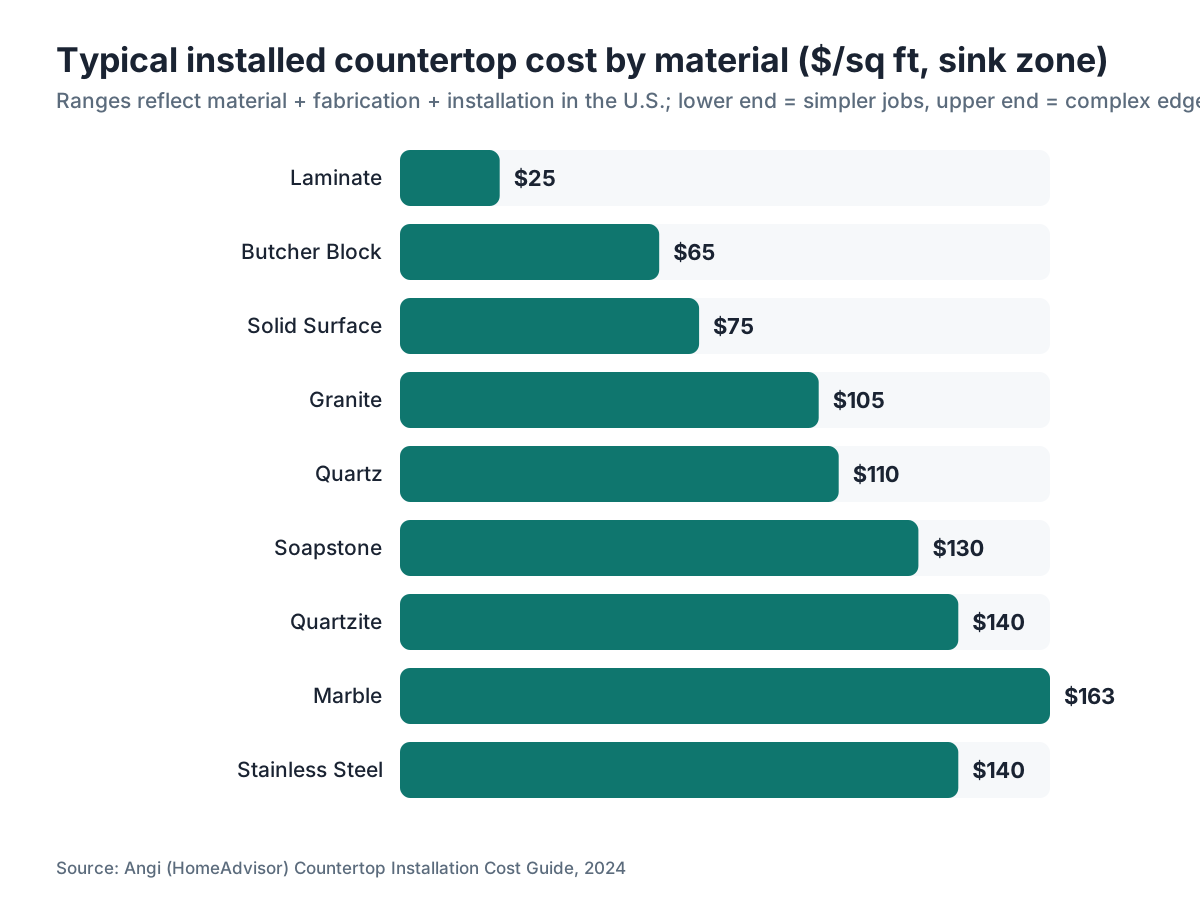
Cutout pricing is almost always a line item separate from the slab cost. Most fabrication shops charge $50, $150 per cutout for a standard undermount sink opening [4]. The range covers complexity: a square undermount with radiused corners is faster than a double-bowl with tight radii or a custom shape.
Farmhouse apron cuts typically run more, $100, $200, because they involve multiple cuts and precise fitting against the sink body.
If you're remodeling and keeping an existing countertop, adding or changing a cutout in already-installed stone is possible but expensive and risky. Vibration during cutting can crack a slab, especially in marble or thinner materials. Budget $200, $400 for an in-place cut and accept that there's genuine risk involved.
The total installed cost around the sink isn't just the slab and cutout. You also have edge profiles, which run $10, $30 per linear foot for basic eased or beveled edges, and $20, $60 per linear foot for detailed profiles like ogee or dupont [4]. The sink perimeter is the most visible edge in the kitchen, so many homeowners spend more here than elsewhere.
For context on full countertop project costs, the kitchen countertops overview has current installed price ranges across all material categories.
Does the countertop thickness matter for sink installation?
Yes, and in two specific ways.
For undermount sinks, 3/4-inch (2 cm) stone can technically hold a cutout, but the exposed polished edge at the sink is narrow enough to look thin and is easier to chip. Most fabricators recommend 1.25-inch (3 cm) material for undermount because the thicker edge looks substantial and resists chipping [5]. If you're using 2 cm material and still want undermount, a mitered edge buildup at the perimeter adds thickness visually, but it's a fabrication cost adder.
For laminate and solid surface, thickness matters differently. Laminate postform countertops are built on particleboard substrate, typically 3/4-inch nominal. The factory-formed front edge covers the substrate, but the sink cutout exposes raw particleboard unless the fabricator applies a waterproof edge banding or the sink rim covers it entirely. Solid surface in 1/2-inch thickness can flex under heavy sink loads without proper cabinet support.
Slab thickness also affects how the plumber makes the connection. Undermount clips, silicone adhesive, and epoxy systems are all in play, and they're spec'd against the slab thickness. Your plumber and fabricator need to talk about this before installation day.
What is the best countertop material if you want an undermount sink?
Quartz is the practical answer for most households. It's non-porous, so the polished edge at the cutout never needs sealing against constant moisture [3]. It's also consistent in density, which means CNC cutting produces clean, predictable edges. Brands like Cambria countertops advertise a lifetime warranty and non-porous composition, which matters at the wet zone.
Granite is basically just as good if you maintain it. The difference is that granite is a natural material with real variation in porosity. A dense, dark granite like Absolute Black is nearly non-porous in practice. A lighter, coarser-grained stone is more porous and needs consistent sealing. For the sink area specifically, a water drop test every few months is good practice: if water soaks in within 4 minutes rather than beading, it's time to reseal [6].
Soapstone is the old-school favorite for sink surrounds. It's naturally non-porous, doesn't need sealing, and was literally used for lab sinks in chemistry classrooms for generations because of its chemical resistance [7]. It scratches more easily than granite or quartz, but the scratches can be sanded out and the material develops a patina many people love. See how to clean soapstone countertops for maintenance specifics.
Solid surface materials like Corian countertops offer something the others can't: an integral sink, where the sink and counter are the same material with no joint at all. No joint means no water infiltration point. The tradeoff is that solid surface scratches more easily than stone and can't take high heat.
Marble is the material to be cautious with. It etches from acids, including citrus juice, vinegar, and many dish soaps. The sink zone is the highest-acid zone in the kitchen. Marble fans accept this and treat the etching as part of the material's character, but it's a real maintenance commitment. Marble countertops covers this tradeoff in detail.
How do you protect the countertop around the sink from water damage?
The surface itself is rarely the failure point. The failure is usually at the seam between the countertop and the wall backsplash, or at the sink-to-counter joint where the silicone ages out.
Silicone caulk between the undermount sink rim and the stone is the primary water barrier. That bead should be 100% silicone (not latex-modified caulk), applied in full contact, and replaced when it shows cracking, peeling, or discoloration. A professional silicone joint done right lasts 5 to 10 years before it needs attention [8]. A sloppy bead fails in two.
For stone countertops, the sealer is the defense at the surface. Penetrating sealers fill the microscopic pores in natural stone and slow water and oil absorption. They don't make stone waterproof forever; they buy time. The Marble Institute of America recommends re-sealing kitchen countertops annually as a conservative baseline, with actual frequency depending on the stone's absorption rate [6]. The how to clean stone countertops guide has the practical sealing and cleaning protocol.
For laminate, the protection is simpler: don't let water stand at the sink rim joint, re-caulk if you see gaps, and use the sink drain properly. Water infiltration under laminate at the front edge is almost always a caulk failure or a drop-in sink that isn't bedded in plumber's putty correctly.
For butcher block, a sink apron or drip rail on the cabinet below is a smart addition. Some woodworkers add a thin strip of stainless or copper along the sink edge to steer drips off the wood. Tung oil or a marine-grade finish holds up better than plain mineral oil in a high-moisture zone, though you give up food-safe status with some film-forming finishes.
Can you install any sink type in a granite or quartz countertop?
Almost any sink works in granite or quartz. The practical limits are around weight and cutout geometry.
Weight matters for the cabinet, not the stone. The stone spans across the opening; the sink hangs from it or rests on it. A very heavy cast-iron farmhouse sink, 200 to 350 pounds dry, creates significant point loads on the cabinet box below [2]. Standard frameless cabinets in 3/4-inch plywood handle this fine with proper face-frame reinforcement. Older cabinets or lower-quality construction may need blocking added [11].
Cutout geometry has limits in thick stone. A double-bowl undermount with a very narrow divider between the bowls puts two close cutouts in the same slab. If the bridge of stone between them is less than 2 to 3 inches, there's real fracture risk [1]. A fabricator may recommend a single-bowl sink or a different layout to keep the slab strong.
Integral sinks (same material as the counter) are available in quartz and solid surface, not typically in natural stone. The look is clean and there's no joint to fail. Cost is higher because the fabrication is more involved.
For fabricators pricing these jobs, systems like SlabWise can account for cutout complexity, edge lineal footage at the sink perimeter, and material waste in nesting, which is where the real cost variation lives in sink countertop jobs.
What edge profile works best for the sink cutout?
This is more practical than aesthetic. The goal at the sink edge is a profile that sheds water away from the joint and doesn't collect grime in crevices.
Eased edge (slightly softened square) is the most popular choice for undermount sinks because it's simple, easy to clean, and gives water no ledge to pool on. It reads as modern and clean.
Bevel edge adds a small angled face below the top surface. It directs water slightly outward. Also easy to clean.
Bullnose rounds the entire edge. It's comfortable to the touch and there's no sharp corner to chip, which is an advantage in stone. The rounded profile can steer water back toward the sink if the counter is slightly crowned, which actually helps.
Ogee and dupont profiles have decorative coves and ridges. They look more traditional and formal. The crevices in the profile trap soap scum and need more attention to keep clean. At the sink, that matters.
For the sink perimeter specifically, most designers and fabricators steer toward simpler profiles. Save the ornate edge detail for the island or the perimeter counter where it's visible and doesn't live in a water zone.
Edge profiles at the sink cutout are priced the same as any other edge. Expect $10, $20 per linear foot for eased or bevel, $20, $40 for bullnose, and $30, $60 for ogee or dupont at current fabrication pricing [4].
How is the sink cutout actually made during fabrication?
In a modern shop, sink cutouts are done on a CNC bridge saw or a waterjet machine. The fabricator imports the template or CAD drawing of the sink, programs the machine to cut the opening with the specified corner radii, and the machine makes the cut in a single pass. On a CNC, the cut edge is then hand-polished to match the rest of the counter surface.
Templating is the step that makes or breaks this. The plumbing rough-in, the sink dimensions, and any faucet or soap dispenser holes all get captured in the template. Traditional templating uses physical strips of cardboard or thin plywood; digital templating uses laser measuring tools that produce a file going straight to the CNC. Digital templating cuts human error and is now standard at most mid-to-large fabrication shops [9].
Faucet holes are usually 1-3/8 inches diameter in stone, drilled with a diamond-core drill bit. The number of holes depends on the faucet: single-hole, three-hole spread, and four-hole configurations are the most common. These are straightforward additions but each one is a cost line item.
If the countertop installation is being handled as a full project, the countertop installation overview covers what to expect from the full sequence from template through final silicone.
Does the countertop material affect resale value in a kitchen?
This is an area where good data is genuinely hard to find. The National Association of Realtors publishes a Remodeling Impact Report that covers kitchen renovations, and its 2023 edition estimated a mid-range kitchen remodel recovers about 67 cents on the dollar at resale nationally [10]. That's the kitchen as a whole, not countertops alone.
What realtors say consistently, if anecdotally, is that granite and quartz read as premium to buyers in ways that laminate and tile don't. But that premium is captured in the overall kitchen quality impression, not as an isolated countertop line.
For the sink area specifically, visible water damage, staining, or a failing caulk joint around the sink is one of the details buyers notice and read as deferred maintenance. A scratched or etched marble counter near the sink raises questions about care. A clean quartz or granite undermount with a fresh caulk bead reads as well-maintained.
The practical answer: material choice affects resale mostly by affecting condition over time. A material that holds up, seals well, and looks good at year 10 is the one that helps at resale. That points toward quartz or granite for most kitchens.
What should you check before and after the countertop is installed around a sink?
Before installation, verify the cabinet is level. Stone countertops can be shimmed to level, but a cabinet that's badly out of plane puts stress on the slab. Check that the plumbing rough-in height gives enough clearance below the countertop for the P-trap and any under-sink connections you're planning.
At delivery and installation, watch the cutout corner radii. They should be smooth, not sharp. Run your hand over the polished edge at the sink opening; any rough patches or tooling marks mean the polishing wasn't finished and should be fixed before you sign off.
Check the silicone application. The bead connecting the sink rim to the stone should be continuous, with no voids or gaps. Voids let water in, and you'll see it within months.
After installation, run water in the sink and watch for any evidence of leaks at the clips, the drain connection, and the silicone joint. Check the underside of the counter at the cutout edge with a flashlight. Any moisture means something wasn't sealed properly and needs immediate attention.
For natural stone, apply a penetrating sealer within the first week of installation if the fabricator hasn't already done it. Some shops seal in the shop; confirm whether yours does [6]. The Marble Institute of America recommends a 15-minute dwell time for most penetrating sealers before buffing off the excess [6].
For granite countertops specifically, the sealing frequency and method vary by stone. A tight, polished black granite may need sealing only every 3 to 5 years. A more porous light granite may need it annually.
Frequently asked questions
Can you put an undermount sink in a laminate countertop?
Not reliably. Undermount requires the exposed cutout edge to hold up to constant moisture, and laminate's particleboard substrate swells and fails when wet repeatedly. Drop-in sinks work with laminate because the sink rim covers the cutout edge entirely. If you want undermount, you need a solid material like quartz, granite, solid surface, or stone.
How long does the silicone seal around an undermount sink last?
A properly applied 100% silicone bead between an undermount sink and the countertop typically lasts 5 to 10 years before it cracks or peels and needs replacement. Latex-modified caulk fails faster. You'll know it's time when you see cracking, lifting at the edges, or discoloration that doesn't clean off. Replacing it is a DIY-able job with about $8 of silicone and two hours of time.
What size hole does a faucet need in a stone countertop?
Most standard faucets require a 1-3/8-inch (35 mm) hole in stone countertops. Some faucets spec a 1-1/2-inch hole. Always verify with the faucet manufacturer's installation sheet before the countertop is drilled. These holes are made with a diamond-core drill bit and are typically $30, $75 each as a fabrication line item. Soap dispensers and pot fillers use the same hole size.
Is quartz or granite better near a kitchen sink?
Quartz is slightly easier to maintain near the sink because it's non-porous and never needs sealing. Granite is equally durable but needs periodic sealing, especially at the high-moisture sink zone. Practically, a well-sealed granite is nearly indistinguishable from quartz in performance. If you're someone who won't remember to reseal, quartz is the safer choice.
Can you have a farmhouse sink with any countertop material?
Yes, but the countertop is cut back to expose the apron front, which means the front edge of the counter stops at the sink's sides rather than running across the full front. This works in granite, quartz, marble, solid surface, and butcher block. The cabinet below must support the sink's weight directly. Heavy cast-iron farmhouse sinks (200 to 350 lbs filled) may require cabinet reinforcement.
How do I stop water from getting under my countertop at the sink?
Three things matter: a continuous silicone bead at the sink-to-counter joint with no voids; a caulk joint between the counter and the backsplash with no gaps; and a sealed stone surface if you have natural stone. Inspect the silicone around your sink annually and replace it at the first sign of cracking. For laminate, make sure the drop-in sink rim is sealed with plumber's putty on installation.
How much does it cost to add a sink cutout to a countertop?
Most fabrication shops charge $50, $150 for a standard undermount sink cutout as a separate line item from the slab price. Farmhouse apron cuts run $100, $200 due to added complexity. Faucet holes add $30, $75 each. Modifying an already-installed stone countertop in place costs $200, $400 and carries some risk of cracking, so it's best done before installation.
What countertop material is easiest to clean around a sink?
Quartz and solid surface are the easiest. Both are non-porous, so water and soap residue don't penetrate the surface. Wipe with a damp cloth and mild soap and you're done. Soapstone is also easy because it's naturally non-porous. Granite and quartzite are easy when properly sealed. Tile with grout lines is the hardest because the grout catches grime and needs regular attention.
Can butcher block countertops be used around a kitchen sink?
Yes, but it takes real upkeep. The wood around the sink should be finished with a food-safe oil or a marine-grade finish, more than mineral oil, if it's in a high-moisture zone. A drop-in sink is safer than undermount because it covers the cutout edge. Keep standing water off the wood surface and expect to refinish the sink area every few years in a hard-use kitchen.
Does countertop thickness matter for sink installation?
Yes. For undermount sinks, 3 cm (1.25-inch) stone is strongly preferred because the exposed edge at the cutout is thicker, more substantial-looking, and harder to chip. 2 cm stone works but the edge looks thin and is more vulnerable. For laminate and solid surface, standard 3/4-inch substrate handles most sinks, but very heavy cast-iron sinks need confirmed cabinet support regardless of surface material.
What are the corner radii requirements for a sink cutout in stone?
Standard practice is a minimum 3/8-inch radius at each inside corner of the sink opening, with many fabricators defaulting to 1/2-inch for added strength. Sharp corners concentrate stress and can start cracks in brittle materials like stone, especially under thermal cycling and impact. A CNC machine produces these radii precisely; hand-cut openings are more variable.
How do I know if my stone countertop near the sink needs to be resealed?
Do a water drop test: put a few drops of water on the counter near the sink and wait 4 minutes. If the water beads up, the sealer is working. If it absorbs into the stone and darkens it, it's time to reseal. The Marble Institute of America recommends checking granite kitchen countertops this way periodically, with annual resealing as a conservative baseline for most kitchen stones.
What is an integral sink countertop and which materials offer it?
An integral sink is made from the same material as the countertop with no joint between them. It's available in solid surface materials like Corian and in stainless steel. Some quartz manufacturers offer undermount sinks designed to bond tightly, but true integral sinks are a solid-surface specialty. The advantage is one continuous surface, which means no water infiltration point at the sink-counter joint.
Can you put a single-piece countertop with a sink into a small kitchen?
Yes. Prefabricated cultured marble and solid surface vanity-style tops with integral sinks are common in small spaces. For kitchens, a single slab spanning the sink zone is standard; the limit is weight and transportation. A 10-foot run of 3 cm granite runs 180 to 250 lbs and requires two to four people and a vehicle with covered cargo space. Fabricators handle this as part of a standard install.
Sources
- Marble Institute of America, Dimension Stone Design Manual: Minimum 3/8-inch corner radius at sink cutouts in stone to reduce stress concentration and cracking risk
- National Kitchen and Bath Association, NKBA Planning Guidelines: Cast-iron farmhouse sinks weigh 200 to 350 pounds when filled and may require cabinet reinforcement
- NSF International, NSF/ANSI 51 Food Equipment Materials: Engineered quartz surfaces are non-porous and do not require sealing to resist moisture absorption
- HomeAdvisor (Angi), Countertop Installation Cost Guide: Sink cutout fabrication costs $50, $150; edge profiles range $10, $60 per linear foot depending on complexity
- Marble Institute of America, Stone Countertop Fabrication Standards: 3 cm (1.25-inch) slab thickness is recommended for undermount sink applications for edge strength and appearance
- Marble Institute of America, Care and Cleaning of Stone: Annual resealing is a conservative baseline for kitchen stone countertops; water drop test determines actual need
- Vermont Soapstone, Soapstone Properties and History: Soapstone is naturally non-porous and was historically used for laboratory sinks due to chemical resistance
- GE Sealants, Silicone Application and Longevity Guidelines: 100% silicone caulk applied correctly at sink-to-counter joints lasts 5 to 10 years before replacement is needed
- International Surface Fabricators Association (ISFA), Digital Templating Best Practices: Digital laser templating reduces measurement error and is now standard practice at many fabrication shops
- National Association of Realtors, 2023 Remodeling Impact Report: A mid-range kitchen remodel recovers approximately 67 cents per dollar spent at home resale nationally
- U.S. Department of Housing and Urban Development, Residential Structural Load Guidelines: Kitchen cabinet structures must be assessed for point load capacity when installing heavy fixtures such as cast-iron sinks
Last updated 2026-07-09