TL;DR
- Edge profiles range from free (eased, included in most quotes) to $10, $30 per linear foot for standard shapes like bullnose or beveled, up to $45, $70+ per linear foot for hand-carved ogee or stacked profiles on marble and natural stone.
- The right choice depends on your slab thickness, stone type, safety needs, and kitchen style.
What is a countertop edge profile and why does it matter?
The edge profile is the shape cut into the exposed front and side edges of your countertop slab. It's one of the last decisions homeowners make and one of the first things guests actually touch. That matters more than people expect.
A flat, squared-off edge catches crumbs differently than a rounded one. A sharp bevel reflects light in a way that makes a modest granite slab look expensive. A full ogee on a thick marble island signals a specific design vocabulary, traditional and formal, that either fits your kitchen or clashes with it hard.
Fabricators cut edges with CNC machines for standard profiles and by hand or with specialized wheels for custom ones. The labor and tooling required for each shape is what drives the price gap between a simple eased edge (often $0 extra) and a hand-finished stacked profile ($60+ per linear foot). [1]
For most kitchens, the edge perimeter runs 15 to 25 linear feet. That means a profile upgrade from eased to a mid-tier ogee at $20/LF adds $300 to $500 to your total job. Worth knowing before you fall in love with the catalog photo.
What are all the different countertop edge profiles available?
Here's a plain-language rundown of every profile type you'll encounter at a fabricator showroom, roughly from simplest to most complex.
Eased (flat with a slight softened corner): The default. The top corner is barely broken, not truly sharp, not truly round. Almost every fabricator includes this in the base slab price. Clean, contemporary, works on any thickness.
Beveled: A flat 45-degree cut across the top edge. Creates a strong visual line and a bit of glam without complexity. Very popular on quartz and granite. Usually $5, $15/LF extra. [2]
Pencil (quarter-round top): A small, smooth convex curve on just the top corner. More polished than eased, less chunky than a full bullnose. Good for families because the radius eliminates the hard corner.
Bullnose (half-round): The entire edge is a half-circle, top to bottom. Classic, safe for kids, easy to clean. One of the most common upgrades. Typically $10, $20/LF on granite and quartz, $15, $30/LF on marble. [2]
Full bullnose vs. demi bullnose: Full bullnose rounds both top and bottom corners into a complete half-circle. Demi bullnose (also called half bullnose) rounds the top corner only, leaving the bottom edge flat or slightly eased. Demi is the more common residential choice because it reads cleaner against cabinet faces.
Ogee: An S-curve profile, concave at top curving to convex at bottom. Very traditional, very formal. Gorgeous on 3 cm marble islands. Costs more because CNC wheels wear faster on complex curves and hand finishing is often required. Expect $25, $45/LF on granite, $30, $60/LF on marble. [2][3]
Dupont (also spelled DuPont): A flat top with a concave curve along the front face, ending in a small flat bottom return. Looks like a reverse cove. Popular in transitional kitchens. Pricing is similar to ogee.
Cove dupont: Adds a small cove or fillet at the transition. One step more ornate than standard dupont.
Waterfall (straight drop to floor): Not an edge profile in the traditional sense but worth including here. The slab continues vertically down the cabinet side to the floor, creating a monolithic look. Requires extra slab material and precision miter joints. Labor alone can run $200, $500 per joint, separate from edge cost. [1]
Chiseled / rock-pitched: The edge is hand-chipped to look rough and natural. Common on rustic granite or quartzite. Labor-intensive. $20, $50/LF depending on thickness.
Triple pencil / stacked profiles: Multiple routed profiles combined on a thick slab (often 6 cm mitered to fake extra thickness). The most expensive residential option because it requires mitering two slabs together and finishing the combined edge. Can reach $60, $100/LF on marble. [3]
How much do countertop edge profiles cost?
Edge profile pricing is quoted per linear foot (LF) and almost always added on top of the base slab and fabrication price. The base price from most fabricators assumes a standard eased edge. Everything beyond that is an upcharge.
Prices below are fabricator-side retail ranges collected from industry pricing surveys and fabricator association data. Regional labor markets shift these numbers, sometimes a lot. Rural Midwest shops may charge half what a coastal metro shop charges for the same profile. [2]
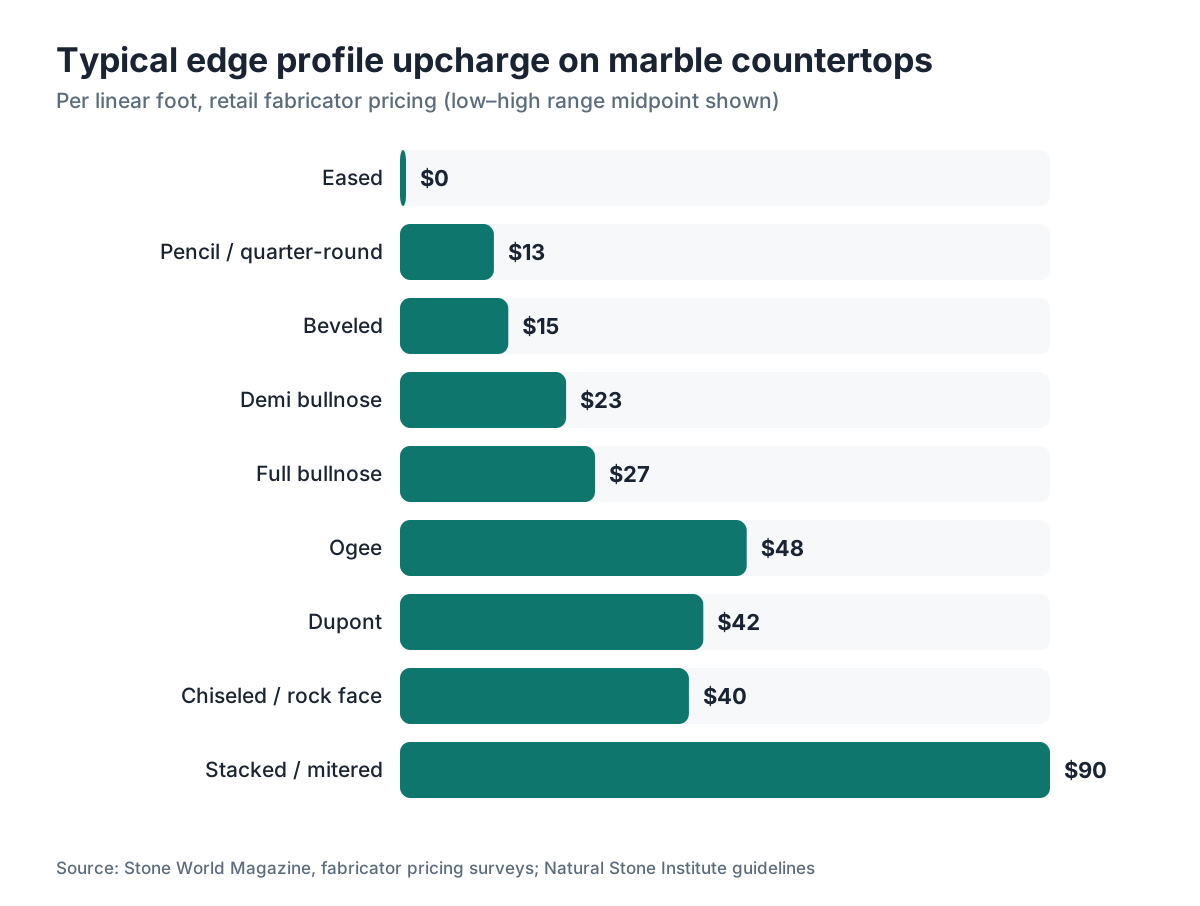
| Profile | Typical upcharge (per LF) | Notes |
|---|---|---|
| Eased | $0 | Included in base price |
| Pencil / quarter-round | $5, $12 | Minor tooling |
| Beveled | $5, $15 | Very common, fast to cut |
| Demi bullnose | $10, $20 | Standard CNC profile |
| Full bullnose | $12, $25 | Slightly more material removal |
| Ogee | $20, $45 | Complex wheel, more finish time |
| Dupont | $20, $40 | Similar complexity to ogee |
| Chiseled / rock face | $20, $50 | Hand labor |
| Mitered / stacked | $45, $100+ | Two slabs, precision miters |
For a 20 LF kitchen, switching from eased to demi bullnose might cost $200, $400 extra. Switching to an ogee on that same job runs $400, $900 extra. A full mitered stacked edge on marble could add $900, $2,000 to that same perimeter. [2]
One more thing fabricators often don't mention upfront: inside corners and sink cutout edges may be priced separately. Ask specifically whether the quote includes all exposed edges or just the perimeter runs.
How much do marble countertop edge profiles cost specifically?
Marble is harder to machine than engineered quartz and more unforgiving than most granites. The crystal structure is softer (3 on the Mohs scale compared to 6 to 7 for granite), so CNC wheels dull faster, hand finishing takes longer, and the risk of chipping during fabrication is higher. [4] Fabricators price that risk into marble edge upcharges.
Expect to pay 20 to 40% more for the same profile on marble compared to quartz or granite. Here's a realistic range for marble specifically:
| Profile | Marble upcharge (per LF) |
|---|---|
| Eased | $0 (included) |
| Pencil | $8, $18 |
| Beveled | $10, $20 |
| Demi bullnose | $15, $30 |
| Full bullnose | $18, $35 |
| Ogee | $30, $65 |
| Stacked / mitered | $60, $120+ |
The cheapest edge profile for marble countertops is the eased edge, which costs nothing extra on top of your base fabrication price. If you want one visible upgrade, the pencil or demi bullnose gives the most finished look for the least additional cost on marble. [2]
On high-end marble like Calacatta Gold or Statuario, some fabricators hand-finish every profile regardless of complexity, just to protect the material. That hand-finishing time is baked into their quote, so get line-item detail if you're comparing bids.
Which edge profile is cheapest for marble countertops?
The eased edge is always cheapest because it's the baseline, meaning no upcharge. The CNC machine barely modifies the sawn edge, just breaks the corner slightly. For a contemporary kitchen with flat-front cabinets and minimal ornamentation, an eased edge on marble looks intentional and refined. It's not a budget compromise.
If you need one step up for safety (households with young children or older adults who might catch a sharp corner), the pencil edge adds $8, $18/LF on marble and rounds the top corner enough to eliminate injury risk without adding visual complexity.
The demi bullnose sits in the sweet spot for most marble kitchens: enough visual polish to justify the material cost, clean enough to stay out of the way of the slab's veining, and priced at $15, $30/LF, which is manageable. On a 20 LF kitchen, that's $300, $600 extra, significant but not irrational given what marble slabs themselves cost. [2]
How do edge profiles look different on thick vs. thin slabs?
Slab thickness changes everything about how a profile reads in the finished kitchen. Most countertops come in two standard thicknesses: 2 cm (about 3/4 inch) and 3 cm (about 1-1/4 inches). Some premium island applications use 6 cm, which is actually two 3 cm slabs mitered together.
On 2 cm slabs, complex profiles like ogee or stacked look squished because there simply isn't enough vertical face to express the curves. Fabricators often laminate a second piece at the front edge to build apparent thickness before cutting the profile, which adds cost. On 3 cm slabs, bullnose, ogee, and dupont profiles have enough face to look properly proportioned. [1]
For waterfall or stacked profiles, you need the mitered buildup regardless of slab thickness to get the visual weight that makes them look right. That's why stacked edges are expensive: you're paying for extra material, precision miter cutting, and the labor to join and finish two pieces invisibly.
One practical note: 2 cm slabs installed with laminated edges are more fragile at the overhang than 3 cm slabs. If your countertop has a bar overhang of more than 6 inches, get 3 cm or add supports. The Marble Institute of America (now part of the Natural Stone Institute) recommends support every 24 inches for overhangs beyond 6 inches on 3 cm stone. [5]
Which edge profile works best for different kitchen styles?
There's no single right answer, but there are wrong ones. A heavily carved ogee edge on a flat-panel, handleless modern kitchen fights the design instead of serving it. A plain eased edge on a traditional kitchen with raised-panel cabinets can look unfinished.
Here's a practical guide by style:
Contemporary / minimalist: Eased, flat-mitered waterfall, or a single small bevel. Avoid anything with multiple curves or classical S-profiles.
Transitional (the most common American kitchen style): Demi bullnose or beveled. Both work with most cabinet profiles. Neither commits hard to traditional or modern.
Traditional / farmhouse: Full bullnose, ogee, or dupont. The more formal the cabinet style, the more ornamentation the edge can carry.
Industrial / loft: Chiseled rock face or flat eased on concrete or dark granite. Clean cuts, no flourishes.
Coastal / Mediterranean: Ogee and cove dupont are historically common in these styles on marble, particularly in American kitchens renovated in the 1990s and 2000s. They've become somewhat dated in that specific combination. If your goal is updated coastal, consider a cleaner profile.
One opinion worth stating plainly: the edge profile should read as a detail, not the focal point. The slab's color and veining should do the work. The edge should finish the look without drawing the eye away from the stone itself. A subtle pencil or demi bullnose does that more reliably than an ogee on most residential applications.
Are there edge profiles that are safer for households with kids or elderly adults?
Yes, and this is a real consideration, not a trivial one. Sharp 90-degree countertop edges are a documented source of household injuries, particularly for toddlers (height of a child's forehead correlates roughly with countertop edge height) and for older adults who may stumble against a counter. [6]
The profiles that reduce injury risk are those with a convex radius: pencil, demi bullnose, and full bullnose. The rounded edge deflects rather than cuts. A full bullnose is the most protective because both the top and bottom corners are completely rounded.
Beveled edges reduce the sharpness of the corner but still present a relatively acute angle compared to a bullnose. Eased edges are slightly safer than a raw square corner but not significantly so.
Ogee and dupont profiles have a concave portion that can create a different kind of catch point, less of an injury risk, but something to think about if you're trying to eliminate sharp angles entirely.
If safety is the main concern, full bullnose is the standard recommendation. It's also one of the most affordable upgrades, at $12, $25/LF on quartz and granite, $18, $35/LF on marble. [2]
How do fabricators quote and machine edge profiles?
Most residential fabricators use CNC (computer numerical control) machines with interchangeable diamond-profile wheels to cut standard edges. The CNC runs the wheel along the edge of the slab in a controlled path. A standard profile like eased, pencil, or beveled takes a single pass. An ogee requires a more complex wheel and sometimes two passes. Stacked profiles require cutting two separate pieces and then joining them with adhesive and careful hand finishing at the seam. [1]
Quoting software (shops that use tools like SlabWise can generate itemized quotes that break out material, edge profile upcharges, cutouts, and installation separately) makes it easy to see exactly where the money goes. When you're comparing bids from multiple fabricators, ask for a line-item quote. A lump-sum quote makes it impossible to know whether you're paying more for the slab, the edge, or the labor.
A few things fabricators legitimately charge more for beyond the basic profile upcharge: inside radius corners (the curved inside corner where two runs meet), sink cutout edge finishing, returns (the short side edges where a counter meets a wall), and cooktop cutout edges if they're exposed. These are typically priced separately from the main edge linear footage.
Time estimates for edge fabrication: a skilled CNC operator can run about 20 to 30 LF of a simple bullnose per hour on granite or quartz. Marble runs slower, closer to 15 to 20 LF per hour for a clean bullnose, less for ogee or hand-finished profiles. Those are rough shop floor numbers that explain why complex profiles on soft stone cost what they do.
Does edge profile choice affect how easy the countertop is to clean?
It does, and people underestimate this. The crevice at the back of an ogee profile, where the concave section meets the counter surface, collects crumbs and dried food in a way that a bullnose or eased edge never will. You'll need a brush or toothpick to get into that channel. On a marble ogee, that's also a potential spot for acidic food residue to sit long enough to etch the stone. [4]
Bullnose and eased edges are the easiest to wipe clean. One smooth arc from top to front, nothing to catch debris.
Beveled edges have one flat angled surface that wipes clean easily but can show water spots and grease more than a matte or rounded profile, because that flat face catches light differently.
For a kitchen with high cooking volume or young children who smear things, simplicity in the edge profile pays off in practical maintenance. For a more formal kitchen used primarily for entertaining, the cleaning complexity of an ogee is manageable.
For guidance on keeping natural stone surfaces clean regardless of edge profile, see our articles on how to clean stone countertops and how to clean quartzite countertops.
Do edge profiles look different on different countertop materials?
The same profile cut on marble, granite, quartz, laminate, and butcher block looks different because the materials have different visual properties.
Natural stone, especially marble, shows the crystal structure through the entire edge. A bullnose on white Carrara marble reveals the translucency and veining moving through the radius, which looks beautiful. On a solid dark granite, that same radius is less dramatic but still shows the grain texture. [4]
Engineered quartz has a uniform particle structure, so edges look very consistent and crisp. Some people find this a bit flat. Others prefer it because there are no surprises.
Laminate countertops have always had limited edge options because the substrate is particleboard. Post-form laminate (the kind that's formed with the backsplash and edge in one piece) uses a gentle round-over because that's what the forming process allows. Flat-lay laminate with a separate edge treatment can accept a wood edge or PVC edge profile. True stone-shaped profiles are not available on standard laminate. See more about material options in our overview of laminate countertops.
Butcher block countertops are typically edge-profiled in wood with router bits, which are far cheaper to run than stone CNC wheels. A bullnose or ogee on butcher block might cost $5, $15/LF, a fraction of the stone equivalent.
For engineered surfaces like Corian or Cambria, edge options vary by manufacturer. Solid surface materials like Corian can be shaped and sanded with standard woodworking tools, so custom profiles are more accessible. Cambria offers a defined menu of profiles per their fabricator agreements. Check the manufacturer spec sheet before assuming any profile is available.
What should you ask your fabricator before choosing an edge profile?
These are the questions that prevent surprises on installation day:
-
Is the eased edge included in your base price, and what does it look like? Ask to see a sample piece, more than a diagram.
-
Can I see a finished sample of the profile I'm considering in the same material? A bullnose on quartz looks different than a bullnose on marble. Many shops keep sample boards.
-
Are inside corners priced separately? Inside corners (where two runs of counter meet at a 90-degree inside angle) often require hand finishing that isn't included in the per-LF edge price.
-
How are returns priced? The short edge where a countertop meets a wall is sometimes included, sometimes not.
-
Does the price change for the sink cutout edge? Some fabricators include the sink rim edge in the main profile price. Others charge a flat fee per cutout.
-
Is my slab thick enough for the profile I want without laminating? If you're looking at an ogee on a 2 cm slab, you may need a laminated edge build-up, which adds cost.
-
What's the lead time? Complex profiles, especially hand-finished or chiseled edges, may extend fabrication time by a day or two.
For a broader view of the full installation process, see our guide to countertop installation. For a general look at material choices before you get to edges, kitchen countertops is a good starting point.
How do you choose between similar edge profiles like ogee, dupont, and cove dupont?
These three profiles get confused often because they all involve curves and are all in a similar price tier. Here's the functional difference:
Ogee is a classical S-curve. The top face of the counter transitions through a concave trough and then a convex nose before the bottom flat. The result is a profile with strong shadow lines. It reads as formal and traditional. On a thick marble island, it's a statement.
Dupont (or DuPont) has a flat top surface that transitions sharply to a concave curved face, then ends in a small horizontal flat return at the bottom. Less ornamentation than a full ogee. Slightly more contemporary because the flat top reads cleaner.
Cove dupont adds a small decorative cove (a concave cut) at the junction between the top surface and the front face. One more step of detail. More time to finish, more places for debris to collect.
If you're choosing between them, consider what your cabinet style can support. Raised-panel traditional cabinets can carry a full ogee. Shaker-style cabinets, which are the most common transitional choice in American kitchens today, look better with a dupont than a full ogee. Flat-panel cabinets should generally stop at a beveled or bullnose. [7]
And honestly: when in doubt, go simpler. Edge profiles are permanent. Slab color and veining get most of the attention. The edge is supporting cast.
Frequently asked questions
What is the most popular countertop edge profile for kitchens?
The demi bullnose (half bullnose) and beveled edge are the two most commonly selected residential profiles in the U.S. market. Both work in transitional kitchens, both are priced as standard upcharges ($5, $20/LF), and both are fast to machine. Eased is the most installed profile by volume because it's the default, but when homeowners actively choose an upgrade, demi bullnose wins most surveys.
How much does it cost to change the edge profile on an existing countertop?
Recutting an installed countertop edge is possible but expensive and risky. The fabricator needs to work in place or remove the slab. Labor alone runs $80, $150/hour plus a minimum service fee. On stone, there's real risk of cracking during in-place machining. Most fabricators will quote it if asked, but the consensus is that it's rarely worth doing unless the countertop is being reused in a renovation and can be removed cleanly.
Can I get an ogee edge on a 2 cm thick marble slab?
Technically yes, but it won't look right. The ogee profile needs at least 3 cm of vertical face to express its curves properly. On a 2 cm slab, fabricators laminate a second strip of material to the underside of the front edge to build apparent thickness before cutting the profile. This adds cost and introduces a visible seam line on the face. For ogee profiles, 3 cm slabs are strongly preferred.
Are edge profile upcharges per linear foot or a flat fee per job?
Almost always per linear foot. That means the total cost depends on how many feet of exposed edge you have. A kitchen with an island and a perimeter run might have 25 to 35 LF of exposed edge. A simple L-shape kitchen might have 12 to 18 LF. Get the linear foot count from your fabricator and multiply by the upcharge to know the true cost of an edge upgrade before committing.
Does the edge profile affect the countertop's resale value?
Not directly or measurably, according to any formal study. Edge profile is a finishing detail that buyers notice but rarely quantify. What matters for resale is material (marble, quartz, granite all tend to support home value), condition, and overall kitchen design coherence. A contemporary profile in a contemporary kitchen reads well. A mismatched profile can make an otherwise good kitchen look dated, which may affect buyer perception more than any price-per-LF calculation.
What edge profile hides the most chipping on granite or marble?
Eased and flat beveled edges chip most visibly because any ding on the top corner is in plain sight. Bullnose profiles are more chip-tolerant because the rounded edge distributes impact forces and any chips occur on the curved surface where they're harder to see. Chiseled or rock-face edges hide chips completely because the rough texture makes any new damage blend in. For chip-prone households, bullnose or chiseled is the practical choice.
Is an ogee edge outdated or still stylish?
Ogee is very traditional, and in certain kitchen styles, traditional is exactly right. A classic white kitchen with raised-panel cabinets and marble counters looks correct with an ogee edge. The ogee has become a bit associated with 1990s and early 2000s renovation aesthetics when combined with tan granite, but that's a material pairing issue, not a profile problem. In contemporary or minimalist kitchens, ogee looks out of place. In genuinely traditional settings, it still works.
What edge profiles are available on laminate or Formica countertops?
Standard laminate countertops have limited edge options. Post-form laminate uses a gentle bullnose-style round-over formed into the laminate sheet itself. Flat-lay laminate can be edge-banded with matching laminate strip (very thin, no profile) or trimmed with a solid wood edge that can then accept a simple router profile. True ogee or stacked profiles in stone-style shapes are not available on standard laminate. See more about laminate options at our guide to Formica countertops.
How long does edge profile machining add to fabrication time?
For standard profiles like eased, pencil, or bullnose on quartz or granite, edge machining adds little time; it runs concurrent with the CNC cutting sequence. Complex profiles like ogee or stacked edges add half a day to a full day of shop time per job. Hand-finished or chiseled edges take longer and depend on linear footage. Most fabricators quote a 3 to 5 business day turnaround for standard work, 5 to 7 days for complex profiles or difficult materials like marble.
Can edge profiles on marble countertops be repolished if they get etched or scratched?
Yes. Marble edges can be repolished by a stone restoration professional. The process involves diamond polishing pads at progressively finer grits, followed by a crystallization or polishing compound. Simple bullnose and eased edges are much easier to repolish than complex ogee or stacked profiles because the polishing equipment can run the full radius without getting stuck in concave sections. Budget $150, $400 for a professional edge repolish depending on linear footage and profile complexity.
What is a waterfall edge and how much does it cost?
A waterfall edge is not a routed profile but a design treatment: the slab continues vertically down the side of the cabinet to the floor, creating a continuous stone panel. It requires precision miter-cut joints where the horizontal counter meets the vertical panel, usually two joints per waterfall side. Material cost runs $300, $800 extra per side for the additional slab piece; miter cutting and installation labor adds $200, $500 per joint. Total cost per waterfall side is commonly $600, $1,500 depending on market and stone type.
Do different edge profiles require different levels of ongoing sealing on marble?
The edge itself doesn't change sealing requirements; sealing decisions are based on the stone type and finish (polished, honed, leathered). However, complex profiles with concave sections are harder to seal thoroughly because a standard brush or cloth doesn't reach the full depth of the cove. For ogee or cove dupont profiles on marble, use a spray-applied penetrating sealer and work it into the concave section with a small brush to ensure full coverage. Reseal every 1 to 2 years.
Can granite countertops have the same edge profiles as marble?
Yes, the full range of profiles available on marble is also available on granite, and granite is generally easier to machine. Prices on granite run 20 to 40% lower than marble for equivalent profiles. A full bullnose on granite costs $12, $25/LF versus $18, $35/LF on marble. A granite ogee runs $20, $45/LF versus $30, $65/LF on marble. The same design logic applies: simpler profiles for contemporary kitchens, more ornate profiles for traditional ones. See more at our guide to granite countertops.
What does a countertop edge profile sample board look like and where can I see one?
Most fabricator showrooms keep sample boards: strips of actual stone (usually granite or quartz) cut with each profile they offer, mounted side by side. Some boards show the profile on a 2 cm and 3 cm thickness. If your fabricator doesn't have one, ask specifically for the stone species and thickness matching your slab. A photo from a catalog is not the same as seeing and touching the actual profile in the material you're buying.
Sources
- Natural Stone Institute, Fabrication & Installation Technical Manuals: CNC machining process for stone edge profiles, laminated edge build-up for 2 cm slabs, overhang support requirements
- Stone World Magazine, Fabricator pricing surveys (industry trade publication): Per-linear-foot upcharge ranges for common edge profiles on granite, quartz, and marble; regional pricing variation
- Marble Institute of America (now Natural Stone Institute), Stone Design Guidelines: Stacked and mitered profile construction requirements; hand-finishing labor on marble; pricing tiers for complex profiles
- Geological Society of America, Rock and Mineral Hardness Reference: Marble Mohs hardness approximately 3; granite 6 to 7; affects machining speed, wheel wear, and edge finishing requirements
- Natural Stone Institute, ANSI/NSI 373 Standard for Countertop Overhangs: Overhang support recommended every 24 inches for overhangs beyond 6 inches on 3 cm stone countertops
- U.S. Consumer Product Safety Commission, Home Safety Resource Center: Sharp countertop edges as a documented household injury point particularly for young children and older adults
- National Kitchen and Bath Association (NKBA), Kitchen Design Guidelines: Edge profile selection recommendations by cabinet style; design coherence guidelines for transitional and contemporary kitchens
- U.S. Geological Survey, Mineral Commodity Summaries: Stone (Dimension): Dimension stone production and fabrication industry data; stone slab thickness standards in U.S. residential market
- Occupational Safety and Health Administration (OSHA), Silica Dust Regulations for Stone Fabrication: Stone fabrication dust hazards and controls; relevant to CNC machining and hand finishing operations
- HomeAdvisor / Angi, Countertop Cost Guide (consumer pricing aggregator, 2023 to 2024): Consumer-facing countertop installation cost ranges including edge profile upcharges; national average data from contractor quotes
Last updated 2026-07-10