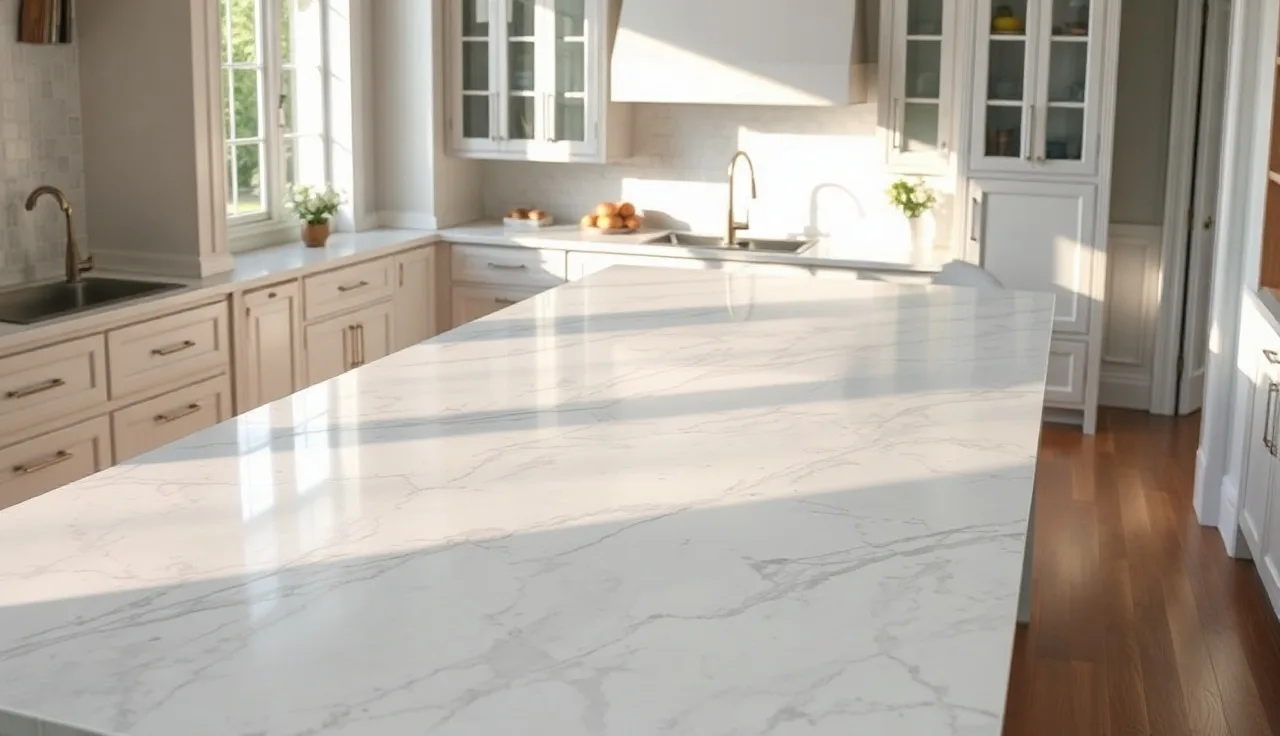
TL;DR
- Italian marble countertops run $75 to $250 per square foot installed, depending on the stone variety and slab grade.
- Carrara is the cheapest way in; Calacatta and Statuario sit at the top.
- Every Italian marble etches and stains without proper sealing.
- The look is unmatched, but it asks for real maintenance in return.
What is Italian marble and why does it cost more than other marble?
Italian marble is natural limestone that metamorphosed under extreme heat and pressure, mostly in the Apuan Alps of Tuscany, though quarry sites also sit in Sicily and Lombardy. What separates Italian stone from Turkish, Greek, or Chinese marble is a mix of mineral purity, vein character, and centuries of quarrying knowledge that produces very consistent slab quality.
Carrara, Calacatta, and Statuario all come from the same mountain range in the Apuane area near the city of Massa-Carrara. They are technically the same geological formation, but different zones of the quarry yield dramatically different visual results. Calacatta, with its bold gold-and-gray veining on a bright white background, comes from a narrower, harder-to-reach section of the deposit. That scarcity is the core reason it costs two to three times more than Carrara [1].
Not all stone sold as "Italian marble" actually is. Some suppliers relabel Turkish or Chinese white marble to charge a premium. If provenance matters to you, ask for a Certificate of Origin or check whether the supplier is a member of the Marble Institute of America. The MIA maintains sourcing standards and can point you toward verified distributors [2].
Which Italian marble varieties are available for countertops?
There are roughly a dozen commercially significant Italian marble varieties, but five own the countertop market.
| Variety | Background | Vein character | Typical slab price (per sq ft) | Best use |
|---|---|---|---|---|
| Carrara | White to gray | Fine gray veins | $40, $80 | Kitchens, bathrooms, islands |
| Calacatta | Bright white | Bold gold or gray veins | $90, $200 | Feature islands, bath vanities |
| Statuario | Warm white | Dramatic gray veins | $100, $250 | High-end kitchens, statement pieces |
| Arabescato | White | Dense gray-brown network | $60, $120 | Waterfall edges, backsplashes |
| Bardiglio | Blue-gray | Subtle white veins | $50, $100 | Bathrooms, fireplace surrounds |
Carrara is the workhorse. It has a softer, more consistent look, and because it comes from a larger quarry area, slabs are plentiful. Most fabricators keep Carrara in stock and can turn a project in one to two weeks.
Calacatta is the one you see on design blogs and Pinterest boards. The bold veining reads beautifully from across a room, which makes it a favorite for kitchen islands. The catch is matching veins across multiple slabs on a large countertop, which takes real skill. You want a fabricator who will book-match on the floor before cutting, more than pick slabs that look close on a warehouse shelf.
Statuario is rarer than Calacatta and commands the highest prices. It has a warmer white background than Calacatta and veins that run more linear and dramatic. Genuinely high-grade Statuario is hard to find outside large stone distributors in major metro areas.
Arabescato has a busy, networked vein pattern. Some people love the movement. Others find it visually chaotic. It works well for waterfall edges where the pattern wraps around the corner and turns the island into a display piece.
Bardiglio is the outlier. Its blue-gray base feels contemporary and pairs with white cabinets in a way that reads more modern than traditional.
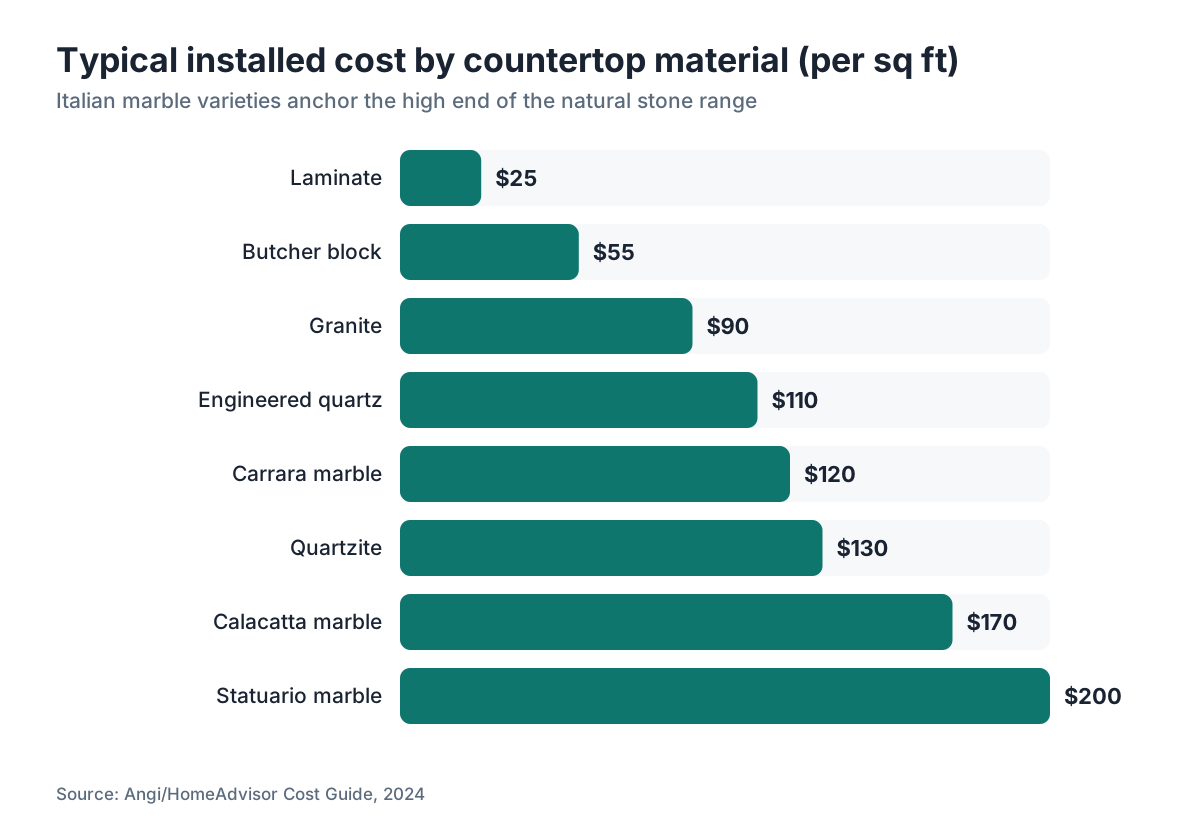
How much do Italian marble countertops cost installed?
Installed costs run $75 to $250 per square foot for the full project, meaning stone plus fabrication plus installation. That range is wide because it spans Carrara from a regional stone yard to a hand-selected Statuario slab from a specialty importer.
Here is a realistic cost breakdown for a typical 50-square-foot kitchen countertop:
- Slab material: $2,000, $10,000 depending on variety and grade
- Fabrication (cutting, edging, polishing): $800, $2,000
- Installation: $300, $800
- Sealing (first application): $100, $300
- Sink cutout: $150, $400
Total range: $3,350, $13,500 for a mid-size kitchen [3].
Those numbers assume you buy through a fabricator with a wholesale account at a stone distributor. If you buy a slab retail at a home improvement store and have a local shop cut it, you may pay more for fabrication and less for the stone, but the total usually lands close.
Grade matters enormously. Italian marble is graded informally (Commercial, Standard, Premium, Extra) by most distributors, though there is no single industry-wide standard. Extra-grade Calacatta slabs with the boldest veining can hit $250 per square foot installed on their own.
Fabricators who use software to optimize how slabs get cut, like SlabWise's nesting tools, can sometimes cut material waste on large or oddly shaped countertops, which drops the number of slabs you need. On a $150/sq ft stone, that matters.
Does Italian marble etch and stain? What does that look like in real life?
Yes. This is the honest part of the conversation that gets glossed over in showrooms.
Marble is calcium carbonate. Acids react with calcium carbonate and etch the surface, leaving a dull, slightly rough spot that looks like a watermark or a ghost of whatever touched it. Lemon juice, orange juice, vinegar, wine, tomato sauce, coffee, even sparkling water over time. These etch regardless of whether the stone is sealed. Sealing protects against staining from oils and pigments, not etching from acids. Those are two separate problems [4].
Etching shows up more on polished finishes than on honed. On a polished surface, an etch creates a matte patch that catches light differently from the glossy stone around it. On a honed surface, the etch is harder to see because the whole surface is already matte. If you want Italian marble in a working kitchen, honed is the more forgiving choice.
Staining happens when oil or pigment sinks into the porous stone. Olive oil, butter, red wine, and dark sauces are the usual culprits. A good penetrating sealer cuts this risk a lot, but it does not erase it. If a sealed marble surface takes a deep oil spill that sits for hours, you may end up with a stain that needs a poultice to draw out [5].
In real life, kitchens with Italian marble develop a patina. Some homeowners love this, calling it "lived-in" or "antique." Others find every new etch mark stressful. Know which camp you fall into before you commit.
How do you seal Italian marble countertops and how often?
Penetrating sealers, also called impregnating sealers, are the right product for marble. They soak into the stone and block the pores without changing how the surface looks. Topical coatings that sit on top of the stone are a mistake. They peel and create more maintenance than they solve.
The first sealing on new stone is simple: apply the sealer with a clean cloth or applicator pad, let it penetrate for 5 to 15 minutes (follow the product instructions), then buff off the excess before it dries on the surface. Most products call for two coats on marble, especially porous white varieties like Carrara [6].
How often you reseal depends on the sealer quality and how hard the countertop works. The water-drop test tells you where you stand: put a quarter-teaspoon of water on the surface. If it beads up, the sealer is holding. If it soaks in within a few minutes, reseal. For most kitchens, that means resealing every six months to a year. Bathroom vanities that see less acid exposure might go two years between applications.
The Marble Institute of America publishes care guidance that matches this approach [2]. Its general recommendation is to clean spills immediately, use pH-neutral cleaners, and never use vinegar or bleach on marble surfaces.
For more general help keeping natural stone clean, the how to clean stone countertops guide covers products and techniques that apply directly to marble.
How does Italian marble compare to quartzite, granite, and quartz?
Shoppers make three comparisons over and over: marble versus quartzite (which can look similar), marble versus granite (the classic natural stone alternative), and marble versus engineered quartz (the practical alternative).
Quartzite is a metamorphic rock like marble, but it is made of quartz minerals, not calcium carbonate. That means it does not etch from acids. Several white quartzite varieties from Brazil and India carry a veined look close enough to Calacatta to fool most guests. Quartzite typically costs $80 to $150 per square foot installed, overlapping marble's range but generally harder and more resistant to daily damage. The how to clean quartzite countertops guide has more on maintenance differences.
Granite is igneous rock. It is harder than marble, more resistant to etching, and generally cheaper per square foot. White granites with movement (like White Ice or Alaska White) can approach marble's look, though the crystalline pattern reads differently up close. See the granite countertops guide for a deeper comparison.
Engineered quartz (brands like Cambria, Silestone, or Caesarstone) is man-made: ground stone plus resin binders. It does not etch, needs no sealing, and shrugs off stains. Several Calacatta-look quartz products are basically indistinguishable from marble in photographs. The tradeoff is that quartz lacks the depth and variation of a natural slab, and it can look slightly artificial under raking light. Cambria countertops are a popular pick for homeowners who want the marble aesthetic without the upkeep.
| Material | Etch resistance | Stain resistance | Sealing needed | Typical installed cost |
|---|---|---|---|---|
| Italian marble | Poor | Fair (sealed) | Yes, 1-2x/year | $75, $250/sq ft |
| Quartzite | Good | Good | Occasionally | $80, $150/sq ft |
| Granite | Good | Good | Every 1-3 years | $55, $130/sq ft |
| Engineered quartz | Excellent | Excellent | No | $70, $150/sq ft |
Is Italian marble a good choice for kitchen countertops or only bathrooms?
The honest answer depends on how you cook and how much the look matters to you.
Marble has lived in pastry kitchens for centuries because the stone stays cooler than the air around it, which keeps butter-based doughs from getting too warm. That practical advantage is real. Rolling croissant dough on cool marble beats laminate or tile.
But a marble surface used for daily cooking will develop etches. In six months you will have marks from lemon halves cut straight on the stone, from a splash of vinegar dressing, from a glass of wine set down without a coaster. On a honed finish these read as darker patches. On a polished finish they read as dull spots.
Some kitchens split the difference: a marble island for pastry work and visual impact, with quartzite or granite on the perimeter counters where the sink and prep happen. This costs more, but it puts the look where it counts and the durability where you need it.
Bathrooms are an easier call. Acid exposure is much lower (toothpaste is mildly abrasive but not strongly acidic), and the surfaces take far less hard daily use. A marble vanity top can last decades and age gracefully.
The kitchen countertops guide covers how to weigh stone choice against cooking habits for anyone still deciding on material.
Here is a fabricator's read: marble jobs need more careful handling during template, cut, and install than granite or quartz. The stone is softer (roughly 3 to 4 on the Mohs scale [7]) and more likely to crack at thin sections like sink cutouts or sharp inside corners. Experienced shops add support rods across cutouts and keep inside corner radii at least 3/8 inch.
How is Italian marble fabricated and installed?
Fabricating marble looks like fabricating other natural stone, but it demands more care at specific steps.
Templating comes first. Most shops now use digital templating systems that create a precise CAD file of the countertop layout. That matters more for marble because you want to plan the vein layout before any cuts happen. A good fabricator lays the digital template over a photograph or scan of the actual slab to show you exactly where the veins will fall before anything is cut.
Slab selection is where homeowners add real value. If you can visit the stone yard and hand-select your slabs, do it. Every slab is different. Even within the same block of Calacatta, adjacent slabs carry different vein intensity and background whiteness. Book-matching, where two consecutive slabs are mirrored like an open book, creates a dramatic symmetrical vein pattern on large islands. Not all fabricators offer this, and it demands more precise layout planning.
Cutting marble on a CNC waterjet or bridge saw is straightforward for straight cuts. The challenge is sink cutouts and inside corners. Marble cracks more easily than granite at stress points. Any inside corner needs a radius, not a sharp 90-degree angle, and a well-made marble sink cutout often carries a fiberglass or epoxy rod bonded across the opening on the underside for reinforcement.
Edge profiles on marble look best simple. A standard eased edge or a small bevel works well. Ogee and other heavily worked profiles chip more easily on marble than on granite. For a waterfall edge, the slab needs to be continuous or perfectly matched, and the miter joint has to be tightly cut and expertly bonded.
Installation needs supports under spans longer than about 24 inches if there is no cabinet below. Marble's weight (roughly 18 to 20 pounds per square foot at 3/4-inch thickness [8]) and its low tensile strength mean unsupported overhangs beyond 12 inches need either corbels or a thicker slab section.
The countertop installation guide covers what to expect on installation day and how to check the job before signing off.
What thickness should Italian marble countertops be?
The two standard thicknesses are 2 cm (roughly 3/4 inch) and 3 cm (roughly 1.25 inches). For kitchen countertops, 3 cm wins by a mile.
Here is why. Marble has lower flexural strength than granite. A 2 cm marble slab over a standard 36-inch cabinet run sits at real risk of cracking if the substrate is not dead flat and well-supported, or if any serious weight or impact lands on it. A 3 cm slab is much more forgiving. Most US fabricators will not install 2 cm marble in a kitchen without a plywood substrate laminated to the underside, which adds cost and complexity.
For bathroom vanity tops, 2 cm can work because spans are shorter and the cabinet supports the stone more completely. Many vanity tops run 22 inches front-to-back with no unsupported sections, a very different stress situation from a 96-inch kitchen run.
For islands with a waterfall edge, you need the same thickness on the horizontal top and the vertical drops, which means ordering enough material from the same slab to cover all three pieces. This detail gets miscommunicated sometimes, so confirm it out loud with your fabricator before the slab is cut.
How do you repair chips and etches in Italian marble?
Small chips on polished marble can sometimes be filled with a color-matched epoxy or polyester filler, then polished back to a shine. This is a job for an experienced stone restoration pro, not a weekend DIY. The filler has to match the stone's color and translucency, and polishing it back to blend with the surrounding surface takes diamond polishing equipment.
Etches on polished marble are the most common repair request. Light etches can sometimes be handled by hand-polishing with marble polishing powder (tin oxide is the traditional compound) and a felt pad, which re-establishes the shine in the etched spot. Deeper etches need professional diamond polishing.
On honed marble, surface damage hides better, and a light resanding often blends minor scratches and scuffs. That is one more reason honed is the practical finish for a kitchen.
Cracks are a different animal. A crack that runs through the full thickness of the slab is a structural failure, usually from inadequate support, impact, or a flaw in the stone itself. These can be repaired with epoxy and color-matching, but the repair is usually visible under raking light. Whether that is acceptable depends on where the crack sits and how much the appearance matters.
The Marble Institute of America has a contractor locator for finding certified stone restoration professionals [2]. For day-to-day cleaning questions, the how to clean stone countertops guide covers which products are safe and which cause damage.
What are the best Italian marble options for white kitchen countertops?
White kitchen countertops are the single most common home for Italian marble, and the choice within that category comes down to how bold you want the veining.
If you want a quiet, consistent background that recedes and lets other kitchen elements stand out, Carrara is the pick. The gray veining is fine and spread across the surface. From 10 feet away, a Carrara countertop reads as soft white. It is the easiest stone to match across multiple slabs because the pattern variation is low.
If you want the stone to be the statement, Calacatta or Statuario delivers. The veining on these stones is bold enough to anchor the whole room. A large Calacatta island with book-matched veins is a centerpiece.
One underrated option is Calacatta Oro, a variety with warm gold veining on a very white background. It reads warmer than standard Calacatta and pairs well with brass or gold hardware. Pricing sits close to standard Calacatta, but good slabs can be hard to find outside major metro areas.
For people who want the look without the maintenance, porcelain slabs printed with Italian marble photographs are a legitimate alternative. Large-format porcelain (from Italian makers like Atlas Concorde or Florim) can be convincing and is essentially acid-proof. The main giveaway is the edge profile, which looks different from natural stone on close inspection.
You can also compare marble countertops broadly if you are not locked into Italian origin and want to see how the full category stacks up.
How do fabricators quote and source Italian marble jobs?
For fabricators, Italian marble jobs carry higher material costs and higher risk than granite or quartz work, which means pricing them right matters more.
Material sourcing usually runs through regional stone distributors who stock slabs in large format (typically 110 by 66 inches, or larger). Calacatta and Statuario are not always on the floor, so lead times can run three to six weeks if the distributor has to import. Carrara is almost always available domestically from distributor warehouses.
Quoting a marble job takes accurate slab yield math. Marble slabs vary more in usable area than granite because of veining direction requirements and matching needs. A job that would take 1.3 slabs of granite might need 1.8 slabs of Calacatta if the homeowner wants consistent vein direction throughout. Waste factors on marble typically run 15 to 30 percent higher than on granite or quartz.
Fabricators who move real stone volume use shop management and nesting software to model exactly how templates lay onto slabs before buying material. That cuts the risk of buying a slab that produces too much waste. Platforms like SlabWise let shops model nesting digitally and attach those layouts straight to quotes, so the material cost is accurate before any stone is cut.
Markup on Italian marble material tends to run a lower percentage than on commodity stone, because the raw cost is so high that a 30 percent markup on a $200/sq ft slab is visible and sometimes negotiated. Many fabricators price marble on a blended margin that leans on higher labor rates (for the extra care) rather than high material markup.
For any fabricator building a countertop quote workflow, the line items that matter on a marble job are: slab cost, waste factor, fabrication labor (higher than granite), edge profile complexity, special handling, sealing, and delivery and installation.
Frequently asked questions
How long do Italian marble countertops last?
With proper sealing and careful use, Italian marble countertops can last the lifetime of the home. The stone itself does not degrade. What changes over time is the surface finish: etches, minor scratches, and patina accumulate. A professional restoration can polish the surface back to near-new condition. The Colosseum and the Pantheon are built from Italian stone over 2,000 years old, though admittedly nobody is slicing lemons in the Pantheon.
Can Italian marble countertops be used outdoors?
Technically yes, but it is a bad idea in most climates. Marble is porous enough to absorb water, and freeze-thaw cycles make that absorbed water expand and crack the stone from within. In mild, dry climates (like Southern California or the Mediterranean itself), outdoor marble lasts reasonably well. In regions with hard winters, outdoor marble surfaces deteriorate noticeably within a few years. Porcelain or sealed granite hold up far better outdoors.
What is the difference between Calacatta and Carrara marble?
Both come from the Apuan Alps in Tuscany, but from different zones of the quarry. Carrara has a gray-white or blue-white background with fine, feathery gray veins spread across the surface. Calacatta has a brighter, whiter background with fewer but bolder veins, often in gold or warm gray. Calacatta is rarer and costs roughly two to three times more than Carrara per square foot of slab.
Does sealing Italian marble prevent etching?
No. Sealing prevents staining from oils and pigments by filling the pores. Etching is a chemical reaction between acids and the calcium carbonate in the stone. Acids dissolve the surface whether or not a sealer is present. The only way to avoid etching on marble is to keep acids off the surface, which is very hard in an active kitchen. Honed finishes make etches less visible than polished finishes.
How heavy is Italian marble and does my cabinet need reinforcing?
Standard 3 cm (1.25-inch) marble weighs about 18 to 20 pounds per square foot. A 50-square-foot kitchen countertop weighs 900 to 1,000 pounds. Most standard kitchen cabinetry handles this weight fine if it is well-built and properly leveled. Older or lower-quality cabinet boxes may need reinforcement, especially at unsupported spans. Your fabricator should assess the cabinets during templating and flag any concerns.
Is Italian marble from Italy actually better than marble from other countries?
For the classic white veined varieties (Carrara, Calacatta, Statuario), yes: the specific geological formation in the Apuan Alps produces a stone character nobody has replicated elsewhere. For other colors and patterns, marble from Turkey, Greece, Spain, and Portugal can be excellent and sometimes superior. The Italian label sometimes gets slapped on non-Italian stone by unscrupulous suppliers, so asking for a Certificate of Origin is reasonable on high-value orders.
What edge profile works best on Italian marble?
Simple profiles work best. An eased edge (slightly softened 90-degree corner), a bevel, or a small ogee all look right and chip less than complex carved profiles. Heavily worked profiles like a full bullnose or a traditional ogee require more stone removal, which concentrates stress on thinner sections and raises the chance of breakage both during fabrication and over time with normal use.
Can I cut food directly on Italian marble?
You can, but you should not. Cutting straight on marble scratches the polished surface (marble is soft at Mohs 3 to 4) and if the blade touches any acid-containing food it will etch the surface. More practically, cutting on hard stone dulls your knives much faster than a wood or plastic board. Use a cutting board. Protect the marble and your knives.
How do I get a stain out of Italian marble?
Oil-based stains respond to a poultice made of baking soda or diatomaceous earth mixed with a solvent like acetone or a commercial degreaser. Apply the paste thick, cover with plastic, and leave it 24 to 48 hours to draw the stain out as it dries. Organic stains (coffee, wine) respond to a poultice made with hydrogen peroxide. For deep or set stains, a stone restoration professional with commercial-grade poultice products gets better results than DIY attempts.
What is the resale value impact of Italian marble countertops?
High-quality stone countertops generally add to resale appeal, though pinning down the exact dollar return is hard. The National Association of Realtors reports that kitchen upgrades are among the most cited factors buyers consider, and natural stone reads as a premium finish. Whether you recover the cost depends on your market and comparable sales. In luxury markets, Calacatta marble may be expected at the price point. In moderate markets, it may not move the needle in proportion to its cost.
Are there budget alternatives that look like Italian marble?
Yes. The closest in look and feel is large-format porcelain in a marble pattern, which resists acid, cleans easily, and costs $40 to $100 per square foot installed. Engineered quartz with Calacatta or Carrara patterns (made by brands like Cambria or Silestone) runs $70 to $150 installed and needs no sealing. Laminate with printed marble patterns exists at $15 to $40 per square foot but looks noticeably less convincing, especially at edges. See the guides on laminate countertops and Cambria countertops for more.
How do I find a fabricator experienced with Italian marble?
Ask directly whether they have done Calacatta or Statuario work before, and ask to see photos. The Marble Institute of America keeps a directory of member fabricators who have agreed to its professional standards. Ask specifically how they handle sink cutouts on marble (they should mention reinforcement rods) and whether they book-match slabs for large islands. A fabricator who has never done it is not the right choice for a $15,000 Calacatta kitchen.
How does Italian marble compare to butcher block for a kitchen island?
They do very different jobs. Butcher block is warm, renewable, and great for food prep but needs regular oiling and takes damage from standing water over time. Italian marble is cool, dramatic, and good for pastry work but etches from acids and needs sealing. Some kitchens run both: marble on one side of an island for looks, butcher block on the other as a dedicated prep surface. The butcher block countertops guide covers maintenance and cost comparisons in detail.
Sources
- Marble Institute of America, Stone Types and Origins: Calacatta marble comes from a narrower, more restricted zone of the Apuan Alps quarries than Carrara, contributing to its higher cost and relative scarcity.
- Marble Institute of America, Care and Maintenance Guidelines: MIA recommends pH-neutral cleaners, immediate spill cleanup, and penetrating sealers for natural marble surfaces; provides a contractor locator for restoration professionals.
- HomeAdvisor (Angi), Countertop Installation Cost Guide: Installed marble countertop costs typically range from $75 to $250 per square foot depending on stone type, slab grade, and regional labor rates.
- Penn State Extension, Understanding Stone and Its Properties: Marble is calcium carbonate (calcite), which reacts chemically with acids to produce etching on the surface; sealing does not prevent this acid reaction.
- University of Florida IFAS Extension, Cleaning and Maintaining Natural Stone Surfaces: Penetrating (impregnating) sealers reduce stain absorption in porous stone by filling capillary pores but do not prevent acid etching on marble surfaces.
- Marble Institute of America, Sealing Natural Stone: MIA recommends two coats of penetrating sealer for porous white marble varieties, with reapplication when the water-drop bead test shows reduced beading.
- USGS, Mohs Hardness Scale Mineral Reference: Calcite (the primary mineral in marble) rates 3 on the Mohs hardness scale; marble countertops typically fall between 3 and 4 depending on impurities.
- Natural Stone Institute, Technical Manual: Weight of Stone: 3 cm (1.25 inch) marble slabs weigh approximately 18 to 20 pounds per square foot, a standard reference figure used in structural load calculations for countertop installations.
- National Association of Realtors, Remodeling Impact Report: Kitchen upgrades, including stone countertops, are among the most frequently cited factors buyers consider, with natural stone viewed as a premium finish in the resale market.
- Italian Trade Agency, Italian Marble and Stone Sector Overview: The Massa-Carrara province in Tuscany is the primary source of commercially significant white marble varieties including Carrara, Calacatta, and Statuario.
- ASTM International, Standard C503: Specification for Marble Dimension Stone: ASTM C503 defines dimensional marble and establishes minimum physical property standards including absorption, modulus of rupture, and compressive strength for dimension stone applications.
Last updated 2026-07-09