TL;DR
- Granite countertops cost $40 to $60 per square foot installed, and most kitchens land between $2,000 and $5,000 depending on slab grade, edge profiles, and cutouts.
- The job runs in four phases: template, fabrication, delivery, and installation, usually over one to two weeks.
- DIY is possible but risky.
- Slabs weigh 15 to 18 pounds per square foot and a wrong cut turns the whole piece into scrap.
What does it cost to have granite countertops installed?
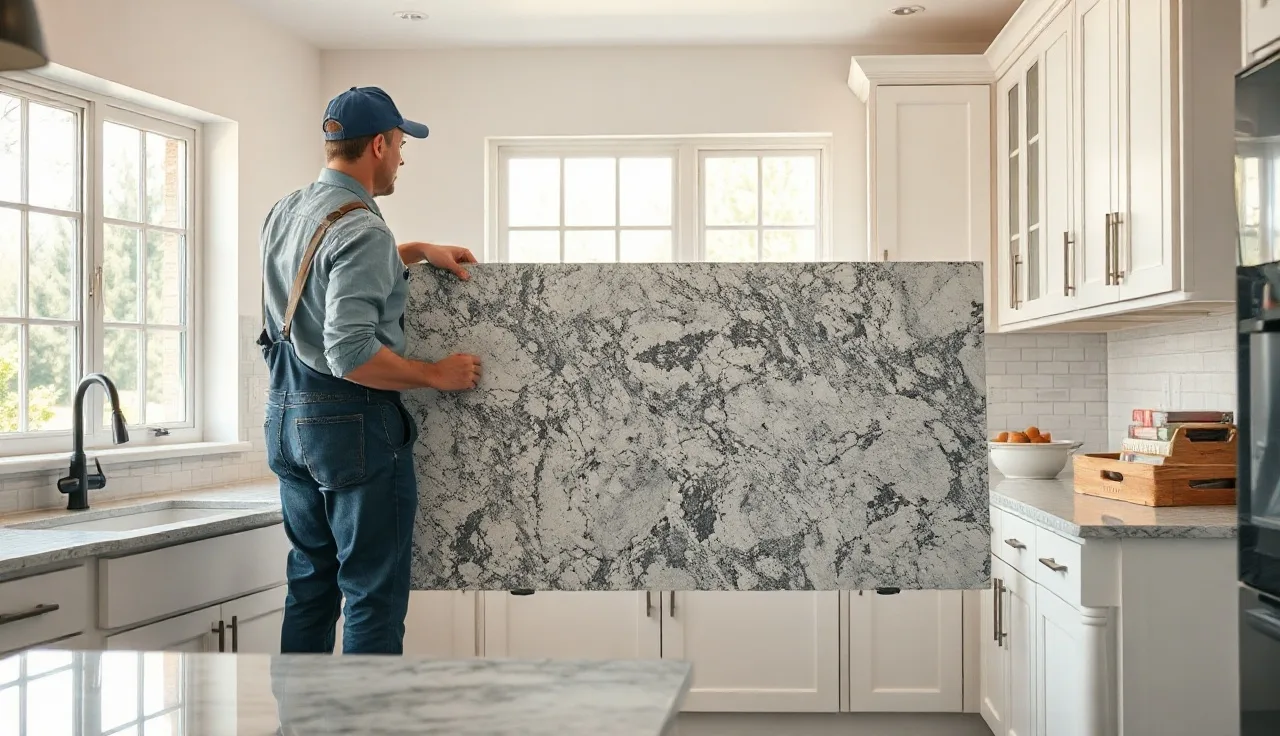
Granite countertops cost $40 to $60 per square foot installed. That range covers the slab, fabrication (cutting, polishing, edge work), and professional installation. For a typical kitchen with 40 square feet of counter space, budget $1,600 to $2,400 for a basic granite with a simple edge, and $3,000 to $5,500 once you move into premium slabs, waterfall edges, or multiple cutouts. [1]
Those numbers come from aggregated contractor data. Treat them as a realistic midpoint, not a floor. Your actual price swings on four things: the slab tier you pick, how many cutouts the fabricator makes (sinks, cooktops), which edge profile you want, and how far the shop hauls the stone.
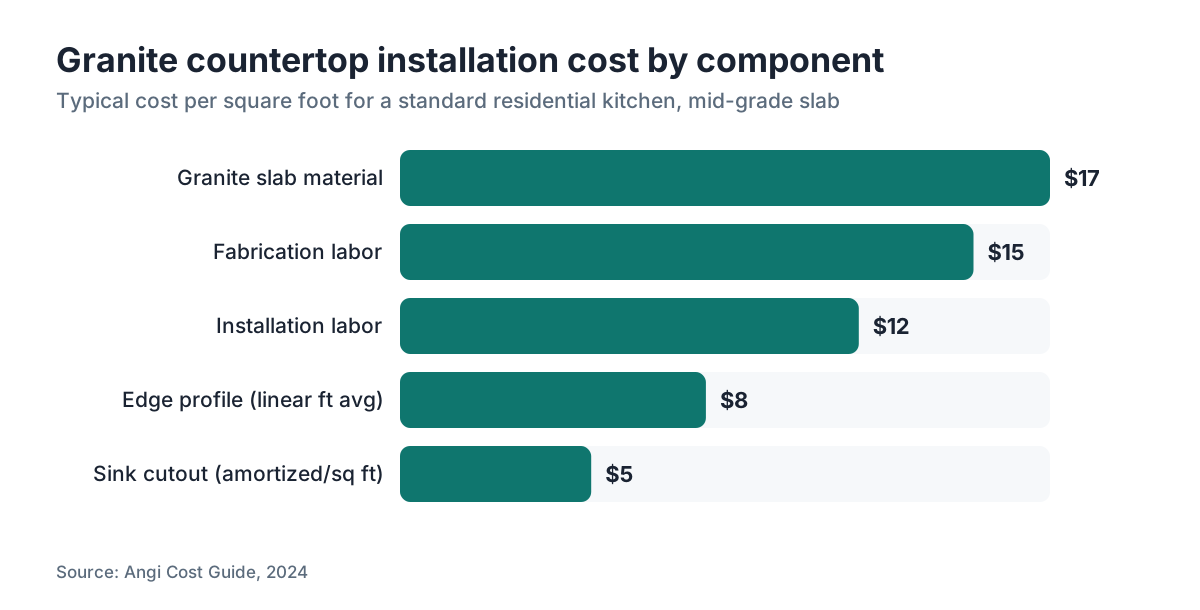
Here's what you're actually paying for, broken out:
| Cost Component | Typical Range |
|---|---|
| Granite slab material (per sq ft) | $5, $30 |
| Fabrication labor (per sq ft) | $10, $20 |
| Installation labor (per sq ft) | $10, $15 |
| Sink cutout | $100, $250 per cutout |
| Cooktop cutout | $150, $300 per cutout |
| Upgraded edge profile (per linear ft) | $10, $30 |
| Removal of old countertops | $150, $600 |
| Plumbing reconnection | $100, $350 |
The granite price you see advertised on big-box store websites usually reflects the slab material only. You won't get an accurate installed number until a fabricator measures the space and prices your specific job. Anyone quoting granite installed without knowing your square footage and cutout count is guessing. [1]
How does granite countertop price vary by slab grade?
Slab grade is the single biggest lever on your material cost, and it swings from $5 to more than $30 per square foot. Fabricators sort granite into informal tiers (Level 1 through 4, or Entry/Mid/Premium/Exotic), but the logic behind the labels is consistent. The tier reflects how rare the color and movement pattern are, where the stone came from, and how much waste a fabricator eats to match the pattern across seams.
Entry-level granite (Level 1) runs $5 to $10 per square foot for material. These are solid, reliable stones, often standard black, white, or beige with minimal veining. Think Santa Cecilia or Uba Tuba. Mid-grade slabs (Level 2 to 3) go $15 to $25 per square foot and carry more movement and rarer colors. Exotic slabs, things like Blue Bahia or White Ice with dramatic veining, hit $30 or more per square foot for material alone, before a minute of fabrication. [1]
The total price climbs faster than the material sticker when you go exotic. Heavy veining and pattern matching demand careful nesting, more waste, and more time at the saw, so shops often add a fabrication premium on top of the higher stone cost.
Here's my honest take. Choose a Level 1 or Level 2 slab and spend the savings on a nicer edge profile. The edge is what you touch every day. Most people never regret a simple eased or beveled edge on a good mid-grade stone.
What is the full process for installing a granite countertop?
Five phases sit between the day you pick your slab and the day the counters are done. Knowing each one keeps your expectations honest and saves you from the scheduling mistakes that stall most jobs.
Step 1: Template (measuring the space) After your cabinets are set and the plumbing rough-in is done, a fabricator sends someone to template your kitchen. Most shops now use a digital templating tool that captures the exact geometry, including every wall angle and cabinet quirk. Some still use plywood or cardboard. The visit takes 30 to 90 minutes. Do not template until cabinets are fully installed and level. Sounds obvious. It's still the most common cause of delay.
Step 2: Slab selection If you haven't picked your stone yet, do it before or during templating. You need to physically see the slab you're buying, not a sample chip. Each slab is unique. The pattern on the showroom sample is not the slab going in your kitchen. Go to the yard, mark your slab, and ask the shop to photograph which pieces get cut for your job. [2]
Step 3: Fabrication The shop lays your template on the slab (nesting) to cut waste and line up veins across seams. Then they cut the pieces, make your cutouts, profile the edges, and polish everything. Fabrication takes 3 to 7 business days for a standard kitchen, longer if the shop is slammed or the stone fights back.
Step 4: Delivery and installation day Granite is heavy. A single slab weighs 15 to 18 pounds per square foot, so a 3-by-8-foot piece runs 360 to 430 pounds. [3] The crew (usually 2 to 3 people) carries pieces in through your widest door, sets them on the cabinets, and joins seams with epoxy color-matched to the stone. Cutouts drop over your sink and cooktop. Installation day runs 2 to 5 hours for a standard kitchen.
Step 5: Sealing Most shops seal the stone before they leave, or it arrives pre-sealed. Either way, granite should be sealed before it touches water or food. A penetrating sealer takes about 15 minutes to apply. Let the counter cure 24 hours before normal use, and 48 to 72 hours before reconnecting the sink and running water. [4]
Total elapsed time from template to done: 1 to 2 weeks is normal. Rush jobs can finish in 3 to 5 days at premium pricing. If a shop quotes 4 or more weeks on a standard kitchen with no complications, they're probably overbooked, and you should ask what's driving the timeline.
Can you install granite countertops yourself, and is it a good idea?
DIY granite installation is possible. For a full kitchen, it's a bad bet for most people, and here's exactly why.
The weight is the first problem. A standard kitchen job involves pieces that weigh 200 to 500 pounds each. Moving granite without specialized suction cups and at least three strong people is how you drop a $1,500 piece of stone on a tile floor, or on someone's foot. Rental suction handles exist. They're not the pro-grade Fezer or Anver vacuum lifters shops rely on. [3]
Cuts are the second problem. Make one wrong cut in granite and the piece is scrap. Granite saws cost thousands of dollars and need a water cooling system. A rented angle grinder with a diamond blade makes rough cuts but won't give you the polished edge a wet saw produces. An unpolished cut on a visible surface looks amateur, and you can't easily fix it.
Seam quality is the third. Matching two pieces across a seam, getting them flush and epoxied right, is a skill that takes time to build. A bad seam is ugly and structurally weak.
Where DIY makes sense: you're a contractor with stone experience, you're swapping a single bathroom vanity top (lighter, simpler), or you're doing a small laundry room with no seams. In those cases, rent the right tools and go slow. For a full kitchen, hire a fabricator. Labor is a fraction of the material cost, and it's where most of the real risk lives.
What do you need to do to prepare before granite installation?
Good prep means the crew isn't standing in your kitchen waiting on you. Here's what has to be in place before they arrive.
Cabinets must be fully installed, shimmed, and leveled. Granite has no flex. If cabinets aren't level, the stone bridges the high spots and builds stress cracks over time, or the installer shims under the slab and creates a new set of problems. [5]
The plumbing rough-in should be complete, but the sink and faucet should not be installed yet. Countertop first, then the sink drops in (for an undermount), then plumbing connects. If you have an existing faucet running through your old counter, the plumber disconnects it before demo and reconnects after installation.
Clear the cabinets completely. Empty every drawer and shelf near the countertop zone. The crew sets heavy stone right above that space, and vibration knocks things around.
Decide on seam placement before installation day. Seams should fall in low-traffic zones, not right in front of the main prep area, and they need a cabinet below to support them. The fabricator proposes seam locations off your slab layout, but you should know where they'll land and approve them before fabrication starts.
If old countertops are coming out, find out whether demo is in your quote. Some fabricators include it. Many don't. Pulling old laminate or tile is its own job that adds $150 to $600 depending on what's under there. [1]
How are granite countertops actually attached and supported?
Granite doesn't glue down like laminate. The stone rests on the cabinet structure and stays put mostly by gravity and its own weight. The support is usually the plywood top of the cabinet carcass or a subtop layer, not adhesive.
Fabricators run silicone adhesive (not epoxy) along the cabinet contact points. It keeps the stone from shifting and seals out moisture underneath. Silicone flexes enough to handle minor movement without cracking. A rigid adhesive would create stress points.
Seams between pieces get joined with two-part color-matched epoxy, then clamped with seam setters that pull the two pieces tight and flush. The epoxy sets hard and creates a structural bond. A well-made seam is nearly invisible and as strong as the stone around it.
Overhangs need support. Standard practice: 3/4-inch granite overhangs up to 12 inches with no extra support. [5] Past that, you need corbels, brackets, or a steel rod cast into the stone. Breakfast bar overhangs of 18 to 24 inches are common, and they always need proper brackets. If an installer tells you a 20-inch overhang is fine unsupported, that's wrong. Push back.
For oversized islands or spans over a dishwasher or other appliance, fabricators sometimes add a plywood subtop. That's standard and nothing to worry about, as long as you know it's there.
What questions should you ask a granite countertop fabricator before signing?
Comparing fabricator quotes is where homeowners lose money, because two quotes rarely cover the same scope. These are the questions that actually matter.
What does the price include? Ask for a line-item quote: material, fabrication, delivery, installation, cutouts, edge profile, sealing, and removal of old tops. Some shops bundle everything. Others quote material and fabrication, then bolt on labor and delivery. You can't compare two numbers unless they cover the same work.
Will I see the actual slab before you cut it? The answer should be yes. If a fabricator won't show you the exact slab and where your pieces lay out on it, that's a problem. This matters most on premium or veined stones.
How many cutouts does the quote include, and what's the rate for extras? Standard quotes often include one sink cutout. A cooktop, a soap dispenser hole, and a farmhouse sink each add to the price.
Who installs, your own crew or subcontractors? Many fabricators run in-house crews. Some subcontract. That's not automatically bad, but you want to know who's on the hook if something goes wrong.
What happens if a piece gets damaged during install? It's rare. It happens. A shop with confidence in its work has a clean answer: they recut at their cost, full stop. A vague answer here is a warning sign.
If you run your own shop, tools like SlabWise handle the quote-to-template-to-fabrication workflow digitally, which cuts manual transcription errors and leaves a cleaner paper trail when disputes come up. Worth knowing when you're judging whether a shop has its process together.
How do granite countertop costs compare to other countertop materials?
Granite sits in the mid-range of countertop materials, cheaper than marble or premium quartz, pricier than laminate or butcher block. Here's an honest side-by-side:
| Material | Installed Cost (per sq ft) | Notes |
|---|---|---|
| Laminate (Formica) | $15, $40 | Lowest cost, least durable at seams |
| Butcher block | $35, $60 | Needs oiling, warm look |
| Granite | $40, $60 | Durable, needs sealing, each slab unique |
| Marble | $50, $80 | Etches and stains more easily than granite |
| Quartz (engineered) | $50, $90 | Consistent pattern, no sealing needed |
| Quartzite | $60, $100 | Harder than granite, natural stone |
| Cambria / premium quartz | $80, $120 | Lifetime warranty, uniform pattern |
Granite lands in a sweet spot. It's more durable than laminate countertops and cheaper than marble countertops or Cambria countertops. It asks for more care than engineered quartz (periodic sealing, don't leave acidic foods sitting for hours), but it's natural stone, unique per slab, and it holds up for decades under normal kitchen use. [6]
On a tight budget, butcher block countertops are the only natural material that consistently undercuts granite. If low maintenance is the priority and you don't mind a uniform pattern, quartz is the real competitor. The choice between granite and quartz almost always comes down to one question: do you want natural stone character, or something that needs less attention? Both are good answers.
How do you get an accurate estimate for your specific kitchen?
For a real number, you need an in-person measure. Online calculators give you a ballpark, which is fine for figuring out whether you're in the right budget range before you start calling shops, but they can't account for the variables that actually set your price.
Here's how to get a quote that means something.
Measure your existing countertop footprint in square feet before you call anyone. Multiply linear feet by depth (typically 25.5 inches, which is 2.125 feet) for each run of cabinets, then add up the runs. That gives your approximate square footage. Most kitchens run 30 to 60 square feet.
Get at least three quotes from local fabricators, not big-box stores. Big-box stores outsource fabrication and installation to local shops anyway, often the same shops you'd hire directly, and they tack on a markup for the referral. Going direct almost always saves money and gives you more control over slab selection. [2]
Compare price per square foot installed, not the total dollar figure, because different shops measure slightly differently. Then compare what's included: edges, cutouts, sealing, and demo.
For kitchen countertops specifically, ask about lead time. A shop quoting $10 per square foot less than everyone else but running a 6-week backlog may blow your renovation timeline. Price is one dimension. A reliable install date matters just as much.
Shops that use digital quoting software (the kind that pulls from template geometry instead of hand-written measurements) tend to produce more accurate estimates, because there's less room for human error between the measure and the quote. Ask how a shop generates its quotes. The answer tells you a lot about how it's run.
What happens after granite countertops are installed?
The first 48 hours matter more than most homeowners realize. The silicone under the stone needs time to cure, and so does any seam epoxy. The rules are simple.
Don't reconnect the sink or run water for 24 to 48 hours. The silicone holding an undermount sink needs to cure fully. Run water before it sets and you can pull the sink loose. [4]
Don't load heavy objects onto unsupported overhangs right away. The brackets and silicone under a breakfast bar overhang need 24 hours before you pile on bowls, appliances, or people leaning.
Check the seams. Walk around and look at every seam in raking light (hold a flashlight parallel to the surface). A slight color difference in the epoxy is normal. A seam that isn't flush, where one piece sits noticeably higher than the other, is a problem to raise with your fabricator now, not six months later.
Seal the stone if the fabricator didn't. For most residential granites, one coat of penetrating sealer a year is enough. Denser granites like Absolute Black may not need sealing at all. The water bead test settles it: pour a tablespoon of water on the stone and wait 4 minutes. Beads up, the sealer is working. Darkens and soaks in, time to seal. [4]
For daily care, how to clean stone countertops covers the products that are safe and the ones that wreck a granite sealer in a few weeks (spoiler: most spray cleaners with vinegar or citrus are the culprit). Read it before you pick your everyday cleaner.
Full countertop installation aftercare, including what to do if a crack appears, gets covered separately. The short version: hairline cracks in seams are usually a sealer gap or epoxy settling, not structural failure. Cracks in the field of the stone are more serious, and the fabricator needs to see them.
What are the most common mistakes homeowners make when installing granite countertops?
These come up over and over, and most are avoidable with a little advance knowledge.
Scheduling the template too early. Cabinets must be fully set before templating. Period. Template with temporary cabinet placement because you're in a rush, and the stone won't fit once the cabinets get adjusted.
Picking granite from a sample chip instead of the actual slab. A 4-by-4-inch sample tells you the color family and rough pattern. It says nothing about the veining, the background color variation, or whether the slab has natural fissures you'd want to steer clear of. Always go to the yard. [2]
Not budgeting for plumbing reconnection. Your plumber disconnects the sink and supply lines before demo and reconnects after installation. That's separate from countertop installation, and it runs $100 to $350. Homeowners who don't plan for it get surprised.
Choosing an edge profile on looks alone. Ogee and dupont edges photograph beautifully but they trap grime in the crevices and take longer to clean. A pencil edge or a simple bevel wipes clean and looks sharp for decades. If you love a fancy edge, that's fine, just know what you're signing up for.
Ignoring seam placement until installation day. Seams should be discussed and agreed on during the quote, before fabrication. Moving a seam after the stone is cut costs money and may not even be possible.
Taking the cheapest quote without asking what's included. The cheapest bid is sometimes the right bid. It's also sometimes a shop that skips sealing, runs thin material, or subcontracts installation to whoever's free. Ask the questions from the section above before you sign anything.
Is granite still worth installing in 2025, or has it been replaced by better materials?
Granite is still worth it for most kitchens. Its market share has slid since engineered quartz took off in the mid-2000s, but granite remains one of the most-installed natural stone surfaces in the United States. [6] It hasn't been replaced so much as it now competes on even footing with quartz instead of winning by default.
The case for granite is straightforward. It's genuinely durable, with a Mohs hardness of 6 to 7, which means it shrugs off scratches from nearly everything in a kitchen. [7] Every slab is unique, so two kitchens with the same granite name still look different. It holds resale value in most markets. And the installed cost often beats comparable quartz once you account for material-only pricing on mid-grade slabs.
The case against is real too. You have to seal it. Acidic foods, citrus juice, and vinegar-based cleaners will etch poorly sealed granite over time. The pattern isn't controllable the way engineered stone is, so it's harder to match across a big island or a complex layout. If you have a precise design vision with tight color control, granite may frustrate you.
For the material science, slab grades, and maintenance in depth, see granite countertops. The short verdict: granite lost its status as the automatic prestige pick, but it didn't lose its durability, and on a per-decade basis it's hard to beat.
Shops that want to quote granite jobs faster and more accurately, especially as slab pricing and remnant inventory shift constantly, can see how SlabWise handles digital quoting and nesting in a live demo.
Frequently asked questions
What is the average cost of granite countertops installed per square foot?
Granite countertops cost $40 to $60 per square foot installed, covering material, fabrication, and labor. Entry-level granite sits at the low end, exotic slabs with complex edges at the high end. A typical 40-square-foot kitchen comes out to $1,600 to $2,400 for basic granite, and $3,000 to $5,500 for mid-grade stone with a few cutouts.
How long does it take to install granite countertops after templating?
From template to installation, most shops deliver in 1 to 2 weeks. Fabrication alone takes 3 to 7 business days for a standard kitchen. Installation day itself takes 2 to 5 hours. Rush service at some shops compresses this to 3 to 5 total days at a price premium. If a shop quotes 4 or more weeks with no stated reason, they're likely overbooked.
Do granite countertops need to be sealed after installation?
Yes, most granites need sealing, and most fabricators apply one coat before leaving. Reseal annually as a rule of thumb, though denser granites may need it less often. The water bead test is the reliable check: put a tablespoon of water on the stone and wait 4 minutes. If it soaks in and darkens the stone, apply a penetrating sealer. If it beads up, you're fine.
Can granite countertops crack during or after installation?
Granite can crack, though it's rare with proper support. The highest-risk moment is transporting and setting thin pieces over large spans. After installation, cracks show up most at the corners of cutouts (stress concentration points) or where an unsupported overhang takes a hit. Hairline seam cracks are usually epoxy settling, not structural failure. Any new crack should be evaluated by your fabricator.
How thick should granite countertops be?
Residential granite countertops are almost always 3 centimeters (about 1.18 inches) thick. That's the current standard and handles normal kitchen use without a plywood subtop in most cases. Some budget jobs use 2-centimeter slabs (about 0.75 inches), which need a plywood subtop for support and limit overhang options. When comparing quotes, confirm the thickness. It directly affects durability and price.
Can granite countertops be installed over existing countertops?
Technically possible in some cases, generally a bad idea. Installing granite over existing laminate or tile adds height that can clash with your backsplash, appliances, or sink depth. You're also relying on the old substrate to carry significant extra weight. Most fabricators won't warranty an installation done over an existing top. Demo the old counters first. It's worth the extra $150 to $600.
What edge profile is best for granite countertops?
A simple eased edge (slightly softened square edge) or a small bevel works for most kitchens. They're the easiest to clean, the most chip-resistant, and they don't go out of style. Ogee, dupont, and bullnose edges look great but collect crumbs and grime in their profiles. Waterfall edges are striking on islands but expensive. Choose based on how much edge you want to clean, more than how it photographs.
How much does a granite countertop installation cost for a bathroom vanity?
Bathroom vanity granite tops typically run $200 to $600 installed for a standard single-sink vanity, because the square footage is small (often 8 to 15 square feet). The per-square-foot rate can be slightly higher than a kitchen, since small jobs carry fixed costs that don't scale down. Many fabricators have a minimum job charge, often $300 to $500, regardless of size.
Do fabricators charge extra for undermount sinks with granite?
Yes, almost universally. An undermount sink cutout typically adds $100 to $250 to the fabrication cost. That covers the cut, polishing the inside edge of the cutout to a finished look, and sometimes the undermount clips and epoxy that hold the sink from below. A farmhouse (apron-front) sink can cost more, because the front edge of the cabinet and stone need to be cut back to fit it.
How do I know if my cabinet structure can support granite countertops?
Standard kitchen cabinets built with 3/4-inch plywood boxes handle granite weight fine in almost all residential situations. The concern is older cabinets built with particleboard, or cabinets that are soft, water-damaged, or poorly fastened to the wall. If cabinets flex, creak, or aren't level, fix that before templating. Granite doesn't forgive unlevel cabinets and can crack over time where it bridges a low spot.
What's the difference between a granite countertop estimate and a final price?
Estimates based on photos or rough measurements almost always land lower than the final invoice, because shops find real conditions only when they template. Things that add cost after an initial estimate: more cutouts than described, a sink style needing extra polishing, wall angles that force more waste, or a slab that requires careful layout to dodge a flaw. Get a firm quote only after the fabricator has templated, or at minimum seen your exact floor plan.
Can you use a granite countertop cost calculator to get an accurate price?
Online granite cost calculators are useful for rough budget planning, not for actual quotes. They multiply square footage by an average installed rate and add standard cutout fees. They don't account for your specific slab grade, local labor costs, shop minimum charges, or the layout complexity of your kitchen. Use a calculator to set a budget range, then get three real quotes from local fabricators.
How do granite countertop installation costs vary by region?
Labor drives most regional variation. Fabrication and installation labor in high cost-of-living areas like New York, California, and the Pacific Northwest runs 20 to 40 percent higher than in the Midwest or Southeast. Material costs vary less by region, since slab pricing is mostly tied to import and wholesale markets. If you're near a major stone import port (Miami, Houston, New Jersey), expect more slab selection and lower material costs.
What warranty should I expect from a granite countertop fabricator?
Most reputable fabricators warranty their workmanship (seams, cutout quality, installation) for 1 year. Some extend to 2 years. The stone itself carries no manufacturer warranty because it's natural stone, but defects should be visible before installation and a good shop will point them out. Get the warranty terms in writing before signing. Verbal warranties are worth nothing if the shop changes hands or disputes your claim.
Sources
- HomeAdvisor (Angi), Granite Countertops Cost Guide: Average cost of granite countertops installed ranges $40 to $60 per square foot; component cost breakdown for material, fabrication, installation, and cutouts
- National Stone Institute, Consumer Stone Selection Guide: Consumers should view and approve the actual slab before fabrication; sample chips do not represent full slab variation
- OSHA, Respirable Crystalline Silica / Material Handling Standards: Granite slabs average 15 to 18 pounds per square foot; safe material handling requires appropriate lifting equipment
- Natural Stone Institute, Care and Maintenance of Natural Stone: Granite should be sealed before use; 24 to 48 hour cure time before running water; water bead test to assess sealer effectiveness
- Natural Stone Institute, Dimension Stone Design Manual (ANSI/NSI 373): 3/4-inch granite can overhang up to 12 inches without support; overhangs beyond 12 inches require structural support such as corbels or brackets
- U.S. Census Bureau, American Housing Survey: Kitchen remodel data including countertop replacement frequency and typical homeowner spending ranges
- U.S. Geological Survey, Mohs Hardness Scale: Granite has a Mohs hardness of approximately 6 to 7, making it highly scratch-resistant in kitchen environments
- National Kitchen and Bath Association: Countertop selection and installation labor represent a significant cost component of kitchen remodels; professional installation recommended for natural stone
Last updated 2026-07-10