TL;DR
- Imitation marble countertops replicate the white-and-veined look of marble using quartz, porcelain, laminate, or sintered stone.
- Installed costs run from about $10 per square foot for laminate up to $120 or more for high-end sintered stone.
- None need sealing, and all resist staining far better than real marble.
- The right pick depends on your budget, how hard the surface will work, and how close the look needs to be.
What counts as an imitation marble countertop?
Imitation marble is any countertop material engineered or manufactured to look like natural marble without actually being it. The category covers four main materials: engineered quartz (the biggest seller), large-format porcelain slabs, high-pressure laminate, and sintered stone products like Dekton and Lapitec. Each one mimics marble's characteristic white or cream ground with gray, gold, or green veining, but they do it through completely different manufacturing processes and they perform very differently in a kitchen.
Natural marble is a metamorphic rock, mostly calcite, and that calcite reacts with acids. Lemon juice, vinegar, tomato sauce, coffee, any of them will etch the surface over time, leaving dull spots that no amount of cleaning fixes. That's why so many homeowners who love the look end up choosing something fake. The imitation versions dodge the etching problem almost entirely, which is the whole point.
To be clear about scope: cultured marble (a polyester-resin product used almost exclusively for bathroom vanity tops and shower surrounds) also belongs in this family but isn't covered in depth here because it's rarely used for kitchen countertops and has a noticeably artificial look up close. This article focuses on kitchen-grade surfaces. If you want to understand what real marble actually is before comparing, marble countertops has a thorough breakdown.
What are the main materials used to imitate marble?
Engineered quartz is the market leader by volume. It's made by binding roughly 90 to 94 percent ground quartz with polymer resins, then pressing it into slabs under high pressure [1]. Manufacturers inject pigments and sometimes sinuous veining during the process to replicate marble patterns. Brands like Silestone, Caesarstone, Cambria, and MSI all sell marble-look lines. The finished surface is non-porous, never needs sealing, and resists most household stains well. Heat resistance is the weak point: quartz resins can discolor or delaminate above about 300 degrees Fahrenheit, so trivets matter.
Porcelain slabs (sometimes called porcelain tile countertops or large-format porcelain) are fired ceramic with marble patterns printed through the full thickness of the slab or at least deeply into it. The printing technology has improved dramatically since 2015, and the best large-format porcelain slabs are genuinely hard to distinguish from natural marble at a glance. They're harder than quartz, scratch-resistant, UV-stable (important for outdoor kitchens), and can handle hot pots. The downside is brittleness at the edges during fabrication and installation; a less experienced installer can chip or crack a slab.
Laminate is a layer of photographic paper printed with a marble image, fused under high pressure to a particleboard or MDF core, then coated with a hard melamine or aluminum-oxide wear layer. Formica's Calacatta Marble pattern is a well-known example. Modern laminate looks far more convincing than it did twenty years ago. It's light, affordable, and easy to install, but the seams show, the substrate swells if water gets underneath, and it scratches more easily than stone or quartz. Laminate countertops and Formica countertops both have detailed guides if that's your budget tier.
Sintered stone (Dekton, Lapitec, Neolith, Stoneam) is made by compressing a mix of glass, quartz, and porcelain powders at extreme heat and pressure, essentially accelerating the geological process that creates natural stone. The result is extremely dense, scratch-resistant, UV-stable, and heat-proof. It's the most realistic-looking imitation at the high end of the market, and it's also the most expensive and the hardest to fabricate because it can crack if not cut and supported correctly [2].
How much do imitation marble countertops cost?
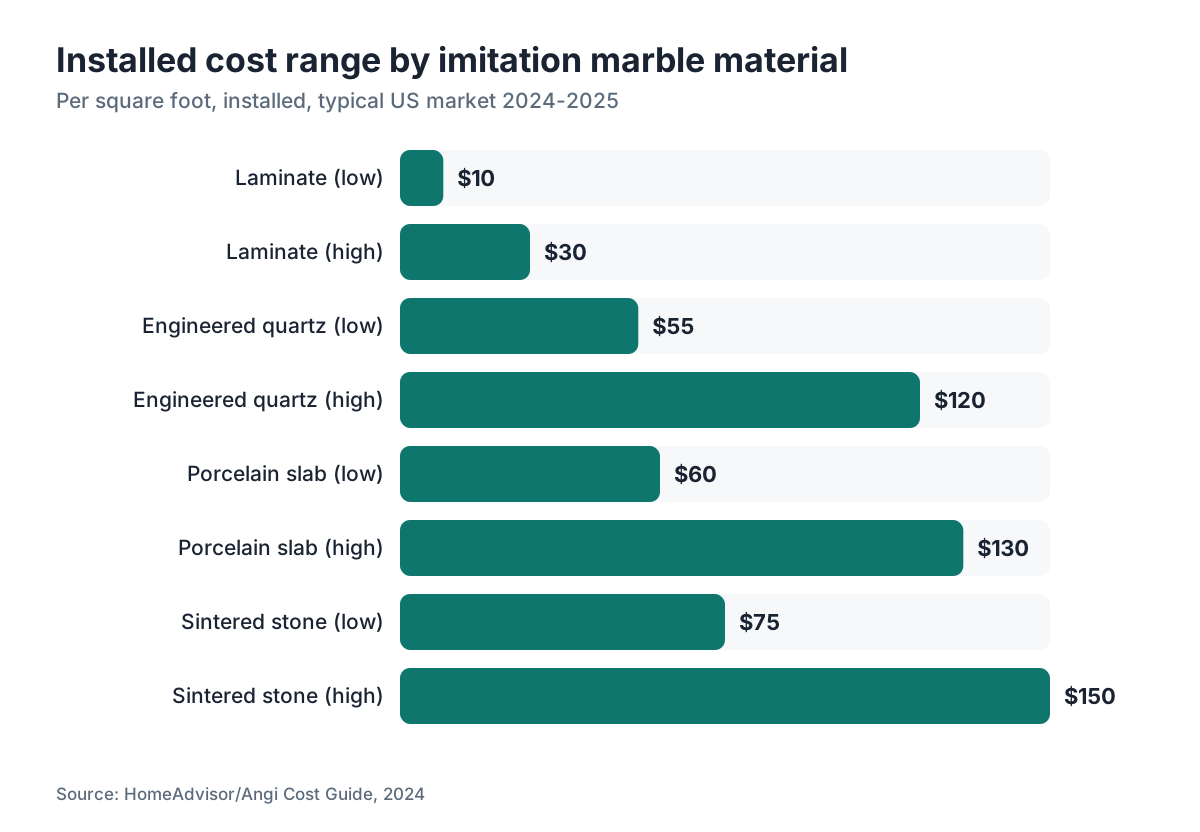
Prices vary a lot by material, brand, thickness, edge profile, and your local market. The table below gives honest installed ranges based on industry pricing surveys and fabricator data as of 2024 to 2025. All figures are per square foot, installed, including a standard edge and basic cutouts.
| Material | Low end | High end | Notes |
|---|---|---|---|
| Laminate | $10 | $30 | DIY-friendly; professional install adds $5-10/sq ft |
| Engineered quartz | $55 | $120 | Brand and thickness drive the range |
| Porcelain slab | $60 | $130 | Fabrication labor often higher due to skill required |
| Sintered stone (Dekton, etc.) | $75 | $150+ | Highest material and fabrication cost |
| Cultured marble (vanity) | $15 | $45 | Not recommended for kitchen use |
For a typical 40-square-foot kitchen, laminate might total $400 to $1,200, quartz $2,200 to $4,800, and sintered stone $3,000 to $6,000 or more. These are rough ranges. A complex layout with lots of cutouts, a waterfall edge, or a mitered edge detail can push any category significantly higher [3].
Labor costs run roughly $35 to $85 per hour for experienced stone fabricators depending on region, per Bureau of Labor Statistics data on tile and stone setters [4]. Laminate is the only category where competent DIY installation is realistic for most homeowners.
One honest note: the cheapest quartz marble-looks often have digital veining that repeats every few slabs in a highly visible pattern. Spending a little more for a brand that runs the veining in random orientations, or that does full-slab book-matching, gets you a result that's much harder to identify as fake.
How do imitation marble countertops compare to real marble for durability?
Real marble is rated at about 3 to 4 on the Mohs hardness scale, which makes it softer than glass (5.5) and considerably softer than quartz (7). That's part of why marble etches and scratches relatively easily in kitchen use. Imitation materials mostly beat real marble on everyday durability.
Quartz engineered stone rates around 7 on the Mohs scale for the quartz component itself, though the resin binder is softer and more vulnerable to sharp knives dragged across the surface. Porcelain slab is typically fired to a hardness of 7 to 8 Mohs, which is harder than most metals you'd encounter in a kitchen. Sintered stone is similarly hard. Laminate wear layers vary but are generally rated for light kitchen use and will show knife marks over time.
Acid resistance is where the gap is biggest. Real marble etches on contact with anything acidic because the calcite reacts chemically with acid. The Marble Institute of America notes that even water with a pH below 7 can cause micro-etching over time [5]. Quartz, porcelain, and sintered stone are all acid-resistant because they don't contain reactive calcite. Laminate is also acid-resistant at the surface, though sustained water or acidic spills at the seams can swell the substrate.
Heat is where quartz falls behind real marble. Natural marble handles heat fine; a hot pot won't damage it (it might stain if you set something oily on it, but the heat itself isn't the problem). Quartz resins can deform around 300 to 400 degrees Fahrenheit. Porcelain and sintered stone handle heat as well as natural stone does, sometimes better.
For UV resistance, real marble, quartz, and laminate all yellow or discolor with prolonged sun exposure over years. Porcelain and sintered stone are UV-stable, which matters for outdoor kitchen applications.
Which imitation marble material looks most realistic?
Sintered stone tops the realism ranking right now, full stop. Products like Dekton's Rem, Entzo, or Kadum patterns are printed at very high resolution and carry veining that runs through the full slab thickness, so a mitered edge or a chipped corner doesn't reveal a flat printed layer underneath. From across a room, and even up close, the best sintered stone marble-looks are genuinely difficult to distinguish from Calacatta or Statuario marble.
High-end porcelain slabs from Italian manufacturers like Atlas Plan, Florim, or Fiandre have closed the gap substantially. The veining is photo-realistic and, in their thicker formats (12mm or more), the surface texture varies in ways that mimic real stone's slight topographic irregularity.
Engineered quartz has improved a lot but still shows its limits at the high-magnification, touch-the-surface level. The veining in quartz is applied during pressing and tends to have a slightly more uniform, controlled look. Brands like Cambria countertops have invested heavily in more random, natural-looking patterns. For most people standing in a kitchen, a well-chosen quartz marble-look is convincing. A stone professional will clock it immediately.
Laminate is the most obviously synthetic at close range. The surface has a uniform texture, the pattern repeats, and the seam at a sink or inside corner is visible. For a rental property, a basement bar, or a very tight budget, it's fine. For a kitchen you're trying to pass off as having marble countertops at resale, it won't hold up to scrutiny.
One thing that genuinely helps any imitation material look more real: full-slab veining that runs uninterrupted across a long countertop run, rather than repeating short panels. Ask your fabricator whether the material you're considering comes in full slabs (usually 120 by 60 inches or larger) and whether they can orient and match the veining across seams.
Do imitation marble countertops need sealing or special maintenance?
No sealing required. That's one of the main practical advantages over real marble, which needs sealing every one to three years depending on traffic and the specific stone.
Engineered quartz is non-porous by design. The resin binder fills all the voids between quartz particles, so bacteria and liquids can't penetrate. The Marble Institute of America and most quartz manufacturers are consistent on this: no sealer, no wax, no special treatment [5]. Clean with mild dish soap and water. Avoid harsh abrasives, bleach in high concentrations, and drain cleaner, all of which can degrade the resin binder over time.
Porcelain slab is similarly non-porous, vitrified during firing to essentially zero water absorption. The Tile Council of North America defines fully vitrified tile as having less than 0.5 percent water absorption [6]. No sealing needed. Clean the same way you'd clean any hard surface.
Sintered stone is non-porous and chemically inert. Dekton's published technical specifications state that the material has zero porosity, making it resistant to stains, frost, and UV exposure [2].
Laminate needs the most careful handling, not because the surface is porous but because the seams and edges are. Water that gets under the laminate or into the particleboard substrate causes swelling that's irreversible. Keep seams caulked, don't let water pool near the sink, and replace the caulk the moment it cracks.
For all imitation marble surfaces, avoid cutting directly on the countertop (it scratches quartz and laminate, and will eventually dull the surface finish of porcelain), and use trivets under hot pans if you have quartz. Beyond that, maintenance is genuinely easy compared to natural stone. How to clean stone countertops covers the underlying principles if you want to go deeper.
How does imitation marble hold up for resale value?
This is where honest hedging is appropriate. Nobody has solid controlled data that isolates countertop material as an independent variable on home sale price. The closest proxies come from remodeling cost-vs-value surveys.
Remodeling Magazine's annual Cost vs. Value report (the most widely cited source in this space) tracks mid-range and upscale kitchen remodels. The 2024 report found that a major mid-range kitchen remodel recouped about 38 percent of its cost nationally, while an upscale kitchen remodel recouped about 31 percent [7]. The countertop choice is bundled into those totals; it's not broken out separately. What that says is that kitchen upgrades in general recover less than half their cost at sale, so the argument that you need to spend $8,000 on natural marble countertops for resale value is shaky.
Real estate agents commonly report that buyers respond positively to stone-look surfaces and that laminate is a visible negative in higher price-point homes. Whether that means engineered quartz outperforms porcelain or sintered stone on resale is not something any published data shows.
The practical answer: if you're remodeling to sell soon, mid-grade quartz in a marble pattern is probably the safest bet. It photographs well, buyers recognize the brand names (Silestone, Caesarstone), and it costs less than sintered stone. If you're staying in the home for ten or more years, durability and your own satisfaction with the look matter more than resale calculation.
What are the drawbacks of imitation marble countertops?
Every material has real weaknesses. None are deal-breakers for every buyer, but it pays to be honest.
Quartz scratches from knives are permanent and visible on light marble-colored surfaces because the cuts expose the slightly different texture of the resin versus the quartz particles. White or light cream quartz also shows every coffee ring, water spot from hard water, and oil smear more than a darker surface would. Some quartz brands have had issues with discoloration in kitchens near south-facing windows over many years, though the industry has largely addressed this with improved UV-stable pigments since around 2018.
Porcelain slab edges chip during fabrication more readily than quartz or natural stone. A shop with limited porcelain experience can crack a slab during a sink cutout. Insist on a fabricator who regularly works with large-format porcelain, not someone who does it once a year. The other porcelain problem: it's very hard, which means knife blades dull faster if you're someone who cuts directly on the counter.
Sintered stone has the same edge fragility issues as porcelain, amplified. It's also the most unforgiving to retrofit; adding a new cutout after installation is a specialized job. And the price is real: a full sintered stone kitchen can cost as much as or more than natural marble.
Laminate is honest about what it is at close range. Seams are visible. Knife marks accumulate. And if the substrate gets wet, you're looking at replacement, not repair.
None of these materials are well-suited to outdoor UV exposure except porcelain and sintered stone. Quartz warranties typically exclude outdoor use for this reason [1]. If you want an outdoor kitchen with a marble look, porcelain or sintered stone are the only reasonable options.
How does the installation process differ from natural stone?
In broad terms, imitation marble countertops install the same way natural stone does: cabinets are measured, a template is cut, slabs are fabricated to spec, and the finished pieces are delivered and set. But there are differences that matter.
Porcelain and sintered stone require specialized tooling and more cautious blade selection than granite or quartzite. The materials are extremely hard and brittle, and feeding them too fast through a bridge saw can cause edge fractures. A competent natural stone shop can learn to work with these materials, but it takes practice. If you're getting quotes, ask how many porcelain or sintered stone jobs the shop has done in the last year.
Quartz installs almost identically to granite, and any experienced countertop fabricator handles it daily. Weight is comparable (quartz at 3cm thickness is roughly 19 to 20 pounds per square foot, similar to granite [8]), so cabinet support requirements are the same.
Laminate is the outlier. It's light, cuttable with woodworking tools, and many confident DIYers install it without professional help. Post-form laminate (the kind with a rolled front edge and backsplash integrated) is even simpler since the edges are already finished.
For any countertop installation, the template step is where errors happen. A template that's off by 1/8 inch can mean a slab that doesn't fit or an ugly gap at the wall. Digital templating (using a laser measuring device and software) reduces this error rate significantly. Fabricators using tools like SlabWise can generate quotes and nesting layouts directly from the digital template, which cuts material waste and speeds up turnaround. More on what to expect during the whole process at countertop installation.
One installation detail specific to light marble-look surfaces: the color and finish of the adhesive and caulk at seams matters visibly on a white or cream background. Ask your fabricator what they use and whether color-matched caulk is included. A gray seam on a white Calacatta-look quartz is jarring and avoidable.
How do I choose between quartz, porcelain, and sintered stone for a marble look?
Start with your actual use conditions, not the showroom photo.
If you cook hard, meaning hot pans coming off the stove, a lot of acidic food prep, and kids who drag forks across the counter, porcelain or sintered stone are better fits than quartz. They handle heat without care and resist scratches better. The trade-off is higher installation cost and the need for a more experienced fabricator.
If budget is the main constraint and you want the look without spending more than $70 to $80 per square foot installed, quartz gives you the most realistic result in that price bracket. Porcelain and sintered stone start getting interesting above $80 to $90.
If you're doing an outdoor kitchen or a surface that sees direct sun, porcelain or sintered stone only. Quartz manufacturers explicitly void warranties for outdoor installations.
If the kitchen is in a rental property or a flip, laminate is a defensible choice. Nobody is going to mistake it for real marble up close, but in listing photos it passes reasonably well, and your cost basis stays low.
For bathrooms and vanity tops specifically, engineered quartz is the dominant choice and works well because heat and outdoor UV aren't factors. Cultured marble (cast polymer) is worth a look for shower surrounds and integrated sinks because it pours as one continuous piece with no visible joints, even though it looks more artificial than quartz.
A quick path through the decision: Can you spend $80 or more per square foot installed? If yes, look at porcelain and sintered stone first. If no, quartz in the $55 to $75 range. If under $30, laminate. Don't overthink the brand within each category; the look you're drawn to in person (at a slab yard or showroom, more than on a website) is the most reliable guide.
What questions should I ask a fabricator before buying?
A few questions will tell you a lot about whether a shop knows what they're doing.
Ask how many jobs they've done with the specific material you're considering. Porcelain and sintered stone experience varies a lot shop to shop, and a shop that primarily does granite and quartz may not be the right call for a 20mm Dekton slab.
Ask to see the slab in person before they cut it. Marble-look patterns vary significantly slab to slab even within the same product line. Two Calacatta Gold Silestone slabs from the same batch can have different vein intensity. Your fabricator should be willing to show you the actual slab, more than a sample chip.
Ask whether the veining runs full-length across the slab and whether they can orient the slabs to run the veining in the same direction across a seamed countertop. This is called vein matching, and it's a real fabrication skill that costs a little extra in layout time but makes a big visual difference.
Ask what their process is for sink cutouts, specifically on porcelain or sintered stone. The answer should include slow cutting speeds, specialized bits, and ideally a router pass rather than a single blade pass.
Ask for the warranty documentation for both the material and the installation. Most quartz manufacturers offer 10 to 15 year limited warranties on the material [1]. The installation warranty from the shop is typically 1 to 2 years and covers things like seam separation or uneven settling.
Getting multiple quotes matters more than most buyers realize. Countertop pricing varies 20 to 40 percent between shops in the same market for the same material and layout. If you want to compare quotes systematically and understand what drives the differences, an instant quote tool like the one at SlabWise lets you input your layout and get a baseline before talking to fabricators.
Are there any other countertop materials worth comparing?
The alternatives that don't fit neatly into the four imitation-marble categories are worth a brief mention.
Corian countertops and other solid-surface materials are technically in the imitation-stone family (they're acrylic-based), and some patterns mimic marble. They pour and join into one continuous surface with no visible joints, and scratches can be sanded out. They work well in integrated sink applications. But their heat resistance is poor (don't exceed about 212 degrees Fahrenheit without a trivet) and they look noticeably artificial at close range.
Concrete countertops can be formed with veined patterns and sealed to look loosely like marble. They're heavy, require expert sealing, and are prone to cracking over time if the substrate shifts. Few fabricators do them well.
Glass countertops exist as a niche product. Some have printed marble patterns on the underside visible through the glass. They're heat-resistant, completely non-porous, but expensive to fabricate and hard to find a shop that does them.
None of these alternatives come particularly close to matching real marble's appearance. The quartz-porcelain-sintered stone category is where the realistic imitation market lives.
For comparison to other real stone options, granite countertops covers the most popular natural stone material, and if you're curious about other stone materials with low maintenance requirements, how to clean quartzite countertops and how to clean soapstone countertops are useful reads since both quartzite and soapstone fill a similar niche as natural stones that are more durable than marble. Kitchen countertops has a broader comparison of every material category if you want to step back and look at all of your options at once.
Frequently asked questions
What is the cheapest imitation marble countertop?
Laminate is the cheapest option, running $10 to $30 per square foot installed. Modern laminate patterns like Formica's Calacatta Marble look convincing in photos and from a distance, though seams are visible up close and the substrate is vulnerable to water damage. It's a reasonable choice for rentals, basements, or anywhere you need the look on a tight budget.
Does quartz imitation marble look fake?
At a distance, a well-chosen quartz marble-look is convincing. Up close, and especially if you know what to look for, the veining has a slightly more controlled, uniform quality compared to natural stone. Higher-end brands have improved significantly since 2020. The most realistic imitation marble at close range is currently sintered stone like Dekton, not quartz, but quartz beats laminate easily.
Will imitation marble countertops etch?
No. Etching is a chemical reaction between acid and calcite, the mineral that makes up real marble. Engineered quartz, porcelain, sintered stone, and laminate contain no calcite, so they don't etch. Lemon juice, vinegar, and tomato sauce won't damage the surface the way they would on real marble. This is one of the biggest practical reasons people choose imitation marble for working kitchens.
How long do imitation marble countertops last?
Quartz and porcelain countertops routinely last 20 to 30 years with normal care. Sintered stone is similarly durable. Laminate has a shorter lifespan, typically 10 to 20 years before visible wear, edge chipping, or water damage to the substrate makes replacement worthwhile. Quartz and porcelain warranties from reputable manufacturers run 10 to 15 years on material defects.
Can you put hot pans on imitation marble quartz countertops?
Not recommended. Quartz resin binders can deform or discolor at temperatures above roughly 300 degrees Fahrenheit. A hot pan straight from the oven can cause permanent thermal shock marks. Always use a trivet or hot pad. Porcelain and sintered stone handle high heat without any special precautions, which makes them better choices for heavy cooking households.
Is imitation marble good for bathrooms?
Yes, and it's often a better choice than real marble in bathrooms too. Quartz is the most popular option: non-porous, easy to clean, and resistant to toothpaste, makeup, and cleaning product splashes. Cultured marble (cast polymer resin) is a cost-effective option for integrated sink and vanity top applications in bathrooms, though it doesn't look as realistic as quartz at close range.
What is sintered stone and is it better than quartz for marble-look countertops?
Sintered stone (brands include Dekton, Lapitec, and Neolith) is made by compressing glass, quartz, and porcelain particles at extreme heat and pressure. It's harder than quartz, completely heat-proof, UV-stable, and produces the most realistic marble imitation available. It's also the most expensive category ($75 to $150+ per square foot installed) and requires a fabricator experienced with its brittleness.
How do I clean imitation marble countertops?
Mild dish soap and warm water handles daily cleaning for quartz, porcelain, and sintered stone. Avoid abrasive scrubbers, bleach in high concentrations, and drain cleaner, all of which can degrade quartz resin or surface finish. For laminate, keep seams dry and replace caulk if it cracks. None of these materials need sealing or polishing under normal use.
Do imitation marble countertops add home value?
The evidence is indirect. Remodeling Magazine's 2024 Cost vs. Value report found mid-range kitchen remodels recoup about 38 percent of cost at resale nationally, but it doesn't isolate countertop material. Real estate agents generally report that quartz and porcelain surfaces photograph better and get a positive buyer response compared to laminate, especially in homes priced above the median in their market.
Can you cut on imitation marble countertops?
Technically you can, but you shouldn't. Quartz resists cuts reasonably well but will show knife marks on light-colored surfaces over time, and those marks are permanent. Porcelain and sintered stone are so hard they'll dull your knives faster than they'll scratch the surface. Laminate scratches visibly from knife use. Use a cutting board regardless of which material you choose.
What is the difference between quartzite and quartz countertops?
Quartzite is a natural metamorphic rock (sandstone transformed by heat and pressure) while engineered quartz is a manufactured product binding ground quartz with polymer resins. Quartzite looks more like natural marble and is harder, but it's porous and must be sealed regularly. Engineered quartz is non-porous and needs no sealing but has lower heat resistance due to its resin content.
Is porcelain slab or quartz better for a marble-look kitchen?
For a working kitchen with heat exposure and direct sun, porcelain edges out quartz. It handles hot pans, doesn't yellow with UV exposure, and the best Italian large-format porcelain is extremely realistic. For a kitchen where heat and UV aren't issues and budget is tighter, quartz gives you very good looks for less money and is easier and cheaper to fabricate and install.
How much does it cost to install imitation marble countertops in a kitchen?
For a typical 40-square-foot kitchen, expect $400 to $1,200 for laminate, $2,200 to $4,800 for engineered quartz, and $3,000 to $6,000 or more for porcelain or sintered stone, all installed. Complex layouts with multiple cutouts, waterfall edges, or thick mitered profiles add significantly to any category. Getting three quotes from local fabricators is the most reliable way to price your specific job.
Can I use imitation marble outdoors?
Porcelain slab and sintered stone (Dekton, Neolith, Lapitec) are the only imitation marble materials rated for outdoor use. They're UV-stable, frost-resistant, and handle temperature swings without degrading. Quartz manufacturers explicitly void warranties for outdoor installations because UV exposure can cause resin discoloration over time. Laminate is not suitable outdoors at all.
Sources
- Marble Institute of America, Engineered Stone Technical Reference: Engineered quartz is composed of roughly 90 to 94 percent ground quartz bound with polymer resins; most manufacturers warrant the material for 10 to 15 years
- Cosentino / Dekton Technical Datasheet: Dekton sintered stone has zero porosity, making it resistant to stains, frost, and UV exposure; sintered stone can crack if not cut with appropriate tooling and support
- HomeAdvisor / Angi, Countertop Installation Cost Guide 2024: Installed countertop costs range from approximately $10 per square foot for laminate to $150 or more for high-end sintered stone, with complex edge profiles and multiple cutouts raising costs in all categories
- U.S. Bureau of Labor Statistics, Occupational Employment and Wage Statistics: Tile and Stone Setters: Tile and stone setter labor rates vary by region; national median wage data supports typical shop labor billing of $35 to $85 per hour for experienced fabricators
- Marble Institute of America, Care and Maintenance of Natural Stone: Even water with a pH below 7 can cause micro-etching to marble over time; engineered quartz is non-porous and requires no sealing
- Tile Council of North America, ANSI A137.1 Standard for Ceramic Tile: Fully vitrified tile is defined as having less than 0.5 percent water absorption, making large-format porcelain slab non-porous for practical purposes
- Remodeling Magazine, 2024 Cost vs. Value Report: A major mid-range kitchen remodel recouped about 38 percent of its cost nationally in 2024; an upscale kitchen remodel recouped about 31 percent
- Natural Stone Institute, Stone Weight Reference Tables: Engineered quartz at 3cm thickness weighs approximately 19 to 20 pounds per square foot, comparable to granite at the same thickness
- Silestone by Cosentino, Product Warranty Documentation: Silestone quartz warranty explicitly excludes outdoor installations due to UV exposure risk to resin binders
- U.S. Geological Survey, Mineral Resources Program: Industrial Minerals: Quartz (silicon dioxide) rates approximately 7 on the Mohs hardness scale; calcite (the primary mineral in marble) rates 3 to 4
- Formica Group, Laminate Product Technical Data: High-pressure decorative laminate is composed of photographic paper layers fused with a melamine or aluminum-oxide wear surface; patterns include Calacatta Marble
- Dekton by Cosentino, Technical Specifications for Fabrication: Sintered stone requires specialized tooling and controlled cutting speeds to prevent edge fractures; slow feed rates and diamond-tipped router bits are specified for sink cutouts
Last updated 2026-07-11