TL;DR
- A good countertop showroom appointment runs 45 to 90 minutes and ends with a written quote or a clear next step.
- Homeowners should arrive with measurements, a budget, and photos.
- Fabricators should pre-qualify leads, walk a structured process, and never send someone home without a price.
- Shops that skip this structure lose warm leads before a quote goes out.
What actually happens during a countertop showroom appointment?
A showroom appointment is a sales conversation that happens to be surrounded by stone slabs. It has three jobs: figure out what the customer actually needs, match them to materials that fit their life and budget, and get a number in front of them before they leave. Shops that treat it as a casual tour miss the third job almost every time.
The typical visit breaks into four loose phases. First, a short intake conversation, usually five to ten minutes, where you find out what room they're doing, their timeline, and roughly what they want to spend. Second, the slab walk, where you pull two or three material options and let the customer react. Third, a countertop layout discussion where edge profiles, sink cutouts, and finish options get decided. Fourth, the quote. That last phase is where most showrooms fall apart because they say 'we'll email you something' and then the lead goes cold.
The National Kitchen and Bath Association tracks remodeling project timelines, and the pattern is consistent: customers who get a quote the same day they visit sign at higher rates than customers who wait two days or more [1]. The drop-off is not subtle. It is steep.
How long should a countertop showroom appointment take?
Plan for 45 to 90 minutes for a standard kitchen job. A small bathroom vanity might take 30 minutes if the homeowner comes prepared. A whole-house project with multiple materials, multiple rooms, and a contractor in the mix can stretch to two hours.
The mistake shops make is letting appointments drift without structure. A 90-minute visit is fine. A 90-minute visit where you covered the same ground three times and never got to a price is a problem. Homeowners feel it too. They leave tired instead of excited.
If you're a homeowner, block two hours in your calendar anyway. The extra time is buffer, not expectation. Bring your phone charger because you'll want to photograph slabs and hold them against your cabinet samples.
For fabricators running back-to-back appointments, stagger them by 105 minutes, not 90. You need 15 minutes between visits to reset the showroom, update notes, and not look rushed when the next person walks in. Looking rushed is one of the fastest ways to lose a premium job.
What should a homeowner bring to a countertop showroom appointment?
Four things matter most: measurements, a budget, photos, and samples.
Measurements: A rough sketch of your countertop layout with dimensions in inches. You don't need an architect-level drawing. A photo of your existing countertops with a tape measure in frame works fine. Most fabricators re-measure before templating anyway, but having numbers in front of you means the quote you get at the appointment lands close to real instead of a wild estimate.
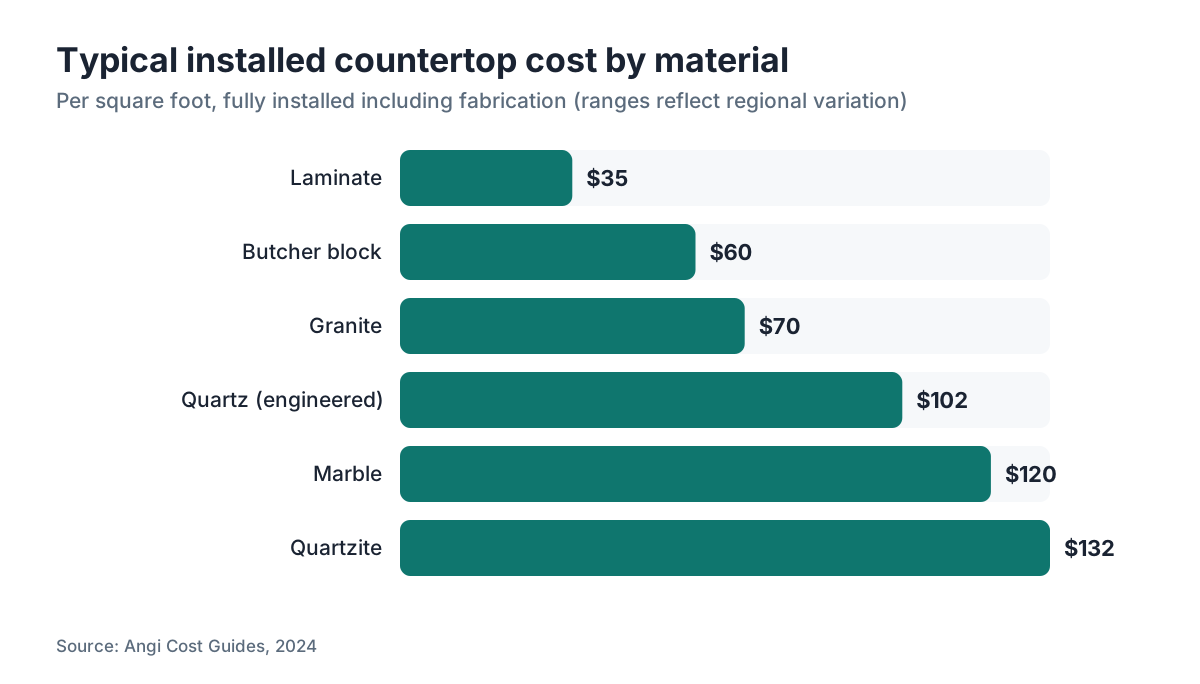
Budget: Know your number before you walk in. You don't have to say it in the first minute, but be ready to answer honestly when asked. A fabricator who knows you have $3,000 to spend will not march you past the $180-per-square-foot quartzite. That's a kindness, not a limitation. Installed granite runs roughly $40 to $100 per square foot including fabrication and installation. Quartz runs $55 to $150 per square foot installed, depending on brand and complexity [2].
Photos: Pull ten to fifteen images from Houzz, Pinterest, or manufacturer sites that show kitchens or baths you actually like. You don't have to love every image. A collection of 'this feels right' photos tells an experienced salesperson more about your direction than any description you could give.
Samples: Bring a cabinet door or paint chip if you can. Countertops get chosen in showrooms and lived with next to cabinets. Colors shift hard between a lit showroom and a north-facing kitchen. A 2-by-2-inch cabinet sample saves everyone from a regrettable choice.
What questions should you ask at a countertop showroom?
Ask about the material's real maintenance before you fall in love with a slab. Marble etches from acidic cleaners and needs sealing. Quartzite varies wildly in hardness by source. Some slabs sold as quartzite are actually softer marble-family stone and will etch the same way [3]. If you want the full picture on how to clean quartzite countertops, that matters before you buy, not after.
Here are the specific questions worth asking every shop:
- How do you price the job, by the square foot or by the slab? Some shops price per square foot of finished surface. Others charge by the slab, which can hurt you on small jobs and help you on large ones.
- What's included in the install price? Removal of existing countertops, sink cutouts, edge profiling, and sealing sometimes show up as separate line items.
- How far out is your template date and your install date? A shop quoting three weeks in March may be quoting eight weeks in October. Get the real number.
- What happens if the slab has a defect? Veining is natural and beautiful. A crack running through a structural area is a defect. Know how they handle it.
- Will you hold the slab with a deposit? If you find a slab you love, ask whether they'll tag it while you finalize decisions. Most shops hold for five to seven days.
For marble countertops specifically, ask about sealing frequency and whether the shop seals before or after install. The answer tells you a lot about their process quality.
How should a fabricator structure the appointment to close more jobs?
The single best structural change most shops can make is moving the budget conversation to the first five minutes, not the last five. Salespeople resist this because it feels blunt. It isn't. It's efficient, and customers appreciate it. A homeowner who walks in expecting $4,000 and gets a $9,200 quote at the end of a 90-minute appointment is not going to sign. They're going to feel embarrassed and leave.
Here's a structure that works in most shops:
Minutes 0 to 10: Intake. Room, timeline, budget, decision-makers present. Ask 'Are both of you here today?' If a spouse isn't there and they need both to decide, book the next appointment for when both can come.
Minutes 10 to 35: Material selection. Pre-pull two or three slabs based on what you learned in intake. Don't show ten options. Choice overload is real and it kills appointments. Show a value option, a mid-range, and one premium pick. Let them react.
Minutes 35 to 55: Layout, edges, and details. Walk the sink location, discuss edge profiles, confirm drop-in versus undermount, ask about backsplash if you do that work.
Minutes 55 to 80: Quote. This is the part that decides the job. A written or screen-visible number before they leave. If you use shop software that builds quotes from the appointment inputs, this is where it pays off. Shops using digital quoting tools, including options like SlabWise, cut the time from appointment to delivered quote from days to minutes, which moves close rates directly.
Minutes 80 to 90: Next steps. Hand them the quote in writing, explain the deposit and scheduling process, and ask for a decision timeline.
What materials should be on the showroom floor, and how many options is too many?
There's no universal number for how many slabs to stock, but research on consumer choice says that presenting more than six options in a category sharply reduces the chance of a purchase. The Iyengar and Lepper jam study from 2000 found shoppers were ten times more likely to buy when offered six jam varieties instead of twenty-four [4]. Stone slabs are not jam. The psychology is the same anyway. More is not better.
For a mid-sized fabrication shop, a curated floor of 40 to 80 active slabs organized by material type and price tier works well. Having sample chips for the full catalog matters more than parking every slab on the floor. Customers react emotionally to real slabs and intellectually to samples. Use both.
Materials worth having represented at minimum:
| Material | Why it needs to be there | Typical installed cost per sq ft |
|---|---|---|
| Granite | High demand, natural variation shows well in person | $40 to $100 [2] |
| Quartz (engineered) | Dominant market share, uniform look reassures buyers | $55 to $150 [2] |
| Marble | Aspirational, drives emotional decisions | $60 to $180 [2] |
| Quartzite | Growing segment, easily confused with marble | $65 to $200 [2] |
| Laminate or compact surface | Budget segment, no shop should ignore it | $20 to $50 [5] |
| Butcher block | Popular for kitchen islands and prep areas | $35 to $85 [5] |
For deeper background on specific materials, readers often want detail on granite countertops, butcher block countertops, and laminate countertops before they visit.
One honest note on budget materials: some shops still treat laminate and compact surface as low-status and give them a corner. That's a mistake. A homeowner who came in for laminate and got treated well will refer two friends who want quartz.
How do you handle a homeowner who isn't ready to decide?
Some visits are research trips, not buying trips. You can usually tell within ten minutes. They're vague on timeline, they haven't measured, and they say things like 'we're just looking around.' That's fine. Pushing these customers toward a decision doesn't close the job. It makes them uncomfortable enough to leave and never come back.
The right move is to give them a great experience, put a ballpark range in their hand, and give them a reason to return. A printed price sheet by material category, even approximate, is more useful to a researcher than a full custom quote they weren't ready to receive.
Ask for an email address and send a follow-up with the materials they responded to and a link to the full quote when they're ready. Set a task for seven to ten days out. Most shops do none of this and then wonder why warm leads disappear.
A customer who wasn't ready on visit one and gets a good follow-up is a far easier close on visit two than any cold lead. The average kitchen remodeling decision takes two to four months from first research to signed contract, per Houzz's annual renovation survey [6].
What are the most common showroom appointment mistakes fabricators make?
Not quoting on the spot is the biggest one. Everything else is smaller. Here is the real list:
Talking too much about process and not enough about the customer's project. Customers do not care how slabs get cut. They care whether their kitchen will look the way they imagined it.
Showing too many materials at once. Pull three, not ten.
Not confirming who the decision-makers are. If the person in the showroom can't sign the check, build in a second conversation before the first appointment ends.
Letting the appointment end without a clear next step. 'We'll send something over' is not a next step. 'I'll email you the quote by 5 PM today and follow up Thursday if I haven't heard back' is a next step.
Ignoring the emotional part of the sale. A countertop is a big purchase in a home someone lives in. The homeowner is often excited and a little anxious. Acknowledging that, in a normal human way, builds trust faster than any product-knowledge recitation.
Not training staff on material differences. A salesperson who can't explain why one quartzite etches and another doesn't, or who can't honestly describe the maintenance gap between marble countertops and quartz, loses credibility fast with informed buyers.
How should the showroom itself be set up to support a good appointment?
Light matters more than almost anything else. Stone looks completely different under warm incandescent light and under cool LED daylight. If your showroom runs one type of lighting, you're showing customers half the picture. Build a lighting station where customers can view a slab under multiple color temperatures before committing. This is cheap. A few track-mounted adjustable fixtures solve it.
Organize slabs by material type, not by supplier. Customers think 'I want granite,' not 'I want SlabCo inventory.' Group your whites together, your dark materials together, your movement-heavy stones together.
Have a mock countertop surface, even a small one, where you can set cabinet door samples against actual slabs. The comparison beats any verbal description. Some showrooms keep a standard sink cutout mockup too, to show how undermount versus drop-in reads in context.
For care questions that come up during appointments, keep a simple printed card for each major material category. Questions like how to clean stone countertops or how to clean soapstone countertops come up in almost every appointment involving natural stone.
One more thing: keep the showroom clean. That sounds obvious, but stone shops are dusty places. A showroom that smells like fabrication dust and has fingerprinted samples sends a signal about shop quality that no amount of good conversation fixes.
What does the quote process look like and what should it include?
A quote delivered in the showroom before the customer leaves is the goal. It doesn't have to be the final number. It has to be real enough to make a decision on.
At minimum, a countertop quote should name the material and finish by supplier code, the square footage of countertop surface, the linear feet of edge profiling, a line item for each cutout (sink, cooktop, outlets), removal of existing countertops if you're doing that, and a delivery and installation line. Sales tax should either be included or clearly noted as extra.
Shops using digital quoting tied to actual slab inventory generate this in the showroom in five minutes. Shops doing it on paper or in spreadsheets often take 24 to 48 hours to follow up, and most of those quotes never get signed. The math is unforgiving: every additional day between appointment and quote delivery cuts close probability.
If you can't quote on the spot because the job needs a site visit first (unusual layouts, uncertain square footage, structural questions), say so plainly. 'I need to see the space to quote this accurately' is credible. 'We'll get you something' is not.
For fabricators trying to cut quote time without losing accuracy, the SlabWise quoting tool connects slab inventory to quote generation so prices reflect real material costs, not guesses. That's the kind of operational change that shows up straight in close rates.
For homeowners wondering what's included in countertop installation costs, a good quote makes every line item visible.
How do you compare showroom quotes from multiple fabricators?
Get at least two quotes for any job over $3,000. Get three if you can. Compare them carefully, because line items vary enough to make a $500 difference look like a $2,000 difference.
Check whether each quote covers the same scope. One shop might include sink cutout and removal of existing tops. Another might not. Normalize the quotes to the same scope and the price spread often narrows fast.
Ask each shop to name the material by brand and supplier code, more than 'white quartz.' 'Calacatta Gold quartz' from two different suppliers at the same price is not the same product.
Turnaround time matters. A quote that's $400 lower but pushes your install six weeks past your renovation timeline may cost more than the savings once you count delayed contractors and a temporary kitchen.
Fabricators who provide itemized quotes are generally running tighter operations. A one-line quote ('countertops installed: $4,800') is not something you can compare or verify.
Engineered stone brands like Cambria countertops publish suggested retail ranges publicly, which gives homeowners a useful cross-check when a quote includes that material.
For homeowners also weighing Corian countertops or Formica countertops as budget-tier alternatives, those products carry more standardized pricing than natural stone, which makes comparison a little easier.
Frequently asked questions
Do I need an appointment at a countertop showroom or can I just walk in?
Most shops welcome walk-ins but won't have a salesperson free to run a full consultation. If you want a structured appointment, a written quote the same day, and someone's full attention, book in advance. Forty-five minutes to an hour is the typical slot. Busy shops in peak season (spring through fall) may be booked out a week or two.
Should I bring my contractor to the countertop showroom?
It helps, especially if your contractor is managing sequencing across multiple trades. They can confirm rough-in dimensions, clarify undermount sink requirements, and catch conflicts between the countertop scope and plumbing or appliance timelines. If the contractor has a preferred fabricator relationship, ask about that upfront so you know whether you're getting a referral or an independent recommendation.
How do I know if a countertop showroom quote is fair?
Compare it against at least one other quote for identical scope. For granite, installed costs typically run $40 to $100 per square foot. Quartz runs $55 to $150 installed. If a quote sits far below that range, ask what's excluded. If it's far above, ask what's included that competitors don't offer. A quote that names materials by brand and supplier code is easier to verify than a vague one.
What if I don't know what material I want before my appointment?
That's completely normal. Come in with a rough budget and some photos of styles you like. A competent salesperson can narrow you to two or three material categories in the first ten minutes. Bring a cabinet door or paint chip if you have one. Seeing materials next to your actual finishes beats any description of color you could give.
How much does countertop installation typically cost and will the showroom quote include it?
It should. Installed costs for natural stone and engineered quartz run $40 to $200 per square foot depending on material and job complexity. Ask each shop whether the quote includes sink cutouts, edge profiling, removal of existing tops, and sealing. Those items are sometimes separate. Getting a quote that leaves out installation and then adding it later is a common source of budget surprise.
How long does the countertop process take from appointment to install?
Count on three to six weeks from a signed contract to finished installation for most standard jobs. That covers material ordering or slab hold, template measurement (usually one visit after existing tops come off or after cabinet install), and fabrication plus install. Busy shops in peak remodeling season run longer. Some premium or imported stone adds two to four weeks for material lead time.
Can a countertop showroom appointment be done virtually or remotely?
Some shops offer virtual consultations by video call, especially for initial material selection and rough quoting. Virtual works reasonably well for engineered products with predictable color consistency. For natural stone like granite, marble, or quartzite where slab variation matters enormously, an in-person visit is worth the trip. Most customers who buy natural stone regret not seeing the actual slab before committing.
What's the difference between a showroom appointment and a template appointment?
A showroom appointment is the sales and design conversation where you choose materials and get a quote. A template appointment happens later, usually after you've signed a contract and your cabinets are in place, when a technician visits your home to take precise measurements. The template is what the shop uses to cut your actual slabs. Don't confuse the two. You need both, in that order.
How do fabricators handle a customer who wants a very specific slab vein pattern?
Ask the shop whether they do slab matching or book matching, and ask to see the specific slabs that would go into your job before you commit. Most reputable shops pull your slabs and hold them with a deposit so you can confirm veining, movement, and color before fabrication starts. If a shop won't let you see your actual slabs, that's worth asking about.
Is there a best time of year to shop for countertops to get a shorter wait?
Fabrication shops are busiest from March through October, when kitchen and bath renovations peak. January and February run slower, and shops may have more scheduling flexibility, sometimes faster template and install dates. Pricing rarely shifts seasonally for finished countertops, but wait times can vary by four to six weeks between peak and off-peak.
Should I seal my countertops before or after installation, and who does it?
Most fabricators seal natural stone after polishing and before delivery, so the first seal happens at the shop. Ask explicitly whether sealing is in your quote and whether it covers the top surface only or all exposed edges too. After installation, you reseal on a schedule that depends on material: granite typically every one to three years, marble every six to twelve months, per Natural Stone Institute guidelines.
What should a fabricator do if the homeowner's budget is far below realistic pricing?
Be direct early. Saying 'your budget is tight for the material you're describing, but here's what we can do in that range' is more respectful than walking them through premium options for an hour. Point them toward laminate, compact surface, or simpler edge profiles. Some homeowners expand their budget once they understand what the upgrade costs. Most appreciate honesty over a wasted visit.
Sources
- National Kitchen and Bath Association (NKBA), nkba.org: Customers who receive a quote the same day they visit a showroom convert at higher rates than those who wait; NKBA research on remodeling project sales timelines.
- HomeAdvisor (Angi), Cost Guide: Countertop Installation: Installed granite runs roughly $40 to $100 per square foot; quartz runs $55 to $150 per square foot; marble runs $60 to $180 per square foot.
- University of Minnesota Extension, Rocks and Minerals identification resources: Some slabs marketed as quartzite are geologically marble-family stone and will etch from acidic cleaners the same way true marble does.
- Iyengar SS and Lepper MR, 'When choice is demotivating,' Journal of Personality and Social Psychology, 2000: Consumers presented with six jam options were ten times more likely to purchase than those presented with twenty-four options; choice overload reduces conversion.
- HomeAdvisor (Angi), Laminate and Butcher Block Countertop Cost Guides: Laminate countertops installed run approximately $20 to $50 per square foot; butcher block runs $35 to $85 per square foot installed.
- Houzz, U.S. Houzz Kitchen Trends Study (annual renovation survey): The average kitchen remodeling decision takes two to four months from initial research to signed contract, per Houzz annual renovation survey data.
- U.S. Bureau of Labor Statistics, Consumer Expenditure Survey: Home improvement spending data underlying industry cost benchmarks for kitchen and bath remodeling.
- U.S. Small Business Administration, sales and customer experience guidance: SBA guidance on sales process structure and follow-up timing for small business customer conversion.
- Natural Stone Institute (formerly Marble Institute of America), stone maintenance guidelines: Natural Stone Institute guidelines on sealing schedules: granite typically every one to three years, marble every six to twelve months.
- U.S. EPA, Indoor Air Quality (IAQ): Background reference for showroom environment considerations including dust and air quality in fabrication-adjacent retail spaces.
- Cambria, price and product guide: Cambria publishes suggested retail price ranges for its quartz product lines, enabling homeowner cross-checking of fabricator quotes.
Last updated 2026-07-11