TL;DR
- A countertop showroom turns browsers into buyers by letting them touch and compare materials in person.
- Budget $15,000 to $80,000 depending on size and finish.
- Plan for 400 to 1,200 sq ft, display your top 30 to 50 SKUs, and design the flow around how people actually decide: material first, edge detail second, finish last.
Why does a physical showroom still matter for countertop fabricators?
Stone and quartz are decisions people make with their hands. A homeowner can spend forty minutes on a manufacturer's website and still feel lost until she runs her palm across a leathered quartzite and says "that's it." No screen replaces that moment.
The data holds up. The National Kitchen and Bath Association (NKBA) has tracked consumer buying behavior for years. In NKBA's 2023 consumer research, a large majority of respondents said they visited at least one physical showroom before a major kitchen surface purchase [1]. That number stays high even as online research dominates the early part of the funnel.
A showroom does something a website can't. It shortens the sales cycle. Customers who walk in, pick a slab, and confirm an edge profile in one visit rarely ghost you after the quote. Every day between "I'm interested" and "here's my deposit" is a day a competitor can steal the job.
There's a margin argument too. Shops with a well-run showroom close at higher average tickets because the in-person experience makes upsells feel natural instead of pushy. Showing someone the difference between a standard eased edge and a waterfall mitered island in person beats a line item on a PDF every time.
How much does it cost to set up a countertop showroom?
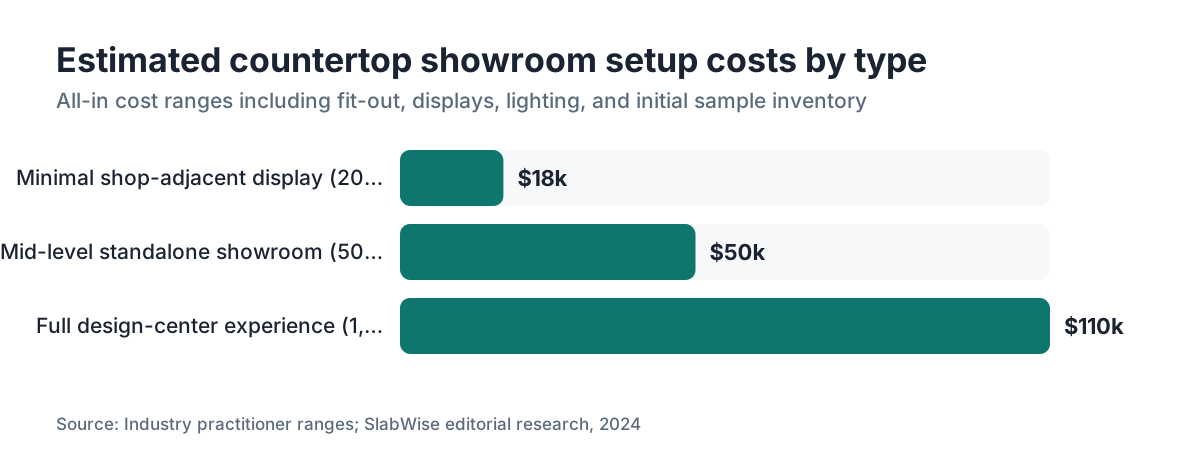
It depends on whether you're carving space out of an existing shop, leasing a standalone retail unit, or building a full design-center experience. Here's an honest breakdown.
| Setup type | Typical square footage | Estimated all-in cost | Notes |
|---|---|---|---|
| Minimal shop-adjacent display | 200 to 400 sq ft | $10,000 to $25,000 | Repurposed warehouse space, basic racks and counters |
| Mid-level standalone showroom | 500 to 900 sq ft | $35,000 to $65,000 | Dedicated space, branded fit-out, lighting upgrade |
| Full design-center experience | 1,000 to 2,000 sq ft | $70,000 to $150,000+ | Custom vignettes, plumbing for working sink displays, professional A/V |
The biggest line items are flooring and lighting (together often $8,000 to $20,000 for a mid-size space), display infrastructure like slab racks and full-height sample panels ($5,000 to $15,000), and the slab inventory itself. Fabricators underestimate that last one constantly. Carrying 40 to 60 display slabs, even off-cut remnants, ties up real money.
Rent is the wildcard. Industrial and retail space in smaller markets runs $8 to $18 per square foot a year. In major metros you may pay $30 to $60 [2]. If your shop already has street-visible frontage, converting a corner of it is the most capital-efficient path by a wide margin.
Don't skip the lighting budget. Stone looks like a different material under cool fluorescent shop light versus warm LED track lighting aimed to graze the surface. Spend the money here. It's the single most impactful dollar in the room.
What size showroom does a countertop fabricator need?
Smaller than you think, if you curate. A 400-square-foot showroom with 35 well-chosen samples and great lighting will outsell a 1,200-square-foot warehouse stuffed with 200 slabs nobody can navigate.
Use a planning benchmark of roughly 10 to 12 square feet of floor space per active display position, meaning a spot where a customer can stand and examine a sample with a companion. For a showroom handling 4 to 6 customers at a time, that's 40 to 72 sq ft just for circulation around displays, before you count vignettes, a sales desk, or a sample library wall.
Most fabricators doing $1M to $5M in annual revenue run comfortably in 500 to 800 square feet of dedicated space. Shops with more volume or a luxury customer base push toward 1,000 to 1,500 sq ft for working vignettes: a sink cutout, an island mockup, a fireplace surround sample.
Zoning matters. Check with your municipality before committing. Many fabrication shops sit in light-industrial zones that allow retail as an accessory use, but some don't. Many local codes let a limited share of a building's floor area (often 20 to 30%) go to retail sales as an accessory use [3]. Confirm with your local planning department before you sign a lease.
How should you design the layout and customer flow?
Think about how a customer actually decides. It's not a straight line. They arrive with a vague preference ("something light," "a dark dramatic look," "definitely not white marble after my sister's disaster"), then narrow by material type, then by specific slab, then by edge and finish.
Your layout should mirror that funnel. Split the showroom into three zones.
-
Material category zone (entry area): large sample panels or standing slabs organized by material family (quartzite, granite, quartz engineered stone, marble, laminate, butcher block). First impressions happen here. Use your best-looking slabs.
-
Detail selection zone (middle area): edge profiles on a physical edge board (buy a real one, not printouts), finish comparisons (polished versus honed versus leathered on the same stone), and sink cutout options. This is where you narrow the sale.
-
Close and visualize zone (rear or side): a vignette or two showing materials installed in a realistic kitchen or bath, a sales desk with a screen for 3D renderings or layout work, and a sample library of smaller chips customers can borrow.
Keep the path obvious. Retail designers often recommend a counterclockwise flow because it matches natural walking tendencies in Western markets, a pattern Paco Underhill documented in his observational shopping research [4]. Follow that or don't, but avoid dead ends, and make sure customers can see the full showroom from the entry without feeling trapped.
Aisle width: 36 inches is the ADA minimum clear width for accessible routes in commercial spaces [5]. Plan for 42 to 48 inches in your main aisles so two people walk side by side. A couple picking countertops together is your most common selling scenario.
Which materials and samples should you display?
You can't stock everything, and you shouldn't try. The goal is a curated selection that covers your real product mix and your target customer's price range without drowning them.
Start here: display your 10 to 15 highest-volume SKUs (the slabs you sell most), 5 to 8 aspirational or premium options (the upsell), and 5 to 10 "story" pieces that show your range (an exotic quartzite, a book-matched slab, a Cambria quartz design). That's 20 to 33 featured positions, which is manageable.
For each material, show the same stone in at least two finishes where you can. The gap between polished and leathered on a dark quartzite is dramatic, and customers routinely don't know leathered exists until they see it.
Sample size matters. Full slabs or at least 12x24-inch samples work best in the featured zone. Smaller 4x4-inch chips are fine for the edge and finish board and the take-home library. NKBA guidance notes that small samples can misrepresent the variation in natural stone, so featured displays should be large enough to show a realistic pattern repeat [1].
Label every display: material name, origin country for natural stone, price tier (budget, mid, premium is fine, no need to post per-sq-ft prices), and whether it's in stock or order-only. Nothing kills momentum like a customer falling for a slab you can't source.
How do you light a countertop showroom properly?
Lighting is where fabricators new to retail consistently under-invest, and it shows. The right lighting makes stone look alive. The wrong lighting makes everything look like a warehouse.
The rules are simple. Use adjustable track lighting so you can aim fixtures to graze across surfaces at a low angle, roughly 30 to 45 degrees from horizontal. Grazing light catches the movement and crystal sparkle in granite and quartzite that flat overhead light kills. For white and light stones, warmer color temperatures (2700 to 3000K) read as luxurious. For dark dramatic stones, slightly cooler light (3000 to 3500K) pops the contrast.
Avoid cool fluorescent (5000 to 6500K) in customer areas entirely. It reads cheap and clinical. If your shop has fluorescent overheads, put a partition between the shop and the showroom.
Natural light is wonderful, and variable. If you have windows, check how displays look at 10am on a sunny day and 5pm on an overcast one. Skylights or north-facing windows give the steadiest natural light.
Budget: LED track fixtures from commercial suppliers like Liteline or WAC Lighting start around $150 to $300 each and last 50,000-plus hours [6]. A 600-square-foot showroom might need 15 to 25 fixtures, so $3,000 to $7,500 for fixtures alone is realistic. Add $2,000 to $5,000 for an electrician if you're running new circuits.
How do you handle pricing and quoting in the showroom?
This is where small fabricators leak money. A customer falls in love with a slab and asks "what's this going to cost for my kitchen?" If your answer is "I'll email you a quote in three days," you've handed your competitor three days to close that sale.
You need a way to give a ballpark number in the showroom, in real time. Not a binding contract. A credible range based on their approximate square footage and the material they like.
The fastest path is a simple pricing sheet by material tier (price per square foot installed, including standard edge and sink cutout) plus a rough sq-ft calculator. Walk them through it out loud: "Your kitchen looks like about 45 square feet. This quartzite runs $95 to $110 installed, so you're looking at roughly $4,275 to $4,950 before upgrades." That's a number they can act on.
Quoting software built for fabricators does this even faster, pulling material costs and shop rates into a live estimate on a tablet while the customer stands at the slab. SlabWise is built for exactly this workflow, taking a quote from material selection through edge and cutout options in a few minutes at the showroom counter. A screen at the sales desk that lets you do this in front of the customer builds real trust.
On transparency: you don't have to post every price publicly, but be ready to give a range for anything you display. Customers who leave without a number almost never call back with one.
What does showroom staffing actually look like?
A showroom only works if someone is in it. The biggest failure mode for fabricator showrooms is an unstaffed or inconsistently staffed space that customers arrive at to find dark, locked, or manned by a fabricator trying to finish a job.
For a shop under $1.5M in revenue, one dedicated showroom person (part-time to full-time, depending on traffic) is usually enough. This person needs to know your materials cold, walk a customer through the decision process, and produce a rough estimate. They don't need to be a designer. They need to be a confident, knowledgeable guide.
As volume grows, the role often becomes a sales and design coordinator position. Many fabricators find that someone with a kitchen design background, or prior experience at a tile or flooring showroom, moves into this role well.
Hours: match your customers, who skew heavily toward Saturday mornings and weekday evenings. NKBA benchmarking points to Saturday as the highest-traffic day for surface-focused showrooms by a wide margin [1]. If you can only open limited hours, Saturday 9am to 2pm plus Thursday evening beats Monday through Friday 9am to 5pm on ROI.
Don't staff the showroom with your lead fabricator. Their time is worth more at the saw. Hire or train a dedicated person, even part-time.
How do you drive traffic to your countertop showroom?
A beautiful showroom nobody visits is expensive storage. Traffic generation is part of the business model, not an afterthought.
The highest-ROI channels for fabricator showrooms, based on industry reporting:
Google Business Profile: free, and it matters more than almost anything. Fabricators with complete, photo-rich profiles (including showroom interior shots) show up in local "near me" searches, which dominate early stone shopping [7]. Keep current hours, post photos of new slabs, and respond to every review.
Kitchen and bath contractor referrals: general contractors, kitchen designers, and bath remodelers are your single best referral source. Invite them to a private trade preview of new inventory. Give them samples to take to client meetings. This relationship outperforms almost any paid ad spend for most shops.
Home shows and NKBA chapter events: the NKBA has local chapters in most major markets [1]. Their events put you in front of both trade pros and consumers.
Instagram and Pinterest: for countertops, visual platforms still drive real discovery. A post of a leathered quartzite install with your location tagged is genuinely useful content, more than vanity.
Paid search (Google Ads): works for high-intent queries like "granite countertop fabricator [city]" but needs active management. A $500 to $1,500 monthly budget is reasonable for a regional shop. Spend less and you won't generate enough volume to optimize [8].
Neighborhood referrals: ask satisfied customers directly. A follow-up text two weeks after installation is enough. Word-of-mouth drives 20 to 30% of new customers for most home improvement businesses [9].
What permits and compliance issues do countertop showrooms face?
Adding a showroom to a fabrication shop layers on compliance that a pure production facility avoids.
Occupancy classification: most fabrication shops are Group F (Factory Industrial) under the International Building Code [10]. Adding retail customer access often triggers a mixed-occupancy classification (F plus M for mercantile), which can require upgraded egress, signage, and fire separation depending on square footage and jurisdiction.
ADA compliance: any commercial space open to the public must meet accessibility standards under Title III of the Americans with Disabilities Act [5]. That covers door widths (32-inch minimum clear), accessible routes, parking (1 accessible space per 25 spaces), and restroom access if you offer a customer restroom. The ADA National Network has free technical help at adata.org.
Business licensing: many states and municipalities require a separate retail sales license or seller's permit even if you already hold a contractor's or fabricator's license. Check with your state's revenue or business licensing agency. In most states this costs under $100 and is straightforward [11].
Silica dust: if the showroom connects to the shop, know OSHA's silica rule (29 CFR 1926.1153). The standard sets a permissible exposure limit of "50 micrograms of respirable crystalline silica per cubic meter of air" as an 8-hour time-weighted average [12]. Keep customer areas separated from dust-generating work by physical barriers and adequate ventilation.
How do you create a good experience around natural stone specifically?
Natural stone, unlike engineered quartz, has variability customers need help understanding before they're comfortable buying. Two slabs of the same material can look meaningfully different. That's a feature, not a bug, but only if you explain it right.
Build a short education moment into every natural stone conversation. Explain that quartzite, granite, and marble get cut from living rock, so every slab is unique. Show two slabs of the same material side by side to prove it. Customers who understand variation before they buy are far less likely to be surprised or disappointed after installation.
Maintenance expectations matter too. Marble needs sealing and etches from acid. Quartzite varies widely in hardness and porosity. Granite is generally the most forgiving of the naturals. A one-page maintenance card by each natural stone display, covering what to clean it with and how often to reseal, cuts post-sale complaints sharply. Link care guides on your website (or resources like SlabWise's guide to how to clean stone countertops) so customers can reference them later.
For marble, managing expectations around etching is non-negotiable. Don't sell it as maintenance-free. Customers who go in with accurate expectations stay happy. Customers promised something easy who got something that needs care do not.
How do you track whether your showroom is actually working?
If you can't measure it, you can't improve it. Most fabricators track revenue but ignore the showroom-specific metrics that would tell them what's driving results.
The numbers worth tracking:
Showroom visit-to-quote rate: how many visitors leave with a written quote? Below 50% points to a gap in your sales process, either follow-up, pricing clarity, or staff confidence.
Quote-to-close rate: industry benchmarks for residential countertop fabricators cluster around 30 to 45% for quotes that reach the customer [13]. If your showroom quotes close meaningfully lower, something in the in-person experience is creating doubt instead of confidence.
Average ticket, showroom leads versus other leads: if showroom customers buy at higher values, that's a strong case for investing more in the space. Fabricators who measure this often find a 15 to 30% higher average ticket from showroom leads.
Source tracking: ask every new customer how they heard about you. Log it consistently. Six months of that data shows you which channels actually drive showroom traffic worth funding.
Review velocity: a healthy showroom generates a steady stream of Google reviews. Fewer than one review per 15 completed jobs means you're not asking often enough.
Frequently asked questions
How much space do I need for a countertop showroom?
Most fabricators do well in 500 to 800 square feet. That fits 30 to 50 featured sample positions, an edge and finish board, a sales desk, and comfortable circulation for two or three customer groups at once. You can run a respectable showroom in 300 to 400 square feet if you curate tightly and keep it uncluttered. More space matters mainly for working vignettes or high foot traffic.
Do I need a separate retail license to run a showroom in my fabrication shop?
In most states, yes. Even with a contractor's or fabricator's license, selling direct to the public usually requires a retail seller's permit or a business license with a retail designation. It typically costs under $100. Check with your state's revenue agency or secretary of state office. Your building may also need a change in occupancy classification if customers regularly enter a space previously classified as industrial-only.
What's the best way to display slab samples without full slabs?
Vertical sample boards in the 12x24-inch to 18x36-inch range are the standard for featured displays. They're large enough to show pattern repeat on most stones without full slabs. Pair each board with a chip library of 4x4-inch take-home samples. For your top-selling naturals, at least one full slab or a 2x4-foot section displayed upright gives customers the most accurate picture of what their kitchen will look like.
How do I handle customers who visit but aren't ready to buy?
Give them something to leave with: a take-home sample, a maintenance guide, a rough price range for the materials they liked, and your card. Log their contact info and the materials they were drawn to. A follow-up call or text three to five days later converts a real share of browsers. Fabricators who track this often find 15 to 25% of "not ready" visitors close within 90 days with a single follow-up.
What's a realistic return on investment for a showroom?
Hard ROI data for fabricator showrooms is thin, and nobody has published a rigorous study. Fabricators consistently report higher close rates and average tickets from showroom leads versus phone or web leads. A reasonable frame: if your showroom costs $40,000 to set up and $2,000 a month to run, it needs to generate roughly $24,000 a year in extra gross margin to break even in two years. Most active showrooms clear that if staffed properly.
Should I display laminate and engineered quartz alongside natural stone?
Yes, if you sell them. Hiding budget options doesn't push customers toward premium. It sends them to a competitor who will show them what they need. Laminate countertops and Corian-style solid surfaces have a real market. Showing the full range helps premium materials sell by making the contrast visible and tactile. Just put entry-level materials near the door and premium materials deeper in the space.
How often should I update my showroom samples?
Review your sample inventory twice a year. Pull anything you can no longer source reliably or that hasn't generated a quote in six months. Add materials your suppliers are pushing hard or that you're seeing demand for. Kitchens turn over roughly every 8 to 12 years per household, but color and material trends move faster, and your showroom should reflect what's selling now, not what was popular three years ago.
How do I handle slab variation and customer disappointment after installation?
Set expectations before you close. Show two slabs of the same natural stone side by side so customers see variation first-hand. Explain, in writing and out loud, that the installed slab will differ from the display sample. Have customers initial a line on your contract acknowledging natural variation. For dramatic stones (heavy-movement marbles, exotic quartzites), take the customer to your yard to pick the specific slab before you order or cut.
Do I need a designer on staff for the showroom to work?
No. A knowledgeable, personable sales coordinator who knows your materials, produces a rough quote, and genuinely listens will outsell a credentialed designer who's stiff or pushy. Kitchen and bath design experience is a plus, not a requirement. If you later add kitchen remodel services or work with high-end custom builders, a designer credential (NKBA's CKBD or similar) becomes more relevant.
What's the biggest mistake fabricators make when setting up a showroom?
Overstocking and under-lighting. Fabricators want to show everything, which creates a cluttered warehouse feel that overwhelms customers and makes deciding harder. The second most common mistake is bad lighting, usually cool fluorescent left over from the shop, which makes even beautiful stone look institutional. Curate to 30 to 50 strong samples, spend on warm LED track lighting, and the space sells better than a larger, messier one.
How do I compete with big-box store countertop displays?
On expertise and experience. A big-box countertop section has more SKUs and lower perceived prices, but nobody there can walk a customer through the difference between honed and leathered quartzite, explain how their kitchen lighting changes how a slab reads, or produce a custom quote in 10 minutes. Your edge is knowledge, speed, and showing real stone at full or near-full scale. Lean into that gap hard.
Should I charge for take-home samples?
No. Charging for samples creates friction at exactly the moment you want customers moving toward a decision. Most samples cost you under $5 in material and labor. The cost of not letting a customer take a chip home to check it against their cabinets is the whole sale. Standard practice is free samples with a light ask ("just bring it back when you've decided") and no serious enforcement if they don't.
Can I run a countertop showroom from a residential address or home shop?
Rarely, and verify carefully before you try. Most municipalities prohibit retail customer traffic at residentially-zoned properties under home occupation ordinances, and your homeowner's insurance almost certainly excludes commercial liability. A small industrial or commercial lease, even 300 square feet subleased from a related trade business, is far safer legally and far more credible to customers than a residential garage.
Sources
- National Kitchen and Bath Association (NKBA), Consumer & Trade Research: A majority of consumers visit at least one physical showroom before a major kitchen surface purchase; Saturday is the highest-traffic day for surface-focused showrooms; samples should be large enough to represent pattern variation in natural stone.
- U.S. Bureau of Labor Statistics, Producer Price Index (commercial rent series): Commercial retail lease rates commonly range from $8 to $60 per square foot annually depending on market.
- American Planning Association, Zoning Practice resources on accessory uses: Many light-industrial zones allow retail as an accessory use, often capped at 20 to 30% of building floor area.
- Paco Underhill, 'Why We Buy: The Science of Shopping' (Simon & Schuster, 1999): Counterclockwise customer flow is documented in retail observational research as a common natural walking tendency in Western markets.
- U.S. Department of Justice, ADA Title III and ADA Standards for Accessible Design: ADA requires 32-inch minimum clear door width, accessible routes, and 1 accessible parking space per 25 spaces for commercial spaces open to the public.
- WAC Lighting, commercial track lighting product specifications: Commercial LED track fixtures start around $150 to $300 per fixture and are rated for 50,000-plus hours.
- Google, Google Business Profile Help Center: Complete, photo-rich Google Business Profiles improve visibility in local 'near me' search results.
- LocaliQ, Google Ads Benchmarks for the Home & Home Improvement Industry: Monthly budgets of $500 to $1,500 are typical for regional home services paid search campaigns to generate meaningful volume.
- U.S. Small Business Administration, Marketing and Sales guidance: Word-of-mouth referrals drive a meaningful share (commonly estimated at 20 to 30%) of new customers for many home improvement businesses.
- International Code Council, International Building Code (IBC), Chapter 3: Use and Occupancy Classification: Fabrication facilities are typically classified as Group F (Factory Industrial) occupancy; adding retail customer access may trigger mixed-occupancy requirements.
- U.S. Small Business Administration, Apply for Licenses and Permits: State retail seller's permits are typically under $100 and required for businesses selling goods directly to the public.
- U.S. Occupational Safety and Health Administration, Respirable Crystalline Silica Standard (29 CFR 1926.1153): OSHA's silica rule sets a permissible exposure limit of 50 micrograms of respirable crystalline silica per cubic meter of air as an 8-hour time-weighted average.
- Stone World, industry business surveys (various years): Quote-to-close rates for residential countertop fabricators cluster around 30 to 45% for quotes delivered to customers.
Last updated 2026-07-11