TL;DR
- Countertop showroom displays cost fabricators anywhere from $50 for a small edge sample to $8,000 or more for a full kitchen vignette.
- Most shops recover the money through vendor co-op programs, distributor display allowances, or by selling retired samples at a discount.
- Pricing a display comes down to three numbers: what it costs to make, how long it runs, and who helps pay for it.
Why does display pricing matter so much for a countertop shop?
A showroom display is a sales tool with a real cost of goods, a useful life, and a return most shops never calculate. Price it wrong and you either eat the cost quietly (which hits margin) or pass along a premium that feels arbitrary to the customer.
The stakes are real. According to the National Kitchen and Bath Association's 2023 Kitchen and Bath Market Outlook, kitchen projects remain the largest single category in residential renovation spending, averaging $14,000 to $34,000 per project depending on scope [1]. A big share of that money gets decided by what a customer touches and sees in a showroom. Displays do heavy lifting.
Fabricators face two separate display-pricing questions. First: what do you charge a vendor, distributor, or builder who wants a display in your showroom? Second: how do you account for display costs internally so you know what each running foot of showroom space actually costs you? This article covers both, because mixing them up is where most shops go wrong.
What types of countertop displays are there, and how do costs differ?
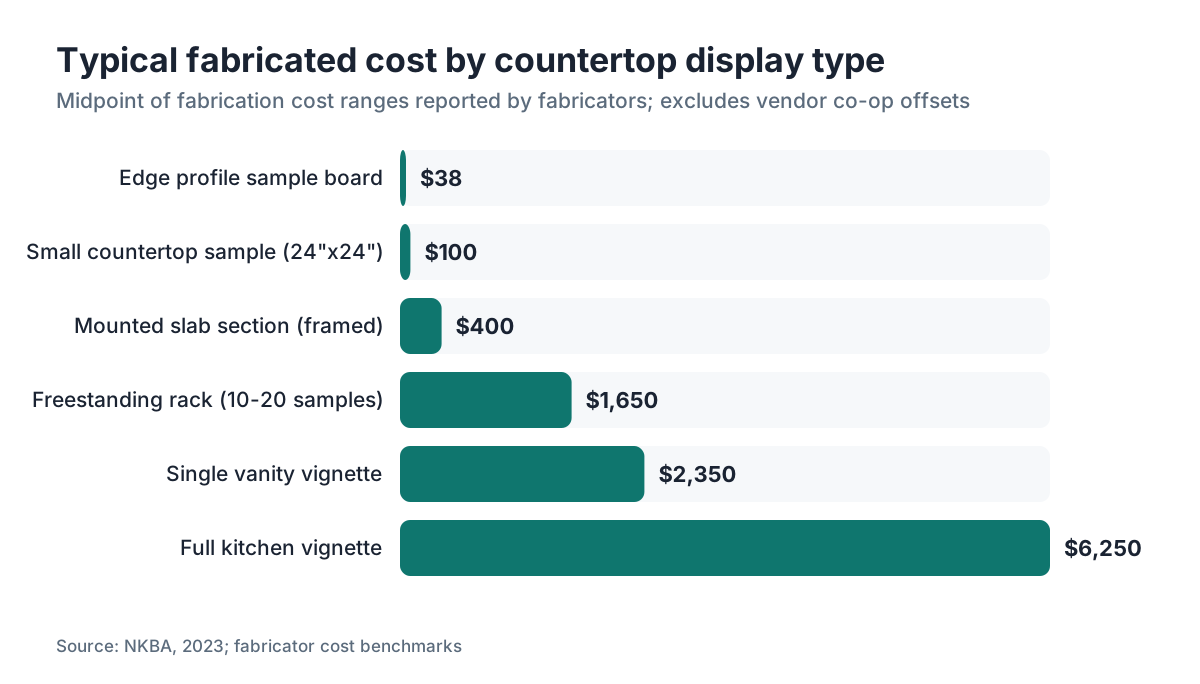
Displays run from a $15 edge chip to an $8,000 kitchen vignette, and the cost tracks size, complexity, and labor far more than material. Here is a practical breakdown of the categories most shops use.
| Display Type | Typical Fabricated Cost | Expected Showroom Life |
|---|---|---|
| Edge profile sample board (12"x12" or smaller) | $15 - $60 per piece | 3-7 years |
| Small countertop sample (18"x18" to 24"x24") | $50 - $150 | 3-7 years |
| Mounted countertop slab section (full thickness, framed) | $200 - $600 | 3-5 years |
| Freestanding display rack with 10-20 samples | $800 - $2,500 | 5-10 years |
| Single vanity vignette (top + cabinet + sink cutout) | $1,200 - $3,500 | 3-5 years |
| Full kitchen vignette (island + perimeter, multiple materials) | $4,000 - $8,500+ | 3-7 years |
These ranges come from fabricator cost surveys and distributor co-op program documentation, not any single published study, so treat them as a working benchmark and not gospel. Your labor rate and material costs will move every number.
The stone itself is usually the smallest line. A 2-centimeter quartzite remnant for a display sample might cost $20 in material. Labor to cut, profile, polish, back-mount, label, and install it can run $80 to $150 depending on shop wages. That is the cost inversion most shops miss: fabrication labor dominates display cost, not the stone.
How do vendor co-op and distributor display allowance programs work?
Most major quartz and natural stone brands run some form of co-op or display allowance program. Cambria, MSI, Cosentino (Silestone and Dekton), Caesarstone, and dozens of regional distributors all have them. The structure is the same at the core: you agree to display the brand's material prominently, you meet minimum display specs, and in return you get free material, a credit on future purchases, or a direct cash allowance [2].
Typical allowances run $200 to $1,500 per display position depending on the brand and where the display sits. A brand that wants prime floor space near your entrance pays more than one willing to sit in a side rack. Some programs are structured as percentage rebates on annual purchases instead of per-display payments.
The catch is the conditions. Minimum square footage, signage requirements, photo documentation, and sometimes exclusivity clauses that restrict competing products nearby. Read those contracts closely. A fabricator who takes a display allowance but misses the signage spec can forfeit the payment and still be stuck with the display.
Juggling multiple vendor relationships gets tedious fast. Build a simple spreadsheet that logs display install date, vendor, allowance amount, renewal date, and any exclusivity terms. Shops that skip this step routinely leave $3,000 to $8,000 a year in unclaimed co-op money sitting on the table.
How should a fabricator calculate the true cost of a showroom display?
The formula is short, but shops rarely run all of it. True display cost has four parts:
- Material cost (remnant or purchased slab, at your actual cost, not retail)
- Fabrication labor (saw time, CNC time, hand finishing, edge profiling)
- Installation labor (building the cabinet or frame, mounting in the showroom, signage)
- Opportunity cost (the showroom square footage the display occupies)
Everyone skips the opportunity cost. If your showroom runs 1,200 square feet and your annual occupancy cost (rent, utilities, insurance, pro-rated) is $36,000, that is $30 per square foot per year. A full kitchen vignette that takes up 80 square feet costs you $2,400 a year in floor-space cost alone, before a dollar of labor or material [3].
Once you have the total annual cost of a display position, you can ask the right question: is the revenue this display influences worth its total carrying cost? Most fabricators can't answer that precisely, but even a rough estimate helps. A kitchen vignette that costs $1,800 a year (material amortized over 5 years, labor, and floor space) and influences four $25,000 kitchen sales pays for itself many times over. If it influences zero sales because it is outdated and nobody asks about it, pull it.
What do fabricators typically charge to install a vendor's display in their showroom?
When a vendor asks to put a branded display in your showroom, you hold real bargaining power. You are handing over floor space, foot traffic, and sales credibility. Charging for that is normal and appropriate.
Most shops that charge for vendor display placement use one of three structures.
Flat monthly fee. Common range is $150 to $500 per month for a defined display area, depending on shop traffic and market. High-traffic urban shops in Chicago or Los Angeles can command more.
Annual co-op offset. The vendor's co-op allowance covers the display fee. You install at cost, the vendor pays the allowance, and you net zero or slightly positive. This is the most common structure because it is simple to administer.
Revenue share. Rare, but some shops negotiate a small percentage of sales on any job that specifies the vendor's material. It aligns incentives, but the tracking is more than most shops want to do.
Setting a fee from scratch? Start with your true cost per square foot per year (from the section above), then add margin. Charging $0 or pure cost recovery is fine if the material is one you genuinely want to sell. Charging a profit margin is also fine, especially when the vendor gets branding benefit from your traffic.
How do you price countertop display samples when selling them to customers?
Retired or surplus display samples are a real revenue stream. Homeowners buy them for small bathroom vanities, laundry rooms, bar tops, and outdoor spots. Pricing them takes a different calculation than pricing new fabrication.
The sample is already fabricated. It is a sunk cost. What you are pricing is the remaining value of the piece, not the cost to make it. A few approaches work.
Cost-plus on replacement. Price the sample at 50 to 70 percent of what a new fabricated piece of the same material and size would cost at retail. It feels like a deal to the customer, still clears margin for you, and moves inventory that would otherwise sit.
Floor price by square foot. Set a minimum per square foot by material tier. Many shops use $20 to $40 per square foot for remnant-grade samples regardless of original retail price. Simple and consistent.
Condition tiering. Grade samples A (pristine), B (minor scratches or chips), C (display wear, minor damage). Price accordingly: A at 65% of retail, B at 40%, C at 20% or as-is.
For laminate countertops and other lower-cost samples, pricing small pieces below $50 is common and fine. For granite, quartzite, or exotic marbles, a retired 24"x48" display piece in good shape might sell for $200 to $600 and moves fast through Craigslist, Facebook Marketplace, or a shop remnant sale.
What role do remnants play in display cost recovery?
Most displays get built from remnants, and remnants that don't become displays usually get discarded or sold at thin margins. So there is a natural cost recovery loop that well-run shops use.
Here is how it plays out. A shop cuts a kitchen job from a large slab of granite countertops and has a 24"x36" remnant left over. That remnant was already paid for as part of the job's material cost. Use it for a display sample instead of scrapping it, and the material cost of the display drops close to zero. The only real cost left is labor to finish, mount, and label it.
That changes the math a lot. A display made from a job remnant might cost $60 to $100 in labor and carry zero incremental material cost. Amortized over five years, that's $12 to $20 a year per sample. At that price, even a modest influence on sales pays for the display.
The trap is burning premium purchased slab on displays when remnants would do the same job. Unless a vendor specifically wants fresh-cut material from a current lot (some do, to show the current veining and color), remnants are the right call. They are a sunk cost already recovered through job pricing.
How do you decide which materials to display and which to skip?
A showroom that tries to display everything shows nothing well. The hardest part of display management is deciding what earns floor space.
Here is a framework that works. Rank your material categories by two factors. First, what percentage of your annual revenue does each category bring in? Second, how much higher is the close rate when a customer sees it in person versus a digital sample?
For marble countertops, the in-person close rate usually runs much higher than digital because veining, translucency, and surface variation are hard to convey in photos. Marble earns display space even if it isn't your top revenue category. For Cambria countertops and other engineered quartz where the pattern is consistent and well-photographed, digital samples do a decent job, so your display investment there can be lighter.
Materials that rarely close but generate a lot of questions, like exotic quartzite or leathered finishes, earn display space because they pull traffic and start conversations that lead to easier upsells. Materials your sales team rarely recommends and customers rarely ask about do not earn display space, no matter the vendor pressure.
Review your display mix at least once a year. A display that has sat for four years without influencing a single sale your team can recall should be retired. The floor space cost alone justifies pulling it.
How does showroom display pricing affect the customer quote experience?
This link gets ignored. A well-kept display with current pricing context speeds up quoting because the customer arrives already anchored to a material and finish. A confusing or outdated display slows everything down because the customer isn't sure what they saw, what it costs, or whether it's still available.
The best shops pair each display with a clear price-per-square-foot range, right on the label. Not a firm quote, a starting range: "Granite from this collection: $55 - $85 per sq ft installed, depending on edge profile and cutouts." That pre-qualifies customers and cuts the number of quotes that go nowhere because the price came as a shock.
Fabricators who want to connect display materials directly to live quoting can use tools like SlabWise to link material selections to quote templates, so when a customer picks a material they saw in the showroom, the estimate populates automatically. That continuity between showroom and quote trims a step or two out of the sales cycle.
Include the countertop installation cost on display labels too, because installed price is what customers actually care about. A display that shows only material cost sets up sticker shock later when fabrication and installation fees land on the quote.
What are the tax and accounting implications of showroom displays?
Display costs are a real business expense, and treating them right matters for how your shop reads its own profitability.
Under U.S. tax rules, display fixtures with a useful life of more than one year are generally classified as depreciable assets rather than immediate expenses [4]. A $5,000 kitchen vignette would typically be depreciated over its useful life (often 5 to 7 years under MACRS asset class rules for retail fixtures) rather than expensed in the year you build it. But Section 179 of the Internal Revenue Code lets businesses elect to deduct the full cost of qualifying property in the year it is placed in service, up to the annual limit ($1,160,000 for tax year 2023) [5]. For most countertop shops, displays qualify.
So the practical call is this: work with your accountant to decide whether to expense displays immediately under Section 179 or depreciate them over time. Profitable year and you want to cut taxable income? Expensing a batch of new displays makes sense. Reporting a loss? Depreciating them pushes deductions into future profitable years.
Vendor co-op payments you receive for hosting displays are taxable income. Don't leave them off the books. They show up as cooperative advertising income or display allowance income. Your accountant should be tracking these.
What are realistic benchmarks for showroom display ROI?
Nobody has published a rigorous academic study on countertop display ROI. The closest you get is NKBA industry research and NAHB survey data, which cover renovation decision factors but not display-specific conversion rates [1].
Here is what experienced fabricators report anecdotally: a well-placed, well-kept kitchen vignette in an active showroom influences 15 to 40 percent of the kitchen countertop sales that walk through the door. For a shop doing 150 kitchen jobs a year at an average of $4,000 per job (material and fabrication only), that vignette influences $36,000 to $96,000 in annual revenue. Even at a modest 30 percent gross margin, that's $10,800 to $28,800 in gross profit from one display position.
Set against a total annual display cost of $2,000 to $4,000 (material amortized, labor, floor space), the return is strong, if the display is doing its job. Shops that struggle with display ROI usually have one of three problems: outdated displays that don't match current inventory, no sales process connecting the display to the quote, or so many displays that no single material gets attention.
For a fabricator building or rebuilding a showroom, the pattern points one way: fewer, better displays beat more, cheaper ones. Five strong vignettes outperform twenty tired sample boards.
How should you handle display pricing for builder and designer partnerships?
Builders and designers often want their own material selections displayed in your showroom, especially when they send you real volume. This is a different negotiation than a vendor co-op program.
A builder who sends 40 jobs a year has legitimate power to ask for preferred material displays. The right move isn't to comply for free. Structure a formal display agreement instead: the builder or their preferred vendor funds the display material, your shop fabricates at cost, and the display carries the builder's program name. The builder wins (their clients see the selections in a professional setting), you win (you know what to keep in stock for that builder's jobs), and it costs both parties less than a raw cash arrangement.
Designers are a slightly different case. A designer who specifies your shop on 10 projects a year may want a curated corner where their preferred materials live. Charge a nominal monthly fee, $100 to $200, to cover your floor space cost, and put it in a one-page agreement. Designers with a dedicated corner send more business there because they can walk clients straight to a pre-curated selection. It is a retention tool as much as a revenue line.
For kitchen countertops and bathroom vanity displays tied to builder programs, keep the display materials aligned with what that builder's price point actually sells. A builder working the $400,000 to $600,000 home price point does not need a Calacatta Gold vignette. Matching the display to the customer cuts confusion and makes the builder's clients feel like the selections were built for them.
Frequently asked questions
How much does a countertop showroom display typically cost to build?
Small edge profile sample boards run $15 to $60 each in fabrication cost. A mounted display section (full thickness, framed) runs $200 to $600. A single vanity vignette costs $1,200 to $3,500, and a full kitchen vignette typically lands between $4,000 and $8,500. Labor to cut, finish, and install usually exceeds the material cost in every category.
Can I get paid by vendors to display their countertop materials in my showroom?
Yes. Most major quartz and stone brands run co-op or display allowance programs. Allowances typically range from $200 to $1,500 per display position depending on brand and placement prominence. Programs usually require minimum display specifications, signage, and documentation. Track these agreements carefully because many fabricators leave thousands in unclaimed co-op dollars on the table each year.
How do I price retired countertop display samples when selling them to customers?
Price retired samples at 40 to 70 percent of what a new fabricated piece of the same size and material would cost at retail. A simple approach is to set a floor price by square foot: $20 to $40 per square foot for standard stone, more for exotic materials. Grade by condition and price A, B, and C samples accordingly. Small samples for laundry rooms and vanities move quickly when priced fairly.
Are countertop showroom displays tax-deductible?
Yes. Displays with a useful life over one year are depreciable assets. Under IRC Section 179, most shops can elect to deduct the full cost in the year the display is placed in service, up to the $1,160,000 annual limit for 2023. Vendor co-op payments you receive for hosting displays are taxable income and must be reported. Work with your accountant on the right treatment for your situation.
How long should a countertop showroom display stay up before being replaced?
Edge profile samples last 3 to 7 years before wear becomes noticeable. Vignettes typically run 3 to 5 years before they start looking dated or the material goes out of production. The better trigger than a fixed timeline: if your sales team cannot recall a display influencing a sale in the past 12 to 18 months, it should be reviewed for replacement regardless of its physical condition.
What is the opportunity cost of showroom floor space for displays?
Take your total annual showroom occupancy cost (rent, utilities, insurance) and divide by total square footage. In many markets this runs $20 to $50 per square foot per year. A full kitchen vignette occupying 80 square feet costs $1,600 to $4,000 per year in floor space alone before any material or labor. This is the calculation most shops skip, and skipping it makes display ROI invisible.
Should I make displays from job remnants or purchase fresh material?
Remnants first, almost always. A remnant from a completed job has already been paid for through job pricing, so its incremental material cost for a display is effectively zero. The only real cost is finishing and installation labor. Reserve purchased fresh material for situations where a vendor specifically requires current-lot slabs to show accurate color and veining, which some brands do require.
How many displays should a countertop showroom have?
Fewer, better displays outperform more, cheaper ones. A showroom with five strong vignettes that your sales team knows cold will close more business than one with twenty mediocre sample boards. Focus display investment on your top revenue material categories and the materials where in-person viewing significantly changes customer decisions, like marble, quartzite, and leathered finishes.
What should countertop display labels include to help with sales?
At minimum: material name, origin or brand, thickness, finish, and an installed price range per square foot. A starting range like '$65 to $90 per sq ft installed' pre-qualifies customers and reduces quote sticker shock. QR codes linking to the material's product page or your quote request form are increasingly common and genuinely useful for capturing leads from showroom visitors outside business hours.
How do I negotiate a display agreement with a builder or designer?
Structure it as a formal arrangement: the builder or designer funds the material, your shop provides fabrication at or near cost, and the display is labeled with their program. Charge designers a nominal monthly floor-space fee of $100 to $200 and put it in a simple written agreement. Builders who see their selections displayed professionally send more clients to your showroom and maintain loyalty longer.
Does displaying a material mean I have to keep it in stock?
Not strictly, but if you display it, customers will ask to order it. You should have a reliable supply path for anything on your showroom floor, even if you don't stock slabs on-hand. If your distributor for that material has unreliable lead times, either pull the display or add a note that material is special order with a stated lead time. Displaying materials you can't reliably source creates frustration and erodes trust.
How do I calculate the ROI on a countertop showroom display?
Add up total annual display cost: material (amortized over useful life), fabrication labor, installation labor, and floor space opportunity cost. Then estimate how many jobs per year the display influences, multiplied by the gross profit per job. If a kitchen vignette costs $3,000 per year to carry and influences 10 jobs at $1,200 gross profit each, the ROI is clear. Most shops have never done this math, which is why display investment decisions are often made on instinct alone.
Sources
- National Kitchen and Bath Association, 2023 Kitchen and Bath Market Outlook: Kitchen projects average $14,000 to $34,000 per project in residential renovation spending depending on scope, making countertops a high-influence sales category
- MSI Surfaces, Dealer Program Documentation: Major stone and quartz distributors including MSI run co-op and display allowance programs for fabricator partners who display their materials
- U.S. Bureau of Labor Statistics, Occupational Requirements Survey (commercial real estate cost benchmarks): Occupancy cost per square foot basis used to calculate showroom floor space opportunity cost for display positions
- IRS Publication 946, How To Depreciate Property: Display fixtures with a useful life of more than one year are classified as depreciable property under U.S. tax rules
- National Association of Home Builders, Remodeling Market Index: Kitchen and bath remodeling represent the largest share of residential renovation activity, supporting the case that showroom displays influence high-value decisions
- Cosentino Group, Fabricator Partner Program Overview: Cosentino (Silestone and Dekton brands) runs branded display allowance programs for fabricator showroom partners with defined placement and signage requirements
- U.S. Small Business Administration, Managing Business Finances and Accounting: Vendor co-op payments received by businesses are taxable income and must be reported as such in business accounting
- IRS, MACRS Asset Class Table (Revenue Procedure 87-56): Retail display fixtures typically fall under 5 to 7 year MACRS asset class for depreciation purposes
Last updated 2026-07-11