TL;DR
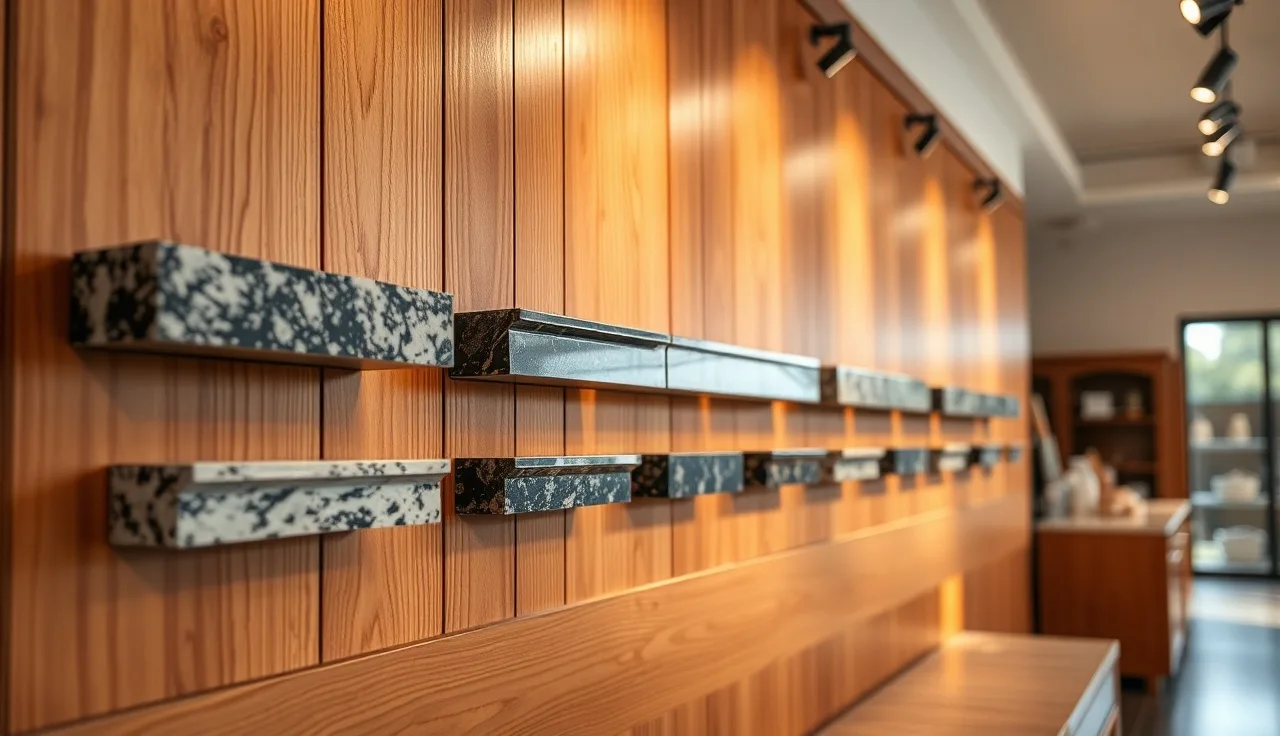
- Mount physical edge samples on wall boards or counter-height rails at eye level, lit with consistent directional light.
- Show the 8 to 12 profiles you cut regularly, label each with its real name and upcharge, and cut samples from the material they'll actually be made in.
- Homeowners can't read an edge from a photo.
- Touchable, correctly lit samples close more jobs.
Why does edge profile display matter so much in a showroom?
Most homeowners walk into a countertop showroom having seen exactly zero real edge profiles in person. They've scrolled Instagram, maybe pinned a few kitchens, and they have a vague idea that there's an eased edge and something called an ogee. That's the whole starting point. The choice they're about to make will live in their kitchen for 20 or 30 years.
Edge profiles are one of the few countertop decisions where touching the sample changes what people pick. The gap between a 3 cm eased edge and a 3 cm full bullnose isn't obvious in a photo. Run a hand along both in person and it's clear in a second. Shops that build good sample displays report that customers upgrade their edge more often, which raises ticket value without adding a dollar of material cost.
There's a liability angle too. If a homeowner picks an ogee off a blurry laminate card and the finished top looks nothing like they expected, you own that conversation. A correctly lit, correctly sized physical sample in the real material kills most of that ambiguity before it starts.
What types of edge profile display systems work best?
Three formats dominate, and each one costs you something. Wall boards save space but lose the hand test. Rail displays win the hand test but eat floor space. Binders handle color but fail edges.
Wall-mounted sample boards are the most common. You cut short sections of each profile, usually 6 to 8 inches long, from a 3 cm slab, then mount them vertically on painted MDF or plywood at eye level. Organize the panels by material (granite, quartz, quartzite) or by profile family (straight, curved, layered). Boards are space-efficient and easy to scan fast.
Counter-height rail displays mount samples horizontally on a bar or rail at roughly 36 inches, the same height as an installed top. Customers run a hand along the edge exactly like they will at home. It costs more floor space but produces better decisions because the ergonomics are right. If you have the room, a rail display for your top eight profiles pays for itself.
Loose sample books or binders suit smaller shops and materials with lots of color options. Quartz makers like Cambria ship sample chips in organized binders [1]. Fine for color. Poor for edges, because chips are small and can't reproduce the feel of a full-thickness profile.
Here's the honest read. Use a wall board or rail for physical edge samples, and a binder or digital tool for material and color. Don't force one system to do both jobs.
How many edge profiles should you display?
Display the profiles you actually cut. That sounds obvious, and yet plenty of shops mount samples of profiles they can run in theory but haven't touched in two years, then act surprised when a customer orders one.
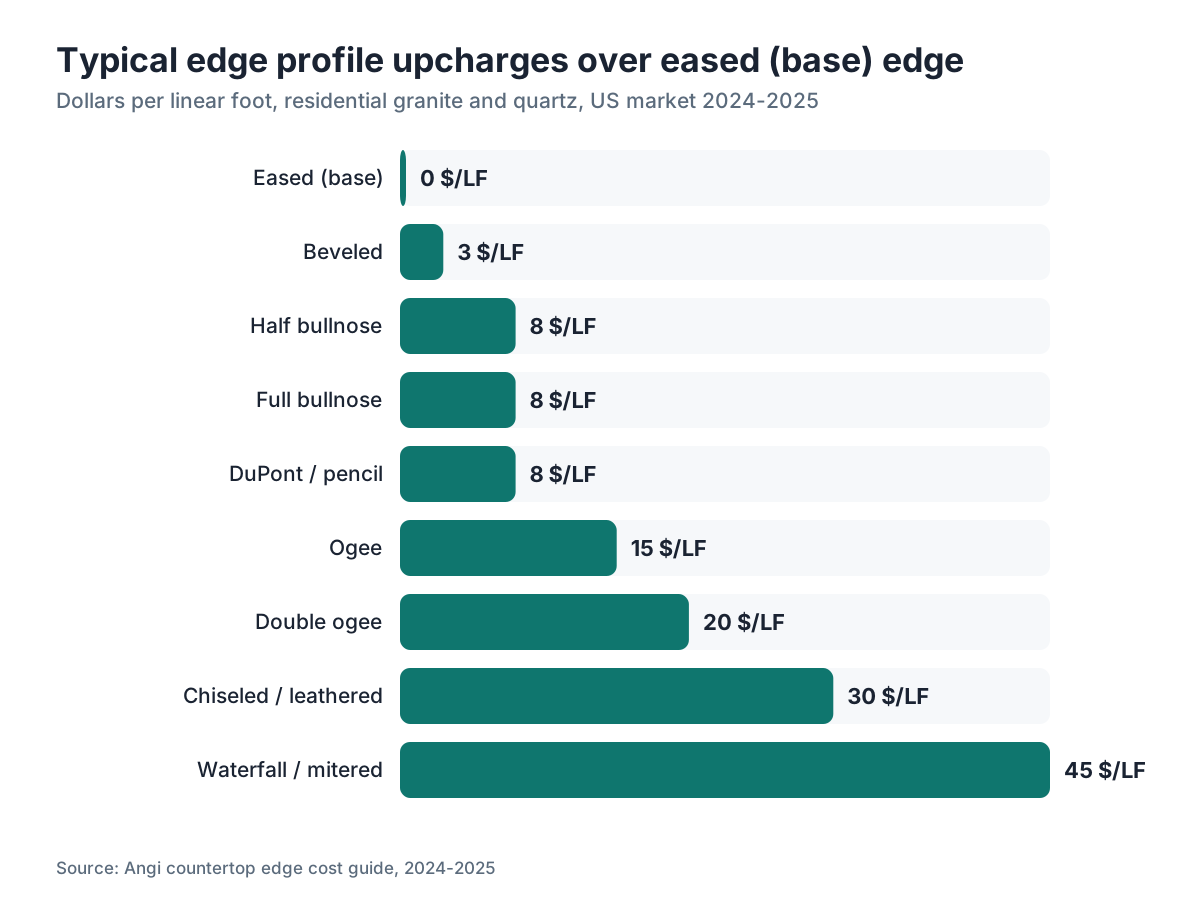
A practical baseline is 8 to 12 profiles [2]. That covers simple through decorative without drowning a customer who just wants to pick and move on. A reasonable core set looks like this:
| Profile | Complexity | Typical Upcharge over Eased |
|---|---|---|
| Eased (straight) | Base | $0 |
| Beveled | Simple | $0-$5/LF |
| Full bullnose | Simple | $5-$10/LF |
| Half bullnose | Simple | $5-$10/LF |
| Dupont (pencil edge) | Simple | $5-$10/LF |
| Ogee | Moderate | $10-$20/LF |
| Double ogee | Moderate | $15-$25/LF |
| Waterfall (mitered) | Complex | $30-$60/LF |
| Laminated (double stacked) | Complex | $25-$50/LF |
| Chiseled/leathered edge | Specialty | $20-$40/LF |
The ranges above are typical for the US market as of 2024-2025; your rates will move with region and material [3]. Put that upcharge information on the display itself. A customer who sees that an ogee costs $12/LF more than eased makes their own call and feels fine about it. A customer who learns the number at quote time feels managed.
If you fabricate granite countertops, marble countertops, or engineered stone like Cambria countertops, show the same profiles cut from each material. A bullnose in granite looks and feels different from one in quartz because the crystal structure and surface finish differ. When your shop handles kitchen countertops across many materials, grouping by material rather than by profile usually reads better to customers.
What size should edge profile samples be?
Cut wall-board samples 6 to 8 inches long. That's enough to read the profile shape clearly. Go shorter than 4 inches and the eye can't register the form, especially on a curved profile like an ogee.
Thickness matters more than length. Cut samples from 3 cm material if that's what you mostly sell. A 2 cm sample of a profile you'll run in 3 cm misleads the customer, because the proportions of the curves change with thickness. Sell both thicknesses? Show both, and label them.
Give the sample some top face, more than the edge. A 4-inch-wide mount that shows 2 to 3 inches of flat top surface plus the full edge drop gives the customer the right picture. They're buying the transition from a flat work surface down into that edge, so let them see it.
How should you light edge profile displays?
Light is where most showrooms leave money on the table. Bad lighting makes every profile look flat and identical. Good lighting picks up the relief cuts, the curves, and the polish variations that make one profile worth an upcharge.
Aim directional light at roughly 30 to 45 degrees from the side. That grazing angle throws shadows into the relief and reveals the three-dimensional form. Straight overhead lighting, the default in most shops, flattens everything into a smear.
Color temperature matters too. Edges in natural stone like granite or quartzite read best under warm-to-neutral light in the 3000 to 3500K range [4]. Engineered quartz in pure white or a solid color often looks cleaner under a cooler 4000K. Mixed materials in one room? Split the difference at 3500K.
Add a small directional LED track aimed straight at the edge board. A couple of PAR20 or MR16 LED spots at the right angle cost almost nothing to install, and the difference is obvious the moment you flip them on.
How should you organize and label edge samples?
Label every sample with the profile's real trade name, never an invented marketing name. Customers who research at home already know eased, bullnose, ogee, waterfall. They won't recognize "Classic Curve" or "Premium Arch," and they'll feel confused or handled when they try to look it up later.
Under or beside each name, show the upcharge in dollars per linear foot over your base edge (usually eased). Some shops hide pricing and plan to handle it at quote time. That's a mistake. Visible pricing builds trust and speeds the whole sale.
Organize by one of two logics: complexity (simple to ornate, left to right) or profile family (straight together, rounded together, multi-profile together). Complexity ordering works better for most homeowners because it maps the mental trip from "I just want something clean" to "I want some detail."
If your shop runs quoting software, match the profile names on your display exactly to the names in your quote system. A customer says "I want the ogee," the quote comes back "Classic Profile 3," and trust drains out of the room. Software like SlabWise lets you standardize profile names in your quote templates so the showroom and the paperwork agree. That matters more than it sounds during a job handoff.
Should edge samples be in stone, resin, or another material?
Stone. Always stone if you sell stone.
Resin or foam demo samples from trade shows are fine for a salesperson to carry in a bag. They are not fine as the primary showroom display for a customer making a $4,000 to $15,000 decision. Resin profiles don't reflect light the way polished granite or quartzite does. They hide how grain direction meets the profile cut. They feel wrong under the hand. The customer notices the disconnect the day the real top arrives.
Cut your samples from actual slab offcuts. This costs almost nothing, because offcuts are waste. A 6-inch by 4-inch piece cut from a remnant and run through your CNC or profile router takes maybe 15 minutes of machine time. The sample is free in any way that counts.
Same principle for butcher block countertops and laminate countertops. A wood edge sample should be actual wood. A Formica countertops or Corian countertops sample should be the actual material. Post-form laminate edges are limited by the material's bend radius anyway, so the real sample also shows what's achievable.
Where in the showroom should edge displays be positioned?
Put the edge display on the path between the front door and the seat where customers review pricing. They should see it and touch it before the quote conversation, not after. Retail research consistently shows that placing upsell products on the customer's natural traffic path lifts engagement [10].
Set the display near your material samples so a customer can hold a material chip in one hand and compare an edge profile with the other. The real decision is "which material in which edge," not two separate errands.
Counter height, 36 inches, is the right mounting height for edge samples because it mirrors an installed top. Wall panels at chest height (around 48 to 54 inches to the center of the display) work as a fallback when floor space is tight. Mount heavy sample boards securely; OSHA general industry rules require display fixtures at height to be fastened against tip-over and fall hazards [9].
Don't tuck edge samples behind a counter where the salesperson stands between the customer and the display. People who can't touch things buy with less confidence. Physical access to the samples is the whole point.
How do you handle edge profile displays for specialty or custom profiles?
Give custom and specialty profiles (waterfall edges, chiseled, hand-honed, stacked multi-tier) their own section, clearly marked "by quote" or "custom."
For waterfall or mitered edges, a photo works as a supplement, because the profile itself is simple. It's a 90-degree mitered corner joint, and the impact is architectural rather than tactile. Show a clean, high-resolution photo of a finished waterfall island next to the miter sample.
For hand-chiseled or leathered edges, the feel is the entire pitch. These need physical samples more than any other type. A 6-inch leathered edge in a dark granite sells itself to the right customer better than any script you could write.
Charge a sample fee for customers who want to take specialty pieces home. A refundable $20 to $50 deposit is standard practice [5]. It cuts sample loss and sorts serious buyers from browsers.
What do homeowners most commonly misunderstand about edge profiles?
A few things come up in every shop.
Homeowners often assume a more ornate edge always looks better. It doesn't. A heavy ogee on a busy quartzite slab with strong veining turns into visual noise. A clean eased or beveled edge lets the stone be the star. Your display should show busy stones with simple edges and quiet stones with decorative edges, so customers can see the relationship for themselves.
Durability differences are real but oversold in a lot of sales pitches. A full bullnose chips less than a sharp eased edge because there's no thin arris to fracture. In granite or quartz, though, the practical difference for normal residential use is minor [6]. Don't sell the upgrade on durability. Sell the look.
Customers who researched online frequently arrive thinking edge profiles are free or already included. Be clear and early about upcharges and you skip the friction at quote time. Pricing on the display board does that work for you, quietly, before anyone sits down.
If you're a homeowner reading this before your showroom visit, spending a few minutes on countertop installation helps you see where edge profiles fit into the fabrication and install process and what you're actually paying for.
How often should you update your edge profile display?
Review the display once a year, minimum. Pull profiles you stopped cutting. Add anything new your shop can now run. If a displayed profile keeps generating jobs you have to subcontract out, either buy the equipment or take the sample down.
Samples get greasy, scuffed, and chipped. A chipped edge sample is the worst offender, because it suggests the finished product will chip too. Replace damaged samples the day you notice them.
When material trends shift, the display should follow. The waterfall edge went from rare to everywhere between roughly 2016 and 2022 as open-concept kitchens and large islands became standard [7]. Shops with a waterfall sample on the wall caught those jobs. Shops that added it to the price list but not the display kept losing them.
Can a digital display supplement or replace physical edge samples?
Supplement, yes. Replace, no.
A tablet or touchscreen showing 3D renderings or photos of edges in various materials earns its keep for profiles you don't stock as samples, or for helping a customer picture an edge in a specific material before committing. Plenty of fabricator platforms and manufacturer sites offer this kind of tool.
The research on in-store decisions runs one direction, though: touch drives purchase confidence for tactile products. Peck and Childers, writing in the Journal of Retailing in 2003, found that "the ability to touch a product" increased confidence and reduced post-purchase regret [8]. Countertop edges are about as tactile as a kitchen gets. Customers who only see digital versions report lower satisfaction with their final choice than those who handled the real thing.
Use digital for the edges of your catalog, literally and figuratively. Keep physical samples for your core 8 to 12 profiles.
If you want to track which edges customers actually choose and how that maps to quote value, tie the showroom conversation to your quoting process properly. SlabWise's quoting tools connect the edge profile selected in the showroom to the line item in the quote, which cuts the transcription errors that cause remakes.
Frequently asked questions
How much does it cost to build a basic edge profile display board?
Material cost is minimal if you use your own offcuts. A 4 x 8 sheet of MDF for the mounting board runs $30 to $60. Cutting 10 to 12 samples from remnants costs nothing in material and maybe an hour of machine time. Add hardware and adhesive and a full wall board comes in under $200 out of pocket for most shops. The real investment is the labor to cut, finish, and mount the samples.
Should edge profiles be displayed in the same material as what the customer is buying?
Ideally yes, especially for your top sellers. A bullnose in granite reflects light differently than the same profile in white engineered quartz. If you can't cut samples in every material, prioritize your two or three most-sold materials. A small label reading 'available in all our stone materials' handles the rest without cluttering the board.
What's the most popular countertop edge profile right now?
The eased edge (a straight or flat edge with a small break) has been the most commonly specified residential profile for several years because it suits contemporary design. The waterfall or mitered edge jumped from niche to mainstream between roughly 2016 and 2022. Ogee profiles hold on in traditional kitchens. Your local sales mix beats any national number, so track what you're actually quoting.
How do I explain the difference between an eased edge and a beveled edge to a homeowner?
An eased edge has only a tiny mechanical break on the top corner, just enough to take off the sharpness. A beveled edge has a deliberate angled flat cut at about 45 degrees, wide enough to read as a design element. With a sample in hand, this takes five seconds to show. By phone or email it takes two minutes of careful description. That gap is exactly why physical samples matter.
Do edge profile upcharges apply to every linear foot of the countertop?
Yes. Upcharges are priced per linear foot of exposed edge. A kitchen with 30 linear feet of exposed edge carries the decorative upcharge on all 30 feet, unless specific sections are designated otherwise (say a sink cutout perimeter or a back wall edge nobody sees). Always clarify which edges are included when you discuss profile choices with a customer.
Should I show edge profiles for countertop materials other than stone in my showroom?
Yes, if you sell them. Butcher block, solid surface, and laminate all have edge options that differ from stone profiles. Laminate post-form edges are limited by bend radius. Solid surface can be shaped into almost any custom profile. Show what's achievable in each material separately. A granite ogee sitting next to a laminate bevel without clear labeling just confuses customers about what they're buying.
How do I stop edge profile samples from getting damaged in the showroom?
Mount wall samples at an accessible height that isn't elbow-height for small kids. For rail or counter-height displays, accept some wear as the cost of doing business. Replace samples annually or whenever a chip, stain, or scratch shows on the profile itself. A damaged edge sample sends the wrong message fast. Keep backup cuts in your remnant bin so a swap takes 20 minutes instead of a new production run.
What information should be on the label next to each edge sample?
At minimum: the profile's proper name, the slab thickness the sample was cut from (2 cm or 3 cm), and the upcharge in dollars per linear foot over your base edge. Optionally add a short note on the style it suits, like 'contemporary' or 'traditional.' Keep labels readable from 18 inches away. Laminated card labels hold up better than paper in a working showroom.
Is it worth displaying a waterfall or mitered edge even though it's more of an architectural detail?
Yes. The waterfall edge is one of the highest-value upsells in a fabrication shop, often $30 to $60 per linear foot or more, and customers genuinely love the look. A photo display works as a supplement since the profile is a simple 90-degree miter. But keeping one corner miter mock-up on hand for customers to see in person closes more of these jobs.
How many edge profiles is too many to display?
More than 15 active profiles on a single board causes decision fatigue for most customers. With a large catalog, split into two boards: a core board of your 8 to 10 most common profiles and a specialty board for decorative and custom work. Customers who want something standard never wade through the exotic stuff, and buyers who want something special still know it exists.
Do homeowners need to see edge profiles before they visit the showroom?
It helps. Shops whose websites show real photos of their displayed profiles with proper names report shorter visits and faster decisions. A simple photo gallery of your edge samples lets customers arrive with two or three preferences narrowed down. Don't expect photos to replace the in-person experience, though. Most customers change or confirm their choice only after touching the physical sample.
Can I use manufacturer-supplied edge profile samples instead of cutting my own?
Manufacturer samples are fine for engineered stone brands that supply them in a standard format. The catch is they often come in a limited range of colors and thicknesses, and they may not match the profiles your shop actually cuts. Cutting your own from your own material shows customers exactly what you'll produce. For brands like Cambria, the manufacturer program is well-organized and worth using alongside your own cut samples.
Sources
- Cambria, Dealer Resources and Sample Program: Cambria supplies organized sample chips and binder systems to authorized dealers for countertop material and color selection.
- Natural Stone Institute (formerly Marble Institute of America), fabrication and showroom best practices guidance: Industry guidance on showroom display recommends presenting a range of edge profiles representative of the shop's production capability, commonly 8-12 profiles.
- Angi, countertop edge profile cost guide: Typical edge profile upcharges range from $0 for eased to $10-$30/LF for decorative profiles, with complex waterfall or mitered edges running $30-$60/LF or more, as of 2024-2025.
- U.S. Department of Energy, lighting and color temperature guidance: Light source color temperature is commonly specified in kelvin, with warm-to-neutral sources around 3000-3500K and cooler daylight-range sources around 4000K and above.
- Natural Stone Institute, fabricator business practices resources: A refundable sample deposit of $20-$50 is cited as standard practice among fabricators to reduce showroom sample loss.
- Natural Stone Institute, Dimension Stone Design Manual: Bullnose profiles reduce arris chip risk compared to sharp eased edges; for normal residential use in granite and quartz, the practical durability difference is minor.
- National Kitchen and Bath Association (NKBA), design trends reporting: Waterfall and mitered edge countertop designs rose sharply in specification frequency between 2016 and 2022 as large kitchen islands became a dominant residential design feature.
- Peck and Childers, 'To Have and To Hold: The Influence of Haptic Information on Product Judgments', Journal of Marketing, 2003: "The ability to touch a product" increased purchase confidence and reduced post-purchase uncertainty in studies of tactile retail goods.
- Occupational Safety and Health Administration (OSHA), general industry safety requirements: Heavy display fixtures including stone sample boards mounted at height must be securely fastened per general industry safety requirements to prevent tip-over or fall hazards.
- U.S. Small Business Administration, retail layout and customer experience guidance: Retail research consistently shows that placing high-margin or upsell products on the customer's natural traffic path increases engagement and conversion rates.
- NKBA, Kitchen and Bath Market Index reporting, 2023: The eased edge remained the most commonly specified residential countertop edge profile in 2023 per NKBA industry tracking data.
Last updated 2026-07-11