TL;DR
- Replacing countertops takes 1 to 3 days of active work and costs $40 to $200 per square foot installed, depending on material.
- The process: measure, choose material, get three quotes, remove the old surface, install the new one.
- Quartz runs $70 to $120 per sq ft installed; granite runs $60 to $110.
- A 40-square-foot kitchen lands between $2,400 and $4,800 for either.
What does it actually cost to replace countertops?
Most homeowners spend $1,500 to $8,000 on a full kitchen countertop replacement, with the midpoint sitting around $3,000 to $4,000 for a 40-square-foot kitchen [1]. Material choice drives that range more than anything else. Pick your stone and you've picked most of your budget.
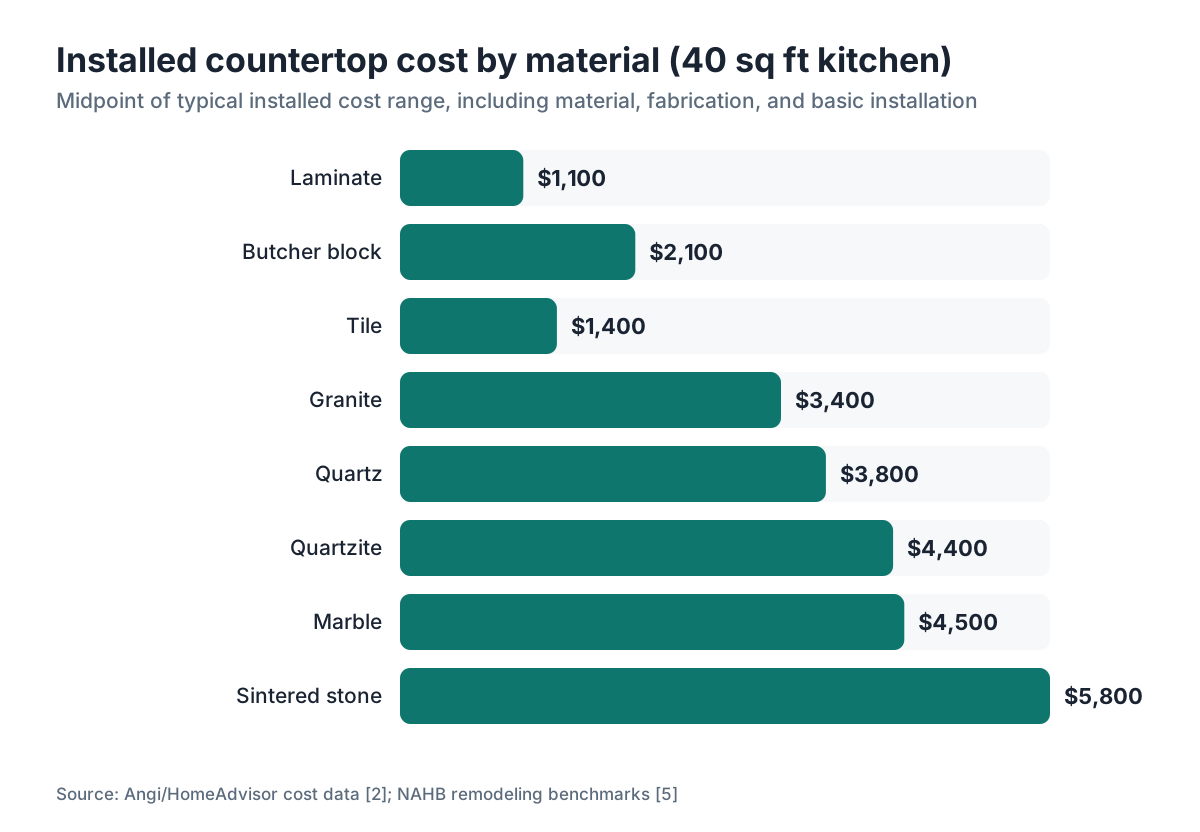
Here is a realistic installed-cost table covering the most common materials:
| Material | Installed cost per sq ft | Typical 40 sq ft kitchen |
|---|---|---|
| Laminate (Formica-style) | $15, $40 | $600, $1,600 |
| Butcher block | $35, $70 | $1,400, $2,800 |
| Tile | $20, $50 | $800, $2,000 |
| Granite | $60, $110 | $2,400, $4,400 |
| Quartz (engineered) | $70, $120 | $2,800, $4,800 |
| Quartzite (natural stone) | $80, $140 | $3,200, $5,600 |
| Marble | $75, $150 | $3,000, $6,000 |
| Dekton / Neolith sintered | $90, $200 | $3,600, $8,000 |
Those numbers cover material, fabrication, and basic installation. They do not include demolition of your old counters (add $200 to $500 for a pro), plumbing disconnection for sinks, or cabinet repairs uncovered once the old top comes off [1].
Labor alone runs $35 to $85 per hour for installers, and a two-person crew needs 4 to 8 hours for a standard kitchen [9]. Do the demo yourself and you save a realistic $200 to $400.
What is the cost to replace countertops with granite specifically?
Granite replacement runs $60 to $110 per square foot installed, so a 40-square-foot kitchen lands at $2,400 to $4,400 [1][2]. That spread comes from slab grade, edge profile, number of cutouts, and your region.
Granite pricing works in tiers. Level 1 granite (thin slabs, limited colors, often pre-cut at big-box stores) runs $40 to $60 per square foot installed. Level 2 and Level 3 slabs with richer veining and fewer inclusions push to $70 to $110 or more. Exotics like Blue Bahia or Juparana Bordeaux can clear $150 per square foot once you add fabrication.
Ripping out granite to install new granite usually costs the same as a first-time granite install, because the material price does not change. What changes is the demo fee, which a fabricator might fold into the quote or bill separately at $200 to $400. Ask which it is.
A straight eased edge is typically included in the fabrication price. Ogee, waterfall, or dupont profiles add $10 to $30 per linear foot. Twenty-five linear feet of edge with a complex profile costs $250 to $750 extra. Worth knowing before you fall for a profile in a showroom.
For a deeper look at what granite is and how it performs, the granite countertops guide covers density, finish options, and long-term sealing needs.
What is the cost to replace countertops with quartz?
Quartz (engineered stone from brands like Caesarstone, Cambria, and Silestone) costs $70 to $120 per square foot installed for most product lines, putting a 40-square-foot kitchen at $2,800 to $4,800 [1][3]. Premium lines like Cambria countertops or large-format book-matched slabs can push past $150 per square foot.
Quartz costs a bit more than entry-level granite because manufacturing adds labor before the slab ever reaches a fabricator's shop. Raw quartz aggregate gets mixed with polymer resins (7 to 10% by weight), pigmented, pressed under vacuum, and cured [3]. You are paying for consistency, not rarity.
The practical upside: quartz never needs sealing. Granite needs sealing every 1 to 5 years depending on the stone's porosity. Over 10 years that maintenance gap is worth maybe $50 to $150 in products and time, so it is not a big financial factor. It is zero mental load, though, and some people value that.
Quartz versus granite pricing is genuinely close. At the installed midpoints, quartz runs maybe $5 to $15 per square foot more than comparable granite, which is $200 to $600 more on a 40-square-foot kitchen. The premium buys you consistency instead of the organic variation of natural stone. That is the whole decision, right there.
How do you measure your countertops before ordering?
Measure twice. Then measure a third time. Fabricators work from either your dimensions or a template they build on-site, and a sloppy measurement from you just means you get a ballpark, not a real quote.
For a rough quote, you need total square footage. Measure the length and depth of each counter run in inches, multiply to get square inches, then divide by 144 for square feet. Add a 10 to 15% waste factor for cuts around sinks, cooktops, and angled walls [4].
Example: a 120-inch run at 25.5 inches deep is 3,060 square inches, or 21.25 square feet. Round to 22, add 15% waste, and you need about 25.3 square feet of material for that run.
For the actual fabrication order, the shop sends a templater to your house after cabinets are installed and level. They use either a physical cardboard or thin-board template or a digital laser system (Prodim, Leica). Digital templates run tighter, especially around farmhouse sinks or cooktops with odd geometry. Ask which method your fabricator uses. Most shops doing volume work go digital.
Do not order slabs before your cabinets are set and level. The fabrication world is full of jobs where a homeowner bought slab early and a cabinet off by a quarter inch forced a painful re-cut.
How do you remove old countertops without damaging cabinets?
Removing the old countertop yourself is genuinely doable. The goal is to avoid cracking cabinet boxes or ripping off face frames, because those repairs cost more than you saved on demo.
Tools you need: a utility knife, an oscillating multi-tool, a pry bar, a reciprocating saw if the old top is one piece, and gloves. Old laminate counters are usually screwed from inside the cabinet up through corner brackets. Tile counters sit on cement board screwed to the cabinet. Stone slabs are held by silicone and sometimes a few drops of epoxy at the front edge.
Step-by-step for most countertop types:
- Turn off the water supply and disconnect the plumbing under the sink. This is a licensed plumber or a confident DIYer job, but the sequence is simple: shut the valves under the sink, disconnect the supply lines, disconnect the P-trap drain.
- Score the silicone caulk at the wall and at the sink rim with a utility knife.
- For stone: cut any silicone bond along the underside of the front edge with a putty knife or multi-tool. Stone is heavy (1-inch granite weighs roughly 18 to 20 pounds per square foot), so have at least one helper.
- For laminate: remove the screws from the corner brackets inside the cabinet and lift the top off. Usually a one-person job on smaller runs.
- For tile: expect a reciprocating saw through the cement board substrate, and expect mess.
Once the counter is off, check the cabinet tops. If the top rail is damaged or out of level, fix it now. A countertop is only as flat as what it sits on, and stone will not flex to save a cabinet that dips.
Dispose of stone responsibly. Most haulers will not take stone in a regular dumpster without notice. A 40-square-foot granite slab weighs 720 to 800 pounds. Rent a dumpster rated for heavy debris, or ask your fabricator, since some will haul away the old stone for a fee.
What material should you actually choose for your replacement countertops?
Here is the honest answer: most people replacing counters in a kitchen they cook in should look hard at quartz or granite before anything else. Both hold up. Both look good. Both carry strong resale appeal. The choice between them is aesthetics and maintenance preference, not durability.
Where the other materials fit:
Laminate countertops (including Formica countertops) are the move if budget is tight or the kitchen is a rental. Modern laminate looks far better than the stuff from 20 years ago, installs fast, and costs a fraction of stone. It scratches and cannot take a hot pot, but at $600 to $1,600 installed, you get a working surface.
Butcher block countertops are warm, easy to fix with a sander, and beautiful in farmhouse or transitional kitchens. They need oiling 2 to 4 times a year and hate standing water near the sink. Not ideal as a whole-kitchen surface if your sink area sees heavy use.
Marble countertops are stunning, and they etch. Citrus, wine, and most acidic foods leave dull spots on polished marble. Want marble? Hone the finish and make peace with the patina. Do not buy polished marble and expect it to stay flawless in a working kitchen.
Corian countertops and other solid surfaces are worth a look for bathrooms or for anyone who wants an integrated sink with no seam. They scratch more easily than stone but sand and refinish cleanly.
One straight take: if you are replacing counters to sell the house, quartz photographs beautifully and has broad buyer appeal. Staying 10-plus years? Pick what you actually want to live with.
How do you get an accurate quote from a fabricator?
A useful quote means handing the fabricator enough to price the whole job, more than square footage. Vague inputs get you vague numbers that move once the crew shows up.
Here is what a fabricator needs to give you a real number: total linear feet of counter run, depth (standard is 25.5 inches for kitchen, 22 inches for bath), number and type of sink cutouts (undermount versus drop-in), cooktop or appliance cutouts, the edge profile you want, the material and slab grade you're considering, and whether you need the old counter demoed.
Call or visit at least three fabricators. Pricing swings more than you'd expect between shops in the same city, sometimes 20 to 30% for the same material, because overhead, waste assumptions, and slab markup all differ. A shop buying direct from a stone importer can often beat a big-box store on quality at the same price.
Ask for a line-item quote, not a single total. You want material cost per square foot, fabrication charge, edge upcharge, sink cutout fee, demo fee, and installation broken out. Shops that refuse to itemize are harder to compare and harder to negotiate with.
Fabricators running modern quoting software (tools like SlabWise do this, generating slab-level quotes with real waste and nesting) tend to produce faster quotes with fewer surprises on the final invoice. A quote built on actual slab dimensions is less likely to jump once the job runs.
For what happens on the day itself, the countertop installation guide walks through a typical stone install from delivery to silicone cure.
What happens on installation day, and how long does it take?
For stone (granite, quartz, quartzite, marble), installation day goes like this: the crew arrives with slabs already cut to your template. Two to three people handle the lift, depending on size and weight.
They set each piece dry first to confirm fit, then apply silicone to the cabinet top rails, lower the stone in, and clamp or brace seams while it cures. Seams get filled with color-matched epoxy or polyester adhesive. Edge-to-wall gaps get caulked with silicone matched to the grout or wall.
A standard kitchen takes 2 to 4 hours to install once the slabs land. Add 30 to 60 minutes for level checks, final adjustments, and cleanup.
You cannot use the counter the same day. Silicone typically needs 24 hours to cure before you reconnect plumbing. Some installers say 12 hours is fine. The safe answer is 24. Keep heavy weight and stress off a seam until the adhesive fully sets.
Laminate and tile run differently. A prefabricated laminate top can be cut and installed in a few hours the same day you buy it at a home center. Tile takes longer, since substrate, tile setting, and grout curing stretch to 2 to 3 days.
Be home during the install. You want to eyeball the seam placement before the adhesive goes down, because once stone is set, moving it risks a crack. A good crew walks you through the plan before they lift a thing.
Can you replace countertops without replacing cabinets?
Yes, and it is one of the cheapest kitchen updates that actually looks like an update. Replacing counters while keeping existing cabinets is common and works well, as long as the cabinets are structurally sound and reasonably level.
The fabricator templates to whatever cabinets exist. If the tops are not level, they shim the stone at installation. Shimming more than about 3/8 inch across a run invites stress cracks over time, so if your cabinets are out of level by more than that, get a carpenter to adjust them before the counter goes in.
Check one practical thing: older cabinets sometimes have face frames that rise above the box top, or filler strips that change how the stone overhangs at the front. Measure your existing overhang (usually 1 to 1.5 inches past the door face) and make sure the new stone matches it. An overhang that's off looks wrong and can jam a drawer.
Painting cabinets at the same time? Do the painting first. Painters will thank you, and you avoid getting primer on fresh stone.
What permits or codes apply to countertop replacement?
In most U.S. jurisdictions, replacing countertops needs no building permit on its own [5]. It reads as a like-for-like cosmetic swap. Two related tasks can still pull in permits or licensed trades.
Plumbing: disconnecting and reconnecting supply lines and drain connections usually counts as plumbing work under the International Residential Code [11]. Many jurisdictions require a licensed plumber for any supply-line work, even a simple shutoff-and-reconnect. Some states let homeowners do minor plumbing on their own primary residence without a permit. Check local code before you assume.
Gas lines: if your cooktop is gas and the job involves moving or disconnecting any gas connection, a licensed gas fitter or plumber has to do it, no exceptions. Do not improvise gas work.
Electrical: outlets in the backsplash or the counter itself (pop-up outlets, for example) must meet local electrical code if relocated. Under the National Electrical Code, all kitchen countertop receptacles serving the counter surface require GFCI protection.
One more thing, if your home was built before 1978: demo can disturb lead paint on old cabinet surfaces, and federal disclosure rules apply to homes of that age [10]. If you're hiring out the work, the contractor should be lead-safe certified.
In a condo or co-op, read your building's alteration agreement. Some buildings demand board approval and licensed contractors for any work touching plumbing, whatever the scope.
How do you care for new countertops after installation?
The first 24 hours are simple: do not use the counter. Let the silicone cure. After that, care depends on material.
For granite: most fabricators seal it at installation. Reapply a penetrating stone sealer every 1 to 5 years depending on density and use [7]. The water test tells you when: drop water on the surface. Beads up, sealer's working. Soaks in within about 4 minutes, reseal. Use pH-neutral cleaners, not vinegar or citrus products, which etch the surface slowly.
For quartz: wipe with warm soapy water. No sealing, ever [3]. Keep it out of long stretches of direct sunlight (UV degrades the polymer binder over years and discolors it), and never set a hot pot straight on it. Use trivets. Quartz handles brief heat, but repeated thermal shock from hot pans can crack it at seams or cutout edges.
For marble or quartzite: treat like granite, but stay more careful with acids. For a full routine, the how to clean stone countertops guide covers each stone type.
For laminate: skip abrasive cleaners and keep standing water off the seams. Once water gets under a laminate seam, the particleboard swells and the top is done.
For butcher block: oil with food-safe mineral oil or a beeswax-oil blend every 1 to 3 months for the first year, then 2 to 4 times a year after that. Never let water stand on wood.
How much does DIY countertop replacement save, and is it realistic?
You can realistically save $500 to $1,500 on a kitchen countertop replacement by doing the demo yourself and handling the plumbing reconnect where code allows. The fabrication and install of stone is not a DIY job for most people, because cutting granite or quartz needs wet saws, diamond blades, and polishing gear you almost certainly do not own [4].
Laminate is the exception. Prefabricated laminate counters (the standard-length ones at home centers) cut with a circular saw, miter at corners with a laminate miter kit, and install with construction adhesive and screws from below. Legit Saturday project for someone comfortable with basic carpentry. Budget $150 to $400 in materials for a typical kitchen.
For stone: do the demo, do the prep, be home for the install, and let the fabricator handle the slab. A botched cut in granite is a $500 to $1,000 piece of stone you just wrecked, with no fix but buying another.
One spot where homeowners consistently overspend: buying slab straight from a stone yard thinking they'll save, then paying a fabricator to work with it. Many fabricators prefer, and some require, supplying their own material, because their warranty covers material and labor together. Buy slab separately and you may void that. Confirm the shop will accept your slab and ask how it affects the warranty before any money changes hands.
Frequently asked questions
How long does a countertop replacement take from start to finish?
Figure 1 to 3 weeks total when you include quotes, material selection, the template appointment, fabrication lead time, and installation. Install day itself is 2 to 4 hours for a typical kitchen. Stone fabrication after templating takes 5 to 10 business days at most shops. Busy periods (spring and fall remodel season) can push fabrication lead time to 2 to 3 weeks.
What is the average cost to replace granite countertops in a kitchen?
Granite replacement runs $60 to $110 per square foot installed. For a typical 40-square-foot kitchen, that is $2,400 to $4,400. Level 1 granite at big-box stores can come in lower at $40 to $60 per square foot installed, while premium or exotic slabs can clear $150 per square foot depending on color and slab grade.
Is quartz or granite more expensive to install?
Quartz typically runs $5 to $15 per square foot more than comparable granite installed. On a 40-square-foot kitchen, that means quartz costs roughly $200 to $600 more. The gap narrows at mid-grade materials and widens at premium lines. Both land in the same price band for most homeowners: $2,400 to $4,800 installed for a standard kitchen.
Can I put new countertops over old ones?
Technically yes for tile over laminate, but most pros advise against it. Layering adds height (which throws off appliance clearances and sink depth), can stress cabinet boxes, and creates a substrate that templates poorly. It also does not work for stone at all. Remove the old surface first. The demo cost is $200 to $500 and it is worth every dollar.
How do I know if my cabinets need to be replaced before new countertops?
Check that cabinet boxes are solid and not water-damaged at the base or top rails, that the top rail is level within about 1/8 inch across each run, and that face frames are not loose or warped. Pass those checks and the cabinets can support new counters. Cosmetic issues like dated door styles have no bearing on whether a countertop can go in.
How much does it cost to replace just a bathroom countertop?
Bathroom vanity tops are smaller, typically 22 to 36 square feet, so total cost is lower even though per-square-foot rates match or slightly beat kitchens. A typical bathroom countertop replacement runs $300 to $1,200 for laminate or solid surface, and $600 to $2,500 for stone. Integrated sinks add $100 to $400 to the fabrication cost.
Do I need to hire a plumber to replace countertops?
You need someone to disconnect and reconnect the sink plumbing. A licensed plumber charges $75 to $150 per hour, and the disconnect and reconnect usually take under an hour each way. Some jurisdictions let homeowners do minor plumbing on their own primary residence. Check local code before assuming you can skip the plumber.
How much does it cost to replace countertops in a large kitchen (over 60 sq ft)?
A 60-square-foot kitchen at granite or quartz midpoints runs $3,600 to $7,200 installed. Large kitchens sometimes earn a slight per-square-foot discount, because the fixed costs of templating and showing up to install spread over more material. Get itemized quotes to confirm that discount is actually baked into the number your fabricator gives you.
How do I find a reliable countertop fabricator?
Ask for references from jobs finished in the last 6 months and call them. Confirm the fabricator carries general liability insurance (ask for a certificate). Look for a physical shop, more than a truck. Get at least three quotes. A fabricator who templates in person before quoting produces a more accurate final price than one quoting off your measurements alone.
Will replacing countertops increase my home value?
Remodeling Magazine's Cost vs. Value report consistently shows kitchen remodels recoup 50 to 80% of their cost at resale, though countertops alone are hard to isolate [8]. Stone counters (granite or quartz) are broadly expected by buyers in mid-range and higher homes and can prevent a price concession more than they add value outright. Replacing dated or damaged laminate at sale time usually pays for itself.
What is the cheapest way to replace countertops?
Prefabricated laminate installed by you or a handyman is the lowest-cost path, often $600 to $1,600 for a full kitchen. Want stone at the lowest price? Look at remnants. Fabricators sell leftover pieces from larger jobs at steep discounts, sometimes 40 to 60% off full-slab pricing. Remnants work well for bathrooms and shorter counter runs.
How do I dispose of old granite or stone countertops?
Old granite is heavy (roughly 18 to 20 pounds per square foot at 3 cm) and most standard dumpsters are not rated for it without advance notice. Options: ask your new fabricator if they haul away old stone for a fee, list it on a local reuse marketplace, or check whether a Habitat for Humanity ReStore will take it in good condition. Otherwise rent a heavy-debris dumpster rated for concrete and stone.
Can you replace countertops in a rental property without permits?
In most jurisdictions, yes, a like-for-like countertop replacement needs no building permit regardless of ownership. Plumbing reconnection rules still apply. Check local code and your lease or HOA agreement. Some municipalities require a permit for any kitchen work in a multi-family rental building, so a quick call to the local building department is worth five minutes.
How thick should new countertops be?
Stone counters sell in 2 cm (3/4 inch) and 3 cm (1.2 inch) thicknesses. Most residential kitchens use 3 cm because it is stronger, needs no laminated edge buildup for a full-thickness look, and is what most fabricators stock. Bathroom vanities sometimes use 2 cm to cut weight. Laminate counters are typically 1.5 inches thick including the substrate.
Sources
- U.S. Census Bureau, American Housing Survey: Typical countertop replacement costs and material price ranges for kitchen remodel projects
- Angi (formerly HomeAdvisor), Granite Countertop Cost Guide: Granite countertop installed cost range of $40, $110 per square foot depending on slab grade
- Natural Stone Institute (formerly Marble Institute of America), quartz surface fabrication guidance: Quartz engineered stone is roughly 90 to 93% quartz aggregate bound with 7 to 10% polymer resins; does not require sealing
- Tile Council of North America, TCNA Handbook for Ceramic, Glass, and Stone Tile Installation: 10 to 15% waste factor recommended when estimating stone material for countertops with cutouts
- National Association of Home Builders, remodeling permit guidance: Like-for-like countertop replacement classified as cosmetic work not requiring a building permit in most U.S. jurisdictions
- Natural Stone Institute, Care and Maintenance of Natural Stone: Penetrating sealer should be reapplied to granite every 1 to 5 years depending on stone density and use
- Remodeling Magazine, Cost vs. Value Report: Kitchen remodels recoup 50 to 80% of cost at resale; midrange kitchen remodel national average cost and resale value data
- U.S. Bureau of Labor Statistics, Occupational Employment and Wage Statistics, tile and stone setters: Tile and stone setters earn roughly $35, $85 per hour, supporting installed labor cost estimates for countertop work
- U.S. EPA, lead-based paint program (RRP and disclosure rules): Homes built before 1978 may have lead paint on cabinet surfaces disturbed during countertop demo; disclosure and lead-safe rules apply
- International Code Council, International Residential Code: Plumbing disconnection and reconnection requirements for residential kitchen remodels under the IRC
Last updated 2026-07-09