
TL;DR
- A granite countertop quote covers four things: square footage of stone, material grade (budget slabs run $40 to $60/sq ft installed, premium can hit $150+), edge profiles, and cutouts.
- Most kitchens land between $2,000 and $4,500 installed.
- Measure every run, add 10 to 15% for waste, confirm slab availability before quoting, and get every line item in writing.
What does a granite countertop quote actually include?
A real quote is more than a price per square foot. A complete granite countertop quote has six line items: stone material, fabrication labor, edge profile, sink and cooktop cutouts, delivery, and installation. If any of these are missing from the number someone hands you, you're not comparing apples to apples.
Most homeowners see an advertised rate like "granite starting at $45 per square foot" and assume that's the total. It usually isn't. That rate often covers slab cost alone, or slab plus basic fabrication, without edges, cutouts, or installation. The all-in installed price per square foot runs higher, and that gap surprises people when the final invoice lands.
For fabricators, a quote that leaves out line items is a quote that causes arguments at delivery. Build every cost into the number upfront, even if it means your headline price looks higher than the shop across town. Customers who understand what they're paying for rarely dispute invoices. The ones who don't, almost always do.
How do you measure square footage for a granite quote?
Measure each countertop run in inches, not feet. Multiply the length by the depth, divide by 144, and you have square feet. A standard kitchen counter is 25.5 inches deep (25 inches of usable surface plus a 0.5-inch overhang over the cabinet face), so a 10-foot run works out to roughly 17.7 square feet.
Most kitchens have multiple runs: a main perimeter, an island, and sometimes a peninsula. Measure each one separately. Add them up, then add 10 to 15 percent for waste. That waste allowance covers off-cuts around sinks, the natural variation in slabs, and any breakage during fabrication. On an irregular layout with lots of inside corners or a large farm sink, push that buffer to 15 to 20 percent.
For fabricators templating on-site, a digital template (laser or arm-based) removes most of the human error. For homeowners getting preliminary quotes before templating, use a tape measure and accept that the final number will shift slightly once the fabricator measures. It almost always does.
The rough math for a typical U-shaped kitchen: three runs totaling about 40 square feet of usable surface, plus a 15% waste buffer, brings you to 46 square feet of stone to purchase and cut. At $70 per square foot installed (a common mid-range all-in rate), that's $3,220 before any upgrades [1].
Islands complicate things because they often have finished edges on three or four sides instead of one. Each finished edge costs more to fabricate. Measure island perimeter and flag every exposed edge in the quote.
What are granite material grades and how much does each cost?
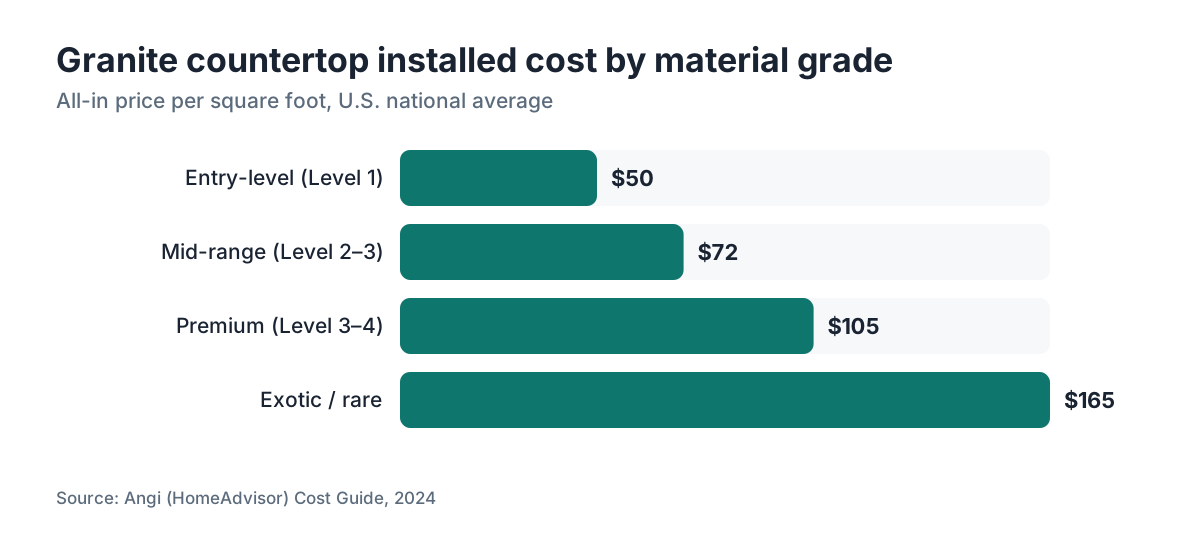
Granite is graded by suppliers, not by a universal standard. Grade 1 (or Level 1, or entry-level) usually means a simple pattern, consistent color, thin slab, and a high-volume quarry source. Grade 3 or higher means more movement, rarer coloring, thicker slab stock, or an exotic origin. No federal standard defines these grades, so one supplier's Level 2 is another's Level 3 [8]. Always look at the slab, not the label.
That said, price brackets do exist and hold up reasonably well across the U.S. market:
| Grade | Typical slab cost (per sq ft) | All-in installed (per sq ft) |
|---|---|---|
| Entry-level (Level 1) | $15 to $25 | $40 to $60 |
| Mid-range (Level 2 to 3) | $25 to $45 | $60 to $85 |
| Premium (Level 3 to 4) | $45 to $80 | $85 to $125 |
| Exotic / rare | $80 to $150+ | $130 to $200+ |
These ranges come from aggregated contractor and industry cost data [1][2]. Your market matters: granite in Atlanta or Houston tends to run 10 to 20 percent cheaper than in the San Francisco Bay Area or New York City, because of warehousing competition and transport costs.
Thickness is part of grade too. Most residential granite is 3cm (about 1.2 inches). Some entry-level slabs are 2cm and require a plywood buildup at the front edge. That buildup adds labor. If a quote doesn't specify thickness, ask.
For granite countertops in general, the material-to-labor split in a typical job runs about 40% stone and 60% fabrication plus installation. That ratio shifts as you climb the grade ladder, because exotic slabs cost more but fabrication rates don't change as dramatically.
How much does granite countertop installation cost in total?
The national average for granite countertop installation, all-in, sits around $3,000 to $3,500 for a typical kitchen, according to contractor cost surveys [1][2]. That average covers roughly 40 square feet of mid-range granite with a standard eased edge, one undermount sink cutout, and normal installation.
Here's where the total climbs:
- Island additions add $800 to $2,000 depending on size and edge count.
- Premium edge profiles (ogee, dupont, waterfall) add $10 to $30 per linear foot over a basic eased or beveled edge.
- Each sink cutout runs $100 to $250. A cooktop cutout is similar.
- Tear-out and disposal of old countertops adds $150 to $400.
- Backsplash cuts and scribing against walls add labor time.
High-end kitchens with exotic stone, multiple islands, and elaborate edges can top $15,000 installed without much effort. Budget kitchens using entry-level granite come in under $2,000. The spread is real.
For comparison, laminate countertops installed average $1,000 to $1,500 for the same kitchen, and butcher block countertops typically fall between $1,500 and $3,000 installed. Granite sits in the middle of the natural stone category. Marble countertops often run 20 to 40 percent more than comparable granite because of quarrying and finishing costs.
What's the right way to calculate waste and slab yield?
Slab yield is the percentage of a raw slab you actually use after cuts. On a simple linear kitchen, yield might hit 80 to 85 percent. On a complex layout with lots of inside corners, a large island, and mismatched runs, yield can drop to 60 to 70 percent. Every percentage point of waste costs money, because you're paying for stone you throw away.
Fabricators who run nesting software calculate yield precisely before cutting. The software lays out all the pieces digitally on the slab and finds the tightest arrangement. This matters most on expensive stone. On a $120/sq ft exotic slab, the difference between 70% and 85% yield on a 50-square-foot job is about $900 in material cost. For homeowners, the takeaway is simple: a fabricator who measures carefully and uses digital templating should deliver a more accurate quote, and sometimes a better price on premium stone.
For quoting purposes, always add the waste buffer before multiplying by price per square foot. If a homeowner's kitchen measures 40 net square feet, quote 46 to 48 square feet of stone. Then when the final template confirms 43.5 square feet, you have a clean conversation rather than an awkward upcharge.
How do edge profiles affect the granite quote?
Edge profiles are one of the most underestimated cost drivers in a granite quote. Every linear foot of exposed edge gets a profile, and the profile choice changes both price and fabrication time.
A basic eased edge (a slight softening of the 90-degree corner) is often included in a fabricator's base price. Once you move to a beveled edge, bullnose, half-bullnose, ogee, or dupont, you're adding router time and in some cases hand-finishing time. Waterfall edges (where the stone wraps vertically down the cabinet side) require an extra slab section and precise mitering.
Typical upcharges over a basic eased edge:
| Profile | Upcharge per linear foot |
|---|---|
| Beveled | $0 to $5 |
| Bullnose | $5 to $12 |
| Half-bullnose | $5 to $10 |
| Ogee | $12 to $25 |
| Dupont | $12 to $22 |
| Waterfall | $25 to $60+ (plus extra slab) |
A U-shaped kitchen might have 20 to 25 linear feet of exposed edge. Choosing an ogee over a basic edge adds $240 to $625 to the job. That's meaningful. Pick the edge that fits the design, but know what you're choosing.
For homeowners looking at countertop installation bids from multiple fabricators, always confirm whether the quoted price includes the edge profile you discussed. A fabricator quoting eased edges and a competitor quoting ogee are not quoting the same job.
What questions should you ask before accepting a granite quote?
Before you sign anything, get clear answers to these:
- Is this price installed, or just the material and fabrication?
- What edge profile is included, and what do upgrades cost?
- How many sink and cooktop cutouts are included?
- Who handles plumbing disconnection and reconnection?
- Does the quote include tear-out of existing countertops?
- What thickness slab are you supplying, 2cm or 3cm?
- Will I see the actual slab before it's cut? (You should almost always say yes to this.)
- What's the payment schedule, and when is the balance due?
- What's your policy if the slab has a hidden fissure or cracks during install?
- How long between template and installation?
That last question matters practically. Most fabricators run 5 to 14 days between templating and installation, depending on backlog. Rare stone can take 3 to 4 weeks if it needs to be ordered. Plan your kitchen timeline around that window, especially if your plumber or electrician is waiting on the countertops to finish their work.
On the slab inspection question: visit the warehouse and approve the specific slab or slabs going into your kitchen. Granite varies within a single color family. Two slabs of the same named granite from the same quarry can look completely different. Walk the yard, stand the slabs up in daylight, and say yes or no before cutting starts. Reputable fabricators expect this and build time for it into the process.
How do fabricators build a granite quote, step by step?
A fabricator's quoting process runs a predictable sequence. Understanding it helps homeowners know what's negotiable and what isn't, and helps newer shops build a professional workflow.
Step 1: Collect the job details. Kitchen dimensions, sink type (undermount vs drop-in), cooktop location, edge preference, stone grade, and timeline. Most shops do this over the phone or via an online form before anyone goes on site.
Step 2: Calculate net square footage from the homeowner's measurements, apply the waste buffer, and look up current slab pricing from your supplier. Slab prices move with shipping and stone market conditions, so a price from six months ago may not hold today.
Step 3: Calculate fabrication cost. Most shops use a per-square-foot rate that covers saw time, CNC time, and polishing, plus line-item adders for edges, cutouts, and mitered joints.
Step 4: Add delivery and installation labor. Installation typically runs $200 to $400 flat for a standard kitchen, plus any complexity adders.
Step 5: Add any subcontracted work, like plumbing if the shop provides it, or seam filler or silicone.
Step 6: Apply margin. Most granite fabricators target 35 to 50 percent gross margin on materials and 40 to 60 percent on labor, though competition compresses this, especially at the entry-level end [3].
Step 7: Review and send the quote, ideally with a line-item breakdown the customer can actually read.
Shops that run quoting software, like SlabWise, can automate steps 2 through 5 and cut quoting time from 30 minutes to under 5. For a shop doing 10 to 15 quotes per week, that's hours recovered every week that go back into fabrication.
For homeowners, the insight here is plain: a fabricator who can show you a line-item quote quickly and clearly is almost certainly more organized than one who hands you a single number on a handwritten slip. Organization in quoting usually predicts organization in fabrication.
What causes granite quotes to vary so much between shops?
You can get three quotes for the same kitchen and see a $1,500 spread. Here's why.
Material sourcing is the biggest variable. A shop that buys direct from importers or holds its own slab inventory pays less than a shop buying through a distributor. That cost difference hits the quote.
Overhead varies enormously. A shop with a CNC waterjet and a large warehouse carries higher fixed costs than a two-man crew with a saw in a rented bay. That overhead spreads across jobs differently.
Waste assumptions vary. An efficient nesting process means less stone purchased per job. A shop eyeballing cuts may add a fat waste buffer and pass that cost to you.
Edge inclusions vary. One shop bundles a basic bullnose into its rate. Another charges extra for anything beyond an eased edge. Comparing quotes without confirming edge type is almost meaningless.
Market positioning matters. Some high-end fabricators price for quality and service and don't apologize for it. Some volume shops compete on price and make it up in throughput. Neither is wrong. You're choosing a provider, more than a price.
If you're a homeowner and one quote is dramatically lower than the others, ask specifically what's included. A missing line item (like tear-out, or a site visit for templating) often explains the gap. If every same item is genuinely included and one shop is still 30 percent cheaper, that's worth investigating before you commit. Ask for references and look at completed jobs.
Should you get multiple quotes, and how do you compare them fairly?
Get at least three quotes. Two isn't enough to spot an outlier. Four or five is fine if you have time, but three gives you a real baseline.
To compare quotes fairly, build a simple spreadsheet with these columns: shop name, square footage quoted, material grade, edge profile, sink cutouts included, tear-out included, installation included, and total price. Then calculate an effective price per square foot for each by dividing total price by quoted square footage. That number normalizes the differences and lets you compare actual value.
A quote comparison table (fill in your actual numbers):
| Shop | Sq ft quoted | Grade | Edge | Cutouts | Tear-out | Total | $/sq ft |
|---|---|---|---|---|---|---|---|
| Shop A | 46 | Level 2 | Ogee | 2 | Yes | $3,800 | $82.60 |
| Shop B | 46 | Level 2 | Eased | 1 | No | $2,900 | $63.04 |
| Shop C | 50 | Level 3 | Bullnose | 2 | Yes | $4,100 | $82.00 |
In this example, Shop B looks cheapest but is missing tear-out, uses a basic edge, and includes only one cutout. Adjusted for those differences, the shops sit much closer than the headline prices suggest.
The lowest quote is not automatically the best choice. Neither is the highest. Choose based on adjusted total cost, material quality, shop reputation, and your read of the people involved. Whoever fabricates your countertops is handling a permanent fixture in your home. A little extra money for a shop that communicates clearly and stands behind its work is usually money well spent.
For context on how granite compares to other materials in a full kitchen project, the kitchen countertops overview covers the major options side by side.
Are there any hidden costs in a granite quote homeowners miss?
Yes. Several, and they show up in almost every project.
Plumbing reconnection. If you're replacing existing countertops and have an undermount sink, a plumber needs to disconnect and reconnect the drain and supply lines. Some fabricators handle this. Many don't. Budget $150 to $350 for a plumber if it's not in the quote [4].
Seam location and visibility. In a long run, granite slabs don't span the full length. A seam is unavoidable. Where that seam falls, and how visible it is, depends on the fabricator's skill and layout choices. Ask where the seam will be before templating, not after.
Permit requirements. Most countertop replacements don't require a permit. But if you're changing the layout, adding an island, or moving plumbing or electrical, permits may apply. Check with your local building department. In most U.S. jurisdictions, a simple countertop swap counts as a repair or maintenance item, not new construction, and doesn't trigger permit requirements, but this varies by municipality [5].
Appliance moves. Moving a stove or refrigerator to access countertops takes time. Some installers charge for it, some don't.
Cabinet levelness. If your existing cabinets aren't level, the fabricator may need to shim before installation. On older homes, this is common. It adds time and sometimes material cost.
Stone care products. A good sealer applied at installation protects granite from staining. Some fabricators include one sealing in the install price. Others charge $50 to $150 extra. Ask. And ask when resealing is recommended, which for most granite is every 1 to 3 years depending on use [6]. For caring for your stone once it's in, how to clean stone countertops is a solid starting point.
How can fabricators make their granite quotes more accurate and faster?
Accuracy problems in quoting almost always trace back to one of three places: measurement errors, wrong material pricing, or missed line items. Each has a fix.
For measurement errors, the answer is digital templating. Laser templating systems or arm-based digitizers produce measurements with tolerances under 1mm, and they kill the transcription errors that happen when someone's reading a tape measure and writing numbers in a cold kitchen [7]. The equipment runs $5,000 to $20,000 depending on the system, but most shops recoup that in reduced waste and remakes within the first year.
For material pricing, the fix is a live price sheet synced to current supplier costs, not a spreadsheet someone updates when they remember. Stone prices move. A shop running quotes against prices from three months ago is either overcharging or eating margin.
For missed line items, use a quoting checklist or quoting software with a fixed template. Every quote should run through the same questions: edge profile, cutouts, tear-out, delivery zone, seam count, and any unusual site conditions. If the field for a line item is blank, it forces someone to either fill it in or mark it explicitly as not applicable. That one habit eliminates most of the invoice disputes that surface at the end of a job.
SlabWise was built for exactly this workflow: a fabricator enters measurements, picks the stone and edge, and gets a complete line-item quote in minutes instead of running the math by hand each time. If you're quoting more than five jobs a week by hand, that kind of automation is worth a look.
Quotes sent within 24 hours of a customer inquiry close at a higher rate than those sent three days later. Speed matters as much as accuracy.
Frequently asked questions
How much does a granite countertop quote typically cost to get?
Most fabricators provide quotes at no charge, though some charge a site visit or templating fee (typically $50 to $150) that gets credited toward the job if you proceed. Get this confirmed upfront. If a shop charges for a quote with no credit back, that's unusual and worth questioning.
What square footage should I quote for a 10x10 kitchen?
The countertop industry uses a standard 10x10 kitchen as a reference point, which typically has about 30 square feet of usable counter surface. Add 15% waste and you're quoting roughly 34 to 35 square feet of stone. Real kitchens vary widely, so always measure your specific layout rather than relying on the 10x10 benchmark for actual pricing.
Is the price per square foot for granite installed or just the material?
This varies by quote and by shop. Always ask. Advertised rates like '$45 per square foot for granite' almost always mean material only, or material plus fabrication, without installation. An all-in installed price typically runs 30 to 50 percent higher than the material-only rate. Get the total installed price in writing before comparing quotes.
How long does it take to get a granite countertop installed after quoting?
Most fabricators run 5 to 14 days between initial templating and installation, depending on their backlog and material availability. Rare or special-order stone can add 2 to 4 weeks. Some shops offer rush slots for an added fee. Plan your kitchen remodel timeline around at least a two-week window between template appointment and countertop day.
What's the difference between Level 1, Level 2, and Level 3 granite?
These grades are set by individual suppliers, not by any industry standard, so they're not perfectly consistent across vendors. Generally, Level 1 granite has simpler patterns and is mass-produced from high-volume quarries. Level 2 and above have more movement, rarer coloring, or higher-quality finishing. Always evaluate the actual slab, more than the grade label, before approving a purchase.
Does a granite quote include removing the old countertops?
Not always. Tear-out and disposal of existing countertops is a separate line item at many shops, running $150 to $400 depending on material (tile is more labor-intensive to remove than laminate). Always check whether tear-out is included before accepting a quote. If it's not listed, assume it's not included and ask about adding it.
Can I negotiate a granite countertop quote?
Yes, within limits. Material costs are harder to negotiate because fabricators pay real prices for stone. Labor and margin are softer. Offering to be flexible on scheduling (off-peak weeks), bundling multiple rooms, or paying faster can sometimes earn a 5 to 10 percent reduction. Asking a fabricator to match a competitor's quote works better when the scopes are genuinely identical.
How accurate is a quote before templating vs. after templating?
Pre-template quotes are estimates based on your measurements, which may be off by 5 to 15 percent. Post-template quotes are accurate, because the fabricator has precise measurements and has laid out the cuts digitally. Expect the final number to shift slightly after templating. A reputable shop will explain any change before proceeding, not surprise you with it on the invoice.
What's a seam, and should it affect how I evaluate a granite quote?
A seam is the joint between two slab sections, required when a run is longer than a single slab (typically more than 10 feet). Seam quality varies by fabricator skill and equipment. Ask where seams will be placed before templating. Poor seam placement (in high-visibility spots) or poor seam quality (visible gaps or height mismatch) are common complaints in negative reviews of fabricators.
How do I know if a granite quote is too high or too low?
Compare at least three quotes for the same scope. Calculate effective price per square foot for each. If one quote is more than 20 to 25 percent below the others, ask what's missing. If one is much higher, ask what's included that the others left out. Use national cost benchmarks ($40 to $85 per square foot installed for mid-range granite) as a sanity check, adjusted for your region.
Do I need a permit to replace granite countertops?
In most U.S. jurisdictions, a straightforward countertop replacement does not require a building permit, because it's classified as a repair or maintenance project rather than new construction. However, if the project involves moving plumbing, electrical work, or structural changes, permits may apply. Always confirm with your local building department before starting work.
What payment schedule is normal for a granite countertop job?
Most fabricators use a two-payment structure: 50 percent deposit at signing and 50 percent on installation day or delivery. Some shops ask for a third check-in payment at templating. Avoid paying 100 percent upfront. Full payment before templating offers you no recourse if anything goes wrong during fabrication or installation.
How does granite pricing compare to quartz or other stone countertops?
Mid-range granite typically runs $60 to $85 per square foot installed. Quartz (engineered stone like Cambria) often runs $70 to $100 installed for comparable quality. Marble typically runs $80 to $120 installed. Quartzite, which is a natural stone often confused with quartz, sits in a similar range to premium granite. Granite is generally the most price-competitive natural stone option.
Sources
- HomeAdvisor (Angi), Granite Countertop Cost Guide: National average for granite countertop installation runs $3,000, $3,500 for a typical kitchen; all-in installed rates range $40, $200+ per square foot depending on grade
- U.S. Bureau of Labor Statistics, Producer Price Index: Stone Products: Stone product pricing data used to contextualize regional variation in granite slab costs
- National Kitchen and Bath Association, Industry Statistics: Granite fabricators target 35 to 50% gross margin on materials; labor margins in the countertop segment run 40 to 60%
- HomeAdvisor (Angi), Plumber Cost Guide: Plumbing disconnection and reconnection for sink during countertop replacement typically runs $150, $350
- U.S. Department of Housing and Urban Development, Residential Rehabilitation Inspection Guide: Countertop replacement is generally classified as a repair or maintenance item, not new construction, and typically does not require a building permit in most jurisdictions
- Natural Stone Institute, Care and Maintenance of Natural Stone: Granite countertops should be resealed every 1 to 3 years depending on use and porosity
- Laser Products Industries, Digital Templating Accuracy Specifications: Laser templating systems produce measurements with tolerances under 1mm, reducing fabrication errors and material waste
- Marble Institute of America (now Natural Stone Institute), Granite Product Standards: There is no universal federal or industry standard for granite 'grades'; grading is set by individual suppliers and varies across distributors
- U.S. Census Bureau, American Housing Survey: Kitchen remodeling is among the most common major home improvement projects; countertop replacement is a frequent component
- Occupational Safety and Health Administration (OSHA), Silica in Stone Fabrication: Stone fabrication operations involving cutting and grinding create silica dust hazards; federal silica standards apply to fabrication shops
Last updated 2026-07-10