TL;DR
- Most fabricators charge $35 to $85 per extra faucet hole drilled in stone countertops.
- Harder materials like quartzite and full-thickness porcelain run toward the top.
- The hole itself takes 5 to 15 minutes with a diamond core bit, but bit wear, edge finishing, and layout complexity are the real cost drivers.
- Price it as a flat per-hole fee, never a percentage of the job.
What does a faucet hole actually cost to drill?
A single extra faucet hole in natural stone or engineered quartz runs roughly $35 to $85, based on pricing reported across fabricator forums, trade publications, and Stone Fabricators Alliance community discussions. The range is wide for one reason: the real number tracks material hardness, slab thickness, and your local labor rate.
For standard 3/4-inch granite or quartz at 3 cm, most shops in mid-cost metros land at $45 to $65 per hole. High-cost markets like New York, San Francisco, and Seattle push that to $70 to $85. Rural or low-labor-cost shops sometimes drop to $35, but below that the charge stops covering bit wear plus the installer's time.
Marble, quartzite, and full-bodied porcelain are harder on tooling and command a premium. Expect $65 to $100 per hole in those materials. Softer stones like soapstone and limestone are easy to drill but rare enough that most shops just apply their standard rate. [1]
Laminate and solid surface are a different story. Drilling a faucet hole in laminate countertops or Corian countertops costs $15 to $35, because a standard hole saw handles it and there is no diamond core bit wear to recover.
What drives the cost of drilling a faucet hole?
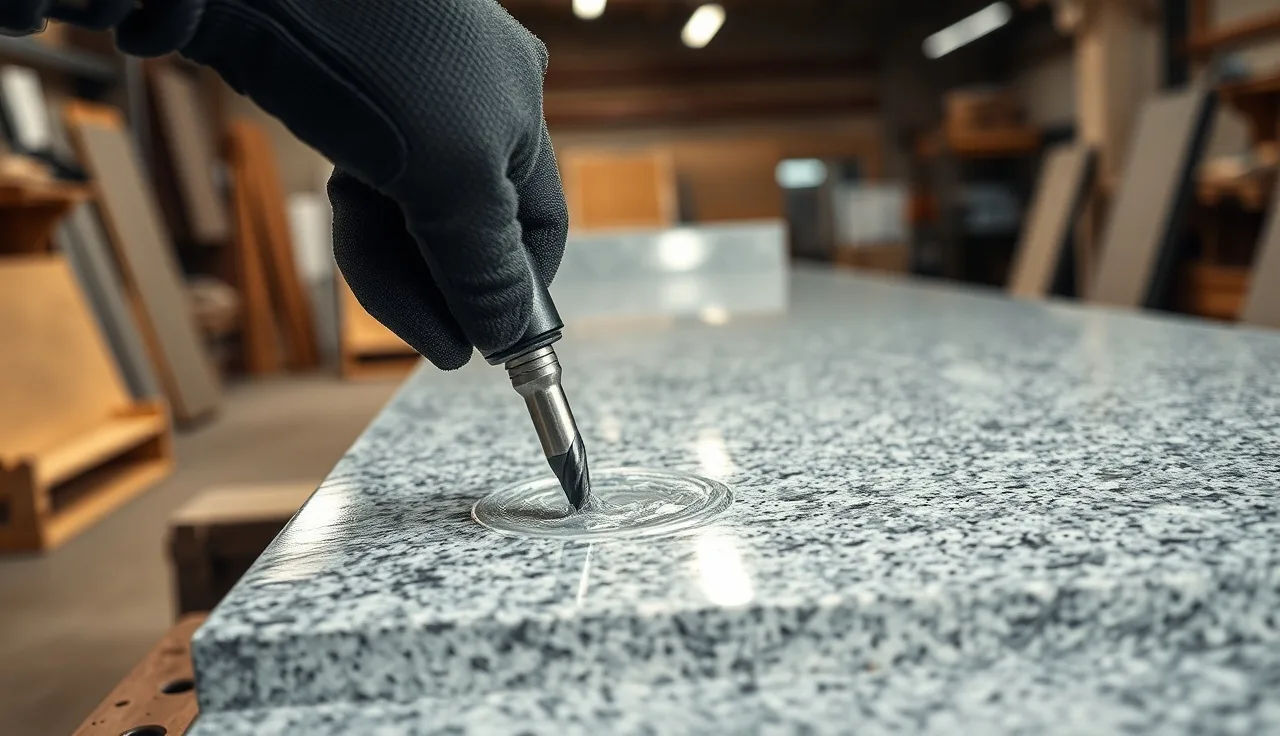
Drill time is almost a red herring. A skilled installer cores a 1-3/8-inch faucet hole through 3 cm granite in about 8 to 12 minutes with a wet diamond core bit. That is not the expensive part.
Bit cost is the biggest hidden expense. A quality diamond core bit for stone costs $40 to $120 depending on diameter and brand, and most shops report 60 to 150 holes per bit before quality degrades. [2] Do the math: at $80 per bit and 100 holes, tooling costs $0.80 per hole before you touch labor. Sounds cheap. But shops drill a lot of sizes (1-3/8 inch for standard faucets, 1-3/4 inch for widespread handles, 2 inch for air gaps, 3/4 inch for soap dispensers), and each size needs its own bit. A shop keeping a full set can have $800 to $2,000 tied up in drill tooling at any moment.
Edge finishing matters too. When a core bit exits the bottom of a slab, it chips if the installer ignores backing material and drill speed. Many shops run a partial drill from the top, flip the piece, and finish from the bottom for a clean break-out edge. That takes control a rushed crew will skip, and skipping it means callbacks. Pricing the hole right is what buys you a crew that does it right.
Layout complexity adds time on oddly configured decks. A single-hole faucet centered in a 10-inch backsplash zone is routine. A farm sink with a bridge faucet needing two holes 8 inches on center on a narrow ledge, plus a third for a side spray and a fourth for a water filter, takes real layout time to keep the stone between holes from cracking. Keep holes at least 1.5 hole-diameters apart, roughly 2 inches center-to-center for a 1-3/8-inch bit, to avoid stress fracturing. [3]
Jobsite drilling versus shop drilling is a real cost gap. If a hole gets missed during fabrication and the installer drills it in the field, they are on their knees with a drill rig, managing water runoff and dust in a client's kitchen. That is worth a surcharge of $25 to $50 on top of the standard hole rate. Some shops make it policy: holes drilled at the jobsite because of a customer change order cost 1.5x the shop rate.
How many faucet holes does a typical kitchen countertop need?
A standard kitchen sink needs one hole for a single-body faucet or three holes for a widespread faucet (two for the hot and cold handles, one center for the spout). Beyond that, homeowners commonly add a fourth hole for a soap dispenser, a fifth for a water filter or dedicated drinking faucet, and sometimes a sixth for an air gap if the dishwasher discharge requires one under local plumbing code.
The base quote should spell out exactly how many holes are included. Most fabricators include one hole as standard when a sink cutout is in scope, because they assume a single-hole faucet. Every hole past that first one is extra.
A six-hole setup on a single run of stone is not rare in a high-end remodel. At $55 per extra hole, that is $275 in add-ons a shop can easily miss if holes are not itemized. On kitchen countertops where the homeowner also adds a prep sink, you can hit eight or nine total holes across the project.
Bathroom vanity tops are simpler. A single vanity faucet almost always needs one centered hole, though vessel sink faucets sometimes want a second hole for a separate drain pop-up lever. Undermount vanities with widespread faucets go back to three holes. Price each one explicitly.
How should fabricators structure the line item in a quote?
List faucet holes as a separate line item at a flat per-hole rate, and state clearly how many are included in the base price. "Sink cutout includes 1 faucet hole; additional holes $55 each" is unambiguous. Do not bury holes in a catch-all "miscellaneous fabrication" line, because it confuses homeowners and creates scope fights at invoice time.
If you quote by square footage, do not fold hole pricing into your per-square-foot rate. You will either overcharge simple projects or undercharge complex ones. Holes are a count-based item, not an area-based one.
For shops using quoting software, a dedicated holes field in the line-item list keeps the number from getting lost. SlabWise lets fabricators set a default per-hole price that auto-populates when a hole count is entered, so a salesperson typing "4 holes" never has to remember to apply the adder by hand.
Make the language specific. "Faucet hole (1-3/8-inch diameter, standard)" beats a bare "faucet hole," because it sets the customer's expectation and creates a paper trail if they later ask for a 2-inch diameter to clear a bridge faucet pull-out hose that needs a different bit entirely.
Should the price change based on material?
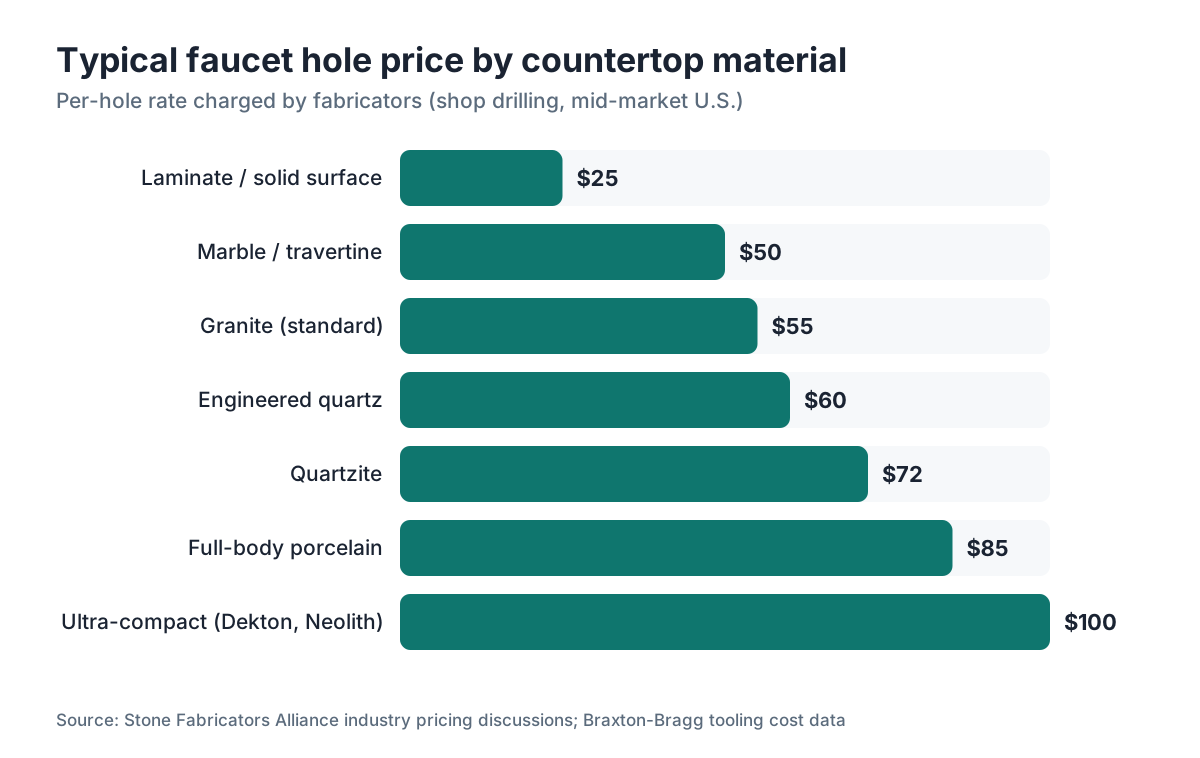
Yes. Most experienced shops tier their hole pricing by material hardness even if they never advertise it. A reasonable structure looks like this:
| Material | Relative drill difficulty | Suggested hole adder |
|---|---|---|
| Laminate / solid surface | Very low | $15, $35 |
| Marble / travertine | Low-medium | $40, $60 |
| Granite (standard) | Medium | $45, $65 |
| Quartz (engineered) | Medium-high | $50, $70 |
| Quartzite | High | $60, $85 |
| Full-body porcelain slab | High | $70, $100 |
| Ultra-compact surfaces (Dekton, Neolith) | Very high | $80, $120 |
Ultra-compact surfaces like Dekton are the hardest to drill, full stop. The material is sintered at extreme pressure and temperature, and it is brittle in ways even quartzite is not. [4] Bit wear is severe and the chipping risk is real. Charging $100 to $120 per hole in Dekton is not gouging. It is accurate cost recovery.
For granite countertops, the species matters too. A dense black absolute granite is harder on bits than a medium-grained colonial white. Most shops do not price that granular, but if you do a lot of exotic granite work, tracking bit life by stone type will sharpen your numbers over time.
Marble countertops sit on the softer end of natural stone, roughly 3 to 4 on the Mohs scale versus granite's 6 to 7, so bit wear is lower. The risk with marble is chipping at exit, not drill speed. [5]
What about holes drilled in the field versus the shop?
Shop drilling wins every time. The slab is on a stable surface, water cooling is easy to manage, and dust control is contained. A shop drill press or jig produces cleaner, more precisely positioned holes than freehand work on an installed top.
Field drilling happens for two reasons: the fabricator missed a hole (their fault) or the customer added a hole after installation (their change order). Price those two situations differently in your contract.
For fabricator error, eat the cost of the field visit. That is the right call. But document in your contract that the hole rate covers shop work only, and that return-trip labor bills separately for customer-initiated changes. Then you are not arguing about fault at invoice time.
For customer-requested field drilling, charge the standard hole rate plus a service call fee of $75 to $150 depending on drive time. Some shops charge a flat "after-installation modification" fee that covers one hole plus travel. Either way, get a signed change order before the installer heads back out. The hole rate alone rarely covers the trip.
One safety note that is not optional: wet-drilling with proper water cooling is required for silica dust compliance. OSHA's final rule on respirable crystalline silica (29 CFR 1926.1153) requires engineering controls for silica-generating tasks in construction, including stone cutting and drilling. [6] In a shop, that means wet methods and local exhaust ventilation. In the field, wet drilling with a water-fed bit plus respiratory protection is the floor. [11]
How do you explain the extra faucet hole charge to homeowners?
Homeowners push back on faucet hole charges because the hole looks like a small thing. It is a small thing. The explanation that lands: "The cost is not the hole itself. It is the diamond-tipped tooling required to cut through stone without cracking it, plus the labor to do it cleanly."
Be specific. Tell them the bit costs around $80 to $120 and only lasts so many holes before it needs replacing. That turns the charge from "you are paying $55 for five minutes of work" into "you are paying for equipment wear and the skill to not crack your $4,000 countertop."
For homeowners pricing a project from scratch, count your holes before you sign anything. Widespread faucets, soap dispensers, water filters, and air gaps all stack up, and a quote showing only one included hole can grow $150 to $300 once you add everything. That is not a bait-and-switch. It is a specification detail that is easy to miss.
A good fabricator asks about your faucet configuration during the consultation and quotes all holes then. If yours did not ask, ask them. Pull up the faucet spec sheet before templating, because it tells you exactly how many holes and what diameters the faucet requires.
Are faucet hole charges taxable?
Whether faucet hole charges (and countertop fabrication charges generally) are subject to sales tax depends entirely on your state, and sometimes on how the transaction is structured.
In states that tax fabricated stone as a manufactured product, the hole charge falls inside the taxable sale. Texas, for example, taxes fabrication labor when it is part of a sale of tangible personal property. In states where construction labor is exempt but materials are taxed, you may need to break out the material component from the labor. [7]
This is genuinely complicated and varies enough by state that you need your own accountant or a state revenue department guidance letter for your situation. The Texas Comptroller has published guidance on stone fabrication taxability. California, New York, and Florida each run their own rules for mixed labor-and-material contracts.
For homeowners, the practical answer: ask the fabricator whether sales tax applies to the whole invoice or just the materials portion, and get the answer in writing on the quote so nothing surprises you.
How do hole prices change for sink or countertop type?
The countertop context shapes hole pricing in a few ways.
Undermount sink decks often have a wider faucet zone with more room between holes, which cuts cracking risk and makes layout easier. Drop-in sinks sometimes ship with a pre-drilled sink deck that limits where holes can go, which may push the fabricator into a tighter spot or closer to a cutout edge.
Apron-front (farm sink) installations with narrow decks are the toughest. The deck behind the sink is narrow, so holes can end up close to both the front and rear edges. A hole less than 1.5 inches from a polished edge or a cutout is a cracking risk, and a careful fabricator will either talk you out of that placement or charge a difficulty premium.
For butcher block countertops, hole drilling is straightforward with standard woodworking tools, but sealing the end grain around the hole matters for longevity. Some butcher block fabricators drill holes at no charge. Others charge $20 to $35. Minor in wood, but worth asking.
Bathroom vanity tops with integrated bowls (like one-piece cultured marble units) arrive with holes pre-drilled or at least scored by the manufacturer. If you supply a custom stone vanity top, the same per-hole rate applies, but the volume is usually low, one to three holes per vanity.
What's the minimum a fabricator should charge to not lose money on a faucet hole?
This is the number most shops never actually sit down to calculate. Do it once.
Start with bit cost. A mid-quality diamond core bit at $80, lasting 100 holes, is $0.80 per hole. A premium bit at $120 lasting 150 holes is the same $0.80. But if bit life runs short (new installer, harder stone, sloppy technique), that jumps to $1.50 to $2.00 per hole in tooling alone.
Labor is next. Ten minutes of shop time at a loaded rate of $75 to $95 per hour (benefits, overhead, and margin on labor included) is $12.50 to $15.80 for drill time. Add 5 minutes of layout and cleanup, and you are at $19 to $24 in labor. [8]
Overhead allocation is the piece shops forget. A slice of rent, insurance, equipment depreciation, and admin time sits behind every billed item. Even a modest 30% overhead allocation on $20 of labor adds $6.
So the all-in cost to drill one hole in a standard shop is roughly $26 to $35 before any profit. A $35 charge is essentially break-even in a lean shop. A $45 to $55 charge is a reasonable 30 to 40% gross margin on the item. Going below $35 means you are subsidizing holes from other parts of the job, which hides your true project profitability.
Shops running fabrication quoting software can build this cost model into a pricing floor, so no salesperson accidentally quotes holes below cost while giving a fast estimate over the phone. That kind of pricing discipline is where shops with good software pull ahead of shops quoting from memory and spreadsheets.
How do other countertop materials handle faucet hole pricing?
Stone gets the most attention because diamond-bit drilling is the most specialized skill. But faucet hole pricing shows up across every countertop type, even when it is informal.
Formica countertops and laminate in general: hole saws handle these easily, and many installers include one or two holes in the overall job price. Extra holes, priced separately, run $15 to $25 each.
Corian countertops and other solid surface: Corian is machined with standard woodworking router bits. Trinseo (formerly DuPont) fabrication guidelines specify minimum distances from edges and adjacent holes to prevent cracking in solid surface, and a certified Corian fabricator follows those specs. [9] Extra holes in solid surface typically cost $20 to $40 each.
Cambria countertops are engineered quartz, so they follow the same diamond-bit requirements as other quartz products. Cambria publishes fabrication guidelines through its dealer network, and hole drilling technique matches other engineered quartz. [10] Pricing sits in the same $50 to $70 range.
Concrete countertops: holes get cast in or drilled with a hammer drill and carbide bit. Custom concrete fabricators often charge $50 to $100 per hole, because the positioning has to be planned before the pour and any post-pour drilling risks cracking the slab or hitting the reinforcement.
The countertop type also hints at long-term maintenance. If you want to know how different stone types need care around sink areas, how to clean stone countertops covers it in detail.
Frequently asked questions
How much does one extra faucet hole cost in a stone countertop?
Most fabricators charge $45 to $85 for a single extra faucet hole in granite, quartz, or marble. The exact price depends on your market, material hardness, and whether the hole is drilled in the shop or in the field after installation. Field drilling after installation typically costs $25 to $50 more than a shop-drilled hole.
Is the faucet hole charge negotiable?
It is, but pushing hard on it rarely pays off. A fabricator charging $55 per hole is recovering real tooling cost and labor. A shop that caves to $20 per hole either has lower overhead than average or is absorbing the loss elsewhere in your quote. If you are getting multiple holes drilled, asking for a small volume discount (10 to 15% off for four or more) is a more reasonable ask than trying to kill the charge.
Does my faucet type determine how many holes I need?
Yes. A single-hole faucet needs one hole (1-3/8-inch diameter standard). A widespread faucet needs three: two for the handles, one for the spout. Add separate holes for a soap dispenser, water filter faucet, and air gap if you have a dishwasher. Your faucet's product sheet lists the exact hole count and diameters, and you should share it with your fabricator before templating.
Can a fabricator add a faucet hole after the countertop is already installed?
Yes, with wet-drilling equipment and care. It is harder than shop drilling because the countertop is in place and water management is tougher. Expect to pay the standard hole rate plus a service call fee of $75 to $150. There is a small but real risk of cracking in brittle materials like quartzite or full-body porcelain, so confirm the installer has field drilling experience before you agree.
What is the standard faucet hole diameter for stone countertops?
The most common diameter is 1-3/8 inches (35mm), which fits the vast majority of single-hole and widespread faucet shanks. Some bridge faucets with pull-out hoses need a 1-3/4-inch or even 2-inch hole to clear the hose. Air gaps and soap dispensers typically use a 1-3/8-inch hole too. Always check your faucet's specification sheet before the fabricator templates your project.
How close can two faucet holes be without risking a crack?
The general rule is to keep hole centers at least 1.5 times the hole diameter apart, which works out to roughly 2 inches center-to-center for a standard 1-3/8-inch hole. In practice, most fabricators prefer 2.5 to 3 inches between centers on harder materials like granite and quartzite. Closer spacing raises cracking risk, especially near a cutout edge. Ask your fabricator to mark the layout before drilling.
Why is drilling faucet holes in Dekton or ultra-compact surfaces so expensive?
Dekton and similar sintered ultra-compact surfaces are made at extreme heat and pressure, which makes them exceptionally hard and brittle. Diamond core bits wear out two to four times faster than on standard granite, and the chipping risk at hole exit is higher. Most fabricators charge $80 to $120 per hole in these materials. The premium reflects real tooling cost, not markup. Manufacturer guidelines also specify slower drill speeds and continuous water cooling.
What should my countertop quote say about faucet holes?
The quote should list how many holes are included in the base price (typically one per sink cutout), the per-hole charge for additional holes, the assumed diameter, and whether the price covers shop drilling only. A line like "Additional faucet holes: $55 each (1-3/8" diameter, shop drilling; field drilling is $55 plus service call fee)" kills most disputes. If the quote does not address holes, ask before signing.
Do faucet holes affect the structural integrity of the countertop?
Properly placed holes in good stone do not weaken the countertop in any meaningful way. The risk comes from holes drilled too close to an edge, a sink cutout, or each other. In those cases, the remaining web of stone between a hole and an edge can be thin enough to crack under load or thermal stress. A 1.5-inch minimum distance from any edge is a widely cited rule of thumb in fabrication training.
Can I drill my own faucet hole in a stone countertop?
Technically yes, but it is high-risk for a homeowner. You need a wet diamond core bit sized to your faucet, a drill that holds low RPM, continuous water cooling, and patience. Rushing produces chipping, and one bad exit break can crack a slab worth thousands. On laminate or wood countertops, a DIY hole with a standard hole saw is very reasonable. On stone, paying the fabricator's hole rate is cheap insurance.
Does the number of faucet holes affect countertop installation time?
Shop drilling adds 10 to 15 minutes per hole to fabrication time, which matters for scheduling but rarely shifts the delivery date on a standard project. What does affect installation time is a complex layout with holes close to edges or cutouts, which needs extra care and marking. If you are adding four or more holes to one section of stone, tell the fabricator early so the schedule accounts for the extra work.
How do I know if my countertop quote is missing faucet hole charges?
Look for a line item that explicitly says "faucet holes" or "drill holes" with a count and unit price. If the only mention of holes is buried in the sink cutout line or absent entirely, ask the fabricator how many holes are included and the rate for additional ones. A quote that does not address holes separately means a surprise charge at invoice time, or holes you assumed were included getting left out.
Are faucet holes included in the price of a pre-fabricated countertop from a big-box store?
Pre-fabricated countertops sold at home improvement stores usually come with no holes drilled, or with a pre-scored knockout for one standard hole. Extra holes are either not offered in-store or available as an add-on service at the store's countertop desk. Pricing varies by retailer and material, but the same $35 to $65 range applies for stone. For laminate pre-fab tops, the knockout is designed for DIY drilling with a standard hole saw.
Sources
- Stone Fabricators Alliance, Industry Pricing and Operations Resources: Fabricator community discussions and trade guidance on per-hole pricing norms in the $35-$85 range for natural stone
- Braxton-Bragg, Diamond Core Bit Life and Selection Guide: Diamond core bits for stone cost $40-$120 and yield approximately 60-150 holes depending on material hardness and technique
- Natural Stone Institute, Dimension Stone Design Manual: Minimum spacing guidance between penetrations in stone: holes should be kept at least 1.5 hole-diameters apart center-to-center to avoid stress fracturing
- Cosentino Group, Dekton Technical and Fabrication Manual: Dekton ultra-compact surface is sintered at extreme heat and pressure, making it exceptionally hard and brittle relative to granite and quartz, with severe diamond bit wear
- U.S. Geological Survey, Mohs Hardness Scale Reference for Common Minerals and Rocks: Marble rates approximately 3-4 on the Mohs hardness scale; granite rates approximately 6-7, confirming marble causes less bit wear but carries higher chipping risk
- U.S. Occupational Safety and Health Administration, 29 CFR 1926.1153 Respirable Crystalline Silica Standard for Construction: OSHA's final silica rule requires engineering controls including wet methods for silica-generating tasks such as stone cutting and drilling in construction settings
- Texas Comptroller of Public Accounts, Sales and Use Tax Guidance: Texas taxes fabrication labor when it is part of a sale of tangible personal property, including stone fabrication services; each state has different rules
- National Kitchen and Bath Association (NKBA), Business Management and Pricing Guidance: Industry guidance on loaded labor rate calculations and overhead allocation in kitchen and bath trade businesses; supports the $75-$95 per hour loaded labor rate estimate
- Trinseo (formerly DuPont Performance Building Solutions), Corian Solid Surface Fabrication and Installation Guide: Corian fabrication guidelines specify minimum distances from edges and adjacent holes to prevent cracking; fabrication uses standard woodworking router bits, not diamond bits
- Cambria, Fabrication and Installation Guide for Dealers: Cambria engineered quartz requires the same diamond core bit drilling technique as other quartz products; hole specifications follow standard engineered quartz fabrication practice
- U.S. Occupational Safety and Health Administration, Silica in Construction Resources: OSHA specifies wet drilling as an acceptable engineering control for reducing silica exposure during stone drilling tasks in the field
Last updated 2026-07-11