
TL;DR
- Most countertop shops close 20% to 40% of the quotes they send.
- Getting to 50% or 65% comes down to four things: responding faster, presenting price in context, following up on a schedule, and removing the reasons customers stall.
- Each one is covered below with specific numbers and tactics you can use this week.
What is a good countertop quote close rate?
Most independent shops close 20% to 40% of the quotes they issue. Top-quartile shops by revenue per employee report 50% to 65%. Anything above 65% usually means you're either very selective about who you quote or you're pricing below market. Almost no fabricator tracks this number cleanly, so treat every benchmark here as a working estimate drawn from trade forums, distributor reps, and Kitchen & Bath Industry Show research.
Here's the honest read. If you're closing fewer than 3 in 10 quotes, something structural is broken, and it's not luck. If you're closing more than 6 in 10, you may be leaving margin on the table by pricing too low to feel safe.
Close rate matters more than it sounds. A shop that quotes 80 jobs a month at a $3,000 average ticket and closes 25% makes $60,000 in monthly revenue. The same shop closing 40% makes $96,000. Same leads, same overhead, same crew. That extra $36,000 is almost pure profit once fixed costs are covered.
Why do countertop customers go silent after getting a quote?
Customers ghost for a short list of repeating reasons, and price shock leads the pack. Not because the number is unfair, but because the quote arrives with no context. A homeowner who sees "$6,400" and no explanation of the material, edge profile, sink cutout, or installation has no way to judge it. They compare the raw number to something they saw online, decide you're expensive, and move on.
Second most common: they got three quotes, yours landed in the middle, so they took the cheapest. That's a trust problem. When two proposals look identical on paper, price wins. If yours communicates quality, warranty, or fabrication detail better than the competition, price stops being the only lever.
Third is indecision. Countertops are a big, permanent, expensive choice. Plenty of customers stall because they haven't committed to a material yet. They saw quartzite at a friend's house, and now they're second-guessing the quartz they walked in wanting. A shop that helps them decide, by showing real slabs, explaining maintenance, or linking to comparison guides, keeps the deal alive. A shop that waits loses it.
Fourth is slow follow-up. The Harvard Business Review study "The Short Life of Online Sales Leads" found that companies contacting leads within one hour were nearly seven times more likely to qualify the lead as those that waited even two hours [1]. That figure came from B2B leads, but the pattern holds in home improvement. By the time you call back two days later, the customer has already walked a competitor's showroom.
How fast should you respond to a countertop inquiry?
Respond within one hour, and ideally before the customer leaves your parking lot. That window is real and documented. In the Harvard Business Review audit of 2,241 U.S. companies, "firms that tried to contact potential customers within an hour of receiving a query were nearly seven times as likely to qualify the lead" as those that waited longer [1]. For a countertop shop, the person who walked in Monday at 10 a.m. asking for a quote should have at least an acknowledgment, and ideally a ballpark, before they drive away.
In practice: collect the measurement info (even a rough kitchen layout), enter it into your quoting system, and hand them a written range on the spot. If they called or emailed, respond within the hour with a number, or at minimum a message that says "I have your info, your quote will hit your inbox by 3 p.m."
Auto-responders help on after-hours inquiries, but only when they're specific. "Thanks for reaching out, we'll be in touch" is useless. "Got your request for a 45 sq ft quartz kitchen, full quote by 10 a.m. tomorrow" keeps the customer from shopping overnight.
Shops with estimating software that spits out quotes in minutes have a structural edge here. Your competitor takes two days to measure, price, and email. You hand the customer a quote while they're still standing in your showroom. You close a big share of those deals before any competition enters the picture.
What should a countertop quote include to win more jobs?
A winning quote is a decision tool, not a price tag. Here's what separates the proposals that close from the ones that get ghosted.
Line-item transparency. Break out material cost, fabrication labor, edge profile, sink cutouts, and installation. When a customer sees that $1,200 of the total is the Calacatta quartz and $400 is the mitered waterfall edge they asked for, the price makes sense. A single lump sum invites suspicion.
Material photos and spec sheet. Include a photo of the actual slab or a close representative image, plus the material name, supplier, and thickness. A customer who can picture exactly what they're buying stops shopping.
Scope clarity. Spell out what's included: templating, number of pieces, number of seams and where they land, backsplash, cutouts, and removal of old countertops if that applies. Scope ambiguity is the top source of post-sale disputes and the top reason a customer picks a slightly cheaper competitor they trust more.
Lead time. Give a realistic install window. "Approximately 2 to 3 weeks from template" is fine. Remodel customers are juggling plumbers, cabinet installers, and tile setters. A fabricator who tells them when to expect the job beats one who leaves them guessing.
A clear expiration. "This quote is valid for 30 days" does two jobs. It protects you from slab price changes, and it creates soft urgency that nudges the customer to decide instead of parking the quote in a folder for three months.
One call-to-action. Tell the customer exactly what to do next. "Reply to this email with your approval or call us at [number] to schedule your template" beats leaving it open-ended.
How should fabricators price quotes to close more sales without cutting margin?
Dropping your price is the weakest way to close more deals. It trains customers to negotiate, and it pulls in price-sensitive buyers who tend to be the most high-maintenance.
Use price anchoring instead. Present two or three options: a base option in the material they asked about, a mid-tier option in a slightly upgraded material at a modest premium, and a premium option showing what the full vision could look like. Car dealers have run this play for decades because it works. When the customer sees $4,800, $5,900, and $8,200, the middle one suddenly looks reasonable. Choice research in the attraction-effect tradition finds that adding a higher-priced option increases selection of the mid-tier option by roughly 20% to 30% in product-choice studies [2].
Show value per square foot. A customer sticker-shocked by a $6,000 total relaxes when they see it's $67 per square foot installed, in line with a reasonable kitchen renovation. Put the number in context against flooring or tile they've already approved.
Avoid per-square-foot-only quoting when your competitors quote in total dollars. A $72/sq ft quote sitting next to a competitor's $6,100 flat quote reads as abstract and large, even if the totals match.
Financing closes deals. The National Kitchen and Bath Association reports that homeowners spend a median of $4,000 to $8,000 on countertops in kitchen renovations [3]. At that price, a "12 months same as cash" option converts customers who want the job but freeze at a lump-sum commitment.
What follow-up process actually gets countertop quotes accepted?
Most fabricators follow up once, hear nothing, and move on. That leaves real money on the table. Sales research across home-improvement categories consistently shows about 50% of closes happen after the fifth contact, yet most salespeople quit after one or two [4].
A realistic cadence for countertop quotes:
- Day 0: Quote sent. Same-day call or text to confirm receipt.
- Day 2: Check-in. "Just making sure the quote was clear, happy to walk through any line item or show you alternative materials."
- Day 5: Value add. Send a photo of a recent project in a similar material, or link to a maintenance guide relevant to what they're considering. (A link to a guide on how to clean stone countertops or marble countertops shows expertise without pushing.)
- Day 10: Soft urgency. "Our fabrication schedule fills 2 to 3 weeks out. If you want your target install date, we'd need to lock in the template this week."
- Day 20: Last attempt. "Your quote expires in 10 days. Want us to hold the slot or let it go?"
Text beats email for residential follow-up. SMS open rates run near 98%, versus roughly 20% to 25% for email, per Mobile Marketing Association benchmarks [5]. A short, friendly text, "Hi, this is Mark from [Shop], following up on your kitchen quote. Any questions?", gets read. Most emails don't.
Document every touchpoint. Five salespeople and no CRM means follow-up is inconsistent by definition. Even a shared spreadsheet with quote date, contact log, and status beats memory.
Do trust signals and reviews actually affect close rate?
Yes, and it's measurable. The BrightLocal Local Consumer Review Survey 2023 found that 98% of consumers read online reviews for local businesses, and 46% said average star rating was the most important factor in whether they contacted the business at all [6]. For fabricators, reviews are a pre-filter customers apply before they ever ask for a quote.
The practical read: if you close 35% of quotes but your shop shows 3.8 stars with 12 reviews, you're probably not losing on price. You're losing before the conversation starts. Skeptical customers need more convincing. Customers who arrive already trusting you close higher and negotiate less.
The best way to get reviews is to ask within 48 hours of install completion. Satisfaction peaks then, and the countertops still feel new. A short text, "We'd love a quick Google review if you're happy with how it turned out," with a direct link to your review page converts around 20% to 30% per request, far above a general email blast.
Trust signals on the quote itself matter too: your contractor license number (required in most states for installation work), your liability insurance carrier, any manufacturer certifications (Cambria, Corian, and the like), and photos of your shop or crew. A homeowner about to hand $6,000 to a stranger wants proof you're real and accountable.
Answering detailed material questions builds trust fast. A fabricator who can explain the difference between granite countertops and quartzite, or lay out the maintenance profile of marble countertops, signals a level of expertise a box store can't touch.
How does quoting speed affect close rate, and what tools help?
Speed and accuracy together win. A fast quote that's wrong burns trust. A slow quote that's detailed shows up after the customer already signed with someone else.
Manual quoting takes most shops 30 to 90 minutes per quote: measuring, sketching, calculating material waste and cutout deductions, adding edge profiles, then typing it all into a Word document. That's fine at two quotes a week. At 20 to 30 inquiries a month, it's the bottleneck that kills your close rate.
Estimating and quoting software cuts that to 5 to 15 minutes for a standard kitchen. The productivity gain is real. Shops moving from manual to software-assisted quoting report same-day responses on a much higher share of inquiries, which feeds directly into the first-hour response advantage above.
SlabWise is built for countertop fabricators and runs the quoting and nesting workflow end to end: material pricing, waste calculation, edge profiles, and PDF output. You can hand a complete quote to a customer while they're still in the showroom. Their demo shows the full flow if you want to see it.
Software-generated quotes are also more consistent. Same structure, same disclosures, same scope clarity that cuts post-sale disputes on every quote. Consistency at scale is something manual quoting can't deliver reliably.
What common mistakes kill countertop close rates?
These patterns show up again and again in shops with low close rates.
Quoting what the customer asked for, not what they meant. A customer who says "white quartz" might be picturing Calacatta-look quartz at $75/sq ft while expecting to pay for basic white quartz at $45/sq ft. Quote the cheap version and you win the bid but set up a letdown. Quote the version they actually want and explain why, and you win a happy customer.
No written quote at all. Some fabricators still run on verbal estimates. That's a close-rate disaster and a legal liability. Get it in writing, every time.
Overcomplicating the options. Eight materials and twenty edge profiles create decision paralysis. Curate. Show three materials, two edge options, and a clear recommendation. Customers who feel guided decide faster.
Ignoring the partner who wasn't at the first meeting. Most countertop decisions involve two people. If your quote lands in front of only one of them, you're counting on that person to sell it internally. A follow-up that speaks to both, "feel free to forward this or bring your partner by to see the slabs," helps.
Quoting materials they can't picture. Not every homeowner knows what laminate countertops or Corian countertops look like in a real kitchen. Physical samples beat brochure images. If they can touch it, they can commit to it.
How do you handle price objections without losing the job?
Price objections are almost never really about price. They come down to one of three things: the customer doesn't understand what they're getting, they don't trust it's worth the number, or they found a lower number somewhere and can't see why yours is different.
For the first, go back to the line-item breakdown and walk them through it. "The $600 for the sink cutout covers templating the radius, two rods for the overhang, and grinding the edge smooth. That's about two hours of skilled labor." Most customers have no idea what fabrication involves. Explaining it builds perceived value.
For the second, bring out your portfolio, your reviews, your warranty. A shop offering a 2-year workmanship warranty is offering something the guy working out of a cargo trailer can't. Say so.
For the third, ask what the other quote included. More often than not the competitor left out backsplash, charged extra for the undermount cutout, or quoted a thinner material. A respectful scope comparison, done without attacking anyone, closes a lot of "the other guy is cheaper" objections.
If price really is the barrier and you want the job, offer a value adjustment, not a straight discount. Swap to a less expensive material. Drop the decorative edge. Skip the backsplash for now. That protects your margin and your standing as a premium shop while giving the customer a path forward.
Some customers are just price shopping and will take the lowest number no matter what you do. Let them go. Chasing them with discounts trains your whole market to expect discounts and shrinks your margin for good.
What metrics should fabricators track to improve close rate over time?
You can't improve what you don't measure. These are the numbers worth tracking.
Quotes issued per month. Your baseline volume. If it drops, the problem is lead generation, not close rate.
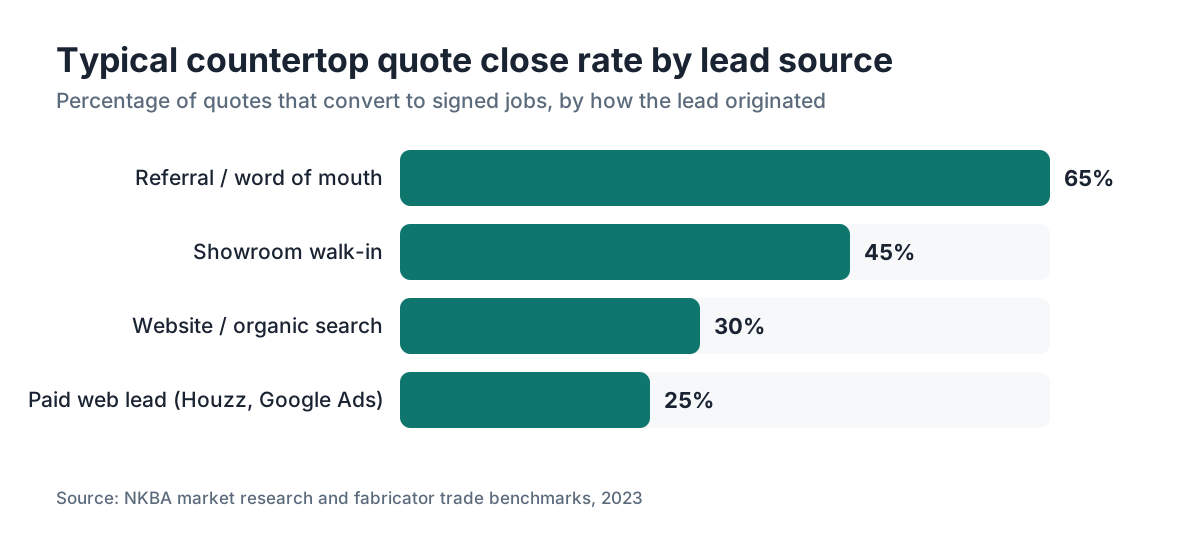
Close rate by source. Website leads, showroom walk-ins, referrals, and Houzz-type platforms close at very different rates. Most shops find referrals close at 60% to 70%, walk-ins at 40% to 50%, and paid web leads at 20% to 30%. This tells you where to put your money.
Time from inquiry to quote sent. Track it honestly. If the average is 48 hours, that's your first fix.
Time from quote sent to decision. If most deals close within 5 days or never, your window is short and you should front-load contact.
Average ticket by close and no-close. High-ticket quotes sometimes close at lower rates simply because those customers shop harder. That's normal and doesn't mean your high-end pricing is wrong.
Reason for lost quotes. Ask. A simple "we went with someone else, any feedback?" email recovers useful data. You'll hear "price" a lot, but dig and you'll find "they had our quote faster" or "I liked their showroom better" hiding underneath.
A monthly review of these numbers, even a loose one, surfaces patterns you can act on. A spreadsheet works. A CRM is better. The tool matters less than the habit of looking.
Does offering more material options help close countertop quotes?
More options help up to a point, then they hurt. Behavioral economists call it the paradox of choice: past a certain number of alternatives, decision difficulty climbs and selection rates fall [7]. For countertop quotes, the sweet spot lands around three to five material options presented clearly, not ten listed without context.
What does help is offering options across budget tiers. A homeowner asking about quartz countertops who hasn't set a budget benefits from seeing a good result at $55/sq ft, a great result at $70/sq ft, and a showstopper at $95/sq ft. Tiering the quote this way isn't upselling. It's helping them decide with real information.
For customers on the fence about a material category, comparison content closes the gap between conversations. Pointing a customer to a breakdown of granite countertops versus quartz, or explaining the difference between butcher block countertops and solid wood, does the teaching that would otherwise eat multiple showroom visits.
The goal is a customer who shows up to the second conversation already knowing what they want. Shops that invest in educational content, on the website, in follow-up emails, even printed in the showroom, close those second-conversation customers at a much higher rate.
How important is the in-person or showroom experience for closing countertop quotes?
Very, especially for jobs above $5,000. NKBA remodeling research finds that a large majority of homeowners, around 71%, visit at least one physical showroom before settling on countertops or cabinetry [10]. The share who felt the showroom shaped their choice runs even higher.
The showroom converts for one plain reason: touch. A customer who feels the heft of a 2 cm quartzite slab, sees the veining under real light, and runs a finger across a leathered finish has a sensory investment that a photo can't match. That investment tips the balance when price is close.
Use the showroom to close. Keep physical samples of your ten most popular materials at the front counter, not buried in a back room. Make it easy for customers to take sample chips home. If you have a slab yard, offer a ten-minute walk where customers pull slabs and hold them side by side. That's one of the highest-converting sales activities a fabricator can run.
For distance customers who can't visit, a ten-minute video call where you walk the slabs on camera is the next best thing. Still miles better than a static PDF.
There's also a link between showroom investment and perceived quality. A clean, organized shop with good lighting signals professionalism in a way that shifts what customers believe your work is worth. This isn't surface stuff. Customers are trying to predict whether you'll show up, do the job right, and stand behind it. The showroom is the evidence they use.
Frequently asked questions
What is the average close rate for countertop fabricators?
Most independent fabricators close 20% to 40% of the quotes they send. Top-performing shops in the 75th percentile by revenue tend to close 50% to 65%. Below 25% points to a structural problem, usually response time, quote quality, or follow-up frequency. Above 65% is a signal to check whether you're pricing too low rather than selling too well.
How quickly should I follow up after sending a countertop quote?
Same day you send it, ideally within a few hours. Harvard Business Review research found companies that contact leads within one hour are nearly seven times more likely to qualify the lead than those waiting longer. After that first contact, a set cadence of day 2, day 5, day 10, and day 20 keeps deals alive without feeling aggressive.
Should I offer discounts to close countertop quotes?
Rarely. Discounts train customers to negotiate and pull in the most price-sensitive buyers, who are often the hardest to work with. Offer a value adjustment instead: swap to a less expensive material, drop a decorative edge, or defer part of the scope. That preserves your margin and your position as a quality shop while giving the customer a real path forward.
How many follow-up attempts should I make on a countertop quote?
At least five contacts across roughly three weeks before marking a quote lost. Sales data across home-improvement categories consistently shows about half of closes happen after the fifth contact, yet most salespeople stop after one or two. A mix of phone, text, and email across those touchpoints performs better than any single channel alone.
What information should I include in a countertop quote to close more sales?
Break out material cost, fabrication, edge profiles, cutouts, and installation. Include a photo of the material, lead time, scope details (number of seams, what's included), a quote expiration date, and one clear call-to-action. Quotes that explain what the customer is paying for convert far better than single-number bids.
Does response time really affect whether I win a countertop job?
Yes, it's one of the highest-leverage variables you control. A Harvard Business Review study of over 2,000 companies found that responding within one hour produces nearly seven times the lead-qualification rate compared with waiting two or more hours. For a countertop shop, handing a quote to a customer before they leave your showroom wins a big share of jobs before any competition can respond.
How do online reviews affect a fabricator's close rate?
Reviews act as a pre-filter before customers even request a quote. The BrightLocal 2023 survey found 98% of consumers read reviews for local businesses and 46% said star rating was the most important contact factor. Shops with fewer or lower-rated reviews convert worse even at competitive prices, because skeptical customers need more convincing or never call at all.
Is it better to quote a single price or offer multiple options?
Multiple tiered options beat single-price quotes. Choice research shows that adding a higher-priced option increases selection of the mid-tier by 20% to 30%. For countertops, a good, better, and best option at three price points helps customers self-select and shifts the conversation from 'should I buy this' to 'which version do I want.'
How does quoting software help close more countertop sales?
Quoting software cuts quote production from 30 to 90 minutes down to 5 to 15 minutes for a standard kitchen, which supports same-day or in-showroom delivery. It also produces consistent, professional quotes with full line-item detail, both linked to higher close rates. Consistency matters most in shops with multiple salespeople, where manual quoting produces uneven output.
Why do countertop customers say yes at the showroom and then go silent?
Usually because they haven't made the internal decision yet. 'Showroom yes' often means 'I like this,' not 'I'm ready to spend the money.' They go home, the partner has questions, they check the budget, they get a second quote. Structured follow-up, a quote expiration date, and speaking to both decision-makers all cut down on silent disappearances after a good visit.
What close rate should I target for web leads vs. referrals?
Referrals typically close at 60% to 70% because trust is already there. Walk-in showroom customers close at 40% to 50%. Paid web leads from Google Ads, Houzz, or similar close at 20% to 30% for most shops. Tracking close rate by source shows you whether a channel is actually profitable once quoting labor and follow-up time are counted.
How do I handle a customer who says a competitor quoted lower?
Ask what the competitor's quote included. Most lower bids leave something out: backsplash, sink cutout, haul-away of old tops, or they quote thinner material. A respectful scope comparison usually neutralizes the gap. If the competitor really is cheaper for the same scope, move the conversation to warranty, experience, and workmanship instead of matching their price.
Does offering financing improve countertop close rates?
Yes, especially for jobs above $5,000. When the total is a big lump sum, plenty of customers who want the job stall at the commitment. A 12-months-same-as-cash option converts a share of those stalls into signed jobs. The NKBA reports median countertop spend of $4,000 to $8,000 for kitchen renovations, right in the range where financing moves decisions.
How should I track my countertop quote close rate?
At minimum, log every quote with date issued, source, total dollar amount, and outcome (won, lost, pending). Review monthly and calculate close rate by source. Also track time from inquiry to quote sent and time from quote sent to decision. Those three metrics together reveal whether your problem is speed, follow-up, or quote quality, each pointing to a different fix.
Sources
- Harvard Business Review, 'The Short Life of Online Sales Leads' (Oldroyd, McElheran, Elkington, 2011): Companies that contact leads within one hour are nearly seven times as likely to qualify the lead as those that wait longer; 'firms that tried to contact potential customers within an hour of receiving a query were nearly seven times as likely to qualify the lead.'
- Journal of Consumer Research, attraction effect and asymmetric dominance in consumer choice (Huber, Payne & Puto foundational work): Adding a higher-priced option increases selection of the mid-tier option by roughly 20 to 30% in product-choice studies.
- National Kitchen and Bath Association (NKBA), 2023 Kitchen and Bath Market Outlook: Homeowners spend a median of $4,000 to $8,000 on countertops in kitchen renovations.
- U.S. Small Business Administration, customer acquisition and follow-up guidance for small service businesses: Roughly 50% of closes happen after the fifth contact, yet most salespeople give up after one or two attempts; general SBA guidance on follow-up cadence and CRM use.
- Mobile Marketing Association, SMS open rate benchmarks: SMS open rates hover around 98%, versus 20 to 25% for email.
- BrightLocal, Local Consumer Review Survey 2023: 98% of consumers read online reviews for local businesses; 46% said average star rating was the most important factor in whether they contacted the business.
- American Psychological Association, choice-overload and paradox of choice research (Iyengar & Lepper, Journal of Personality and Social Psychology): Past a certain number of alternatives, decision difficulty increases and selection rates drop, the paradox of choice effect documented in consumer choice research.
- U.S. Bureau of Labor Statistics, Occupational Outlook Handbook, Construction and Extraction Occupations: Background on countertop installation as a construction trade for licensing and classification context.
- U.S. Federal Trade Commission, business guidance on advertising and customer communications: General guidance on truthful advertising and clear disclosures in customer-facing quotes and financing offers.
- NKBA, 2022 Homeowner Remodeling Survey: About 71% of homeowners who completed a kitchen remodel visited at least one physical showroom before final material decisions.
Last updated 2026-07-11