TL;DR
- A countertop seam repair service call typically costs homeowners $150, $400, though complex stone repairs or long drives push that toward $600.
- Fabricators should charge a flat trip fee ($75, $150) plus hourly labor ($85, $150/hr) plus materials.
- Pricing below your true cost to 'keep the customer happy' is the most common way shops bleed cash on service work.
What does a countertop seam repair service call actually cost?
The honest range for a residential seam repair is $150 on the very low end for a simple epoxy fill on laminate near the shop, and $400, $600 for a natural stone repair with a long drive. A few shops charge as little as $100 for warranty callbacks, which is usually a mistake (more on that below). National handyman-service data from HomeAdvisor/Angi puts the average countertop repair cost at roughly $200, $300, though that bucket includes everything from chips to full replacements, so take it as a rough anchor only [1].
The number that matters most to a fabricator is not what competitors charge. It's what the job actually costs you. Most service calls that look cheap on the invoice are quietly expensive once you add the technician's drive time, shop overhead, and the cost of the color-matched epoxy or seam filler that went into that truck six months ago and has been sitting there ever since.
What goes into the cost of a seam repair: the real line items
Break every service call into four components and price each one separately before you decide on a flat or hourly rate.
1. Trip fee (travel) This covers windshield time both ways, fuel, and vehicle wear. The IRS standard mileage rate for 2024 is $0.67 per mile [2], which gives you a defensible floor. A 20-mile round trip at that rate is $13.40 in vehicle cost alone, before the driver's wage. Most shops in metro areas charge a flat $75, $100 trip fee; rural shops often go $125, $150. Charging zero is a subsidy you're paying out of pocket.
2. Labor A seam repair at the counter typically takes 45 minutes to 2.5 hours depending on material and severity. Granite or quartz seam work (grinding, re-filling, polishing) usually runs 1.5 to 2 hours. Laminate is faster. Billing $85, $150/hr is normal for skilled stone techs in most U.S. markets; $65/hr in low-cost rural markets is about as low as you'll see without losing money [3].
3. Materials Seam filler, color pigments, razor blades, sandpaper, polishing pads, and alcohol wipes add up. A seam filler kit from a supplier like Integra runs $12, $30 retail; a full set of polishing pads is $40, $80. Budget $15, $40 in materials per average repair call. If you're doing a full seam re-do on a waterfall island, material costs can hit $60, $80.
4. Shop overhead allocation Every hour your tech is on a service call is an hour not spent on billable new fabrication. Your fully-loaded shop overhead rate, including rent, utilities, insurance, equipment depreciation, and office time, needs to be in the hourly rate you charge. The Fabricators and Manufacturers Association notes that many small shops underestimate overhead at 25 to 30% of labor cost when the real figure is closer to 40 to 60% [4].
Add those four components, then add a margin. For a service call (not a warranty callback), 20 to 35% gross margin is reasonable. That's how you get to the $150, $400 range for most jobs.
Should you charge a flat rate or hourly for seam repair?
Both work. The right answer depends on how predictable your jobs are.
Flat rate is customer-friendly and easy to quote over the phone. A typical flat-rate menu looks like: $175 for a standard seam fill (any stone, one seam, under 2 hours), $250 for a seam grind and re-polish, $350+ for a full seam re-do with color-match. The problem with flat rates is that you eat the overages. If the job takes 3 hours instead of 1.5, your margin collapses.
Hourly is more accurate but creates sticker-shock anxiety for homeowners. A transparent hourly model works best when you give an honest time estimate upfront and stick to it. If you quote 2 hours and bill 2.5, expect a call.
A hybrid works well in practice: flat trip fee plus hourly labor with a quoted range. Something like "$100 trip fee plus $95/hr; most seam repairs take 1.5 to 2 hours, so plan on $242, $290 total." That framing sets expectations, gives the homeowner a real number, and protects you if the job gets complicated.
How should fabricators handle warranty vs. out-of-warranty repairs?
This is where more money leaks than anywhere else in service work.
Most shops offer a one-year labor warranty on installations. If a seam opens in month three because the substrate moved, the ethics are clear: go fix it for free. But a lot of shops extend that generosity indefinitely because they don't want a bad review. That's a business decision, not an obligation.
For out-of-warranty repairs, charge your standard service rate. Period. The customer's granite countertop [/articles/granite-countertops] seam that failed at year four because someone put a pot of boiling water on it is not your fault, and a discounted or free repair teaches the customer nothing and teaches your tech that their time has no value.
For in-warranty repairs, you still have real costs. Track every warranty call as a line item in your job costing. If one installer generates three warranty callbacks per month and the next generates zero, that's a $500, $1,500/month labor quality problem hiding in your "goodwill" budget.
One practical rule: offer one free callback within 30 days for workmanship issues, charge a reduced trip fee (half your standard rate) for months 1 to 12, and full rate after that. Put it in writing on your installation contract.
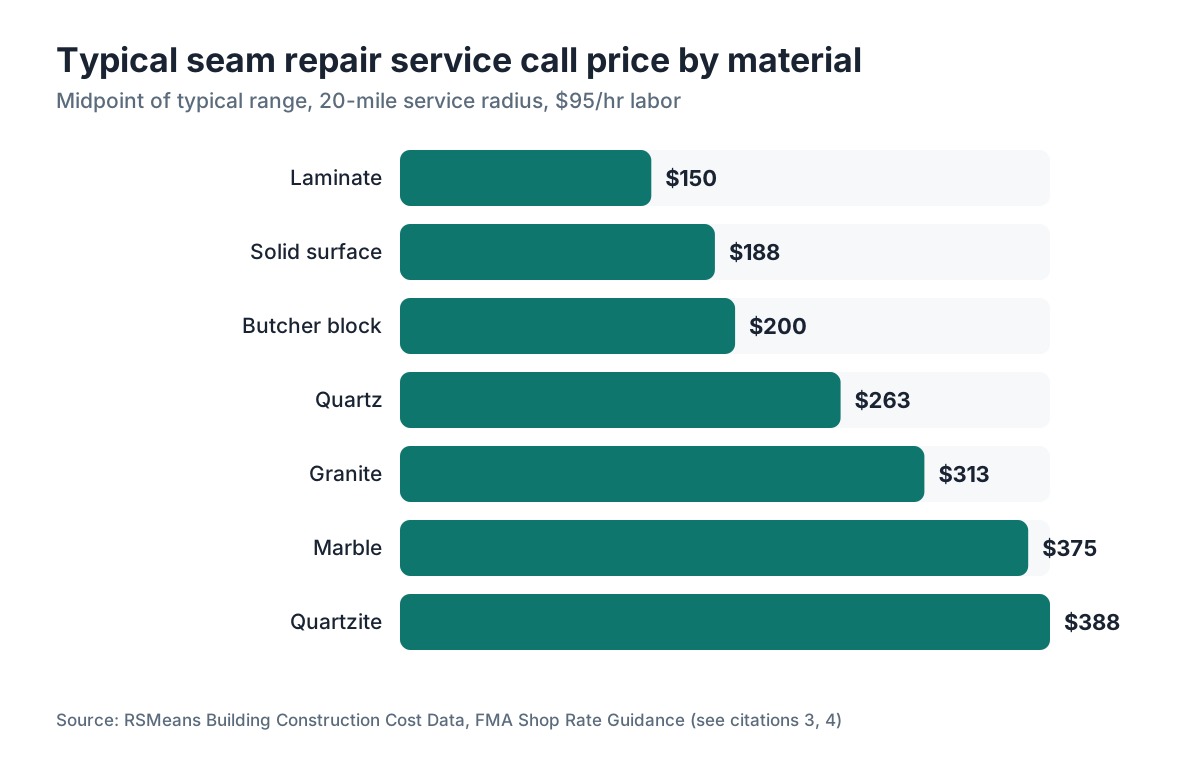
What are typical seam repair prices by material?
Material type affects difficulty, time, and consumable cost more than most fabricators quote for.
| Material | Typical repair time | Materials cost | Suggested service call price |
|---|---|---|---|
| Laminate (Formica, Wilsonart) | 30 to 60 min | $8, $15 | $125, $175 |
| Solid surface (Corian, etc.) | 45 to 90 min | $15, $25 | $150, $225 |
| Quartz (engineered) | 1 to 2 hrs | $20, $40 | $200, $325 |
| Granite / natural stone | 1.5 to 2.5 hrs | $20, $45 | $225, $400 |
| Marble | 1.5 to 3 hrs | $25, $60 | $275, $475 |
| Quartzite | 2 to 3 hrs | $25, $60 | $275, $500 |
| Butcher block / wood | 45 to 90 min | $10, $25 | $150, $250 |
Prices in the table assume a 20-mile service radius and $95/hr labor. Adjust upward for metro labor markets. Marble and quartzite take longer because color-matching the filler to veining is genuinely hard. A botched color match on a white Calacatta marble island is a disaster, so techs slow down. [/articles/marble-countertops]
Laminate seam repair is often not worth the homeowner's money if the laminate is old. A full laminate replacement (see laminate countertops) is usually $200, $600 for a small kitchen and solves the problem permanently.
Solid surface like Corian is one of the easier repairs because the material can be sanded and buffed back to a true surface [/articles/corian-countertops]. Some fabricators use that as a selling point when quoting: "if this seam ever needs work, it's one of the most repairable materials out there."
How do you calculate your true cost per service call?
Here's a simple worksheet fabricators can run through for any service call.
-
Technician loaded hourly cost: Take your tech's hourly wage, multiply by 1.25 to 1.35 to cover payroll taxes and benefits. A $25/hr tech costs you roughly $32, $34/hr fully loaded [5].
-
Drive time: Estimate round-trip drive time and multiply by the loaded hourly rate. A 45-minute round trip at $33/hr = $25 in labor cost for the drive alone.
-
Mileage: Multiply round-trip miles by $0.67 (IRS 2024 rate) for vehicle cost [2].
-
On-site time: Estimated repair time multiplied by the loaded hourly rate.
-
Materials: Actual or estimated cost of filler, pads, consumables.
-
Overhead allocation: Multiply total labor (steps 1+3) by your overhead rate. If you don't know your overhead rate, a rough industry estimate is 40% of labor cost [4].
-
Add up steps 2 to 6 for your true cost. That's your floor. Price above it.
Example: A tech paid $25/hr does a 30-min drive (each way), a 1.5-hour repair, using $25 in materials. Loaded labor rate = $33/hr. Drive time labor = $33. Mileage (20 miles) = $13.40. Repair labor = $49.50. Materials = $25. Overhead (40% of $82.50 labor) = $33. True cost = $153.90. Price at a 25% margin = $205. That's your minimum quote for that job.
What should a service call invoice include?
A clean invoice protects you legally and reduces disputes. Include these items:
- Date, technician name, and address serviced
- Scope of work in plain language ("Filled and color-matched open seam between island sections 2 and 3, approximately 18 inches, polished to match surrounding surface")
- Time in and time out
- Materials used and individual costs
- Trip fee listed as a separate line item
- Any exclusions ("Seam fill does not address underlying substrate movement; homeowner advised to monitor")
- Warranty statement for the repair itself ("Workmanship warranted 90 days from date of service")
That exclusion language is not boilerplate. A seam that fails because the cabinet box twisted is a structural problem, not a fabrication flaw. If you don't document that distinction, you may end up owning the next repair too.
For shops managing multiple service calls a week, software that tracks job time and materials per visit pays for itself fast. SlabWise, for example, handles quoting and job tracking for fabrication shops and can help you see at a glance which service calls are profitable and which are eating your margin.
How should homeowners evaluate a seam repair quote?
If you're a homeowner getting quotes, here's what to watch for.
A quote under $100 for a stone seam repair is almost always either a loss-leader from a shop hunting a replacement job, or a tech who will rush through it in 20 minutes and leave you with a visible color mismatch. Either way, you probably won't be happy.
Ask the contractor to tell you specifically what filler product they use and whether they do color-matching on-site or pre-mix in the shop. On-site color matching takes time and skill. Pre-mixed is fine for standard colors but fails on heavily veined marble or exotic granite.
Get a written scope of work before they start. "Seam repair" can mean a quick wipe of filler that lasts six months, or it can mean a proper grind, fill, and polish that lasts years. You want the second one. Ask how long the repair itself should take. If a tech tells you a granite seam repair is 20 minutes, that's a red flag.
For kitchen countertops in high-traffic kitchens, ask whether the existing seam location can be shifted if you ever replace the top. Some layouts have inherently bad seam placement near the sink or range, and no amount of re-filling will make that spot bulletproof long-term.
When does a seam repair cost more than a countertop replacement?
This is a real question and the honest answer is: more often than homeowners expect.
If a seam has failed repeatedly (third or fourth repair), the underlying issue is usually substrate movement, an improperly supported joint, or an installation that was just done wrong. Paying $300 for a fourth repair on a $1,200 laminate counter is poor math.
For natural stone, replacement costs are higher, so repair is usually worth it through two or three attempts. A slab of mid-range granite runs $50, $100 per square foot installed [3]; a small kitchen at 30 square feet is $1,500, $3,000. So a $250, $400 repair makes sense two or three times before you hit half the replacement cost.
For Cambria countertops and other premium engineered stone, Cambria's own warranty covers manufacturing defects but not installation failures, and replacement slabs are expensive. Repair makes strong economic sense unless the damage is structural.
For laminate and lower-cost materials, the math flips faster. See the formica countertops guide for a breakdown of when replacement beats repair on budget surfaces.
One concrete threshold: if the repair quote is over 40% of the installed replacement cost, get a replacement quote before committing.
What common mistakes do fabricators make when pricing service calls?
These are the patterns that actually hurt shops.
Undercharging for warranty callbacks. Every warranty callback has a real cost. Even if you charge zero to the customer, track the internal cost and audit it quarterly. If your service call cost exceeds 2 to 3% of your annual installation revenue, you have a quality or substrate problem that's worth fixing at the source.
No trip fee. A shop that absorbs travel cost is subsidizing customers within a 5-mile radius and refusing to take jobs 25 miles out because "they're not worth it." A stated trip fee fixes both problems.
Hourly rate that ignores overhead. The most common version: a shop owner pays a tech $22/hr and charges the customer $45/hr, thinking that's a 100% markup. But after payroll taxes, benefits, truck cost, insurance, and shop overhead, the real cost is closer to $42, $46/hr. The margin is nearly zero.
No written scope. Verbal agreements on service calls turn into "you didn't fix everything" disputes. One-page service authorization forms cost nothing to produce and settle arguments before they start.
Discounting to avoid a bad review. This is a real trap. Chronic discounters train customers to complain because complaining works. Holding your pricing while delivering excellent work is better for your reputation long-term than caving every time someone grumbles.
For fabricators building out their quoting and job-costing workflows, tracking service call profitability separately from installation profitability is one of the fastest ways to find money hiding in your business. A tool like SlabWise lets you attach time and material records to individual jobs, so the service call history is right next to the original fabrication record.
Are there any regulations or licensing requirements that affect seam repair pricing?
Seam repair specifically has no federal licensing requirement. The relevant regulatory layer is at the state and sometimes local level, and it mainly covers contractor licensing rather than the repair act itself.
In most U.S. states, any home improvement work above a dollar threshold, often $500, $1,000 depending on the state, requires a licensed contractor [6]. California, for instance, requires a C-54 (tile) or C-61/D-12 (prefabricated millwork, which covers countertops) license for work over $500 [7]. Texas has no statewide contractor licensing for this category but several cities require a certificate of registration [8].
The practical implication for pricing: if you're operating legally with proper licensing, insurance, and workers' comp, your cost structure is legitimately higher than an unlicensed handyman doing the same job for $80 cash. You don't need to apologize for that; you need to explain it clearly on your website and invoices.
Business insurance for a stone fabrication or service company typically runs $1,500, $4,000/year for a small shop, which translates to roughly $0.75, $2.00 per billable hour if you work 2,000 hours annually [9]. That's real overhead, and it belongs in your rate. Cutting stone also triggers OSHA's crystalline silica rule, in effect since June 2018, which requires exposure controls that add to a compliant shop's operating cost [10].
How do you quote a seam repair over the phone without seeing the job?
Phone quotes are unavoidable. Here's how to do them without underselling.
Ask four questions before you give any number:
- What material is the counter (granite, quartz, laminate, etc.)?
- How long is the open seam, roughly?
- Is the seam just open/separating, or is it chipped, stained, or cracked through?
- Where is the counter (kitchen, bath, outdoor)?
From those answers you can give a range with a clear caveat: "Based on what you're describing, most jobs like that run $200, $325. The exact number depends on the color match complexity and how much surface prep the area needs. We can confirm the exact price when we see it, and we'll call you before doing any work that takes it above that range."
That framing gives the customer a real number, sets a ceiling expectation, and protects you from scope creep. "We'll call you before going above the range" is the single most trust-building thing you can say on a service call quote.
For countertop installation quotes where seam placement is part of the original job, note the seam locations on the drawing and talk through repair access with the homeowner upfront. Seams near undermount sinks are harder to reach for future repairs, and flagging that early saves an argument years later.
Frequently asked questions
What is the average cost of a countertop seam repair?
Most homeowners pay $150, $400 for a professional seam repair. Simple laminate fills on the low end, granite or marble repairs with color-matching and polishing on the high end. Complex jobs, long travel distances, or premium stone like quartzite can push prices to $500, $600. The national average for all countertop repairs (including chips and cracks) is roughly $200, $300 according to aggregated service data from Angi.
How much should a fabricator charge for a warranty callback?
Even on warranty callbacks, charge an internal cost. For customer-facing pricing, a reasonable policy is one free callback within 30 days, a reduced trip fee (half-rate) for months 1 to 12, and full rate after that. Document every callback's real cost and audit quarterly. If warranty service exceeds 2 to 3% of your annual installation revenue, trace it to an installer or a substrate problem and fix the root cause.
Should I charge a trip fee for countertop service calls?
Yes. A trip fee of $75, $150 is standard and justified. The IRS standard mileage rate for 2024 is $0.67/mile, so a 20-mile round trip alone costs $13.40 in vehicle expense before driver wages. Shops that absorb travel cost subsidize nearby customers and lose money on distant jobs. A transparent trip fee makes pricing fair and predictable for everyone.
How long does a countertop seam repair take?
Laminate seam fills take 30 to 60 minutes. Quartz repairs with color matching run 1 to 2 hours. Granite and natural stone repairs typically take 1.5 to 2.5 hours. Marble and quartzite take the longest, often 2 to 3 hours, because matching filler to complex veining requires careful work. Rushing a color match on expensive stone is the most common cause of visible, unsatisfying repairs.
Can I repair a countertop seam myself?
Simple laminate seams can be re-glued with contact cement by a handy homeowner. Natural stone is harder. Color-matching epoxy filler to granite or marble veining requires practice and specialized pigments; a bad match on an expensive stone is often more visible than the original gap. For anything over $500 in replacement value, a professional repair is usually worth the cost.
What is the difference between a seam fill and a seam re-do?
A seam fill means cleaning the gap and injecting color-matched epoxy or filler, then leveling and polishing. It works on seams that have separated slightly but are otherwise in good shape. A seam re-do means grinding down the area around the seam, re-aligning the slabs if possible, applying new filler, then re-polishing the whole zone. Re-dos cost $50, $150 more and take longer but are necessary when a seam has shifted vertically.
How do I price a seam repair for quartz vs. granite?
Quartz seam repair runs $200, $325 for a standard job. Granite runs $225, $400. The gap exists because granite varies more in color and pattern, making pigment matching harder. Quartz has a more uniform pattern that's easier to blend. Both materials require diamond polishing pads to restore the surface, so material cost is similar; the extra charge for granite is really a skill premium.
Should seam repair be priced flat rate or hourly?
A hybrid works best: flat trip fee plus hourly labor with an upfront time estimate. Pure flat rates protect the customer but expose the shop to overruns on difficult jobs. Pure hourly is accurate but creates anxiety without an estimate. Quoting 'trip fee of $100 plus $95/hr, expect 1.5 to 2 hours' gives homeowners a real number and protects the shop if the job takes longer than expected.
At what point does repairing a seam cost more than replacing the countertop?
A practical threshold is 40% of installed replacement cost. If a new countertop in that material would cost $800 installed and you've had three repairs at $250, $300 each, you're at the break-even point and should replace. For high-end stone where replacement is $3,000, $5,000, repair makes sense through multiple attempts. Budget materials like laminate reach the replacement threshold much faster.
Do I need a contractor's license to do countertop seam repair?
It depends on your state and the job value. Most states require a licensed contractor for home improvement work above $500, $1,000. California requires a C-54 or C-61 license for countertop work over $500. Texas has no statewide license but some cities require registration. Check your state's contractor licensing board. Operating unlicensed above the threshold exposes you to fines and voids any warranty you give.
How do fabricators track whether service calls are profitable?
Track trip time, drive mileage, on-site labor time, and materials per call in your job management software. Compare actual time against your quoted time each month. If service calls average below your fully-loaded cost including overhead, either raise rates or tighten quoting. Many shops discover that 20 to 30% of service calls lose money because labor overruns and travel cost were never built into the original price.
What materials and tools are needed for a seam repair service call?
A standard service call kit includes: color-matched epoxy or polyester filler, pigment set for on-site blending, razor blades and card scrapers, 220 to 3000 grit wet/dry sandpaper, a set of diamond polishing pads, stone polish or honing compound, isopropyl alcohol for surface prep, and blue tape for protecting adjacent areas. Total consumable cost per average call is $15, $40. Keep a stocked kit in the service vehicle to avoid wasted trips.
How do you write a service call invoice for a countertop repair?
Include: date and address, technician name, specific scope in plain language (location of seam, approximate length, materials used), time in and out, trip fee as a separate line, materials itemized, any exclusions noting causes outside your workmanship, and a 90-day warranty on the repair work itself. Explicit exclusion language protecting you from substrate-movement callbacks is worth the two lines of text it takes.
Sources
- Angi (formerly HomeAdvisor), Countertop Repair Cost Guide: Average countertop repair costs nationally range from roughly $200, $300, covering chips, cracks, and seam repairs across all material types.
- IRS, Revenue Procedure 2023-34, Standard Mileage Rates for 2024: The IRS standard mileage rate for business vehicle use in 2024 is $0.67 per mile.
- RSMeans Building Construction Cost Data, stone countertop installation unit costs: Mid-range granite countertop installation costs $50, $100 per square foot; skilled stone fabrication labor in most U.S. markets bills at $65, $150/hr.
- Fabricators and Manufacturers Association, Shop Rate and Overhead Guidance: Many small fabrication shops underestimate overhead at 25 to 30% of labor cost; the real figure for most shops is closer to 40 to 60% of direct labor.
- U.S. Bureau of Labor Statistics, Employer Costs for Employee Compensation: Total employer cost for a worker, including wages plus benefits and payroll taxes, averages roughly 1.25 to 1.35x the base wage rate for production and construction occupations.
- National Conference of State Legislatures, Contractor Licensing Overview: Most U.S. states require a licensed contractor for home improvement work above a dollar threshold, commonly $500, $1,000, though thresholds vary by state.
- California Contractors State License Board, License Classifications: California requires a licensed contractor (C-54 tile or C-61/D-12 prefabricated millwork classification, which covers countertops) for construction work valued at $500 or more.
- Texas Department of Licensing and Regulation, Residential Contractor Requirements: Texas has no statewide contractor licensing requirement for countertop installation and repair, though several municipalities require local registration.
- National Association of Home Builders, Builder Insurance Cost Benchmarks: General liability and workers' compensation insurance for a small stone fabrication or home improvement shop typically runs $1,500, $4,000 per year.
- Occupational Safety and Health Administration, Crystalline Silica Rule: OSHA's crystalline silica rule (effective June 2018) requires silica exposure controls for stone fabrication work, affecting shop operating costs and compliance overhead.
Last updated 2026-07-10