TL;DR
- A multi-finish stone countertop quote needs four things: a square-footage count with a waste factor, a per-finish material price, an upcharge for each specialty finish (honed, leathered, or fluted surfaces usually add $10 to $30 per square foot over polished), and separate lines for edge profiles, cutouts, and installation.
- Miss one and the quote is wrong.
Why is quoting a multi-finish countertop harder than a standard job?
A single-finish job has one slab price, one fabrication rate, one edge. A multi-finish job splits all three into separate cost buckets, and the relationships between them are not proportional. That is the whole problem in one sentence.
Say a homeowner wants polished Calacatta marble on the perimeter and a honed island top from the same block. The material cost is basically identical. The fabrication cost is not. Honing takes extra passes on a different set of heads, and switching between polished and honed on one job adds setup time. That time is usually invisible in a flat-rate quote, which is exactly how it turns into lost margin.
There is also a layout problem. Polished and honed cuts of the same slab can read like two different stones under the same kitchen lighting, so the fabricator and homeowner have to lock in which sections get which finish before the template is drawn. Getting that conversation wrong after the stone is cut costs real money.
Sealing changes by finish too. Honed and leathered stone is more porous at the surface, so the sealer spec shifts. Some fabricators absorb that cost and some pass it through. Either way it needs a line item. A quote that skips it is missing a real cost.
What information do you need before you can write a number?
You need six things. Without all six, any number you put on paper is a guess.
-
Confirmed dimensions, not estimates. The biggest source of quote error in stone work is rough measurements standing in for a real template. For pricing, measure to the nearest quarter inch and run those numbers. For the cut ticket, you need a digital or physical template. The quote and the template do not have to happen the same day, but the quote should say plainly that it is based on field measurements and gets confirmed at template.
-
Which surfaces get which finish. Get it in writing. A sketch works. A marked-up photo of the kitchen plan works. An email works. Anything that creates a record.
-
The specific stone and slab. "White marble" is not a spec. Statuario Venato from a named quarry, bought through a named distributor, in a stated thickness (2 cm or 3 cm), is a spec. Prices for nominally similar stones vary by 40% or more at the distributor level [1].
-
Edge profiles for each section. A mitered waterfall edge on the island costs more than an eased edge on the perimeter. Different edges mean different line items.
-
Cutout count and type. Sink, cooktop, and outlet cutouts each carry different labor. An undermount sink cutout in a honed surface needs more careful finishing than in a polished one, because the raw inside edge shows.
-
Installation scope. Is the fabricator setting the tops, or a GC? Does the job include tearing out old counters? What is the delivery distance? These move the total a lot and get left out of early quotes constantly.
How do you calculate square footage for a multi-finish job?
Start with the raw square footage of each surface and keep them separate by finish from the first line. Do not lump everything into one number and try to split it later. You will lose track of which finish drives which cost.
For each section, multiply length by depth in inches, then divide by 144 for square feet. A standard 25.5-inch-deep perimeter counter running 120 inches is (120 x 25.5) / 144 = 21.25 square feet.
Now apply a waste factor to each section on its own. Waste factor covers the material that gets cut away and can't be reused. The right number depends on layout complexity, the stone pattern, and whether you have to match veining across sections. A straight run of solid-color granite might need only 15%. A book-matched marble island with a waterfall edge might need 35% or more [2].
The core formula:
Billable square footage = (raw SF x waste factor) + edge linear feet converted to SF equivalent
Edge profiles get priced per linear foot, not per square foot, so keep them separate. But when you buy slab material, remember edge fabrication eats material off the slab face, especially on thick mitered edges. A 3 cm mitered waterfall edge basically doubles the material needed for the island edge faces.
| Surface | Raw SF | Waste Factor | Billable SF |
|---|---|---|---|
| Perimeter polished | 48.0 | 1.15 | 55.2 |
| Island honed | 22.0 | 1.20 | 26.4 |
| Waterfall sides (leathered) | 8.0 | 1.35 | 10.8 |
| Total | 78.0 | 92.4 |
That 92.4 square feet is your material order number. Your customer invoice is based on the raw 78.0 square feet, or on the billable SF, depending on your shop's model. Both approaches exist. Just be consistent and say which one you use.
What does each finish actually cost, and how much do upcharges vary?
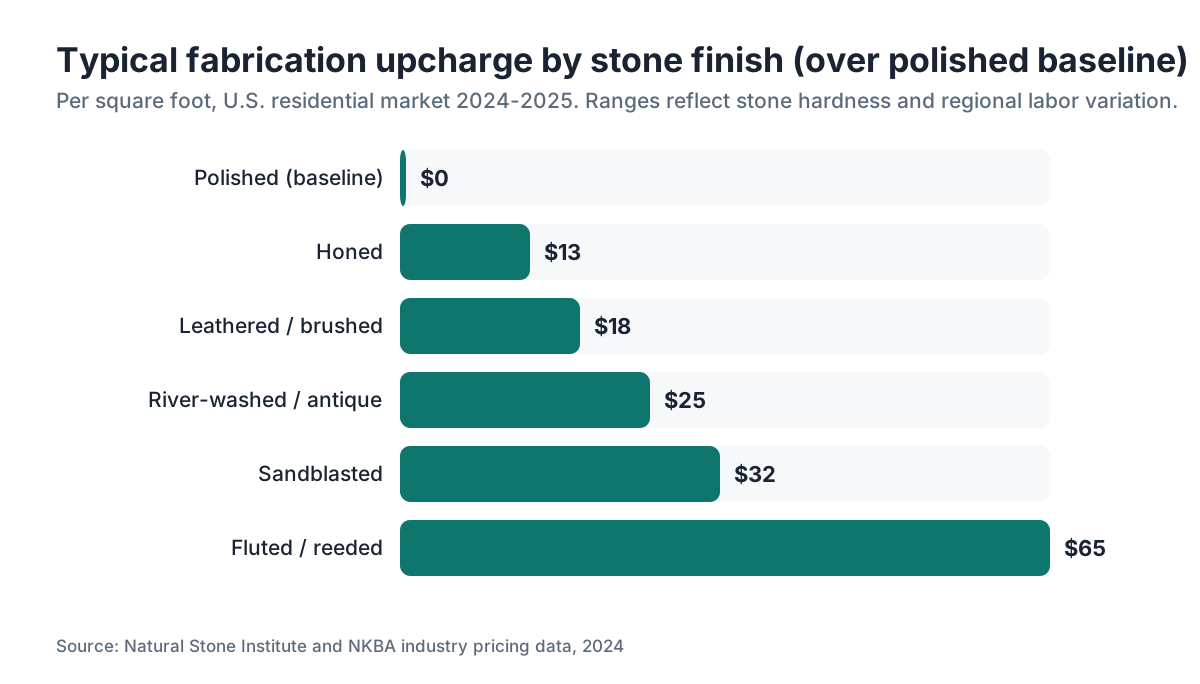
Polished is the baseline. Every other finish is an upcharge from there, because polished is what the machine does by default when a slab runs through the line. Anything else means stopping the process early (honed), adding a different abrasive sequence (leathered or brushed), or running a specialized tool (fluted, sandblasted, or river-washed).
Pricing is not standardized and shops set their own rates. The ranges below reflect common market pricing across 2024 and 2025 from distributor and fabricator rate cards [3]:
| Finish Type | Typical Upcharge Over Polished |
|---|---|
| Honed | $8-$18 per SF |
| Leathered / brushed | $12-$25 per SF |
| Fluted / reeded | $40-$90 per SF (hand-work) |
| Sandblasted | $20-$45 per SF |
| River-washed / antique | $15-$35 per SF |
The ranges are wide because the cost rides on the stone. Leathering a soft quartzite chews through tooling faster than leathering a harder granite, so the upcharge is higher. Honing a dense black granite takes more passes than honing a softer marble.
For a project like marble countertops where you mix polished and honed on the same material, a working number is $10 to $15 per square foot for the honed upcharge in most markets, assuming a commercial CNC shop. A custom hand-finish shop can run two to three times that.
Don't forget sealer. Honed and leathered surfaces usually need a penetrating impregnator rated for higher porosity. A good penetrating sealer on a mid-size island runs $30 to $80 in materials, plus 30 to 45 minutes of labor [7]. That is a real line item.
How do edge profiles get priced on a multi-finish job?
Edge profiles get priced per linear foot, and the price tracks profile complexity, not the surface finish of the top. But finish does affect how an edge reads and what it costs to execute well.
An eased edge (a simple 1/8-inch break on the top corner) is basically free. Most shops fold it into the base fabrication rate. An ogee or cove duplet on a polished surface runs $15 to $35 per linear foot depending on the market. A mitered edge for a waterfall island prices differently because it takes precise 45-degree cuts and usually gluing pieces together, so it is often quoted flat per waterfall panel rather than per linear foot, typically $200 to $600 per side depending on stone thickness and complexity [4].
When a job carries multiple edge profiles across sections, list each one separately:
- Perimeter eased edge: 32 linear feet at $0 (included in base rate)
- Island bullnose: 14 linear feet at $22 = $308
- Waterfall sides, mitered: 2 panels at $380 = $760
That structure keeps the quote readable and makes it easy to swap a profile if the customer flinches at the price.
For granite countertops, edge profiles on harder stone cost more to fabricate because tooling wears faster. Some shops bake that into the base rate for granite versus marble. Others run a material-specific upcharge. Ask your CNC supplier what their tooling cost per linear foot is for the specific stone, and sanity-check your edge pricing against it.
How do cutouts and sink types affect the quote?
Cutouts are the most under-priced line item in most stone quotes. They look trivial on paper. They take real time, especially in hard stone, and the finish on the inside edge matters the moment the cutout is visible.
Typical cutout pricing across 2024 and 2025 [4]:
| Cutout Type | Typical Range |
|---|---|
| Undermount sink (rectangular) | $150-$300 |
| Undermount sink (farm/apron) | $250-$450 |
| Drop-in sink | $100-$200 |
| Cooktop (rectangle) | $150-$250 |
| Outlet / USB box | $50-$125 each |
| Faucet hole | $40-$80 each |
On a honed or leathered surface, the inside edge of an undermount sink cutout has to match the top finish. On a polished surface you can often leave the cutout edge semi-polished without anyone noticing. On a honed surface, a polished cutout edge jumps out and looks wrong. Budget an extra 15 to 20 minutes of hand work per sink cutout on non-polished surfaces.
Farm sinks on any material need an apron cutout at the base cabinet, and that is a separate scope item, often done by the installer instead of the fabricator. Say who owns it in the quote so nobody argues about it on site.
How do you structure the actual quote document?
A well-built multi-finish quote has six sections. Skip any of them and you create ambiguity that costs money or a relationship.
1. Project scope header. List the stone name, source and distributor, thickness, and which sections get which finish. This is the most important page, because it defines what you are quoting. If this is wrong, everything below it is wrong.
2. Material line items. One line per surface finish, showing raw SF, waste factor, billable SF, and price per SF. Keep polished, honed, and leathered as separate rows even when they come from the same slab.
3. Fabrication line items. Base fabrication rate, finish upcharges by surface, edge profiles by section, and cutouts. Each one gets its own line.
4. Installation. Delivery fee, install labor, and any demo or removal scope. If a third party installs, say so and state that it is not included.
5. Sealer and aftercare. List the sealer spec and cost. Some shops include one application in the base rate. Some charge separately. Either is fine, but make it explicit.
6. Exclusions and assumptions. This is the part most fabricators skip, and it is where disputes are born. List what is NOT included: plywood substrate, cabinet leveling, plumbing disconnection, backsplash tile removal, anything else the customer might assume is covered.
Shops running quoting software like SlabWise can automate steps 2 and 3 by pulling live slab costs and applying finish multipliers, which cuts the manual math errors that creep into multi-finish jobs.
Send the quote as a PDF. Line-item detail builds trust and kills the back-and-forth that starts the moment a customer sees a lump sum and asks what is inside it.
What waste factors and slab yields should you use?
Waste factor is the most consequential variable in a stone quote and the one with the least standardized guidance. In practice, the numbers run from 10% to 40% depending on job type, and both ends are defensible under the right conditions [2].
A practical framework:
- Simple rectangular layouts, solid or consistent-pattern stone: 15-18%. Strip-efficient, minimal offcuts.
- L-shaped or U-shaped kitchens, moderate veining: 20-25%. The corners and angles waste material.
- Book-matched slabs, strong directional veining: 30-35%. Aligning the pattern means sacrificing yield.
- Waterfall islands with matched grain continuation: 35-45%. The waterfall sides have to match the top grain, which usually means cutting from a specific part of the slab.
- Exotic or heavily figured slabs where every placement matters: up to 50%.
For a multi-finish job, calculate waste separately for each finish section, because they often come from different slabs and carry different pattern-matching demands.
One rule worth memorizing: if you buy slab material by the square foot, round up to the next full slab. Slabs don't sell in fractions. If your billable SF says you need 47 SF from a slab that comes in 55 SF pieces, you are buying the 55 SF piece and paying for all of it.
Some distributors offer remnant pricing for smaller cuts, which changes the math when one finish section is small. Ask. The discount on a remnant for the honed island top can run 20% to 40% off full-slab pricing [1].
How do material prices vary by stone type and finish combination?
Stone material prices sort into three tiers at the distributor level, and those tiers interact with finish upcharges in ways that move the total a lot.
Approximate distributor pricing (per square foot, slab cost only, no fabrication) for common stones across 2024 and 2025 [1][6]:
| Stone | Entry Tier | Mid Tier | Premium Tier |
|---|---|---|---|
| Granite | $8-$15 | $18-$35 | $40-$80+ |
| Marble | $15-$30 | $35-$65 | $80-$200+ |
| Quartzite | $18-$40 | $45-$90 | $100-$200+ |
| Soapstone | $20-$45 | $50-$80 | $90-$150 |
| Engineered quartz | $20-$35 | $38-$65 | $70-$120 |
Those are slab costs. Add fabrication ($30 to $80 per SF depending on complexity and market), finish upcharges, edges, cutouts, and installation to reach the homeowner price.
For kitchen countertops with a mixed-finish spec, a mid-tier marble kitchen (polished perimeter plus honed island) runs roughly $120 to $200 per square foot installed in most U.S. markets as of 2025, based on aggregated contractor estimates [8]. That number swings hard by region, with coastal markets running 20% to 40% above midwest pricing [5].
Engineered quartz deserves a warning here. Most engineered quartz products like Cambria countertops ship in a fixed set of factory finishes (polished, matte, or a proprietary texture). You can't create a custom honed or leathered finish on engineered quartz in the field the way you can on natural stone [9]. If a homeowner wants mixed finishes, they usually have to mix materials or pick from the manufacturer's catalog.
How do you handle seams on a multi-finish job?
Seams on a single-finish job are hard enough. On a multi-finish job, a seam has to answer for two things at once: the structural joint and the visual transition between finishes.
If the finish transition lands at a logical break point (the edge of a cabinet run, a corner, the edge of an island), the seam can pull double duty as the finish transition. That is the cleanest solution and should be designed into the layout whenever you can.
If the transition falls mid-slab, you have a different problem. A polished-to-honed transition mid-surface looks deliberate when it is well executed and looks like a mistake when it is not. The line has to be clean, which means either a CNC-routed groove or a taped-off manual sand line. Budget labor for it: 45 to 90 minutes of skilled finishing time per linear foot of mid-slab transition [4].
Seam placement belongs on the quote as a note or sketch, more than a line item. Homeowners rarely picture what a seam means until they see it, and seam location is one of the most common sources of job-site friction in stone work. Show the seam plan during the quote presentation, not after.
For countertop installation, the seam adhesive color has to be matched separately for each finish. A color-matched epoxy that looks perfect on polished white marble reads wrong on a honed version of the same stone, because the surface reflects differently. Keep a chip set of cured epoxy samples in different finishes for customer approval.
What are the most common quoting mistakes on multi-finish jobs?
Most quote errors fall into one of five buckets.
Flat per-square-foot pricing across finishes. A shop that quotes $85 per SF installed for everything can't price a mixed-finish job right. Leathered quartzite and polished granite do not cost the same to fabricate. Finish-specific line items are not optional here.
Forgetting that different finishes may need different slabs. You can't hone half a polished slab after fabrication. Well, you can, but it takes real rework. On a multi-finish job, the honed and polished sections often need to come from separate slabs, or at least get cut before the polishing line. If your shop isn't set up for that workflow, the timeline stretches and costs climb.
Underestimating waste on matched-grain waterfall edges. The math on a waterfall island with continuous grain looks fine until you realize you need three pieces from one slab, all matching at the mitered edges. That guts your usable yield.
No exclusions section. A quote without an exclusions list is an open contract. Customers assume cabinet leveling, plumbing disconnection, and old countertop removal are included. They almost never are.
Quoting from memory instead of a template. Multi-finish jobs carry too many variables to price reliably in your head. Use a worksheet or quoting software every time. SlabWise is built for exactly this kind of multi-variable quote, with finish multipliers and edge profile pricing in the calculator. Try the demo if you are still running these by hand.
For shops that also handle how to clean stone countertops or sell aftercare packages, bundling a sealer maintenance plan into the quote adds value at almost no cost, and it creates a customer touchpoint six to twelve months after install.
How should homeowners read and compare multi-finish quotes?
If you are a homeowner collecting quotes for a mixed-finish stone job, the line-item detail tells you more than the total ever will.
A quote with separate lines for material by finish, finish upcharges, edge profiles, cutouts, and installation comes from a shop that thought the job through. A quote that is one number or a couple of lump sums comes from a shop that didn't, and that gap tends to reappear as a change order later.
Here is what to check.
Is the stone spec specific? If the quote says "quartzite" with no slab name or distributor, ask for the spec. Quartzite ranges from $18 to $200+ per square foot at the distributor level [1]. "Quartzite" is not a price.
Are both finishes quoted separately? If you want polished perimeter and honed island, the two surfaces should show up as separate lines with separate square footages.
Is installation included? Some fabricators include it. Some quote fabrication only. Comparing a fabrication-only quote against an installed quote makes the cheaper one look better than it is.
What are the payment terms? Most stone fabricators take a 50% deposit at signing, with the balance due at delivery or installation. That is standard.
Is the waste factor disclosed? You don't have to follow the details, but a fabricator who can explain why they are billing X square feet when your kitchen measures Y is a fabricator who knows the math. That matters more than the logo on the truck.
For homeowners still weighing materials, it helps to see how different stones behave with different finishes before committing. How to clean quartzite countertops and how to clean soapstone countertops give a practical sense of how finish type changes daily maintenance, which should steer which finish you pick for high-use areas.
Frequently asked questions
Can you mix polished and honed finishes on the same stone slab?
Technically yes, but it is uncommon and adds fabrication complexity. Polishing and honing usually run as separate machine passes, so mixing finishes on one slab means pulling it off the line early for part of the surface. Most shops cut the honed and polished sections from different slabs unless a grain-match requirement forces them from the same block. Expect a premium of $15 to $40 per linear foot of transition edge for the extra setup and finishing.
How much does a leathered finish add to the total installed cost?
A leathered finish typically adds $12 to $25 per square foot over polished in fabrication cost, depending on stone hardness and your market. On a 22-square-foot island, that is $264 to $550 in added fabrication. The sealer changes too: leathered surfaces usually need a penetrating impregnator rated for higher porosity, adding $30 to $80 in materials plus application labor.
What is a reasonable waste factor for a marble kitchen with an island?
A marble kitchen with moderate veining and a separate island typically runs a 20% to 25% waste factor on the perimeter and 25% to 35% on the island if any grain matching is required. If the island has a waterfall edge with continuous grain, push the island section to 35% to 45%. Calculate each surface separately instead of applying one blanket percentage to the whole job.
Do engineered quartz countertops come in multiple finishes?
Yes, but the manufacturer controls the options, not the fabricator. Brands like Cambria offer polished, matte, and proprietary textured finishes, and you pick from their catalog. You can't custom-hone or leather an engineered quartz surface the way you can natural stone. If you want a specific mixed-finish look, you are limited to what the manufacturer offers, or you mix materials, like a natural stone island with an engineered perimeter.
How do fabricators price a mitered waterfall edge?
Most fabricators price waterfall edges flat per panel rather than per linear foot. Common pricing across 2024 and 2025 runs $200 to $600 per waterfall side depending on stone hardness, panel height, and whether grain matching is required. A full waterfall island with two sides is $400 to $1,200 for edge work alone, before material, top fabrication, or installation. Always confirm whether that rate includes the side-panel material or just labor.
What is typically not included in a stone countertop quote?
Standard exclusions include old countertop removal, cabinet leveling or shimming, plumbing disconnection and reconnection, appliance moving, backsplash tile work, and any substrate or plywood work. Some fabricators also exclude the sealer application. Read the exclusions section closely before comparing quotes. A lower number that leaves out installation and demo is often more expensive in total than a higher all-in quote.
How long does it take to get a custom multi-finish stone countertop installed?
From signed quote to installation, expect 2 to 4 weeks for a standard job with in-stock material. Multi-finish jobs with special-order stone or custom finishes like fluting or sandblasting can run 4 to 8 weeks. Template to fabrication is usually 5 to 10 business days at a CNC shop. Scheduling install adds time depending on backlog. Rush fees for compressed timelines exist but are not standardized, so ask.
Should the quote price be per raw square foot or per billable square foot?
Either works as long as it is consistent and disclosed. Pricing on billable SF (raw SF times waste factor) is easier for the customer to check against their space. Pricing on raw SF with a disclosed waste factor is more transparent about the math. Avoid quoting on raw SF without disclosing that billable SF is higher, because the final invoice will look like a surprise upcharge even when it isn't one.
Does the type of sealer change based on the finish?
Yes. Polished stone has a tight, low-porosity surface and takes a lighter-duty penetrating sealer applied less often, sometimes just once every 1 to 3 years depending on the stone. Honed and leathered surfaces are more porous at the contact layer and need a penetrating impregnator with higher solids content. Fluted or sandblasted surfaces expose the most surface area and need the most thorough application. Name the sealer product in your quote, more than writing 'sealer.'
What does a complete multi-finish stone countertop quote look like for a typical kitchen?
A typical 50 to 60 square foot kitchen with polished perimeter and honed island (roughly 22 SF island) in mid-tier marble might quote as: material $2,800 to $4,200, polished fabrication $1,440 to $2,400, honed upcharge $220 to $330, edge profiles $300 to $700, two cutouts $300 to $500, sealer $80 to $150, installation $600 to $1,100. Total installed range roughly $5,740 to $9,380 before tax. Premium stone or complex profiles push it higher.
Can you use different stone materials for different finishes in the same kitchen?
Yes, and this is more common than mixing finishes on the same stone. Polished white marble perimeter with a honed quartzite island, or polished granite perimeter with a leathered soapstone island, are all legitimate design choices. Mixing materials means separate material quotes, separate slab purchases, and possibly separate fabrication runs. The quoting structure is the same, but you need a section for each material type.
How do regional market prices affect a multi-finish stone quote?
Fabrication labor rates vary a lot by region. Coastal metro markets like New York, Los Angeles, and Seattle run 20% to 40% above midwest pricing for the same scope. Material costs vary less because stone is distributed nationally, but shipping heavy slabs adds $1 to $4 per SF depending on distance from the distributor. When comparing quotes across shops, confirm the scope is identical before reading anything into the price gap.
What questions should a homeowner ask a fabricator when getting a multi-finish quote?
Ask: What specific slab am I buying, and from which distributor? Are both finishes line-itemed separately? What is the waste factor and why? Does the price include installation, old countertop removal, and sealing? Where are the seams, and can I approve placement? What is your lead time from template to install? What is the payment schedule? A fabricator who answers all of these without hesitation is one who priced the job right.
Is it cheaper to use the same stone for all finishes versus mixing stone types?
Same stone with different finishes is almost always cheaper than mixing stone types, because you buy from one slab, coordinate one fabrication run, and deal with one supplier. The savings depend on whether you can get both finishes from the same slab purchase without heavy waste. Mixing stone types makes sense when the design needs two very different looks, or when the finish you want isn't achievable on your primary stone.
Sources
- Natural Stone Institute, Stone Industry Resource Center: Distributor slab prices for nominally similar stones vary by 40% or more based on source, quarry, and thickness tier
- Marble Institute of America / Natural Stone Institute, Fabrication Best Practices: Waste factors in stone countertop fabrication range from 15% for simple rectangular layouts to 35-45% for book-matched waterfall edges
- Houzz, 2024 U.S. Houzz Kitchen Trends Study: Material and finish upcharge price ranges for stone countertops including honed, leathered, and specialty finishes in U.S. residential market 2024-2025
- National Kitchen and Bath Association, Cost vs. Value Resource: Edge profile pricing per linear foot and cutout pricing ranges for professional stone fabrication in the U.S. residential market
- U.S. Bureau of Labor Statistics, Consumer Price Index: Household Furnishings and Supplies: Regional variation in construction and installation labor costs, used to contextualize 20-40% coastal vs. midwest pricing differences
- U.S. Geological Survey, Mineral Commodity Summaries: Stone, Dimension: Dimension stone import and domestic production data supporting price tier ranges for granite, marble, quartzite, and soapstone
- Natural Stone Institute, Technical Manual for Stone Countertop Fabrication: Sealer specification differences by finish type: honed and leathered surfaces require higher-solids penetrating impregnator sealers due to increased surface porosity
- Remodeling Magazine, 2024 Cost vs. Value Report: Installed countertop cost ranges by region and material tier, supporting $120-$200 per SF installed estimate for mid-tier marble in U.S. markets
- Cambria Surfaces, Finish Options Product Guide: Engineered quartz surfaces including Cambria are available only in manufacturer-specified finishes; field honing or leathering is not a supported process
- U.S. Environmental Protection Agency, Safer Choice Program: Stone Care Products: Penetrating sealer product specifications and application requirements for natural stone surfaces with varying porosity levels
Last updated 2026-07-11